Welcome to HalPhillips.net, where the lede headline remains the March 2026 publication of my new book. My publishers at Bloomsbury issued Sibling Rivalry: How Mexico and the US Built the Most Contentious, Co-Dependent Feud in World Soccer on March 5, 2026. Get your very own copy here, or click that handsome book cover. We recommend two or three copies per person… Now, look up: Observe the Sibling Rivalry tab right there in the nav bar. That’s where you’ll find the book’s new companion site, always freshly stocked with timely World Cup news, book-related features and excerpts, my recently posted Soccer America essays, reviews and more. In the blog there, one can also read the official press release from Bloomsbury.
Do feel free to root around the more general offerings here at halphillips.net. Or visit my Instagram feed: a pretty cool, rivalry-centric digital museum & gallery dedicated to relevant, North America soccer ephemera. There’s another tab up there in the nav bar that links to my Threads page. That’s where I tend to micro-blog a lot these days on issues of the day, soccer-related and otherwise.
Dedicated futbol folk might also wish to check out my first book, Generation Zero: Founding Fathers, Hidden Histories & The Making of Soccer in America. This best-selling 2022 release is available via print, eBook or audio editions (the latter is read by a charming, disembodied A.I. simulacrum of Rebecca Lowe). Click the graphic below to find GZ’s companion site, replete with published, GenZero-centric soccer features, commentary and podcasts.
Suffice to say, all these channels represent a must-visit for soccer news and views ahead of the 2026 World Cup. That’s an event our two Siblings will co-host, along with Kid Brother Canada, which is coached by an American now. So it’s all very much on brand.
PROVIDENCE, R.I. (Jan. 5, 2024) — It’s never too late to mark and quantify the impact of Ernie DiGregorio. Not in New England. Not when the subject is college basketball. Yet here’s the immediate news peg, the reason to contemplate Ernie D and his attendant rabbit hole early in 2024: It was 50 years ago this week that DiGregorio set the NBA rookie record for assists in a game: 25, for the old Buffalo Braves, during a 120-119 win over the hapless Trailblazers, in Portland on New Year’s Day 1974.
This particular moment in NBA history, in and of itself, packs enough meaningful hoops serendipity to justify an entire 30 for 30 documentary: • Ernie D led the Association in assists that 1973-74 season, his first. He led the league in free throw percentage, too. • The Trailblazers were indeed terrible enough to earn the no. 1 pick in the June 1974 draft. They took a guy named Bill Walton. • The Braves coach that record-setting January night? Dr. Jack Ramsey, who left for Portland the summer of 1976, whereupon he and Walton immediately led the Blazers to their only NBA championship. • After acquiring Nate Archibald in September 1977, Buffalo let DiGregorio go — to the Lakers, who waived him halfway through the season. Boston signed him but didn’t offer a new deal. Just like that, Ernie D’s NBA run was over. • That same summer of ’78, Buffalo owner John Y. Brown Jr. swapped franchises with Celtics owner Irv Levin, who promptly moved the Braves to San Diego. • A year later, the newly christened Clippers signed Walton, meaning Ernie D missed playing with The Big Redhead by only a couple Degrees of NBA Separation.
To sum up on Ernie D: Consensus NCAA Player of the Year in 1973, at Providence College. NBA Rookie of the Year in 1974. Out of the league by the summer of 1978.
Today, that sounds like an epic tale of crash and burn. Yet the mid-1970s did represent the most turbulent period in NBA history. The league had battled the ABA for talent and eyeballs the previous 10 years, before absorbing its competitor prior to the 1976-77 season. Free agency was instituted at roughly the same time. Upshot: Many on-court careers were cut short or otherwise doomed by the ensuing roster consolidations, by franchise-swapping owners, by drugs, by a decidedly incoherent league promotional strategy.
In the pre-cable age, television networks never convinced the NBA would ever prove marketable as a major sporting enterprise. Aside from not being football or baseball, the newly merged NBA was uncomfortably Black. (The pre-merger NBA was so lily white, there was meaningful playing time for not one but two Van Arsdales!) Would Middle America ever watch something so “urban”?
Ultimately, yes it would. But as late as June 1980, two full seasons after Magic and Larry showed up, CBS was still showing NBA Finals games at 11:30 p.m. EST, on tape delay.
It’s no coincidence that college basketball first planted its own flag during the Seventies, this period of such marked NBA chaos and weakness. In this sliver of broadcasting daylight, especially, college hoops created a viable toehold in the culture. And it was the college game where Ernie D would prove a far more influential figure.
Heartiest New Year’s greetings from the band to everyone out there in Mumbles Nation. We wanted to share some content here and encourage you to monitor this space, as 2026 is shaping up as a busy year on the gig calendar. We should soon have news about a cool April date at a new, prestige venue. Well, new to us… Also, our first Fryeburg Fair is lined up (first week in October), and several more new-venue dates are in the works.
Meantime, however, we ran across this podcast and couldn’t help but share it. “Flightless Bird” ranges all over the map in terms of subject matter but this one, on tribute bands, hit home. Because, as some of you well know, Pocket Full of Mumbles started out as a Simon & Garfunkel tribute duo. Yes, we have evolved way from that enterprise, adding new sounds and personnel, while widening our content to include originals and covers of many different artists. Just this winter we’ve added new ones from Little Feat, REM and The Pixies.
Yet facts are facts: The band was born in the tribute milieu and this podcast discussion really got us thinking about what that meant at the time. And what it means now.
Of course, our name is enduring. Pocket Full of Mumbles refers to a specific lyric from “The Boxer,” and we don’t see that changing or evolving.
Pocket Full of Mumbles: No Cosplay
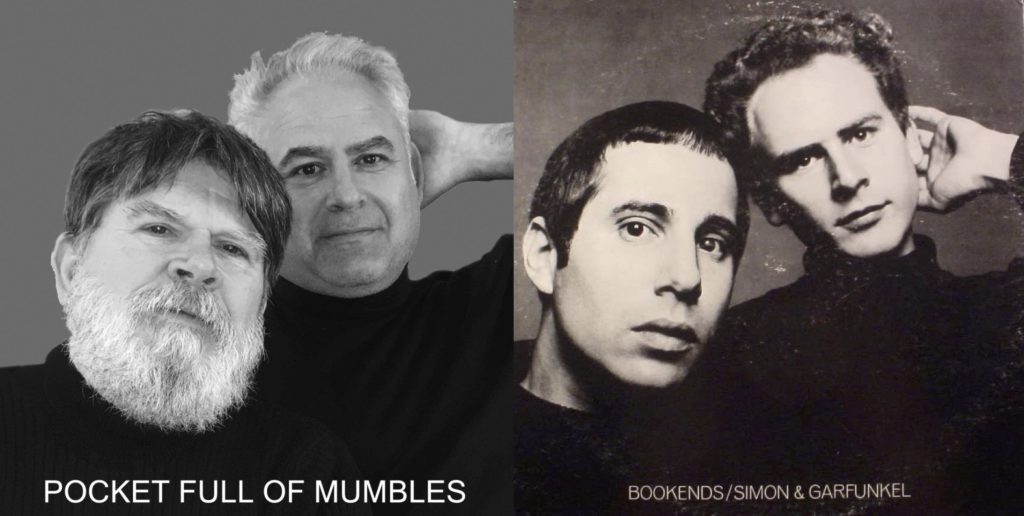
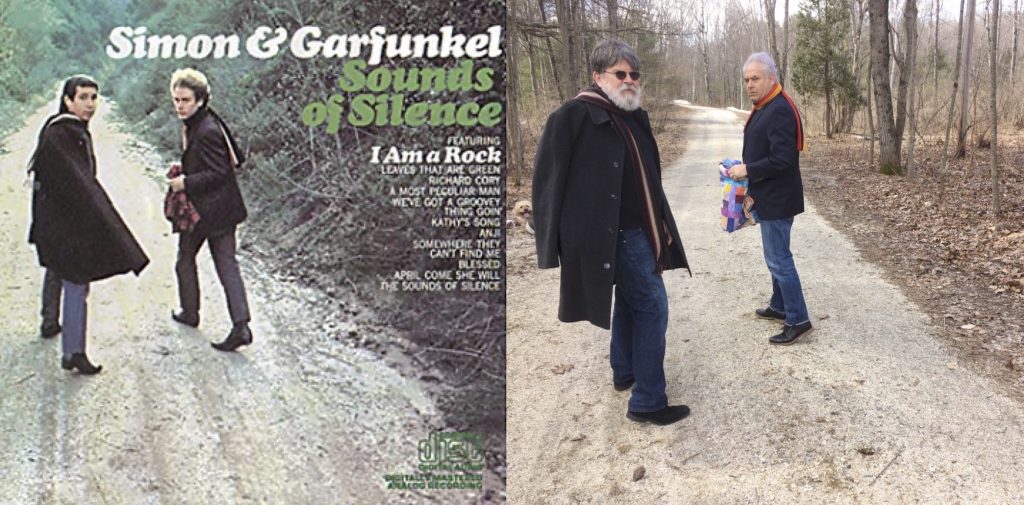
But unlike many of the tribute bands operating today — and there are hundreds working today and making good money from coast to coast — we Mumbles never much indulged in cosplay. Early on we had some fun re-creating famous S&G covers. See here some examples. But we never took that whimsy to the stage., whereas many tribute bands purposely perform, dress and promote themselves on- and off-stage in ways that pay homage to the original bands. As one pod guest put it (he performs in an AC/DC tribute ensemble), it’s often the goal to create a sort of Broadway-show version of the original lineup from night to night.
There was quite a bit of discussion regarding what distinguishes cover bands from tribute bands. This doesn’t seem a very fine line to us. Cover bands do not indulge in much cosplay; how could they? You can’t dress up and act like a dozen different bands during a single performance. I mean, think of how many wigs that might require!
Cover or “bar’ bands also seem to place more emphasis on interpreting recognizable songs in a different but effective way altogether. We often say, “You may know the Simon & Garfunkel version of America but you can’t truly appreciate the song until you’ve heard it with pedal steel.”
The Mumbles have moved well past the tribute thing but we still perform half a dozen S&G songs and we don’t judge. Tribute bands go that route today because they ‘re popular and can be lucrative, which is just another way of saying, “Many folks who patronize live music venues want to hear what they know.”
Foreign Journey? Genius
There can be great creativity in the exercise, not just dressing up but crafting the brand: Apparently, there is a tribute ensemble out there that opens with a set of Foreigner, followed by another in the “role” of Journey. The are, naturally, called Foreign Journey. Some original acts actually mine established, skilled tribute bands to replace aging, deceased, disaffected members. Journey famously plucked a tribute lead singer (based in the Philippines!) back in 2007, when the original Steve Perry stopped believing.
In the end, a good set, ably performed, is its own reward regardless of genre. I saw an outfit called The Outsiders deliver a truly excellent Tom Petty show at Bell’s Brewery in Kalamazoo two years ago. First rate, and they didn’t do any “characters” or costumes. [If you think drunk middle-aged women go crazy when they hear a spot-on version of “Last Chance for Mary Jane,” you should experience that phenomenon in the Midwest.]
By the same token, if you play in a Grateful Dead tribute band — as Mumbles drummer Jeff Glidden has (along with an Allman Brothers outfit called Wake Up Momma) and you don’t get stoned with fans between sets, you’re not really trying.
For us, this pod reminded us of these bands, how all types of bands, are conceived. Mike Conant and Hal Phillips had played together in a couple different bands starting circa 2008. At some practice five years later, Mike started noodling the melody of “Leaves That Are Green,” off Sounds of Silence. I joined him and sang the whole thing, start to finish. We looked at each other and said, without speaking, “Well then. Here’s someone who likes S&G as much as I do.” And the rest is history…
I tend to spend a lot of time at the computer. In 2025, I started collecting fun golf course images to use as wallpaper on my oversized monitor. The better ones stay in place for several weeks, allowing for detailed scrutiny and study. I decided to share some of the most thought-provoking examples here.
1) This one image from Royal Lytham & St. Anne’s shows the better part of four golf holes (7-10). It shows a substantial dune ridge, greats swaths of multi-hued vegetation and a public walking path — all of it tightly surrounded by a densely populated suburban neighborhood. Total course acreage: 90. Perspective: Merion GC is considered a small parcel for golf. It sits on 124 acres.
2) Still, there is room here for a massive and completely ornamental blowout bunker (top left) that does nothing but looks great.
3) How do you get 7,118 yards into such a small space? Observe the tournament teeing ground below the blowout bunker. That box serves the mainly off-camera 11th hole. There’s a similar walk back to 8 tee, off-camera bottom right. Of course, most members wouldn’t dream of playing these back tees, so day-to-day safety issues are greatly reduced.
Golf Wallpaper: Backward & Forward
4) The Old Course at St Andrews famously plays its course backwards once a year, but many GBI clubs do the same. Observe how beautifully these four would play in the opposite direction. To boot: Check out the awesome par-3 from that back tee at 11 to the 8th green. GBI clubs often play so-called “cross-country” tournaments with similarly gerrymandered holes & routings. One can see how easily that could be done at Lytham.
5) This aerial was snapped, by photography guru Gary Lisbon, at exactly the right height. Too many are taken from 30 feet or higher, which tends to flatten out fairway contours especially. Look at the lovely humps and hollows here, even those in the distance. Perfectly captured.
6) Lytham had sought the 2026 Open to celebrate the centenary of Bobby Jones’ famous victory here. Birkdale will host instead. Championship golf can be accommodated at Royal LSA (as recently as 2012), but it’s getting harder to imagine 30,000 spectators here, too. Or merch tents. This image shows why.
Driving home from a dreamy golf excursion, author Hal Phillips noticed wispy grasses glistening alongside a newly widened stretch of a busy interstate. Their presence raised questions about the agronomics of incorporating a linksy feature into inland settings.
[Ed. This essay was first published in the November 2026 print edition of Golf Course Industry magazine. It’s posted in its entirety here. And yes: Fescue Program would make a great band name.]
Prior to the smartphone era, when folks read mainly in analog fashion, a great many of us kept a Maine Atlas and Gazetteer in the glove compartment of our cars, or the privy. Published by Yarmouth-based mapmaker DeLorme, this oversized, soft-cover booklet neatly divided this Great State of ours into 96 pages, or rectangular quadrants, each of which depicted a specific 16-by-11-inch map in remarkable detail and scale.
Most of you know this, of course. We studied The Gazetteer so as to orienteer around the state, to better familiarize ourselves with topographies and place names, in addition to those potential routes that might traverse and connect them. The conditional nature of these journeys is critical to Maine’s mythos. Our unofficial state motto, offered to folks from away seeking directions, spells this out pretty clearly: You can’t get there from hee-yah.
GPS titan Garmin purchased DeLorme back in 2016, along with Eartha, the massive, slowly rotating globe that still occupies three full stories inside the former company headquarters. GPS-enabled mapping applications have reduced the need for physical maps of all kinds. However, the need to better know and understand this place we call Maine remains undiminished.
Case in point: The many odd-ball municipal naming conventions to be found here. Until 1820, Maine was part of Massachusetts, where British place names remain commonplace. This makes sense: Winchester and Boston and Middlesex were the very towns, cities, counties and regions from whence a great many 17th and 18th century settlers hailed. I’m a Masshole born, bred and proud — the Oxford English Dictionary added the word “Masshole” in 2015 (How do you like them apples!?). And so, I endorse this naming convention as quite sensible.
Maine Place Names defy Convention
Maine has its share of similarly UK-derived place designations among its 23 cities, 430 towns, and 30 plantations. Yet the naming conventions here are more varied and, well, idiosyncratic. Way more. It’s possible, for example, that the founders of Lebanon, Norway, Poland, Mexico, Sweden, Smyrna, Stockholm, Moscow, Carthage, Monticello, Bremen, Rome, Athens, Troy, Denmark, Peru, Palermo, Dresden, Paris, West Paris and South Paris all hailed from these original locations. But I doubt it.
There would appear to be little rhyme or reason to this geographic exotica. Rather, each place was so named for its own particular reason, on account of its own eccentric Creation story. The western Oxford County town of Peru (pop. 1,509), for example, was incorporated in 1821, in solidarity with the South Americans who had just declared their independence from Imperial Spain. It had first been organized in 1812 as Plantation Number 1 — a plantation being a rudimentary form of municipal self-government that, by Maine statute, cannot pass or enforce its own local ordinances. Thirty such townships still operate this way, mainly deep in the state’s interior, though the islands of Matinicus and Monhegan also function today as plantations.
Prior to its incorporation, Peru was also known as Thompsontown, in honor of General Samuel Thompson, the former Brunswick tavern keeper and one of Maine’s most prominent Revolutionary War figures. In May of 1775, shortly after the battles of Lexington and Concord, he led 600 militia in capturing and expelling the HMS Canceaux from Portland Harbor, then known as Falmouth Harbor. The Canceaux would, ahem, return in October 1775 and burn most of Falmouth to the ground.
While I’m a “Masshole” born, bred and proud (the word’s now ensconced in the Oxford English Dictionary), I’ve made my home in Maine since 1992, and never has there been a bigger soccer story to hit the Pine Tree State than Hearts of Pine, our first-year entry in USL One.
The club’s fairytale run finally ran out of pixie dust in Spokane, Washington. I was there, along with 50 hardcore supporters who watched their Sons of Maine surrender a tying goal in OT stoppage time, then miss a deciding penalty that, if converted, would have sent them to the final. Oof.
A brutal way to lose. But the club brain trust, the fans and coach Bobby Murphy are to be commended, along with the players naturally, for putting together such a remarkably competitive campaign. Assembling a pro roster on the fly, with limited funds and zero relationships with other clubs, at any level of the American soccer pyramid, is difficult. But Hearts quickly identified a dependable, flinty rotation of 14-15 players by mid-summer and, with just enough flair to entertain in the nation’s professional third division, caught bloody fire.
The club went 10-4-4 from July 6 to the close of the season in late October. That sublime stretch included a 6-1 drubbing of eventual league finalist, Spokane Velocity (last year’s rookie darlings), and the ouster of 2025 USL Championship winner Pittsburgh Riverhounds from the Jägermeister Cup, a sort of leagues-cup competition for both USL divisions.
Heart-Stopping and Brand Savvy
\That’s merely the competitive side of the ledger. Across Maine itself, Hearts have proved a cultural phenomenon, selling out every home date at 6,000-seat Fitzpatrick Stadium in Portland, and pimping more merchandize than Danish outfitter Hummel and local boy L.L. Bean, a fitting shirt-sleeve sponsor, could have imagined.
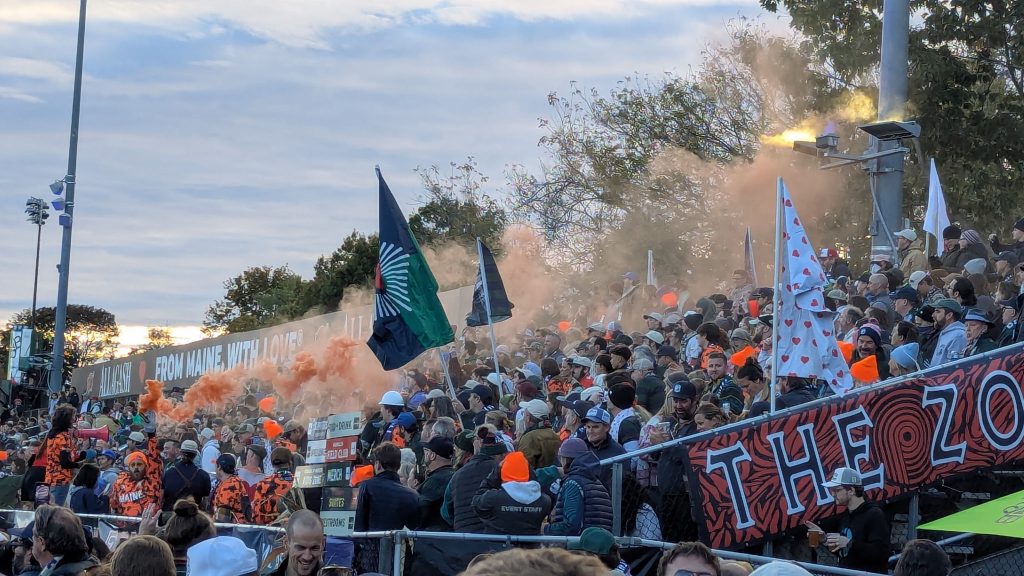
What’s more, the fan section at Fitzy Park has proved a sensation unto itself, replete with non-stop singing, chanting and flair-lighting. These are not European-style ultras or Argentinian bravas, but rather a more harmless bunch of bearded hipsters who helped transform their interstate-adjacent home ground into a fortress through non-stop, quite genial-but-insistent stomping and craft-beer swilling. Think of The Guy from HBO’s “High Maintenance”. Only crunchier. With female counterparts in knitted Carhartt hats. That is the Hearts fan section demographic.
I’ve followed Hearts of Pine closely all this inaugural season, but I’m not a season-ticket holder. I attended four matches, two at Fitzpatrick and two U.S. Open Cup dates at Lewiston High School. I point this out because, while I’ve been to more away matches in the U.K. than Hearts fans have had hot dinners, I tend not to gravitate toward these fan-section spectacles. Home or away, I cheer and sing on occasion, always in support. Mainly I’m there to watch the match.
To be honest, my big day out in Spokane owed absolutely nothing to my relatively casual Hearts support. I arrived in western Montana earlier in the week to visit my two kids, both legitimate Mainers (they were born there) who nevertheless make their homes in Missoula.
Two days after touching down, however, I did realize that Hearts were scheduled to play their USL One semifinal in Spokane, just three hours to the west. In Big Sky Country, a 3-hour drive is like running out to Cumberland Farms for a gallon of milk. So off I went to Eastern Washington, on a Sunday afternoon, to support my new local club.
It’s often argued that the 1975 World Series — contested 50 years ago this month — ranks among the finest in baseball history. In terms of legendary personalities and the competitive iconography that framed them, Game 6 featured enough fairy-tale moments all on its own: a not-yet-befouled Pete Rose bellyflopping into third then popping up to jawbone with his opposite number, Rico Petrocelli; rookie golden boy Fred Lynn propped limp and lifeless against the center-field wall after failing to flag down Ken Griffey’s RBI triple in the 3rd; Sparky Anderson on the top step of the dugout, ready to give Rawley Eastwick his trademark hook, only to let him face Bernie Carbo in the 8th; Johnny Bench short-hopping George Foster’s throw from left-field foul territory to cut down Denny Doyle at the plate, sending the game to extra innings where, of course, Carlton Fisk waved his game-winning homer just fair enough to hit the foul pole.
Taken together, those 12 innings form a universe unto itself, an heroic parade of Hall of Fame and otherwise iconic players doing impossibly dramatic things under extraordinary circumstances.
As a result, however, Game 6 also tends to overshadow what made this 7-game encounter an all-timer. This past summer I happened upon a passing reference to Luis Tiant’s epic 163-pitch, complete game performance in Game 4. I grew up in Boston and turned 11 the month before this World Series took place. I watched every second of Game 4. To my shame, apart from El Tiante running the bases in his little blue jacket, I remembered very few specifics.
Friend, let me remind you that for all its faults, the 21st century is a remarkable thing: All seven installments of this Fall Classic are available via YouTube — in their entirety, without commercials — so I watched Game 4 on my iPhone over the course of several hours in July. This sublime experience led to web-aided consumption of Games 2 and 3, in that order, as these, I reasoned, were the chapters in this epic saga that I remembered least of all.
I undertook this throwback-baseball immersion exercise at the same time I was reading Chuck Klosterman’s fine non-fiction book, “The Nineties,” wherein he posits that October 1975 was also a critical tipping point — those final cultural moments where baseball and its fans could claim “the sport held a unique place in U.S. life and would always be recognized as the national pastime.” By 1990, he points out, twice as many people watched NFL football.
Four years later, with release of his mini-series Baseball, Ken Burns presented the game as a prism through which we might better understand the American experience. A soulful, often convincing take but an excuse for the historian to treat the game like a relic, an historical phenomenon that did what it did but had since relinquished much of its civilizational juice.
So much of the American social contract came undone during the Seventies, why should baseball have been exempt? If retroactive understanding recasts the 1975 Fall Classic as a swan song, so be it. However, allowing such a raft of perfectly amazing memories to fall through the cracks unheeded and under-absorbed — when they’re all just sitting there on some Google server, waiting to be enjoyed all over again — is foolish. What follows is a YouTube-enabled report on this 3-game series within a Series, an event I first consumed as pre-teen, staying up way past my bedtime, exulting and sobbing by turn in a suburban living room exactly 13 miles southwest of Fenway Park.
World Series 1975: El Tiante en Fuego
Game 4, Riverfront Stadium, Oct. 15, 1975: El Tiante was already a Boston legend before he took the mound in Game 4, of coursre. After doing his best to thwart Sox hopes in 1967, for Cleveland (one of four clubs with legitimate pennant hopes that final weekend of the season), he’d come over in 1971 and immediately claimed our hearts. No one knew how old this amiable, rather elfin Cuban really was; I suppose we still don’t know. He was a bit dumpy and could come off as clownish though a lot of that public persona was surely down to his idiosyncratic grasp of English. But he won — 18 times in 1975, despite back issues — and he did so with singular style. After his virtuoso performance in Game 4, his place in the Boston Sports Pantheon was utterly secure.
The Reds had jumped out to a 2-0 lead, but starter Fred Norman surrendered 5 in the 4th and that’s all Tiant would need, throwing ONE HUNDRED AND SIXTY-THREE pitches to level the Series and nail down another complete-game victory, 5-4.
Yet that’s mere box-score fodder. Tiant at his best had to be observed to be fully appreciated, and he proved even more indomitable 50 years on, despite my diminutive screen. While the man had shut out the Reds in Game 1 at Fenway four days earlier, familiarity helped the National League champions not a whit. Tiant bullied and confounded them by turn — nearly picking the imperious Joe Morgan off first in the 7th, twice running the bases, scoring what proved to be the winning run, and looking utterly gnomish the entire time.
It’s weird to learn via media report that specific, intimate aspects of one’s own cultural history are making “comebacks”. Maybe 15-20 years ago, a certain American demographic started collecting and playing vinyl records again, for example. Out of nowhere this became trendy. Today, folks of all ages are still giddily sourcing records from Discogs and investing in turntables, after a 20-year respite.
My Millennial son and daughter-in-law maintain a modest record collection today. Yet they have gathered these vinyl relics more or less at random, in small batches, from second-hand shops. They don’t even bother to seek out records from artists they like. Their enjoyment of this seemingly kitchy, analog activity is almost entirely ironic, like dressing as a steam punk, or churning butter.
I get it. Millennials do love their irony. But they are divorced entirely from the activities and emotions that once made vinyl-collection and record-playing irresistable.
Just last month, and in the same vein, I learned of a cassette tape revival. Yes, cassette tapes are back in vogue after three decades away. I am not technically a part of this revival. I maintain two means of playing cassettes, and have for some time, because my mixed-tape collection — dating back to my own golden age of mixed tapes (1986-92) — has remained sweetly nostalgic to me. The idea of buying new tapes, or making them, feels rather anachronist, because the technical and interpersonal conditions that prevailed during this golden age no longer exist.
In short, one must have achieved a certain age — “old as dirt” is the technical term, I believe — in order to remember cassette tapes and what made them so special. But that doesn’t mean we should consign their fascinating 20th century narrative to the dustbin of history.
Cassette Tape Revival: Dawn of Music Sharing
Until the late 1970s, there was no practical way for everyday folks to record music from vinyl — or off the only other practical music source then available, the radio. Cassette tapes changed all of that. The advance proved both technological and cultural: A friend who owned Jackson Browne’s album “Late for the Sky,” for instance, could just tape the whole thing for you. This saved money. Cassettes also stored more efficiently, in something as small as a shoe box. Critically, one could also play them in your car, if said vehicle featured a tape deck. This was huge.
Yet cassettes also transformed any schmuck into a legit DJ. Throughout the 1970s, radio was the only place where music consumers could experience a stream of individual cuts off multiple albums, from multiple artists. We take this phenomenon for granted today, thanks to Spotify, iTunes, Pandora and YouTube. Commercial radio originated this experience, however — with interruptions from advertisers. Our record players gave us commercial-free choice, but only one immutable album at a time.
Cassette tapes cannily merged these multiple forms of music consumption. They allowed us to create those playlists for ourselves, from our own record collections. They enabled playlists using other folks’ collections, from songs highjacked off the radio, even from other tapes (if a stereo had two tape decks). This multi-valent ability, acquired during the first Reagan Administration, proved thoroughly mind-blowing and futuristic. Then Sony introduced the Walkman and we all felt like cinematic characters from Blade Runner.
Observing the proliferation of dope stores here in my former mill town is, by now, old hat. They’re everywhere across the Great State of Maine and their attendant foot traffic has even begun to attract pleasantly parasitic commerce, like the Casa Del Taco truck that took up residence beside one shop, the Cure Cannabis Co., before mysteriously disappearing three weeks later.
I don’t frequent these marijuana dispensaries (though I would pay to see the staff at Cure dressed up like Robert Smith). I know a dozen folks who’ve been growing their own for decades. When Maine legalized the skunk in 2009, when municipalities decriminalized possession in 2013, I got separate calls from friends familiar with my personal habits. You celebrating? they asked. No sir, I told them. My lifestyle hasn’t changed one iota.
But psilocybin? That’s another matter. After consuming my fair share of mushrooms during the 1980s, I didn’t partake for long stretches of my subsequent adulthood. There were a few one-off experiences during The Aughts, when I consumed the same 3 to 3.5 grams that folks routinely scarfed during the second Reagan administration. But I mainly left them alone — because a standard 20th-century dose of 3.5 grams could mean a 7- to 9-hour commitment. Easy to carve out, as a college student, over a weekend. Not so much when one is working 9 to 5 with a wife and small kids.
However, I’m here to report that shrooms are back, in a very different but curiously familiar way, particularly among my Gen X and late-stage Boomer cohort. Psilocybin products remain technically illegal in Maine, for now. But not in California or several other states… Ain’t federalism and the U.S. Postal Service grand?
The Joys of Microdosing
The difference 40 years can make has proved both fascinating and nuanced. Four or five years ago, a buddy of mine revealed that he’d been procuring his mushrooms in a unique form: from a vendor who, when he wasn’t painting houses, gathered the particulate, or shake, from the bottom of a 1-gallon plastic storage bags. He’d fill and sell cute-little 1-gram capsules that, I discovered, represented the perfect microdose. Perfect for me anyway.
Nothing psychedelic, mind you. As with THC and alcohol, everyone processes these chemical compounds differently. I never got an acid-style trip out of psilocybin shrooms, no matter how many grams I gobbled. These 1-gram shake capsules produced a delightfully toned-down buzz that lasted 2-3 hours and didn’t continually lobby my brain for more, more, more. You know, like other white, powdery drugs I associate with the 1980s.
For example, I caught Jerry Harrison and Adrian Belew’s spectacular “Remain in Light” review, early in August. They went on around 9 p.m. After parking the car and popping a gummy, I remained plenty wide awake and ready to have fun till midnight. A most pleasant stimulant. Plenty sober enough to drive home. No trouble sleeping afterward.
Today, of course, gummies are the in-vogue medium for shrooms and cannabinoid THC, and there exists an entire universe of delivery media: chocolate, root beer, oils and tinctures, salves and creams. I frankly prefer to smoke the kind bud: Its old-school results remain immediate and predictable, for me. Yet that’s precisely the noteworthy thing about these manufactured products: By paying attention to gram dosage, one can monitor and enable only the buzz one desires — no more, no less. Brands differ, but my older, wiser friends and I have found consistency within most any manufacturer’s product line.
That unknown variability had always annoyed me when it came to homemade hash brownies, or pot cookies: How strong are these? “Uh. I dunno, dude.” Not a science.
Corporate Consistency: Good
The corporatization of dope has its drawbacks, as well, but it has delivered to the marketplace consistent expectations and results on the buzz front. It’s no mistake that beer menus today routinely include the percentage of alcohol for each pint on offer. The legalization of weed and other products has influenced an entire industry in this way.
Critically, the active ingredient in shroom gummies is stronger and calibrated differently compared to the analog method. According to the National Institutes of Health, “a 25 mg psilocybin fixed dose is approximately 2.5 grams of dried Psilocybe cubensis mushroom. However, it is important to note, there is intra- and inter-species variability of psilocybin content.”
I’m intrigued by the way all these particulars, including our understandings of dosage, have evolved in the course and context of my own life. Back in 1985, the fall of my senior year in college, I went to visit a friend at UMass. A buddy of his had a bunch of mushrooms and asked me to move some for him, back at my own institute of higher learning. This I proceeded to do, in addition to partaking myself, chaperoning other folks on maiden voyages, and eventually microdosing — though that terminology had not yet been coined. Still, I’d pop a cap before a party. Another time, I remember downing a fat stem before the annual Nebraska-Oklahoma football game, the day after Thanksgiving. Nothing like a mild shroom buzz to watch nimble quarterbacks prosecute the triple-option wishbone.
While arguably ahead of their time, these casual microdoses eventually gave me pause. The worry: I was beginning to normalize the shrooms by microdosing them, however responsibly I may have been doing so. To my 21-year-old mind it felt immature, perhaps reckless, maybe even a slippery slope. When the supply was depleted, I didn’t seek out more. For decades, I considered shrooming only on special occasions, at the suggestion of others. A couple times I took the plunge but most of the time I demurred.
Reckless? No, that was Moderation
Now, on the verge of 60, all these folks around me are microdosing pretty much exactly as I had my senior year in college! What had seemed reckless back then is now prosecuted with great intention and precision, by demonstrably reasonable old people. And Talking Heads are back on tour in support of an album released in 1980. Amazing.
I’m not the least bit surprised the Maine Legislature approved last September a commission to study the possibility of legalizing psilocybin; or that elsewhere shrooms are now being prescribed to people who struggle with depression and PTSD. Everyone’s different, and even the big doses never made the walls breathe or the trees talk — not to me. What they can do, for a time, regardless of dosage, is take one completely outside of one’s self, to a place where one might examine his/her own experiences in completely new ways.
I remember one young man in particular whom I chaperoned on his first psilocybin experience, back in the day. He was sitting on the tailgate of a gigantic ‘70s-era station wagon, calm and contemplative, but he’d clearly been laughing with great vigor. One could see it in his eyes. “This is the most amazing thing I’ve ever done,” he told me, without any trace of irony, anxiety or pride. “I’m never doing it again.”
With the experience of decades, I wish I could have responded, Hey, I get it. Next time — if there is a next time — try taking one third as much.