NEW GLOUCESTER, Maine (April 18, 2019) — So my wife and I have a 12-year-old girl staying with us for a while and last Thursday evening she settled down beside me — armed with a big bag of magic markers and a sketch pad — as I watched a DVR recording of The Masters first round. She wasn’t paying much attention. In that way she was a credible stand-in for the broader American public, which, let’s face it, doesn’t pay much attention to golf, even its majors. Indeed, when she did take notice, she playfully mocked the idea of watching golf altogether — that is, until she noticed Tiger Woods walking off a tee.
“Who’s that?” she asked.
That’s Tiger Woods, I told her. I swear to god, I did not prep her in any way; she picked him out of the crowd of players all on her own. The next afternoon, during the live broadcast of round two, she wandered back into the living room. Unbidden she asked, “How’s Tiger doing?”
He’s
doing quite well, actually. You like him?
“Yeah.”
Why?
“He’s handsome.”
What
else do you like about him?
“He’s cool. Look at the way he’s walking around. He’s very confident.”
What
about that mock turtleneck? Is that cool?
“Oh yeah. Those are in.”
Tiger Woods: The Anointed One
Watching golf with a 12-year-old, distaff, golfing neophyte is a fascinating exercise in its own right. This one in particular had strong opinions: She thought Jon Rahm looked like a fat punk; she didn’t like him at all and rode him without mercy throughout (“He should just go home”). She quickly remarked on the unusually lanky stature of both Tony Finau and Matt Kucher. Brooks Koepka was notably swaggy — but nothing like Tiger, in her opinion. Surprisingly, Ricky Fowler’s youthful mien did nothing for her — something about his eyebrows being too dark (“And I don’t like his shirt”). Norwegian amateur Victor Hovland was pilloried for his prominent schnozz, which, in fairness, was fair comment.
But these were all bit players in the drama so far as she was
concerned. Tiger was the anointed one.
A lot has already been written about how Tiger’s victory on Sunday has introduced his phenomenon to an entirely new generation of golfers. I don’t anticipate this girl will suddenly want to play the game, or start wearing mock T’s. But it has been 11 years since Tiger won a major. This weekend’s performance reminded many of us of what we’ve been missing.
Forget the 15 majors, the renewed Nicklaus chase. We’ve missed this
man’s naked charisma most of all. No golfer in history has half the presence
Tiger exhibits just walking down a fairway. Charisma is a hard thing to
quantify, but it’s also one of the few things that readily spills over from a niche
sport like golf into the larger culture. And that’s another thing golf has been
missing these past 11 years.
I watched Sunday morning’s finale at Tomaso’s, a fashionably down-market, diner-sized cantina in Portland, Maine. At 10:30 a.m., when I showed up, there weren’t but 3 or 4 us there. An hour later, the brunch crowd had attracted a full house of young, bearded, IPA-swilling hipsters. This was no sports bar, much less a golf bar (Does such a thing exist north of Pinehurst?). Even so, when Tiger birdied 15, the place went crazy. The barman quickly turned off the music — a pleasant alt-country playlist featuring the likes of Ryan Adams, Old Crow Medicine Show and Jason Isbell — and turned up the CBS television feed. Tiger had this unlikely place in the palm of his hand. When his tee shot on 16 came to rest 2 feet from the hole, the patrons inside Tomaso’s erupted.
About this time, I noticed a text had arrived. A friend of mine was
down in Boston at the TD Garden watching the Celtics-Pacers playoff game, an
inelegant affair he referred to as a “game/rock fight.” He reported there were
“tons of people clustering around TVs on the concourse watching golf. It’s
amazing how much love there is for Tiger.”
Stupid Amounts of Charisma
There’s really is something about this guy — something non-golfers
can appreciate. Yes, he has battled back from considerable personal/physical adversity,
but this obscures the larger point: He was stupidly charismatic when he
appeared on the Mike Douglas Show at the age of 2, when he won three straight
U.S. Amateurs, when he debuted as Nike’s cross-over pitch man, when he claimed
those 14 majors… Apparently, after a decade away, he remains stupidly
charismatic, not just to core golfers but to casual fans and mere onlookers
around the world.
Sunday night, my daughter
sent me a text: “Is Tiger Woods good again?”
She’s 20 years old, a junior in college, and couldn’t care less about golf. But somehow word of his resurrection had reached her via the broader cultural news drip. I asked exactly how she had learned of his Masters victory.
“I saw him on the TV at this
bar! Some people were watching.”
Do you find him charismatic?
“Not really. He’s cheated on a
lot of women.”
My daughter is clearly not so forgiving of Tiger, in part because she’s a woke young woman, but also because she’s yet to make the mistakes that Tiger and the rest of us 40, 50 and 60somethings have made. But her admonition is well taken: Recognizing and appreciating anew Tiger’s ungodly magnetism doesn’t mean we should get all crazy (again) about what that charisma really means.
It doesn’t mean, for example, that we should start believing Tiger’s
mere presence will bring millions of kids (or Millennials, or Baby Boomers)
into the game. That never held in 2003; it doesn’t hold now. Nor does it mean
we should start building new golf courses willy nilly to accommodate this chimerical
wave of converts. It doesn’t mean Tiger has, on account of his victory,
instantly become a particularly good man or father. It made no sense to ascribe
him these qualities in 2007 frankly; knowing what we know, it makes even less
sense now. Why we blithely attach these sterling personal traits to men (or
women) who exhibit extraordinary sporting skill is beyond me. One hopes we’ve
learned our lesson here.
Golf is Different Now
But it does seem clear that Tiger and the professional game in which he competes have changed more than a little in the 11 years since he limped to his last major win. Today’s Tiger is 43 years old, his hairline in full retreat. He’s been through a world of shit, both physical and personal. The process of dealing and coming back from all that would change anyone. His swing and his outlook on life are forever altered.
And here we confront what might be the most interesting
manifestation of all this change: Sunday’s victory was the first time Tiger has
ever come from behind in the final
round to win a major tournament. The greatest front-runner in history has
learned how to come back.
Tiger won from the front so frequently because, from 1997 through 2008, his outsized aura truly cowed most all of his would-be competitors. Remember how they’d wilt when paired with him? Francesco Molinari and Tony Finau did not play well beside Tiger on Sunday but here, too, the game has changed a great deal in 11 years. Today’s PGA Tour is stocked to the gills with young, dynamic, swaggering talent. It will be fascinating to watch this generation of professionals compete with the man many of them grew up idolizing.
Because one thing has not changed: You can’t take your eyes off this Tiger Woods fellow. This was true over the weekend; it was true through 2008. If we’re honest with ourselves, it was true afterward, too, through his many trials. We rather shamelessly rubbernecked the wounded, struggling Tiger like we ogle an accident on the side of the road. More than a decade has passed and we still can’t look away. Why? Because he still has more charisma than anyone who has ever played this game, more perhaps than all the major winners in history, combined. Even a 12-year-old, non-golfing girl can see that.
Roger Goettsch and his pride and joy, a ’49 Chevy pickup he restored.
[Ed. I once heard at an Associated Press seminar that anyone, in the right hands, could prove the subject of a prize-winning profile. This one may or may not qualify, but it’s pretty darned good and has been widely shared in golf circles of late. Mostly because the story of Roger Goettsch, even in my hands, is damned compelling. A published version appeared in a 2019 issue of Golf Course Management magazine. See below a slightly longer, more casually profane original draft. Note: The subject here has since moved on to Coto de Caza Golf & Racquet in Trabuco Canyon, California.]
By HAL PHILLIPS LONGGUN, Hainan PRC (April 9, 2019) — I received the following email from Roger Goettsch, CGCS, in the spring of 2018: I recently designed and built two different wetting forks for applying wetting agents to the soil in our LDS [localized dry-spot] areas. We have had issues getting wetting agents into the soil due to the thatch layer and this seems to have helped… He attached pictures of the wetting forks in action, along with shots of the “Plug Pushers” he also designed and built, to remove cores following aeration.
Goettsch
is the head superintendent at Shanqin Bay Golf Club in the small town of
Longgun, on the island of Hainan, in the People’s Republic of China. Like many
American-trained supers working overseas, Goettsch can’t get his hands on every
last piece of equipment his little heart desires. So he just builds what he can,
himself, putting to work his AutoCAD skills, his welding and fabrication
expertise, and a mechanical imagination born deep in the American heartland.
Goettsch has worked all over North America, and now Asia, leaving behind him a
trail of custom-designed and custom-built equipment — like breadcrumbs in the
woods.
“You have no idea all the shit that I’ve built,” he says, upon compiling for GCM a list of Top 10 Greatest Hits. “Literally, what you’re seeing there are just the big items from the last decade or so. There’s at least another 20 big-ticket items I’ve leaving out and several hundred more I’ve just sort of forgotten.”
Like
those sprig planters you built for all those contractors? Or the fairway
aerifier you whipped up that one night?
“Well, not
one night. We were growing in a Palmer course in Ft. Worth, Texas, working with
Arnold’s project architect, Bob Walker. He’ll confirm this story. The soil was
horrible there, dark heavy clay. We just had
to aerify it. So I decided to build an aerifying machine with my head mechanic,
Bill Hess. We had to get this done because I promised Bob Walker I’d have it
ready for his next site visit. So me and Bill had been working on it several
days, but we worked till 4 a.m. that last night and Bill — I had trained him
how to weld — all of a sudden hollers over at me: Roger we gotta quit… I fell asleep welding.”
When
pressed for why exactly he’s compelled to build so many things — while
simultaneously working full time, taking care of first-class courses from the
Gulf to the South China Sea — Goettsch chalks it up to self-reliance, a quality
his dad embodied and passed along to young Roger in the farmlands of western
Iowa.
“That’s the
through line for all this stuff, based on my upbringing — being
self-sufficient. You know what they say: The DNA precedes you.”
Roger Goettsch, Heartland Figure
Goettsch was born on a small farm in Holstein, Iowa, a burg of 500 souls, most of German descent, where his parents grew corn, soybean, alfalfa, oats, and clover. “The clover and alfalfa mainly served as feed for livestock,” Goettsch explains. “We sold the other crops locally. We raised cattle, pigs and chickens routinely and had a couple horses on the farmstead.”
Roger, his two
brothers and three sisters were involved in all the works. The girls
de-tasseled corn in the summer time.
“We grew
everything: all the garden vegetables; we had an orchard with peaches,
cherries, plums and apples. Our freezer was always full of meat and my mother
was always canning something. From the time I was a 5-year-old kid, I was also
working on the farm. But my father’s workshop was the most interesting part of
that operation. He built everything for us: wagons, cattle chutes, a bail
elevator. He also built a riding lawn mower! I have two older sisters who swear
that he was the first person to ever manufacturer a riding lawn mower. I have a
picture of that I need to dig up. He built so many things.
“In my
spare time I used to hang out in his shop. I was more of a pest to be honest.
Very curious, always wanting to tear something apart and see how it worked.
Typically, I didn’t put things back together, which sorta pissed my dad off.
Compared to modern shop, dad’s was so small. He made his own cut-off saw, to
saw metal. He didn’t have an acetylene torch like I do today.
“Not only
did he build a lawn mower, he took old bicycle frames and built motor scooters
for us. He took the bicycle wheels off, then modified the frames, welded a
plate on there to mount an engine, and new tires. I could draw you a detailed
picture of those things; I’ll never forget riding them around. You put your
foot down, it tightened up a belt and you just went down the road! My dad
bought my mother a Honda Dream 150cc motorcycle back in 1965. They knew it
meant a lot to me, so they willed it to me when they died. My dad also had an
Indian motorcycle that he totally refurbished — one of his pride and joys.
“You name
it, he could build it. Every time I tell my sister that I’ve built something,
she says, You are so much like your dad
it is not even funny.”
The young
Goettsch took every metal working class he could in high school. He became so
good at welding that he was chosen to help construct a metal school bus barn
for the local district. “That was the first project that got me thinking this
was something I could really do. A career maybe.”
The golf
business just sorta happened to Roger Goettsch, the way it does for kids
sometimes. In fact, if it weren’t for Dennis Wiebe, Goettsch might be somewhere
in America, welding and/or fabricating something right now.
As the
story goes, “My friend Dennis dragged me to go golfing one day, even though I didn’t
want to go. I might have been around 12 or 13. I fell completely in love with
the game. That was all it took. During my junior high school days, folks
started to build a 9-hole golf course in town. Cow pasture pool, that’s what my mother always called it.
“I could
not wait to be on the golf team when I became a high school freshman. Even
though we didn’t have a course in Holstein before that. My friend Dennis — his
family had built a house that backed up to this new golf course they were going
to build. By then I’m playing regularly with him and I’m not too bad. From then
on, I couldn’t play enough. My entire four years of high school, all I wanted
was to be a pro golfer.
“I gained
another friend, Steve Kofmehl, who lived just three houses away from Dennis. His
dad was the key guy who put the whole golf course construction deal together,
Charles Kofmehl… So my friend Steve and I would wander over there and walk the [course]
site when it was under construction. We were there often and began to volunteer,
helping to build the course when we had time. When the course opened for play, we
continued to hang around with the new greenkeeper there, a guy named Tim Hupke.”
Hupke was the next key player in this budding golf industry drama. He was one of the best young golfers around, too, and soon he was hired to run the shop and take care of all 9 holes — by himself. He was just out of high school when he landed this job. Goettsch recalls that while Charles Kofmehl and the Board of Directors had pulled together the money to buy Hupke the equipment he needed, “Tim didn’t take care of the golf course that well his first year…
“So the summer after my sophomore year, Tim decides to go off and get married. Because Steve and I were hanging out there all the time, and because his father was involved in building the club, they came to us and said, Would you boys like to take care of this place for 2 weeks while Tim is on his honeymoon?You can work as many hours as you want — and we’ll pay you. Well, we went crazy down there, working sun-up to sundown and they paid us what we considered a king’s ransome.
“That
winter, at school, Steve comes running down the hall: Dean Vollmer wanted to
talk to us. He was chairman of the green committee. He and his brother Don
owned the Chevy dealership in town. So we go down to the dealership after
school and Dean says, Boys, I want you to
know that the golf course was in so much better shape the 2 weeks you worked
there. We want you guys to take care of the golf course this coming season. You
want the job as a twosome? You can work all you want, we’ll pay you… and you
can play the course all you want.
“Believe it
or not, what was rolling through my mind: Would
we be able to golf for free? We didn’t wind up playing golf so much — but I
used that money to buy my first car, a 2-door hardtop Chevy Impala. Dean sold
it to me for $700 and I paid it off in two years. To this day, I have never had
so much fun working on a golf course in my entire life. That’s where I decided
I wanted this to be my career.”
First, the Oil Business
The
rest, as they say, is history. Goettsch went to Iowa State University and
studied turf management, interning all four years at Des Moines Golf &
Country Club under the legendary Bill Byers (though he also took as many
metal-working classes as he could). After graduating (1978) and serving time as
an assistant at several courses, he left the golf business altogether to pursue
a welding career in the oil fields of west Texas. “I made a
lot more money there than I ever made in the golf business,” he recalls. But
golf work is steady; the oil business is not. In fact, when it collapsed in
1983, Goettsch went back to growing grass, his welding equipment in tow.
He landed his first head superintendent’s job at Squaw Creek GC near
Ft. Worth. Eventually, he would come to specialize in the construction and
grow-in of new courses, something he did all over North Texas before landing
his first high-profile head super’s gig at the Arnold Palmer Golf Club
at Fossil Creek. He moved from there to a regional director’s position with the management company
RSL (now Arcis Golf) before going overseas (Thailand and Indonesia) in the
early ‘90s for two more construction/grow-ins. He returned home to do the same
at The Bandit in New Braunfels, Texas, Blackhorse GC down the road in Cypress, and
Redstone Golf Club (now the GC of Houston) in nearby Humble. He was Director of
Agronomy at Barton Creek’s 72 holes when he was lured back to Asia in 2014 —
first to India, then to China.
But that thumbnail sketch, diverse though it is, leaves out nearly all of his creative, metalworking history.
“Bill Byers had so much faith in my ability, he bought an entire pump station and I did all the fabrication and helped [pump engineer] John Tucker install it at Des Moines Golf & Country Club,” Goettsch recalls. “At some point, after I’d become a super, I went out and bought all my own welding and fabrication equipment — and I brought it all with me from job to job. I do think that was a consistent benefit to my employers. These skills have honestly never got in the way of my relationship with the mechanic. Quite the opposite. I always had a great relationship with the mechanic, because he could see that I could help him and my passion for his work was real.
“At Squaw
Creek we hired a mechanic who was a real machine shop guy —he could work a
metal-turning lathe. Between him and me, we made things like a mechanical edger
for the greens. Built the whole damned thing, because he could do all the
shafting. We built some unbelievable stuff at that time… I don’t believe
there’s single mechanic I’ve had the pleasure of working with in the golf
business who doesn’t absolutely love me. We would collaborate. I built things
they would never think of themselves: roll-around benches, shelving, custom
things for their shops. You can buy that stuff, sure. But if you got a shop
with small rooms, we made it all fit. I built a boat trailer out of aluminum
one time — for a pontoon boat. I repaired things out of steel, stainless steel,
cast iron. Back in the day cast iron was difficult to weld. You really had to
know how to do it. I had one Toro representative who used to yell at me: Goettsch, put that welder away so we can
sell you more iron!
“One more
thing mechanics loved me for: When you brake or sheer off a bolt flush with the
top, there’s a special welding rod that I could use to remove it 9.5 times out
of 10 times — saved the company a ton of money each time. Most of my mechanics
were pretty amazed at that.”
These
skills tend to get the attention of various engineering types, too, whom
Goettsch greatly admires. Squaw Creek was where he met P.C. Schedule, who ran a
pump station business. Goettsch would end up doing all manner of jobs with/for Schedule
and John Tucker, on the side, though he gathered as much as he contributed.
“They’re so
smart, those engineers; they’ve got the math. John Tucker has stood by me
forever and taught me so much, as did P.C, who has sadly passed away. Lee Niles
at Southern Irrigation Consultants was another extremely intelligent guy. Lee
hired me at one point and I went to work for him doing GPS and irrigation work.
I would help him draw as-builts — and that’s where I learned AutoCAD. After
that, I did all my own drawings for all my own stuff. That has really helped me
do things quicker, more efficiently. I used to do stuff from memory and just
wing it.”
Ignoring Work-Life Balance Came at a Cost
This sort of efficiency should have given a Goettsch a bit more time for himself, for his family. But only recently has he achieved that sort of balance in his life.
“I was a
workaholic. It’s probably why I’m single now,” he says. “A lot of golf course
supers send everyone home when it rains. I couldn’t wait for it to rain! I
would go into the shop and weld, train my guys. Early on Saturday mornings, I’d
be there in the shop… That was the old Roger. I was very career driven and it
did cost me some things, in my personal life. It did. I’ve always loved what I
do and still love it to this day. I just know how to balance it a bit better.”
The past
few years, Goettsch takes digital images of all his projects. Pre-digital, it
was all old-fashioned photography. Those snap shots — documenting his many,
many creations through the years — can today be found in a storage unit outside
Dripping Springs, Texas, near Austin. That’s also where you’ll find Goettsch’s enduring
pride and joy, a 1949 Chevy pick-up that he helped refurbish (a classic
restoration that took 16 years). In Goettsch’s absence, his car buddies still
display it at various shows around the American Southwest.
When one
looks closely at Goettsch’s lengthy resume and building history, it seems clear
this native Iowan’s admiration for self-reliance isn’t the only thing that
drives him. That turf roller he built for Daniel McCann at Oak Hill CC in San
Antonio… that pontoon boat trailer… those two special Hydro Cyclone
Water Separators he and Tucker installed at Lochinvar Country Club in Houston,
to clean the drinking water… a BBQ for his GM in China… 90 percent of the hand-made things he has
lavished on his mechanic, his maintenance staff, his various employers…
These acts
of creation are a form of friendship and intimacy — the same things his dad
provided to him, for the same reasons.
“I think
there’s some truth to that,” he says. “While I’m building things for the golf
course, I’m usually building other stuff for other people. It gives me a real
good feeling, building relationships in the process.
“When I did
spend a lot of time doing that sort of thing — projects outside the golf course
—I guess there might have been a perception that maybe the club wasn’t always
getting my full attention, their full money’s worth. But I don’t think the
owners ever felt that way. The mechanic definitely never felt that way. And
believe me, wherever I’ve been, we’ve had the best greens around.”
JAKARTA, Indonesia (June 18, 2018) — The history of working media seeking to leverage publishing capabilities to secure personal fringe benefits is long and sordid indeed. Traditionally, as befits transactions undertaken by relative paupers, such perks rarely rise above the level of heavy hors d’oeuvres. When they rise to the level of media junkets — the “FAM” or familiarization trips writers accept in exchange for coverage — the stakes and potential shithousery increase by orders of magnitude.
Again, this tawdry exercise in professional barter typically starts out innocently enough. I worked at a daily newspaper back in the late 1980s. The nightly assignment schedule invariably included this Chamber of Commerce reception or that City Hall event — places often devoid of news value, but where free food could be had. Open bar? Well, the entire editorial staff might show up for something like that.
Reporters and editors don’t traditionally make a lot of money; they’re frequently quite young. This is to say, freeloading of this ilk shouldn’t be viewed as particularly untoward or shameful. It’s something of a necessity frankly. One of our many mascots in that same newsroom was a giant cartoon headshot of a Dick Tracy-like character, complete with ‘40s era fedora. Tucked in his hatband was an index card that might have read “PRESS”; instead it read, “I’m with the PRESS. Where’s the FOOD?”
Several links up the food chain in this realm sits the media FAM. There’s no way to spin such junkets according to journalistic standards or ethics. These are flat-out boondoggles whereby some publicity-seeking entity lures reporters and freelancers on some trip — with the understanding that once they’ve been wined/dined and returned home, said media will publish nice stories about the resort property, the golf course or cuisine to be had there, or maybe the broader “destination” itself. In the golf and travel realm, where I’ve toiled for more than three decades now, FAM trips are the ultimate perk because, well, let’s not be coy: In addition to free food & drink, participating media also get complementary air fare, lodging and assorted swag.
Media Junkets & The Barter Economy
The quid pro quo nature of the FAM exercise is little discussed but well understood by all parties. One doesn’t visit a golf course or hotel, on a junket, only to savage the place in print. That would be untoward. As our moms all told us, if you don’t have anything nice to say, say nothing at all — or concentrate on something else that doesn’t suck.
Here’s another FAM trip bylaw: Answer the bell. No matter how much free boozing and carousing was had the night before, media guests have an obligation to show up, on time, first thing the next morning (according to the itinerary) without fail.
There’s one more, less formal understanding re. media trips: Something is sure to go terribly wrong. I’ve been on dozens of these excursions as a working journalist. I’ve organized dozens more, as a PR professional, working on behalf of various clients. When one is devising a week-long itinerary in a foreign country — for one’s own travels — something is sure to be overlooked or go sideways. When organizing for a dozen people, most of whom will be drunk 35 percent of the week? The odds only increase. The mere presence of a dozen journalistic chancers eating, drinking and indulging on someone else’s dime makes the possibility of mishap a mortal lock.
Someone, someday, will write a comprehensive and hilarious book about all the great FAM trips gone awry: who got thrown in jail, what foreign dignitary got naked, why shellfish is always a risky choice… In the meantime, journalists will merely trade these yarns back and forth like war stories. In that tradition I offer up below the itinerary from a single morning gone completely haywire, in Jakarta, during Ramadan, back in 2012. This was a trip I helped to organize and host. I promised the client I wouldn’t breathe a word until a reasonable discretionary period had passed. Still, I have changed the names to protect, not the innocent necessarily, but rather those professional reputations still in play.
This Junket did its Job
In most respects, this particular FAM proved a roaring success. It produced dozens of glowing, published pieces re. the awesome golf product on offer in and around Indonesia’s sprawling capital. To produce this content I had wrangled a genial and cosmopolitan group of 12 media and tour operators hailing from the UK, China, South Korea, Japan, Hong Kong, Australia and the United States. From the Fond Memory Dept., I could just as easily cite the epic karaoke session we all enjoyed, the compelling version of “Take It To The Limit” I performed with the band at our closing soirée, the five superb rounds of golf we played, or the incredible dinner we organized for 20 at the Four Seasons.
But none of those vignettes would include the burning of tires or police in combat gear.
See below a timeline of events the morning after said banquet. I can vouch for its accuracy because, like James Comey, I was moved to take contemporaneous notes, on my phone — such was the utterly random and alarming nature of the proceedings.
The late-2017 sale of Sports Illustrated, TIME Magazine and other titles to Meredith Publishing, a deal made possible by an infusion of $650 million from Koch Industries’ private-equity arm, has elicited both howls of indignation — from those who fear the further right-wing weaponization of information — and an ongoing hail of gauzy nostalgia, from those who grew up loving SI and fear the sale will only further its fall from a decades-long perch atop the sports media food chain.
Here I will indulge in the latter, because I’d been meaning to post the above story in some way, shape or form ever since my friend Jammin’ ran across it last September. Sports Illustrated was not merely a staple of my young reading life, alongside The Boston Globe’s superb sports section. It was where I started my freelance-writing career. Indeed, this story above was my very first freelance piece, full stop. It warms the cockles of my heart to see it lovingly preserved online in flipbook fashion deep in something called the SI Vault. Check that: Said version has been recently disappeared. Copy and paste this URL and you can find it more conventional online form: https://www.si.com/vault/1997/10/27/233677/small-wonder-the-dunes-club-our-pick-as-the-best-nine-hole-course-in-the-country-is-twice-the-challenge-of-most-18-hole-layouts#
By 1997, when this piece was published (Oct. 27 issue), I had spent some 10 years as a working journalist, first for a collection of weekly and daily newspapers in Massachusetts, then as editor of Golf Course News, a national business journal published here in Maine. Indeed, taking that job brought me north and rescued me from the nocturnal newspaper grind. Nineteen ninety-seven was also year I left GCN to start Mandarin Media, Inc., with the secondary intention freelancing in earnest. The ensuing years would see my work appear in pretty much every major North American golf and travel magazine (several of which still exist!). That effort started here, with this Sports Illustrated feature.
I had pitched the magazine a piece ranking the best 9-hole golf courses in America, but, as often happens in the freelance milieu, the story ended up being something quite different: a feature on Mike Keiser and his 9-hole masterpiece, The Dunes Club, with a sidebar detailing the country’s other top 9s. The story itself frankly could have been better. I ended up submitting a finished draft, only to have the editor suggest a major rewrite. This I did, and then the bastard ended up running something that quite closely resembled the original version. Some old stories you read with great pride — this, alas, is not one of those. It feels cautious and dry.
SI Memories: Editorial Authority
The sidebar produced a funny moment: When we agreed on this feature and brief ranking sidebar, I launched into some lengthy disquisition on how we’d research and tabulate a proper Top 9 Nines list. The editor interrupted me and simply said, “This is SI. We’ll just tell people what we think the Top 9 is.” Such was the power, some would say hubris, of the magazine in those days.
Despite my failure to reprint this on the 20th anniversary of its publication, the experience was not without its serendipities. For a Boston-bred lad, it was fabulous to be included in any issue with Larry Bird on the cover. What’s more, while I wouldn’t say I discovered Mike Keiser, one would be hard pressed to find earlier coverage of the man who eventually revolutionized the golf resort business. When I first met him in the spring of 1997, the private, 9-hole Dunes Club was Keiser’s only connection to golf development. Today, having created five, award-winning, top-ranked courses in Oregon at Bandon Dunes, he’s also had a major hand in developing additional, no-less-heralded, multi-course projects in Nova Scotia (Cabot Links, Cabot Cliffs) and Wisconsin (the new Sand Valley), with another now planned for Scotland. All are links courses fashioned from sandy sites hundreds of miles from the beaten path. Keiser didn’t just build awesome tracks; he proved that American golfers would pay top dollar — and travel to the middle of freakin’ nowhere — to play this type of golf.
I remember sitting in the modest clubhouse at The Dunes Club with Keiser in the summer of 1997, eating hot dogs and conducting our interview when, at some point, he mentioned that he’d just purchased 2,000 acres of coastal property in Oregon, 2 hours west of Eugene and 4 hours south of Portland. He said that he planned to develop not just one course but a whole complex of them. I thought to myself at the time, “I like this guy, but he’s clearly delusional.”
It would not be the last time I mistook vision for delusion.
,The PGA Merchandise Show in Orlando traditionally dominate the late January golf calendar in North America. I received this morning a press release re. the vaunted Mackenzie Walker. I no longer “carry”, as they say; the ol’ L4/L5 and S1/S2 discs won’t allow it. But I did report on introduction of the Mackenzie Bag once upon a time, circa 2002, for the dearly departed Golf Connoisseur magazine. That piece is reprinted below. Glad to see the company (if not the publication) is still in business.
ORLANDO, Fla. (Jan. 25, 2018) — Considering all our outward reverie for tradition and history, today’s golfers have very few practical, retro options. Yes, we can walk, take a caddie, wear a Hogan cap or perhaps re-attach to our shoes those god-awful kilties. But we don’t see modern players making any truly meaningful throwback gestures, such as forsaking his Pro V1 for a Haskell — or even an Acushnet Club Special. We don’t see them trading micro-fiber for tweed. Yes, Old Tom Morris reportedly made one helluva niblick but the market for one, today, is limited to collectors and hickory-wielding re-enactors.
This is precisely the beauty of the Mackenzie Walker, the all-leather carry bag that was first introduced in the 1980s, fell into obscurity amid a hail of ownership failures, but has re-emerged under the aegis of Oregon-based professional Todd Rohrer. It’s a niche market, to be sure. But the sumptuous, hand-sewn Mackenzie bag — which, when slung across your shoulder, feels like a comfortably worn club chair, only not nearly so cumbersome — is beginning to gain traction at some of America’s finest clubs. Perhaps as a statement of principal in an ever more titanium-reinforced world.
Mackenzie Bag: Buttery Leather
“Technology makes the game a little more enjoyable, but so does this,” Rohrer says, while gently stroking two new shipments of buttery leather, one in black, the other champagne. “The first bag I make out of this stuff is going to look like a Rolls Royce with buckskin seats.”
The first Mackenzie bag Rohrer ever saw was black. He was managing The Reserve Vineyards & Golf Club in Portland, Oregon. It was the late 1990s, during the Fred Meyer Challenge, “and Peter Jacobsen came walking across the practice green with the coolest black leather Sunday bag I’d ever seen. I was like, ‘Whoa…’ These bags evoke strong emotions. They just make people feel good.”
Jacobsen provied an early backer of the Mackenzie phenomenon. Indeed, he and his brother, Dave, named the product. Not for Alister, the architect, but for Rick MacKenzie, their caddie during a 1985 trip to Scotland and now the caddie master at St. Andrews. That was one spelling corruption and several ownership groups ago. Rohrer is the new keeper of the flame (www.mackenziegolfbags.com) and he’s determined to “refine” the bag without messing with it.
‘Just about a work of art’
“For example, the round ring here at the top of the bag. It used to be a piece of steel we got from Mexico. But through my sewing machine mechanic I found an experienced welder who just happens to sculpt in metal. Now the ring is hand-formed stainless steel and the weld on it is just about a work of art — and you’ll never even see it because we sew it into your bag!”
Ditto for the lighter, 50-gram, composite-fiber batten (replacing a 675-gram metal frame) that provides the Mackenzie Walker just enough structure, while maintaining its requisite Sunday-bag slouch.
Otherwise the Mackenzie bag remains gloriously low-tech, unchanged and unadorned. No double-helixed nylon straps. No insulated water-bottle receptacle. No special compartments for, well, anything really. They’ll hand-sew you some lovely barrel-style, leather head covers but, outwardly, there will never be more to a Mackenzie Walker than a single strap, a couple pockets and impossibly soft leather.
Okay, a bag stand would be nice. Some day. Maybe.
“We’ve had that conversation,” Rohrer admits, a bit warily. “But if we ever do one, it will be the most damnably elegant bag stand you’ve ever seen.”
This piece appeared in the Singaporean lifestyle magazine “Cache” as part of a 2015 series that examined the best public and private courses to play in prominent metropolitan areas worldwide. This first bit spotlights French golf and Greater Paris. It’s coupled with a follow-on piece re. Melbourne that appeared 3 months later. Above, that’s me at Morfontaine GC, outside the capital, in Oct. 2015.
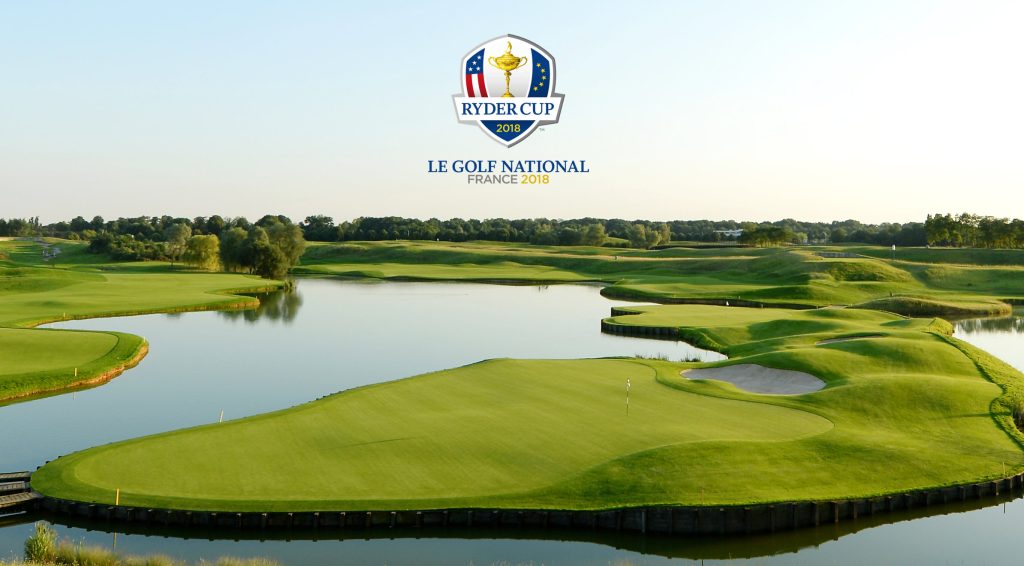
PARIS, France (Jan. 8, 2028) — The French do not follow the examples of nations, a fact that applies most stringently to their golf-crazy cousins across the Channel. This begins to explain the marked lack of great golf courses and accomplished players in a country so big, so populous, so temperate and so blessed with golf-worthy coastline. All that said, France is hosting the Ryder Cup in 2018, whether we golfers (or the French themselves) like it or not. And while Gallic sportsmen may never take to the game en masse, French Golf provides surprisingly well for anyone visiting Provence or the capital before or after September’s event.
Let’s first fixate on the Ryder Cup theme (even if the French may not). The host venue, Le Golf National, is nominally private but anyone willing to shell out 120 Euros can get a game there, and what a game. There are 45 holes here but L’ Albatros (that’s “The Albatross” for you non-Francophones) is the preferred 18, a track befitting golf’s biggest team event. It’s also hosted every French Open but two since opening in the early 1990s.
Architects Hubert Chesneau and Robert Von Hagge fashioned a flamboyant, 7300-yard beast from what had been a pretty humdrum piece of terrain. For anyone but the old world design purist, there’s plenty to enjoy here: wide landing areas, artificial mounding that renders each hole a golfing pod unto itself, forced carries, and peninsular greens bounded by wooden retaining walls jutting out into water hazards. It’s a feast for the modern golfing eye.
The other factors recommending Le Golf National, the next time business takes you to Paris, are convenience and variety. The property is located in suburban Saint-Quentin-en-Yvelines, just west of Versaille. What’s more, the secondary 18, L’Aigle (The Eagle), is more of the same good fun, if not quite so stern a test. There’s even a sprightly, 9-hole short course, L’Oiselet (The Birdie), for those with a little extra time, or not quite enough.
French Golf at its Best
Golf de Morfontaine is everything Le Golf National is not. Set aside an entire day for this place, where nothing is rushed and time would appear to have stood still since architect Tom Simpson fashioned this design in the late 1920s, the heart of course architecture’s “Golden Age”. Indeed, it was Simpson — designer of Cruden Bay in Scotland and The Berkshire outside London, who coined this now-hackneyed phrase.
In any case, Simpson’s patron at Morfontaine, the 12th duc de Gramont, chose his ground well. This is arguably the best course in continental Europe. It’s also among the most private, meaning it’s THE place to leverage all your best Parisian connections in order to wangle a visit.
What you’ll find, if those connections prove distinguished enough, is a deft cross between the best of London’s heathland tracks (think Sunningdale, where Simpson once renovated the New Course), and Northern California — think Olympic, with its ubiquity of trees and paucity of fairway bunkers. Indeed, the fairway corridors at Morfontaine, while firm and fast (thanks to perfectly sandy soil conditions), are a bit too crowded by massive Scotch pines to truly embody the “heathland” milieu. However, its stupendous putting surfaces, strategic greenside bunkering and elegant routing thoroughly overcome this stylistic impurity. French golf doesn’t get any better.
Metro Melbourne: Easy on & World Class
If there were a spectrum to chart the exclusivity of private golf clubs, by continent, the results might surprise you. At one end we’d have the United States, where everyone bangs on about living in a classless land of opportunity, but where private clubs are well and truly exclusionary to unaccompanied non-members. Oddly, in the United Kingdom, where clubs are generally older and more hidebound (some still ban women and require jacket-and-tie in the clubhouse, for example), it’s comparatively easy for outsiders to get a game unaccompanied. A polite letter to the club secretary, requesting courtesy of the course, will often do the trick, provided you pay a premium green fee. Asian clubs typically follow this British model, but forget the letter. Just call ahead and bring the cash.
Which brings us to Australia, where colonial Brits founded all the top private clubs but where famously casual, leveling Aussies have since beaten any and all pretension into submission. Nowhere in the world is gaining access to private golf clubs easier — and, sanguinely, nowhere are the course pickings quite so marvelous.
Normally in this space we detail for readers the best public course in a particular city, alongside the best private club. In Melbourne, the golf capital of Australia (nay, the entire Southern Hemisphere), this distinction is unnecessary. The best courses are all private, yet non-member tee times are routinely arranged without a fuss.
Melbourne’s best tracks are located cheek by jowl, south of the city, along a narrow strip of suburban real estate known as the Sand Belt. There is gorgeous golfing ground all around the metro area, but here the substratum is pure sand — the key ingredient in growing and maintaining turf that promotes both bounce and roll over this lovely terrain. See here four venues, ostensibly private but all perfectly accessible, that any traveling golfer would be remiss in missing during his/her next spell in Melbs.
Royal Melbs Has Great Company
Royal Melbourne GC — Justly ranked among the top 10 courses on Earth, RMGC doesn’t disappoint. Don’t be thrown by the Royal moniker. The tone is casual and be prepared to walk; members routinely pull their own trolleys. The championship 18 is a composite of the East and West courses. You won’t be allowed to sample that, but don’t fret. Either track on its own would be well worth indenturing a son or daughter in order to play.
Victoria GC — Located a stone’s throw from Royal Melbourne, the Victoria layout rollicks over this same premium terrain, though it’s restricted to a smaller footprint. The property has nevertheless been marvelously accoutered with golf holes — and scads of bunkers, all cut in the Australian fashion: clean-edged and steep-faced, prompting ensnared golf balls to roll down those faces to flat bunker floors.
Kingston Heath GC — Some argue this course is the equal of Royal Melbourne; it is, in fact, routinely ranked among the world’s top 30 courses. Truth is, the terrain here isn’t nearly so compelling. But the routing is so sublime, the greens and bunkering so devilishly devised, one is loath to complain.
Metropolitan GC — The elite Sand Belt courses have succeeded in creating distinct physical environments from a stretch of land that, aside from topography, is pretty much the same. Metro is lush and sub-tropical in a way the others are not, and here the ground really moves (in a way Kingston’s does not). What’s more, sitting in the low-slung, modernist clubhouse — sipping a local pale ale, chatting with the club’s amiable members, overlooking the magnificent 18th green — is a reminder of why some pay dues for the privilege (even if you don’t have to).
Ed. — This story first appeared in March/April 2003 issue Golf Journal magazine.
By HAL PHILLIPS The Swift River started rising in the rural Massachusetts town of Greenwich on Aug. 14, 1939. Soon enough the fairways at Dugmar Golf Club had become unseasonably soggy. After a time the bunkers and teeing grounds were completely submerged. Had the pins not been removed years before, their flags would have been some of the last things visible before this 9-hole track and the rest of Greenwich were lost for good.
It’s been 68 years since Greenwich and three neighboring bergs were systematically condemned and flooded, all in the name of Metropolitan Boston’s chronic thirst. This massive, Depression-Era public works project, on whose ass the loss of Dugmar GC was but a pimple, created the Quabbin Reservoir, then the largest man-made, fresh-water reserve on earth.
The Lost Towns, as they’re known today, were literally erased by the Quabbin’s introduction; every tree, every man-made structure in the Swift River Valley was burned or bulldozed to make way for it. The river itself having been dammed — in Belchertown, to the south — some 412 billion gallons of water gradually rose behind the Winsor Dam and Goodnough Dike. Not until 1946 did they first lap over the reservoir’s massive spillways.
By then Dugmar GC had been largely forgotten — but not erased, for memories are made of stronger stuff.
Dugmar Golf Club: The First Disposable Course
Other layouts have been lost to history, of course. Some have simply been abandoned; others were sold off to make way for post-war suburbia. But so far as we know, Dugmar GC — opened for play in 1928, hard by Curtis Hill — was the only golf course to meet its end in a purposeful deluge, sacrificed along with four 200-year-old communities to supply tens of millions of faucets in larger communities some 60 miles east.
Hundreds of golf clubs were built, as Dugmar had been, during the heroic age of Jones and Ruth, when the moneyed classes sought to bring the same sort of bravado to their own lives (not to mention a place to drink hooch in a country gone dry). More than a few of these establishments “went under” during the ensuing Depression, but none quite so purposely or literally as Dugmar Golf Club. You see, Dugmar’s developers KNEW the club’s fate before the course was ever built — before the bentgrass was imported from southern Germany, before the elegant stone patio was laid beside the farmhouse-turned-clubhouse, before the first crate of Canadian Club was hidden from view.
Dugmars creation was, in short, a set up: a crafty land deal with golf at its core; a trifle built to amuse its backers, for a time, before enriching them at the public’s expense. “Those guys knew what they were doing; they made out,” recalls a chuckling, 85-year-old Stanley Mega, who caddied at Dugmar GC and still lives close by Quabbin’s shores, in Bondsville. “Those guys knew the reservoir was going in and they made a killing.”
In essence, Dugmar GC was conceived and ultimately proved to be the world’s first and only disposable golf course.
This aerial of Dugmar GC was taken in 1931
Canny Chapman Valve Co. Executives
“Those guys,” the men behind Dugmar Golf Club, were a pair of canny executives from the Chapman Valve Co. in Springfield, then and still today the hub of Western Massachusetts. In 1924, Chapman President Thomas F. Mahar and Treasurer John J. Duggan together purchased a pleasant chunk of property some 30 miles northeast of their corporate offices — in the tiny hamlet of Greenwich (pronounced green-witch), conveniently located on the Athol branch of the Boston-Albany Railroad.
The towns of Greenwich, Dana, Enfield and Prescott were poor farming communities and had been for centuries, but their lakes and myriad points of river access were popular with holiday-makers from the big city. It was common for Springfielders to own summer camps and cottages up there.
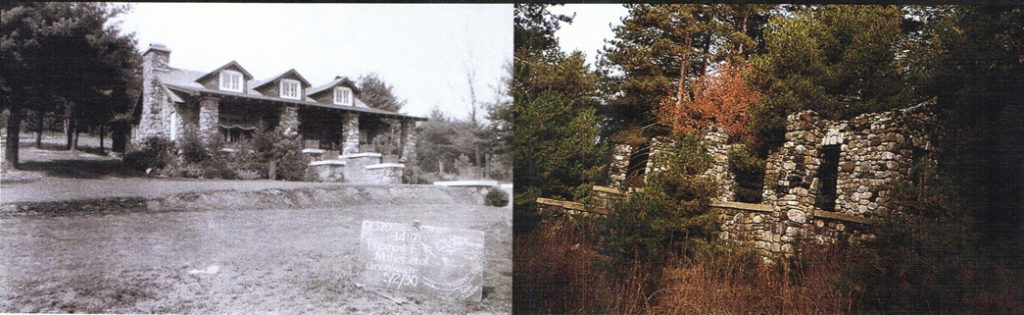
Duggan and Mahar had far grander plans. After paying $6,850 for 147 acres of abandoned agricultural land, they immediately set to work refurbishing the property’s existing farmhouse. In 1925 its value was assessed at $2,000; two years later this homestead was valued at $7,000. Next, Duggan and Mahar built a striking fieldstone lodge on the south-facing slope of Curtis Hill. Completed in 1926, it was assessed a year later at $12,000.
Once an additional 15 acres had been purchased, they commissioned Orrin Smith to design and build Dugmar’s golf course. Opened in 1928, the nine-hole layout occupied ground southeast of Curtis Hill, in full and magnificent view of the lodge with its distinctive stone-pillared porch.
The layout at Dugmar — a moniker created by combining the surnames Duggan and Mahar — was not some bit of amateur course design. Smith had been a respected and quite prolific New England architect, one who had apprenticed with Willie Park Jr. and Donald Ross before starting his own Hartford, Conn.-based practice in 1925. Dugmar GC measured a stout 3,160 yards from the back tees, boasted state-of-the-art putting surfaces of South German bentgrass, and featured 8,000 feet of underground irrigation pipe, something only the better courses could afford in those days.
An unforgettable place
“It was an unbelievably beautiful place right there in the valley. I’ll never forget it,” says Mega. “It was a very nice golf course, but I was too young to play back then. We caddied. I used to travel up there with Dave Belisle and Jimmy Fitzgerald. We spent a lot of time up there. If I made 35 cents a round, well, that was great!”
Mega and his older brother Alec would often rise in Bondsville, their tiny home town just south and west of the Swift River Valley, and take the train up to Greenwich. Or they’d hitch a ride via Belchertown on Route 21, the only paved road that ran north/south through the watershed. “It was quite a place up there. A few of the holes I forget, but I remember everything else. Between the 1st and 2nd there was a big stand of pine, sort of squared off. There were more woodlands guarding the 3rd, on the right. That’s where I found all my golf balls, you know. Now that was a nice hole, a great dogleg par-5.
“The greens were what always impressed me,” Mega continues, gathering steam. “Tiny things. You had to be accurate! And boy were they in great shape. Beautiful. Imported! People were always bragging about how they were imported. In fact, before they flooded the place, someone came in, picked up those greens and took them away! … I just caddied up there but my brother, he was a good golfer. He played Dugmar quite a bit. So did another good player, Whitey Wisnewski, who was almost like a pro. He used to play with [Henry] Bontempo here in Springfield. He played the best around. Good golfers played up at Dugmar. I still remember.”
A Raucous Close to Phase I
The 1928 opening of Dugmar’s 9-hole course fulfilled the “Phase I” vision of its founders. This was now a fully fledged country club, complete with a golf course ana clubhouse. It featured several guest rooms and a lively social calendar — because, lest we forget, this was the decade of Prohibition.
“There were raucous parties up there; they certainly took advantage of the remoteness of the place,” explains J.R. Greene, an historian who’s been researching Quabbin and the Lost Towns since 1975.
“The Greenwich Village train stop was very close to the golf course, a short walk. So it was very convenient for these ‘bit city outlanders’ to travel there from Springfield. And I have it on very good authority that Dugmar members brought plenty of liquor up there — and women who weren’t necessarily their wives. This was a heavily Yankee, Protestant region; there were no bars or taverns there, even before Prohibition. So that sort of behavior was duly noted.”
“It was a wild place,” Mega concurs. “To be served drinks, well, you had to know the right people. There was a lot of drinking. Those guys were really something; they knew what they were doing.”
The fieldstone lodge serving Dugmar used to sit on Curtis Hill. Today, it’s Curtis Island.
Phase II? Depends on Whom You Ask
Duggan and Mahar’s Phase II vision for Dugmar GC remains, to this day, the subject of some speculation. The idea of creating Quabbin Reservoir, you see, was put forward as early as 1919. The Legislature formally proposed the measure three years later. In 1927, the state legally impounded the mighty Swift River, thereby clearly declaring its intention to take the towns of Dana, Prescott, Enfield and Greenwich by eminent domain. That act that would eventually displace some 2,500 residents.
In other words, by 1929, when Dugmar Golf Club’s curious, boisterous run was just beginning, many residents of The Lost Towns had already sold their condemned properties to the state and moved their lives elsewhere. Others had sold out and rented their own homes, buying time to determine where and how exactly their lives might continue.
“This area was dying unless you raised livestock or fowl. For the younger generation it was an obvious opportunity to get out and start fresh,” says Greene, whose history, The Creation of Quabbin Reservoir, was reissued by Performance Press in 2001. “But for people in their 40s and up, their lives were torn apart – during the Depression no less! This was a tragedy. And of course, these folks didn’t want some peckerwood from the state telling them to move out. You have to remember, this was a very wrenching thing. There was no job-relocation assistance. Nothing like that. They had to find a new house, a new job, a new life — in the heart of the Depression.”
So why build a remote country club here, on land legally destined to sit under 40 feet of drinking water?
“It was an investment,” Greene says flatly, fighting a wry smile. “Just a part of the game Duggan and Mahar played. I believe they knew the reservoir was going to happen and this golf project was pure speculation on their part. I’ve had older residents say as much to me. It’s received wisdom, if you will.”
Claiming Qualified Ignorance
Of course, Duggan and Mahar claimed no such wisdom, not publicly anyway. They didn’t claim ignorance of the proposed reservoir project; when pressed in court, they claimed to have considered the Quabbin in the same way many Commonwealth residents still view certain state-funded, public works initiatives: I’ll believe it when I see it.
In any case, by the time the Commonwealth of Massachusetts had formally taken the Dugmar property — on Sept., 15, 1933, by eminent domain — Duggan and Mahar had naively or shrewdly (take your pick) drawn up an 800-lot subdivision plan for their property. A “gentlemen’s estate,” they called it — with “beach access.” They had secured access to Curtis Pond and harbored visions, on paper at least, of selling these lake-front lots to Springfield swells in search of a holiday home.
As the creation of Quabbin Reservoir was going to happen after all, Duggan and Mahar sought “fair” compensation from the Commonwealth of Massachusetts — to the tune of $436,500, or some $11.2 million in 2026 dollars.
For the record, the town of Greenwich in its entirety had last been assessed, in 1932, at $640,000.
The state, which valued the golf property at no more than $56,000 — basically, a sum of the club’s biggest assets, plus maintenance equipment and whatnot — immediately balked at Duggan and Mahar’s asking price. The matter was referred to a Board of Referees, a body specially appointed by Quabbin’s administrative entity, the Metropolitan District Water Commission, to arbitrate disputes such as this. At first the Referees awarded Duggan and Mahar a split-the-difference sum of $221,000, pending approval by the state Supreme Court. The court would offer no such approval; it remanded the matter to the Referees.
Determining fair market value for Dugmar Golf Club — at the time of its “taking” in 1933 — would prove an arduous task. The legal process took nearly four years and produced some gloriously arcane golf course-related testimony. An endless parade of real estate experts took the stand, but so did an assembly of New England golf luminaries, all of whom offered their varying opinions on the quality (read: ultimate monetary value) of Dugmar.
Golfing Luminaries Take the Stand
Appearing for the state, among others, were Walter Hatch, longtime construction superintendent in the employ of Donald Ross. Fred Wright, a 1923 Walker Cupper and 7-time Massachusetts Amateur champion, took the stand. So did Dr. Lawrence S. Dickinson, distinguished agronomist and longtime member of the faculty at the University of Massachusetts in nearby Amherst. Produced by the Commonwealth to argue for Dugmar’s lower valuation, Dickinson was particularly critical of the property’s soil. As evidence, he toted several samples to the Springfield District Courthouse in masonry jars.
Appearing for Duggan and Mahar were Orrin Smith and fellow course architect Wayne Stiles, both of whom offered testimony well ahead of their times. For instance, while the nine holes themselves were built for $18,000, the architects testified that Dugmar’s golf course actually increased the value of the property around it, including these would-be housing units. Similar arguments would be trotted out for several decades to come.
Assistant Attorney General John S. Derham, a bombastic figure of the non-golfing variety, wasn’t buying any of this conjecture. At one stage, he pointedly asked Stiles whether it was “good architecture” to place larger greens on holes requiring a long approach and smaller greens where only a short carry is necessary. “Any fool knows that,” snapped Mr. Stiles — or so reported the Springfield Evening Republican, which doggedly covered the hearings from start to finish.
Long story short, the state’s witnesses agreed that Dugmar was worth anywhere between $52,000 and $56,000. Duggan and Mahar’s cadre of specialists all agreed the property was worth between $340,000 and $360,000, mainly on account of all the house lots they might have sold.
In the end, on June 11, 1937, the Board of Referees ruled that Duggan and Mahar be awarded $150,000 for their condemned property, plus 4 percent interest accrued from the land-taking in September 1933. That brought the total payout, including legal and court fees, to $179,042.
Not bad return for a disposable item.
Ultimately, Duggan and Mahar received more than $1,100 per acre for Dugmar GC. On average, Greene asserts, other landowners in the Swift River Valley towns of Dana, Prescott, Enfield and Greenwich were compensated at approximately $100 per acre. Contemporary press accounts in the Athol Transcript described Duggan and Mahar as “aggressive, up-to-date businessmen”, and so they were. It took a while, but eventually they beat the state at its own game — in its own eminent backyard.
One Step Ahead of the Flood
Once the June 1937 judgment was handed down, Dugmar GC beat a hasty retreat into the deeper recesses of public consciousness. Our Chapman Valve executives had up and left Greenwich in 1933, content to pursue their Dugmar concerns in court. The putting greens, if Stanley Mega is to be believed, were uprooted and sold, perhaps to some long-admiring greenkeeper at a nearby course. “When did the course close for good?” Greene asks rhetorically. “We have reports of people playing there well after it had been abandoned, in 1933. But other than that, we don’t really know.”
One thing’s for sure: the water started rising on Aug. 14, 1939. By that time Dugmar GC had been thoroughly disposed of.
Mahar didn’t long enjoy his share of the $179,042. He died of a massive cerebral hemorrhage just six weeks after the judgment came down. He was 52 years old. Duggan lived a while longer. He became a member of Longmeadow and Springfield country clubs. Duggan would succeed Mahar as president of Chapman Valve and make a name for himself as a philanthropist and Democratic Party bigwig, though he never stood for office. He too suffered a debilitating cerebral hemorrhage, in 1953, and died a year later at the age of 65.
The Quabbin Reservoir project was originally budgeted at $65 million. Amazing though it may seem to educated observers of Massachusetts’ infamous public works scene, the job was completed under budget. A mere $54 million was spent, thanks to depressed labor costs and federal grants.
“So, paying Duggan and Mahar was a drop in the bucket,” Greene notes. “Even so, that was taxpayer money. Their attitude was, ‘We’ll do this, have a good time and if things work out, we’ll make some money on it.’ ”
And so they did. Duggan and Mahar even managed to fashion a lasting, relatively dry testament to themselves and their anomalous, dually eponymous endeavor: The fieldstone lodge on Curtis Hill still stands — on the south-facing shore of what became Curtis Island. It remains the only man-made structure, the only above-water evidence of The Lost Towns in the entire 89-square-mile Quabbin reserve.
“I find that extremely ironic,” says Greene, “because here’s something that was built by outsiders — and it was one of the very last things ever built in the valley. It’s really quite a monument.”
To what exactly?
“To the cupidity of Duggan and Mahar.”
Chasing Pre-Pollution Fauna
Biologist and scuba enthusiast Dr. Ed Klekowski is way into pre-pollution fauna. This explains why, for years, he had tried to get a close, forensic look at the Quabbin’s floor — to study the organic legacies of lakes and streams long ago overwhelmed by 412 billion gallons of river water. Several years ago, he succeeded. Klekowski led a dive of the area during the 2001 filming of “Under Quabbin”, a Massachusetts public television documentary which chronicled the lives of humans (and pre-pollution fauna) in the Lost Towns.
Klekowski, his cameramen, and their guides in the Mass. State Police Underwater Recovery Team are the last people to see Dugmar up close.
“Diving the golf course was much more interesting to think about than actually do,” reports Klekowski, a professor of biology at UMass Amherst. “Flooded fairways are probably the planet’s most monotonous dive sites: endless vistas of algae-covered flatness! We spent most of our time searching for something, anything, to film. Golf will never be an underwater sport.”
Klekowski’s team did find several of Dugmar’s irrigation pipes protruding from what is now the reservoir floor. They found the stone patio Duggan and Mahar had built beside the old farmhouse where, six decades earlier, martinis had been served (despite federal law) and beknickered sportsmen (despite their marital status) had flirted with flappers.
“Our goal,” Klekowski says, “was to find and video the remains of the buildings associated with the course. When we finally found the old foundations, you couldn’t but feel a bit nostalgic. It was actually sort of creepy being down there, where there had been so much life at one time.”
Lunch on Curtis Island
It’s illegal to set foot on Curtis Island today, but Bradley Gage has done it. Twenty years ago, as a member of the state Fisheries and Wildlife Board, he and his fellow board members lunched there. The day trip was an odd homecoming for Gage who was born in nearby Enfield — some 40 feet below the reservoir’s surface and two miles north. He spent the first 8 years of his life there before his father, Roy, moved the family to Amherst in 1932.
“My dad played Dugmar,” Gage says. “He talked about it with pride and interest, that he and his friends had played it.” Gage had been too young to have experienced the course himself, to remember much of anything about the place. Fact is, the number of folks with first-hand memories of Dugmar is small and getting smaller.
Gage grew up to become a golfer and the state official wishes he had spoken more of Dugmar with his dad, while they had the chance. This memory is a false one. Still, it’s one he might have cultivated further — because some memories are worth having, even if they’re not your own.
They are complicated things, these memories. Stanley Mega retains many of his own, but they can prove a burden. It had been 30 years since Mega had spoken or thought of Dugmar Golf Club, he says, and one could see the act — exhilarating for a time — eventually led him back to the realities of an 85-year-old life. Mega doesn’t play much golf anymore. After 20 minutes of animated recollections, his voice trailed off in that way an older man’s sometimes does. His brother is gone now. So are Dave Belisle and Jimmy Fitzgerald. Whitey Wisniewski, too.
Dugmar GC may as well be gone. It exists only in the suspended, dreamy netherworld of algae, pre-pollution fauna and would-be tap water — utterly hidden from all those lacking scuba gear and a state police escort. The train doesn’t stop in Bondsville or Greenwich any longer. Route 21 survives, but only in part. The road terminates outside Belchertown, its asphalt ribbon slowly descending toward, then disappearing beneath the Quabbin with an eerie, incongruous finality.
The stone patio beside the converted farmhouse is the only underwater evidence that Dugmar GC was ever there…
The stunning clubhouse serving Siam CC’s Plantation Course.
PATTAYA, Thailand (Sept. 5, 2017) — It’s 11 p.m. local time and my 8-man golfing gaggle is strolling down the main drag here. Pattaya’s “Walking Street” is the epicenter what most consider the capital of Thai Golf. The days and nights we’ve spent here, south of Bangkok, depart so radically from typical North American buddy trips, they make one reconsider the entire exercise.
Front and center is the golf component, of course. Normally this is the primary factor in determining quality or desirability. But there’s no denying that packs of (primarily) male golfers generally prize golfing locales for their nightlife, too. Any group of 8-12 golfing friends will include a few lads determined to rip it up each night, their wild hair perhaps offset by a few compatriots who’d just as soon play poker or watch sports in the condo. And so there is equilibrium.
Still, many insist the destination also offer some degree of lascivious attraction — if only to get the hard-partying faction on the plane. Think Myrtle Beach and its strip of nightclubs and bars. Think Vegas and its many diversions.
I consider the different buddy trips I’ve experienced, in these very locales, and I laugh to myself as another sultry Thai evening obliges me to wipe the beads from my perspiring brow. The Walking Street in Pattaya, ground zero for the city’s famously over-the-top nightlife, frankly makes an evening in Vegas feel like a evening out in Amish Country.
Black Mountain Golf Club in Hua Hin.
Blocked to vehicular traffic — save a series of small open-air trucks that continuously circle the downtown area, picking up patrons and dropping them off, for a dollar — Pattaya’s Walking Street stretches several kilometers along the Gulf of Siam beachfront. Either side of this thoroughfare is fairly well riddled with some of the craziest nightclub scenes you can possibly imagine. If you’ve never been to Thailand, you will have to imagine it — because you’ve surely never seen anything like it.
Thai Golf: All comparisons tend to pale
This is the primary take-away from my 10 days golfing across Thailand: There is such a breadth of experiences to be had that, after a point, all comparisons tend to pale.
For starters, it’s a big country — from Chiang Mai in the north to Phuket in the south it’s some 750 miles, or about the distance from Boston to Myrtle Beach. In other words, it’s too big to be climatically or culturally monolithic. This explains the striking contrast between the cool highlands of mountainous Chiang Rai, hard by the Burmese and Lao borders, and the utterly tropical environs of Koh Samui, an island off the east coast of Thailand’s tendril-like southern reach, on the Gulf of Siam.
Chiang Mai feels loose and slightly bohemian, like an overgrown backpacker haven, while Bangkok is the picture of a glittering, modern, bustling, gargantuan metropolis. Hua Hin is a quiet, gracious, retiring, seaside retreat while Pattaya… isn’t.
While the airport in Phuket accepts international arrivals from hubs like Singapore, most international visitors disembark via Bangkok, if only to go somewhere else. And so we did, immediately connecting to Chiang Mai where our early November arrival coincided with Loy Krathong, a festival marking the full moon.
The Hilton Millenium in Bangkok.
It’s different up North
Krathongs are little cup-shaped flowers, each with a candle and incense stick tucked inside; Loy Krathong means “floating Krathongs.” Our first night in town we ate dinner by the Ping River and watched thousands of these illuminated devotionals drift past. This marvelous scene and a stupendously sweet-and-spicy Burmese-style curry made for a keen introduction to the north country.
Next day we were off to Chiang Mai Highlands, home to 18 holes designed by the America duo of Lee Schmidt and Brian Curley. The superb terrain here made their job easy, but the finer touches impress: Profuse bunkering, pleasing to the eye, frames the inside of most every dogleg. The verdant peaks in the distance, the immaculate conditioning, the dryer heat all give the impression of playing somewhere east of San Diego.
The par-5 6th at Chiang Mai Highlands.
The north is a different brand of Thailand, slower and less insistent. After a cabana attendant offered me an iced towel — these weigh stations/snack pagodas come every 4 holes or so — she clasped her palms together, as in prayer, and, smiling contentedly, nodded over them. Just 36 hours in Thailand and this gesture was already reflexive in me, so I returned the gesture — a spiritual though not religious recognition of the divinity the Thais believe resides in each of us.
At the Robert Trent Jones II-designed Santiburi Chiang Rai Country Club — an hour north, where Burma, Laos and Thailand meet to form the famed Golden Triangle — the landscape proves lush, sweeping and equally divine. The holes feel as if they’ve been cut from a jungle, and so they have. Pleasing trade winds cool things down a bit further; it looks, feels and plays like a top-flight Hawaiian track — at one-third the price.
Feels like the Big Island
Back down south in Pattaya — some 90 minutes by car from Suvarnabhumi, Bangkok’s gleeming, modernist airport — we presage our adventure on the Walking Street with a pair of rounds at 36-hole Siam Country Club, host to the Honda PTT LPGA Thailand. The Plantation Course reminded me again of Hawaii — the Big Island this time, with its huge scale and colorful purple-hued undergrowth framing the fairways — while the Old Course feels like a primo private club somewhere in the Carolinas.
That night we took in several Singha and another killer curry (green this time) before swallowing hard and heading for the bright lights.
Walking Street nightclubs run the gamut in theme and tone, from the brazenly sexual to the coyly geisha, from darkly gothic to high camp. On this night we spent 20 minutes — or the time it took us to dispatch an ice-cold Singha — watching a group of 15 topless women dance amongst themselves (with various levels of enthusiasm) on a stage flanked on three sides by stadium-style seating. It was dimly lit and the décor entirely black and red. Sorta grim.
From there we braved a small side street and happened upon a totally different sort of place: cheerful lighting, an outer space theme. Same sort of central, raised dance floor but the mood was leavened 10-fold by the presence of soap suds, trapeze bars and flexible polyurethane tubes, which the dancers playfully wielded against each other’s backsides, and those of patrons, witting or otherwise as they walked near the stage. It was as if “Josie and the Pussycats in Outer Space” had gone live action and gotten really naughty.
I don’t want to make myself out as some naïf. A great many of the patrons were on hand, as I was, for the mere spectacle. But others were clearly on the prowl. Each dancer, after all, wore a number. A mere wave of the hand would summon her to one’s table. After obliging to buy her a few drinks (thereby generating revenue for the club), one is free — or, rather, one is free to pay $50-100 — to bring her back to a motel for the evening.
The comparisons are inescapable
I was reminded of the North American strip joints that we’ve all been exposed to, at one time or another, as adjuncts to golf trips or bachelor parties or whatnot. It’s made quite clear to any patron of these U.S. establishments that nothing, and I mean nothing, is going to happen between you and the hired help. Ever. Chris Rock wrote an entire monologue on the subject that sums it up quite well: “There is no sex in the champagne room.” It’s always confused me, the allure of these places. I mean, one can stuff all the money one likes in a G-string, but she is not going home with you — and that is ironclad.
In Thailand, that stricture is removed. Utterly. It’s a bit dizzying to contemplate frankly, a bit unreal. We could debate the moral merits of this system — clear objectification vs. straightforward commerce. What strikes me is the clarity, legality and transparency of the exercise when set against the equivalent here in the states.
Whether too smart or prudish, no one in our group took the plunge in Pattaya, or anywhere else in Thailand for that matter (there are Walking Street equivalents in most every city of any size). We stumble out of the space bar back onto the teeming streets which, when I look closely, are peopled by men, women and children of two dozen different nationalities. Everyone looks to be on holiday, heads on a swivel, eyes wide. It’s more reminiscent of a circus midway than a den of iniquity. It’s an assault on your senses, each and every one. To that end, I buy several divine, street-vended skewers of fried squid and satay chicken before heading back to the hotel with my compatriots. On the spur of the moment we decide to get a massage at one of the dozens of parlors around the corner from our hotel, the plush Woodland Suites.
Again, there are plenty of establishments in Pattaya where the word “massage” is just a device, a front — but far more deliver nothing more than the finest $8 massage you’ve ever had. An oil massage is what you’ve probably had elsewhere; a Thai massage involves no oil and can be quite a workout. After 72 holes in four days, there’s a whole lot to be said for either approach.
A Different sort of Golf Round
Sunrise at Muang Kaew GC, in the heart of otherwise urban Bangkok.
You’ll never rake a bunker in Thailand. In the Kingdom, that’s a caddie’s job and it’s but one benefit of the country’s utter reliance on 80- to 115-pound loopers. Yes, they’re all female and they’re a constant at every course in Thailand. Take a cart? They’ll drive it. Feel like driving? They’ll ride on the back. Walking? They’ll pull the trolley. All of this is done with unfailing courtesy and a solid understanding of the course. Club selection? I’d handle that yourself — but that’s my feeling toward caddies most anywhere.
In a place like Thailand, with its walking streets and massage parlors, the whole caddie phenomenon tends to elicit raised eyebrows from the uninitiated. But trust me: There is absolutely nothing sexual about the Thai caddie experience. For starters, despite the heat, they are completely swathed in clothing from head to toe, complete with long sleeves and gloves. Such is the standard of female beauty in Thailand: Tans are not fashionable for women, at all, and caddies go to great lengths to avoid them.
Second, they are all business. In most cases they are far too busy fixing ball marks, putting sand in divots and raking bunkers to flirt with you.
Some of the best caddies we experienced were served up back in Bangkok at the sporty Muang Kaew Golf Club, where conditions included near-100 degree temperatures and not a breath of wind. Our caddies never wavered — until we did. My two playing partners and I ditched the back nine, paid full caddie fees, and made three friends for life. Then we went for a massage in the clubhouse, a typically sterling facility in a country where they hew to a very high standard.
Asian clubhouses in general make their American counterparts look downright dowdy. Because Thai clubhouses cater to so many Asian golfing tourists, they are borderline palatial — how else to impress the Japanese or Korean who is used to merely opulent clubhouses back home? Massage rooms are standard fare in Thai clubhouses. Locker rooms are cavernous, as each golfer is assigned a locker at no charge, as a matter of course. After the round one is expected to shower, don a change of clothes, and kick back for several hours in the bar or restaurant. It’s a damned fine ethic, if you ask me.
The clubhouse at Thai Country Club has for several years been voted the best in Asia, and it’s not difficult to see why. It has all the bells and whistles, plus a superb restaurant (yellow curry this time, with chicken-lime soup) and an epic hot tub big enough to accommodate you and 11 of your closest friends. The course at TCC is no slouch — good enough to have hosted several tour events, including Tiger’s first foray in Thailand, the 1997 Asia Honda Classic. Despite all his issues of late, Tiger remains popular here. His mother is Thai, after all, and his name remains emblazoned on locker no. 1 at Thai Country Club. At least, it was when I visited…
Never Colonized, Never Outdone
Because Bangkok is the center of Thailand’s ancient culture — a culture, a nation that was never colonized by a Western power — it is naturally home to myriad examples of impossibly grand, ornate Thai architecture, each one more elaborate and awe-inspiring than the last. I recommend taking a cruise up and down the Chao Phraya River, which affords passengers a veritable water-born palace and temple tour. The swank Bangkok Marriott Resort & Spa, where we stayed, has its own boat — the dinner cruise is not to be missed.
With all this history, and with all our western prejudices on board, it’s startling to travel around Greater Bangkok (and indeed all of Thailand) with such ease. Bangkok traffic is world-renowned, but super highways connect the entire country, a monorail runs between downtown BKK and the new airport at Suvarnabhumi, and there are all manner of cheap domestic flights. This is clearly a first world country where everything still goes for second and third world prices.
We finished our Thai journey — arranged through the tour operator Golfasian (www.golfasian.com), roughly along an itinerary comprised of resorts and hotels belonging to Golf in a Kingdom (www.golfinakingdom.com) — with a couple days in the semi-sleepy town of Hua Hin, about 2 hours southeast of the capital on the Gulf of Siam. At the turn of the last century, the Thai royal family decided they liked this place, then just a village called Samoriang. The royals authorized a railway station here and commissioned fancy Italianate hotels. Then King Rama VI hired a Scot, A.O. Robins, to design the country’s first course, Royal Hua-Hin GC.
The rest is history. Today there are 275 golf courses and some 2 million native players, a figure that places them behind only the golf-mad Japan and South Korea. Of course, the vast majority of courses in Japan and Korea are private, so where do they go on golf holiday? Thailand.
Here’s what you see as you turn in to the Anantara Resort Hua Hin.
After waking up in a tropical garden that doubles as the Anantara Hua Hin, we decamp for our final round of the trip. It’s fitting that we close it down with 18 holes at Banyan Golf Club. Not because it was voted (by Asian Golf Monthly magazine) the best new course in Asia-Pacific for 2009, but because it was designed by the Thai architects at GolfEast. And because, as is the case at most Thai courses, one is just as likely to be playing behind a group of Thais as a group of Kiwis, Finns or Singaporeans.
Banyan was laid out over a former pineapple plantation, a giant bowl-shaped plateau set in the foothills above the sea. You get a peak at the Gulf of Siam from the picturesque par-3 15th. The striking modernist clubhouse looks out over the property from a commanding perch and it’s here that my golfing companions contemplate the genius of Thai golf over these final few Singha (and yes, one last curry).
It’s the organic quality of the golf culture here that resonates, we decide. Unlike some Asian nations where golf is nothing but a modern development gambit, or others where a colonial overlord foisted golf on the culture, Thailand came to the game on its own. The Thais really do love their golf. We decide they have every right to feel that way: We love it, too.
The 11th at Royal St. David's (photo courtesy of Brandon Tucker/WorldGolf.com)
Royal St. David’s Golf Club and its singular Welsh backdrop, Harlech Castle
HARLECH, Wales (July 13, 2017) — The British Open is nearly underway and, while there are myriad reasons to visit the U.K. with your golf clubs, none of them have much to do with British Open venues. Look at Wales, located right next door to this year’s host, Royal Birkdale — to all of England, if we’re honest.The R&A has never staged The Open over this border. Still, the golf up and down the northwestern Welsh coast is outstanding. Welsh golf along the south coast ((Royal Porthcawl, Southerndown, Pennard) is even better.
What’s more, when you venture into this section of the British Isles, you experience a region so remote, so removed from modern resort and tournament conventions, that a golf journey there feels almost Arthurian.
A hefty chunk of the King Arthur legend is Welsh, drawn from early poetic sources such as Y Gododdin. Like the Welsh language itself, theses texts pre-date Roman Britain, much less Christianity. The Druids, the UK’s pre-Christian priestly class, considered the Welsh island of Anglesey sacred. This ancient, mystical aura continues to pervade the country’s dark hollows, its untamed coastline, even its trees. The Celts thought them sacred, you know.
I’m a voracious fan of the historical novelist Bernard Cornwell, whose Arthurian trilogy, The Warlord Chronicles (comprising The Winter King, Enemy of God and Excalibur) were all published about during mid-1990s. Taken together, they represent the best, most accurate and compelling take on the Arthurian tales — and much of the three-book saga takes place in Wales.
Indeed, they made a movie loosely based on Cornwell’s Warlord Chronicles, in 2004 Alas, the film — titled “King Arthur” and starting Clive Owen and Keira Knightly — proved middling at best. But they filmed all the castle scenes in Harlech.
Welsh Golf: Where Worlds Collide
Here’s an example of how this ancient world and the modern golfing world can interact in the UK’s least heralded golf destination:
About 15 years ago my girlfriend, Sharon, who would later become my wife, and I went to visit friends in Market Drayton, Shropshire, just over the Welsh border, in England, and not far from Birmingham. I was there on assignment, writing a travel piece about “where to play in the Midlands” while attending the 1995 Ryder Cup.
We can see what sort of long-term promotional effect that story had: To this day, no one talks about Edgbaston, Beau Desert or Hawkstone Park.
Anyway, we decided to head west a couple hours, over the Welsh border to seaside Harlech, home to Royal St. David’s Golf Club. I had written a letter to the club secretary requesting courtesy of the club (remember written, posted letters?). He had kindly obliged. We three arrived in coat and tie, ready for an audience and perhaps a drink in the bar before teeing off.
Ahead of our game, however, we stashed our clubs in the boot and walked a few hundred meters up the hill from RSDGC to Harlech Castle, which overlooks the course, the town and the entire countryside. Built by King Edward I during his late-thirteenth century conquest of Wales, it served as de facto capital of an independent Wales between 1404 and 1409. That’s when was held by Owain Glyndwr, the last native Welshman to hold the title Prince of Wales.
Try doing something like that within walking distance at Royal St. George’s.
Impressing the Club Secretary
Sharon was a pretty rank novice back then. She had her own clubs and arrived at the club looking pretty darned smart in a turtleneck and one of my vintage sport jackets with the sleeves rolled up (remember the ‘90s?). Still, the club secretary was dubious. I don’t know whether he suspected her inexperience (none of us were asked to present handicap cards), or he was merely a mild sexist when it came to lassie guests playing his course.
Whatever the case, he followed us to the first tee to witness our opening drives. I’m not sure who was made more nervous by this “gesture,” Sharon or myself — but she proceeded to drill one right down the middle, about 210 yards, and off we went. Come to think of it, that may have been the day I decided she was the one.
In any case, Royal St. David’s was and remains fairly sublime. The opening holes are a bit ordinary and flattish, hidden as they are behind (and not amid) the giant dunes at seaside. But the back nine rollicks through some truly extraordinary dunesland. Great stuff.
Welsh Golf doesn’t have to be — some would argue that it shouldn’t be — about resorts and tourism initiatives and tournament-enabled marketing synergies. It’s about watching your future wife stripe one, after mingling with the spirits of rebel kings and pre-Christian sorcerers in a real, live castle. Not to belabor the point, but they ain’t doing that at Birkdale.
The 11th at Royal St. David’s (photo courtesy of Brandon Tucker)
This piece appeared in the April 2004 issue of LINKS Magazine. Above, George von Elm (left) and Billy Burke, combatants in the longest U.S. Open every contested..
TOLEDO, Ohio (April 10, 2004) — The next time you play a round of golf in some modicum of heat and humidity, the next time you trudge up the 18th fairway and feel a bit of lactic acid building up in your thighs, spare a thought for Billy Burke and George Von Elm. These unflinching principals squared off golf’s longest week, the most extraordinary physical and competitive test the game has witnessed. The 1931 U.S. Open was held some 86 Julys ago here at The Inverness Club in Toledo, Ohio. Grantland Rice called their duel there “the most sensational open ever played in the 500-year history of golf.” Burke and Von Elm required 144 holes of medal play to produce a winner: Burke, by a single stroke.
Take a moment to think about the parameters here: 72 holes contested over the first three days, followed by 36 playoff holes on Monday and 36 more on Tuesday. Waged in the midst of a stifling, July heat wave — in an era devoid of fitness trailers, cushioned in-soles, and air-conditioned clubhouses — this match proved golf’s precursor to the Bataan Death March, the games original Duel in the Sun. It was and remains, needless to say, the longest playoff in U.S Open history. Supreme Court cases have taken less time to adjudicate.
Or so it appeared during the morning round on Tuesday, July 6, 1931, as Burke and Von Elm — with 126 holes behind them and 18 still to negotiate — staggered off the 18th green toward the clubhouse for lunch. Even the most callow observer could see the quality of play eroding, under the enormous dual burdens of fatigue and Open-playoff pressure.
Yet Burke rallied to play his finest golf of the tournament over the final 18 holes. Von Elm, too, rose to the occasion and finished but a single shot in arrears.
“I looked for a rather ghastly finish to a grand struggle,” wrote O.B. Keeler in The American Golfer. “Instead it was, and ever shall remain in my mind, the most remarkable exhibition of recovered stamina and poise and of sheer staying power and determination I have ever witnessed.” Legend says that Von Elm, a lithe figure with little to lose, shed nine pounds during the championship, while the stocky Burke managed to gain two. “A circumstance,” Keeler mused, “which, if accurate, gives rise to wonder as to his diet.”
Golf’s Longest Week required No Jones
The first major of of 1931 was the first “Jones-less” U.S. Open since 1920. The Emperor had retired from competitive golf following his epic Grand Slam the year before, and while he was on hand at Inverness, the golfing public was anxious to see just who would fill the considerable void. Golf’s professional class was especially keen. Bobby Cruickshank admitted he and colleagues were delighted to see Jones in the gallery, as opposed to the field.
Nineteen thirty-one was also the year competitors were obliged to deploy the so-called “balloon ball” during Open play. This larger and lighter spheroid didn’t prove popular at Inverness, as competitors complained loudly that mis-hits were exacerbated by the new-fangled thing, which neither carried nor rolled as far. After just one year, the USGA would junk it — returning to the previous, heavier guideline of at least 1.62 ounces, but keeping the balloon’s larger size (1.68 inches in diameter).
Yet the weather soon quelled alltalk of balls and would-be kings The heat was oppressive by any discernible measure. Contemporary accounts of the championship are littered with modifiers like blistering, blazing and sweltering. Golf Illustrated‘s “special correspondent” noted that “The field was all on hand early for practice several days ahead of time, but so intense was the heat that on these practice days no one with any chances to jeopardize played more than nine holes of golf.”
The mercury registered 105 degrees on Friday, July 2, the first day of competition. It was no cooler on Saturday, when Von Elm served notice to the field with a 69, the tournament’s low round. His 36-hole total of 144 led 63 players who made the cut; Burke stood one stroke back. Thirty-four years would pass before before the USGA extended the Open format to 18-holes on four consecutive days, so Von Elm’s 73 on Sunday morning placed him two shots clear of Burke with the afternoon round still to play.
By lunch time, temperatures hovering between 97 and 99 degrees. Igniting one of his trademark cigars (he would go through 32 during the championship), Burke went off in the penultimate group with Johnny Farrell, while Von Elm and Al Espinosa formed the final pairing.
Espinosa and Farrell had fallen from contention with substandard third rounds; by Sunday’s final nine, it was essentially a two-man race, with Von Elm in the driver’s seat. Standing on the 12th tee, he led Burke by two strokes but Von Elm would stumble over the next six holes, playing them in four-over. Burke parred the 18th to post a 292, meaning Von Elm needed a birdie 3 to force a playoff. He did just that, calmly draining a 12-footer as the breathless, sweat-soaked multitudes gathered a green’s edge.
With its extraordinary fugue of physical demand and competitive drama, Sunday’s play (the presumptive 36-hole finale) might have gone down as one of the most thrilling days in Open history.As it turned out, the tournament was just half over.
Businessman Golfer vs. the Club Pro
A dapper, big-hitting Californian, Von Elm isone of those curiously recurring characterswho isn’t particularly well known but nevertheless continues to crop up as one leafs through the pages of golf history. He won the U.S. Amateur at Baltusrol in 1926, defeating the great Jones, who had claimed the two previous titles and went on to win the Amateur in 1927 and ’28. Only Von Elm kept him from winning five in a row.
A seasoned 30 years of age when he arrived at Inverness, Von Elm was hardly new to golf marathons. During the 1930 Amateur at Merion, he played the longest extra-hole playoff in U.S Amateur history, going 28 holes before succumbing to Maurice McCarthy. What are the odds the same man would participate in both the longest U.S. Amateur playoff and the longest U.S. Open playoff — and lose both?
The defeat at Merion effectively ended Von Elm’s auspicious amateur career. From that point forward he would compete as a “businessman golfer”, meaning he would accept whatever prize money his finishes might earn. This proved a prudent if slightly unorthodox vocational step. According to Herbert Warren Wind’s Story of American Golf, Von Elm’s earned him some $8,000 in January and February of 1931 alone, a veritable king’s ransom in Depression-era America.
Burke, on the other hand, was a 29-year-old, bonified professional of the club variety, playing out of swanky Round Hill in Greenwich, Conn. Born Billy Burkauskas, the Nutmegger spent a portion of his young adulthood puddling iron in a Naugatuck, steel mill. His swing was a tad awkward, and Von Elm outdrove him on nearly every hole. That said, “Temperamentally,” Keeler observed of Burke, “it is difficult to suggest an improvement.”
Some have painted Burke’s showing at Inverness as something of a shock result, but contemporary accounts tell a different story. It’s true that 1931 marked the club pro’s first real foray into national, tournament competition. Yet Captain Walter Hagen shrewdly named Burke to his 1931 Ryder Cup team. Tthe matches took place a week prior to the Open, at nearby Scioto, where Burke won each of his foursomes encounters and his singles match — the latter by 7&6.
Indeed, his cracking Ryder Cup form made him something of a fashionable dark horse entering the U.S. Open at Inverness.
Timeless Terrain in Toledo
The 15th at The Inverness Club.
The championship layout at Inverness, like many of its early-20th century counterparts, has undergone considerable change over the course of a century. The course we know today was created by Donald Ross, who renovated an existing nine and added a companion loop prior to the 1920 U.S. Open. A.W. Tillinghast prepped the course for the 1931 event, and half a dozen different architects have tinkered with it since. Inverness held the Open again in 1957 and 1979, enduring pre-tournament preps each time. [Architect Andrew Green would renovate yet again in 2017, then revisit once more in 2024.]
Despite all this, the ground itself at Inverness has remained essentially unchanged since the last ice age, when a pair of rivers carved two distinct valleys from the sandy soil just south of Lake Erie. “The course has always been laid out across these two gorges,” explains Tom Walker, course superintendent at Inverness since 1980. “The elevation change is about 30 feet, which isn’t a whole lot. But you’re continually playing across these valleys, walking down and coming up the other side. I would not classify this as an easy walking course, not by any means.”
The U.S. Senior Open was held at Inverness in 2003. Sort of ironic, as it’s the only Senior PGA Tour event where the competitors are obliged to walk.As Burke and Von Elm learned — as Bob Tway learned, before he hold out on the 72nd green to beat Greg Norman at the 1986 PGA Championship; as modern seniors learned a decade later — holes 1, 10, 12, 14, 15, 16, 17 all span at least one of these gorges. The other ravine requires similar hikes on holes 4 and 5. As the layout was configured back in 1931, no. 7 required yet another valley crossing.
Walker caddied at Inverness during the 1960s: “I didn’t necessarily enjoy it, especially in July. It’s no walk in the park. To think that these guys — and their caddies — walked 144 holes in five days, in that heat… I think that’s an incredible feat. Just the mental aspect, let alone the physical aspect.”
According to Walker, whose livelihood depends on an accurate meteorological understanding, a typical July day in Toledo is “muggy”, meaning 85-92 degrees with relative humidity of 50-60 percent. During the Open of 1931, these conditions would have qualified as refreshing cold snaps, as temperatures consistently soared into the upper 90s and beyond.
It was, in short, extraordinarily hot.
How hot was it? Nine players who made the cut at Inverness chose instead to withdraw, including two — Albert Alcroft and J.M. Hunter — who reportedly tore up their scorecards after the third round and went fishing. By comparison, at Interlachen the year before, just three Open competitors who made the cut chose to withdraw.
Either it was quite a bit hotter at Inverness, or the fishing just isn’t that good in suburban Minneapolis.
But seriously, folks: How hot was it? Here’s all you need to know: The USGA would never again stage its Open Championship during the month of July.
Monday, Monday: Head to Head
Burke watches Von Elm’s bunker shot come to rest during Tuesday’s final 36 holes at Inverness.
Following Von Elm’s 18th green heroics on Sunday, he and Burke rejoined their Open battle Monday morning. For the first time, the two combatants played alongside one another. The results proved predictably dramatic.“This playoff changed complexion at least 15 times,” Rice wrote in The American Golfer. Indeed, Monday’s remarkable give and take left the normally verbose Keeler at something of a loss: “I saw altogether too much… to make any sensible selection of features from such a wealth of them.”
Von Elm fell four strokes back at one stage, only to birdie four on the trot and reclaim a two-stroke lead. Burke was steadier, and by the time he reached the 36th tee — the 108th, all told — he held a one stroke cushion.
Then, as now, the 18th at Inverness is a short par-4 of just 330 yards. This is where Tway’s birdie from a greenside bunker defeated Norman during the 1986 PGA playoff. This is where Von Elm’s birdie at Sunday’s 72nd hole forced the 1931 Open playoff. Once again, on Monday, Von Elm needed a birdie 3 at the last to fend off defeat. And once again, he delivered — holing a 10-footer and forcing another 36 holes the following day.
Burke and Von Elm trudged on, playing the Tuesday morning 18 amid unrelenting temperatures — into the high 90s by 10 a.m. They played like the exhausted, punch-drunk combatants they had every right to be. Each shot their worst rounds of the tournament, though Von Elm’s 76 nevertheless afforded him a one-stroke advantage at the break.It looked for all the world as though the 1931 Open winner would be meted out by attrition.
And yet, as Keeler noted above, after lunch both players rose magnificently to the occasion. Burke went out in one-under 34, building a two-stroke advantage. Von Elm fought back and drew level with a par on 13. But Californian’s putter deserted him on 14 and 16, where three-putt bogeys essentially sealed his fate. The man whose putter had saved him Sunday and Monday betrayed him on Tuesday afternoon. He shot 73, with 35 putts.
When Von Elm’s long birdie attempt on 18 didn’t find the hole, Burke had the cushion he’d long lacked. Before addressing his own 25-foot birdie attempt, Burke was regaled by a green-side photographer: “Say, Burke, how about a shot?” With 143 holes behind him and poised to claim golf’s greatest prize, the unflappable Burke obliged the press corps by producing a winning smile. “Go ahead,” he said. “I’ve got three putts to make it.”
He would use all three.
Despite this cautious lags on 18, Burke’s exquisite, even-par 71 was his lowest round of the championship. “There is no need to gild a par round at this stage,” the sage Keeler remarked. “It speaks for itself.”


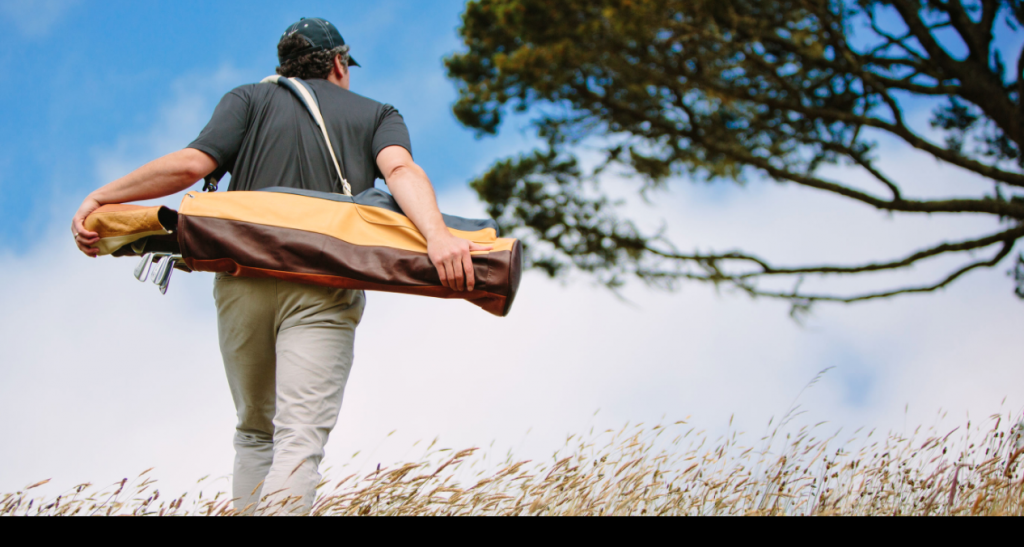 The PGA Merchandise Show in Orlando traditionally dominate the late January golf calendar in North America. I received this morning a press release re. the vaunted Mackenzie Walker. I no longer “carry”, as they say; the ol’ L4/L5 and S1/S2 discs won’t allow it. But I did report on introduction of the Mackenzie Bag once upon a time, circa 2002, for the dearly departed Golf Connoisseur magazine. That piece is reprinted below. Glad to see the company (if not the publication) is still in business.