PROVIDENCE, R.I. (Jan. 5, 2024) — It’s never too late to mark and quantify the impact of Ernie DiGregorio. Not in New England. Not when the subject is college basketball. Yet here’s the immediate news peg, the reason to contemplate Ernie D and his attendant rabbit hole early in 2024: It was 50 years ago this week that DiGregorio set the NBA rookie record for assists in a game: 25, for the old Buffalo Braves, during a 120-119 win over the hapless Trailblazers, in Portland on New Year’s Day 1974.
This particular moment in NBA history, in and of itself, packs enough meaningful hoops serendipity to justify an entire 30 for 30 documentary: • Ernie D led the Association in assists that 1973-74 season, his first. He led the league in free throw percentage, too. • The Trailblazers were indeed terrible enough to earn the no. 1 pick in the June 1974 draft. They took a guy named Bill Walton. • The Braves coach that record-setting January night? Dr. Jack Ramsey, who left for Portland the summer of 1976, whereupon he and Walton immediately led the Blazers to their only NBA championship. • After acquiring Nate Archibald in September 1977, Buffalo let DiGregorio go — to the Lakers, who waived him halfway through the season. Boston signed him but didn’t offer a new deal. Just like that, Ernie D’s NBA run was over. • That same summer of ’78, Buffalo owner John Y. Brown Jr. swapped franchises with Celtics owner Irv Levin, who promptly moved the Braves to San Diego. • A year later, the newly christened Clippers signed Walton, meaning Ernie D missed playing with The Big Redhead by only a couple Degrees of NBA Separation.
To sum up on Ernie D: Consensus NCAA Player of the Year in 1973, at Providence College. NBA Rookie of the Year in 1974. Out of the league by the summer of 1978.
Today, that sounds like an epic tale of crash and burn. Yet the mid-1970s did represent the most turbulent period in NBA history. The league had battled the ABA for talent and eyeballs the previous 10 years, before absorbing its competitor prior to the 1976-77 season. Free agency was instituted at roughly the same time. Upshot: Many on-court careers were cut short or otherwise doomed by the ensuing roster consolidations, by franchise-swapping owners, by drugs, by a decidedly incoherent league promotional strategy.
In the pre-cable age, television networks never convinced the NBA would ever prove marketable as a major sporting enterprise. Aside from not being football or baseball, the newly merged NBA was uncomfortably Black. (The pre-merger NBA was so lily white, there was meaningful playing time for not one but two Van Arsdales!) Would Middle America ever watch something so “urban”?
Ultimately, yes it would. But as late as June 1980, two full seasons after Magic and Larry showed up, CBS was still showing NBA Finals games at 11:30 p.m. EST, on tape delay.
It’s no coincidence that college basketball first planted its own flag during the Seventies, this period of such marked NBA chaos and weakness. In this sliver of broadcasting daylight, especially, college hoops created a viable toehold in the culture. And it was the college game where Ernie D would prove a far more influential figure.
Another bout of March Madness has come and gone. And now the money-grubbing power conferences are looking to further sully its pristine symmetry. From the moment the play-in gambit was instituted, in 2001, the slope got very slippery indeed. At first, just two small-conference champions squared off for the right to get boned, on 36-48 hours’ rest, by a top regional seed. Today it’s four, plus four more power conference also-rans. Let’s skip over mere half measures, or further regression, and proceed straight to the ultimate solution: Universal NCAA Bids. That’s right, tournament berths for every last Division 1 program, all 361 of them.
Don’t freak out: Here’s how quickly, seamlessly and magically it would work:
1) The regular season ends when February does. All 361 teams retire briefly to their ever-more plushly appointed training facilities, where they wait on the tabulation of a final computer ranking — 1 through 361. In essence, the period now devoted to “Championship Week” is given over to a 292-game, three-round, six-day tournament that produces the familiar, final bracket of 64.
2) The opening round — comprising 100 games and held the first Tuesday & Wednesday in March — pits the team seeded 361st (cue the “Team Irrelevant” stories) against the school seeded 156th. In between, #157 takes on #360, and so on. You like Cinderella? I’ll give you Cinderella: Imagine the crazy shit that will inevitably stem from a 200-team first round — contested over two nights, at on-campus venues all across these United States. Elegant in its mayhem, Round I rewards the top 155 with byes (thus lending meaning toour otherwise meaningless regular season) and quickly reduces the field to 256, a bracket-friendly multiplier of 64.
3) Round II takes place Thursday & Friday, whereupon those 256 remaining teams — the bye teams and the Tuesday/Wednesday winners — contest 128 games and symmetrically reduce the field to 128. Traditionally, the Thursday/Friday segment of NCAA Tournaments delivers 32 games and a dependably crazed bacchanal of buzzer-beaters, nail-biters, upsets and blowouts, all in the space of 36 hours. A universal-bid Thursday/Friday takes that spectacle and quadruples it.
4) The 64 games comprising Round lll, on Saturday & Sunday, would approximate a mere doubling of the traditional Thursday/Friday pandemonium, while neatly and cleanly winnowing the field to the recognizable 64. Sunday night the remaining teams — retaining their original seeds — are assigned opponents and regions in the traditional manner we’ve come to expect.
Universal NCAA Bids: Elegant & Logical
Rounds I, II and III would essentially form a massive, universal play-in bracket unto itself — producing more money in less time, using a more competitively honest framework than the current play-in scheme. The odious, so-called Championship Week would do the respectable thing and disappear.
All 287 games are necessarily played on campus, at the higher-seeded school. This mechanism is critical because, in rewarding higher seeds, it assigns another, much needed element of meaning to the college basketball regular season. It also guarantees kick-ass atmosphere and avoids potential short-notice scheduling conflicts at neutral sites, while reducing site-rental and travel costs. There is no reseeding between rounds. The bracket holds its shape and schedule all week, meaning teams are locked into either a Tuesday/Thursday/Saturday schedule, or a Wednesday/Friday/Sunday schedule.
What’s more, there is no good reason why a 361-team women’s tournament could not, or should not, be administered in exactly the same way, during the exact same time frame.
One of the great attractions of March Madness, perhaps the greatest of all, is the meting out of champions based purely on game performance. Polls don’t matter. Bowl traditions don’t muck up the works. Ultimately, seeds don’t either. By winning six games in a row, a deserving champion is invariably crowned.
The universal-bid system underlines, preserves and enhances this dynamic. As an added bonus, we dispense completely with any and all “bubble” and “snub” talk. Crucially, the regular season is dramatically transformed, for the better, in myriad ways I detail below. The bloated frippery of conference tournaments is eliminated. Bracketology? That irksome construct, along with the tiresome, flatulent conjecture that wafts about it, are similarly put out to pasture.
No More Perks for Major-Conference Also-Rans
The original play-in scheme, instituted at the turn of the millennium, was shameful enough. The 8-team “First Four” we’ve endured since 2011? Whatever. I wish I could report that each of these “expansions” was undertaken in the name of inclusiveness and fairness. But let’s not kid ourselves: This peculiar arrangement was first advanced and expanded entirely in service of annually preserving tourney revenue and exposure for no more than a dozen would-be, at-large, major-conference also-rans — at the expense small-conference champions.
Today, the Atlantic Sun Conference title-winner is obliged to play-in against its Summit Conference counterpart because, if they did not, there would be no room in the field of 64 for some eighth- or ninth-place team from the Big Ten — a conference that now has 18 basketball members.
This is shameful. If you think about it, the entire bubble/Bracketology thing — as a media construct — is built around whether and which second-tier, major-conference teams make the tournament, at whose mid-major expense. It defies logic that such expansive hoo-hah fixates on a group of teams ranked 55-75 in the country, teams that will not win the title, almost certainly won’t make the Elite 8, and may not even win a tournament game. Accordingly and appallingly, play-in games have eventuated so these demonstrable haves might make more money — at the direct expense of have-nots.
But here’s the good news: From the moment this play-in component was introduced, we began the inexorable move toward the final, most competitive, most equitable, most evolutionarily mature, most lucrative solution: a pair of all-in, 351-team NCAA basketball tournaments. This format is nothing less than our national hoop destiny. It will generate way more money and fan interest. There’s no practical reason why all-in men’s and women’s tournaments cannot run concurrently.
NEW GLOUCESTER, Maine (Nov. 14, 2018) — I don’t want to blow anybody’s mind. But here’s the thing: The classic cartoon Go-Go Gophers is further evidence of a little acknowledged but fascinating, mid-century trend in pop culture. Over and Over again, animators actively ripped off popular, live-action television shows of the time, essentially mining and co-opting them for themes, plots and personalities. These cartoons were the stuff of my GenX youth — on Saturday mornings, after school — and I expect much of my cohort will read this and nod dismissively: “Duh. The Flintstones.”
Yes, but it’s way bigger than that.
The Flintstones are the best-known example of this dynamic. It was also the first cartoon ever to air on network television in prime time. Launched in 1960, the show was a blatant rip-off of The Honeymooners. Its 39 episodes had aired from 1955-56, though star Jackie Gleason would intermittently reprise the role and the show for years. Fred and Wilma Flintstone were clear homages to the lead, live-action roles played by Gleason and Dorothy Meadows. Barney Rubble was even more distinctively based on Art Carney’s character, Ed Norton. I think everyone realized what was going on here, even at the time. It was part of the imprimatur that led to featuring The Flintstones in prime time, something unprecedented for an animated series at that time and frankly, still today, apart from The Simpsons.
But cartoonists would eventually prove some of the most facile and prolific rip-off artists in 20th century media history. The Flintstones formula worked. Accordingly, producers reprised the process without shame — to a degree we kids didn’t realize at the time and, I’d wager, few appreciate still today.
Exhibit A? The inimitable Go-Go Gophers, an under-appreciated cartoon and based completely on another live action (and culturally tone-deaf) TV show from that era, F Troop. Indeed, Go-Go Gophers was the cartoon that decades ago tipped me off to this weighty matter.
Classic Cartoons: A bin of Questionable Taste
As a kid, I thought F Troop was sorta funny. It was raucous confection, with a catchy theme song. Its cartoon incarnation did it one better in most every respect. Each episode of Go-Go Gophers begins with one of cartooning’s all-time great theme songs, followed by an uncanny, even cheekier homage to F-Troop’s fertile-if-untoward frontier theme.
One wonders today how anyone could see the opportunity for such broad humor in the slow-moving genocide of an indigenous people. We could include in this bin of questionable taste a sitcom based in a German POW camp. Of course, when Hogan’s Heroes was airing, perhaps folks were similarly dumbfounded by our bygone acceptability of black minstrel humor, like Amos & Andy, just 30 years prior. Three decades from now, we may similarly come to grips with other such untoward manifestations of white supremacy and the patriarchy.
Be all that as it may, the creators of Go-Go Gophers were ad guys from Dancer Fitzgerald Sample. They created the show to allow their client, General Mills, to advertise cereal. The producers of Go-Go Gophers — Total Television, then CBS starting in 1967, as part of the brilliantUnderdog Show — devised a cast of characters that also did the live-action show one better. The two aboriginal characters, members of the Hakawi Tribe, are straight cribs from the TV show. But you’ll recall the cartoon Colonel inhabits a Teddy Roosevelt milieu, while the Sergeant (played by Forest Tucker on TV) is animatedly morphed into a laconic John Wayne-ish figure.
Larry Storch’s memorable TV character, “Agarn,” didn’t make the cut. Neither did the Colonel’s live-action love interest. She was a sort of Annie Oakley figure clearly inspired by Ellie May from the Beverly Hillbillies. During the 1960s, no matter how incongruous to the sitcom premise, producers were sure to write into the show some hot young blonde. See The Munsters and, for that matter,The Jetsons. Television producers did a lot of shameless things, then and now. They borrowed from any genre or competing show that worked. And so, they could hardly complain when cartoon producers did the same.
HOLLYWOOD, Calif. (April 4, 2011) — I’ve never subscribed to HBO. There may have been a month here and there when it was provided to my family, by mistake, or as part of some promotion. Invariably, when our cable monolith attempted to charge us, we balked. The movie-watching we missed as a result of this cultural diminishment we didn’t see as relevant. However, each time I told Spectrum to go fuck itself, I did think twice about acess to all those episodes of Curb Your Enthusiasm and The Larry Sanders Show.
Last year, from some Bangkok street vendor, I procured the first four seasons of Curb for a ridiculously small sum. The entertainment was good. I had seen the odd 30-minute installment here and there. But ultimately I had trouble watching them en masse. After 5-6 episodes, not even a full season, I found myself worn out by the sameness of each plot: No, Larry. No, don’t do that. Oh geez…
By contrast, IFC started rebroadcasting The Larry Sanders Show in January and, with a deft flick of my DVR settings, I have proceeded to record each and every episode, in order, from the very beginning of the show’s run in 1992. It’s hard to keep up. My family rolls its eyes when they glimpse the list of recorded shows and spy this vintage Sea of Larry.
I’ll temper my ultimate, unbridled enthusiasm by saying the first two seasons of Larry Sanders were only slightly better than average — and something of a letdown when contrasted with the glowing tributes this series routinely garners from television cognoscenti. These episodes didn’t suffer from a sameness, a la Curb, but I did find myself wondering why I am supposed to care about any of the main characters who are unfailingly funny, but rather shitty.
Well, I can report that by Season 4, the show officially hit its stride. It’s not just easy for me to sit down and watch 2-3 episodes in a sitting; I make time for it. I recently watched the fictitious talk show’s 8th anniversary special. It struck me that a number of things have come together, revealing the show’s genius and explaining all the accolades I’d read and listened to over the years.
NEW GLOUCESTER, Maine (Feb. 22, 2018) — I have the distinct memory, among my very earliest, of my mother describing a new television show about to debut on Public Television. “It’s for kids exactly your age,” she told me, and so it was. Sesame Street first aired in late 1969, when I was 5. In a home where screen time was highly restricted — our boxy Sony Trinitron representing the only screen at that primitive time — Grover, Ernie, Bert, Maria, Mr. Hooper, Kermit, Gordon, Guy Smiley & Co. proved staples of my early cultural sentience. It occurred to me recently that without the enthusiastic approval of kids my age, of this founding Sesame Street cohort, the show might not have survived or become such a thing.
And what a thing it has become: 50 years old and counting.
While channel surfing through the upper, premium reaches of my cable guide, I never seem to happen upon Sesame Street. Yes, today the show airs on HBO. You may have read about this arrangement whereby first-run episodes can be found there on Saturday mornings; eventually, they cycle back onto PBS in a post-modern form of syndication. I never see it there either, to be honest. My kids are way too old. My viewing habits are primarily nocturnal. The show made this transition to HBO 2 years ago and I gather the show continues to wear extremely well.
Buoyed by the idea that this hugely influential, 50-year old show retains “the brassy splendor of The Bugs Bunny Show and the institutional dignity of a secular Sabbath school,” I’ve been conducting an experiment these last few weeks: I’ve been mentioning Sesame Street to folks generally my age and paying attention to their mood in reaction. If it generally brightens, I know they are fellow members of my cohort, Generation X. However, if I make a Cookie Monster or Roosevelt Franklin reference to someone just 4 years older, the reactions differ quite markedly. Often they don’t get it, or they will roll their eyes and make it clear they didn’t really watch Sesame Street. This makes sense: When the show debuted, these elder folks (Baby Boomers, primarily) had already aged out.
Sesame Street: Ultimate Generational Marker
More and more I realize that members of my generational cohort (what cultural historians and demographers William Strauss and Neil Howe call “The 13th Generation”, what the rest of us call Generation X) possess a unique relationship to this show and to American culture frankly. We weren’t just the first to watch and appreciate Sesame Street; we staffed the damn thing. Remember those little ditties they did, spelling out various numbers and letters with the bodies of other 5- and 6-year-old kiddies? Wesleyan, where I went to college during the 1980s, was full of Manhattanites who played those “roles” on the early shows. A dozen years on, we took great delight in catching Sesame Street some afternoon after class and spying our friend Ben Irvin forming the cross section of the letter A.
Another favorite SS gag of mine, as a kid, was the chef who’d emerge from some doorway, at the top of a small stairwell, bearing a huge tray of ice cream sundaes. He’d invariably appear there at the close of some peppy-but-educational music video extolling the virtues and qualities of, say, the number 7 — and when he did, he’d sing out, “Seven! Chocolate! Sundaes!!” Whereupon he’d trip and fall down the stairs, making a huge mess. I found this side-splittingly hilarious and remember rooting to see the 7 video (as opposed to 5 or 8) because I knew it would result in the largest, most gratifyingly splattered chaos.
In my relative dotage, and in wake of reading Strauss & Howe’s important 1991 book, “Generations: A History of America 1584-2054”, I continue to come across these cultural touchstones that more definitively separate myself from (and more finely hone my ambivalence toward) Baby Boomers, our feckless, navel-gazing next elders in the culture. Sesame Street is one such marker. If you’re an early 50something like myself and you knew the words to “Rubber Ducky”, you’re clearly a member of the 13th Generation — for Boomers had by then put away such childish things.
Here’s another music-based, but hardly fool-proof way to separate Boomers from Xers: The Grateful Dead. If you’re way into The Dead, you’re likely a Boomer.
Boomers don’t have the same need to parse things in this way, of course. Their cohort is so big, so culturally domineering, they assume (quite rightly) that most of the American society we now occupy was created for or by them, but certainly to their benefit. Culturally, Boomers are too big to fail. Meanwhile, we in Gen X must poke around a bit for examples where our own identities weren’t completely overrun or ignored.
Pod Explains America
Eventually I would outgrow Sesame Street, too, graduating as it were to The Electric Company, a companion PBS show also produced by the Children’s Television Workshop that more strongly emphasized the development of reading skills, or that’s the way it seemed to me at the time. Rita Moreno of all people hosted that enterprise, or so I was recently reminded when listening to a fascinating podcast/interview with her.
If you’re never heard Mark Maron’s WTF, here is yet another example of why the long-form pod is so fabulous: Where else might one hear Moreno, now 86, so engagingly but casually discussing West Side Story, public TV in the 1970s, and her navigation of the decaying MGM studio system as a young Latina in the late 1940s? And here’s another reason I dig WTF: host Maron is exactly my age.
Over and over again I find his conversational interviews revealing of a generational attitude that syncs up with my own, from movies and television shows that made big impressions on us both; to the particular drug culture that pervaded when we arrived at college in the early 1980s; to an ambivalence toward Boomers, in whose wide-ass shadow we have lived our entire lives; to attitudes of broad tolerance and political skepticism that Strauss & Howe tell us are trademark of 13ers (and other Reactive generations that inevitably follow Idealist cohorts like Boomers).
A more amorphous but still compelling argument can be made that this immediate post-Boomer, 50something cohort of ours remains a sui generis cultural product of Sesame Street and its distinct moral universe. Even if we weren’t, the show was unabashedly urban and diverse, never judgmental (but never cloying either), assertive when pushed but generally interested in getting along with others. We could throw Mr. Rogers into this mix, too. His show debuted nationally in 1968 and would bear equal cultural heft, though it was aimed at even younger kids and could be pretty cloying, in my view — though I did like the trains and Daniel the Stri-ped Tiger.
Boomers were raised on a different sort of television, a more commercial, pre-PBS brand of programming that reacted to the 1960s in a completely different way — by glorifying bland conventions that seemed to come from previous decades (My Three Sons, Gunsmoke). As such, my next elders in the culture reacted differently: They either rebelled against these hidebound and nostalgic traditions, or they clung to them with the fervor of a Trump voter, which all too many of them grew up to be. We in GenX have our own issues, of course. But I daresay we don’t carry around THAT sort of baggage — and Sesame Street is one reason why.
PHILADELPHIA (Feb . 18, 2018) — When we learned my daughter Clara would matriculate at the University of Pennsylvania, naturally her dad was thrilled. Ivy League pride? Nah. Here was my chance to make a proper pilgrimage to The Palestra, the most storied college basketball venue of the 20th Century.
As I’ve written here before, while my hoops allegiance today favors the overtly professional NBA. Yet there was a two-decade period starting in the mid-1970s, just as John Wooden’s run at UCLA came to end, when I was a far more fervent college basketball junkie. The Palestra was central to that emerging fandom, which just happened to coincide with the sport’s surge into the national sporting consciousness.
College basketball and the NCAA Tournament are so popular today, so ubiquitous on television, it’s easy to forget their dual ascension is relatively recent. For all intents and purposes, UCLA and its 10 NCAA titles from 1962-75 effectively stunted the sport’s broader popularity. When certain teams/programs utterly dominate an underexposed sport, big cultural awareness only comes when some ridiculous win streak is snapped. Think UConn, whose dominance has similarly stunted women’ college basketball. It took the rise of South Carolina, LSU and Caitlin Clark to get the sport out from under.
Men’s college basketball should have taken off in the 1960s, but it didn’t because the only time anyone paid attention was when UCLA got beaten: first by Houston (1968’s famous Astrodome game), then by Notre Dame in 1973. These losses proved to be mere blips; the Bruins eventually won national titles both years. But someone finally did beat them when it counted — NC State, in the 1974 national semifinal. Then Wooden retired with one last title, in 1975. Suddenly the field was open and seeded. Take it from someone who was there: The idea that some team other than UCLA could win it all each year was novel and beguiling (!). Only then did the sport truly take off.
The Palestra: TV Take Notice
The Palestra (bottom right) sits directly beside historic Franklin Field, home of the Penn Relays and where Santa got booed in 1968. It also hosted the Philadelphia Eagles’ last NFL championship (1960). We visited Feb. 3, 2018, one day before the Eagles did it again.
Growing up in New England at this time, our interest had already been piqued by a Providence College team led by Ernie D, Kevin Stacom and Marvin Barnes. The Friars went all the way to the Final Four in 1973 — that year WJAR Channel 10 out of Providence started televising a bunch of PC games. The following year, rival WPRI Channel 12 took the talented University of Rhode Island teams, led by Sly Williams, under its broadcasting wing.
Soon the national networks and their affiliates in Boston got wise and started televising big regional games every Saturday afternoon. Here is where I got to know The Palestra. Hoop-rich Philadelphia was home to The Big 5, a city series featuring local rivals Villanova, Penn, St. Joseph’s, Temple and LaSalle. Every Big 5 game was played at The Palestra and these were the games I watched with manic intensity each weekend, starting in the mid-1970s.
These were the memories dislodged to glorious effect earlier this month, when daughter Clara, wife Sharon and Philly-born, erstwhile golf freak Mike Sweeney watched the Quakers beat Yale, 58-50.
When the 10,000-seat Palestra opened in 1927, it was among the largest indoor sporting venues on Earth. The name is derived from the ancient Greek term palæstra, a rectangular space attached to a training facility, or gymnasium, where athletes would compete in public, before an audience. Today it’s a bandbox but still all I could have hoped for: seating stacked steeply with front rows right on the baselines/endlines; vaulted ceilings filled with banners; exposed brick everywhere. Pretty much exactly as I remember it from the mid to late ‘70s.
But there was more to our Feb. 3 visit. Quite a bit more.
The Cinderella Narrative
James Salters, point guard on Penn’s 1979 Final Four team, glides across The Palestra hardwood one more time.
One of college basketball’s enduring appeals is the Cinderella narrative, an unlikely NCAA run that propels some unlikely team deep into the tournament, perhaps all the way to the Final Four. Providence in ’73, for example. Larry Bird’s Indiana State Sycamores, who came within a game of going undefeated and winning it all in 1979. Later, any sort of unlikely tourney run qualified for Cinderella status. Starting in the 1980s, hoop junkies would go gaga every time Penn’s great rival, Princeton, would almost beat some highly-seeded team in the tournament’s opening round; Tiger coach Pete Carril became something of a folk legend based on this run of compelling near-misses.
Well, as a student of the game (and father of future Penn alum), I’m obliged to point out that back in 1979, an Ivy League team went all the way to the Final Four! Yeah, the Quakers were summarily bludgeoned there by Magic Johnson, Greg Kelser and Michigan State, 101-67. But still. This was a great team. The year before, it lost to national runner-up Duke in the regional final.
Guess who was honored at halftime of the Penn-Yale game earlier this month? That’s right, this very Quaker cohort. They were all there: James “Peanut” Salters, the silky, sinewy point guard; Ronnie Price, the 6’5” scoring machine who seemed way too good for the Ivy League; Matt White, whose awkward-but-effective 6’10” frame allowed Penn to truly play with (and beat) the big boys. To think that I would see them all again, 40 years later, at The Palestra, because my own daughter was a student there? Pretty fuckin’ cool.
The Palestra, I would learn, isn’t famous just for being old, à la the original Boston Garden, a rat-infested dump where I covered many games as a young sportswriter. The University has done a formidable job keeping the place up: squeaky clean and not a brick out of place. But the history is inescapable. For many years, the same outfit owned both The Palestra and Madison Square Garden; in order to play MSG in NYC, teams were often obliged to schedule games in Philadelphia, as well. Penn would acquire the facility in 1939, and Philly would soon develop a storied basketball tradition of its own. Even today, when there’s a big college or high school game to be played, The Palestra serves as host.
This long, diverse, illustrious history doesn’t merely waft about in the rafters. It is scrupulously catalogued by a series of pictorial exhibits located all around the concourse. There are life-sized images of all the great college stars who played here through the ages, from LaSalle’s Tom Gola and Michael Brooks to Princeton’s Bill Bradley; from Villanova’s Rory Sparrow and Easy Ed Pinckney to Temple’s immortal Mark Shakin’ Bakin’ Macon.
All the Penn greats get extra attention, of course — not just the cagers, but the wrestlers and volleyball players who starred here, too. The high school exhibit features a bunch of guys I’ve never heard of, but several anybody would (Wilt Chamberlain, Kobe Bryant). And lest we forget, a whole raft of famous coaches cut their teeth or made their bones at The Palestra: Dr. Jack Ramsey (at St. Joe’s), Chuck Daly (Penn), Jon Chaney (Temple) and Rollie Massamino (‘Nova) are but a few to earn oversized pictures on the concourse.
All Hail the Immortal Dick Weiss!
There was even a displaying honoring notable Philly sportswriters, the ink-stained wretches who labored here at courtside, including the immortal Dick Weis. He covered hoops for The Daily News but also, in the early 1980s, single-handedly produced Eastern Basketball magazine. Further warmed to the college basketball phenomenon by emergence of the Big East Conference in 1979, I subscribed to this publication in the early 1980s, at college. I recall that my housemates couldn’t believe anything so arcane even existed — frankly, neither could I. Accordingly, Dick Weiss would become one of my sportswriting heroes and role models. I never had a clue what he looked like until Feb. 3, 2018.
Ironically, The Big East — for all its successes — would eventually overshadow and ultimately diminish eastern basketball in general and The Palestra in particular. When the league hijacked St. John’s, Syracuse, Providence and UConn from the old ECAC and Yankee conferences, each of these lesser leagues splintered into even weaker sisterhood, or extinction. When The Big East plucked Villanova from the old Eastern 8 conference (which then became the perennially outgunned Atlantic 10), the Wildcats used their new riches to build a fancy, new, on-campus gym. In this diversified, enriched media/conference universe, the Big 5 would lose much of its cachet. Today, only a few rivalry games are played here. In many ways, The Palestra in 2018 is simply Penn’s home court.
It seems as though Penn is content with this evolution — eager to tout The Palestra’s broader history but just as happy the old barn still so ably serves the university’s many athletic programs. As the Big 5 has ebbed, Ivy League games have taken on more importance — they are one’s ticket to the NCAA tournament, after all. At this writing, the Quakers are 19-6 overall, 9-1 in conference, poised to earn yet another bid. After many years of holding out, the Ivy will conduct its first conference tournament in 2018, with the winner advancing to the Big Dance. More important perhaps: Penn swept archrival Princeton this year. The Tigers are 3-7 in the league and the Quakers are loving it.
Out on the concourse is yet another display, this one a simple tally board that tracks this long and bitter rivalry between the Ivy League’s two traditional powers. Following the Quakers’ win on Feb. 6, it reads, “Penn 126, Princeton 113”.
The inimitable Bob Barker, flanked by “Price is Right” eye candy Janice Pennington (left) and Anita Ford.
As yours probably does, my alma mater hits me all too frequently with some manner of e-newsletter cum fund-raising communiqué. One can hardly escape the memories stirred/jarred by all this WesContact, which is surely the way they want it. In any case, a recent MailChimp morsel revealed, among other things, that three Wesleyan University faculty, among them Nat Greene, had received The Binswanger Prize for Excellence in Teaching. While this particular tidbit proved interesting enough to peruse, I’m only now addressing the nostalgia it prompted — immersed as I am, third party, in the college experience of both my kids.
The first thing to say is that my cohort and I attended Wesleyan University in Middletown, Conn., alongside an actual Binswanger — Benjamin Pennypacker Binswanger to be exact. Never knew him but my housemates and I made note of his titanically pretentious name the first week of school freshman year and never forgot it. Never tired of mocking it, either. Always wondered if he was related to Princeton’s Jay Binswanger, winner of the first Heisman Trophy…
Wesleyan Professor Nat Greene
More to the point, Nat Greene was one of these recent Binswanger honorees. I took a couple classes with him but the first was a survey of European history 1815-1945, and I remember it best because it was the only class I ever took with my housemate Dennis Carboni, an art history major whose course load never again overlapped with mine (classical history/modern American lit).
Greene didn’t necessarily tilt the material toward “social” history, an approach then sweeping uber-liberal bastions like Wesleyan. His hewed more to the traditional “Great Men, Great Events” approach. I remember the syllabus included a book of his own scholarship, “From Versailles to Vichy: The Third French Republic, 1919–1940”, which a) struck me at the time as being pretty awesome, that this guy was teaching from his own work; and b) still resides in a bookcase somewhere here in my house, for reasons completely bewildering to my wife. An entertaining lecturer and no-nonsense grader of essays (all testing was conducted via manic, long-hand scribbling in those little blue booklets), Greene was a fine professor, the sort I hope Silas and Clara will experience at some point in their academic careers.
Nat Green Class at 10, Price is Right at 11
But here’s what I remember most from my class with Nat Greene: It ran from 10 to 10:50 on Monday, Wednesday and Friday mornings in the old PAC building — a few steps from the manhole where we often plunged down into Wesleyan’s famous tunnel system, the subject of another remembrance perhaps. If Dennis and I didn’t dawdle after class, we could race home to my off-campus apartment and catch The Price Is Rightat 11 a.m.
Yes, The Price Is Right. It became a sort of ironic obsession for me but something more than that for Dennis, as many things did. It gave me great pleasure to watch him obsessively game this once-seminal game show.
I’m not sure that college kids go in for this sort of thing today, awash as they are in video content and on-demand entertainment delivery choices. However, during the early 1980s, TV was a sort of novel diversion for college kids. We had grown up with it, of course, but had virtually no access to it at school. And so, great delight was taken in the ironic devotion to retrograde programming like soap operas in dorm lounges and late-night reruns of shows like the Rockford Files and Star Trek — things we would never bother watching when home with our families. My sophomore year, my housemate and I came by a tiny black-and-white TV that I’m pretty sure we carried with us the next three years, to three different houses, deploying along the way a staggering array of make-shift aerials including one that involved a pumpkin wrapped in aluminum foil.
The Price is Right fell right into this determinedly low-brow TV consumption, representing, as it did, all that was bourgeois and mass cultural — a great pleasure following high-blown, Nat Greene-led discussions of Marx, Captain Swing and Bismarck’s deft wrangling of German principalities. While Dennis’ note-taking habits at the knee of Professor Green were notoriously suspect, Bob Barker proved another matter entirely. While watching the show, Dennis kept copious notes on the price of every consumer item so that he might later blurt out a winning price before any of the three official contestants. When some dishwasher was revealed from behind the curtain, Dennis would browse his cheat sheet while everyone else in the studio cooed with consumerist abandon (take that, Karl!).
“Whirlpool, eh? That’s upmarket,” Dennis would muse strategically. “I’m going with $538.”
And invariably, it was so — or near enough that Dennis would have earned, in our demented fantasy world, the right to bound up on stage to mug with Barker at close quarters.
Our College/Young Adult Families
I heard an interesting interview a few years ago with writer/director Noah Baumbach and his partner Greta Gerwig, star of his movie, Frances Ha. Gerwig, then 28, talked about how several characters she’s played on screen ]stumble through their mid-20s in an unhinged emotional state — not necessarily because of new adult demands being foisted upon them, but rather because the surrogate families all 20somethings create for themselves at college (and just afterward) invariably fall away, sometimes bit by bit, but always in ways that unmoor. I remember this dynamic: We gathered these people upon leaving our actual families, and Gerwig explained that she was completely taken aback when close college and post-collegiate friends moved away, took jobs that contravened all she had assumed they stood for, or married someone whose presence effectively severed or weakened these bonds — bonds that young, college-educated folk believe are strong and meaningful enough to last forever.
I find Gerwig’s observation to be spot on. I remain close to several friends from college and that immediate-post collegiate period, including Dennis, but many more did fall away over time for reasons that were surely legitimate but felt to me, at the time, like a sort of casual betrayal. I mean, these were people I lived with, for years — they contributed to the shaping of me and presumably I reciprocated in some way. It makes one value all the more those who’ve not fallen away, but it also makes one sad and wistful that all we have to show for these folks, now lost, are weirdly disconnected memories, the odd anecdote, and persistent wonder as to whom they turned out to be.
I stay in pretty good touch with Dennis but there are probably a dozen others I haven’t spoken to for many years now. I wonder how they’re doing, beyond the superficial info I might gather on Facebook (were they, or I, to indulge in such a thing). If we tripped over each other somewhere, would we trade grand truths? Would we trade Nat Greene recollections or their equivalents before falling into the banter we perfected and found so very absorbing all those years ago?
CHARLOTTE, N.C. (May 8, 2016) — The life of an elite professional golfer is one of great privilege, born of great skill. This spring, the International Olympic Committee has learned what organizers of PGA Tour events have known for some time: Getting elite players to schedule your event is like trying to lure multi-millionaires to time-share presentations. When it comes to PGA Tour incentives, piles of money aren’t what they used to be.
The news that Adam Scott won’t be competing in Rio broke just as the Tour’s traveling road show stops this week in Charlotte for the Wells Fargo Championship, a top-tier event not just on account of its huge purse and quality golf course (Quail Hollow GC), but for the way it has traditionally pampered competitors. This aspect of tour life is seldom discussed outside the most wonky, Tour-obsessed websites and cable channels. However, the last decade has witnessed a startling arms race of perks and incentives, all bestowed with an eye toward delivering “name” players to individual PGA Tour events.
It’s a hard trick to turn, making elite players show up. As the IOC is now learning, top-shelf professionals have no real incentive to show up anywhere outside the Majors and World Golf Championship events, as they set their own schedules and money no longer motivates them. Olympic glory? Representing your country? Cementing golf as an Olympic sport after a 112-year hiatus? A familiar 72-hole stroke-play format (as opposed to the team formats first advanced by Olympic organizers)? Today, all these prospects, conceived to excite and allure, are likely to be met with indifferent yawns.
And why wouldn’t they yawn? Top players are so well compensated, the incentive to play 25-30 events per year — thus spreading around to many events the Tour’s considerable star power — has largely been removed. The fallback position for event organizers: lavishing\ perks and niceties on players and their families.
At The Players Championship, conducted over Pete Dye’s TPC Sawgrass course each May, a purpose-built 77,000-square-foot clubhouse sports a cavernous locker room, a separate champions locker room, and a full-on spa that, during the tournament, dispenses free services — not just massage but manicures, pedicures and hot shaves — to players and their family members. The gourmet vittles served here are considered the best on Tour.
PGA Tour Incentives: It’s about the Experience
There was a time when tour events burnished reputations by serving really good milk shakes and providing courtesy cars. The latter are today de rigeuer for all players, at every tour stop, but Charlotte takes it up a notch. Each golfer there is provided a silver Mercedes-Benz S-300 or S-500 for the week. They are also entitled to police escorts if they happen to encounter something unseemly, like traffic congestion. Free valet parking at Quail Hollow? Of course — even the caddies get that!
Event organizers here have recognized that cosseting players (and caddies) is good, but indulging their wives and girlfriends is equally vital. During past Wells Fargo events, Tour WAGS have been flown by private jet to visit the Biltmore Estate, the enormous Vanderbilt mansion in Asheville, where the movie Being There was filmed. Players themselves have, in the past, been ferried by helicopter to the Loews Motor Speedway, where they get behind the wheels of NASCAR rigs.
This is just a sampling of what has, in the past, been done for players and their families. I’m not exactly sure what goodies and jet-set diversions were supplied to them in Charlotte this week. The Tour has wisely stopped publicizing this stuff, as it can appear out of touch or unseemly. But there remains the very real expectation that tour-event organizers must continually up the ante in this regard, or else “name” players simply won’t schedule you. The purse — $1,134,000 to the winner in Charlotte this year — is almost an afterthought.
This is what the IOC is up against in Brazil. Forget the romance of lodging alongside triple jumpers in the Olympic village. These guys are used to the availability of private homes. Throw in the Zika virus, plus the sheer distance, and I think we can all see what’s coming. Olympic rosters for the 60-player men’s and women’s fields will be finalized July 11. Between then and now, expect a parade of polite declinations, citing the need to spend more time with family, the safety of those families, and perhaps the quality of milk shakes in Rio.
It doesn’t matter where MadMen auteur Matthew Weiner picked up the narrative thread when beginning the seventh and final season. Some might have insisted on 1969, to keep the specific-decade ethos in tact — though the award-winning series actually started in the late ‘50s. Others may have argued for 1974, thereby neatly bookending the Dick Nixon Era. I don’t care how the final season might have started, but I have strong feelings how it should have closed.
Fans and critics of MadMen have debated the show’s narrative choices since its debut in 2007. The actual series finale — whereby Don Draper passes over into a 1970s American Milieu by joining an EST retreat in Big Sur — has garnered all sorts of feedback. But still, halfway through Thursday’s 2-hour finale, the show should have leapt forward to a recognizably modern day. Maybe the suit jackets might have seemed a bit oversized, especially through the shoulders. Hairstyles would shift. In keeping with the way other MM seasons have begun, however, it’s not exactly clear what year it is.
What is clear, in this alternate finale of mine, is this:
Sterling Cooper & Partners has survived and thrived, perhaps added a name or two. The agency has taken up residence in chic modern offices high in a glittering Manhattan tower of glass and steel. For 50 minutes of this final hour, in the course of a normal business day, we learn what’s happened to most all the characters who matter, i.e. who remains at the firm, how the hierarchical machinations have shaken out, who’s moved over to or formed competitors, who has leftthis mortal coil, who has divorced and remarried whom, who’s aged well and who hasn’t.
The pacing is pointedly brisk, recalling the Season 3 episode “Shut the Door. Have a Seat,” when our gang reboots the firm. This pacing is important because frankly there’s a lot of ground to cover — for the viewer, absent all these years — and to make clear the agency’s ongoing vitality.
MadMen Finale: Chronological Clues
Indications of the time period dribble out via scene details and workaday conversations at SC&P. The Justice Dept. will no longer seek to break-up Microsoft. The codgers at Sterling Cooper aren’t at all sure, charmingly, what a search engine is. But they do care. They’re courting Netscape, which is jittery because a company called Google has just been awarded US Patent 6,259,999 for the PageRank algorithm used in its search engine.
Bobby Draper has grown up to be a political operative. We see him on TV as chief of staff to Congressman Gary Condit, steadfastly defending a man who would appear to be dying a slow political death while denying an affair with 24-year-old Chandra Levy, now missing for 133 days.
All this catch-up takes place on a single day, a Monday.
The next morning, standing in his Upper East Side apartment, an appropriately aged Don Draper reads the paper. In his stylish breakfast nook, a radio plays in the background: Ahmed Shah Massoud, leader of the Afghan Northern Alliance, has been assassinated in Takhar Province. Draper’s young wife frankly doesn’t know who that is. She’s the spitting image of Betty Draper. Or, maybe it’s another brunette…
What we all accept without debate: It’s a late-summer day of rare clarity, made real under a bright, blue, cloudless sky. Don emerges from a cab and bumps into a colleague (Peggy? Roger? Dawn?) outside their NYC office tower. They’re all running late for a conference call at 9 a.m. As they hustle inside, the camera pans back from the monolithic revolving door. It reveals, for the first time, that the Sterling Cooper offices are housed inside the World Trade Center.
Sterling Cooper in Flames
Cut immediately to the Sterling Cooper offices burning out of control. Don is knocked out but slowly coming to beside his own desk. He lies amid charred debris that includes a bottle of bourbon, a tumbler and a slide carousel. Low-licking flames and the eerie, reedy hum of steady wind provide the only soundtrack, as several ceiling-to-floor windowpanes have been shattered/knocked out by the impact and subsequent blasts of jet fuel. Scene staging and blocking actively recall MadMen’s seminal Korean War flashbacks.
Don ultimately does regain consciousness. Things are suddenly moving fast again. MM characters dart in and out, to see if Don’s alive, to express ignorance or disagreement as to what has actually happened. They tell him so-and-so is dead, inform him they can no longer stay put. As per usual, they exude a massive, sincere reverence for this man in particular, whom they’re now looking to for decision-making, beside whom they might well die. A group has decided to ignore the “stay put” advice of emergency personnel on the ground — they’re leaving, and they’re taking the stairs. Draper says he’ll be right there.
Alone now, he grabs the bourbon, pours himself a drink and downs it. As he takes one last look around the wreckage that was his office/firm/life, the episode-ending music begins (“Be My Baby,” by Ronnie Spector and the Ronnettes). Don walks past the camera toward what we assume is the door. Instead, he walks to the open window and calmly steps out.
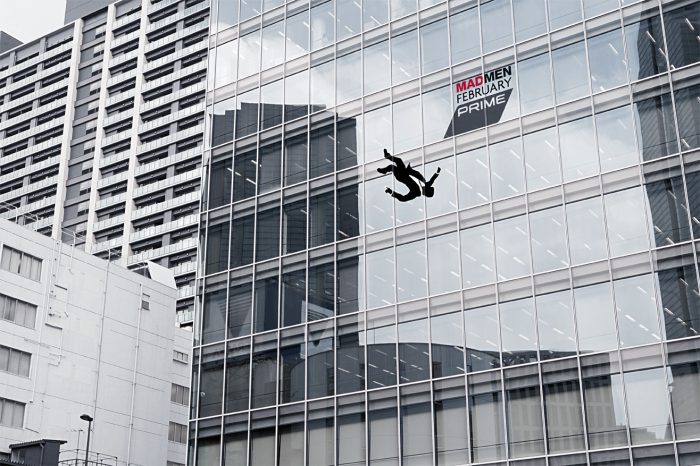
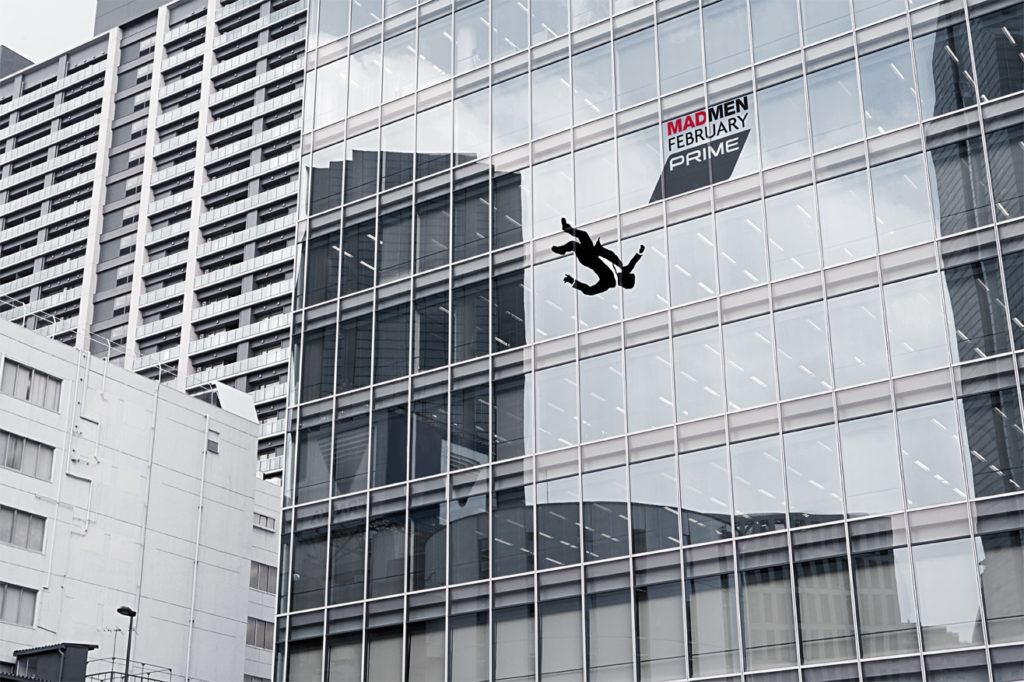
No need to show the trag-iconic footage of that businessman falling from the World Trade Center on 9/11. It is immediately recalled. It provides new meaning to the animated version of that footage we’ve seen at the start of this and every other MadMen episode, including the final one.
For reasons I’ve never quite understood, I’ve maintained an odd recollection of and attachment to the 1969 film, If it’s Tuesday, This Must be Belgium. It was on TV when I was a kid but no more frequently than any other junkie films that populated the late-night film archives of local Boston affiliates. Why would I so fixate this film? For a while I assumed it was the presence of a youngish, sneaky hot Suzanne Pleshette, and maybe that’s it. But maybe, just maybe, it was the fact that her love interest was played by Ian McShane.
I keep running into this guy. I just plowed through three seasons of Deadwood, in which he hit it out of the park as iconic Gem Saloon owner Al Swearengen. Now I’m onto a British mini-series production of Ken Follett’s Pillars of the Fall, where McShane presides as the conniving Bishop Waleran. This son of Blackburn, Lancashire has been around forever but it wasn’t till the other day that I realized what a long screen relationship I’ve had with him.
His big screen credits frankly leave a bit to be desired. I wouldn’t call them four thousand holes in the resume, but several decades of nothing films have been followed, of late, by a series of grey-eminence roles (Coraline, The Golden Compass) and bit parts in animated features (Shrek the Third, Kung Fu Panda). He may be the only British actor who failed to land a sinecure via the Harry Potter franchise. Sexy Beast was a fine film, though his solid portrayal of Teddy Bass was overshadowed (along with everything else in this 2000 feature) by the sublime, astonishingly evil Ben Kingsley character (yeah, he’s got range but who knew Ben had that in him?). McShane’s Blackbeard in the latest installment of Pirates of the Caribbean, On Stranger Tides, was probably a nice payday but it ain’t gonna win him any Best Supporting Actor nominations.
On TV, however, McShane has turned in a hall-of-fame-caliber roster of work, on both sides of the pond. God praise Wikipedia for logging it all for posterity. This guy is a mini-series maestro — Roots, Disraeli, Pillars — and has starred and/or appeared in a laundry list of fine or otherwise noteworthy series: Space 1999, Magnum P.I., Miami Vice, Dallas, The West Wing… Deadwood’s well earned praise, and his centrality to the show, now overshadow what had been the jewels in his crown: eight years as the unabashedly mulletted, somewhat slimy antique dealer, Lovejoy, and a recurring role in the equally laudable (and British) series Minder.
I’m not trying to make any monumental cultural point here. Only that no one does rogues of ambiguous motivation like Ian McShane.



 PHILADELPHIA (Feb . 18, 2018) — When we learned my daughter Clara would matriculate at the University of Pennsylvania, naturally her dad was thrilled. Ivy League pride? Nah. Here was my chance to make a proper pilgrimage to The Palestra, the most storied college basketball venue of the 20th Century.