Category Archives

87 Articles
Irene, Gloria and the Wesleyan Sports Hall of Fame

Irene, Gloria and the Wesleyan Sports Hall of Fame

Events conspired these past few weeks to recall one of the great moments in my sporting life and, in my humble view, one of the singular sporting episodes in the long, largely inconsequential sporting history of Wesleyan University.

The first prompt was Hurricane Irene. What stood out for me, as Irene blew through our small Maine town in late August, was the difference 25 odd years can make. When the lights went out here, I responded by reading and taking multiple naps. When Hurricane Gloria swept north in the fall of 1985, the eye of the storm tracking along the Connecticut River Valley, the reaction was quite different. News of the approaching storm and blanket class-cancellations catapulted the student body into immediate and decisive action: En masse we hit the liquor store and lined up the necessary narcotics, were they not already on hand. The storm would prove an irresistible opportunity to do crazy-ass things, like eat mushrooms and play pick-up football in spectacular winds.

The other recollective catalyst was the letter I received this week from my alma mater inviting me to a dinner honoring 2011 inductees into the Wesleyan Sports Hall of Fame. This invitation comes annually, along with calls for nominations. I notice that, among others, the entire 1980 Cardinal Field Hockey Team will take its place among the hallowed in Middletown on Nov. 5.

Perhaps you see where I’m going with this… In posting this blog item, I’d like to formally nominate for induction, in 2012, the 1985 Pick-up Football Team representing 8 Warren Street.

Thanks to the World Wide Web, there have been several tongue-in-cheek HOF nomination ideas floated by various WesKids over the years — like the time I sailed yet another free kick over the crossbar my sophomore year against Babson, and team captain John Nathan (who wanted the free kick for himself) sarcastically upbraided me as we ran back on defense: “Too many bong hits, Bluto?” Or the time the varsity golf team participated in the NESCAC Championships at Middlebury and, following a killer party I had located for us on campus, Pat Dudley projectile vomited out the passenger-side window of the Wesleyan Athletics van into the cold, unsparing Vermont night, whereupon he passed out, only to be revived the next morning in time to stumble onto the first tee, successfully drive the ball in play, and walk down the 1st fairway into a blizzard. Poor Pat. At one stage he turned back forlornly to those of us assembled on the tee behind him — he and his ghost-like pallor disappearing into that freak storm like an old time baseball player into a field of corn stalks.

These are indeed hall-of-fame-worthy accomplishments, but they are mere moments. Running the wishbone while shrooming on a muddy track in hurricane-force winds AND leading a ragtag group of soon-to-graduate liberal arts misfits to victory is another matter entirely. In the interest of supporting the nomination more credibly, allow me to paint the scene more fully:

Wesleyan is, to be clear, situated just 25 miles north of Long Island Sound, so the storm was quite strong when it arrived and, indeed, the glory of Gloria kicked in about the time the winds picked up. With Patty Smith’s “Horses” blaring from some student house nearby, I remember standing on the soccer practice fields looking back down Warren Street, where dozens of students milled about with/in their cups. Others spread their arms wide so as to better catch the hurricane-force winds, while still more took advantage of an organically muddy slip ‘n slide that had been fashioned on a long, sloping embankment across the street from the old hockey ring parking lot.

We had arrived at the practice fields, just beyond said hockey rink (now a monolithic, state-of-the-art sports complex), to throw the football around. We ended up playing a game of 5 v. 5 football (tackle, naturally) against the guys from across the street. Who were they? Chi Psi brothers, mainly. Basketball and hockey players who liked to stroll around shirtless in their yard smoking cigars and playing bocce. In other words, a high jock quotient and formidable opponents.

We played all offensive possessions in the same direction, downwind, enabling each QB to throw the most splendid 60 yard bombs with mere flicks of the wrist. It was a spirited, fun affair — as only a game of tackle football in a hurricane under the influence of psychotropic drugs can be. But the game got appreciably more interesting when the boys from 8 Warren St. decided to run…  the wishbone.

Yes, the triple-option wishbone, with yours truly doing his very best Jamiel Holloway imitation. And you know what? Barry Switzer would have been damned proud. We thumped them from there on out. If you don’t put the ball on the ground, the wishbone is basically indefensible — even with a soccer player at QB, under stormy skies whose cloud formations appeared to breathe (and bore an uncanny resemblance to the cover art from the R.E.M. album, Murmur).

Gloria at Wesleyan has since been officially memorialized among students of my vintage, on account of our shared experiences that day, but also on account of a singular image — of a student car utterly crushed by a tree felled during the storm. This photograph was played big in The Argus, where I was an editor, and subsequently in our yearbook. But I say it’s time to broaden the Wes legend that was Gloria 1985, and what better way than inducting me and my housemates into the Wesleyan Athletics Hall of Fame? All together now, with feeling:

G… L… O… R… Aye-ay-ay-ay-ay-ay — G-L-O-R-I-A.

GLO-RHEA!

The Curmudgeon tackles Asia, GPS, Celts v. Picts

Great to be with Peter Kessler, again, on his radio show, “Making the Turn,” a staple of the PGA Tour Network. It’s on XM, and this aired a week back but I reckoned I’d share it with you here, under Curmudgeon guise, as a podcast. Ireland vs. Scotland is the burning question. We answer that and touch on course development in Asia, GPS in rental cars, what makes a course worth playing over and over, and more Eire antics. Got to know Peter better during our recent Irish golf trip. The guy is a serious Beatles fan, which explains his show’s segue music. Enjoy.

The 1931 U.S. Open: Golf’s Bataan Death March
George von Elm (left) and Billy Burke, combatants in the longest U.S. Open every contested..

The 1931 U.S. Open: Golf’s Bataan Death March


George von Elm (left) and Billy Burke, combatants in the longest U.S. Open every contested..

The next time you play a round of golf in some modicum of heat and humidity, the next time you walk 18 and feel the lactic acid building up in your thighs and calves, spare a thought for Billy Burke and George Von Elm. These were the stalwart principals in golf’s most extraordinary physical test: the 1931 U.S. Open, held way back when at The Inverness Club in Toledo, Ohio.  As the central characters in what Grantland Rice called “the most sensational open ever played in the 500-year history of golf,” Burke and Von Elm required 144 holes of medal play to produce a winner: Burke, by a single stroke.

Take a moment to think about the parameters here: 72 holes contested over the first three days, followed by 36 playoff holes on Monday and 36 more on Tuesday. It was and remains, needless to say, the longest playoff in U.S Open history. Supreme Court cases have taken less time to adjudicate.

Waged in the midst of a stifling, July heat wave — in an era devoid of fitness trailers, cushioned in-soles, and air-conditioned clubhouses — this match was golf’s precursor to the Bataan Death March.

Or so it appeared during the morning round on Tuesday, July 6, 1931, as Burke and Von Elm — with 126 holes behind them and 18 still to negotiate — staggered off the 18th green toward the clubhouse for lunch. Even the most callow observer could see the quality of play eroding, quite understandably, under the enormous dual burdens of fatigue and Open-playoff pressure.

Yet Burke rallied to play his finest golf of the tournament over the final 18 holes. Von Elm, too, rose to the occasion and finished a single shot in arrears.

“I looked for a rather ghastly finish to a grand struggle,” wrote O.B. Keeler in The American Golfer. “Instead it was, and ever shall remain in my mind, the most remarkable exhibition of recovered stamina and poise and of sheer staying power and determination I have ever witnessed.”

Legend says that Von Elm, a lithe figure with little to lose, shed nine pounds during the championship, while the stocky Burke managed to gain two. “A circumstance,” Keeler mused, “which, if accurate, gives rise to wonder as to his diet.”

Read on to sort through, with me, the fascinating details of this extraordinary championship, staged 80-plus years ago this summer by two fascinating figures whose stories have been obscured by time, during a period when golf was wildly popular but still adjusting to the loss of its dominating figure.

•••

The U.S. Open of 1931 was the first “Jonesless” Open since 1920. The Emperor had retired from competitive golf following his epic Grand Slam the year before, and while he was on hand at Inverness, the golfing public was anxious to see just who would fill the considerable void. Golf’s professional class was especially keen; Bobby Cruickshank admitted he and colleagues were delighted to see Jones in the gallery, as opposed to the field.

Nineteen thirty-one was also the year the so-called “balloon ball” was required for Open play. This larger and lighter spheroid didn’t prove popular at Inverness, as competitors complained loudly that mis-hits were exacerbated by the new-fangled ball, which neither carried nor rolled as far. After just one year, the USGA would junk it — returning to the previous, heavier guideline of at least 1.62 ounces, but keeping the balloon’s larger size (1.68 inches in diameter).

Yet all the talk of balls and would-be kings was quickly subsumed by the event’s overarching conversation piece: the weather. The heat was oppressive by any discernible measure. Contemporary accounts of the championship are littered with modifiers like “blistering “, “blazing” and “sweltering”. Golf Illustrated‘s “special correspondent” noted that “The field was all on hand early for practice several days ahead of time, but so intense was the heat that on these practice days no one with any chances to jeopardize played more than nine holes of golf.”

It was 105 degrees on Friday, July 2, the first day of competition. It was no cooler on Saturday, when Von Elm served notice to the field with a 69, the tournament’s low round. His 36-hole total of 144 led 63 players who made the cut; Burke stood one stroke back.

It would be another 34 years before the USGA extended the Open format to 18-holes on four consecutive days, so Von Elm’s 73 on Sunday morning left him two shots clear of Burke with the afternoon round still to play.

By lunch time, the mercury was hovering between 97 and 99 degrees, with humidity levels only a tad lower. Igniting one of his trademark cigars (he would go through 32 during the championship), Burke went off in the penultimate group with Johnny Farrell, while Von Elm and Al Espinosa formed the final pairing.

Espinosa and Farrell had fallen from contention with substandard third rounds; by Sunday’s final nine, it was essentially a two-man race, with Von Elm in the driver’s seat. Standing on the 12th tee, he led Burke by two strokes but Von Elm would stumble over the next six holes, playing them in four-over. Burke parred the 18th to post a 292, meaning Von Elm needed a birdie 3 to force a playoff. He did just that, calmly draining a 12-footer before the breathless, sweat-soaked multitudes gathered a green’s edge.

With its extraordinary fugue of physical demand and competitive drama, Sunday’s play (the presumptive 36-hole finale) might have gone down as one of the most thrilling days in Open history.

As it turned out, the tournament was only half over.

Irish Golf Tidbits: Stouts, Control, Separated at Birth

Irish Golf Tidbits: Stouts, Control, Separated at Birth

Still emptying the suitcase of the golfing mind, fresh off the Golf Road Warriors’ late-July tour of Ireland. Several matters remain unaddressed, and so they are tackled here. I reserve the right to keep this tab running indefinitely. Even so…

• Guinness Lite. Honestly — We had wonderful couple of days (less than 24 hours, actually, now that I think about it) in the very north of Ireland at Ballyliffin Golf Club. General Manager John Farren was our host, and he could not have been a better one. He looked the other way when we arrived looking like death warmed over (straight from a transatlantic flight and 4-hour drive from Dublin). He personally delivered Peter Kessler’s set of Adams clubs on the 8th hole of our round on the Glashedy Links. He even joined us in the bar for a podcast when all 36 holes had been completed. Somewhere in this blitz of activity, he made what I thought was a joke about offering us a Guinness Lite. I assumed he was joking; I mean, really… But lo and behold he mentioned it again during the pod, and upon drawing him out, it became clear he was perfectly serious. Guinness Mid-Strength is in fact the centerpiece of a “responsible drinking” campaign being waged by Diageo Ireland, Guinness’ current owner. Unlike American light beers that are marketed as being “less filling,” Guinness Mid-Strength was created to offer an unchanged taste experience without getting people so loaded. It weighs in at 2.8% alcohol, compared with the 4.2% we expect from the world’s most recognizable stout. I expressed mild shock and dismay at this development, but John urged me to try one. He even ordered me one from the bar, after the pod, but it was ultimately delivered to someone else — at which point I accused him of taking the joke a bit far. Still, I promised him I’d try one and report back. I did just that during our stay in Killarney and let me say I was impressed. Depending on how cold it’s served, a reasonable person might have trouble telling a Mid-Strength from the original. Indeed, because I’ve gone dozens of Irish posts and thousands of words without saying it, I’m obliged share the sentiment here: Guinness Mid-Strength. It’s magically delicious.

Beamish, where art thou? — I love my Guinness. I’m no fool. But I do enjoy a wide variety of stouts. Why limit one’s self? The American craft brew renaissance, which pretty much coincided with my coming of age, has exposed me to just how many ways one can creatively brew a stout, the thickest and “stoutest” porter-style beer a brewery might produce. Gritty McDuff’s Black Fly Stout is one I enjoy regularly, as it’s brewed just down the road from my home in Maine. I like a Murphy’s every once in a while, and one thing I was dearly hoping to do in Ireland during this GRW trip was down a few Beamish, a lovely stout that I’d quaffed on previous trips to the U.K. Well, I wasn’t really expecting to find it up north in Ireland; Beamish was originally brewed in the south, in Cork, and folks up north don’t demand it. But I was dismayed to see it nowhere on tap in Killarney or any of the clubs we frequented in the southwest. Apparently Heineken International owns it now. There was a brief dalliance with international distribution, in 2009, but that’s been halted and it’s nowhere to be found on the streets of Killarney. What a shame.

Eat, Pray, Love = Control, Feel, Trust? — So, each of the Golf Road Warriors was provided two golf gloves for our trip, courtesy of our friends at Hirzl. We received the Trust Control model, and the Trust Feel model. I can honestly speak only to the Control, which I donned at Ballyliffin’s Old Links and used throughout the trip. Great glove. No stretching, easy on and off, and the palm material (kangaroo leather apparently) was super grippy, without being tacky. I went for the Control because I reckoned we’d be playing multiple rounds in the rain (at which time, I would break out the Trust Feel model). But, as luck would have it, we played only one real wet round (at Carne GC), the Control provided just that, and it dried out in plenty of time for the next day’s round. I’ll report on the Trust Feel when the Control wears out, but don’t hold your breath. I’m thinking this could take some time.

Time-Honored Tracks Enter Digital Age — Failte Ireland, the very capable promoters of Irish tourism (Failte, roughly translated from the Gaelic, means Welcome to), launched during the Irish Open an online search capability that allows visiting golfers to book tee times, in real time. Go to the Search and Plan section at www.discoverireland.ie/golf and you’ll see how it works. Many of the fine old links are represented among participating clubs, in addition to a bunch of top parkland tracks, including Open host Killarney Golf & Fishing Club. 

“If you want to play a number of courses over a few days, you can now make the most of your holiday by checking tee time availability at golf courses online in advance,” explained Keith McCormack, Failte Ireland’s Head of Golf. 

“Our tee time availability search facility will tell you exactly what slots are free. You can then book the tee time that fits your itinerary with your chosen golf course. All you have to do is decide where you want to go and what type of golf course you’d like to play on.”

English pro Chris Wood

Chris Wood, Separated at Birth — As you may recall, I played in the pro-am on Wednesday of last week’s Irish Open at Killarney Golf & Fishing Club. Thankfully, no one was hurt. My pro was Englishman Chris Wood and the whole time around I’m thinking to myself, “This guy reminds me of someone. Not someone I know, but a public figure…” Couldn’t nail it down during the 18, but I did upon returning home. Indeed, I realized it was two guys who both reminded me the 6’6” Bristol native: NASCAR driver Dale Earnhardt Jr. and Robin Lopez, center for the NBA’s Phoenix Suns. See the evidence below. Actually, Robin has a twin in the NBA, Brook, of the New Jersey Nets. But I’m going with Robin because 1) he dated fellow Stanford product Michelle Wie for a time, 2) he was on my fantasy team a couple years back, and 3) his flyaway, corkscrew hair is more reminiscent of Wood’s trademark, wind-blown, nest-like coiffure.

Robin Lopez

Dale Earnhardt Jr.

A True Golf Road Warrior Does It Behind the Wheel

A True Golf Road Warrior Does It Behind the Wheel

You can’t call yourself a proper Golf Road Warrior, no matter how far you travel from home, if you merely settle in one place and encounter only the courses in that vicinity. You’ve got to cover some ground, laddie, behind the wheel — and that we did over the course of our nine days in Ireland, courtesy of our not-quite-British-racing-green VW Transporter. Reputable tour companies, like our friends at Perry Golf, will hook you up with both car and driver, but you can dispense with the latter. Call me a control freak, but I’d rather our party controlled its own destiny. Highlights and observations from our Irish driving experience include:

• In total, I reckon we spent a full 23 hours driving to, from and between various golf courses. That’s nearly 1/9th of our entire sojourn, or 11 percent of our time here. Too much? Perhaps. I’ll drive an hour to play golf at home, each way. That’s 40 percent of the golf experience, not the day itself… I will say that if you’re playing 36 on a road trip like ours, you can’t afford to be driving any more than 2 hours between them. Even if they are right next to each other, at the same resort, that sort of regimen leaves little time for anything else (like blogging).

• On Day I, we landed in Dublin, secured our van and headed dead north to Ballyliffin, 4 hours away at the very northern tip of the island. That’s serious and immediate motoring immersion, but driving on the other side really isn’t that big a deal. Honestly. It’s disorienting for 10 minutes, and then everything locks in, mirror imaged, and you don’t think about it again — until you pay a toll. The urge to hand money to the person on the left is quite overwhelming…

• The big issue is leftward drift, or the tendency to not hug the centerline on Ireland’s famously ribbon-like roads. I don’t really have that center-line-hugging sensation when I drive at home, on the right side. I must do it instinctually. When that instinct isn’t contrived, in Ireland, you tend to hear it before you see it — either the brush of a hedgerow on your left sideview mirror, or maybe something like, “Curb, CURB, CURB!!” from your co-pilot.

• Our gas station/convenience mart of choice on this trip was the Topaz. We stopped at our first one in Northern Ireland, about 2.5 hours north of Dublin. I’m not sure we realized we had passed over this once dangerous, now fairly workaday border. Later we realized that signs in Northern Ireland no longer featured both English and Gaelic language words, but it certainly became clear exactly where we were when the woman behind the counter explained that we could pay in Euros, but she was obliged to give us change in pounds sterling. Hello, plastic…

• This signage dynamic stood in contrast to that which we discovered in the far west of Ireland, where, in Bellmullet, home to the superb Carne Golf Club, we discovered the signs to be written only in Gaelic.

• My mother’s been complaining for all my years about the poor signage adorning New England roadways. She’s probably right, and the signage in Ireland (like that in her native California, in the 1950s) is extremely detailed, copious and accurate. One can simply follow the various road names (N25, R344), or one can keep onesself headed toward the various cities that form the links in a chosen route’s chain, or one can do both. All in all, it’s difficult to get truly lost. That is, if one can read a map.

• I can read a map, and so can Tom Harack, my co-pilot for the great majority of our odyssey. We split the driving and orienteering. We screwed up only a couple times — mainly missed turns at roundabouts (nothing a quick U-turn won’t solve) or not properly divining the most efficient way around substantial towns, as opposed to through crowded city centres.

• We were provided a Garmin GPS plug-in unit along with the van, courtesy of the rental company. It was never once employed during this trip. It was eschewed in favor of a gigantic fold-out map of Ireland where one side featured the northern half of the island, the other the south. There are, as you know, hazards to map usage. Can’t see the left side-view mirror when someone has it fully unfolded in the passenger seat, for example. But there are comic advantages, such as the times I glanced over to see Tom reading the unfolded map but appearing to be hiding under it, as one might hide under a bedsheet.

• There are three major designations of roadway in Ireland: The M’s, like the M1, denote a motorway, or what we’d call an interstate highway in the U.S.; the N’s designate a “national” roadway, one that is pretty substantial, will provide passing lanes on uphill portions, and will more than likely connect major towns (it seems there are also N roads, like the N59, which seem to imply some kind of scenic byway designation). Then there are the R’s which are basically rural routes. They can range from roads of N-like quality to the most rudimentary country lanes. There are some L-designated roads, usually followed by 4 digits, as in the L2364. From a distance, these looked like deer paths and we never did venture down one, by choice or necessity, thank goodness.

• You really want to minimize your time on the rural routes. They’re often beautiful, no question, but they’re a freakin’ hazard and you generally make poor time. We picked up the R253, for example, on the way to Narin & Portnoo Golf Club on Day III. It was no wider than my driveway at home, questionably asphalted, and we were on that sucker for 38 kilometres! Luckily, it was early on a Saturday morning and we only encountered a handful of cars coming the other way. Each time, however, it was the same drill: See oncoming car, come to a full stop, inch by said car (checking both side mirrors all the while), continue on our way.

• Another disadvantage to the rural routes, and narrow Irish roads in general? Passing. Or, as they say over here, “overtaking” (undertaking on motorways, or passing on the left, is seriously frowned upon in the U.K., I’ve found). As indicated, on N and R routes, there is barely room for two cars to pass each other going in opposite directions. When you finally get some visibility and pull out into the oncoming lane to pass, occupying nearly all of that narrow passage, it’s a leap of faith.

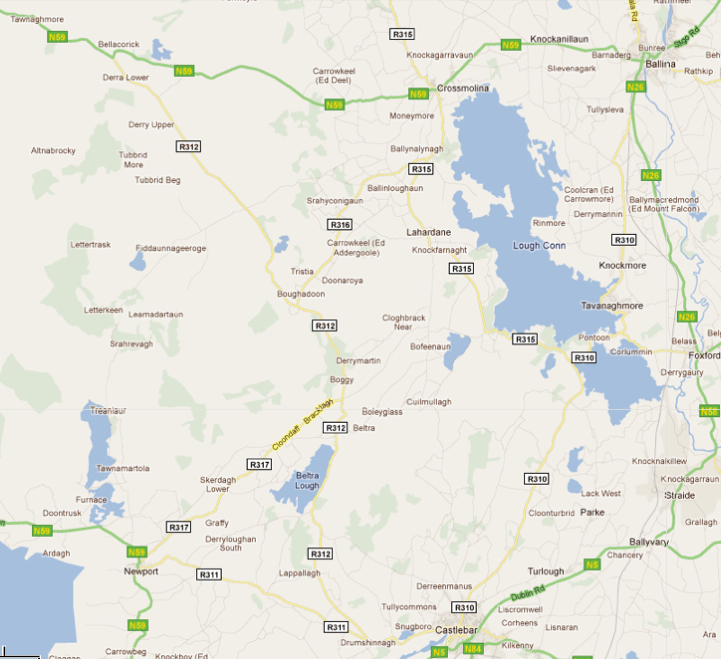
• The one place we avoided a rural route where perhaps we shouldn’t have was some 30 km outside Carne, after our game there. We were headed dead east to Ballina and then took a right turn south to Castlebar, where we planned to pick up good road to Galway, then Limerick, around the River Shannon to Killarney. We had a chance to turn right and angle our way down to Castlebar on the R312 — it was clearly more direct, but we’d have traded an N for an R. So I opted against it. We may never know if this saved or cost us time. It’s a decision that may well haunt me for the rest of my days.

Tralee: Canny Punctuation to an Irish Golf Smorgasbord
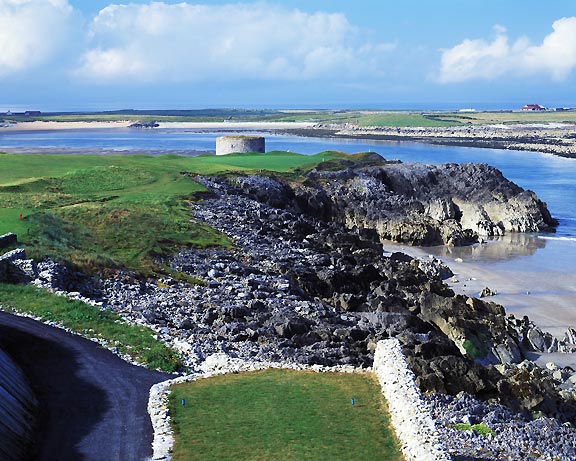
The crazy-good par-3 3rd at Tralee, from the lesser of two killer nines.

Tralee: Canny Punctuation to an Irish Golf Smorgasbord


The crazy good par-3 third at Tralee Golf Links. [photo courtesy of John & Jeannine Henebry]

The odyssey is complete, our nine-courses-in-nine-days schedule has been dispatched, and it’s all over but the ibuprofen withdrawals. Eight links, one parkland track. Three venues in the very north, four in the west of Ireland, and three more in the southwest. I arrived with a bag full of balls and 24 new ones in a box. I’m happy to report there are at least 18 left and, God be praised, I’m actually swinging the club better now than I was at the start. That’s not typical. I’ve been on plenty of long golf trips were things get bad, before they get worse, and there they stay, excruciatingly. But I tallied an 85 at Tralee today and it could have been 81 or 82. For me that’s something to blog about.

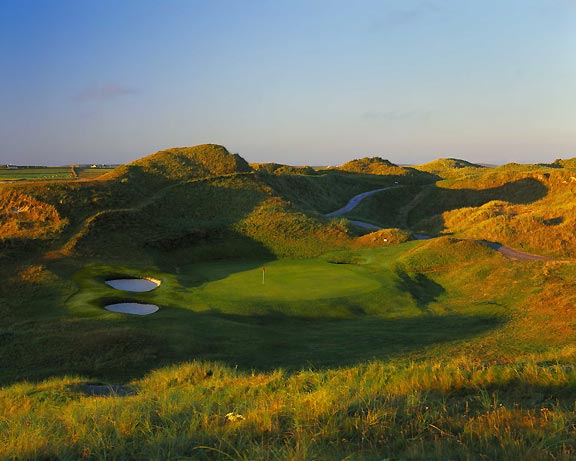
But I won’t. Tralee Golf Links, not my 85, is the story today, and what a grand golf course it is. The back nine is among the best loops of links golf you’ll find anywhere, and after the brutally long, quite tight 10th, 11th and 12th holes, this Tiger does something unique: It retracts his claws and treats the sojourner to six exquisite holes of only moderate length, as they snake up, over and around some massive dune formations.

Tralee is a bit different than many of the links courses I’ve played, on this trip and previously. As indicated, it finishes very reasonably with two short par-4s, a par-3 and a short par-5 (no. 18). It’s nowhere near Tralee town; just a few houses are scattered about the hillside nearby. It sits way out on a point, surrounded by huge tidal lagoons and an estuary or two. The feeling of isolation would be total, if you weren’t looking down off tees over long beaches dotted with families, dogs, etc. When we walked back to the 14th tee, serving a magnificent 300-yard uphill par-4, we noticed a jet ski peeling its way out of a lagoon to our right, headed for more open water. Would’ve made a fine video… sorry we didn’t act quickly enough.

One of our colleagues at Failte Ireland, the estimable Michelle McGreevy, says that the back nine at Tralee is her favorite loop in the country. As a senior tourism official, that means something. As a former Irish Girls Champion who plays off 1, that means a little more. She’ll get no argument from this quarter. Tralee’s front nine is perhaps as beautiful — it skirts massive cliffs before looping back beside another lagoon, across which sit the ruins of some ancient castle — but the back nine is worth the trip on its own.

It was a helluva way to punctuate ours.


Of Blackthorns and Pro-Ams: Three Days in Killarney
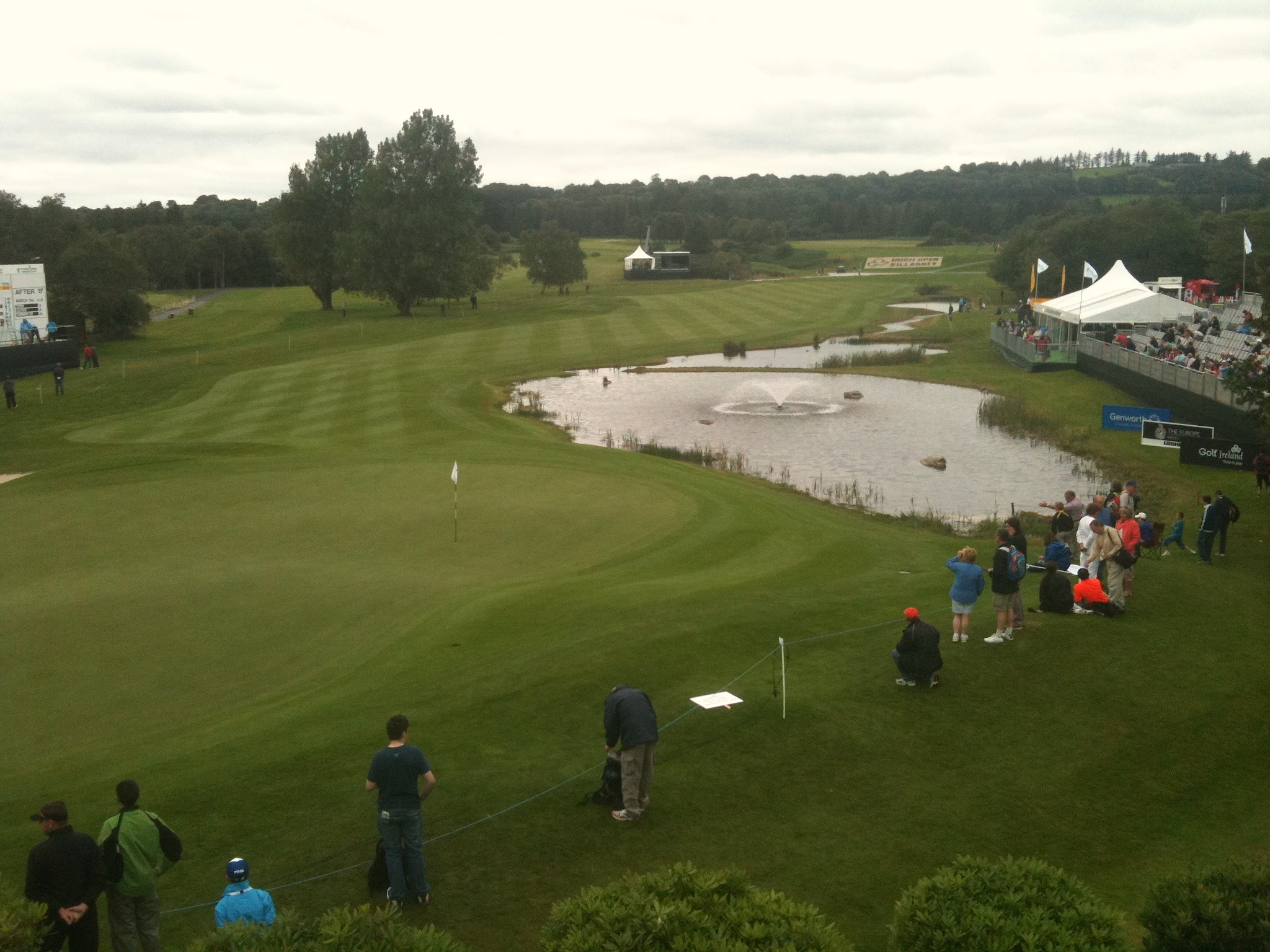
The 18th at Killarney Golf & Fishing Club, site of the 2011 Irish Open

Of Blackthorns and Pro-Ams: Three Days in Killarney

The 18th at Killarney Golf & Fishing Club, site of the 2011 Irish Open

After five manic days on the road, wielding golf clubs in Ireland’s furthest northern and western reaches, we have come to rest in the Killarney, Cill Airne, meaning “church of sloes”. (What’s a sloe, you might well ask? It’s a blackthorn). This is County Kerry, in the southwest, and here we’ve continued our Golf Road Warrior mission whilst de-emphasizing the road part. We’re based here for the next few days, in this charming town 20,000, to complement the media corps covering the Irish Open and play the region’s top tracks.

Day 1 was Ballybunion. Day II, Wednesday 27 July, was the pro-am here at the sterling, Killarney Golf & Fishing Club. Tomorrow, Day III, my penultimate day in Eire, we head back to the links, at Tralee.

It was a brutal 5-hour drive to Killarney from Carne, but if you’re going to put down temporary roots somewhere, you could do a lot worse than Killarney. Like Tralee, the home base for my father, brother and I when we last visited SW Ireland, in 2008, Killarney is a lovely, walkable, vibrant town full of restaurants, pubs and high streets awash in colorfully painted signs and facades. Killarney comes off as even more alive, this week, as it’s fairly well bursting at the seams with Irish Open enthusiasts. The pride of Irish golf fans is bursting, too. They have come from all points to see their four major heroes — Paddy Harrington, Darren Clarke, Rory McIlroy and Graeme McDowell — in action.

Pro-Am day was also free admission day, so the crowds were quite substantial. I’m not used to playing in front of a gallery, but I can report that no one was hurt. Indeed, I treated them to my typically dazzling shot-making, when I wasn’t mixing in self-loathing mutters, three-jacks, and high, peeling slices into the pro-style rough. I was essentially useless to my team, but no one seemed particularly pleased with the way they played, either, and fun was had by all. Chris Wood was our pro. You might remember him for having finished 3rd, as an amateur, at the 2009 Open at Turnberry. I can tell you, having viewed him up close over the course of 5-plus hours, that he’s quite tall, resembles an oversized Dale Earnhardt Jr., hits the ball a bleedin’ mile, and comes off as a genuinely nice lad. I’m rooting for him this week, though as I sit here in the media centre, I see on the big board that he’s 3-over through his first 11 holes. He’ll need to pick things up to make the cut.

Robin Lopez

At first blush, it might seem odd that an Irish Open would be played over a parkland track like Killarney. This is Ireland, after all, home to so many stunning links. But, as we’ve learned, many of those links are stupendously remote, while others don’t have the facilities to handle the huge crowds. With the exception of Dublin, there are more hotel beds in Killarney than in any other Irish city. That would include, I presume, the 14 rooms at Killeen House, a B&B where we dined in admirable style and substance our second night here.

Dale Earnhardt Jr.

English pro Chris Wood

Our group is about 11 media strong, and the Killeen had us at a long table occupying half of a private room. After our appetizers arrived, the other party arrived: 12 dudes on golfing holiday from St. Louis. We recognized them immediately from Ballybunion earlier that day — these were the guys whooping it up on the clubhouse balcony when were putting out on 18. We had seen them at Carne, as well. They were soused at Ballybunion 2 hours prior, so they were predictably boisterous and even more lit by the time they sat down for dinner. Ah, the joys of being an American abroad…

Thankfully, we took our desert in the bar, where the spirits flowed with more decorum and the walls are bedecked in golf balls (the barman here will readily trade you a logoed ball for a pint). The sun was all the way down when we stepped outside. It was quiet and still, and the gloaming made our deep green surroundings that much deeper. A thunder clap of laughter, surely emanating from our original dining room, breaks the silence and continues — ebbing and flowing but remaining constant — for a minute or more until, again, it’s quiet and all we can hear as we approach our bus is the muted crunch of gravel beneath our feet.

The gloaming descends on Killeen House, home to the superb Rozzers’ Restaurant.


How the Irish and Ireland inform their golf
A quiet Sunday morning on the Diamond in Donegal Town. That's the road south, to Sligo.

How the Irish and Ireland inform their golf

A quiet Sunday morning on the Diamond in Donegal Town. That’s the road south, to Sligo.

Sitting on a park bench this Sunday morning in the Diamond, the central square area of Donegal Town. The Road Warriors straggled back here, battered and bruised, late last night between rounds at Donegal Golf Club and Enniscrone. What we found upon checking into the splendid Abbey Hotel was a major league party underway, in our hotel bar/disco, and in every hotel and bar surrounding the Diamond. Saturday night in Donegal is no joke, and it wasn’t just the gaggle of young things strutting about. This was clearly a cross-generational night out. When I checked into my room, I shared an elevator with a 50something couple and another woman who had broken the heel off one of her 60s-era, black, Nancy Sinatra-style, go-go boots. The three of them were literally falling all over themselves in hysterical laughter at what had happened, and they wanted me to join in. When I crashed last night, sometime around 3 a.m., there was still plenty of laughter emanating from the Diamond.

It’s morning now, close to noon actually, and it’s quieter here in the square. A motorcycle club has gathered here on the stone plaza, but their comings and goings are the only break in the quiet remove of a Sunday morning after. You may think I’m crazy, but I believe I hear some Irish pan flute in the distance. Honestly. Some business establishment must be piping it in. I listen to the familiar chug of diesel engines (they predominate here) as lines of slow traffic putter by me. The three main roads all meet on this one spot, heading off south to Sligo, north Letterkenny and west to Killybegs. Nothing here in the square is made of wood. It’s all stone masonry, businesses on the first floor, resident apartments on top. People are out and about and the pubs are open for business.

I’m from Boston, so I’m used to the way Irish towns are laid out (i.e. around a square or town green — these forms of public architecture were imported directly to New England from the old country), and I’m used to the Irish. Growing up, I just assumed (up to a point) that everyone in America but me was Irish and Catholic. Everyone had relatives back in Ireland, just as everyone here has kin in the states.

The difference is (aside from the presence of a proper castle, Donegal Castle, just off the square), the Irish in Ireland are all too happy to chat you up about their relatives, where they live, where you live, what sort of trip you’re doing, have we played Sligo, there’s a pub round the corner you must try, and let me buy you a pint. The American Irish are nice enough; no more or less congenial than me, or any other immigrant population in the U.S., which is to say all of us. But the indigenous Irish are off-the-charts friendly.

Oftentimes the Scots and Irish people are compared, as the links courses in Scotland and Ireland are often compared. There is, I think, an austerity to life in Scotland, to the golf they play, to the courses they play, to their outlook on life. It’s nothing cold or perverse, but there is a reserve, a near asceticism to the people, culture and the courses. I love it there, but when you think of the Scottish links you’ve played, do you think green?

Well, this ain’t the Emerald Isle for nothing, people. It’s green and lush. The outlook is sunny, even if the weather isn’t always. Ireland and the Irish don’t do asceticism. They are, in contrast, generally garrulous and outgoing. Their golf courses run the gamut, naturally, but they generally reflect their keepers: they are greener, the dunes are bigger and more dramatic, the welcome in the clubhouse more genuine than those you find across the Irish Sea. Handsome is as handsome does.

Donegal Castle is just a stone’s throw from the town center, better known as The Diamond.


Ballybunion, Enniscrone and Carne: Discuss
The 16th at Carne GC, in the remote west Ireland town of Bellmullet

Ballybunion, Enniscrone and Carne: Discuss


The 16th at Carne GC, in the remote west Ireland town of Bellmullet. [photo courtesy of John and Jeannine Henebry]

About 50 minutes outside of Bellmullet, bearing down on Ballina, headed east so that we might eventually tack south to Castlebar, Galway, Limerick and Killarney, it registered with me that we were playing Ballybunion the next day. So I was thinking, “How many links golf courses are rated higher than Ballybunion, I mean, in the whole freakin’ world?” Now, ratings are nothing if not subjective, and, as a member of the GOLF Magazine panel since 1997, I am party to that subjectivity. Nevertheless, if you refer to the GOLF list, only the Old Course at St. Andrews, Muirfield, and Royal County Down, Royal Dornoch, Royal Portrush, Turnberry, and Pacific Dunes are more highly rated. Sand Hills? I just don’t think of that as a links.

This would normally be the fodder for yet another pedantic ratings discussion, and I have played Ballybunion before. But as we made our my way down the N56, it occurred to me that I’d be playing it this time having played 7 stellar links courses in the space of 5 days, including one that I’d have a hard time placing behind any links course we’ve mentioned here, so far.

Much as I enjoyed the two courses at Ballyliffin, the Sandy Hills course at Rosapenna, Narin & Portnoo and Donegal, they are simply not in Ballybunion’s class. But Enniscrone is, and it’s interesting to compare the two, having played them both in the space of 48 hours. Both routings spend considerable time NOT weaving their ways through the deep hollows of giant dunes corridors. This is to their credit. Links that spend all their time in there are too intense, too difficult, too funky. You need a break, and there’s nothing wrong with wrapping holes around the perimeter of a dunes complex, or routing an open fairway to a green that sits in a dunesy amphitheater. Both Enniscrone and Ballybunion serve up this sort of thing, in spades.

So, what does Ballybunion have that Enniscrone doesn’t? Or what is it about Enniscrone that keeps it from these lofty heights? Is it, as my colleague put it, simple inertia on the part of the scum-sucking media? It could be that. But here are some alternate theories.

1)    Ballybunion is older and more accessible, meaning that more people have played it over the course of more years. Enniscrone is way out there in County Sligo, hours from Galway and even further from Dublin, Limerick, Belfast or any sort of hub. It’s remote, and unless you’re course was designed by Ben Crenshaw, or developed by Mike Keiser, these types of remote courses don’t get the same sort of attention.

2)    Ballybunion is, I would say, 2.5 shots easier per side than Enniscrone. Now, this can depend a lot on conditions the day you play. But we played the two on very similar sun-splashed days in similar 15 mph winds, maximum. Enniscrone kicked my ass and kicked the ass of everyone in our group. Today, at Ballybunion, I shot 85, best score of the trip. Ditto for the others. Bottom line, it’s a feel good course. I don’t want to call it a “resort” course, where the design is intended to please first-time/only time players. It’s far more quirky and too flat out awesome for that. But the landings areas are more broad, the rough not so thick, the twists and turns not so confounding for visitors.

You know, I was going to just list these reasons one after another, as to why Ballybunion is ranked higher than Enniscrone, but I’ve run out of ammo at two. Beyond that, it’s sorta hard to make the argument. So I’ll stop.

Now, Carne is another matter. There are some who feel this is among the world’s great links, and I’ve decided they’ve got a point. It’s more raw than Enniscrone, not in the same sort of condition, and we played it in a dank mist. My feet were soaked by the third hole (too much walking around searching for balls in the heavy, wet rough) and I lost several golf balls. It’s hard to separate these factors from one’s perception, especially re. a one-time golf experience. Carne goes out into the dunes and never really ducks out for a breather, but I’ve just gone through the course again in my mind, on the card, in the par-saver book, in the pictures and videos we’ve gathered. It’s extremely tough, crazy penal in spots, but it’s the equal of Ballybunion, as well.

So there. I’ve said it.

Old Links vs. New Links: Viva la difference
The 17th at Donegal GC

Old Links vs. New Links: Viva la difference


The 17th, a broad and beautiful par-5, at Donegal Golf Club.


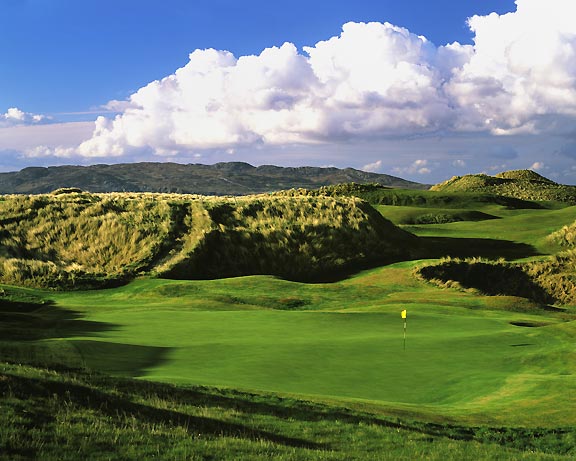
The assumption is that all the links courses here in northwest Ireland are “ancient”, but that’s not the case. Donegal Golf Club, also known as Murvagh, was built in the 1970s, though you’d never guess it.

We’ve played two even newer links on this trip, the Sandy Hill track at Rosapenna, and the Glashedy Links at Ballyliffin GC. Both courses are superb but severe, built amid the big dunes slightly inland from the older courses at both venues, on land Old Tom Morris (who did the original course at Rosapenna) would never have dreamed of using. I’ve written elsewhere that many of these new links suffer from agronomic issues: The rough is too thick, has not been burned off appropriately over the course of decades, and doesn’t generally have that wispy-penal-but-you’ll-find-it quality. But there’s more to it. Back in the day, Old Tom and his like didn’t have the technology to carve holes from terrain like this — so they wisely fashioned subtle holes amid the gentler topography closer to the ocean.

These new links are more dramatic but, as you might imagine, much tougher, too; the locals, who have the option to play either course at both Ballyliffin and Rosapenna, invariably choose the older courses, the staffs inform us. Sensible.

In any case, despite its relative youth, Murvagh has that ‘old course’ feel. The front nine circles around the perimeter of the property — an estuary dotted with dunes — while the back nine forms a separate central loop. Returning nines is perhaps a sign of its recent design, but what a golf course. Old Tom would have approved.