
Category Archives

65 Articles
Of Hillsborough, Heysel & Stamford Bridge: Backstories amplify documentary of tragedy

Of Hillsborough, Heysel & Stamford Bridge: Backstories amplify documentary of tragedy

Hillsborough1_2880476b

This post was excerpted and adapted from, Generation Zero: Founding Fathers, Hidden Histories & The Making of Soccer in America (Dickinson-Moses Press, 2022).

In joining the wide chorus of praise for director Daniel Gordon’s superb “30 for 30” documentary on the Hillsborough soccer disaster, we should be reminded of two things: First, the state of British football fandom in the mid- to late-1980s was legitimately menacing and pervasive; and second, the 1985 Heysel Stadium disaster, where 39 died in a similar crush of humanity, should hang over the Hillsborough proceedings with a pall all its own.

That Gordon never found space in his film for Heysel, nor Britain’s genuine and warranted cultural worry over hooliganism (and Liverpool’s connection thereto) is somewhat startling.

Gordon was clearly at pains to accentuate the unfair and, some would argue, criminal treatment that Liverpool fans received in the wake of Hillsborough. It’s a fair and important point, and the facts here have been too long obscured. However, the context Gordon seeks — namely, that Liverpool’s reputation for hooligan behavior contributed to the way the disaster was investigated — surely cannot be summoned without a discussion of Heysel, which colored everything that came afterward and certainly fixed uncomfortable attention on a club and fan base that played central roles in both tragedies.

Liverpool FC was indeed front and center on May 29, 1985, when the Reds met Juventus of Turin in the European Cup Final, forebear to today’s Champions League Final. Thirty-nine predominantly Italian fans perished that night in Brussels, where Liverpool fans stormed a purportedly neutral area inside the gates but outside the stadium itself. Juventus supporters fled the threat, into the stadium, toward a concrete retaining wall. Fans already seated there were crushed by the onslaught of humanity — then the wall collapsed.

Unlike the Hillsborough narrative, very little of the above account is disputed, by Liverpool supporters or anyone else. Six hundred more were injured at Heysel that night and, as a result, English clubs were banned from all European competitions for five years. Liverpool was banned for 10, but was allowed back after 7 years served.

Gordon makes the important point that, rightly or wrongly, the fear of untoward supporter behavior tragically influenced police actions before, during and after the tragic 1989 FA Cup semifinal. The presumption that drunken fan violence had played a role ultimately moved the English Football Association (FA) to an appalling continuum of cynical posturing. That same presumption influenced media coverage of the event for years to come.

As such, it’s vital to understand the climate in which that semifinal, and so many other matches were routinely played during this period.

The police, the FA and the media behaved abominably post-Hillsborough. Full stop.

However, they were not behaving in a vacuum. The mid- to late-1980s were rife with soccer hooliganism. I was there, in London, for most of 1984-85 season. No one should require my eyewitness accounts, gathered from four separate city grounds, but serious alcohol consumption routinely played a role in the violence.

And yet Gordon touches on this broader cultural phenomenon very little.

Hey, it’s a big subject — probably too big to address fully/fairly in a 120-minute documentary on Hillsborough. But again, methinks Gordon soft-pedaled it because undo context here would tend to explain, if not justify, the behavior/presumptions of police, the FA and media in relation to Hillsborough.

Gordon does make it clear that police, the FA and England’s tabloid culture took this fear of hooliganism — born of Heysel and myriad other incidents involving dozens of clubs — and manipulated it in disgraceful fashion. However, menacing fan behavior was no figment of the FA’s nor Rupert Murdoch’s imagination.

It was all too real and totally out of control in many cases, as I witnessed first hand.

•••

It can be argued that the spring of 1985 represented the nadir of British football hooliganism, as Heysel had not yet gone down and English supporters still traveled to away grounds, foreign and domestic, with impunity. As it happened, this low point coincided with the semester I spent at the University of London, on loan, as it were, from my American college. I traveled all over the city that winter and spring, taking in a dozen matches at three separate grounds.

My maiden voyage, however, would prove the ultimate eye-opener.

I had two English roommates at the Westfield College, University of London; both were rugby fans and sarcastically dismissed football as a meaningless diversion for working class oiks. Accordingly, when Barry — a fellow American and Sheffield Wednesday fan (thanks to several summers spent in South Yorkshire with his cousins) — suggested we and I take in the Chelsea-Wednesday match one early February night at Stamford Bridge, I didn’t even mention it to my roommates. Off Barry and I went.

The word “hooligan” has always been loaded with questionable motivation, but there is no doubt that English soccer in the mid-1980s was then developing, in earnest, its notorious reputation for what has since become known, in a blanket fashion, as “hooliganism”, whereby traveling supporters of certain clubs would clash with home-standing counterparts before, during and after matches in miniature manifestations of England’s particular brand of xenophobia. People always harp upon English hatred of the French, and they do hate them (who wouldn’t). But in truth, the English aren’t particularly fond of anyone in Europe. Indeed, people from the South of England belittle people from the North, and vice versa; residents of Shropshire deride their neighbors in Worcestershire, and vice versa; even neighboring towns have managed to work up healthy mutual hatreds over the course of centuries.

As a consequence, “support” for football clubs routinely takes on a tribal, fever pitch (to borrow a phrase) the likes of which we really cannot imagine here in the States. There is no cultural equivalent that even begins to fit.

The year before, after Liverpool had defeated Roma in the 1984 European Cup Final, bands of Italian toughs on scooters had apparently attacked celebrating British fans as they danced in the Eternal City’s many fountains. Hit and run, or hit and scoot, apparently. This sort of behavior didn’t sit well with the English, as it probably wouldn’t with anyone. A year later, at Heysel, it was payback time.

Yet fan violence wasn’t reserved for internationals. English fans — not all fans, but relatively small subgroups of young toughs — routinely practiced their sordid craft at domestic matches, where rivalries were arguably more heated. Familiarity and contempt, don’t you know. This was the backdrop, only a few months pre-Heysel, as Barry and I left Westfield College, in the north London borough of Hampstead, for south London.

The tableau in and around Stamford Bridge that night was truly surreal. We came up and out of the Fulham Broadway Tube station and immediately walked past a pub that had been thoroughly gutted, all its windows shattered following a punch-up late that afternoon apparently; police and angry masses milled about everywhere.

Picture the scene from Apocalypse Now where Martin Sheen and the boys reach that bridge, the one a few clicks beyond which lies Cambodia and certain peril, the one eerily bejeweled with hanging lights and flairs, where a night-time firefight rages and chaos reigns. I love that scene, and that’s what it was like in and around Stamford Bridge that night, minus (ironically) the illuminated bridge. It was an atmosphere only enhanced by the fact that the river of supporters streaming toward the ground was continually fed by tributaries emanating from local pubs. Plus, I’d gotten well and duly stoned before leaving Hampstead. I was effectively channeling Timothy Bottom’s surfer dude character, Lance, who was transfixed but not effectively warned by the spectacle.

Following Barry’s lead we entered the stadium through a portal reserved for visiting fans alongside a gaggle of Wednesday supporters. The terrace (no seats) set aside for visitors at Stamford Bridge was located behind the North goal. To our left there was nothing — just a sunken access road, well below us, that led to the field. Indeed, 30 feet of open space separated us from the main stand along the touchline.

To our right was an unoccupied terrace guarded on either side by 15-foot, wrought-iron fencing punctuated at foot-long intervals by sharp spikes. Beyond that was the remainder of Stamford Bridge’s North Terrace, occupied by thousands of Chelsea fans, clearly hammered and beside themselves with venom, all of it aimed at — us.

I had been utterly naïve about this excursion. I would soon learn what I should have known beforehand — what my roommates would have readily told me — namely, that Chelsea supporters, back then anyway, were among the “hardest” and most hostile in London, rivaled only by Millwall’s and West Ham’s. Put the money of Russian oligarch ownership out of your mind. This was not the posh club it is today. Chelsea was a hardscrabble, working class club in 1985, with fans to match.

Today, as home to one of the world football’s richest clubs, Stamford Bridge is a jewel (I’ve heard some older fans deride it as a bleedin’ galleria). In 1985, it was no such thing. Picture a dingy, no-frills ground very much like the Hillsborough we see in Gordon’s documentary.

•••

Inside the ground, the Wednesday fans (along with at least one woefully underprepared, somewhat stoned Yank), occupied a pen current observers might also recognize from the “Hillsborough” documentary. No seats. Completely enclosed. But that February evening in 1985, we were but a few hundred traveling supporters from Sheffield. There was no crush of fans clamoring to enter all at once. There was plenty of room to move about freely, though we instead huddled together — to guard against the cold and various projectiles.

From the outset and this considerable distance — the full width of the open terrace, maybe 25 yards — the Chelsea faithful pelted us with AAA batteries and pound coins. However, to be honest, it wasn’t all that threatening. It was a bit of a laugh at that stage. What a good and practical idea, I remember thinking, to leave that section open, as a buffer.

The game? Well, at times it seemed almost secondary to our homestanding neighbors a section removed. Chelsea scored first, through Kerry Dixon, and Sheffield managed to equalize just before halftime.

About then, to our horror, the empty section that separated the home crowd from ours was opened up, practical caution apparently giving way to the reality of ticket sales.

What ensued was a jailbreak. There’s no other way to describe it, and it lends insight to the rush/crush of fans that took place at Heysel and Hillsborough. The Chelsea throng poured over (!) and around this huge, spear-tipped fence like a horde of rabid 11th century Danes, and made a beeline for the lone wrought-iron barrier now separating us. Soon they were pressed up against it, screaming obscenities and taunting us, their arms reaching through the fence like desperate, famished prisoners. We all instinctively moved away from the fence, gathering at the far edge of the terrace and pulling our jackets up around our heads so as not to take a AAA in the ear. Let me tell you: It was fucking scary. I remember turning to Barry and saying, “I should NOT have gotten stoned.”

This was not some frenzied spasm of menace that faded with time. The Chelsea fans were on us the whole time, the entire second half, bombarding us with all manner of pocket-sized ammo. Thank god no human could spit that far.

There was no police presence in the terrace, only a smattering along the access/egress concourse that ran along the back of all three sections, behind the north goal. While the Chelsea horde had scaled one wrought-iron fence, an identical fence continued to separate them from us. The only thing stopping them from invading our space was, well… I don’t know. The fact that police were watching from above and perhaps an obscure, deep-seated tenet of British restraint?

Fortunately Chelsea scored in the final 10 minutes to secure a 2-1 victory. I don’t want to think about how things might have played out if Wednesday leveled things, or managed to win the game. As a player myself (at the time), I remember considering the prospect later that night: Did the Wednesday players, for example, recognize what victory might mean for the 800 or so supporters who’ve traveled down from Sheffield? Can one try to win with all the same commitment, knowing that a goal or victory — or perhaps a goal celebration taken a bit too far — might well bring a battery down on someone’s head, to say nothing of what might happen afterwards, outside the stadium?

Today, in the more refined Premiership era, visiting players score and make beelines to visiting fan sections, where much fist pumping and bellowing is enjoyed by the merry bands of traveling supporters. English football comportment was generally far less exhibitionist during the 1980s (so few of the games were televised). But visiting goal celebrations were relatively muted, in part, so as not to put traveling supporters in unnecessary danger inside and outside the ground.

As it was, when the final whistle blew and the referee pointed to the spot, the home supporters spent a few minutes hugging each other and chanting before they turned back to us and emptied their pockets one last time.

The trip out of the stadium was more frightening still. We Wednesday supporters exited first — and now there were several dozen policemen to help us execute this delicate task. The entire stadium was sealed but for our Bobby-lined egress route, which, of course, passed right behind our neighboring terrace, where the horde reached out to us one last time through the fence. They let us have it again, but I didn’t see any of this spectacle. I had my coat up over my head.

Outside the stadium there were two long lines of police on horseback; we walked between them the three city blocks back to the Tube station, where a special train was waiting for us. We piled on, the doors closed, and, as we slowly pulled away, a group of Chelsea fans burst down onto the platform, half of them singing “We love you Chelsea/Oh yes we do-oo…”, while the other half reiterated the epithets to which we had become accustomed inside the Bridge.

The context is important: Wednesday was and remains no particular rival of Chelsea’s. This was a run-of-the-mill, February match between a pair of mid-table sides, with nothing special to play for. And yet the atmosphere between the two sets of supporters was dire — and routine. That everyday menace like this, and incidents like Heysel, did nothing to move the FA toward meaningful institutional reform and stadium renovation, is a bit mystifying 30 years on. That it took Hillsborough to make that happen, finally, is tragic.

Back at Westfield, just off the Finchley Road, I found my roommates at home and started to regale them with tales of my nerve-rattling introduction to top-flight English football. Yet I’d hardly begun when Trevor interrupted. “Hang on, mate. You sat with the away supporters?” As indicated, Trev was no football fan back then, but he knew enough to throw a disbelieving glance at Adrian, before turning back to me. “That was fucking stupid.”

Mexico-NZ Presents Complicated Rooting Interests for US Soccer Fans

Mexico-NZ Presents Complicated Rooting Interests for US Soccer Fans

usa-mexico

An American friend will be seated in Azteca today when the Mexicans face New Zealand in the first leg of a home-and-home World Cup qualifier. Earlier this week, he and I exchanged the obligatory musings about bringing along some rain gear, or at least a wide-brimmed hat, to guard against flying bags of urine — especially once he revealed that he’d be rooting for the Kiwis. All well and good to be so declaratively brave in a Facebook exchange; we’ll see how overtly manifest his support will be when the whistle blows.

There are, of course, myriad dramas swirling around the Mexican capital today, as El Tri desperately attempt to punch their tickets to Brazil and quell a national anxiety that has raged for months. Our neighbors to the south stumbled badly throughout CONCACAF’s Hexagonal qualifiers. The security blanket of Stadio Azteca — a place where Mexicans had, until this summer, lost only one time in World Cup qualifying history — has been shredded. They’ve gone through three coaches in three months. Mexicans view World Cup qualification as a birthright, but were it not for the Americans’ last minute victory over Panama in the final qualifier, El Tri would have already been eliminated.

But my friend’s decision to go south and root for the Kiwis begs a more nuanced, decidedly North American question: Should U.S. soccer fans be rooting for the Mexicans today, and next week, when the second leg is played in Auckland?

Yes, the Mexicans are our most bitter regional rivals. But they also represent our confederation, and their failure to qualify would diminish CONCACAF, perhaps diminish the region’s automatic qualifying places for the 2018 World Cup, and certainly diminish this summer’s tournament.

It’s hard not to admire the Kiwis and their grit: They were the only undefeated team in South Africa 2010, grinding out three desultory draws. But the Mexicans — with their hordes of traveling fans, attractive style, outsized national expectations, and seeming inability to play for desultory, low-scoring results — would be the clear choice of neutrals the world over.

But are we, as U.S. soccer supporters, neutrals? Just what are our obligations here?

These questions cannot be soberly addressed without first considering how Mexican fans might react were the roles reversed, for they are anything but neutral on the subject of U.S. soccer.

Let’s boil it down: They hate us.

There is indeed no nuance here for the Mexicans. For 24 hours, perhaps they appreciated the fact that our win in Panama — actually, a tie would have done it — saved their bacon, enabling this last-ditch qualifying opportunity vs. New Zealand. But they don’t give a damn about the confederation or its reputation: If the roles were reversed, the Mexicans would be rooting for New Zealand.

The U.S.-Mexico rivalry is completely unique in this respect: I can’t think of another example where the vitriol is so one-sided. They don’t see the rise of U.S. soccer these last two decades as a boost for CONCACAF, or a means to better prepare their own teams for World Cup performance — an issue of longstanding for the Mexicans, frankly, coming as they do from such a notoriously weak confederation. They don’t see a true rival here in North America as remotely interesting or worthwhile. They don’t see the positive impact of Mexican-Americans — on U.S. rosters, on our style of play — as an ego-boosting reflection of their own soccer prowess.

Mexicans see the rise of U.S. soccer as an affront.

El Tri have even gotten in the habit of playing friendly internationals in the U.S., where huge numbers of expatriates guarantee a sellout — and max revenue for the Mexican Football Federation. For fans of the national team living in Mexico (which is to say, the entire country), this is viewed as yet another indignity.

Soccer is one of the few things Mexicans have always been able to lord over their rich, voracious, imperialist neighbors to the north: tequila, daytime soaps, proper tortillas and futbol. These are people who still revile Landon Donovan for discreetly taking a pre-game piss on a Guadalajara field — 9 years ago. In a youth tournament! They viewed it, and continue to view it, all these years later, as a willful desecration of Mexican soil.

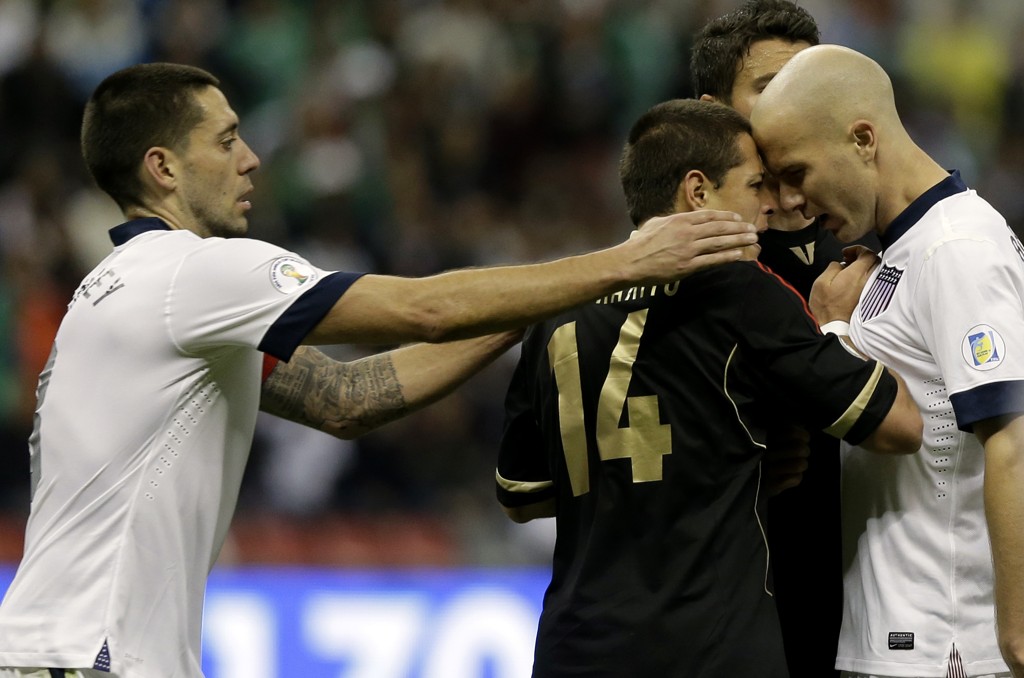
Mexican fans wish us ill, and this broad, cultural dynamic clearly spills over to the players themselves, who understand they are expected to win against the Yanquis, and win big. Failure to do so will subject them to ongoing, perhaps lifelong harassment from their own fans and media. It might cost a coach his job or a player his place in the national team.

There is no real pressure for the U.S. team to perform against Mexico. There is no day-to-day job security at stake, no broad ramifications. Soccer doesn’t yet mean that much to Americans, culturally. That’s not the case for Mexico. In fact, it’s just the opposite.

Watch the Mexican players the next time they face the Americans. After the national anthems, when they make their way down the line — shaking hands as part of the FIFA-mandated, pre-game ritual — there are no smiles and niceties exchanged, not from the Mexicans. They are stoned faced because their compatriots are watching them, ready to pounce on idle chumminess. Observe them after the game ends. If the Mexicans should lose, many pointedly refuse to shake their opponents’ hands. This is very bad form according to the etiquette of international futbol especially. But they know what’s at stake. They can’t afford to be palzy-walzy with the Yanquis — Mexican fans and media would not stand for it.

In fact, should a Mexican player present an American opponent with a truly cheap shot — like the time Ramon Ramirez kicked Alexi Lalas in the balls, in 1997, or when assistant coach Paco Ramirez bitch-slapped Frankie Hedjuk after the Americans eliminated Mexico from the 2002 World Cup — he is hailed as a kind of hero.

I’m torn on this subject, because the U.S.-Mexico rivalry is littered with this sort of bullshit behavior from the Mexicans. But I understand their emotional response, even if I don’t respect it. They’re toting baggage that I legitimately cannot imagine.

Indeed, I find myself rooting for the Mexicans when they’re not playing the U.S., in the same way I will surely root for the Hondurans this summer in Brazil.  They are North Americans, after all. They carry the banner for soccer in this part of the world. They play with flair, to win. The Mexicans in particular truly do add something to a big tournament, in a way that New Zealand never could.

So, my friend is on his own down there in Mexico City today, as I — and the 100,000 on hand in Stadio Azteca — will be rooting for El Tri over this two-legged qualifier. And part of the reason is, I know this sort of behavior will confound and piss off our Mexicans brothers all the more.

Bruins-Rangers: A Curious Rivalry Renewed

Bruins-Rangers: A Curious Rivalry Renewed

ratelle

The Boston-New York sporting rivalry, one-sided though it often is (Hub fans invariably care more about beating anything NYC than the other way around), has traditionally taken a backseat on ice. Still, it beggars belief that Bruins v. Rangers — a battle of Original Sixers separated by just 200 miles — has become such a non-entity, largely because the two combatants have not played a single playoff series since 1973, despite having always competed together in the Eastern Conference, or some randomly named facsimile thereof.

That streak ends Thursday night with Game 1 of the NHL’s Eastern Semifinals at the TD Banknorth Garden, and perhaps it will light a fire going forward. If nothing else, it will serve as a stirring flashback for hockey fans of my vintage who remember a time when this was a proper rivalry and home teams wore dark uniforms in their own barn — a practice that had long prevailed back in the day, was abandoned by the NHL in the mid-1970s, but has recently been restored.

The Bruins’ blood rivals are, of course, the Canadiens, whose decades-long torture of Boston peaked just as the Rangers rivalry fell away, in the late 1970s. Those Montreal teams were all-timers, star-studded winners of four straight Stanley Cups (1976-79). The B’s, though very good throughout the ‘70s, simply could not slay them. Even in their heyday, when they netted a pair of Cups, in 1970 and ‘72, the Bruins were never obliged to beat the Canadiens in a playoff series.

Montreal had many rivals during that period, and it only stoked Boston passions further that peut-être Les Canadiens didn’t care that much about beating the Bruins. Today, recent form and some incendiary incidents of thuggery have perhaps stirred in Montreal fans a hatred that matches that of Bruins Nation.

[Indeed, much of Canada has every right to loathe the current B’s following their organ-removing defeats of heavily favored Vancouver in the 2011 Stanley Cup Finals, and Monday’s unlikely Game 7 dispatch of Toronto’s Maple Leafs, in overtime — the Bruins had trailed 4-1, with just 10 minutes remaining. No Canada-based club has won the Cup since 1993, a fact that continues to gall hockey purists (read: 90 percent of the population) north of the border. Maybe derision of the current Bruins can be that one elusive thing all of Canada can agree upon…]

The Bruins of the early 1970s were not so villainous. They were Big and Bad, in an admirable way, and the Rangers — more of a finesse team, built on the refined skills of Rod Gilbert, Jean Ratelle, Brad Park and Vic Hadfield — proved compelling foils. Boston beat them to win the Cup in 1972. Their last playoff meeting was a Ranger victory, the 1973 conference semifinals. As a young Bostonian, I vividly remember resenting the Rangers for unseating the defending Cup champions, a loss that kicked off one of the most frustrating runs of near misses in hockey history. (Boston would lose the 1974 Cup final to Philly before dropping a dizzying succession of playoff series to Montreal, each one more gut-wrenching than the last.)

But any resentment of the Rangers didn’t last.

Terry O’Reilly and his crew famously went into the stands at Madison Square Garden to punch up some Rangers fans in December 1979, but the lack of playoff confrontation — who could imagine it would last fully four decades? — effectively defused the rivalry. The 1975 and 1976 trades that shipped Phil Esposito, Ken Hodge and Carol Vadnais to New York, in exchange for Ratelle, Park and “Nifty” Rick Middleton, further blurred the line between bitter enemy and mere foe.

Montreal became the fixation.

It’s funny how that works: The best rivalries become a sort of long-term competitive obsession, to the exclusion of teams that might well be torturing or otherwise beating you in the moment. Boston endured 39 years between titles (1972-2011), and in that seemingly interminable span they were beaten back by several great teams of longstanding: the Islanders of the early 1980s, Gretzky’s Edmonton Oilers… Yet we Bruins Fans never stopped hating on the Canadiens exclusively.

[Another great piece of nostalgia prompted by this year’s playoffs: the return of the Islanders after a long post-season absence. Just seeing their uniforms, admirably unchanged from the glory days, stirred strong memories of Bossy, Gillies, Trottier, Nystrom, Smith and Resch. The Nassau County Coliseum — scene of so many vintage Bruins telecasts delivered via rabbit ears and Channel 38 — remains impossibly small, dark and retro. Their current star, John Taveras, wears no. 91 and, for a brief moment during their first-round loss to the mighty Penguins, I mistook him for Butch Goring…]

The Rangers famously went 54 years without a Stanley Cup before winning one in 1994 (deploying a goodly number of former Oilers, it must be said), and I’ve no idea whether Ranger fans brought with them on that long and painful journey a particular rival, or developed one. Maybe, for a time, it was the Islanders. Maybe it has become the Washington Capitals, whom the Rangers seem to have faced, in the playoffs, every year for the last two decades (though it’s hard to develop a rivalry with a team that has never won anything, ever).

If it’s been the Bruins all along, I feel sorry for them, because we never really noticed.

Jordan Homecoming Recalls Rutgers Hoops Heyday

Jordan Homecoming Recalls Rutgers Hoops Heyday

Interesting confluence of events both personal and national last week when embattled Rutgers University — struggling to salvage its basketball cred prior to moving from Big East to Big “10” in 2014 — hired NBA veteran Eddie Jordan to replace head coach Mike Rice, who was jettisoned after video surfaced early in April showing him crassly berating and physically abusing his “student athletes”.

[We’ll leave aside for the moment the fact that Rutgers knew about Rice’s antics long before the video was made public. That’s just more run-of-the-mill, big-time-college-athletics sleaze, and honestly, what more is there to add?]

What interested me more was the return of Jordan to his alma mater, where he played in the mid-1970s as a cog in one of college basketball’s most unheralded great teams — and the fact that I learned of his homecoming while kipping in the Marin County home of my boyhood friend Tom Wadlington.

That Scarlet Knight team, which went unbeaten in 1975-76 before falling to Michigan, Ricky Green and Phil Hubbard in the national semifinals, was even more visible to me, as a budding, 12-year-old college hoops freak, on account of Tom’s arrival in my hometown just two years prior. Tom had moved to Wellesley, Mass., from New Brunswick, N.J., where his parents, if I’m not mistaken, had both worked at Rutgers. He showed up in my 4th grade class, and on my various soccer teams, spewing all sorts of Rutgers propaganda. Much of it was dismissed for what it was — the meaningless parochialism of some pre-teen interloper.

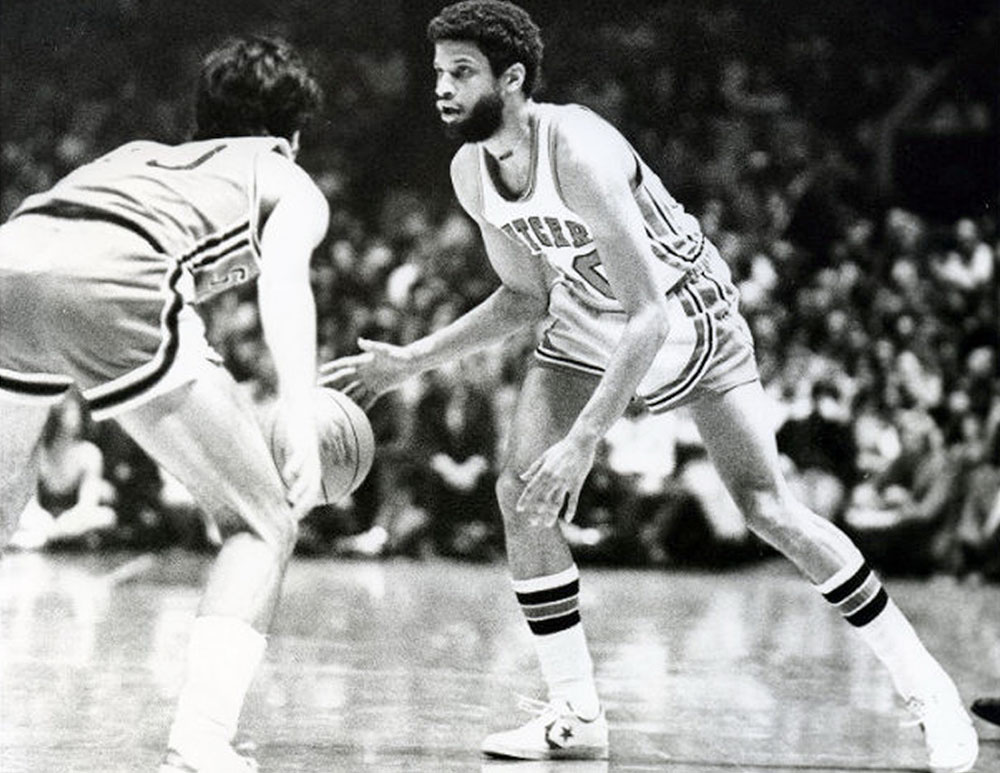
But then, midway through the ‘75-76 season, it was clear that on the college basketball front, at least, Wad was not talking shit. These guys were really good and would eventually run the table, win the East Regional and go to the Final Four (not yet so branded, I don’t believe). They did so with Jordan at the point, Mike Dabney at shooting guard, super-smooth Phil Sellers at small forward, “Hoppin” Hollis Copeland at the 4, and Boston-bred freshman “Jumpin” James Bailey at center.

I think we all remember Larry Bird’s Indiana State team that went unbeaten before losing to Magic & Michigan State in the 1979 NCAA Final. But the long history of college basketball is not exactly littered with teams that go unbeaten over the course of a regular season, much less progress untarnished all the way to the Final Four. UCLA did it repeatedly in winning so many titles under John Wooden, and Indiana went unbeaten start to finish the same year Rutgers came so close, in 1975-76. Other teams that have won titles while going undefeated include Bill Russell and KC Jones’ USF teams in 1955 and 56, North Carolina a year later, UCLA four times, and Indiana.

But it gets thin when you search for teams that remained unbeaten all the way to the Final Four, only to lose there. Once we account for Rutgers and Indiana State, I recall these:

• Indiana went unbeaten the year before its golden campaign, only to lose in the Midwest Regional final to Kentucky, 92-90, largely because  (Hoosiers will argue) star forward Scott May had broken his arm with 7 minutes to play.

• UNLV was 34-0 when it famously lost to Duke in the 1991 national semifinals.

I encourage anyone to set me straight, but I think that’s it: Seven teams went undefeated and won the title, only two more got to the Final Four unblemished.

Jordan has his work cut out for him in Jersey, to be sure. Maybe joining the Big “10” (I’m not sure how many teams are in that conference anymore, but it ain’t 10) will expand his recruiting territory, but Rice has seriously sullied Rutgers’ reputation and recruiting capability in the short term. And despite being located in the heart of a bountiful talent pool, Rutgers has never been that great or recruited many first-rate sons of Jersey (Roy Hinson tops a short list). The Scarlet Knights weren’t part of the original Big East, of course. They joined in 1995, and it could be argued, it didn’t benefit their basketball program a lick.

As for Tom Wadlington, he ultimately matriculated at Cal Berkeley and has since transferred all his propagandizing efforts (on behalf of collegiate athletics) to the Bears. But he did have this to say upon learning the news of Jordan’s hire: “He should bring Phil Sellers and Mike Dabney as assistants!”

Medinah’s Ryder Road Full of Stops, Starts, Remakes
One of the few things that hasn't changed at Medinah: Lake Kadijah, named for the

Medinah’s Ryder Road Full of Stops, Starts, Remakes

One of the few things that hasn’t changed at Medinah: Lake Kadijah, named for the first wife of the Prophet Muhammad, still represents the dominant hazard on several par-3s.

[Ed. This piece ran in GOLF Magazine during the summer of 1999. Its observations, while dated, remain damned prescient.]

Fitting for a golf course located a scant 15 miles from the nation’s busiest air field, in a city that serves as switching gate for half the country’s rail traffic, Medinah Country Club sits at the crossroads of those peculiar trends and politics that now swirl around major championship site selection. When the century’s final major — the 81st PGA Championship — is staged here at Medinah Aug. 9-15, players and spectators will reacquaint themselves with an undeniably classic golf course, a consensus top 25 layout that has nevertheless been repeatedly revamped, strategically elongated and fully leveraged to meet 21st century demands.

In an age when pre-major renovations have become routine, Medinah’s No. 3 course stands as one of the most-tinkered-with layouts in golf’s major championship rota; at 7,384 yards, it is without question the longest. Medinah is also one of several elite clubs which have agreed to host the PGA in order to get their hands on golf’s new commercial grail, The Ryder Cup Matches. As part of its agreement with the PGA of America, Medinah will host the coveted Ryder Cup in 2011 — by which time the club will have held this year’s PGA and another in 2006.

As we learned during this winter’s run-up to the Masters, and during all those periods preceding today’s major engagements, the game of golf and its attendant demands are continually evolving. Accordingly, our championship venues evolve, too. For better and ill, Medinah has come to embody much of what major championship venues have necessarily become in a world so frightfully concerned with licensing deals, technological advancement and the moans of frustrated competitors. Medinah’s ongoing story, which includes an honorable obsession with the ultimate concern (par), tells us a great deal about where golf has been and where it’s headed as the game enters its second millennium.

Read More

The HGP II Scorecard Series: A Final Accounting
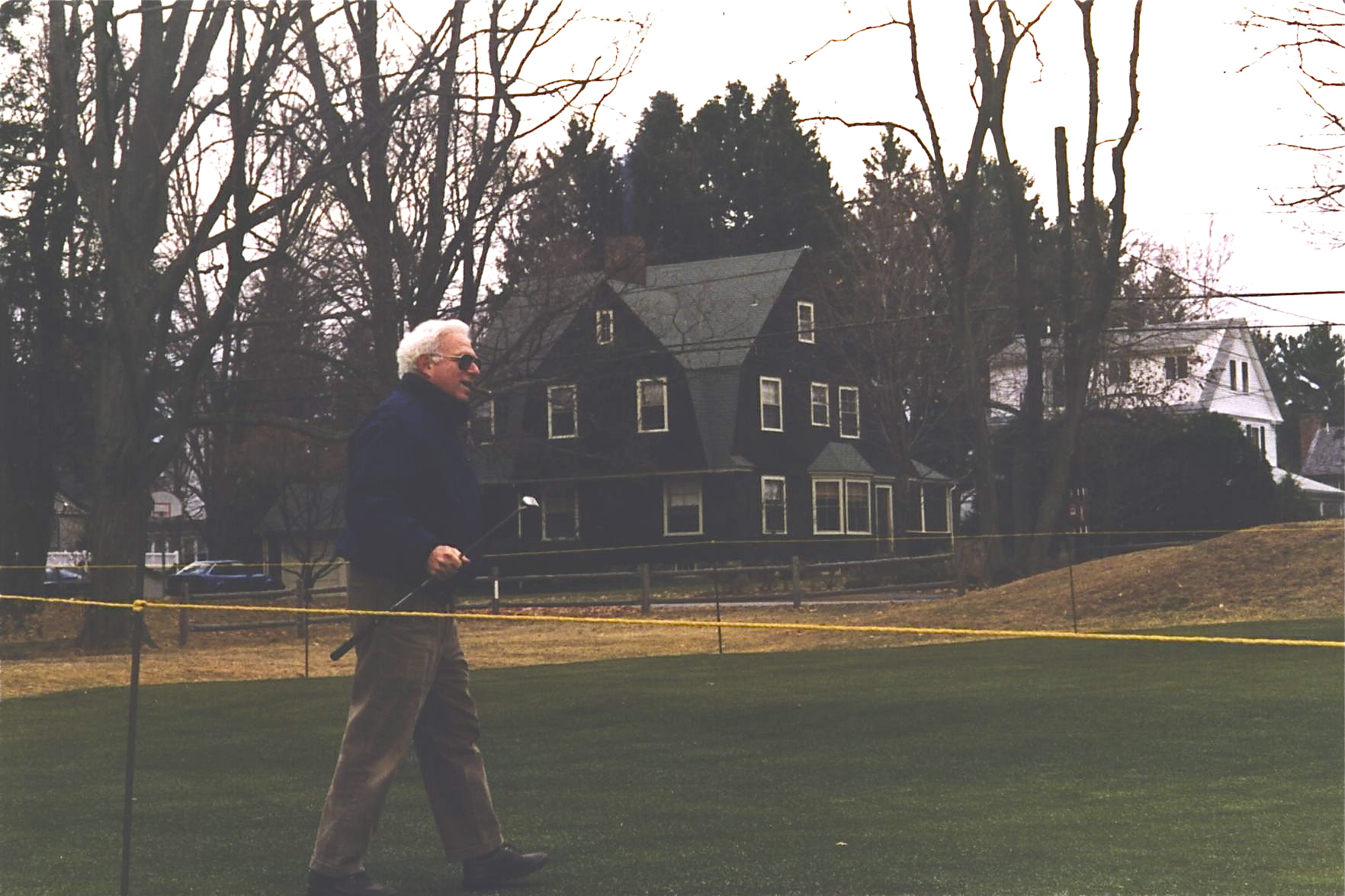
My dad on the 8th green at Nehoiden, right across the street from the house where grew up. It's late November; the greens have been staked for fencing at the first snow. We sprinkled his ashes here, and there's a memorial bench for him just right of this frame, on the 9th tee. There is no headstone in any cemetery for him. This is his spot, for all eternity.

The HGP II Scorecard Series: A Final Accounting

I’ve been picking through a few scorecards left behind, in a shoebox, by my father, Harold Gardner Phillips, Jr., who passed away a year ago this week. They didn’t surface until a month or two after his death. It’s taken till now for me to really engage with them. Haven’t avoided it exactly. It’s been an eventful year, the proof being just how quickly it’s flown by. But I’m glad I waited. A little distance allowed me to revel again in my memories of him. I won’t bore you with a comprehensive accounting of all their lovely time-capsule qualities. See below a third and  final installment in The HGP Scorecard Series, as it’s time write and remember more about him than his golf game. See previous posting on this subject here and here.… A word on the photo above: That’s my dad on the 8th green at Nehoiden GC, in Wellesley, Mass., his home club the last 30 years of his golfing life. Across the street is the home we made those 30 years. It’s late November in this image; the greens have been staked for fencing come the first snow. We sprinkled his ashes here. His memorial bench sits just right of  frame, on the 9th tee. There is no headstone in any cemetery for the man, at his request. This was his chosen spot and will be for all eternity.

The Niagara Falls Country Club, Lewiston Heights, N.Y., circa 1950: My dad was probably 13 or 14 and playing with his dad when this round was recorded. Pop was a jewelry salesman and traveled all over the Northeast visiting clients and playing golf with them. I’d heard tell that he’d take my dad on some of these trips, and here’s the evidence (there’s another card from Hershey CC that details the same sort of round). My dad and I were so different temperamentally. If I played badly, it could get real ugly, especially when I was this age. Whereas Poppy and his son were both incredibly even tempered. I’m sure my dad never embarrassed Pop with any histrionics on this day, despite shooting 92. And who knows: Maybe this was 1948 and a 12-year-old Harold Gardner Phillips Jr. was well pleased with 92, which appeared to best the group. This round is also notable for the fact that there were three Harolds in the group. Filling out the troika was Harold Osw. [sic], probably short for Oswald or something. Some poor boring bastard named Bob was the fourth (!). The card is quite ornate and well designed in an old-fashioned way. There’s a special column for “Side matches”, a table detailing “85% Handicap allowances”, four perforated/detachable tags for the submission of tournament scoring, another long table (opposite the tags) showing what your handicap should be based on “Your Ten Best Scores Total”; and an admonition to “Please have caddies rake traps and replace divots.” I don’t think I’ve ever seen that written on a scorecard, in quite that way, ever in my life. They don’t make cards like they used to.

Fort Monmouth GC, Fort Monmouth, N.J., May 12, 1954: I’ve heard the brief tale and read the brief press clippings re. this game. This was the 73 he shot in some high school match against another dude named Bob, who shot 78 and got smoked. It remained his best round ever in competition, if I’m not mistaken. FMGC is now known as Sun Eagle’s Golf Course at Fort Monmouth. It’s reputed to be a Tillinghast design, built in 1940, or maybe A.W. merely stopped to walk the place and a tap out his pipe here one day — the next thing you know it’s “a Tillinghast”. Couldn’t tell you if it had the markings; never played it, and my dad never had much of anything to say about the course. It was 6,417 from the tips in 1954, so it wasn’t any Mickey Mouse layout for the persimmon era. Military officers formed a big part of the membership here and the high school team played there, which is indicative of 1) good communitarian spirit; and 2) Fort Monmouth probably not being the most prestigious club in the area. But 73 in competition is 73 in competition (he bogeyed the first and played the rest at par). His personal best for the next 25 years. No trouble understanding why he kept this card.

Saddle Hill Country Club, Hopkinton, Mass., circa 1981: It’s obvious why some of these cards were kept in the shoebox, while other keepers are more cryptic. I don’t really keep cards, but if I shot 73 in a high school match, I might have considered it! My best in competition was 75. Somewhere I may have stashed the card recording the day I finally beat my dad, a spring Saturday at Nehoiden that just happened to be same day I first broke 80. So I can’t blame him for keeping the Saddle Hill scorecard, which is from just this time period, when I had finally caught the guy. I could  beat him now, which I think that gave him a great deal of joy (I don’t think there’s another word for that broad emotion I attribute to him in this context: pride, empathy, large amounts of credit probably apply, too). By the same token, it now meant something — something more — to beat me, which he did this day at SHCC, 78-81. This was a big game in another way: We both played quite well, and it may have been the first time that really did happen. You can play years with a guy, and you know his game, you see him play well, he sees the same from you. But it’s actually quite rare for two longtime playing partners, amateurs, to both post really good rounds on the same day. So a round like this is something both parties remember… Saddle Hill was and remains an interesting place. We played many times at Juniper Hill CC just down the road in Northborough, but Saddle Hill always struck us as a fun and finer golf course. There’s a middle portion, holes 8-12 or something like that, where a bunch of par-4s all run back and forth, down into a valley and back up to a green; these were weaker juice, as they also suffered from their sameness. But the rest of the routing was solid and engaging. It was taken private a few years back, renamed Hopkinton Country Club, and redesigned by Canada-based Welshman Ian Andrew. I thought I had read that he’d reversed a bunch of holes — where a redesign literally turns greens into tees and vice versa — but more recently I read or got the impression he had just switched the nines. I’ve gotta get back there and play it because I’m  curious now, especially the idea of reversing some holes I know so intimately, or did. Won’t be nearly as fun going back there without my dad though.

Hollywood GC, Deal, N.J., circa 1951: This was a find. I don’t think my dad remembered, later in life, that he had played here. We talked about it and I didn’t get that impression. Indeed, I had talked about taking him to play there along with sorta-nearby Saucon Valley, where he played his collegiate golf. But we sadly never got around to it. I can say pretty safely there weren’t many of these trips never taken. We did the Scotland and Ireland things, together with my brother Matthew, and we hit a good many plums here in the States. But that Mid-Atlantic romp would have been a great stroll down memory lane for him, and both venues are reputed to be top notch … My dad played Hollywood  this day with his mother, father and some dude identified here as “The Sheep.” I’d like to know who that was, but I doubt that information is available anymore. Pop had been a member here a decade or so earlier, but they were definitely not members at this time. They belonged to Old Orchard CC in Long Branch. Hollywood is and was, to my understanding, the truly fashionable Jewish club on the Shore, with a Walter Travis design, updated by Dick Wilson (much later Rees Jones redid it again). I can’t be sure but I think this card was kept not for what my dad had done there but for what his mom, my Gram, had done. She shot 41 on the front and 45 on the back to shoot 86, tied with my dad. (Pop self-immolated, posting 97). I think shooting 86 and halving my dad, at medal, was probably a superb day for her — and she just happened to have made 9 on the par-5 10th and 7 on the par-4 11th before closing extremely well. I just reckoned the card at match play and she beat her 15-year-old son 2 & 1, straight up, with no handicaps taken into account. I only ever played with Gram as a much older woman, naturally, so I can’t say whether this was a typical round for her, but that’s pretty good golf for a 50-year-old tennis player. She was a handsome woman who, if pictures are any indication, was doing a creditable Joan Crawford thing during this time. I’d like to have seen it. I’d like to have played Hollywood, and maybe I will some day.

There was a Saucon Valley CC card in the shoebox. It’s clearly from the mid-50s, as my dad played collegiate golf there, as a freshman, and enjoyed other rounds at SVCC during his time at Lehigh (’53-58). My dad revered this place. I can date the card pretty well because it lists a third loop (the “New Nine”), built in 1953. This would become known as the Grace Course, designed by William Gordon. Herbert Strong had done the Old Course; Gordon did a lot of renovations there, too. In any case, this card must have been gathered during my dad’s college days, before the Grace was made whole, with the fourth nine, in 1958… As indicated above, we didn’t leave too many stones unturned. When I was young, he got me on all sorts of great courses. In my late 20s, when I started in the golf business, I returned the favor. But I greatly regret never taking him back to Saucon Valley. Arranging a game for us there would not have been too much trouble, but I never made it happen. Fittingly, the SVCC card he kept is empty. No scores. It’s a pure keepsake of the place, of the time. I’ll keep it myself, as a reminder to play it. Maybe with my son, Silas.

Of Kilties and Stymies: A Long Golfing Life Re-examined

Of Kilties and Stymies: A Long Golfing Life Re-examined

My dad passed away almost exactly one year ago this week, so I’m marking the anniversary with a sampling of the scorecards he saved over the years. They were handed down posthumously, in a shoebox, along with other golfing trinkets and memorabilia. The cards form a useful trail of crumbs, which, if followed and elaborated upon, inform us re. the man and his seven decades in the game. The first post can be found here.

• Pinehurst No. 2, Pinehurst, N.C., circa 1974: I’m dating this round by the vintage of Sansabelt slacks modeled on the front of this scorecard. This most decorated of the Pinehurst courses has just undergone a thorough retrofitting from Ben Crenshaw and Bill Coore, who endeavored (as most course renovators do) to restore the “original vision” of Donald Ross (read: lots of exposed sand and scrub). This picture shows the 1970s incarnation and it couldn’t have been further from that purported vision: bright green, overseeded fairways flanked everywhere by wall-to-wall dormant Bermuda. Glad the Old Man got to play and brag about playing No. 2, even at its likely design nadir. News Flash: He shot 83, as he did by default nearly everywhere he played for the first time. A maddeningly steady player, he was… If the course had featured more sand when he played there, my dad would have made frequent use of The Meat Hook, the club he deployed for years as his sand wedge. There was nothing written on this unique club, no markings at all. It was notably heavy, antiquated and rust-colored (this was real oxidation mind you, as it was rendered long before coppery wedges became fashionable). There was something faintly menacing and mysterious about it — a Stealth Wedge, if you will. My dad exploded with a full swing nearly every sand shot around the greens, and he was pretty good at it. He never picked the ball with a smaller, steeper swing imparting serious spin, which is a limiting strategy, of course. He was apparently beguiled by the act of blasting balls from bunkers via the power of The Meat Hook, which he never played  from anywhere but a bunker, which, again, was limiting. He opened his pitching wedge when he wanted to flop something. It was old school, but there’s just no comparing what one can do with a proper sand wedge, with a heel, as I told him many times as a precocious teen and for decades afterward. My dad was nevertheless highly competent around the greens. His misses were never that bad, and he could routinely get up and down from green side with a bumped 5- or 6-iron. In a sense, his short game was what you’d expect from a 12-14 handicap, whereas he was a 7-8 tee to green. His putting followed this form: a decent lag putter but didn’t make a lot of putts, it seemed to me. He wore a glove and never removed it to putt, as many folks do. I think that removal routine seemed to him an affectation — like the kilties he routinely removed from his golf shoes, long before they went out of style completely. My dad was no fashion plate, far from it. But here we must give him credit for being ahead of the curve.

Old Orchard CC, Long Branch, N.J., circa 1950: I wish he’d have dated this one, because he shot 75 (bogeying the par-5s that opened and closed the round; the only sixes on the card) and this was his home course. Was it the first time he broke 80? Or did he keep it because this was his career best here? Was it merely the first time he ever went really low? He couldn’t have been more than 15, as this card would appear older — in its wear and more Spartan post-war design — compared to those he saved from roughly the same period. When did the stymie go out? A key question as this card features a stymie measure across the top! It’s my understanding the USGA abolished this arcane rule in 1950, so my dad could have been well younger than 14 when this score was posted. He played with someone identified as E, and the kid shot a big number. There’s little else to work with in terms of historical detail/clues, but he must have kept it for some reason as he played hundreds of rounds at OOCC. Old Orchard wasn’t a fancy place. My dad claimed to have routinely caddied there for local mobsters and found at least one gun in the bag. But my grandparents socialized and played bridge  there, too, so I don’t think there was anything inherently untoward about the place. (Wise guys need a place to play golf, too.) He never held the course up as anything special and it wasn’t. But he was sentimental about it, and this was the only Old Orchard card in the shoebox… There was, however, another card in the box and it’s a curious one. It says “Long Branch Country Club, Eatontown, New Jersey”, which is a village just west of Long Branch, or so Google Maps informs me. But there’s a logo top left that clearly says “Old Orchard Country Club”. I’ve compared the cards and while the yardages do not always match up exactly, it would appear to be the same golf course. My dad and I played Old Orchard together in the late 1980s — maybe the club toyed with a new name at some point? Indeed, The Architects of Golf, the definitive reference guide to all courses built prior to about 1995, lists Long Branch CC, but not Old Orchard (today the club is again known as Old Orchard). This odd Long Branch CC card would appear to be from the 1980s; someone shot 78 but this is the sole score line and the player is not identified (though the writing for all the world looks like mine). I’m thinking this was indeed the round I played with my dad at Old Orchard and an explanation re. the scoring  is likely mundane — probably an in-the-car recounting of the round, by me, because the original card had been left behind.

HGP II: Following the Crumb Trail of a Golfing Life
Harold Gardner Phillips, Jr., 1936-2011

HGP II: Following the Crumb Trail of a Golfing Life

Harold Gardner Phillips, Jr., 1936-2011

So my dad, who died almost exactly one year ago, was a pretty serious pack rat. He didn’t really save things with any kind of direction. It was more or less an involuntary urge he had (and one I happen to share). Some of us simply cannot countenance the idea of parting with something that, at one time, meant something to him or provided her lasting joy, or insight. At some point my mother threw away a pair of sweatpants my dad had worn in college. This was the source of playful recriminations for years to come. Books were something never to be discarded and while he quite avidly lent them out, he wanted them back. The man passed from this Earth with at least 40 programs on his TiVo, all of which he’d seen but for some reason felt the need to archive.

I suppose that assembling these things, even as a sort of random catalogue (and holding them over time), does indicate direction. He would run across them randomly, on his own, and enjoy the memories. His wife and children might run across them, too, and their reports or remarks would bring it all rushing back to him yet another time.

My father was the first of our immediate family core to go, and so this is the first time our little unit has dealt with one of the five being permanently absent. Accordingly, there has been an active gathering and parsing of these trinkets, these literal souvenirs he left behind. We’ve paid special attention to these things, interpreting them in the context of this fellow we all knew so intimately.

Dad was a big golfer. The U.S. Amateur concluded last week and it was just the sort of televised sporting event he would have adored (see my account here). I’ve written about the golfing life my dad enjoyed, the subtext being that I wouldn’t have much of a golfing life without exposure and direction from his.

But it was ultimately his golfing life, not mine, just as the tiny, sleek, leather-detailed lighter — the one that sat unused in his top-left bureau drawer for decades — was his memento, reminiscent of a time he apparently wished to bank and recall. And maybe the lighter and all this other stuff had been meant for me or my brother, sister or mother to remember him by. During his last year, he passed to me the Johnny Hopp model baseball bat and first-baseman’s mitt he’d owned since he was a kid. Why else would he do something like that?

Among other things, there were several shoeboxes of stuff left behind when my dad, a firm atheist, left this mortal coil. There were big, substantial things, too, things the family reverently went through, remembering him and feeling sad about it, then dividing up so we might all have a healthy supply of these bits going forward.

But the smaller stuff fit into a few shoeboxes, and one was full of scorecards and other golf paraphernalia. Some of these items I had seen but very few of the scorecards were familiar. Here and in a few posts to come is a select accounting, because in the thousands of rounds he logged over seven decades, he only saw fit it to save these dozen or so. They must have meant something to him, and it seems fitting to pore over them and try to discern that something — along with other historical tidbits from his golfing life — on the first anniversary of his death.

This shot of my dad as a young high schooler was taken some time contemporaneous with the round at Jumping Brook.

• Jumping Brook CC, Neptune, N.J., circa 1953: No date on this one. My dad seemed to date only the scores worth dating, and he shot another 84 here with a fellow named Jack Sax (which could be a shortened version of the guy’s full name; my dad refers to himself as Hal Phill; it’s definitely his writing). In 1953 my dad would have been 17 and you gotta figure he played this match as a member of the Red Bank High School golf team in the spring of 1953, before he went off to Lehigh as a freshman. I can pinpoint the date because Johnny Alberti is listed as the pro and he’s also mentioned in passing as being the pro at Jumping Brook in an October 1953 issue of Golfdom, the forebear of all golf trade journals. I edited one of its progeny, Golf Course News, in the ‘90s, and it was fascinating to read this compilation of golf news from all over the country, published as one continuous column for 20 pages! Every new pro and retired superintendent and new course rumor is granted a paragraph. At GCN, we’d have broken all this into 40 stories with their own headlines to make a new section, which probably would have gone on for 20 pages (!). The more things change… My dad was a Jersey guy. Raised on the shore in Little Silver, Long Branch and Red Bank; he and his family would ultimately make house in Montclair and Haddonfield, before moving more or less permanently to Massachusetts. My paternal grandparents were both keen golfers, members of the post-war, hyper assimilated Jewish middle class. When you’re aping WASPs, you play golf and they did honestly love it. They were members of Old Orchard Country Club, where my dad grew up playing and caddying, but they ventured out to places like Jumping Brook, Fort Monmouth and Canoe Brook. My grandfather, Poppy, was a member of Hollywood GC in nearby Deal sometime in the 1930s. He was a lefty and was, at times, a single-digit player himself, according to my dad. My Gram was a good athlete, a tennis player really but picked up golf to be more like Clare Booth Luce or maybe Martha Gellhorn. They arranged lesson for my dad with George Sullivan, the pro at Old Orchard, and off he went. He and another good player, Ronnie Choquette, actually formed the golf team at Red Bank High, if I’m not mistaken. I’m sorta hoping this was merely a casual round because poor Jack Sax shot 102. But the first three holes would seem to indicate a match underway, as there’s a +1, a +2, and +3 listed two rows below the scores. Upon examination, the card shows my dad winning the first 12 holes before halving the 13th, but it would appear he didn’t see the point in writing any of that down. I’ll do it, dad: You beat him 10 & 8.

• TPC Sawgrass, Ponte Vedra, Fla., circa 1983: I have no idea who these guys were my dad played with that day in north Florida: Emil, Pete (a 7 handicap apparently) and Dave. But I was certainly made aware of this round. “Hal” shot 82 from the blues and claimed 12 skins, though he and Dave lost the team match. My dad was playing off 12, or so says the card (this was probably some tournament connected to a convention held nearby; the scorecard is kept quite formally, in a way maybe an event administrator had requested; my dad certainly never scored in this sort of detail). This is a typical round from my dad when he was playing some pretty good, middle-aged golf. He sandbagged this a bit because he carried for years a steady 7-10 handicap at his home course, Nehoiden GC, across the street from our house in Wellesley, Mass., which was and remains a low-slope job, antique and tight, but a place you should score. But then my dad was, in a way, a true 12. He went to the TPC, site unseen, and shot 82. He could shoot 83-84 pretty much anywhere, which is a fairly rare gift… Like a lot of golfers in 1983, he was pretty gob-smacked by the golf course, Pete Dye’s breakthrough design in the flamboyant, post-modern, stadium-mounded links category. My dad was never a course-design freak, though he got into it more as I got into it more. [I presented him at one point, years later, a signed first edition of Tom Doak’s “Confidential Guide”, wherein the architect — long before he became the It Boy of Minimalist Design — lavishes praise and shits upon, by turn, a laudably wide-ranging assemblage of the courses he’s played. It’s some of the best bathroom reading ever devised, and I mean that as an unalloyed compliment. These editions are rare and sought after these days, though my dad never really grasped the import of having one. Now I’ve got his copy back. Then both burned in a 2016 barn/office fire.] The TPC Sawgrass clearly made an impression on him, and I think that (and the course’s subsequent notoriety) moved him to keep this scorecard. When my dad played a golf course that, for good or ill, either confused or radically challenged his expectations, he wasn’t always eloquent in explaining his views. He would assess it as “sorta kooky” or “a little weird”, then close the thought with a mildly exasperated cackle.

Mr. Cornish Covered Lots of Ground in 97 Years

Mr. Cornish Covered Lots of Ground in 97 Years

We were again reminded, by the recent passing of esteemed golf course architect Geoffrey Cornish, of just how integral the act of walking is to the practice and perception of golf course design.

Mr. Cornish died at his home in Amherst, Mass. on Feb. 10, at the ripe old age of 97. Much has already been written about him, in golf circles, though maybe not so much about his work. Every day, right up until the very end of his long life, Mr. Cornish walked/hiked the nearby Lawrence Swamp. Many a tale was related this week about younger men struggling to keep up. For a guy who designed more than 200 golf courses over the course of a 70-year career, for an eminence who was known and loved by nearly everyone, it seemed an odd thing to fixate upon.

I grew up in New England and have lived here pretty much my entire adult life, so I’ve probably played close to 75 of the 200-plus courses credited to Geoffrey Cornish. Still, his design work is difficult to assess. In detailing why that is, we get a fuller picture of the man — and why he was such a beloved and unique figure.

For starters, Mr. Cornish, though Canadian born, was a frugal Yankee on a par with all too many of his clients. He was the anti-signature architect, if you will, often taking jobs with small budgets, on land of questionable golfing value, and making from this the best course he could — one that might be efficiently maintained. (He was trained as an agronomist, after all.) It should come as no surprise that few men designed more municipal tracks than Mr. Cornish (the solid Chicopee Muni in Western Mass., pictured above, is but one example).

Consider the vast number of 9-hole courses where he added new nines, or the rudimentary courses he renovated and/or formalized. I can think of several examples of real dog tracks that Mr. Cornish made whole, and wholly improved, with his renovations and 9-hole expansions. They are today understood to be “Cornish designs”. But it must be said that an architect more concerned with his signature, his reputation, might not have even taken these jobs. But Mr. Cornish could turn down no one.

By the same token, this mixing and matching of his work with that of others tends to muddy evidence of his design skill. In the late 1950s at Wahconah CC in Dalton, Mass., Mr. Cornish added nine to a spectacular original loop laid out in the 1930s by Wayne Stiles. The newer work is good but frankly pales in comparison. At Brunswick (Maine) GC, Mr. Cornish did essentially the same thing and his nine — some of his very best work — is certainly equal to that of the Stiles nine, maybe better. In neither case does there seem to have been an attempt on Mr. Cornish’s part to build upon or advance or mimic Stiles’ style from the original holes. I’m not sure what that means… Just figured I’d throw it out there.

•••

Read More

HH Flashback: Nixon & Dave Remembered

[The Harold Herald, the blog prototype I launched in the early 1990s, was nothing if not political, though the coverage wasn’t always traditional, nor was it my own.  Mark Sullivan, a fellow alum/refugee from the Enterprise-Sun newsroom, was a frequent contributor. Today he’s a skilled and prolific blogger in his own right. His HH essay below, marking the passing of Richard Nixon, was always a favorite of mine.]

By MARK SULLIVAN

Dave was in a triumphant mood when he stopped by my dorm room one night early in the fall of my sophomore year at Boston University. He was quaffing mightily from his favorite mug, a prep-school tankard emblazoned with a Pegasus-like winged beaver, and was pickled to his sizable gills.

I have a picture in my mind’s eye of Dave as he looked that night: The jumbo build, characteristically clothed in club tie and seersucker that gave him the look of giant Ivy League Good Humor man, but this night wrapped in a too-small blue dressing gown; the large head, topped by an outsized Boys’ Regular haircut — part Kemp, part Koppel, crowned by an ungovernable cowlick; the Mr. Limpet-like fish-lips and spectacles, the latter worn for chronic nearsightedness and leading him a resemblance to Piggy, the precocious but doomed overweight boy in the film, Lord of the Flies.

Dave had brought his transcript of President Richard Nixon’s resignation speech, which he proceeded to read in his best Milhousian timbre. When he came to the end of a page, Dave would toss it with a flourish over his shoulder, the sheets fluttering through the air and landing between my bed frame and the wall.

As he approached the end, he summoned all the stage poignancy he could muster: “Uhh, this is, ehr, not goodbye,” he read in choked, Checkers-speech tones, building to the farewell line in fractured Nixonian French: “This is, uhh, ehr, au-rev-oyeur.”

There were tears in his eyes.

I thought of Dave recently when news came of Richard Nixon’s death. David idolized Nixon, or, as he called him, “the, euhr, Pray-sident.” In conversation, Dave would often lapse into his Nixon voice, which was similar to the Nixon impersonation Dan Ackroyd did on Saturday Night Live. The Nixon voice was always preceded and intermittently punctuated by a distinctive low “euhrr” from the back of the throat, as in, “Euhrr, get down on you knees and, euhr, pray with me, Henry.” The delivery was always accompanied by a dismissive, two-digit wave of his index and middle fingers.

Dave Kept about him trappings of his hero. On the large Papal flag that hung on his dorm-room wall were pinned various “Nixon’s The One” campaign buttons. He liked to compose memos, which he would initial “RN.” Opposed to the Kennedys on principle, he liked to play a 1960s novelty recording of the Troggs’ Wild Thing sung by a comic impersonating Bobby Kennedy.

Dave had Praetorian Guard leanings: He once assigned himself the job of advance man to a student-union candidate, preceding his man into the auditorium and giving the audience the “Up, up” gesture, proclaiming, “All rise! All rise for the Pray-sident!”

As a character, Dave was, in a word, preposterous.

He came from a Pennsylvania industrial town on Lake Erie where his family was in the tire business, and from which Dave, given his predilections, had happily escaped none too soon. He endured a checkered career in private school and ended up at Avon Old Farms, in Connecticut, which had been the prep school of last resort.

He weighed in at a good 250 and was given to blazers and oxford-cloth buttondowns of commodious cut, wide-wale corduroys, Norwegian fisherman sweaters, L.L. Bean duck loungers, which were tested by his wide, almost Flintstonian feet. In appearance, he suggested a cross between convicted Nixon aide Chuck Colson and Tweedledee.

Dave disliked the light and kept the shades in his room perpetually drawn, leaving his complexion continually pasty. He was ticklish and did not like to be touched. He chain smoked non-filtered Camels, several packs a day. The butts in his unemptied ashtrays were piled like Mayan pyramids, and his fingers were dyed yellow from the nicotine. He would rise some mornings at 6:30 and immediately begin drinking straight sloe-gin from his 28-ounce Avon Old Farms mug, the flying beaver on which was named Amy.

Dave’s romantic orientation was a matter of conjecture. Some thought him to be asexual. He became obsessed with one friend, John, an easy-going preppie from Wisconsin who sailed boats. Dave referred to John as “the Pray-sident” and kept an hour-by-hour itinerary of John’s classes, which Dave carried about in a case he called “the political football.” John and his roommates gave Dave a key to their dorm suite, which Dave would clean and vacuum.

Read More