Category Archives

36 Articles
A Modest Proposal: Award Penalty Kicks from the Spot of the Foul

A Modest Proposal: Award Penalty Kicks from the Spot of the Foul

Robben Marquez

While much of the soccer world at large is surely gratified to see Americans finally taking to the game — record Nielsen ratings (even for games not involving the Yanks) have been accompanied by admirable on-field performances — many international observers do worry the U.S. will eventually use its outsized cultural sway to exert undo, ill-considered influence on their game.

There is, in fact, considerable precedent for this wariness. In the 1980s, the North American Soccer League toyed with an offside line that was just 35-yards from goal. Major League Soccer, the top league here in the U.S., insists on playing its season from Spring through the Fall (to avoid competing with the NFL and NBA), whereas every other league in the world plays Fall through Spring. MLS also plays official games on artificial turf, a FIFA no-no. Some have even alleged the “cooling breaks” inaugurated during this World Cup are the result of some American conspiracy that will lead, incrementally, to in-game commercial breaks.

What’s more, I think we’ve all been in bars with some soccer-watching American yahoo who confidently proclaims, “Here’s how they could make this sport a lot better…”

While I have spent the last 30 years patiently defending/explaining soccer’s status quo to small-minded people like this, I have also been witness some quite radical rule changes: Even used to be offside; now even is onside. Goalkeepers used to be able to handle any back pass from a teammate; now they cannot (unless it’s headed); extra time was never sudden death, then it was; now it isn’t anymore. This year we say hello to goal-line technology…

So, in the interest of progress, and despite my holding a valid U.S. Passport, allow me to advance one idea as a thought experiment:

Spot kicks in the penalty area should be taken from the spot of infraction, not the penalty spot. If said foul takes place inside the 6-yard box, a traditional penalty is awarded.

This, too, is radical, but it would be more consistent with fouls called anywhere else on the field, i.e. foul occurs here; free kick is awarded on that spot. As with PKs currently, infractions resulting in a direct kick would require all players but the shooter and the keeper to clear the penalty area, until such time that the ball is played.

Why the change? As it stands now, the impact of PKs is, to say the least, outsized. We have attacking players actually going down in the box — trying to draw the ultimate foul — rather than trying to stay on their feet in order to consummate a legitimate scoring chance.

The 2014 FIFA World Cup in Brazil has had its fair share of such episodes: Fred’s questionable tumble during the tournament opener, which drew a deciding penalty kick for the host nation. Even more notably, witness Rafa Marquez’ borderline, last-minute foul on Holland’s Arjen Robben, which resulted in a game-winning penalty kick and sent Mexico packing after the Round of 16 (again).

The Marquez Affair inspired all sorts of back (there was contact; he stepped on Robben’s foot) and forth (clearly an “embellishment” in contravention of the rules). However, this much is clear and straightforward: Robben was more interested (far more) in drawing that foul than in scoring, despite being so close to goal (with all sorts of teammates in the box who, upon receiving a pass, might well score). That’s a perversity, and this rule change would help address it.

At this level, the PK conversion rate is some 75-80 percent. PKs are awarded because an attacking player has presumably been denied a clear goal-scoring opportunity, i.e. the chance to shoot on goal. But how dangerous a position did Robben occupy when Marquez took him down? (Marquez did not, for the record, also surgically invade Robben’s abdomen and rip out the Dutchman’s severed spleen, Robben’s facial contortions, shouts of agony, and pathetic collapse to the turf notwithstanding).

The foul occurred on the goal line, or end line. This rule change I’ve suggested would give Robben his free kick, place the ball at the spot of the foul — close to goal but at a poor angle — and let the chips fall where they may. The angle might be poor but the keeper must remain on the line, as per usual; he may not cut down the angle. So, Robben would be awarded a free kick that provides him a slightly better opportunity to score, from the spot of the foul, had he not been impeded. In other words, we are still giving defenders a disincentive to foul in the area. However, that opportunity for conversion, for scoring, would be more in keeping with the actual scoring chance — the one snuffed out by the foul.

The Marquez example is particularly instructive because imagine the strategy for PKs awarded there, under this proposed system: Robben can’t reasonably score from the touch line, from such an acute angle. He would be obliged to seek out teammates scattered about the edge of the box, creating chances for them — much like a penalty corner in field hockey (I realize this movement has been set back some 15 years with that comparison, but it’s apt). These would be strategic but still flowing, soccer-centric scenarios, however, unlike penalty kicks which, in fact, are the most contrived thing in the game. Those situations — guys standing alone on the spot with no one around him, just shooter and the goalie — almost never happen in the run of play.

Far more frequently, with no wall to take away the short-side post, goalies would be sorely tested from many spots in the box. These “new generation” penalties would result in acrobatic saves. There would be brilliant, net-bulging strikes. But all of these chances and half-chances would be more in keeping with and proportion to the scoring chance the foul prevented.

As indicated above, traditional PKs would be awarded only for fouls that take place in the six-yard box. That makes sense, as trying to keep the goalie on the line, when the ball is placed 3 yards in front of him, would be impractical. Further, a hand ball or foul that close to goal should rightly result in a goal 80 percent of the time.

Indeed, we may, through this rule change, have finally figured out why that mini-box exists. Purportedly, goal kicks can be taken anywhere inside of that box. But surely this is a waste of space and paint. There must be a more practical, intrinsic purpose, and this might be it.

Most interesting and most important would be the new ruling’s effect on overall play in the box.

Right now, each offensive/defensive encounter in the box is all or nothing: Any sort of foul is a PK, almost surely a goal. Defenders are determined to avoid that foul and strikers routinely cheat/simulate in order to draw it. Under the new system, each offensive/defensive encounter would take on but a gradation of risk. Defenders would be more aggressive on the goal line, and out on the peripheries of the penalty area. Referees will certainly call more fouls at the corners of the box more frequently — because the stakes out there would lower, and far more entertaining. Traditional PKs are boring, fait d’accomplit. I, for one, would like to see more mano-a-mano encounters between keepers and strikers who can really strike a 16-yard bullet — from an assortment of angles.

By the same token, less aggression would be manifest in the center or the box, in front of goal, where committing a foul would still result in a more or less point-blank penalty.

Maybe if this gradation of risk were realized, other aspects of the game would be positively affected. Currently, the amount of clutching and grabbing that takes place on any corner kick is absurd. At least one penalty kick could be called on every corner, at this level, if the referee so chose. However, if referees feel more at liberty to call clutching and grabbing at sharp, shallow angles to goal (because it’s not as if that referee would be handing one team an 80 percent chance at goal), clutching and grabbing generally, anywhere in front of goal, might subside.

The other piece of this equation is the tendency toward diving, or, as FIFA calls it, “embellishment”. We already have the means to snuff this out: calling the foul on the offensive player, the diver, and awarding a yellow card. This is a simple matter of referees more frequently whistling players for embellishment (and flashing the yellow caution, two of which get you ejected, of course).

For some reason, refs have been loath to follow this course. There is squeamishness on the referee’s part — getting that call wrong might decide a game unfairly. But games are being unfairly decided right now, and FIFA, in a surprising bit of wisdom, was clever to call it “embellishment”. The foul is irrelevant. The overriding infraction is embellishing the foul in hopes of unduly influencing the referee, drawing a penalty kick, and perhaps getting your opponent thrown out of the game. Once you have embellished, it doesn’t matter if you were fouled. Name go in book.

Fortune Favors the Brave? In Brazil, That Means Goals

Fortune Favors the Brave? In Brazil, That Means Goals

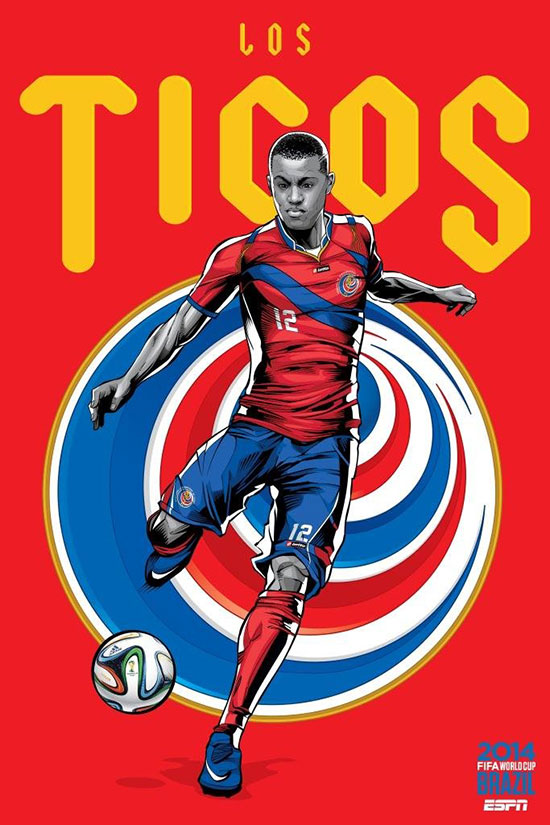
 costa-rica-espn-brazil-football-world-cup-2014-poster

I was just listening to the excellent Guardian football podcast (posted daily during the World Cup) and someone described Costa Rica’s performance against Italy (a 1-0 victory for The Ticos in the group stage) as being particularly brave.

Now, these podders are UK -based, mainly, and describing a soccer performance as brave is a particular British way of putting it, but as with many things English (the game, our language) it fits remarkably well.

What does brave really mean? There are so many contexts that inform, but let’s choose one familiar to us. Some Civil War figure grabs a flag standard and runs out in advance of the front lines, to encourage and embolden his mates. Well, let’s examine the act, and the word that could well describe it is brave.

Putting one’s live at risk, i.e. dancing around in the line of fire, without a gun (but with this honking big flag and pole), is something we would not normally do. It’s not advisable. If there’s an overarching strategy for humans (stay alive), and we apply that strategy to a war context, this act makes no sense. Better to stay in the anonymous line — and try to pick off some of those other guys whose strategy involves shooting at me (or better yet, find some nice, rear-guard job in tending to the sick or feeding the horses).

Teams like the Costa Ricans — lightly regarded for several good reasons: performance in WC Qualifying, history of producing players and teams of quality, the quality of their domestic league, number of players playing abroad in good leagues — would typically approach a game, such as their group encounter with four-times world champions Italy, with trepidation.

What does that mean? It means the opposite of bravery: defend like the dickens, in great numbers (say, 9 “behind the ball” — always between the ball and their own goal), and hope to lure enough Italians away from their defensive positions goal-scoring positions that the Costa Ricans can win possession and quickly counter-attack against relatively few defenders.

That’s a strategy, a common one for soccer teams playing a superior opponent. It’s a time-tested option — the strategy Jurgen Klinsmann looks to deploy with this American team. It’s not brave. It’s practical, and it’s part of what makes international football so interesting to watch, because it can work to great effect: An inferior-but-disciplined team can beat an superior undisciplined one.

Costa Rica took no account of the fact that the Italians (and the Uruguayans, and the English) are considered superior in all the ways listed above. They simply went at them, all over the field, contesting every inch of it, and ultimately scored way more goals than their opponents.

They were brave and they were rewarded.

Chile were brave yesterday vs. Brazil, a team that has now knocked them out of the last three World Cups. The strategic thing to do against the five-times world champions (who just happen to be playing at home, where they’ve not lost a competitive match since 1975) would be the practical, counter-attacking route. But Chile played their fellow South Americans toe-to-toe.

I think that, in general, this has been a particularly brave World Cup. The evidence is simple and straightforward: There have been lots of goals (the most in a group stage since 1958) and a remarkable predominance of open play.

In part, it’s the Brazilian ethos that has made them brave. How can you got to Brazil — the soccer nation that invented “flair”, that pissed way even more World Cups because they insisted on playing open, brave football — and not play open, attacking, “Samba” soccer? Forget the fact that this particular Brazil team is among the most “practical” the country has produced; it was chosen to grind out results rather than simply outscore its opponents (indeed, apart from Neymar, they appear to have a real striker problem; Fred and Jo have been next to useless).

But the Samba Ethos was formed decades before and will outlive this current Brazil squad. More than in any World Cup I can remember, teams came to this World Cup to win and look good doing it. Italy refused and couldn’t get out of the group. England flirted with the idea, gave it up and went home.

There are dangers to bravery. Portugal is going home because it continued to go forward after falling behind Germany and going down to 10 men. If they had hunkered down and kept that game 2-0, the Portuguese might ultimately have gone through. Instead, as they weren’t inclined to damage control, got drilled 4-0, and that goal difference sent the US to the round of 16 in their place.

Which is why today’s Sunday’s slate of knockout games is going to be so interesting. The Mexicans play like Chile, i.e. almost incapable of throttling back their pressure game all over the field. Surely the Mexican coaching brain trust, and the players themselves, understand the Netherlands can utterly shred that sort of adventurism.  To wit, a 2-0 plucking of Chile itself in the group stage, and a 5-1 embarrassment of reigning World Cup champion Spain, who didn’t even play that bravely, or openly, and still got dismantled.

And then we have brave Costa Rica taking on the most practical, disciplined side left in the tournament, Greece, who never play bravely but have a knack for eking out results against better teams. Indeed, they won a European Championship doing this, in 2004. This was perhaps the most remarkable underdog performance in the history of major tournament football, ever, and just 10 years removed from that experience, the Greeks are loath to switch strategies.

Will Costa Rica just fly at them and let the chips fall where they may? Here is a side brimming with confidence — but here is a side that is poised to produce the greatest sporting result, perhaps the greatest geo-political result (a spot in the World Cup quarterfinals) in its national history. Perhaps they temper the bravery and try to beat their opponents another way, lest they risk conceding an early goal and playing into the Greeks’ hands.

The choice is the Costa Ricans’ to make. This afternoon we will test the conventional wisdom, that fortune favors the brave.

Suarez: Warped, a Bit Peckish, but a Ban Doesn’t Fit

Suarez: Warped, a Bit Peckish, but a Ban Doesn’t Fit

 o-LUIS-SUAREZ-facebook

In the first 20 minutes of France’s mind-numbing but practical nil-nil draw Wednesday, Les Bleus central defender Mamadou Sakho delivered an elbow to the face of Oswaldo Minda during a corner-kick skirmish in front of the Ecuadorian goal. It was deliberate and on target. It went unnoticed by the referee and so, the game went on.

This not to excuse the act, but these things happen. When referees see such infractions, off the players go. The red card issued Wednesday to Antonio Valencia, Ecuador captain and Manchester United winger, was not exactly swift (the referee took almost 2 minutes to brandish it). But ultimately it was sure, because it was seen.

What Uruguay’s Luis Suarez did to Italy’s own King of Capers, Giorgio Chiellini, on Tuesday, was certainly a red-card offense. But like Sakho’s no less deliberate but ultimately more painful offense, it went unnoticed by the referee, Marco Rodriguez of Mexico.

Look, what Luis Suarez did was really weird, even more disturbing when you consider his track record: He’s now apparently chomped on three guys in his illustrious and notorious career (there have been charges of racist taunts, too, for the record).

But you can’t ban a guy for being a nut case. This last bite was no worse, in a soccer sense, than Sakho’s elbow to Minda’s kisser (which wasn’t seen, nor called by the ref) or Daniele De Rossi’s elbow to Brian McBride’s face at World Cup 2006, which was. Slapping Suarez with an after-the-fact ban (covering subsequent World Cup matches presumably) seems arbitrary, though FIFA seems determined to do something; on Wednesday it  “charged” Suarez with biting.

The fact that Suarez has bitten guys twice before, and was allowed to play in this competition (and all competitions for club and country in the buildup to Brazil 2014), argues against a ban. Biting an opponent is bizarre, but no more a rules infraction than elbows to the face or, in Valencia’s case, studs-up tackles over the ball.

One final word about Chiellini. Thick was the irony that it was he who played the foil here. The Italians are futbol’s champion practitioners of win-at-all-costs gamesmanship, and Chiellini pushes the limits of this dark genius further than any of the Azzurri. I wish FIFA kept records for the number of times players are whacked in the chest, inadvertently or otherwise, and fall to the ground clutching their faces. Chiellini would lead the league, as it were.

There’s a great Monty Python sketch that begins with a pan of some uninhabited meadow. The viewer is informed that, in fact, there are 40-odd people in this shot, including Mr. E.R. Bradshaw of Napier Court, Black Lion Road, London SE 14. The film’s narrator invites Mr. Bradshaw to show himself, which he does. At which point, he is shot dead.

“This demonstrates the value of not being seen,” the narrator points out.

Suarez bit another guy. The ref didn’t see it. It was Chiellini, which  seems fitting. Next game, please.

Rumble in Jungle: The Sound of US Soccer Coming of Age?

Rumble in Jungle: The Sound of US Soccer Coming of Age?

usa-soccer-dogpile-after-game-winning-goal-over-algeria

Even as another brilliant World Cup serves up so many tasty morsels of soccer drama (some of it even inspired by our boys in the golf shirts), let’s remember NOT to get carried away.

This applies to the micro level: I was sitting around my living room Sunday night with three dudes. As the Portugal-USA game careened into injury time, Clint Dempsey having just coaxed his late, go-ahead goal over the line with his chest, these well-meaning but dangerously insouciant fellows were blithely discussing whom we would face in the round of 16! They thought it was over, and for the vagaries of injury time-keeping, it might well have been.

My guests and I were rightly swept up in the pageantry, the goals, the unpredictable results, even the inherent jingoism of this latest World Cup, and god bless us, everyone. They were fine company and this has been the best World Cup in decades. But this was a dangerous bit of hubris. It might take 90 minutes for something to happen in a soccer match, but when it does, we’re talking the blink of an eye.

Truth be told, I was wary of their chicken-counting for another reason: I had been tipped off.  We spent a bit too much time grilling hot dogs, eating watermelon and gabbing on the porch at halftime. The game had been DVR’d for safety, convenience and posterity, and so we watched the second half about 4-5 minutes behind live action.

Big mistake.

When injury time came around, and the boys were busy taking this win for granted, my phone began twitching in spasms of text alerts. Something had gone down at the death. I just didn’t know what… What exactly prompts that type of spontaneous eOutreach? When Demps converted 5 minutes before, there were no texts… For all this ominous foreshadowing, I was still stunned by just how late Portugal left it. Last kick of the game. 2-2.

•••

On a macro level, we should support this US squad with complete abandon, regardless of our purported soccer sophistication, because they are ours, they are not very good, and yet they are producing remarkable, dramatic results.

Manager Jurgen Klinsmann has pushed every button correctly. Kyle freakin’ Beckerman is starting at defensive midfielder and looking not the slightest bit too slow for the international game. Jermaine Jones has summoned all his unpredictable energy, skill and menace to pull off a damned convincing impression of Edgar Davids. Dempsey’s swashbuckling game has clearly not been dumbed-down by his move to MLS, and his winning tally vs. the Portuguese was delivered by 20-year-old Seattle Sounder teammate Andre Yedlin, a man few though Klinsi had the balls to actually play during this tournament, much less its key moment.

All this is great for MLS and American soccer, whose World Cup games are drawing crowds to parks and plazas all over the nation and other ways of which no one could have dreamed, even during the game’s “puppy love” moment here in the US, World Cup 1994.

(The game’s “nighttime emissions” moment was Italia ’90 — a huge step forward but ultimately a slightly embarrassing event that, for the U.S., mercifully played out in relative privacy.)

But again, let’s not get carried away.

World Cup 2014 has prompted a creditable response from US Soccer Nation. The scene in and around RiRa, the bar where I watched the win over Ghana in the first group game, would have done any country proud. And there is a real feeling, supported by MLS and the never-lying demographics, that the game truly has cleared a tipping point in the culture.

But American Soccer Love will likely remain a mere quadrennial happening in this country, for decades to come. The sheer mass of our sports landscape provide so little room for another “major” sport. MLS just isn’t a compelling product, not yet.

Most important, the DNA of US soccer is such that the national team has always been the focal point of the sport’s popularity here. Once the NASL died, the national team was all there was — it was the only American soccer focal point. Once we started qualifying for World Cups (thanks FIFA, for expanding the number of CONCACAF bids; and thanks for dinging Mexico for using overage players at the 1989 U-20 World Cup — to the tune banning them from Italia ’90, making US qualification possible), it was the national team that fixated the public’s attention on the game’s qualities.

In a way peculiar to international football, the US national team plays an outsized role in domestic soccer consumption here.

Which is fine. One of the game’s most attractive qualities is exactly that international outlook, the pitting of one nation against another. As American sports fans, we really don’t have that opportunity anywhere else, with any other team sport. We don’t care about world championships in basketball. Indeed, American football and baseball — our national sporting obsession and pastime, respectively — are entirely domestic to the point of insularity. The World Series? A peculiar name when you think about it (and one that really bothers international sports fans).

Precisely because soccer is unabashedly internationalist in its outlook, supporting the national team is that rare opportunity to root for America vs. Some Other Country — in something other than the latest trumped up war. It’s sort of surprising that a nation so stuck on itself, and so militaristic in most every other way, has taken so long to appreciate the allure of this joyously partisan activity. But there were are.

And here we are, staring down the barrel of Germany in our final group game with “all to play for”, a spot in the last 16 and another glorious June weekend of packed bars, communal viewing venues, flag-draping and face-painting. I’m just glad we all lived to see it. Not because it’s the fulfillment of some prophecy, but because it’s damned good fun.

•••

A few thoughts and observations on the first 10 days of World Cup 2014:

• There’s a 50-50 chance that Ghana could effectively put us out of a third straight tournament. Yeah, we stole that game off them in the opening match. Revenge might have been sweet but the last laugh has not yet been assigned. If Germany beats the US on Thursday, and there’s every reason to think they will (they are one of the world’s top 3 sides, and they must get a result to qualify for the last 16 themselves), all Ghana needs to do is beat Portugal and the Black Stars are tied with the Americans on 4 points. Goal difference is the decider. After two games, we’re +1 and they’re -1. But we lose buy a goal, they win by a goal, and it’s a dead heat. Germany beats us by two and we’re toast.

• The Black Stars of Ghana. Good team name. The US needs one. We don’t do this sort of thing in America, mainly because, as stated above, we don’t field international teams very often — in sports about which anyone gives a rat’s ass. The men’s national team has progressed to this level of interest, and so should have one bestowed. There are good names out there: Cameroon’s Indomitable Lions. There are bad names: Australia’s Socceroos (the Rugby Union team is the Wallabees; much better). Names need not be animal inspired. Germany’s national team is known as the Mannschaft (simply “The Team”). Italy has its Azzurri (“The Blues”), Brazil its Selecao (“the Select”). What would embody the American psyche and inform a proper American soccer nickname? There was a guy in the Manaus crowd, against Portugal, dressed as Teddy Roosevelt, in full Rough Rider gear (if you have trouble placing that, think of the Colonel in the classic ‘60s cartoon “Go-Go Gophers”). Rough Riders should be given every consideration, especially for this World Cup, where Theodore so famously visited after his presidency, big guns in tow.

• The most encouraging thing about America’s inspired performance thus far (gutty vs. Ghana, truly sophisticated and creative vs. Portugal) has been the fact that all has been achieved without a decent showing from Michael Bradley. The conventional wisdom strongly held that he was the team’s indispensable man. We couldn’t play with the big boys if he didn’t show up. Well, he didn’t really show up, twice, and others stepped up in his place. I love Bradley’s game. He will come good vs. Germany, which gives one hope.

• This has been the World Cup of Nipples. Thanks to the new skin-tight fashion, and sweltering heat, never before in any sporting event have they been so prominently featured.

• Still reeling from the Portugal game. Realized that the US played a truly great 90 minutes of soccer in that match. Portugal scored after a total brain fart from Geoff Cameron after 5 minutes; we dominated the next 90, and then Cameron watched the equalizing cross sail over his head. It must be said that but for those two moments, the Stoke Man (a Maryland Terrapin, my Terp brother-in-law reminded me today) played an excellent match. Sometimes 90 good minutes are not enough.

• Coaches will often sub guys during injury time to help run out the clock, to use up more time. But referees will often just add 30 seconds to injury time for every sub that comes on during any game. They’ll do the same thing with goals: 2 goals = 2 minutes of injury time. Omar Gonzalez, our tallest defender, was sent on by Klinsmann during injury time. Not only did he not make a difference (indeed, he has come on late three times in the last 2 weeks and the opponent has scored in all three games), that extra 30 seconds of injury time may have extended the game just long enough for the equalizer.

• I can’t help myself, but it’s exhilarating to watch the Mexicans win World Cup matches. They are so into it — the team, the coaches, the fans. It bothers me that they almost certainly do not reciprocate in this regard, even after our completely unnecessary late-game goals vs. Panama in the final Hexagonal qualifier got them into the final pre-World Cup playoff and saved their entire country from mass sporting psychosis. They were all full of love and kisses that night, but methinks they’d love to see us crash out on Thursday. Doesn’t seem right.

• Me? I’m a CONCACAF guy, because I have to be. I live here and support a team in the federation. Accordingly, it warms the cockles of my heart to see Mexico do well, and Costa Rica has been a revelation — already qualified after two games and fending off FIFA drug testers, because no one can believe this superlative run of form. If the US can qualify, that’d be three North/Central American teams in the final 16. Maybe those guys at The Guardian will stop make fun of us now (!). I have mused with my soccer podcast buddies Tom Wadlington and Dave Batista about how difficult playing in Central America truly is — compared to European qualifying. Just how would a team like England fare at an away qualifier in San Jose, or Tegucigalpa, or Mexico City? The final game in Group D might have provided some insight into this, on a neutral field, had the Ticos (pretty good name) not already qualified for the knockout stage, and had England not soiled itself so very quickly and publicly.

• I would have pegged Andre Yedlin, pre-tournament, as pretty much the 22nd guy on the 23-man World Cup roster. No one expected him to set foot on the field, unless we were getting blown out or playing some meaningless, third group game after being eliminated. Yet Klinsmann threw him on vs. Portugal, with the game and tournament in the balance, and he delivered. Still, I will eat my hat if he exposes young Julian Green to the rigors of World Cup play. The 18-year-old German-American phenom is the property of Bayern Munich, but he has never played a minute for the senior club. He looked beyond skittish in the three pre-tournament warm-up matches. He’s simply not ready. So, why is he on the roster? No one is admitting that Klinsi cut a deal with Julian Green, i.e. “Julian, join the USA long term [he could have declared for Germany] and we’ll  bring you to Brazil.” Canny long-term politics but you can’t waste a roster spot at the World Cup. Lo and behold, Jozy Altidore pops a hammy and now we’re short a back-up striker. Aron Johannson — another young phenom, Icelandic-American; vetted in the top Dutch league but basically unproven on the international level — was useless vs. Ghana. Chris Wondolowski is an MLS journeyman. Terrance Boyd was left at home, and so was a fellow named Donovan.

• Landycakes and Klinsmann have never seen eye to eye on how American footballers should behave. Donovan took a sabbatical from the game two years ago; Klinsi was reared, played and coached in Germany, where footballers don’t do sabbaticals. I understand the Green negotiation, but there will come a time in this World Cup when the US could have used 30 minutes of Donovan at the end of a game — to hold the ball and more effectively counter-attack with a lead, to change the angle/mode of attack when behind. This is not some sentimental point. That’s why/how older strikers are deployed in tournaments like this: Didier Drogba for Ivory Coast, Kershikov for Russia, Cassano for Italy, etc. I hope this bit of personality conflict, and the way Klinsmann handled it, doesn’t come back to bite us in the ass.

New US Soccer Jersey Fitting — For Quick 18

New US Soccer Jersey Fitting — For Quick 18

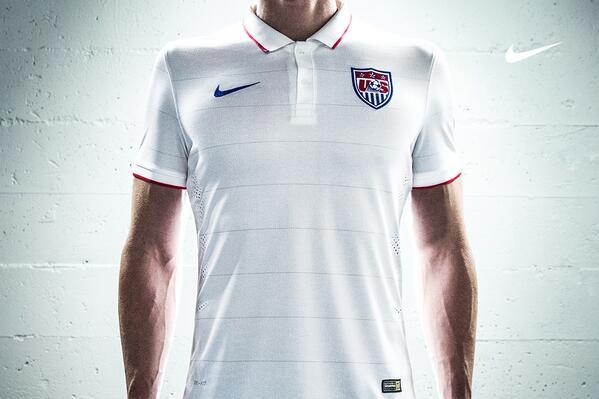
US soccer jersey 2014

As there is little media crossover between the golf and soccer worlds, allow me to relate one such news nugget re. the sartorial tempest now brewing over what the U.S. soccer team will be wearing when they take the field at June’s World Cup, in Brazil.

See above. Apparently this is the new U.S. Men’s National Team home jersey for the upcoming tournament, soccer’s quadrennial world championship. Notice anything familiar about it? Yep, it looks remarkably like a golf shirt — and early returns from soccernistas the world over have not been positive. See here some of the chatter the new shirt has generated online.

One could reasonably argue as to why anyone should care. But considering the blockbuster sales opportunities represented by futbol jerseys, here and abroad, it was an odd choice by U.S. Soccer and its official outfitter, Nike. There are undeniable similarities between traditional soccer jerseys and modern day golf shirts, namely the collar and button-style placket. But it’s odd that U.S. Soccer and Nike would appear to have missed the mark by two years — this looks like something Tiger Woods or Phil Mickelson would wear to Brazil in 2016, when golf makes it return as a bona fide Olympic event.

Maybe you’re like me, in that you’re a bit sensitive about golf’s less-than-stellar track record in the duds department. We’ve made some admirable progress in this regard, I think, as it wasn’t that long ago that outsiders considered golf a game for rich white guys in bad pants. It’s unfortunate enough that a) the good folks at Loud Mouth are trying to bring back utterly ridiculous trousers; and b) white belts have successfully wheedled their way back into the golf couture (somewhere, Greg Brady is laughing).

Now we have soccer fans ragging golf, indirectly, for the plain-vanilla, markedly uncool nature of golf shirts, which, thanks to clothiers like Nike, have actually come a long way.

The whole thing is a bit mystifying, and it’s hard to see how golf gains . Nike is known for pushing the envelope with its golf stylings. What could possibly have moved them to put forward something so lacking in flash? If this was an attempt at something retro, I, as a soccer fan, don’t see the reference point. I think it’s safe to say that if one can plausibly wear a soccer shirt for a round at dad’s club, and it doesn’t look out of place beneath a blue blazer, the youth market will not be impressed.


Mexico-NZ Presents Complicated Rooting Interests for US Soccer Fans

Mexico-NZ Presents Complicated Rooting Interests for US Soccer Fans

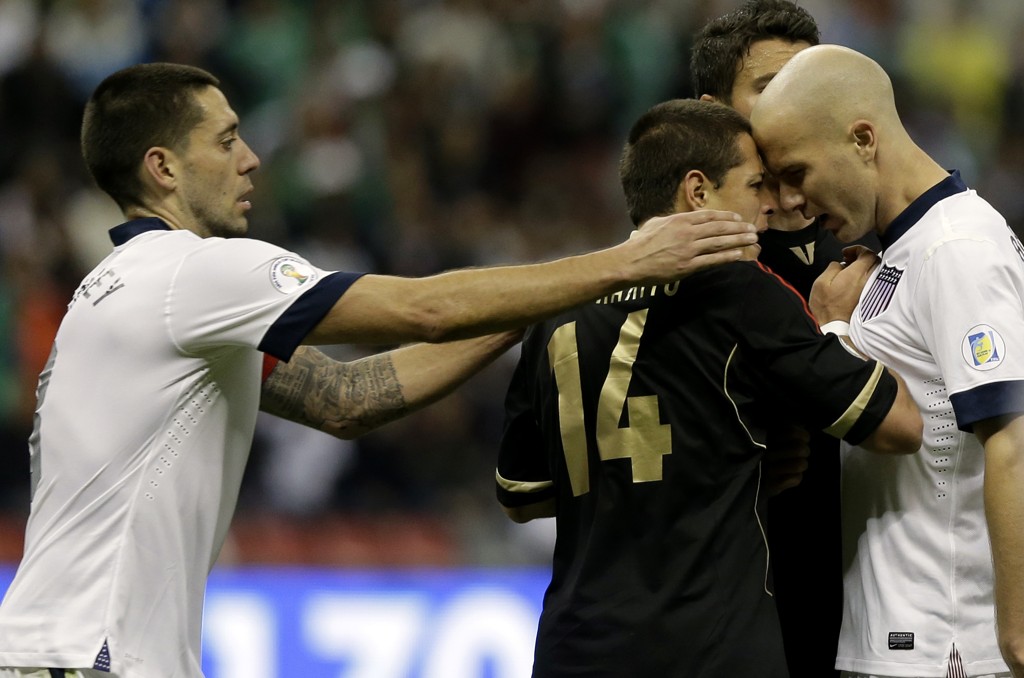
usa-mexico

An American friend will be seated in Azteca today when the Mexicans face New Zealand in the first leg of a home-and-home World Cup qualifier. Earlier this week, he and I exchanged the obligatory musings about bringing along some rain gear, or at least a wide-brimmed hat, to guard against flying bags of urine — especially once he revealed that he’d be rooting for the Kiwis. All well and good to be so declaratively brave in a Facebook exchange; we’ll see how overtly manifest his support will be when the whistle blows.

There are, of course, myriad dramas swirling around the Mexican capital today, as El Tri desperately attempt to punch their tickets to Brazil and quell a national anxiety that has raged for months. Our neighbors to the south stumbled badly throughout CONCACAF’s Hexagonal qualifiers. The security blanket of Stadio Azteca — a place where Mexicans had, until this summer, lost only one time in World Cup qualifying history — has been shredded. They’ve gone through three coaches in three months. Mexicans view World Cup qualification as a birthright, but were it not for the Americans’ last minute victory over Panama in the final qualifier, El Tri would have already been eliminated.

But my friend’s decision to go south and root for the Kiwis begs a more nuanced, decidedly North American question: Should U.S. soccer fans be rooting for the Mexicans today, and next week, when the second leg is played in Auckland?

Yes, the Mexicans are our most bitter regional rivals. But they also represent our confederation, and their failure to qualify would diminish CONCACAF, perhaps diminish the region’s automatic qualifying places for the 2018 World Cup, and certainly diminish this summer’s tournament.

It’s hard not to admire the Kiwis and their grit: They were the only undefeated team in South Africa 2010, grinding out three desultory draws. But the Mexicans — with their hordes of traveling fans, attractive style, outsized national expectations, and seeming inability to play for desultory, low-scoring results — would be the clear choice of neutrals the world over.

But are we, as U.S. soccer supporters, neutrals? Just what are our obligations here?

These questions cannot be soberly addressed without first considering how Mexican fans might react were the roles reversed, for they are anything but neutral on the subject of U.S. soccer.

Let’s boil it down: They hate us.

There is indeed no nuance here for the Mexicans. For 24 hours, perhaps they appreciated the fact that our win in Panama — actually, a tie would have done it — saved their bacon, enabling this last-ditch qualifying opportunity vs. New Zealand. But they don’t give a damn about the confederation or its reputation: If the roles were reversed, the Mexicans would be rooting for New Zealand.

The U.S.-Mexico rivalry is completely unique in this respect: I can’t think of another example where the vitriol is so one-sided. They don’t see the rise of U.S. soccer these last two decades as a boost for CONCACAF, or a means to better prepare their own teams for World Cup performance — an issue of longstanding for the Mexicans, frankly, coming as they do from such a notoriously weak confederation. They don’t see a true rival here in North America as remotely interesting or worthwhile. They don’t see the positive impact of Mexican-Americans — on U.S. rosters, on our style of play — as an ego-boosting reflection of their own soccer prowess.

Mexicans see the rise of U.S. soccer as an affront.

El Tri have even gotten in the habit of playing friendly internationals in the U.S., where huge numbers of expatriates guarantee a sellout — and max revenue for the Mexican Football Federation. For fans of the national team living in Mexico (which is to say, the entire country), this is viewed as yet another indignity.

Soccer is one of the few things Mexicans have always been able to lord over their rich, voracious, imperialist neighbors to the north: tequila, daytime soaps, proper tortillas and futbol. These are people who still revile Landon Donovan for discreetly taking a pre-game piss on a Guadalajara field — 9 years ago. In a youth tournament! They viewed it, and continue to view it, all these years later, as a willful desecration of Mexican soil.

Mexican fans wish us ill, and this broad, cultural dynamic clearly spills over to the players themselves, who understand they are expected to win against the Yanquis, and win big. Failure to do so will subject them to ongoing, perhaps lifelong harassment from their own fans and media. It might cost a coach his job or a player his place in the national team.

There is no real pressure for the U.S. team to perform against Mexico. There is no day-to-day job security at stake, no broad ramifications. Soccer doesn’t yet mean that much to Americans, culturally. That’s not the case for Mexico. In fact, it’s just the opposite.

Watch the Mexican players the next time they face the Americans. After the national anthems, when they make their way down the line — shaking hands as part of the FIFA-mandated, pre-game ritual — there are no smiles and niceties exchanged, not from the Mexicans. They are stoned faced because their compatriots are watching them, ready to pounce on idle chumminess. Observe them after the game ends. If the Mexicans should lose, many pointedly refuse to shake their opponents’ hands. This is very bad form according to the etiquette of international futbol especially. But they know what’s at stake. They can’t afford to be palzy-walzy with the Yanquis — Mexican fans and media would not stand for it.

In fact, should a Mexican player present an American opponent with a truly cheap shot — like the time Ramon Ramirez kicked Alexi Lalas in the balls, in 1997, or when assistant coach Paco Ramirez bitch-slapped Frankie Hedjuk after the Americans eliminated Mexico from the 2002 World Cup — he is hailed as a kind of hero.

I’m torn on this subject, because the U.S.-Mexico rivalry is littered with this sort of bullshit behavior from the Mexicans. But I understand their emotional response, even if I don’t respect it. They’re toting baggage that I legitimately cannot imagine.

Indeed, I find myself rooting for the Mexicans when they’re not playing the U.S., in the same way I will surely root for the Hondurans this summer in Brazil.  They are North Americans, after all. They carry the banner for soccer in this part of the world. They play with flair, to win. The Mexicans in particular truly do add something to a big tournament, in a way that New Zealand never could.

So, my friend is on his own down there in Mexico City today, as I — and the 100,000 on hand in Stadio Azteca — will be rooting for El Tri over this two-legged qualifier. And part of the reason is, I know this sort of behavior will confound and piss off our Mexicans brothers all the more.

FootGolf? Yes, FootGolf. Where Do I Sign…

FootGolf? Yes, FootGolf. Where Do I Sign…


Here’s all I have to say about the advent of FootGolf: “It’s about freakin’ time.” Anything that essentially combines my two favorite participatory sports — and knee-high argyle socks — has my full attention and support.

I knew there was something out there like this, but until I read this piece, I had no idea it was so well developed, and so intrinsically awesome. As a devotee of disc golf, I embrace the game in all its alternative forms. But this one takes it to a new level. There’s even a rule book, to be consulted in the event one’s approach hits the pin and ricochets backward into a lake. (Of course, if that should happen, the ball would be floating on the surface and could presumably be retrieved, prior to a legal drop).

Soccer and golf have a long and distinguished history together. There’s the dreaded foot wedge, of course. And there was that time Alan Shearer played through our group at Gleneagles. I’d love to see him hole out with a proper foot wedge and run the length of the hole with his signature hand held high.

Check out more information here. There’s apparently a FootGolf facility in Las Vegas, but that’s awfully far away. If anyone out there knows where this activity can be pursued here in New England, I’m all ears. After all, there was a FootGolf World Cup held in Hungary in 2012. I now have my sights set on 2016.

Counterintuitive Historical Trends Tumble at Euro 2012

Counterintuitive Historical Trends Tumble at Euro 2012

Maybe it’s my peculiarly American viewpoint (read: spotty historical perspective on all things European Championships pre-1984) but it’s striking to consider that Spain, until it drained the soul of France today, 2-0, had never beaten the French in a competitive match before today. Ever. Even in a qualifier or something? Yes, never. The French have won trophies and, like Spain, was a top-class side for a long time before it finally did win something, but surely the Spanish, defending Euro and World Cup champions, had managed to beat France at some point, somewhere. Apparently not.

I read, too, that Spain has never beaten Italy over 90 minutes, ever, only on penalties (in the quarters at Euro 2010). There’s a mind-blower.

Somewhere I read similarly that Germany had never beaten Italy in a major tournament, i.e. the Euros or World Cup. Germany. Actually, to be fair, I think it was some German football dignitary who had opined that in “big matches”, knock-out games, Germany had never beaten Italy — and so they looked forward to the opportunity in the approaching semi should The Azzurri take down England Sunday. But still, I had just assumed that the holes in my own historical knowledge of past Euro and World Cup encounters would account for the one time Germany had surely ousted Italy from a major tournament. The Mannschaft’s nearly alien efficiency in grinding out tournament results alone should account for one win, even against the Italians. Apparently not.

Makes you wonder what sort of chance the English really have on Sunday, in the last of four quarters. After all, I learned recently of another fascinating historical tidbit — that England had never beaten any past World Cup or Euro champion nation outside Wembley Stadium in a major competition, other than Denmark. The lengths to which some stat freak went to gather that obscure, apparently true factoid dampens one’s awestruck wonder just a bit. But in another way, it remains incredibly telling. Basically, as the English have never won any tournament other than the World Cup (at Wembley), they’ve also never beaten any truly elite time, at any time, in any major tournament, anywhere but North London. Except Denmark of course.

It seems clear to me that these footballing heavyweights could not have played that many times over the years — that’s one reason these “records” have, counterintuitively, lasted as long as they have. England and Italy, the nation that claims to have invented the game and the four-time world champions, have met only twice before in major tournaments, never on neutral soil, and only four times in qualifying games for major competitions. The Germans have played Italy 27 times in 89 years, the vast majority being friendlies and qualifiers, as opposed to Euro semifinals or whatnot. Telling to note that Germany’s overall record vs. Italy is a paltry 7 wins, 14 losses and 6 ties.

Clearly there are some major historical forces being put to the test on Europe’s eastern frontier this summer. Spain has slain one demon in France. England and/or Germany will have the chance to slay another later this week.

Try To Ignore Mario Balotelli. I Dare You

Try To Ignore Mario Balotelli. I Dare You

Why IS it always Balotelli? Missed in the stupefying events of extra time vs. QPR was Mario’s super touch to free Khun Aguero for the Prem-deciding tally. His insertion at 75 minutes, or whenever it was exactly, surely rolled millions of eyeballs around the world. Yes, Roberto Mancini should be applauded for swallowing his pride and running out both Mario and Carlos Tevez after saying they’d never play for the club again. But Balotelli has, by turn, been a moribund and distracting force in 2012. There was no reason to play him. Only desperation-laced necessity brought him on Sunday afternoon, late, along with Dzeko, against 10-man Rangers. But few men can so effectively and quickly put to rest all the psycho-vainglorious-marketing issues we might have with the guy. (Joey Barton should be so lucky). Whatever the packaging, Balotelli makes it happen. His possession at the top of the box, his lunging toe-poke to Aguero… Both touches were brave and deft. (All credit to the Argentinean for exhibiting the cool not to shoot straight away; Taye Taiwo would surely have been blocked it.) Balotelli has again shown himself to be that rare footballer who at once repels and attracts us neutrals. It’s not always him. It’s just that he’s so very good enough, often enough, that we genuinely want to see what he does next.

Whitbread Headlines Intriguing TV Saturday for US Soccer Nuts

Whitbread Headlines Intriguing TV Saturday for US Soccer Nuts

Keep your DVRs at the ready. The U.S. Men’s National Soccer campaign is done for 2011, but that doesn’t mean we can’t check on the progress and form of key individual squad members, as they toil for European clubs and, in some cases, strive to catch the eye of American coach Jurgen Klinsmann. Indeed, Saturday, Nov. 26 provides us three televised games on the trot, all featuring Yanks abroad worth watching.

The most interesting game, the one I’ll be watching closest, is the 10 a.m. EST tilt featuring Norwich City and Queens Park Rangers on Fox Soccer Channel. Not the most compelling or glamorous match on its face, but it’s hoped here that City’s Zak Whitbread, the central defender and Houston native, will earn a start in the Canary back four. Whitbread is not a household name. He’s bounced around England’s lower divisions for some time. He’s no spring chicken, either: 27 years old, meaning he’d be 30 by the time Brazil 2014 rolls around and, so, hardly a more youthful alternative to either Carlos Bocanegra and Clarence Goodson. Klinsmann’s current top choices at center defense have not wowed anyone with their pace nor their ability to play the ball confidently and creatively out of the back. I’ve no idea whether Whitbread is a serious alternative to either one, but how may other Americans are playing central defense for EPL teams nowadays. Who is this guy? Whitbread spent most of his life in England and Singapore (his father, Barry Whitbread, was the coach of the Singapore national football team in the late 1990s). He matriculated via Liverpool’s respected youth academy but never caught on with the senior club. He played at Millwall and now he’s at Norwich. I can’t say that I have any real familiarity with this guy’s game. I’ll be looking to change that  Saturday.

Equally enticing is the 2:30 p.m. EST Serie A match on Fox Soccer Channel pitting Chievo against AC Milan. Michael Bradley showed everyone he deserves a place in the U.S. team with a fine performance in Slovenia last week. I think the hubbub re. whether Klinsi was somehow dissing Bradley in wake of his father being ousted as U.S. coach, in August, was way overplayed. All this fall, Bradley the Younger had been fighting for a place with his new Italian club, and Klinsi would have done him no favors by pulling him out of training for a friendly v. Honduras. Again, we don’t get to see a lot of Chievo on American television, and so we’ll see for ourselves Saturday what sort of place Bradley has fashioned for himself — against top-flight competition in Milan.

I think we know all we need to know about Clint Dempsey at this stage. He’s America’s top talent, can play anywhere in any attacking formation, and does so for both the USMNT and his EPL club, Fulham. Sandwiched between the two games noted above, The Cottagers travel to Arsenal in a 12:30 p.m. EST start on FSC. The Gunners have found their form of late, while plucky Fulham have exhibited difficulty scoring home and away. Here’s hoping FFC scores first in this London Derby, on a Dempsey goal, thereby averting what I fear could be a route.