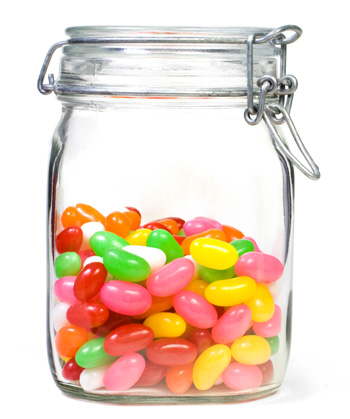
NEW GLOUCESTER (March 14, 2017) — It was the best of times. It was the worst of times… This is how confection historians will judge the prevailing American jelly bean situation early in the 21st century.
When I was kid in the 1970s, jelly beans proved a particular obsession. Commercial confectioners didn’t pay this segment a whole lot of attention back then, but neither was it hard to find them on store shelves, all year long. As the millennium turned, candy makers/marketers resolved to treat them as seasonal items, available in bounty only the 6 weeks ahead of Easter (i.e., right now). When they do arrive on shelves today, they come thicker and faster, in an ever-expanding range of flavors, many inspired by tried-and-true candy genres never before associated with the jelly bean.
Easter seems as good a time as any to parse the jelly bean’s curious evolution. Like so many things through time (a handful of jelly beans, for example), such change has proved something of a mixed bag. Twenty years into the Internet Era, on the dual continua of bean innovation and availability, many would argue we have entered a golden age.
My mother and maternal grandfather were both jelly bean enthusiasts and, to the extent availability allowed, connoisseurs. I love all candy, but I embraced this legacy from a young age. Indeed, there was an inside joke my mother and I shared on this subject, though it wasn’t so much a joke as a cover for snobbery. Basically, we derided anything but first-class jelly beans as “inferior” and, more often than not, only pectin-style bean made the grade. If we might be gifted a bag, or I might bring some home — if they weren’t up to snuff in some way — we’d look at each other very gravely and pronounce them “inferior”.
Then we’d devour them all the same.
Pectin: The Key to Superior Jelly Beans
What makes a superior, pectin jelly bean? Canners and preppers commonly used as a natural thickening agent in jams and jellies. The first pectin available for purchase was derived from apples, which are naturally rich in this complex carbohydrate also found in the cell walls of plants. It keeps them rigid and helps to regulate the flow of water between cells. You’ll note that some plants, off the vine, begin to lose part of this complex carbohydrate as they age; apples left out too long get soft and mushy, as their pectin content diminishes. When apples are perfectly ripe, they have a firm and crisp texture, mainly due to the presence of pectin.
Chemically, I couldn’t detail what the addition of pectin does or is meant to achieve in the jelly bean-making process. I can only tell you what distinguishes the finished product. The inside of a pectin jelly bean is more taut than inferior beans —the kind purveyed by Brach’s all these years, for example. The candied shell of a pectin bean is also shinier and boasts more integrity than a regular/inferior jelly bean.
Many folks are familiar with jelly beans made by Brach’s. They’ve been around forever and can still be found, year round, in places like CVS and Walgreen’s. These are not pectin-style beans. Their insides are a bit mushy. Their coatings are dull and when you press two Brach’s jelly beans together, nose to nose, each sort of smushes into the other.
Russell Stover has made a quality pectin jelly bean for decades. When you press two Russell Stover beans together, nose to nose, one will inevitably prove stronger and simply burrow into the other. The weaker coating will crack and splinter into small but identifiable shards as the pectin coating gives way. This is no idle observation, by the way. I performed this critical testing for many years, as a youth. So the world might some day better distinguish one jelly bean genre from another.
The upshot: Pectin jelly beans provides a crisper, cleaner binging experience, in line with the role it plays in ripe apples and other natural fruits. In other words, it’s the mushiness of a non-pectin jelly bean, inside and outside your mouth, that renders it inferior.
Citrus Flavors Play Well Together
Flavor is another distinguishing factor, of course. Pectin jelly beans are traditionally and primarily citrus in nature, i.e. lemon (yellow), lime (green), cherry (red), grape (purple) and orange. Russell Stover threw in pineapple (white) and grapefruit (pink), to great effect — but not all pectin bean purveyors go for these options.
Some of these pectin assortments include licorice (black) and some do not. Russell Stover never went there, for example. Licorice jelly beans are divisive. Some people love the anise flavoring in this form, others hate it. Some like them it enough but don’t want to eat licorice jelly beans with any OTHER jelly beans, as they argue licorice or anise-flavored anything doesn’t really go well with anything else. I reside in this camp.
Back in the 1970s there were dozens of independent jelly bean makers, pectin and otherwise. Some of these subtly varied products appeared in stores ready-packaged in cellophane; some were offered in bulk, to be scooped out, weighed, priced and dropped into small paper bags. These various and sundry assortments all tasted a bit different. There was no uniformity, adding nuance to the “inferior/superior” judgment.
But I think this much can be said without fear of reprisal: The primary draw of pectin jelly beans isn’t necessarily the coating, but rather that all those citrus flavors go well together. You can grab a handful and not worry about one flavor not “working” with another —save the licorice issue, which is subject to taste. Think about Skittles: Would they work if one was obliged to pluck out the black ones, or grab only those flavors that complemented each other? Not hardly. Think about any proper trail mix: It’s the ensemble of tastes that makes every handful work.
The Availability Quotient
Back in the day, Russell Stover jelly beans were solid pectin entries boasting the added allure of being available broadly. However, I remember the very best jelly beans being the diverse pectin varieties one found in simple, cellophane packets at specialty candy emporia, places like Haven’s today — Maine-owner confectioner that does a pretty darned good pectin jelly bean, licorice included. Then there was Bailey’s, an upscale ice cream and confection shop in Wellesley, Mass., where I grew up.
Bailey’s was quite a place, a proper candy shop and ice cream parlor with small, marble table tops and wrought iron chairs — the stuff of nostalgic confection fantasy. It’s long gone now but the ice cream was top notch (never soft-serve) and the candy first-rate, featured as it was behind a giant, glass-faced display case that ran the entire width of the store. It was one of those places where you stepped up into the establishment from the street, which added to its class somehow, along with the small, marble-top tables served by rounded, wrought-iron chairs. When you had a bit of cash, this was the place to get superior jelly beans, in addition to fine chocolates, traditional ice cream sodas and sundaes.
The other end of the spectrum was a plastic bag of Brach’s jelly beans, which you could find just about anywhere, despite their inherent inferiority. Somewhere in between were the bulk beans we bought at the Dandy Lion in downtown Wellesley Hills, or candy shop located in the Wellesley College student union, The Schneider Center. This place was only a 5-minute bike ride from my house and many a confection run was made to campus for jelly beans in particular — scooped from a large jar, weighed out and poured into a small paper bag.
There were other jelly bean-like products out there on the market at this time: Mike & Ike, essentially elongated, low-grade, often-stale pectin jelly beans that came in a box; Good ‘n Plenty, the all-licorice cousins to Mike & Ike; Brach’s offered a “spiced” version of its jelly beans (never a favorite of mine); and then there were Skittles, which debuted in the U.S. in 1979. These were and remain undoubtedly jelly bean-esque but their shape, thicker pectin shells and chewier insides set them apart. I’m not sure anyone dislikes Skittles, but it’d be a stretch to call them “jelly beans”.
Enter the Jelly Belly
The late 1970s brought radical change to the jelly bean universe, not necessarily for the better. Jelly Bellies debuted in 1976, but I wasn’t aware of them until I went off to college in 1982.
Like Skittles, Jelly Bellies were, without a doubt, an innovation. These were small, quality pectin specimens whose manufacturers pioneered the selling of beans in a wide array of fantastical flavors. At first the novelty of a buttered popcorn- or peppermint stick-flavored jelly bean might have seemed inviting and fun. Some varieties really worked (watermelon) while others most assuredly did not (bubble gum). However, it’s difficult not to applaud the creativity of this completely new take on the milieu. If I’m not mistaken, Jelly Bellies also pioneered the flavoring of both the candy coating and the jelly within (a technique borrowed from Skittles perhaps). This provided a very strong taste the likes of which one needed, presumably, to pull off something like a Dr. Pepper jelly bean. One cannot hope to do such a thing, convincingly, via a flavored coating alone.
The problem came, it says here, when one tried to eat a sour green apple Jelly Belly as part of a handful that includes others flavored of buttered popcorn, margarita, strawberry cheesecake, chili mango and Dr. Pepper. As we were prone to intone during the 1980s, “Gag me.” No spoon was required. In specialty stores one could scoop out and buy a bag of entirely one flavor, or one could buy/mix them according to personal taste — for lemon drop and raspberry surely do go well together.
Alas and all too often, Jelly Bellies were purchased —and continue to be packaged for broad commercial sale— in pre-packaged bags where a dozen different flavors are represented. Sorry, but that’s just too many disparate flavors to be consumed by the handful, the way one is meant to eat jelly beans — by grabbing a bunch and popping 2-3 at time, confident that no matter which 2-3 you randomly pop, they will work together on a flavor-compatibility level.
Sadly, because they so often don’t work together on this level, one is obliged to eat Jelly Bellies individually, savoring those tastes Jelly Belly does well and cursing the rest. Jelly beans, in my view, were not meant to be consumed in this anal-retentive fashion. It’s just not practical.
I must be alone in this, or part of a distinct minority, for Jelly Bellies proved so popular that nearly all the independently manufactured pectin varieties disappeared over the next two decades. Russell Stover has hung in there, but for years starting in the mid-1980s, I would go into candy shops and scan the dozens of clear-plastic, bulk-Jelly Belly receptacles seeking a citrus-only mix of pectin varieties — or the independently produced cellophane packets of yore. No dice. They weren’t there, either on account of low demand or competitive pressures from Jelly Belly, whose corporate overlords might well have leveraged their popularity to insist that stores only carry its product.
A Millennial Change in Marketing
I’m not exactly sure when the game changed, once again. Methinks it was on or around the millennium, as candy makers began to leverage their various brands (and tastes) by putting them to work in divergent confectionary contexts. I can’t prove it, but I think Reese’s Pieces pioneered this dynamic — deftly rendering the taste of a peanut butter cup in M&M form. Yes, this approach is derivative, but in many cases — the Snickers Ice Cream Bar, for example — it really works.
A further, related development took hold in the early 21st century: Candy purveyors began to prioritize limited-edition sales — a strategy I recognize but don’t completely understand. Suffice to say, in many cases candy mongers today don’t strive to sell us a particular candy all year long, forever. Much of this dynamic is seasonally driven. For example, Corporate Candy is content to distribute jelly beans only on or around Easter, once the Valentine’s Day season has conclude. Surely you’ve recognized other examples of genre-twisting and specialty packaging that come and go in concert with Christmas, Fourth of July, Halloween, etc.
Other limited-edition offerings would appear to arrive in stores and disappear quite randomly: the dark chocolate Kit Kat and the Pina Colada Almond Joy, for example. Some of these innovations must test or sell particularly well, because they remain consistently available (the dark chocolate Milky Way is frankly a huge improvement on the original; following its limited-edition introduction, it’s now available 7/24/365). Others show up in some special-offer bin for a time, only to disappear a week later without a trace.
As confounded as I am by the inner workings of this phenomenon — and loath to extoll the virtues of a St. Patrick’s Day-inspired mint Three Musketeers — I’m here to tell you the jelly bean segment has greatly benefited from this confluence of candy marketing initiatives. We may not see all these new entries on store shelves but for a few weeks each year, as winter segues to spring. But they are welcome additions to a genre too long starved of innovation and hamstrung by the misguided Jelly Belly Syndrome. To wit:
New jelly bean innovation
Starburst Jelly Beans — A prime example of a distinct candy taste brilliantly adapted to the jelly bean genre. Like Jelly Bellies, Starburst beans use both a flavored center and flavored shell to maximize taste. Tart and admirably pectin in composition, they trade on the winning Starburst flavor spectrum while providing the ability to eat by the handful — every flavor goes with the others. Indeed, this is a step up from Starburst chews, whose squares are rarely eaten together. There’s too much unwrapping and chewy mass for that exercise. One might not have realized that all the Starburst flavors work so well together, but they do. Oh they do.
Jolly Rancher Jelly Beans — There’s nothing quite like the taste of a Jolly Rancher, though it’s hard to describe precisely what distinguishes its essence from other hard candies. There was something distinctive about Hawaiian Punch that is similarly hard to pin down. Whatever it is, this distillate has been successfully rendered in jelly bean form, and an appreciative public applauds. JR’s signature green apple and watermelon tastes perform exceedingly well according to the handful test.
Lifesaver Jelly Beans — A let down, but this should come as no surprise. Lifesavers were considered a banal, has-been candy choice as far back as 1975. Even 35 years ago, they were seen as something one’s grandparents might prefer. Nostalgia is surely another arrow in the candy- and snack-marketing quiver these days, but I’d bet that Lifesavers are simply too far gone, their fans too many deceased, to save the brand and its jelly bean incarnation.
Sweet Tart Jelly Beans — Here was an entry that really got me thinking about how sophisticated and nostalgia-driven these cross-over jelly beans had lately become. Everyone loves a Sweet Tart, and coating a jelly bean with its essence has proved a master stroke. These are definitely not pectin style beans; the coating is more cakey/chalky, as a Sweet Tart should be. But they pass the handful test and taste like no other jelly bean out there.
I’m surely missing some of the new beans on shelves this Easter season, though I’ve personally seen entries from Laffy Taffy, Black Forest (organic), Welch’s, Just Born, Gimbals (real fruit juice!), Unicorn Poop, Mike & Ike (who have very much upped their game since 1974), SourPatch, Swedish Fish and Nerds. A recent version of the Bertie Botts Every Flavor Beans, inspired by the Harry Potter series, features flavors described as “earwax, dirt, pepper, and vomit.” As polarizing as it’s been within the larger jelly bean culture, Jelly Belly also continues to innovate: On Amazon, I see new offerings ranging from the sublime, SunKist Citrus Mix, to the ridiculous — Krispy Kreme, pancakes & maple syrup, and “Sport Beans” loaded with “energizers”. Even Brach’s has been obliged to modernize and expand its product line with pectin offerings; they insist on calling these and all their products in this category Jelly Bird Eggs.
I’m not sure when the jelly bean universe has ever been so wide, and I’m intrigued by some of the larger questions begged by this bounty. For example, what distinguishes a Mike & Ike from a Mike & Ike jelly bean exactly? Shape? Some canny young GenZer is probably working up his/her/their doctoral dissertation on this subject right now. Here’s hoping that marketers/manufacturers continue to plumb these depths, as well, trading on different aspects of the candy culture, and the culture at large, to better devise and sell product.
Jelly Beans on Demand
For a time, none of this innovation, academic or commercial, worked effectively toward solving the seasonal-availability issue. It remained damned difficult to find even Russell Stover jelly beans on store shelves after April 15 or prior to February 15.
The key phrase here, as we dash headlong into the confectionary future, is “on store shelves”. Who needs shelves in the Internet Age?
A few years back I got the strong urge for some proper jelly beans, off season. Having been foiled, again, by several Russell Stover store displays that featured nothing but chocolates and such, I went online. Turns out one can easily order Russell Stover beans direct from the factory. So I ordered a few bags and enjoyed them 2-3 blissful weeks. Just be sure not to schedule these binges within 2-3 of a blood draw, lest you hazard the Type II Diabetes lecture. True story: I moved my annual physical and its associated blood-sugar tests to July, from April, so Easter would not skew such results.
Suffice to say, if you want any sort of jelly bean on the market today, odds are good you can procure them online, direct from the manufacturer or via mass retailers like Amazon. This is dangerous for those, like me, who love jelly beans and do combat low-grade blood-sugar issues. But this development has effectively solved the seasonal-availability issue — for those who manage a serious jelly bean jones.
Internet retail has changed the way we shop for most everything, decimating brick-and-mortar storefronts and retail employment rolls worldwide. One hesitates to hold up jelly bean availability as any sort of silver lining. However, high-quality beans, in expanding varieties, essentially on demand, delivered straight to my door? How do we not call that progress?
Postscript, June 2026
In the weeks leading up to Easter 2024, I read somewhere that Russell Stover would no longer produce its pectin jelly bean product. This, as you might imagine, landed like physical blow. Upon investigation, I learned that the Vermont Country Store had purchased the entire existing stock of jelly beans from the derelict manufacturer. An immediate mail order was placed. Two bags arrived 3-5 days later.
By March 2025, when I checked back, the VCS stock had been exhausted apparently. They were hawking their own jelly beans and I couldn’t go there — not until a suitable period of mourning had elapsed. In confirming the timing of these post-Russell Stover developments, I noticed a Facebook post bemoaning the pending loss of these standard-bearing beans. One woman assured the thread that See’s Candy makes a good jelly bean. Ten minutes later (at this writing), three bags are on their way…