Category Archives

87 Articles
New Links, New Rough, New Sleeve: Doonbeg Could Use Some Old-Time Greenkeeping

New Links, New Rough, New Sleeve: Doonbeg Could Use Some Old-Time Greenkeeping

It’s been a couple years since I played Doonbeg Golf Club, Greg Norman’s “new” Irish links in the southwest of the country. I’ve thought about it quite a bit since because, well, a lot folks have played it too — it’s just south of Lahinch and just across the Shannon River from Ballybunion and Tralee — and we’re headed back to the Emerald Isle next week. Doonbeg GC is also coupled with one of the finest on-site golf hotels anywhere in the world. So it’s natural to stay at Doonbeg and play the course at least once during a weeklong tour of this stupendous golfing corner of Ireland.

That’s pretty fast company to keep, and Doonbeg is a new course, not even 10 years old, so perhaps it’s not surprising that it tends to suffer by comparison. I don’t see it frankly. I found the terrain, the routing and the greens to be of a very high quality, design-wise. Doonbeg is, as its critics contend, very difficult to play. Too difficult, one could argue, but I’ve decided this judgment has very little to do with the design.

Agronomics are important to the maximizing of any course design, but maintenance of the outlying areas on a links course is particularly crucial. We saw what an overzealous fertilization program could do to the best players in the world during the famous train-wreck at Carnoustie in 1999, and this is the nub of the issue at Doonbeg. The dunes through which the fairways quite masterfully weave here are covered with a thick matting of ball-eating, deep-green fescues. My opening drive at Doonbeg landed in the fairway and bounced some 5 yards into the rough, never to be found. I’ve heard tell that Norman himself lost 10 balls during his inaugural round. That’s nuts, and one begins to understand why even those players far better than I tend not to leave Doonbeg with that warm fuzzy feeling we expect following a round on the coast of Ireland.

I had played Lahinch the day before. As is my custom, I drove the ball all over the map. But the outlying areas at Lahinch were quite different, featuring as much brown matter as green. The fescues were high but sorta wispy. I found a dozen of my wayward balls in there and nearly always had a swing, albeit a recovery swing, at most every one. That’s what more than a hundred years of expertly burning off the rough can produce: The perfect balance of playability and penalty. Doonbeg is simply not there yet.

Will it get there? A murkier question, that. Despite the fact there had once been an ancient links on the site, Doonbeg’s modern development came with caveats. The club rightly touts what is a heavy emphasis on organic maintenance practices, but I’ve heard from several people in the know that Doonbeg isn’t free to do everything it would like in caring for these rough areas. I doubt very much the crews are fertilizing them, at all, but I’d bet they’re not allowed to burn them off as often as they’d like. Like I said, I played there two years ago and I’d wager they had never been burned off.

You gotta figure that today not every British course superintendent who graduates from turf school, or leaves his various course apprenticeships, with a working knowledge of how to properly burn off the rough on a links course. Not any more (and, of course, not every course in Britain is a links; most are not). Methinks the crazy-thick rough at a place like Doonbeg, or at Sand Golf Club (a fabulous Steve Forrest-designed “faux” links, which I played in Sweden the week before Doonbeg) is more the result of agronomic stricture, or a lack of ancient know-how in our modern age, than design intent. Here’s hoping it’s the latter, and it is ultimately overcome, because Doonbeg (and Sand) are both awesome tracks in need of, well, a trim.

Curmudgeon talks Asia, Tiger, galleries with Kessler

The Curmudgeon, a.k.a. Hal Phillips, made a guest appearance Feb. 22 on Peter Kessler’s “Making the Turn”, a fixture on the PGA Tour Radio network (XM 146/Sirius 209). As a guest on someone else’s show, he kept the ranting and complaining to a minimum, but there was nevertheless lively conversation on the state of the U.S. Tour galleries, the rise of Golf in Asia, the transition of media outlets to web formats, course ranking, Tiger Woods and more. Enjoy.


Bali Nirwana stands as epic coda to a golf season
The 7th at Nirwana needs no hype. Note Tanah Lot temple at left.

Bali Nirwana stands as epic coda to a golf season


The 7th at Nirwana needs no hype. Note Tanah Lot temple at left.

It may well be that I’ve played my last golf round for 2010. This is the reality of Maine residence. However, if that’s the case (and I’m not invited to Augusta National next week), I can say that my golf season went out with a bang. I finished par-par-birdie-par after an otherwise dreadful scoring display, but it was the venue, and the finishing holes at said venue, that provided the epic coda to my golf year.

I had toured Bali Nirwana Golf Club two years prior. (Yeah, I know: why go all the way from Maine to Bali and merely tour one the top 3-4 resort tracks in all of Asia-Pacific, what many feel to be Greg Norman’s best work? It’s a long story. And this is a blog, wherein I’m supposed to be concise and punchy. And look how long I’ve gone already…) Well, I played Bali Nirwana this time and it’s something, boy. The kind of course that keeps you thinking about golf all through the long New Gloucester winter.

There are 13 Hindu temples located out and about on this diverse routing, and just off the cliff-to-cliff, 185-yard par-3 7th sits the oft-photographed island temple at Tanah Lot. It’s right there, just offshore, perched on its own rocky cliff, and the devout wade out at sunset in the hundreds amid a faintly orange, billowing cloud of incense. A moving scene. So moving I drilled a 5-iron to 20 feet. Then birdied the next.

As Mickey Dolenz once said, I’m a believer.

There are four more seaside holes at Nirwana nearly as good as the vaunted 7th, and a dozen strong inland-jungle holes on terrain that made it pretty darned incumbent on Norman to conceive killer golf holes. It’s riven by rushing streams and bounded by working rice paddies, which are elegantly tiered and in several spots integrated into holes as hazards. Pretty cool. Then there’s the long and superb par-4 4th playing along a plateau that takes you way up high all of a sudden, with long views to the sea. The opening hole plays gracefully up and around a hillside of rice cultivation, capped by a bold pod of steep-faced bunkers at the elbow. When I toured the course I was struck by how hard an opening hole this seemed to be. When I played it, I found it plenty generous out right of all this eye candy. I also loved the hole; the green is cleverly sunk beside a brook. There’s nothing like putting with the sound of water rushing by. There’s a lesson here on the matter of touring vs. playing a golf course.

We played the back nine first and finished on the front side which, to be honest, is the way the golf course is mostly dramatically routed — for chops like myself and tournament studs. This sorta matters because Bali Nirwana GC, part of the swank Pan Pacific Nirwana Bali, is under new management as of July 2010. They have big plans for place. Big televised-tournament plans, and the two pros I played with — new Bali Nirwana Director of Golf Paul Lightbody and Howie Roberts, his counterpart at the sterling, new Norman-designed Danang Golf Club in Vietnam — both felt an event would better finish on the front side, as it were, along the Indian Ocean at 7, and home to the 9th green with its natural amphitheater setting.

That the amphitheater is tiered with working rice paddies speaks once again to what makes the course, and the experience on that course, so memorable. Enough to last a winter.

Thai Golf: Cost vs. Benefit

It’s impossible to discuss Thai golf without offering some manner of cost-benefit analysis.

Eighteen holes at Chiang Mai Highlands or Banyan Golf Club will run you about $75, plus a caddie fee of $10. Green fees are a bit more expensive around Bangkok and Phuket, a bit less expensive in Pattaya and Hua Hin — but you’ll never pay more than $100 a round, which stands in stark contrast to resort green fees in North American golfing hubs.

The equation as it relates lodging is perhaps more revealing. Forget about golf for a moment: Thailand is the premier holiday destination for Asians, full stop. As such, the hotel stock here is enormous, diverse, and features all the brands you recognize and trust (Marriott, Sheraton, Hilton, etc), plus a few more you should get to know (Anantara, The Peninsula, Mandarin Oriental). Yet most 5-star rooms don’t exceed $150, especially as part of golf packages, and you can find very functional lodgings for less than $50 a night, if you so choose.

Our tour operator, Golfasian (golfasian.com) booked all our golf and hotels, plus a driver and van to ferry us back and forth. Our boutique hotel in Chiang Mai, The DeNaga, is an example of the high lodging standard in Thailand. Though technically a 4-star lodging (due to its lack of a full-size pool and conference facilities), it was nothing short of elegant with spacious rooms, great service and free, dependable WiFi (Fact: Starting at midnight one evening, I conducted an entire, 3.5-hour fantasy basketball draft via Skype from my room at the DeNaga, without incident). Our rooms there were but $100 a night.

It’s true that airfare to Thailand can run anywhere from $1,000 to $1,500. Yet over the course of a week, the savings on golf and lodgings in Thailand dwarf whatever premium international air travel to Bangkok might be, when compared to domestic U.S. airfare. One must ask himself this, too: How much does it cost to eat and drink in Phoenix, in Myrtle Beach, in Palm Springs? The average cost of a first-class meal in Thailand is no more than $12 per person; beers are $2 apiece. Double or triple those figures for almost any North American golf destination. Over the course of 7-10 days, that really adds up.

In Thailand? Not so much.

We could compare the world-renowned nightlife in Bangkok, Pattaya or Phuket to the nightlife in Phoenix, Myrtle Beach or Palm Springs. But that’s hardly a fair fight, and not so much a matter of dollars and cents. More like night and day.

For more information on Thai golf vacations, visit www.golfasian.com and www.golfinakingdom.com

The Curmudgeon: Golf’s Most Bracing Pod

The Curmudgeon: Golf’s Most Bracing Pod


We know how it is. You like your golf. You might even love it, but the game’s fawning media echo chamber leaves you cold, and often woefully ill-informed. Perhaps The Curmudgeon — the golf podcast that dares speak truth to power — is for you. Join host Hal Phillips and a panoply of journalists who aren’t afraid to put their access at risk. What’s more, you don’t have to wear a collared shirt to listen in.

Inside this Special PGA Championship pod:
• Should the Masters really be a Major?
• Sartorial Screed: The Case Against Cargo Shorts
• What are the spoils of Ryder Cup hospitality exactly?

2010.08.12 The Curmudgeon

The Golf Tee & Dentistry: Now it can be told
The Aero-Tee: shaped like a giant, inverted, tri-cuspid fang.

The Golf Tee & Dentistry: Now it can be told

Some golfers look at things the way they are and ask “Why?” Dr. Venanzio Cardarelli dreams of things that never were and asks, “Could you open a little wider please?”

Cardarelli, a practicing dentist who holds some 20 different U.S. patents, is the D.M.D. behind the Aero-Tee, a three-pronged, polycarbonate, cuspid-shaped ball platform that he hopes will revolutionize the golf tee genre. It’s a pretty neat little gizmo and a real step forward, if all the independent testing is on the level (see results at www.aero-tee.com). The product’s tri-fluted, helical support structure is designed to reduce resistance by all but eliminating surface-area contact with the golf ball. According to Cardarelli, 55, this scheme also increases the amount of air accelerating all around the ball — including beneath it.

While the new Aero-Tee departs quite radically from traditional golf tee architecture, its designer does not. In fact Cardarelli continues a long, distinguished and quite curious tradition of dentist-assisted golf tee design innovation. To wit, the wooden golf tee was invented by a Boston dentist, Dr. George Franklin Grant, in 1899, and the tee design most commonly utilized today was patented in 1924, by Dr. William Lowell — a New Jersey-based dentist.

Forget for a moment that Cardarelli’s Aero-Tee, if viewed upside down, bears vague resemblance to a mighty tri-cuspid fang, roots and all.

What is it about the practice of dental arts that spurs an interest, much less sustained structural innovation, in golf tees?

The Aero-Tee: shaped like a giant, inverted, tri-cuspid fang.

“Maybe Grant and Lowell were talking to me from the grave,” laughs Cardarelli, who lives in Plymouth, Mass., and practices four days a week in nearby Braintree. “Honestly, I didn’t even know these guys existed until after I came up with the Aero-Tee. I was just addressing the shortcomings of conventional tees in my basement and came up with this model. Why dentists and golf tees? That’s a tough question. I was just trying to fill a need.”

No pun intended?

“That’s right!”

Cardarelli’s enthusiasm for the Aero-Tee is evident the moment he launches into his rapid-fire, heart-felt spiels on the quest for acceptable tee stability and, of course, polycarbonates strong enough to avoid undue breakage. Yet prior to our conversation, he appears not to have considered why dentists have historically formed the leading edge of golf tee technology. “It’s a very interesting question,” muses the good doctor, slowing down to ponder the matter. “Maybe we look at things with a finer-tooth comb than most people. We do deal with very small increments of measurement all day long, fractions of millimeters. We need to visualize and restore at these levels of fineness and quality — golf tees are created on this sort of scale.”

The morning after we spoke on the phone, Dr. Cardarelli, whose friends call him Vinnie, sent me an email. Evidently our conversation had stuck in his craw. “I am still thinking about your question, about the relationship of dentists and golf tees. Maybe the answer will come from the grave,” he wrote, before adding something he’d neglected to mention the day before: the vice president of Aero-Tee is Dr. Joseph Santelli, a close friend and fellow dentist (D.D.S., actually).

Cardarelli is optimistic about the Aero-Tee’s business prospects, though his product has been on the market a relatively short time [it debuted in early 2004] and there is significant competition. PrideSports of Burnham, Maine, produces some 85 percent of the world’s wooden tees, and golfers aren’t exactly massing in the streets and turning over cars to protest a retrograde state of the art. Most golfers believe low-tech wooden tees, despite their “resistance”, do a creditable job — and most golf courses give them away in pro shops.

That said, Pride has ventured into the high-tech, alternative tee market with its PTS Off-Set model whose design recalls a waitress holding a tray over her head. One of its three prongs is shorter than the others. According to the web literature, “for best results, aim short prong at target”.

The Tomahawx model claimed to reduce resistance by…

A product once marketed under the name Tomahawx went the resistance-free route by concentrating on the other end of the tee — the pointed end that goes sub terra. This knife-shaped point allowed the tee to pivot forward, thus reducing resistance upon driver impact.

… tipping over upon impact — without breaking.

Then there’s the Brush-T (www.brusht.com), another alternative tee product whose flat, bristle-brush platform also claims to reduce resistance and accelerate air flow beneath the golf ball. Sort of ironic that after all those years in the basement — after all those years cajoling his patients — Dr. Cardarelli never saw the golf application of brushes. “I’ve told my wife: I’m shocked that I didn’t come up with that as an alternate design,” he says somewhat ruefully. “I guess what’s really amazing is the person who invented it wasn’t a dentist.”

Indeed, the Brush-T was conceived by Jason Crouse, a South African industrial product engineer. In other words, not a dentist. However, the president of Brush-T North America, Paul Krok, while not a dentist, just happens to be president of another company, Oralgiene USA, Inc., which distributes electric toothbrushes for children. Perhaps for this reason, Cardarelli is gracious in discussing his competitor.

Or perhaps he’s just wary of being pegged as the only dentist on earth against brushing.

Three-wheeling the Vietnamese Highlands

Three-wheeling the Vietnamese Highlands

We had only been a day in Phan Thiet and, frankly, I’d have rather stayed another two. The links at Ocean Dunes Golf Club, part of the seaside Novotel Phan Thiet Resort, were superb (good enough to warrant another go-round, or two) and only a fool would have begged off one fully flaked-out day on the hotel’s long, quiet stretch of beach.

But the itinerary can be a stern taskmaster, so I kept my peace and prepared for our scheduled departure. Then, on the way to breakfast, I saw them — those motorcycles and their attendant sidecars, all neatly lined up in front of the hotel — and my ambivalence melted away. No one in his or her right mind could resist the sheer romance of 200 kilometers, by sidecar, from this tropical perch on the South China Sea to the mountain retreat of Dalat. I was glad to see that my driver, Gilles Poggi, sported a kroma, that distinctive, all-purpose Cambodian scarf. I wanted one, too. I was also hoping we could line up behind our respective machines and, at the sound of a gun, begin the journey rally style.

The reality proves more staid. The sun now peeking over the hotel façade, we slather on the sunscreen, affix our sunglasses, helmets and hats, and wait for the last of our group to return from the bathroom. Hardly the stuff of Paris to Dakar, though our three-wheelers do turn over, en masse, with a very satisfying rumble, and we pull out in precise formation, one after another, like starlettes from a 1930s-era musical follies into the pool.

Poggi, a Corsican who wears his kroma with all the Gallic élan one might expect, is a hotelier whose next project is poised to open just south of here in Ho Tram. These sidecars and their motorized escorts are his personal obsession, and he leads these trips — along with his friends in Team Camel, their touring club — as a one-of-a-kind amenity for guests and acquaintances seeking 360-degree tours of the south Vietnamese countryside.

“We started adventuring with sidecars more than 10 years ago, in Hanoi,” Poggi shouts as we travel up the coast, his voice perfectly audible above the 4-stroke din. “I had two friends who had hooked up with these sidecars. One of them invited me to go to Sapa, and I’ve been riding ever since.”

Poggi slows down and stops his narrative for the moment, to avoid a cavernous pothole. We’ve turned away from the water now, the roads becoming more narrow and dodgy with every passing kilometer. My sidecar, of course, is suspended between three points of a triangle: the two wheels of the motorcycle, to my left, and a third wheel to my right. When Poggi dodges a pothole, my carriage often passes directly over the blemish. The passenger sees it coming and instinctively braces for a jolt that never comes. This is a fine metaphor for sidecar travel: All in all, the experience is far more comfortable than one might expect.

“Later, when we moved to Phan Thiet, I decide to get one for myself,” Poggi continues. “I met a policeman who was selling one, and when I asked him how much, he quoted me a price — by kilo! So I bought one, for maybe $200 US. Later, I realized we should have another one, so we could go out as a group. I bought a second, and the policeman told me, ‘I’ll do you a favor. You buy the second and I’ll give you a third for free.’ Today, we have 11.”

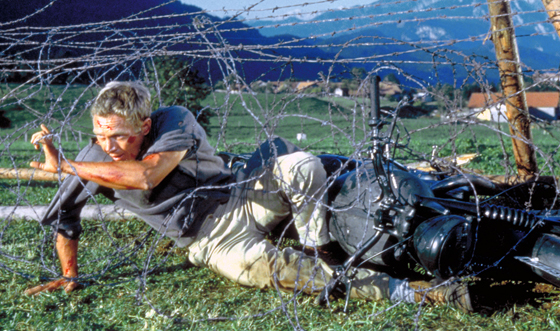
The ride of choice for Team Camel is the 650cc Ural M-72, a Russian replica of the vaunted BMW R71, a German-army staple during World War II and the very bike Steve McQueen made famous jumping barbed-wire fencing in “The Great Escape”. Urals became ubiquitous in Vietnam only after 1975, and they remain practical, Poggi says, because the Russians did a good job simplifying the design, parts are readily available, and Vietnamese mechanics know their way around them. They’ve been fixing them for 30 years after all.

In our party there are two quite spiffy, official-lookijng sidecars while the others are decorated more flamboyantly, according to the whims of individual club members. Remi Faubel, Poggi’s friend and a quite celebrated chef here in VN, drives a Ural of canary yellow featuring the snarling countenance of a large cat-like creature. Poggi and I ride a black model named for “The Ramones”. It’s an odd-but-pleasing juxtaposition, wending my way through a Vietnamese tableau with a Corsican guide, seated in a Russian-made BMW knock-off named for the proto-grungers who gave us “Sheena is a Punk Rocker”.

Having passed through a narrow shelf of level ground set aside for rice paddies, we soon set off into the highlands. We have taken the back roads where villages are fewer and further between. The Urals are working hard now, taking on steep inclines and those potholes too large to straddle. The higher we go into the mountains, the less tropical the landscape becomes. But never is it anything less than lush: 10 shades of deep green set against still darker greens.

On a tree-less plateau set high above a reservoir of sparkling blue-green, we stop for lunch which, thanks to Faubel, qualifies as perhaps the most elegant picnic ever devised by man. Holding a glass of sauvignon blanc, Poggi defends his precious Urals from the half-serious charge that they are, well, rather ungainly in appearance. “The sidecar is not a very noble piece of transportation, it’s true. No matter how we package it. But there is nobility in riding a sidecar, there is nobility in experiencing the highlands in this way, there is nobility in enjoying a lunch of foie gras and perhaps a glass of white wine.”

There’s no arguing this.
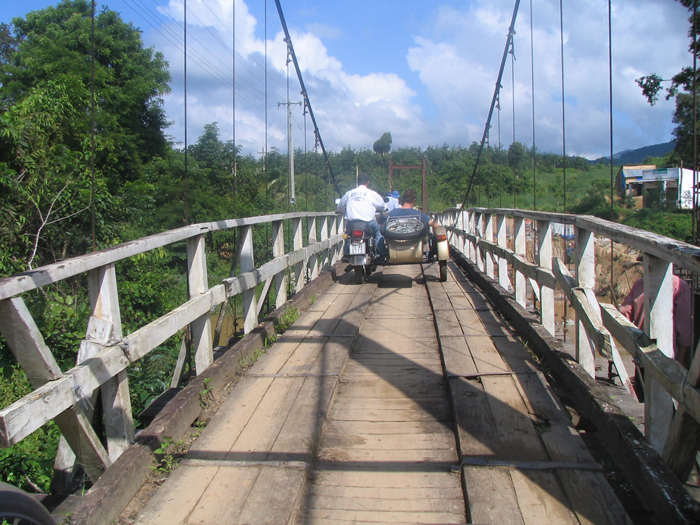
After lunch we climb ever higher into the highlands on narrow roads of the switchback variety, each one flanked by precipitous drop-offs lurking just beyond the guardrails — when there are guardrails. It’s something of a shock to see that Vietnam can be so legitimately mountainous. Two hours from Dalat we zig-zag our way up through a broad mountain pass and Poggi points to a hillside dotted with cultivated vegetation: “Café,” he shouts, lifting an imaginary demitasse to his lips. It was the first of many plantations we would pass in the next half-hour. Vietnam is now the world’s second largest producer of coffee beans, behind Brazil, thanks to elevations and hillsides like these.

As we draw closer to our destination, the roads get better and the population less sparse. For several hours, we had passed only through dusty, remote villages where locals met our odd caravan first with surprise, then with smiles and waves. In these more populous areas, our standing as curiosities is more modest. Dalat is a resort Mecca that attracts all kinds, foreign and domestic. A light rain begins to fall. We draw less and less attention as pedestrians veil themselves and we find our place amid the wider flow of traffic.
Though we’d been climbing steadily since mid-morning, the final stretch of road is the steepest yet. Halfway up this series of switchbacks, the vegetation turns again; there are pine trees at roadside now and the air sports a startling crispness, an absence of moisture I hadn’t experienced since my plane touched down in Ho Chi Minh City the week before.

The French influence in Vietnam is hard to miss, even 50 years and three wars removed, but because the French founded Dalat (as opposed to merely occupying it), this mile-high city has retained more of its Gallic character than just about any place in Vietnam. With its alpine qualities, planned neighborhoods and ubiquitous French architecture, Dalat could be mistaken for Lausanne, or Grenoble. Our ultimate destination, the Sofitel Dalat Palace hotel — surrounded by topiary gardens and verdant lawns sloping down to sparkling Xuan Huong Lake — does nothing to mitigate this sensation. Opened in 1922 and restored to the last period detail, the Palace and its fine-dining venue, Le Rabelais, evoke a level of colonial grandeur and indolence the equal of anything in Southeast Asia.

And yes, that is a golf course I spy on the hillside across the lake. Not just any course, apparently, but the one laid out in 1932 for Bao Dai, the last emperor of Vietnam. I think I’m going to like it here.

Bedecked in shorts and flip-flops, I surely looked a fright as I hoist my dust-covered frame from the Sheena Express. Had I alighted in this state from a mere automobile, I might have felt out of place. As it was, I ascend the Palace’s ornate, white marble steps in the perfect historical idiom, regretting only that I had failed to pack a tuxedo.