Category Archives

65 Articles
Pay College Golfers? Maybe on a Per-Antic Basis…
The majority of Wesleyan students during the 1980s were indifferent to sports and would've been hostile to the golf team, had they known it existed.

Pay College Golfers? Maybe on a Per-Antic Basis…

Most Wesleyan students during the 1980s were ambivalent toward organized sports and would’ve reserved an outright hostility for the golf team, had they known it existed.

The June 2021 Supreme Court decision allowing for the paying of collegiate athletes nevertheless provided little guidance as to how those athletes should be paid. What revenue might college golfers, for example, possibly generate and ultimately demand? Future touring professionals might reasonably command/accept endorsement money from Titleist or the like, but most collegiate golf programs themselves generate no revenue at all. They are essentially loss leaders at most colleges and universities. Back in 2017, Sports Illustrated reported that the University of Oregon annually budgets around $650,000 for its men’s golf team. This might still represent some time of standard for Division I college programs, but that sum is probably jolting to anyone who participated in small-college programs, which accommodate the vast majority collegiate golfers.

It’s positively mind-blowing to those of us who competed for Division III Wesleyan University during the 1980s. This was competitive golf, but it was the stuff of van-enabled matches, mismatched shirts, and the odd overnight invitational. We got paid a couple times: per diems of $5 for lunch at the Big Boy just off I-91 in Agawam, Mass.

Still, while I would never hold up my college golf experience as an argument for or against strict amateurism, neither would I trade the experience. WesGolf was an absolute blast. What stands out today, 35 years on, aren’t the personal victories (which were sadly few) but the ridiculous personalities the game attracts and the sometimes-absurd situations tournament golf continually drops in our laps. You can’t put a price tag on this stuff. At hippy Wes, where the vast majority of students essentially scorned athletics, golf kept a very low-profile. Indeed, our fellow WesKids would have surely been appalled had they known the varsity golf team existed.

•••

Two of my teammates and I recently harkened back to those days via an email roundtable. Rich “Danny” Gibbons and John Brais each shared three Wesleyan golf seasons with me. Despite what the rest of campus didn’t know or ignored, much hilarity ensued.

John Brais: So I’m in Professor Greene’s class, which is set up to produce your Senior paper, to complete your History major. We’re at his house for dinner, about 10 of us, and we’re sitting around the table, setting up the schedule to present our papers. Two separate dates: First day, five people present and the other five choose a paper to critique. The following week, same thing but reversed. Problem for me was the second week was the first day of New England Intercollegiates at New Seabury and I present this dilemma to the professor while going over the schedule, in front of everyone. I suggest that I present and critique on the same day, first week. Professor Greene’s response: “You do know, John, that I was on a committee to cancel the golf program outright as certain students have protested that to support golf, which is obviously an elitist sport, is against the moral and ethical principals that Wesleyan represents.” I replied, If these people knew the members of the golf team, I am sure they would reconsider this opinion. Professor Greene went on to say, “It is your decision to make, if others in the group agree… By the way, congratulations for the great year on the hockey team. My son and I are huge fans.” The other students were stunned.

Rich Gibbons: Talk about worlds colliding. Golf team and the People’s Republic of Wes ethos…

JB: I seem to remember we consumed several cases of beer and an assortment of doobies that trip to New Seabury.

Hal Phillips: I seem to remember that was the case any time we traveled with the golf team. There was one epic quarters game and general piss-up inside some condo where we stayed at New Seabury. Much silliness. That was the year Teddy Galo shot 75 or something on the easy course, when all the good teams were playing the gnarly Ocean Course. So he was, like, top 5 overall after Day I. He pointedly maintained a level of sobriety that night but went out and shot something in the high 90s next day. Classic.

JB: It was 102 actually.

HP: Epic. That may be the biggest spread in the history of New England Intercollegiates.

JB: Wes golf was an absolute forum for top-notch comedy. You remember that 1st hole at New Seabury, the Ocean Course, like 590 yards dead into the wind to a green about an acre in size? Dude from Middlebury (you know that guy… blonde, blue eyes, 6’4” basketball player with no personality) is on the back of the green putting downhill, downwind to the front, about 120 feet of putt. The three of us are near the pin as he crouches down to read the putt. Now picture his golf getup. He’s got tan Haggar slacks (the kind Jack Nicklaus made popular in the ‘70s) with not a millimeter of room to spare around his waist… He crouches down and we hear this amazingly long and loud tear. He has split his paints, front near the belt buckle to back near his belt. He looks like he’s wearing one of those huggy blankets, only this one is for his legs not his arms. He plays nine holes like this and actually turns out to be a great dude.

RG: I recall the guy shredding his pants. What a cruel game. What a wealth of material. New Seabury brings to mind another, but it may have been my senior year after you graduated… I’m rolling a few on the green in preparation for the tumult that is a New Seabury round in wind/rain/cold. Pat Dudley comes out of the clubhouse, walks onto the green looking vexed. Then he’s shaking his head and muttering to himself. “Pat, what’s wrong?” He says, There’s some poor guy in the bathroom just pissing out his ass with diarrhea. I don’t know how he’s going to go 18… College golf. Nothing better. Life lessons of endurance and fortitude abound.

HP: And empathy. Pat could have been that guy. Remember when we did an overnight for the NESCAC Championships, spring of my senior year, up at Middlebury? As captain, I had located for us a killer party on campus. On the way back to the hotel, Pat projectile vomited out the passenger-side window of the Wesleyan Athletics van, into the cold Vermont night. We got him home and, next morning, revived him in time to stumble onto the 1st tee, successfully drive the ball in play, and walk down the 1st fairway — into a gathering snow squall! This was, like, March or early April, in Vermont. Poor Pat. He turned back to those of us assembled on the tee behind him with profound resignation. He and his ghost-like pallor disappeared into that freak storm like an old time baseball player into a field of corn.

JB: Incident B — some horrible condo course outside Hartford…

HP: I think that place was called Farmington Woods. Tightest course in captivity.

JB: Yes. It’s Wes, Trinity and Coast Guard and the course is short and tight with condos on BOTH sides of almost every fairway. White stakes everywhere. The guy from Coast Guard is tall, thin and rigid in both swing and personality. I’m telling you, he had one way to play every hole: aim dead left off the tee and hope the first half of the trajectory cleared the trees. If this occurred the ball would slice back into play and land on the right side of the fairway. He was not a good player — but he was even par going into the 9th!! I swear it was a miracle round and he was actually loosening up and we were having a good time. Now, why am I telling you this: Well, we all know the golf gods are sometimes with us and sometimes against us, usually within reasonable degrees. The golf gods were not going to be reasonable for this poor sucker, not this day. The way they set this poor bastard up for the fall made me rethink my own faith. Like I said, he’s going into nine even par… the round of his life… and that 80-yard slice is working like a charm. So he gets to the 9th tee, aims dead left, straight at one of those condos — and hits the condo. No slice. Out of bounds, so he re-tees. No slice. Hits the roof. He re-tees, no slice — puts it in the backyard. He re-tees, no slice, hits the house again. Finally he takes out a 5 iron, finishes the hole and cards a 15. Poor bastard.

HP: What about the Isao Aoki incident?

RG: Lyman Meadows GC, circa 1985. My putting is a disaster at the time. Eager to try ANYTHING to shake me out of my rut, I adopt an unconventional address/stroke that seemed to be getting some traction on the practice green. Brais and I are playing an afternoon practice round with, I think, Teddy [Galo]. My Aoki set up with the hands-low, putter-heel-down has been working well for six or seven holes, allowing me to sink several over 20 feet. Finally, Brais can’t take it anymore. I roll in a 17-footer and you’re standing on the apron shaking your head, incredulous, yet also disgusted: “Look at him. He looks ridiculous… but he’s FUCKIN’ DRAININ’ THEM!!!” Delivered in your Chowderhead accent of course, which made it.

JB: Gotta shed light on the Little Three foursome.

HP: This is the year we did three-way match play against Williams and Amherst?

JB: Yeah. Me and Matty Shatz, alternate shot. We have no business being in this match but I swear every time I hit a putt, the ball drops in. The other guys are pissed, as we are one up with two to play (9-hole format) after I hit a seeing-eye 30-footer on 7. It was ridiculous. Matty steps up on the 8th tee, 160-yard par 3. He makes his swing but unfortunately that swing just did not hold up. His left side collapsed like an overcooked noodle and he shanked it dead right, 50 feet into the woods. The ball MAY have gotten two feet off the ground. I remember just trying to comprehend the simple physics of that shot. I think I came to the conclusion that only Matty and a jai alai player could produce that one.

So I get into the woods and find the ball. I’d say 110 yards through bushes, trees, you know, the works. I figure we got nothing to lose and just whack a half 5-iron. It clears everything: hits a mound, launches over a bunker and miraculously bends up 40 feet from the pin, on the apron. Marty stands over the putt and rolls it down the hill — and it lips out. He almost made the putt! I tap in which means we go to the last hole all square. Poor Matt is shaking like a leaf. He steps over the ball in the fairway and all five of us literally cover our eyes and, unfortunately, that swing just doesn’t hold up…

HP: Danny, perhaps now’s the time for you to share with us the “Brutalization of Matty Shatz” story.

RG: Circa 1986, Herb was coming down the passenger side of that huge white van. It was parked close to another vehicle, creating a tight alley. He was trying to get by Matty. In what was likely just Herb clowning around, but taken by Marty as an act of overt derision by the coach, Herb shoved him against the sheet metal of the van and walked past while muttering something. Marty was stammering and stupefied, repeating to anyone who would listen in high falsetto, “Did you see that???!?!! He just shoved me. HERB SHOVED ME INTO THE VAN!!” If you’d told me that day Marty was Woody Allen’s nephew, I would have bought it. Piss-your-pants funny.

HP: We haven’t talked much about Herb Kenny, our coach. He was the basketball coach at Wes, too, and a good one. Was an assistant on the 1972 Olympic team, or something like that. Golf was just a lark for him, another way to snag a stipend. I wouldn’t call him fun-loving. But he wasn’t a grouch either. Danny, tell the good people how Herb screened incoming freshmen to determine whether they had the right stuff to play golf for Wesleyan.

RG: “You got shoes? You got clubs? Alright then…”

JB: That’s pretty much all it took.

HP: I will say this about Herb — in my last match as a collegiate, he trotted me out at no. 1 against some dude from Williams, who was New England Champion, all divisions, and some other stud from Amherst. It was three-way match play and I had been playing no. 3 or 4 that year. He tried to pass it off as an honor to play no. 1, as it was my last match as a collegiate, my last match as captain, etc. I was like, “Fuck that, Herb. You’re sacrificing me.” He just smiled and sent me off. The miracle was, I halved the guy from Williams. When I reported in after the round, he seemed genuinely happy and impressed. “Let me buy you a beer,” and he did.

RG: I recall one spring afternoon, Herb engaging in some “coaching”… We were mustered on the practice green and he called us over, intoning:

“If you’re having trouble with your 7-iron, get out there on the range and practice your 7-iron.”

“If you’re having trouble with your 6-iron, get out there on the range and practice your 6-iron.”

“If you’re having trouble with your 5-iron, get out there on the range and practice your 5-iron.”

“If you’re having trouble with your 4-iron, get out there on the range and practice your 4-iron…”

I looked around desperately to lock eyes with someone. Anyone. I was stunned.

I was this close to asking, “Herb, are you going to go through the whole bag?!”

The Top 50 College Basketball Players Ever: A Riposte

The Top 50 College Basketball Players Ever: A Riposte

As we inch toward another college basketball tournament (remember when March Madness actually finished in March?), Chuck Klosterman’s compelling, ambitious ranking of the top 50 college basketball players of all time deserves review — as does this piece below, which refines the matter for all time. Indeed, the foreseeable future won’t bring any changes because college basketball has come to be dominated by a serial collection of 1-and-done, unpaid contract workers whose impact on posterity is minimal, compared to those whose college “careers” lasted 3 or 4 years, not just 1.

When the ranking was first issued, back in 2011, it caught me unawares. By that time I had well developed my unlikely ambivalence toward college basketball. How else to judge its ever-lengthening regular season that, with each passing year, degenerates more brazenly into a tawdry exercise in mere broadcast-content provision? Ninety-five percent of Division I games these days are ultimately meaningless exhibition/cash-grabs leading up to an admittedly thrilling denouement, the NCAA Tournament, which can obscure, for one month each spring, just how ridiculous it is that these basketball “programs” are attached to, and wield such extraordinary fiscal and emotional power over, universities and their attendant communities. I won’t even get into the fact that all this money is being generated — for colleges, media outlets and corporate advertisers — on the backs, jerseys and computer-generated likenesses of unpaid laborers.

[For the record, I’ve transferred my hoop attentions to the unabashedly professional version of the game — for the same reasons Abraham Lincoln once threatened, rhetorically, to abandon his native country for Moscow: Our progress in degeneracy appears to me to be pretty rapid, Lincoln wrote to his friend Joshua Speed, in 1855. As a nation, we began by declaring that “all men are created equal.” We now practically read it, “all men are created equal except negroes.” When the Know-nothings get control, it will read, “all men are created equal except negroes and foreigners and Catholics.” When it comes to this, I shall prefer emigrating to some country where they make no pretense of loving liberty — to Russia, for instance, where despotism can be taken pure, and without the base alloy of hypocrisy.]

But there was a time in my life, from 1973 through the turn of the millennium, when I firmly and happily resided in the college basketball camp. Nothing so captured my sporting imagination in fact. As a middle-schooler, my friends and I devised a gaming scheme that pre-dated brackets: 32 teams in a brown paper bag, pull one for buck; if your team makes the Final Four you’re in the money. We closely followed teams from the old Yankee Conference and Eastern 8. I recall being devastated when one of those YC champs, Rhode Island, lost by a point in the 1978 NCAA Tournament — to Duke, which would go all the way to the Final (that Ram team, led by Sly Williams, was very, very good — Elite 8 good). The Big East took shape in 1979, when I was in high school, transforming (through the power of media exposure) players already known to us — Craig Shelton, Roosevelt Bowie, Corny Thompson, even Dan Calandrillo — from nice ballplayers into gods. In college I subscribed to something called Eastern Basketball magazine, written largely by a guy named Dick Weiss, whose life as it then appeared to me — covering college hoops 24/7 for junkies like myself — only strengthened my resolve to be a sportswriter.

Perhaps this is why Klosterman’s story struck such a nerve. It transported me to a time when I cared so much for college basketball, a time when the mendacity of it all wasn’t so striking, when perhaps the game wasn’t so shabby, or when I was naïve enough to believe it so. Chalk another one up to the palliative powers of nostalgia.

KLOSTERMAN’S LIST is preceded by several qualifiers, the rules of engagement as it were. The James Dean rule applies: Talent is the main criterion, but it helps to have died young. Most controversial but central to his working model is the idea that any player whose NBA stardom proved more “meaningful” than his college exploits is not eligible. Fair enough. If all were eligible, the Top 50 would too closely mimic the NBA’s Top 50 of all-time (issued in 1999), and what would be the point of that?

Read More

Lost and Found: Demi-Icons from the Vinyl Age

Lost and Found: Demi-Icons from the Vinyl Age

Sometimes it’s what you don’t write.

Case in point: An otherwise solid piece in the Wesleyan alumni magazine (“Wesleyan Rocks”) recently fleshed out the stories of two Wes-gestated bands, MGMT and Das Racist, along with a bit of Wes-spawned band history. It also and detailed a few other contemporary outfits trying to make it similarly big. Everyone knows about Dar Williams ’89, but did you know the folkist Highwaymen were Wesboys? I sorta did but was glad to be reminded.

However, the historical rundown of Wes bands stood out to me for a couple ’80s-era omissions that deserve their place in the pantheon, such as it is. Actually, after a little digging (a.k.a. “reporting”), I’ve learned only one omission is legit, but both stories remain intertwined — through me anyway.

Been thinking a lot about vinyl lately. We’re throwing a Vinyl Halloween party in a couple weeks, whereby guests bring an album and dress from the album. Going through my vinyl in search of costume inspiration drove home the fact that record albums, their sound and visual aesthetics, were so very central to my early life, through college but especially at Wesleyan. I had arrived at school with a few records, maybe 10? But to this  freshman single, a tiny cubicle in Butterfield C, I had brought from home only a “box” (this was well before briefcase-sized radio/tapedeck/speaker combos even claimed to boom), i.e. nothing to play vinyl upon.

Luckily, the double two doors down was occupied by two guys I’d end up living with the next four years, plus a few thereafter. Dave Rose ’86 brought a fine stereo to the table. Actually, the turntable sat atop a standard dorm-issue dresser that was, now that I think back on it, the perfect height — chest high, a somewhat novel but ingenious arrangement, as it made the manipulation of the record and needle far more facile. Optimal even.

It was in this dorm room that I gathered and otherwise brazenly co-opted a huge chunk of music and, ultimately, my musical sensibility. Rose was responsible for the entire stereo and a goodly portion of new bands I would absorb. He naturally saw patterns in the stuff I took to, and I remember him suggesting this band called Dumptruck, from Boston. It must have been played, something off that one album Rose owned at the time, Positively, but I don’t remember it making any impact on me.

After college we all moved to Boston, well… Somerville and Medford. At some stage that first year out of school, Rose’s brother Tom had gone to see Dumptruck at Jack’s in Cambridge. Said they kicked ass. When visiting Rose in Somerville I placed Positively on the turntable in his apartment and it was great. See here an extraordinary video from that era, one that could have been filmed in our basement, at 388 Medford Street. And here’s another. “Dumptruck is really good,” I told Rose, who replied with mild exasperation: Yeah, I’ve been saying you’d like them. For years.

When you’re right, you’re right. About that time, late 1986, we came by (okay, Rose purchased) a new Dumptruck album, For the Country. Even better. Not sure they or anyone knew it at the time, but these guys were playing really solid, driving, garage-inflected alt country in the mold of Uncle Tupelo, Son Volt and Wilco. But, of course, Dumptruck anticipated the mold.

For the Country did well but the band and their label soon parted ways, in no way amicably. They sued each other and Dumptruck were effectively barred from any further recording, pending resolution of the actions. So they toured, and we went to see them as often as possible, must have been 10-15 times. They were a tremendous live act, urgent and tight, playing all our faves and a raft of inspired covers (Dylan, Neil Young, Procol Harum).

One drunken night when the Butterfield C boys were living together in Somerville, we decided Dumptruck needed a legal defense fund. We wrote them a note briefly detailing our simplistic legal strategy and enclosed a check for $50. To our shock, we got a letter back from Dumptruck front man Seth Tiven, who addressed the letter “Hey, Somerville Dudes”. Couldn’t have been nicer. Offered a few pleasantries and included a cassette tape of their embargoed new material, which we loved and subsequently played to death. There was even a back-up tape made because, well, they were temperamental, fragile bastards those TDKs.

Sometime shortly thereafter we caught Dumptruck at the legendary bandbox club TT the Bear’s, in Central Square Cambridge. It was, on several levels, one of the finest club shows I’ve ever seen. Galaxie 500 opened; I bought their album On Fire the very next day… Dumptruck killed and played all their songs from the demo tape. Only we Somerville Dudes knew the words, of course, and I thought for a moment Tiven looked our way when perhaps he could hear someone singing the high harmony on my favorite track, Ghost Town.

We said hello backstage, after the show, and though we saw them a bunch more times, we never had any real contact thereafter. By the early 1990s, the band’s moment had come and gone. The label lost the suit, ultimately, but the damage had been done. That incarnation of Dumptruck would never record another album. Tiven moved to Austin in the early ‘90s and recorded some of the demo songs along with his newer material. I believe the album is called Terminal. The name Dumptruck was employed, as it would on some future releases, too, but it was Tiven and a whole new line-up.

There would be a Dumptruck reunion at SXSW, in 2007. I recall hearing about this shortly after the fact and being very angry we didn’t go down to Austin. They did another in 2011, and while I wasn’t at all aware that was happening, it’s possible this gig occasioned the Dumptruck retrospective I read online somewhere this past spring. It was in this retelling of the band’s saga that it was revealed Seth Tiven had attended college at… Wesleyan.

Could this be true? Yep. A Bachelor of Arts in Music, class of 1980.

I emailed Rose: “Did we know this?” No, he confirmed; we had not. But we agreed it was damned cool. So, I think I speak for Rose and other followers of the Boston club scene in the late 1980s when I say, Seth Tiven merited inclusion in the Wes alumni magazine story.

Sadly, while Seth Tiven has been added to my own personal pantheon, there’s one Wes music luminary I must let go. That night at TT’s, I thought for sure I had recognized another Weskid, Naomi, the sullen-cool bassist for Galaxie 500. I spotted her immediately and was convinced we had shared least a couple English classes back in the day, at Fiske Hall, though I can’t claim to have known her really. For more than 20 years I’ve accepted this as fact, that the bassist for Galaxie 500 had Wesroots. However, in researching this piece I’ve come across quite a bit of info to the contrary. Naomi Yang, who would go on to record several more albums post-Galaxie as part of a new line-up, Damon & Naomi, went to Harvard apparently. I am trying to accept this.

One Boy’s Particular Obsession, When Puma was King

One Boy’s Particular Obsession, When Puma was King


When I was 9 or 10 years old, the soccer shoe everyone wanted was the adidas World Cup. I wanted Puma’s King Pele model. I don’t toe the brand line as an adult, but as a childhood footwear consumer, I was always a Puma guy.

Never did swing that pair of King Peles with the ‘rents. They were top of the soccer cleat line, Puma’s anyway, and too expensive for a kid who needed a new pair every year. When I was about 12, I did get myself into the next step down, the Puma Apollo, which distinguished itself from the yellow swoosh and piping of the Peles with a white swoosh and a red dot — the dot being Puma’s trademark back-of-the-heal design. I had two pairs of Apollos then a succession of Pumas straight through my high school, club and college careers. My last pair was procured in Amsterdam, at the close of a backpacking expedition through Europe, the summer before my junior year at Wesleyan. The trip was nearly over, we’d soon be back at school for two weeks of soccer preseason, prior to classes. They were replaceables, the studs that is, and they were expensive but I had to have them. I emptied the vault to buy them, occasioning the first of many dire afternoons in Heathrow, waiting for a flight home with no money for food and nothing but a pack of Dunhills.

Truth be told, those particular cleats never proved very comfortable. Good for sloppy tracks but I had another pair of plastic molded-sole Pumas that got most of the run. For some reason I blacked out the swoosh with some dye that sat in a box full of shoe polish, brushes, rags and neatsfoot oil. It had been at my parents’ house; I took it to college to care for my various brogues and paint my soccer shoes. Is that gay?

More important, is it an actual swoosh that adorns Puma cobblery? I don’t know what to call that upside-down pipe that got wider as it traveled horizontally and form-fittingly from heel to mid-arch, before turning south and terminating where the arch met the sole of the shoe. Should Nike have control of that word? I think not.

Off the pitch I was obsessed with getting me a pair of Puma Clydes, blue felt low-top basketball sneakers with a gray inverswoosh and dot. I played hoops and these were THE coolest shoe anyone could hope to have in 1978, so far as I was concerned. I pleaded with my mom for some, but we stuck to our routine of buying cheap shoes that wore out about the time I outgrew them. However, my feet had stopped growing by 1978, and I argued that a pair of Clydes would last twice as long as the cheap knock-offs at Marshall’s. So she bit, and I remember gathering great confidence and strength from them, on court and off. Seriously. Shoes can do that. When were really young a new pair of sneakers would be appraised for speed in addition to élan. Look how fast they are… With my Clydes I experienced a pre-adolescent version of that sensation when wearing them, or simply by gazing upon them.

In the 9th grade I played my first real basketball, at junior high school, and I went in another direction: the Puma Basket, a white leather job with black dot and inverse-swoosh. I loved my Pumas so much, I devoted to them artistic energy. For fun I drew very detailed renderings of black cleats, taking great care to use just the right colors for the inverswoosh, and the dot, which was rendered in semi-circular fashion because I depicted the shoes in profile. In some junior high school art class I crafted a hollow rendering of the Basket out of clay, painting it and affixing a complete rawhide shoelace. Miraculously, this eminently breakable item still sits on shelf in my parents’ house.

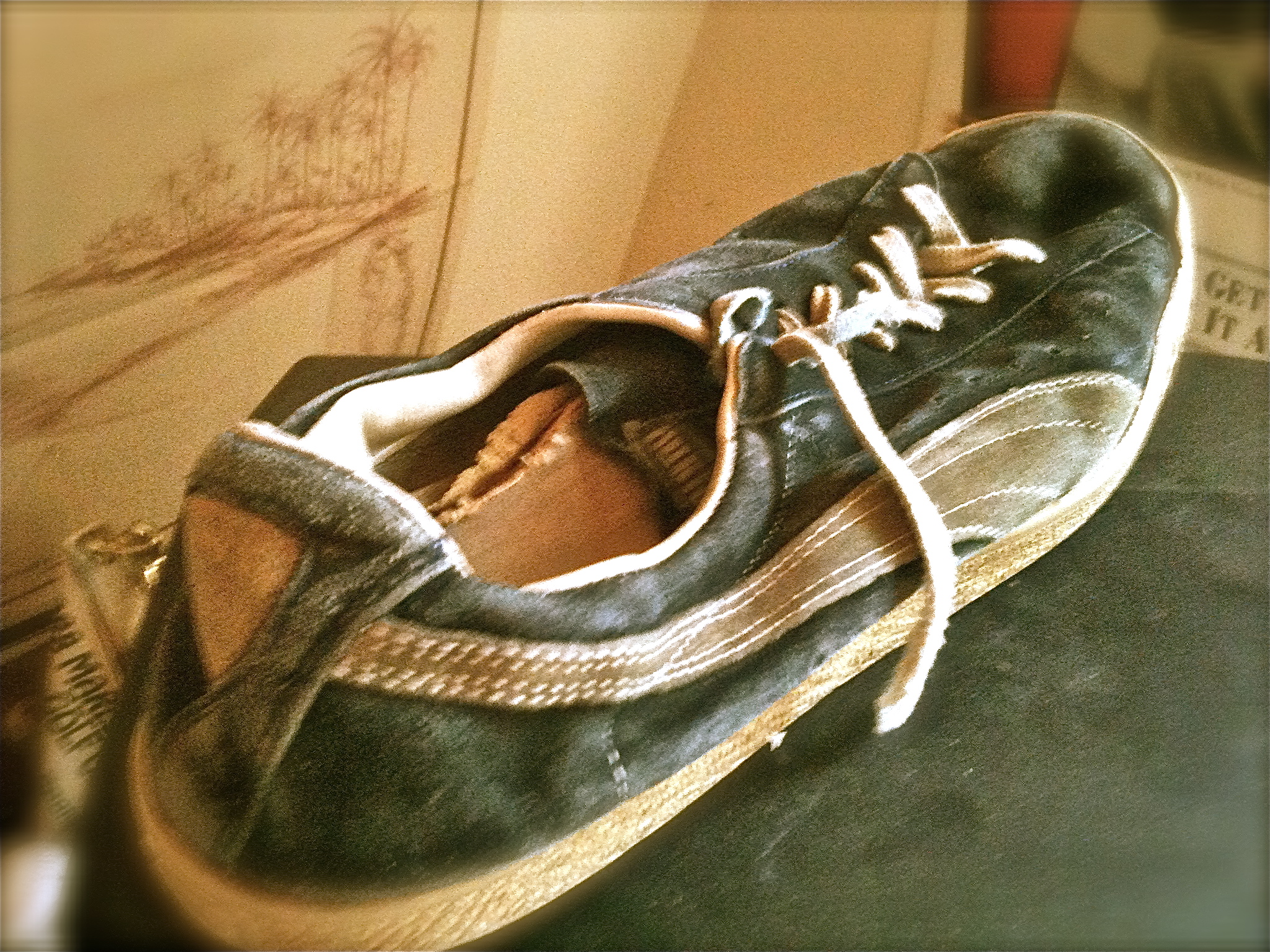
I was down there last month and noticed on my mother’s washing machine a shoe. I went over and inspected it, and here was the original right-footed Puma Clyde I wore so proudly the first day of the 8th grade, and many days thereafter. But how could it be here, and why?

My mother explains: When down parkas and comforters became available, we learned that you could wash them yourself — but you had to dry them properly, or the down would get lumpy. The instructions advised (still do, I guess) that you dry them “three times, with a tennis shoe or tennis ball in the dryer.” I guess “three times” insures they are really dry, all through, and the shoe or ball sort of “stirs” the down while it’s drying. The same technique works to wash/dry down pillows, which I’ve been washing the last few years…

Funny you should ask today because this morning I decided to put my comforter on my bed, and it was all flat; so I put it in the dryer and realized I’ve lost my SHOE! So I went to the garage and got a gardening clog made of rubber, which worked fine…

So yeah, I took her shoe, which was mine all along. I’m looking at it right now. And it feels really good.


Brett Favre Needs a Smack, Followed by a Serious Career Re-evaluation

Brett Favre Needs a Smack, Followed by a Serious Career Re-evaluation

I’ve held my peace on this matter, publicly, for some time. However, it’s high time we all spoke truth to megalomania in the case of Brett Favre.

Has anyone ever faded into retirement more haltingly, with less class, candor or self-knowledge than our Ol’ Gunslinger friend, Brett? When he wasn’t dicking around his various former teams, teasing out his impending retirement charade on an annual basis (the hot breath on his neck being that of ESPN), he was literally showing his dick to distaff media types via his mobile phone.

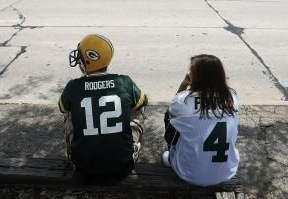
But now, if that weren’t enough, Favre’s shoddy, delusional comments re. Aaron Rodgers have landed him back in the news. And so, it’s time that we leveled with Brett Favre:

You’re a fraud. A media creation. A compiler of yardage and touchdowns at the expense of titles. A man who stands but a hair’s breadth — a single kickoff-return-for-touchdown — from being the second coming of Dan Marino, or Fran Tarkenton, or Jim Kelly.

Let’s recap, shall we? Here’s the entire offending quote, delivered during a radio interview this week with Atlanta’s 790 The Zone:

“He’s got tremendous talent, he’s very bright and he got a chance to kind of sit and watch and he saw successful teams do it right,” Favre said of Rodgers. “And so he just kind of fell into a good situation. And on top of that, he’s a good player. I don’t think anyone would question now the talent around him is even better than when I was there. So I really was surprised it took him so long. Really, the early part of last season, it hadn’t quite clicked yet and I didn’t know if it would. I just figured at some point, when they hit their stride, they’re going to be hard to beat. And that’s what happened.”

That there is a very nuanced bit of damnation via faint praise, and there is so much to take issue with:

• The Packers team that won it all last year had more talent than the back-to-back Super Bowl teams Favre quarterbacked in the late 1990s? Um, I don’t think so… Green Bay limped into last year’s playoffs at 10-6, got hot and won it all. They are arguably a better team THIS year, compared to last, but they were certainly no juggernaut in 2010-11, nor in the three years Rodgers led the team following Favre’s departure.

• Rodgers sat on the bench and watched successful Packer teams do it right? Really? Rodgers spent three years as an understudy to Favre in Green Bay: In 2005, the Pack went 4-12; in 2006, they missed the playoffs. The following year Green Bay and Favre were admittedly superb, but the season ended in the NFC Championship Game when the Ol’ Gunslinger killed yet another playoff game-winning drive by throwing a foolish interception, in Giants territory, in overtime.

Indeed, while Rodgers may well have learned a lesson there — don’t be so fucking careless with the ball, so late in a playoff game — Favre, in his grizzled wisdom, did not. After retiring (following the OT loss to the Giants), then petitioning the league to join the Jets for 2008 (no playoff appearance ensuing), then pulling the same retirement charade again before joining the Vikings for the 2009 season, Favre similarly threw way his team’s chance at a Super Bowl berth by slinging an even more heedless interception in the dying moments of another NFC Championship Game, against the Saints.

Hey, Wrangler Boy: Sorry to be the one to level with you, but despite all your dramatics, all your meaningless yardage and consecutive-starts records, you are one of the great underachievers in football history. You are but a Desmond Howard return-for-touchdown away from being Marino, Tarkenton or Kelly — only worse, because 1) your teams were routinely better than Dan-O’s one-dimensional Dolphin teams of the 1980s, Tarkenton’s overmatched 70s-era Vikings, or Kelly’s Bills from the early 1990s ; 2) you blatantly threw away more playoff games with your impetuosity, something these guys never did; and 3) Kelly and Tarkenton, it should be said, each qualified their teams for 4 Super Bowls, something you did but twice.

•••

Let’s turn back the clock to January 1997, to the only big game Favre did win, Super Bowl XXXI vs. the New England Patriots, because I think we can already see that a great deal of his Hall of Fame reputation rides on this single result, the only Big One he ever one, on any level.

Of course, the Patriots have gone on to bigger and better things since that fateful night in New Orleans (amazing just how many Patriot highlights and lowlights have been recorded there, eh?). The Packers were, you will recall, an excellent team in 1996-97, clearly the better team. Pats poobah Bill Parcells was literally on his way out the door to coach the Jets, something the Patriots players knew and it undoubtedly affected their performance. Favre’s team was favored by 14 points (!) and Drew Bledsoe was the opposing quarterback…

And yet, the Patriots had every chance to win that game, and it wasn’t Brett Favre who won it for Green Bay. Midway through the fourth quarter, New England had driven down the field and scored a touchdown to make it 27-21 — The Pack and their all-World QB had been stuck on 27 points since late in the second quarter. Favre and the Green Bay offense were inert; one more defensive stop from the Patriots and that game was completely up for grabs. But then Desmond Howard returned the ensuing kickoff 99 yards for the TD that sealed the game.

“We had a lot of momentum, and our defense was playing better. But [Howard] made the big play,” Parcells intoned after the game. “That return was the game right there.”

Howard won the game for Green Bay. He totaled a Super Bowl record 90 punt return yards— most of them in the first half, utterly swinging the field position battle in the Pack’s favor. He would rack up 154 kickoff return yards, and his 244 all-purpose yards tied a Super Bowl record. He was the MVP, naturally.

It’s not stretch to say that, but for Howard’s performance and that one huge play, Marino, Tarkenton and Kelly would have company in the Greatest QBs Never to Win the Big One Club (GQBNWBOC).

[Note: My buddy Jammin’ has concocted an intriguing theory attached to this game, Super Bowl XXXI, and this particular play. The last player struck from the Patriots Super Bowl roster that year was none other than Troy Brown, then a 4th year reserve wide receiver and special teams player who would later become not just an all-pro but one of the most respected Patriots of all time. Why? Because Brown was a complete football player, catching passes, playing special teams, even stepping in to play defensive cornerback for the 2004 and 2005 Patriots. As Jammin’ argues, not unconvincingly, “If Parcells keeps Troy Brown on the roster to play special teams, he makes the play on Desmond Howard. Guaranteed.”]

I don’t want to minimize too much Favre’s centrality to what was an excellent Green Bay team, one that would go 13-3 the next year and win a second consecutive NFC championship. But here again, Favre failed to win the Big One. He and the Packers returned to the Super Bowl in 1998 as 11½-point favorites but contrived to lose to John Elway and the Denver Broncos, 31-24, thereby releasing Elway from GQBNWBOC ignominy.

So yeah. Favre is a fool. He’s retired and should just go away. And I wanted it noted, for the record, that I’ve laid out this entire argument and never once referred to Vicodin.


A Day Like Few Others, in Arromanches
The beach at Arronmanches-sur-mer, where remains of the artificial harbor — crafted on the fly by Allied Forces to supply the D Day Invasion — still mark the land and sea scapes.

A Day Like Few Others, in Arromanches

The beach at Arromanches-sur-Mer, where remains of the artificial harbor — crafted on the fly by Allied Forces to supply the D Day Invasion — still mark the land and sea scapes.

The following piece appeared in the Portland Press-Herald in late October 2001. I was a regular op-ed columnist for the PPH from 2000-02. Figured it merited a reprint.


“This won’t stand,” she said. “We are with you.”

This was the straightforward sentiment conveyed to me the morning of Sept. 12, 2001, in the French seaside village of Arromanches-sur-Mer. It was offered by an elderly British woman, which explained the Churchillian tone. There were tears in her eyes.

I spluttered some expression of thanks but little else. A bewildered roll of the eyes perhaps. Standing on the coast of Normandy, we were all struggling to process the import and implications of what had happened the day before, some 3,000 miles away — of what would happen next. What’s more, we were all struck by the irony of what had brought us together.

“It’s no mistake that we are here,” she added, “in a place like this, on a day like today.”

Her tone and reference were apt. It was here in this sleepy fishing village that British engineers created a vast, man-made port through which the entire D-Day invasion force was supplied. It had been Churchill’s outlandish idea, his pet project, and it remains one of the great triumphs in the history of war-time engineering.

It would have been enlightening enough to leave Normandy having learned of the vital role Arromanches played during the largest amphibious assault in human history. It would have been amazing enough to see with my own eyes just how sharply these cliffs rise from Norman shore. It would have been moving enough to have walked amid the grave markers belonging to more than 9,000 U.S. servicemen, who rest for all eternity in bluff-top cemeteries overlooking Omaha Beach.

But this was Sept. 12, 2001, and it was all a bit too much.

IT WAS INDEED a curious time for a family of U.S. citizens to be abroad. We could follow events, but we felt more than a bit detached. Still do, in fact. Americans will always remember where they were that morning; I remember, too, but it wasn’t morning at all. It was four hours after the fact and six time zones ahead.

Almost two months later I still feel strange having essentially missed an extraordinary moment of national, collective consciousness.

What my family and I did experience, firsthand, were heartfelt words of support, not just for us personally but for the American situation in general. All over Western Europe in the days immediately following Sept. 11, restaurateurs bought us beers. Hoteliers cut us deals. In a Dutch internet café, people at neighboring terminals turned, made eye contact (a true cyber rarity) and offered their sympathies.

Driving our Citroen through Belgium, we listened (again, with an odd detachment) to the British voice of outrage via the BBC World Service. Even in haughty Paris, where an American visitor might well be treated as if he were the personal embodiment of U.S. cultural imperialism, we encountered nothing but comfort and concern.

These are staunch allies, of course. These are the people who best remember and appreciate America’s role in beating back fascism. Yet behind their statements of allegiance and comradeship there was the clear realization that, “It could have been us”. They counted themselves lucky, but they also knew full well that, “We could be next”.

Today, as we all wait the next shoe to drop, those sentiments go double for American citizens. Triple for those who happened to be abroad on Sept. 11 — perhaps 10-fold for those, like us, who flew from Logan to Dulles to Paris on Sept. 7, and back the same way on Sept. 16.

ONE OF THE STRIKING things about Normandy is its uncanny historical primacy; whole eras have a habit of dawning and setting here. From these shores in 1066, for example, William launched the Norman Invasion; his subsequent victory at the Battle of Hastings altered the course of Western Civilization forever. Before the millennium was out, dear friends would go once more into the breech here. Tattered armadas would wash ashore here. And allied troops would land here, diverting the flow of history once more.

And there I was, standing on the beach in Arromanches that beautiful, sunlit morning, witnessing the passage of yet another epoch on Norman soil. The Post-Cold War Era had drawn to its horrific close the day before. It was Sept. 12, my birthday, the day the world embarked on a new, unsettling, as-yet-unnamed era.

It’s a funny thing, a uniquely American thing, that we must travel so far to set foot on ground like this. That we must travel 3,000 miles to see these memorials in person speaks to the insular way, the fortunate way we Americans have spent the previous century. Indeed, for Mainers, Pearl Harbor is further still.

We no longer enjoy such a luxury, of course. In its place, we have a cold, hard perspective that Europeans and others around the world have long held — namely, that external forces CAN commit savage acts very close to home. And here’s the grim corollary: Civilian lives are routinely lost in the crossfire. To a long and grisly list which includes London, Dresden, Budapest and Sarajevo, we now add Lower Manhattan… and Kabul.

Little of this was clear to me back on the beach at Arromanches — but maybe it was to her. I wanted to ask my new British friend about World War II, her role in it, what she remembered from June 1944… But I couldn’t find the words, and she didn’t offer anything more. To the both of us, D-Day seemed curiously off the subject and remote.

We wished each other well and slowly drifted down the beach in different directions.

Irene, Gloria and the Wesleyan Sports Hall of Fame

Irene, Gloria and the Wesleyan Sports Hall of Fame

Events conspired these past few weeks to recall one of the great moments in my sporting life and, in my humble view, one of the singular sporting episodes in the long, largely inconsequential sporting history of Wesleyan University.

The first prompt was Hurricane Irene. What stood out for me, as Irene blew through our small Maine town in late August, was the difference 25 odd years can make. When the lights went out here, I responded by reading and taking multiple naps. When Hurricane Gloria swept north in the fall of 1985, the eye of the storm tracking along the Connecticut River Valley, the reaction was quite different. News of the approaching storm and blanket class-cancellations catapulted the student body into immediate and decisive action: En masse we hit the liquor store and lined up the necessary narcotics, were they not already on hand. The storm would prove an irresistible opportunity to do crazy-ass things, like eat mushrooms and play pick-up football in spectacular winds.

The other recollective catalyst was the letter I received this week from my alma mater inviting me to a dinner honoring 2011 inductees into the Wesleyan Sports Hall of Fame. This invitation comes annually, along with calls for nominations. I notice that, among others, the entire 1980 Cardinal Field Hockey Team will take its place among the hallowed in Middletown on Nov. 5.

Perhaps you see where I’m going with this… In posting this blog item, I’d like to formally nominate for induction, in 2012, the 1985 Pick-up Football Team representing 8 Warren Street.

Thanks to the World Wide Web, there have been several tongue-in-cheek HOF nomination ideas floated by various WesKids over the years — like the time I sailed yet another free kick over the crossbar my sophomore year against Babson, and team captain John Nathan (who wanted the free kick for himself) sarcastically upbraided me as we ran back on defense: “Too many bong hits, Bluto?” Or the time the varsity golf team participated in the NESCAC Championships at Middlebury and, following a killer party I had located for us on campus, Pat Dudley projectile vomited out the passenger-side window of the Wesleyan Athletics van into the cold, unsparing Vermont night, whereupon he passed out, only to be revived the next morning in time to stumble onto the first tee, successfully drive the ball in play, and walk down the 1st fairway into a blizzard. Poor Pat. At one stage he turned back forlornly to those of us assembled on the tee behind him — he and his ghost-like pallor disappearing into that freak storm like an old time baseball player into a field of corn stalks.

These are indeed hall-of-fame-worthy accomplishments, but they are mere moments. Running the wishbone while shrooming on a muddy track in hurricane-force winds AND leading a ragtag group of soon-to-graduate liberal arts misfits to victory is another matter entirely. In the interest of supporting the nomination more credibly, allow me to paint the scene more fully:

Wesleyan is, to be clear, situated just 25 miles north of Long Island Sound, so the storm was quite strong when it arrived and, indeed, the glory of Gloria kicked in about the time the winds picked up. With Patty Smith’s “Horses” blaring from some student house nearby, I remember standing on the soccer practice fields looking back down Warren Street, where dozens of students milled about with/in their cups. Others spread their arms wide so as to better catch the hurricane-force winds, while still more took advantage of an organically muddy slip ‘n slide that had been fashioned on a long, sloping embankment across the street from the old hockey ring parking lot.

We had arrived at the practice fields, just beyond said hockey rink (now a monolithic, state-of-the-art sports complex), to throw the football around. We ended up playing a game of 5 v. 5 football (tackle, naturally) against the guys from across the street. Who were they? Chi Psi brothers, mainly. Basketball and hockey players who liked to stroll around shirtless in their yard smoking cigars and playing bocce. In other words, a high jock quotient and formidable opponents.

We played all offensive possessions in the same direction, downwind, enabling each QB to throw the most splendid 60 yard bombs with mere flicks of the wrist. It was a spirited, fun affair — as only a game of tackle football in a hurricane under the influence of psychotropic drugs can be. But the game got appreciably more interesting when the boys from 8 Warren St. decided to run…  the wishbone.

Yes, the triple-option wishbone, with yours truly doing his very best Jamiel Holloway imitation. And you know what? Barry Switzer would have been damned proud. We thumped them from there on out. If you don’t put the ball on the ground, the wishbone is basically indefensible — even with a soccer player at QB, under stormy skies whose cloud formations appeared to breathe (and bore an uncanny resemblance to the cover art from the R.E.M. album, Murmur).

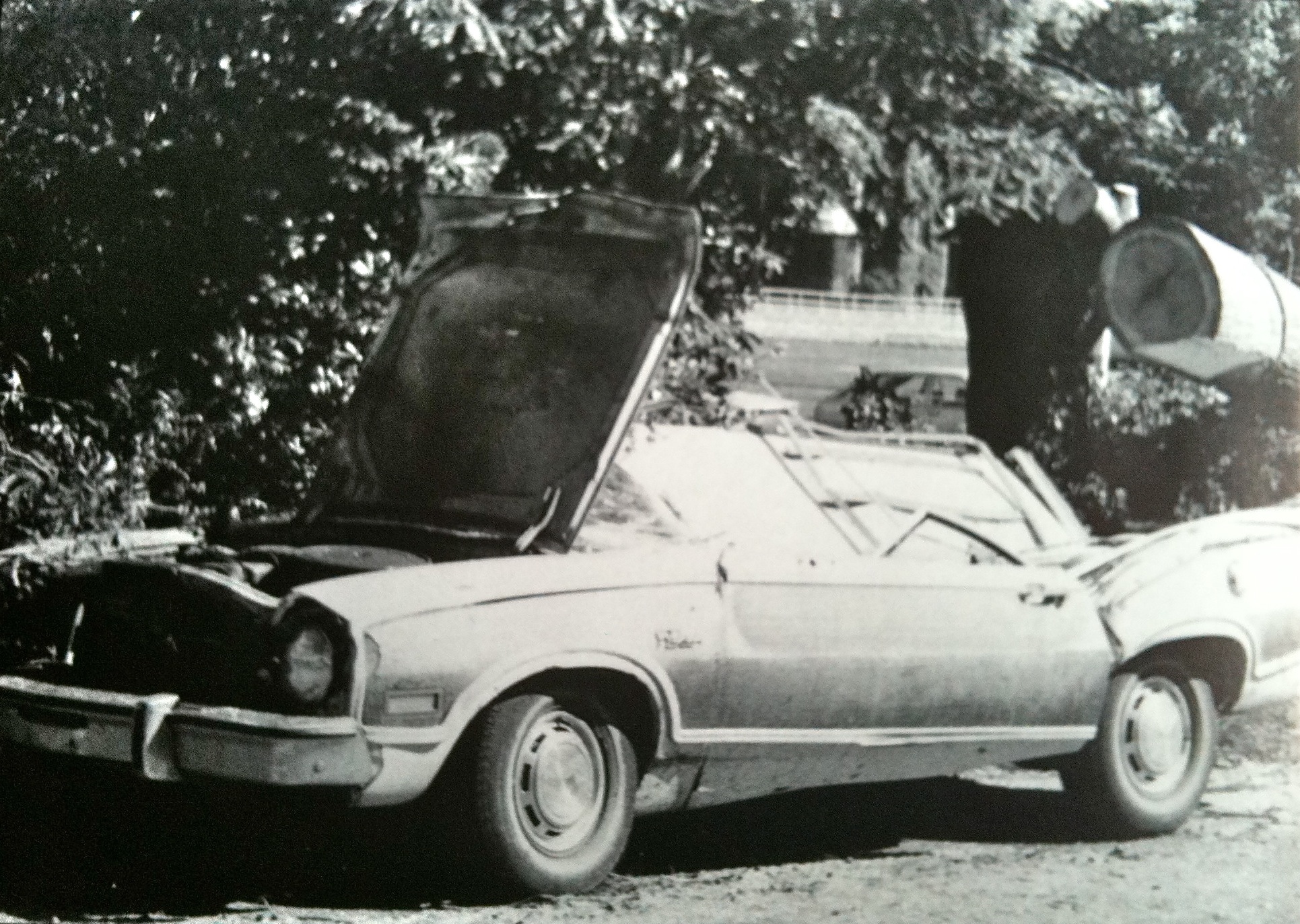
Gloria at Wesleyan has since been officially memorialized among students of my vintage, on account of our shared experiences that day, but also on account of a singular image — of a student car utterly crushed by a tree felled during the storm. This photograph was played big in The Argus, where I was an editor, and subsequently in our yearbook. But I say it’s time to broaden the Wes legend that was Gloria 1985, and what better way than inducting me and my housemates into the Wesleyan Athletics Hall of Fame? All together now, with feeling:

G… L… O… R… Aye-ay-ay-ay-ay-ay — G-L-O-R-I-A.

GLO-RHEA!

Sports Couture Karma: Transgressions will cost you
The inimitable Maurice Lucas in the uniform his Blazers adopted immediately after winning their first NBA Championship, in 1977. They've not won another.

Sports Couture Karma: Transgressions will cost you


The inimitable Maurice Lucas in the uniform his Blazers adopted immediately after winning their first NBA Championship, in 1977. They’ve not won another.

So, I was watching some random highlight of a Patriots-Rams exhibition game about a year ago when it suddenly crystallized for me. It takes two points to make a line, and finally I had identified a second, solid example of Sports Marketing Greed/Hubris, Couture Division.

Bill Walton models the jersey that won Portland a title. A year later, in new togs, he broke his foot, demanded a trade and was never the same again.

Exhibit A) The Portland Trailblazers win the NBA title in 1976-77, wearing the same plain-Jane uniforms (white at home, red on the road; the “Blazers” lettering reading vertically down the jersey) they had sported since their joining the League in 1970. The very next season, they go to the arguably more attractive and apropos design — dual swaths, or blazes, of red, black and white that run diagonally across the breast and down the shorts. The result: They haven’t won a title since. Haven’t really come close, to be honest, despite a couple trips back to the Finals.

You think it’s an accident that one of the finest, most cohesive teams in NBA history literally disintegrated the moment they damned the championship karma and changed uniforms? Don’t be naïve… I had always wondered why the Blazers tempted fate in this fashion, but I couldn’t prove that some sort of karmic law had been transgressed, until now.

Exhibit B) The St. Louis Rams win the 2000 Super Bowl in their old yellow-and-blue uniforms. The next year, attempting to cash in at the merchandize window, they switch to GOLD and blue. Again, arguably an upgrade in style and originality, but a bald-faced affront to a clearly winning formula. They return to the Super Bowl in 2001, lose to an inferior Patriots team, and have since descended into chaos. Koros, Hubris, Ate, Nemesis — the classic Greek cycle of decline…

Purists will note that the Rams’ yellow-and-blue togs were not their originals. The dark blue-and-whites I associate with Roman Gabriel, Merlin Olson and the 1960s; the Rams actually go back to Cleveland in the late 1940s, and I have no idea what colors they wore then. My point: The yellow-and-blue had been worn a good long time prior to 2001, since the early 1970s. They were established.

A one-off merchandizing cash-in you MIGHT get away with. But you can’t  win a franchise’s first-ever championship and change things up so radically. You just can’t.

These have not.

These colors delivered to the Rams Super Bowl glory.

The 1931 U.S. Open: Golf’s Bataan Death March
George von Elm (left) and Billy Burke, combatants in the longest U.S. Open every contested..

The 1931 U.S. Open: Golf’s Bataan Death March


George von Elm (left) and Billy Burke, combatants in the longest U.S. Open every contested..

The next time you play a round of golf in some modicum of heat and humidity, the next time you walk 18 and feel the lactic acid building up in your thighs and calves, spare a thought for Billy Burke and George Von Elm. These were the stalwart principals in golf’s most extraordinary physical test: the 1931 U.S. Open, held way back when at The Inverness Club in Toledo, Ohio.  As the central characters in what Grantland Rice called “the most sensational open ever played in the 500-year history of golf,” Burke and Von Elm required 144 holes of medal play to produce a winner: Burke, by a single stroke.

Take a moment to think about the parameters here: 72 holes contested over the first three days, followed by 36 playoff holes on Monday and 36 more on Tuesday. It was and remains, needless to say, the longest playoff in U.S Open history. Supreme Court cases have taken less time to adjudicate.

Waged in the midst of a stifling, July heat wave — in an era devoid of fitness trailers, cushioned in-soles, and air-conditioned clubhouses — this match was golf’s precursor to the Bataan Death March.

Or so it appeared during the morning round on Tuesday, July 6, 1931, as Burke and Von Elm — with 126 holes behind them and 18 still to negotiate — staggered off the 18th green toward the clubhouse for lunch. Even the most callow observer could see the quality of play eroding, quite understandably, under the enormous dual burdens of fatigue and Open-playoff pressure.

Yet Burke rallied to play his finest golf of the tournament over the final 18 holes. Von Elm, too, rose to the occasion and finished a single shot in arrears.

“I looked for a rather ghastly finish to a grand struggle,” wrote O.B. Keeler in The American Golfer. “Instead it was, and ever shall remain in my mind, the most remarkable exhibition of recovered stamina and poise and of sheer staying power and determination I have ever witnessed.”

Legend says that Von Elm, a lithe figure with little to lose, shed nine pounds during the championship, while the stocky Burke managed to gain two. “A circumstance,” Keeler mused, “which, if accurate, gives rise to wonder as to his diet.”

Read on to sort through, with me, the fascinating details of this extraordinary championship, staged 80-plus years ago this summer by two fascinating figures whose stories have been obscured by time, during a period when golf was wildly popular but still adjusting to the loss of its dominating figure.

•••

The U.S. Open of 1931 was the first “Jonesless” Open since 1920. The Emperor had retired from competitive golf following his epic Grand Slam the year before, and while he was on hand at Inverness, the golfing public was anxious to see just who would fill the considerable void. Golf’s professional class was especially keen; Bobby Cruickshank admitted he and colleagues were delighted to see Jones in the gallery, as opposed to the field.

Nineteen thirty-one was also the year the so-called “balloon ball” was required for Open play. This larger and lighter spheroid didn’t prove popular at Inverness, as competitors complained loudly that mis-hits were exacerbated by the new-fangled ball, which neither carried nor rolled as far. After just one year, the USGA would junk it — returning to the previous, heavier guideline of at least 1.62 ounces, but keeping the balloon’s larger size (1.68 inches in diameter).

Yet all the talk of balls and would-be kings was quickly subsumed by the event’s overarching conversation piece: the weather. The heat was oppressive by any discernible measure. Contemporary accounts of the championship are littered with modifiers like “blistering “, “blazing” and “sweltering”. Golf Illustrated‘s “special correspondent” noted that “The field was all on hand early for practice several days ahead of time, but so intense was the heat that on these practice days no one with any chances to jeopardize played more than nine holes of golf.”

It was 105 degrees on Friday, July 2, the first day of competition. It was no cooler on Saturday, when Von Elm served notice to the field with a 69, the tournament’s low round. His 36-hole total of 144 led 63 players who made the cut; Burke stood one stroke back.

It would be another 34 years before the USGA extended the Open format to 18-holes on four consecutive days, so Von Elm’s 73 on Sunday morning left him two shots clear of Burke with the afternoon round still to play.

By lunch time, the mercury was hovering between 97 and 99 degrees, with humidity levels only a tad lower. Igniting one of his trademark cigars (he would go through 32 during the championship), Burke went off in the penultimate group with Johnny Farrell, while Von Elm and Al Espinosa formed the final pairing.

Espinosa and Farrell had fallen from contention with substandard third rounds; by Sunday’s final nine, it was essentially a two-man race, with Von Elm in the driver’s seat. Standing on the 12th tee, he led Burke by two strokes but Von Elm would stumble over the next six holes, playing them in four-over. Burke parred the 18th to post a 292, meaning Von Elm needed a birdie 3 to force a playoff. He did just that, calmly draining a 12-footer before the breathless, sweat-soaked multitudes gathered a green’s edge.

With its extraordinary fugue of physical demand and competitive drama, Sunday’s play (the presumptive 36-hole finale) might have gone down as one of the most thrilling days in Open history.

As it turned out, the tournament was only half over.

Edgewood GC: Recalling a Course Blotted Out by Progress
The 16th at the TPC River Highlands in Cromwell, Conn. This par-3 is approached today over this pond. Back in the early 1980s, one approached it from the right, high on a hill. (Photo by Jim Rogash/Getty Images)

Edgewood GC: Recalling a Course Blotted Out by Progress

The 16th at the TPC River Highlands in Cromwell, Conn. This par-3 is approached today over this pond. In the early 1980s, one approached this same green from the right, high on a hill.

A few years back I managed to hook up with a former college golf teammate of mine, Stuart Remensnyder, for a friendly reunion/grudge match at TPC River Highlands in Cromwell, Conn., site of this week’s PGA Tour stop, The Traveler’s Championship. Stuart and I spent a lot of time that day musing about the delightful scam that was Division III college golf (we had played for Wesleyan University, in neighboring Middletown). Golf wasn’t like other varsity sports, after all. “Practice” amounted to playing free, fully sanctioned golf three or four days a week.

In any case, Stuart and I were standing in the 1st fairway at River Highlands, musing over past conquests/humblings and waiting on the group in front of us, when I abruptly cut off our conversation and pointed with some urgency at a row of homes sitting high on a hill, deep in the right rough.

“You see those houses?” I ventured. “That’s the old 13th hole.”

“You mean the 13th at the old TPC?” Stuart asked.

“No, the old, OLD 13th — at Edgewood!”

Stalwart New England golf fans might recall that the Greater Hartford Open — today known as the Traveler’s Championship — moved in the mid-1980s, after years at Weathersfield CC, to an ill-fated facility called the TPC at Cromwell (it was, at times, also called the TPC of Connecticut). This Pete Dye design didn’t meet with the slavish approval associated with Dye’s work today. Indeed, the players didn’t like the TPC at Cromwell; the PGA Tour didn’t like it; for all I know, Dye’s late wife Alice wasn’t crazy about it either.

Long story short, architect Bobby Weed — himself a Dyesciple and the PGA Tour’s in-house architect back then — was brought in to renovate the place just a few years later. The joint was renamed the TPC at River Highlands, and everyone loved it.

What New England golf fans might NOT remember is this: The short-lived TPC at Cromwell was not a “new” golf course in the strict sense. It didn’t just materialize from scratch, springing fully formed from the brow of Deane Beman, there by the Connecticut River. No, the TPC at Cromwell resulted from a complete and utter renovation of an existing layout called Edgewood Golf Club, home course to the mighty Wesleyan Cardinals for years. Indeed, the University had owned the club for decades in the middle part of the century.

There were strong holes and weak holes at Edgewood, but during my first two years at Wesleyan, it was my “home” course. I enjoyed many a practice round there with teammates and took many a licking there at the hands of New England’s finest collegiate players. Stuart did, too. We all did.

Now it’s gone. Replaced not once but twice by completely new incarnations in the space of just a few years.

Golf courses do change, after all, for good and for ill — sometimes by design, at the hands of man; other times via naturally occurring phenomena like tree growth and erosion. Some alterations, like those undertaken annually at Augusta National, garner breathless headlines, while others are conceived and authored without a hint of public awareness or concern.

Changes are welcomed by some, reviled by others. Only one thing is universal: All of these evolutions take less time than one might ever imagine.

At Edgewood, the situation was unique because so far as the Wesleyan golf team was concerned, the transformation happened completely without warning. Toward the end of my freshman year, spring 1983, new golf holes started popping up like mushrooms betwixt and between the existing holes! Unbeknownst to us, Dye had already been retained and had begun radically reconfiguring the layout right before our eyes. We didn’t have a clue what was happening. When we asked inside the clubhouse, no one else seemed to have a clue either.

When we returned in the fall of 1983, more new holes had emerged. This was only a few years post-Sawgrass, and Dye’s now familiar mounding — quite mysterious and exotic back then — appeared to be bubbling to the surface. He didn’t just build new holes in former rough areas either. He completely reversed existing holes. He combined a few. Eliminated others. He fashioned new holes that played to existing greens from completely different directions. The entire routing was turned on its ear.

By this time we’d learned of the Tour’s grand plans for old Edgewood. And for one fleeting moment — I can’t honestly remember how long it lasted: 10 minutes, a day, a couple weeks — we, the Wesleyan Golf Team, entertained fantastical thoughts of practicing and playing our matches at this completely retooled golf course, a resplendent-sounding place: The TPC at Cromwell. Home to a future PGA Tour stop for chrissakes!

That’s about when they booted us.

Read More