Category Archives

84 Articles
Born to Run? A ‘This American Life’ Experience

Born to Run? A ‘This American Life’ Experience

The temptation when giving it up for the routinely superb This American Life is to lavish too much praise on Ira Glass. I mean, could he really have purposely, out of sheer genius, slotted the show on Sunday nights when my family (and presumably lots of other families) were driving home from a weekend at their parents’ house, obliging anyone with any sense (and more than an hour to kill) to make some lemonade of the journey by flipping on a show that more or less required one to give himself over to something longterm and really listen? Not hardly. But pretty much everything else about This American Life is, when you had the time to pay attention, consistently quirky and captivating.

I recalled the moment this dynamic became clear to me a few days ago, upon reading Christopher McDougall’s thought-provoking piece, The Once and Future Way to Run”, in the New York Times. The subject here is the contention that early man ran more efficiently than we do today, barefoot, and that modern running technique and athletic footwear have conspired to rob humans of the ability to run long distances, and to do so without injury.

I was sorta surprised the story didn’t cite a 1997 This American Life story, “Running After Antelope,” an amazing tale from Scott Carrier about his efforts to personally prove what was then a new, less accepted anthropological theory: that bipedalism is an adaption for long-distance running, that early man hunted deer and other game, not by throwing spears, but by tracking animals over long distances, essentially running them down, tired and silly — then sticking them with a spear or even a blunt object.

It’s a fascinating topic and this was the episode of TAL that first hooked me. My wife and I sat spellbound, listening ever more absorbedly as we drove north on a darkened Interstate 95, the kids asleep in the backseat. I’ve always been a radio guy, but I’d never heard anything like this — a discursive, dreamy narrative told by a guy, Carrier himself, whose nasal, warbling deadpan was not the sort voice one heard much on the radio, and whose gripping story was equal parts personal quest and anthropological daring.

This is the stuff we’ve come to expect from Ira Glass and TAL, of course. I never manage to make time for the show on Sunday evenings; maybe he wasn’t such a canny scheduler after all. But whenever I do make that time, I am rewarded. Whatever you do, whatever you think of my observations or me, listen to “Running After Antelope.” It’s a mind bender.

Golf still shoulders ambivalence toward all things bourgeois

Golf still shoulders ambivalence toward all things bourgeois

Golf simply cannot shake its reputation as a sport for rich, white guys in bad pants, not even where the game has spread its seeds, i.e. halfway around the world from the preppy, bourgeois, American suburbs where those pants were worn and that reputation was formed.

In Vietnam, one government bigwig, citing the growing number of his minions who’ve taken up the game, has forbade all those in his ministry from taking part. According to the Saigon Times, “Minister of Transport Dinh La Thang has banned senior leaders, chairmen and directors of companies under his ministry from playing, organizing or attending any golf event… According to Minister Thang, some leaders working in organizations under his ministry were not focused on their work and duties which was affecting the progress of several projects. One of the reasons for this heedless neglect of their duties was that officials had adopted the time consuming sport of golf.”

Naturally this tidbit was lapped up by news outlets far and wide, once again proving golf to be a convenient whipping boy — for environmentalists, media, even one-time communists — mainly because its devotees are presumed to be plutocrats with nothing better to do. It’s always been an easy target. I’m surprised Augusta National has not yet been occupied.

The minister is correct that 18 holes can easily occupy 5 hours of your day, and zealots have been known to think of little else. But does anyone think SCUBA diving and skiing require any less money or time? I don’t see them being singled out in this way. Is it the fault of golfers that one cannot conduct business 15 meters below the ocean surface, or in the 10 minutes you might be sharing a chair lift?

The big difference between golf and other cost-exclusive, time-sucking recreational pursuits actually dovetails with a striking irony. Governments like those in China and Vietnam, which spent decades railing against the evils of bourgeois capitalism, still aren’t comfortable with golf and its trappings.  However, golf development is growing all across Asia, in China and Vietnam especially, and where courses are built, jobs and tourists and native golfers follow.

In China, there is an official moratorium on course development, though hundreds of courses continue to be built on the sly, with local government support (because local pols are the guys who provide developers the land, for a price).

Time Out magazine recently detailed the politics of golf development in Vietnam, quoting yours truly in the process. The government in Hanoi has never banned course development, but neither had it ever publicly backed it — not until 2010, when Decision 1946 issued guidelines on how and where all VN courses were to be built going forward. The Decision also capped at 89 the number of courses to be completed by 2020. The government has since increased that number.

But the VN government can and should do more — to promote Vietnam as the burgeoning golf destination it is. Golf attracts tourist revenue, and the Vietnamese clearly love the game, especially those in the Ministry of Transport. This show ban will surely be lifted or simply peter out. Thereafter, let’s keep it to the weekend hours, shall we boys? We don’t want to go spoiling it for everyone else.

Lost and Found: Demi-Icons from the Vinyl Age

Lost and Found: Demi-Icons from the Vinyl Age

Sometimes it’s what you don’t write.

Case in point: An otherwise solid piece in the Wesleyan alumni magazine (“Wesleyan Rocks”) recently fleshed out the stories of two Wes-gestated bands, MGMT and Das Racist, along with a bit of Wes-spawned band history. It also and detailed a few other contemporary outfits trying to make it similarly big. Everyone knows about Dar Williams ’89, but did you know the folkist Highwaymen were Wesboys? I sorta did but was glad to be reminded.

However, the historical rundown of Wes bands stood out to me for a couple ’80s-era omissions that deserve their place in the pantheon, such as it is. Actually, after a little digging (a.k.a. “reporting”), I’ve learned only one omission is legit, but both stories remain intertwined — through me anyway.

Been thinking a lot about vinyl lately. We’re throwing a Vinyl Halloween party in a couple weeks, whereby guests bring an album and dress from the album. Going through my vinyl in search of costume inspiration drove home the fact that record albums, their sound and visual aesthetics, were so very central to my early life, through college but especially at Wesleyan. I had arrived at school with a few records, maybe 10? But to this  freshman single, a tiny cubicle in Butterfield C, I had brought from home only a “box” (this was well before briefcase-sized radio/tapedeck/speaker combos even claimed to boom), i.e. nothing to play vinyl upon.

Luckily, the double two doors down was occupied by two guys I’d end up living with the next four years, plus a few thereafter. Dave Rose ’86 brought a fine stereo to the table. Actually, the turntable sat atop a standard dorm-issue dresser that was, now that I think back on it, the perfect height — chest high, a somewhat novel but ingenious arrangement, as it made the manipulation of the record and needle far more facile. Optimal even.

It was in this dorm room that I gathered and otherwise brazenly co-opted a huge chunk of music and, ultimately, my musical sensibility. Rose was responsible for the entire stereo and a goodly portion of new bands I would absorb. He naturally saw patterns in the stuff I took to, and I remember him suggesting this band called Dumptruck, from Boston. It must have been played, something off that one album Rose owned at the time, Positively, but I don’t remember it making any impact on me.

After college we all moved to Boston, well… Somerville and Medford. At some stage that first year out of school, Rose’s brother Tom had gone to see Dumptruck at Jack’s in Cambridge. Said they kicked ass. When visiting Rose in Somerville I placed Positively on the turntable in his apartment and it was great. See here an extraordinary video from that era, one that could have been filmed in our basement, at 388 Medford Street. And here’s another. “Dumptruck is really good,” I told Rose, who replied with mild exasperation: Yeah, I’ve been saying you’d like them. For years.

When you’re right, you’re right. About that time, late 1986, we came by (okay, Rose purchased) a new Dumptruck album, For the Country. Even better. Not sure they or anyone knew it at the time, but these guys were playing really solid, driving, garage-inflected alt country in the mold of Uncle Tupelo, Son Volt and Wilco. But, of course, Dumptruck anticipated the mold.

For the Country did well but the band and their label soon parted ways, in no way amicably. They sued each other and Dumptruck were effectively barred from any further recording, pending resolution of the actions. So they toured, and we went to see them as often as possible, must have been 10-15 times. They were a tremendous live act, urgent and tight, playing all our faves and a raft of inspired covers (Dylan, Neil Young, Procol Harum).

One drunken night when the Butterfield C boys were living together in Somerville, we decided Dumptruck needed a legal defense fund. We wrote them a note briefly detailing our simplistic legal strategy and enclosed a check for $50. To our shock, we got a letter back from Dumptruck front man Seth Tiven, who addressed the letter “Hey, Somerville Dudes”. Couldn’t have been nicer. Offered a few pleasantries and included a cassette tape of their embargoed new material, which we loved and subsequently played to death. There was even a back-up tape made because, well, they were temperamental, fragile bastards those TDKs.

Sometime shortly thereafter we caught Dumptruck at the legendary bandbox club TT the Bear’s, in Central Square Cambridge. It was, on several levels, one of the finest club shows I’ve ever seen. Galaxie 500 opened; I bought their album On Fire the very next day… Dumptruck killed and played all their songs from the demo tape. Only we Somerville Dudes knew the words, of course, and I thought for a moment Tiven looked our way when perhaps he could hear someone singing the high harmony on my favorite track, Ghost Town.

We said hello backstage, after the show, and though we saw them a bunch more times, we never had any real contact thereafter. By the early 1990s, the band’s moment had come and gone. The label lost the suit, ultimately, but the damage had been done. That incarnation of Dumptruck would never record another album. Tiven moved to Austin in the early ‘90s and recorded some of the demo songs along with his newer material. I believe the album is called Terminal. The name Dumptruck was employed, as it would on some future releases, too, but it was Tiven and a whole new line-up.

There would be a Dumptruck reunion at SXSW, in 2007. I recall hearing about this shortly after the fact and being very angry we didn’t go down to Austin. They did another in 2011, and while I wasn’t at all aware that was happening, it’s possible this gig occasioned the Dumptruck retrospective I read online somewhere this past spring. It was in this retelling of the band’s saga that it was revealed Seth Tiven had attended college at… Wesleyan.

Could this be true? Yep. A Bachelor of Arts in Music, class of 1980.

I emailed Rose: “Did we know this?” No, he confirmed; we had not. But we agreed it was damned cool. So, I think I speak for Rose and other followers of the Boston club scene in the late 1980s when I say, Seth Tiven merited inclusion in the Wes alumni magazine story.

Sadly, while Seth Tiven has been added to my own personal pantheon, there’s one Wes music luminary I must let go. That night at TT’s, I thought for sure I had recognized another Weskid, Naomi, the sullen-cool bassist for Galaxie 500. I spotted her immediately and was convinced we had shared least a couple English classes back in the day, at Fiske Hall, though I can’t claim to have known her really. For more than 20 years I’ve accepted this as fact, that the bassist for Galaxie 500 had Wesroots. However, in researching this piece I’ve come across quite a bit of info to the contrary. Naomi Yang, who would go on to record several more albums post-Galaxie as part of a new line-up, Damon & Naomi, went to Harvard apparently. I am trying to accept this.

One Boy’s Particular Obsession, When Puma was King

One Boy’s Particular Obsession, When Puma was King


When I was 9 or 10 years old, the soccer shoe everyone wanted was the adidas World Cup. I wanted Puma’s King Pele model. I don’t toe the brand line as an adult, but as a childhood footwear consumer, I was always a Puma guy.

Never did swing that pair of King Peles with the ‘rents. They were top of the soccer cleat line, Puma’s anyway, and too expensive for a kid who needed a new pair every year. When I was about 12, I did get myself into the next step down, the Puma Apollo, which distinguished itself from the yellow swoosh and piping of the Peles with a white swoosh and a red dot — the dot being Puma’s trademark back-of-the-heal design. I had two pairs of Apollos then a succession of Pumas straight through my high school, club and college careers. My last pair was procured in Amsterdam, at the close of a backpacking expedition through Europe, the summer before my junior year at Wesleyan. The trip was nearly over, we’d soon be back at school for two weeks of soccer preseason, prior to classes. They were replaceables, the studs that is, and they were expensive but I had to have them. I emptied the vault to buy them, occasioning the first of many dire afternoons in Heathrow, waiting for a flight home with no money for food and nothing but a pack of Dunhills.

Truth be told, those particular cleats never proved very comfortable. Good for sloppy tracks but I had another pair of plastic molded-sole Pumas that got most of the run. For some reason I blacked out the swoosh with some dye that sat in a box full of shoe polish, brushes, rags and neatsfoot oil. It had been at my parents’ house; I took it to college to care for my various brogues and paint my soccer shoes. Is that gay?

More important, is it an actual swoosh that adorns Puma cobblery? I don’t know what to call that upside-down pipe that got wider as it traveled horizontally and form-fittingly from heel to mid-arch, before turning south and terminating where the arch met the sole of the shoe. Should Nike have control of that word? I think not.

Off the pitch I was obsessed with getting me a pair of Puma Clydes, blue felt low-top basketball sneakers with a gray inverswoosh and dot. I played hoops and these were THE coolest shoe anyone could hope to have in 1978, so far as I was concerned. I pleaded with my mom for some, but we stuck to our routine of buying cheap shoes that wore out about the time I outgrew them. However, my feet had stopped growing by 1978, and I argued that a pair of Clydes would last twice as long as the cheap knock-offs at Marshall’s. So she bit, and I remember gathering great confidence and strength from them, on court and off. Seriously. Shoes can do that. When were really young a new pair of sneakers would be appraised for speed in addition to élan. Look how fast they are… With my Clydes I experienced a pre-adolescent version of that sensation when wearing them, or simply by gazing upon them.

In the 9th grade I played my first real basketball, at junior high school, and I went in another direction: the Puma Basket, a white leather job with black dot and inverse-swoosh. I loved my Pumas so much, I devoted to them artistic energy. For fun I drew very detailed renderings of black cleats, taking great care to use just the right colors for the inverswoosh, and the dot, which was rendered in semi-circular fashion because I depicted the shoes in profile. In some junior high school art class I crafted a hollow rendering of the Basket out of clay, painting it and affixing a complete rawhide shoelace. Miraculously, this eminently breakable item still sits on shelf in my parents’ house.

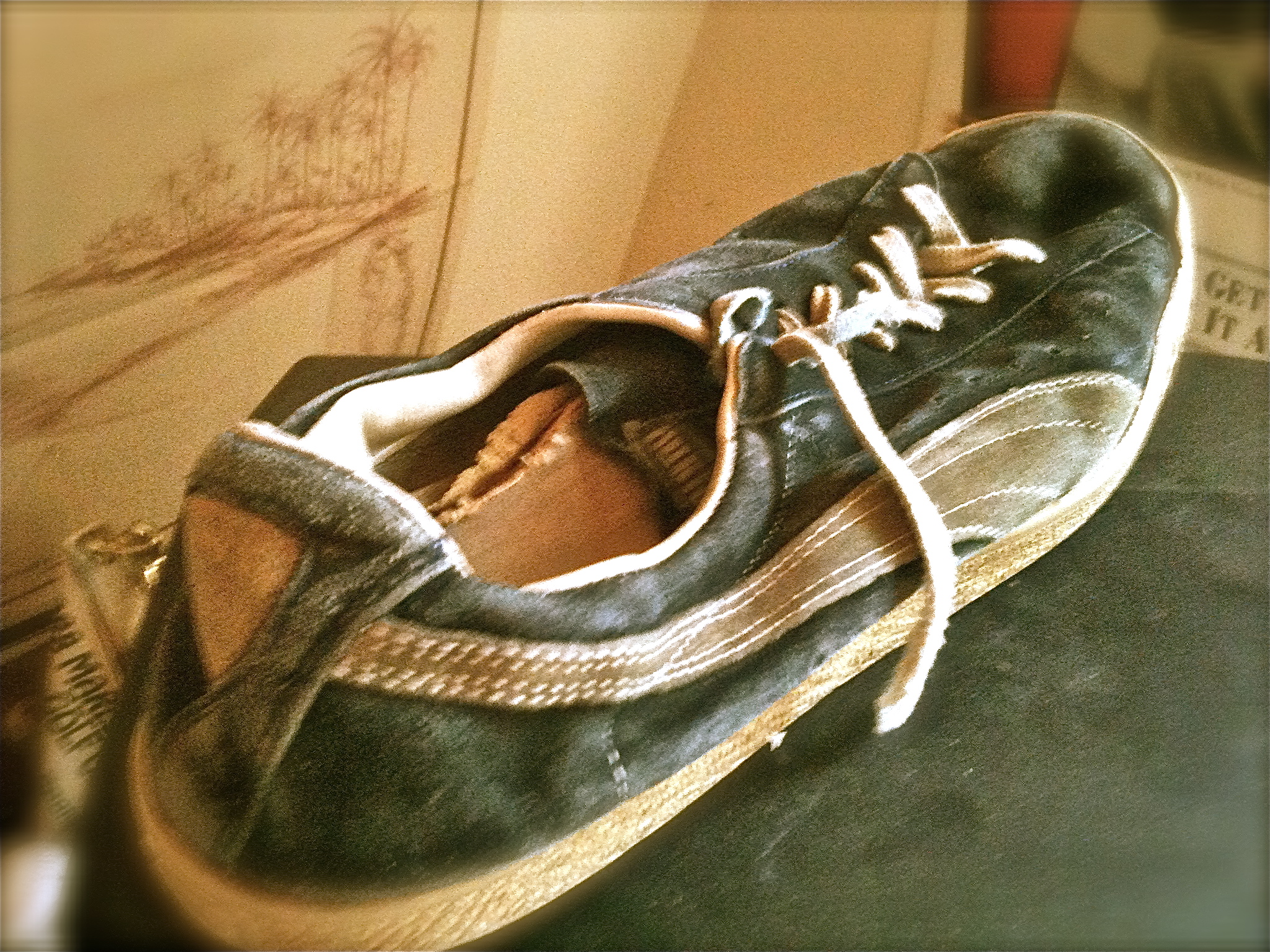
I was down there last month and noticed on my mother’s washing machine a shoe. I went over and inspected it, and here was the original right-footed Puma Clyde I wore so proudly the first day of the 8th grade, and many days thereafter. But how could it be here, and why?

My mother explains: When down parkas and comforters became available, we learned that you could wash them yourself — but you had to dry them properly, or the down would get lumpy. The instructions advised (still do, I guess) that you dry them “three times, with a tennis shoe or tennis ball in the dryer.” I guess “three times” insures they are really dry, all through, and the shoe or ball sort of “stirs” the down while it’s drying. The same technique works to wash/dry down pillows, which I’ve been washing the last few years…

Funny you should ask today because this morning I decided to put my comforter on my bed, and it was all flat; so I put it in the dryer and realized I’ve lost my SHOE! So I went to the garage and got a gardening clog made of rubber, which worked fine…

So yeah, I took her shoe, which was mine all along. I’m looking at it right now. And it feels really good.


Indie Godfathers R.E.M. Refuse to Waste Another Year

Indie Godfathers R.E.M. Refuse to Waste Another Year

How to take the fact that R.E.M. have apparently broken up? It’s not with sadness or shock exactly. Thirty-one years from a band that, at one time, carried the flag for independent/college rock would seem counterintuitive, like perhaps it stayed way too long. Yet this judgment would be obtuse. There was an integrity to R.E.M., a sense that the band was always doing pretty much what it wanted to do — not what the market, nor the recording industry, nor even its loyal following wanted or expected. And while the boys were in certain ways pioneering — a fusion of jingle-jangle folk and post-punk — few would assert they invented anything. “Alternative” rock? I don’t think so. Even from their earliest post-punk days, lotsa bands introduced more and spit more ardently in the face of the establishment that these mellow neo-hippies from Athens.

What R.E.M. always did, however, without fail, was their own thing. So, perhaps we can agree they were the original “indie” band, laudable avatars of the Indie Rock Movement that stemmed from the post-punk era. I’d argue for that. They came from a backwater, stayed on the road playing backwaters well after they made it big, issued several seminal albums whose lyrics were more or less unintelligible, and, aside from offering more enunciation over time, consistently delivered the same brand of anachronistic original work well after signing with established labels, playing bigger venues and establishing a national following. Hell, they even covered Roger Miller, Tommy James, Glenn Campbell and Aerosmith when it was totally not cool to do so. Even today, in an era when commercially viable bands never really go away, R.E.M. has gone away, on their own terms, seemingly without rancor.

In addition to serving as avatars of the indie movement, R.E.M. were, on a personal level, the beginning of my own predilection towards mournful rock, something to which my wife will attest, perhaps with a roll of her lovely blue eyes. Ditto for most of my housemates at college. I wore out the early R.E.M. albums, Murmur and Reckoning; one dirge off the latter, “Camera”, was a particular favorite (of mine). You just can’t beat the melancholy beauty of these tracks, most of them accented by some truly inspired high-background harmonies from bassist Mike Mills, the most underrated aspect of the R.E.M. appeal, in my view… Cuyahoga!

There were always a few radio hits off each of these first 6 to 8 R.E.M. albums, the ones to which I paid particular attention, at the time, and to which I pay particular homage here. What made these LPs so great was their depth. The longer the listening, the more they served up, and the more I tended to discover and better appreciate the deeper cuts. This is the sign of a truly great album in my book, and it’s rare — so the fact that R.E.M. did it with so many albums on the trot is noteworthy.

I’m thinking of “Camera” and “Seven Chinese Brothers” off Reckoning; “Wendell Gee” and “Green Grow the Rushes” off Fables of the Reconstruction; “World Leader Pretend” off Green; “King of Birds” off Document; “Find a River”, “Try Not to Breath” and “Ignoreland” off Automatic for the People (an underrated-but-spectacular piece of work, start to finish); “Electrolite” off New Adventures in Hi-Fi; Murmur’s “Laughing”; and “Near Wild Heaven” off Out of Time. There are dozens more…

The risk in praising R.E.M. for its alt or indie cred is ignoring the critical acclaim and radio play the band did garner, which I suppose is what makes them indie poster boys: commercial success combined with the continued disinterest they showed toward success. Some of their “radio” songs were deserving of wider marketing support: “Fall on Me” was the lynchpin of what I believe to be their finest album, full-stop: Life’s Rich Pageant — a consistently fabulous compilation of songs, keyed from the get-go by “Begin the Begin”, one of the finest album-opening riffs in rock history.

“Radio Free Europe” off the incomparable debut LP Murmur, got tons of deserved play, as did Reckoning’s “Don’t Go Back to Rockville” — one of those tunes that people of a certain age will unabashedly wail along to, if drunk enough. It’s nearly anthemic, something to which indie rock isn’t supposed to inspire. These two radio hits are from the early days, from the high mumble period, and yet they still penetrated the wider culture. I remember walking through the airport in Savannah, Georgia, circa 1994, and hearing a sort of easy-listening version of another Reckoning single, “South Central Rain,” over the PA. Ten minutes later, I saw Peter Buck and a woman I presume to be his girlfriend walk past me on the way to baggage. I still regret not running him down and soliciting comment on the irony.

At the same time, there were lots of radio songs that, in light of the great depth of R.E.M. albums, fell short of these high standards: “Orange Crush”, “The One I Love” and “Losing my Religion” seemed to me repetitive and derivative compared to the broader contents of their respective LPs. The latter just got played to death. I’m still tired of it. But then, who can really claim to extend logic to the process of choosing hit singles. Indeed, they poked fun at that very dynamic with “Radio Song”, the lead cut off of Out of Time.

These are front-loaded observations. The band’s later work was, to me, largely lost in the welter of other adult interests, musical and otherwise. Maybe there are people out there who find their last 6 or 7 albums just as good, just as strong as their earlier work, but I honestly have not heard that point made, even by staunch R.E.M. freaks. When they’d run out of time, they knew it.

Irene, Gloria and the Wesleyan Sports Hall of Fame

Irene, Gloria and the Wesleyan Sports Hall of Fame

Events conspired these past few weeks to recall one of the great moments in my sporting life and, in my humble view, one of the singular sporting episodes in the long, largely inconsequential sporting history of Wesleyan University.

The first prompt was Hurricane Irene. What stood out for me, as Irene blew through our small Maine town in late August, was the difference 25 odd years can make. When the lights went out here, I responded by reading and taking multiple naps. When Hurricane Gloria swept north in the fall of 1985, the eye of the storm tracking along the Connecticut River Valley, the reaction was quite different. News of the approaching storm and blanket class-cancellations catapulted the student body into immediate and decisive action: En masse we hit the liquor store and lined up the necessary narcotics, were they not already on hand. The storm would prove an irresistible opportunity to do crazy-ass things, like eat mushrooms and play pick-up football in spectacular winds.

The other recollective catalyst was the letter I received this week from my alma mater inviting me to a dinner honoring 2011 inductees into the Wesleyan Sports Hall of Fame. This invitation comes annually, along with calls for nominations. I notice that, among others, the entire 1980 Cardinal Field Hockey Team will take its place among the hallowed in Middletown on Nov. 5.

Perhaps you see where I’m going with this… In posting this blog item, I’d like to formally nominate for induction, in 2012, the 1985 Pick-up Football Team representing 8 Warren Street.

Thanks to the World Wide Web, there have been several tongue-in-cheek HOF nomination ideas floated by various WesKids over the years — like the time I sailed yet another free kick over the crossbar my sophomore year against Babson, and team captain John Nathan (who wanted the free kick for himself) sarcastically upbraided me as we ran back on defense: “Too many bong hits, Bluto?” Or the time the varsity golf team participated in the NESCAC Championships at Middlebury and, following a killer party I had located for us on campus, Pat Dudley projectile vomited out the passenger-side window of the Wesleyan Athletics van into the cold, unsparing Vermont night, whereupon he passed out, only to be revived the next morning in time to stumble onto the first tee, successfully drive the ball in play, and walk down the 1st fairway into a blizzard. Poor Pat. At one stage he turned back forlornly to those of us assembled on the tee behind him — he and his ghost-like pallor disappearing into that freak storm like an old time baseball player into a field of corn stalks.

These are indeed hall-of-fame-worthy accomplishments, but they are mere moments. Running the wishbone while shrooming on a muddy track in hurricane-force winds AND leading a ragtag group of soon-to-graduate liberal arts misfits to victory is another matter entirely. In the interest of supporting the nomination more credibly, allow me to paint the scene more fully:

Wesleyan is, to be clear, situated just 25 miles north of Long Island Sound, so the storm was quite strong when it arrived and, indeed, the glory of Gloria kicked in about the time the winds picked up. With Patty Smith’s “Horses” blaring from some student house nearby, I remember standing on the soccer practice fields looking back down Warren Street, where dozens of students milled about with/in their cups. Others spread their arms wide so as to better catch the hurricane-force winds, while still more took advantage of an organically muddy slip ‘n slide that had been fashioned on a long, sloping embankment across the street from the old hockey ring parking lot.

We had arrived at the practice fields, just beyond said hockey rink (now a monolithic, state-of-the-art sports complex), to throw the football around. We ended up playing a game of 5 v. 5 football (tackle, naturally) against the guys from across the street. Who were they? Chi Psi brothers, mainly. Basketball and hockey players who liked to stroll around shirtless in their yard smoking cigars and playing bocce. In other words, a high jock quotient and formidable opponents.

We played all offensive possessions in the same direction, downwind, enabling each QB to throw the most splendid 60 yard bombs with mere flicks of the wrist. It was a spirited, fun affair — as only a game of tackle football in a hurricane under the influence of psychotropic drugs can be. But the game got appreciably more interesting when the boys from 8 Warren St. decided to run…  the wishbone.

Yes, the triple-option wishbone, with yours truly doing his very best Jamiel Holloway imitation. And you know what? Barry Switzer would have been damned proud. We thumped them from there on out. If you don’t put the ball on the ground, the wishbone is basically indefensible — even with a soccer player at QB, under stormy skies whose cloud formations appeared to breathe (and bore an uncanny resemblance to the cover art from the R.E.M. album, Murmur).

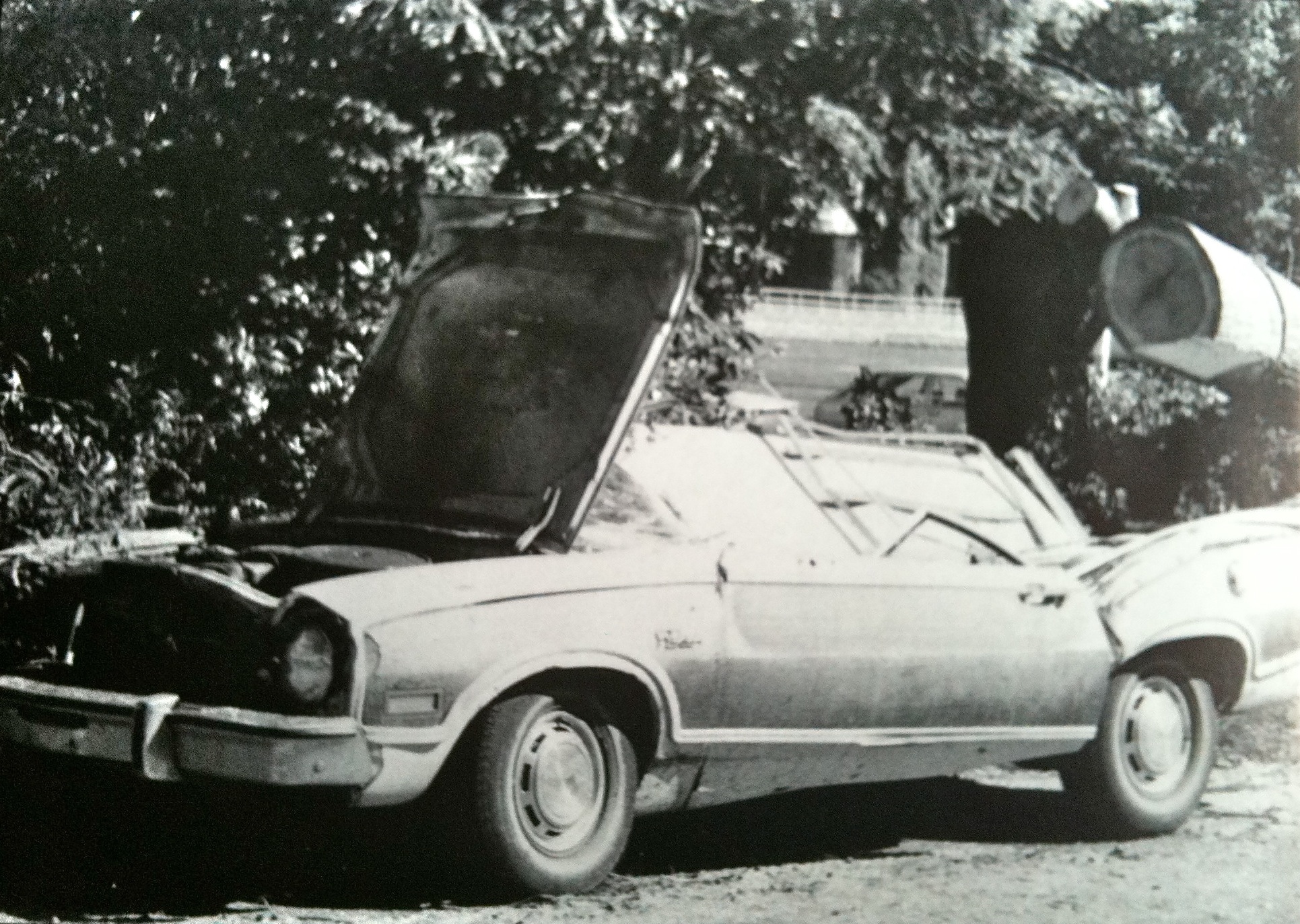
Gloria at Wesleyan has since been officially memorialized among students of my vintage, on account of our shared experiences that day, but also on account of a singular image — of a student car utterly crushed by a tree felled during the storm. This photograph was played big in The Argus, where I was an editor, and subsequently in our yearbook. But I say it’s time to broaden the Wes legend that was Gloria 1985, and what better way than inducting me and my housemates into the Wesleyan Athletics Hall of Fame? All together now, with feeling:

G… L… O… R… Aye-ay-ay-ay-ay-ay — G-L-O-R-I-A.

GLO-RHEA!

Ordering Martinis, Maintaining Decorum: A Guide

Ordering Martinis, Maintaining Decorum: A Guide

I’m something of an asshole, but I reckon it’s much like dealing with substance abuse — acknowledgement of the core issue is the first step toward recovery. Accordingly, I do spend considerable time and effort trying not to be an asshole, or less of one. I just find this task to be particularly onerous when ordering a martini.

I have not allowed this challenge to affect consumption. I developed a taste for gin long before I developed a taste for any other alcohol. We go back a long ways. I don’t claim any broad expertise on the martini subject, notwithstanding where I stand on it. In other words, I know what I like:

• I prefer Bombay, or Beefeater: I’ll accept some lesser quality gin if it’s all that’s available. I’m honestly not too snobby about it, but Bombay and Beefeater are my ideals — and there are horses for courses. Tanqueray is fine with tonic, for example. Better than fine actually. But it’s got a very different sort of taste that, to me, doesn’t work in the martini context. Also, as I explain a bit further down, specifying Bombay tends to lessen my opportunities to come off sounding like an asshole.

• I don’t like olives: Yeah, I know. This is absurd. Everyone loves olives, Dan Bern especially. They are the things that make the martini for many people, but not me. I don’t like them on their own and I surely don’t want the oil, or the essence of anything — lemon peel, onion, or what have you — getting between me and the sublime chemistry of gin + vermouth.

• I want it shaken: Martinis should be served colder than cold, and shaking the ice, gin and vermouth together imbues the mixture with thousands of tiny ice shards that, when the drink is poured from shaker to glass, form a thin, crystalline film on the drink surface. It’s a beautiful composite thing, like a snowflake. Each design is utterly distinct. What’s more, it tells me the drink is cold enough and will remain so for as long as the immediate climate allows. There are establishments that will serve you a small portion in the martini glass, while the remainder is provided separately in a caddie, a small beaker that in turn sits in a glass globe that effectively packs ice around said beaker. This is solid presentation and extremely practical: The martini stays cold. But I still want it shaken on the front end.

• I want it very, very, very dry: This does not mean I want no vermouth at all. As you may have noticed, the dryness of martinis is the subject of much hackneyed, drink-related humor. People will muse, upon my ordering a very, very, very, “Oh, so dry that you just wave the vermouth bottle over the glass?”, or “So dry that all you need to do is whisper the word vermouth over the rim?” No, that’s not the point (and while you’re at it, stop with the Hawkeye Pierce impressions). I don’t want straight gin. Vermouth does something specific and integral to the martini process, even in extremely small doses: It cuts the astringent edge of straight gin like nothing on God’s Green Earth. Some people enjoy the taste of vermouth, which is an aperitif after all, and some enjoy that of vermouth mixed with gin. That’s all well and good. But people like me who want their martinis very, very, very dry do not like either of those things. They’re seeking the taste of gin minus its astringency, which is exactly what just the right amount of vermouth — literally a droplet per martini — provides.

Let me share with you one of the world’s great, fool-proof drink tips. If you want a very-very-very dry martini and you’re mixing for a single, here’s what you do: Pour what is surely too much vermouth into an ice-laden shaker; gently stir it around a bit; then pour out all the vermouth, every drop. The vermouth that remains coated on the ice is the exact right amount for a bone-dry martini. Just add a single serving of gin, shake with vigor, let sit 30 seconds, shake again and serve.

•••

Back to the asshole theme. It is fairly well impossible to order a martini, while conveying all this vital information, without sounding like a pedant. If one were to provide even a quarter of the detail above, anyone within earshot would rightly assume that, “Jeezum crow, that guy there ordering the martini is a Grade A/No. 1 Asshole.”

The martini-ordering process is indeed rife with opportunities to sound like a self-important prick. Here’s another example: If you want your martini shaken, how does one make this clear without invoking a sort of fatuous, wannabe-James-Bond swagger? It’s difficult, let me tell you.

I’ve been drinking martinis for more than 30 years, and trying not to be an asshole for nearly as long. Here’s how I tiptoe through these potential minefields:

First, I have, over time, developed a concise, matter-of-fact, not-at-all swaggering script for my preferred martini order that, I daresay, has proved perfectly effective. Here’s what I say, every time, without fail: “I’d like a very, very, very dry Bombay martini. Straight up. No fruit. Shaken, please.”

I intone “very” three times because I’ve noticed, over the course of decades, that if I say it four times, I’m an asshole — and the bar man is likely to use no vermouth at all, to punish me. If I say it just twice, odds are 50-50 the waiter or waitress will not effectively emphasize this dryness to the bartender and my martini will come back tasting like a vermouth slushee. When it comes to “very”, the number of the counting shall be three. Four thou shalt not count. Five is right out.

Second, note the brand specification inherent to my stock martini order. This component I’ve developed in the last 15-20 years in response to what is frankly a worrying but nevertheless obvious trend. I’ll try not to sound like an asshole while describing it.

It’s ironic that as the martini has grown in popularity — and I think we’ve all noticed this trend — two things have become clear: 1) Much of this uptick is due to the influx of specialty martinis; and 2) the vodka martini has similarly grown in popularity.

These developments are co-dependent. Gin does not mix particularly effectively with, well… anything but tonic or vermouth. Vodka on the other hand is virtually tasteless and mixes well with all manner of mixers and fruit juices. Accordingly, when one is concocting some confection/abomination like an appletini or cranberrytini, vodka is the clear choice when it comes to one’s liquor base.

I shouldn’t say “abomination”. That is too strong a word. What these specialty vodka martinis truly are is “risky”. The martini is no joke, people. I’m a 205-pound man, and I only have a second martini when I’m at home, or not driving home. There is a built-in safety mechanism inherent to this particular drink: When consuming a proper martini, one is damned cognizant of the fact that one is drinking something entirely alcoholic and wicked potent. By contrast, when you’re drinking an appletini, it’s a lot like throwing back a glass of Hi-C  — in a fancy vessel, laced with barbiturates. In other words, it’s all too easy to have 3 or 4, and that is a recipe for disaster.

There’s something else, something a bit cynical and sinister, at play with specialty martinis. Let’s call it the Bartles & Jaymes Syndrome, because the same demographic who drink appletinis today drank wine coolers in the 1980s. In short, alcohol purveyors — in addition to boyfriends and would-be male suitors the world over — are continuously looking for new ways to get young women as drunk as possible, as quickly as possible. Most young women will not stomach proper martinis. Cranberrytinis? This selection I’m afraid they will stomach. Until they don’t. 

But here’s the third and final reason I’ve been obliged to add the “Bombay” to my standard order: If I don’t make this clear, the person taking my order will inevitably ask me, on account of vodka’s surging popularity in this milieu, “gin or vodka?”

I understand why they ask. Honestly, I do. Half the people ordering a martini have never done so before — or they are accustomed to ordering off specialty martini menus that bring high levels of variability to the process. However, as I hope we’ve made clear here today, a martini is a martini. It’s gin, full-stop.

Years ago, when I was younger and less concerned with being an asshole, I would respond to this perfectly innocent question thusly: If I wanted a “vodka martini,” I’d have asked for one. But that was the old Hal — the one who, all too frequently, came off sounding like, well… you know. By strategically inserting Bombay into my order, I make things plain, I get what I want, and all questions are answered ahead of time.

Of course, some 10 percent of the time, I am served a martini that has way too much vermouth, or olives, or vodka — regardless of all the care and forethought I devote to the ordering process. In these cases, I feel perfectly within my rights to send that drink back. But here again, I have gamed out a strategy that mitigates my own assholery.  I don’t reorder the martini. A barman will invariably react poorly to this — by removing vermouth altogether or (my personal favorite) making the exact same wrong martini again. 

I refuse to take that bait and chose instead to defuse the situation, thusly: Hey, sorry to be a bother but this is not what I ordered. I’ll have a Bud. 

Sports Couture Karma: Transgressions will cost you
The inimitable Maurice Lucas in the uniform his Blazers adopted immediately after winning their first NBA Championship, in 1977. They've not won another.

Sports Couture Karma: Transgressions will cost you


The inimitable Maurice Lucas in the uniform his Blazers adopted immediately after winning their first NBA Championship, in 1977. They’ve not won another.

So, I was watching some random highlight of a Patriots-Rams exhibition game about a year ago when it suddenly crystallized for me. It takes two points to make a line, and finally I had identified a second, solid example of Sports Marketing Greed/Hubris, Couture Division.

Bill Walton models the jersey that won Portland a title. A year later, in new togs, he broke his foot, demanded a trade and was never the same again.

Exhibit A) The Portland Trailblazers win the NBA title in 1976-77, wearing the same plain-Jane uniforms (white at home, red on the road; the “Blazers” lettering reading vertically down the jersey) they had sported since their joining the League in 1970. The very next season, they go to the arguably more attractive and apropos design — dual swaths, or blazes, of red, black and white that run diagonally across the breast and down the shorts. The result: They haven’t won a title since. Haven’t really come close, to be honest, despite a couple trips back to the Finals.

You think it’s an accident that one of the finest, most cohesive teams in NBA history literally disintegrated the moment they damned the championship karma and changed uniforms? Don’t be naïve… I had always wondered why the Blazers tempted fate in this fashion, but I couldn’t prove that some sort of karmic law had been transgressed, until now.

Exhibit B) The St. Louis Rams win the 2000 Super Bowl in their old yellow-and-blue uniforms. The next year, attempting to cash in at the merchandize window, they switch to GOLD and blue. Again, arguably an upgrade in style and originality, but a bald-faced affront to a clearly winning formula. They return to the Super Bowl in 2001, lose to an inferior Patriots team, and have since descended into chaos. Koros, Hubris, Ate, Nemesis — the classic Greek cycle of decline…

Purists will note that the Rams’ yellow-and-blue togs were not their originals. The dark blue-and-whites I associate with Roman Gabriel, Merlin Olson and the 1960s; the Rams actually go back to Cleveland in the late 1940s, and I have no idea what colors they wore then. My point: The yellow-and-blue had been worn a good long time prior to 2001, since the early 1970s. They were established.

A one-off merchandizing cash-in you MIGHT get away with. But you can’t  win a franchise’s first-ever championship and change things up so radically. You just can’t.

These have not.

These colors delivered to the Rams Super Bowl glory.

Irish Golf Tidbits: Stouts, Control, Separated at Birth

Irish Golf Tidbits: Stouts, Control, Separated at Birth

Still emptying the suitcase of the golfing mind, fresh off the Golf Road Warriors’ late-July tour of Ireland. Several matters remain unaddressed, and so they are tackled here. I reserve the right to keep this tab running indefinitely. Even so…

• Guinness Lite. Honestly — We had wonderful couple of days (less than 24 hours, actually, now that I think about it) in the very north of Ireland at Ballyliffin Golf Club. General Manager John Farren was our host, and he could not have been a better one. He looked the other way when we arrived looking like death warmed over (straight from a transatlantic flight and 4-hour drive from Dublin). He personally delivered Peter Kessler’s set of Adams clubs on the 8th hole of our round on the Glashedy Links. He even joined us in the bar for a podcast when all 36 holes had been completed. Somewhere in this blitz of activity, he made what I thought was a joke about offering us a Guinness Lite. I assumed he was joking; I mean, really… But lo and behold he mentioned it again during the pod, and upon drawing him out, it became clear he was perfectly serious. Guinness Mid-Strength is in fact the centerpiece of a “responsible drinking” campaign being waged by Diageo Ireland, Guinness’ current owner. Unlike American light beers that are marketed as being “less filling,” Guinness Mid-Strength was created to offer an unchanged taste experience without getting people so loaded. It weighs in at 2.8% alcohol, compared with the 4.2% we expect from the world’s most recognizable stout. I expressed mild shock and dismay at this development, but John urged me to try one. He even ordered me one from the bar, after the pod, but it was ultimately delivered to someone else — at which point I accused him of taking the joke a bit far. Still, I promised him I’d try one and report back. I did just that during our stay in Killarney and let me say I was impressed. Depending on how cold it’s served, a reasonable person might have trouble telling a Mid-Strength from the original. Indeed, because I’ve gone dozens of Irish posts and thousands of words without saying it, I’m obliged share the sentiment here: Guinness Mid-Strength. It’s magically delicious.

Beamish, where art thou? — I love my Guinness. I’m no fool. But I do enjoy a wide variety of stouts. Why limit one’s self? The American craft brew renaissance, which pretty much coincided with my coming of age, has exposed me to just how many ways one can creatively brew a stout, the thickest and “stoutest” porter-style beer a brewery might produce. Gritty McDuff’s Black Fly Stout is one I enjoy regularly, as it’s brewed just down the road from my home in Maine. I like a Murphy’s every once in a while, and one thing I was dearly hoping to do in Ireland during this GRW trip was down a few Beamish, a lovely stout that I’d quaffed on previous trips to the U.K. Well, I wasn’t really expecting to find it up north in Ireland; Beamish was originally brewed in the south, in Cork, and folks up north don’t demand it. But I was dismayed to see it nowhere on tap in Killarney or any of the clubs we frequented in the southwest. Apparently Heineken International owns it now. There was a brief dalliance with international distribution, in 2009, but that’s been halted and it’s nowhere to be found on the streets of Killarney. What a shame.

Eat, Pray, Love = Control, Feel, Trust? — So, each of the Golf Road Warriors was provided two golf gloves for our trip, courtesy of our friends at Hirzl. We received the Trust Control model, and the Trust Feel model. I can honestly speak only to the Control, which I donned at Ballyliffin’s Old Links and used throughout the trip. Great glove. No stretching, easy on and off, and the palm material (kangaroo leather apparently) was super grippy, without being tacky. I went for the Control because I reckoned we’d be playing multiple rounds in the rain (at which time, I would break out the Trust Feel model). But, as luck would have it, we played only one real wet round (at Carne GC), the Control provided just that, and it dried out in plenty of time for the next day’s round. I’ll report on the Trust Feel when the Control wears out, but don’t hold your breath. I’m thinking this could take some time.

Time-Honored Tracks Enter Digital Age — Failte Ireland, the very capable promoters of Irish tourism (Failte, roughly translated from the Gaelic, means Welcome to), launched during the Irish Open an online search capability that allows visiting golfers to book tee times, in real time. Go to the Search and Plan section at www.discoverireland.ie/golf and you’ll see how it works. Many of the fine old links are represented among participating clubs, in addition to a bunch of top parkland tracks, including Open host Killarney Golf & Fishing Club. 

“If you want to play a number of courses over a few days, you can now make the most of your holiday by checking tee time availability at golf courses online in advance,” explained Keith McCormack, Failte Ireland’s Head of Golf. 

“Our tee time availability search facility will tell you exactly what slots are free. You can then book the tee time that fits your itinerary with your chosen golf course. All you have to do is decide where you want to go and what type of golf course you’d like to play on.”

English pro Chris Wood

Chris Wood, Separated at Birth — As you may recall, I played in the pro-am on Wednesday of last week’s Irish Open at Killarney Golf & Fishing Club. Thankfully, no one was hurt. My pro was Englishman Chris Wood and the whole time around I’m thinking to myself, “This guy reminds me of someone. Not someone I know, but a public figure…” Couldn’t nail it down during the 18, but I did upon returning home. Indeed, I realized it was two guys who both reminded me the 6’6” Bristol native: NASCAR driver Dale Earnhardt Jr. and Robin Lopez, center for the NBA’s Phoenix Suns. See the evidence below. Actually, Robin has a twin in the NBA, Brook, of the New Jersey Nets. But I’m going with Robin because 1) he dated fellow Stanford product Michelle Wie for a time, 2) he was on my fantasy team a couple years back, and 3) his flyaway, corkscrew hair is more reminiscent of Wood’s trademark, wind-blown, nest-like coiffure.

Robin Lopez

Dale Earnhardt Jr.

How the Irish and Ireland inform their golf
A quiet Sunday morning on the Diamond in Donegal Town. That's the road south, to Sligo.

How the Irish and Ireland inform their golf

A quiet Sunday morning on the Diamond in Donegal Town. That’s the road south, to Sligo.

Sitting on a park bench this Sunday morning in the Diamond, the central square area of Donegal Town. The Road Warriors straggled back here, battered and bruised, late last night between rounds at Donegal Golf Club and Enniscrone. What we found upon checking into the splendid Abbey Hotel was a major league party underway, in our hotel bar/disco, and in every hotel and bar surrounding the Diamond. Saturday night in Donegal is no joke, and it wasn’t just the gaggle of young things strutting about. This was clearly a cross-generational night out. When I checked into my room, I shared an elevator with a 50something couple and another woman who had broken the heel off one of her 60s-era, black, Nancy Sinatra-style, go-go boots. The three of them were literally falling all over themselves in hysterical laughter at what had happened, and they wanted me to join in. When I crashed last night, sometime around 3 a.m., there was still plenty of laughter emanating from the Diamond.

It’s morning now, close to noon actually, and it’s quieter here in the square. A motorcycle club has gathered here on the stone plaza, but their comings and goings are the only break in the quiet remove of a Sunday morning after. You may think I’m crazy, but I believe I hear some Irish pan flute in the distance. Honestly. Some business establishment must be piping it in. I listen to the familiar chug of diesel engines (they predominate here) as lines of slow traffic putter by me. The three main roads all meet on this one spot, heading off south to Sligo, north Letterkenny and west to Killybegs. Nothing here in the square is made of wood. It’s all stone masonry, businesses on the first floor, resident apartments on top. People are out and about and the pubs are open for business.

I’m from Boston, so I’m used to the way Irish towns are laid out (i.e. around a square or town green — these forms of public architecture were imported directly to New England from the old country), and I’m used to the Irish. Growing up, I just assumed (up to a point) that everyone in America but me was Irish and Catholic. Everyone had relatives back in Ireland, just as everyone here has kin in the states.

The difference is (aside from the presence of a proper castle, Donegal Castle, just off the square), the Irish in Ireland are all too happy to chat you up about their relatives, where they live, where you live, what sort of trip you’re doing, have we played Sligo, there’s a pub round the corner you must try, and let me buy you a pint. The American Irish are nice enough; no more or less congenial than me, or any other immigrant population in the U.S., which is to say all of us. But the indigenous Irish are off-the-charts friendly.

Oftentimes the Scots and Irish people are compared, as the links courses in Scotland and Ireland are often compared. There is, I think, an austerity to life in Scotland, to the golf they play, to the courses they play, to their outlook on life. It’s nothing cold or perverse, but there is a reserve, a near asceticism to the people, culture and the courses. I love it there, but when you think of the Scottish links you’ve played, do you think green?

Well, this ain’t the Emerald Isle for nothing, people. It’s green and lush. The outlook is sunny, even if the weather isn’t always. Ireland and the Irish don’t do asceticism. They are, in contrast, generally garrulous and outgoing. Their golf courses run the gamut, naturally, but they generally reflect their keepers: they are greener, the dunes are bigger and more dramatic, the welcome in the clubhouse more genuine than those you find across the Irish Sea. Handsome is as handsome does.

Donegal Castle is just a stone’s throw from the town center, better known as The Diamond.