STOW, Vt. (Oct. 21, 2019) — So, sports are cruel, whether the participants are professionalized adults or mere school children. But sports are real, which is what makes them so damned compelling — in a way that lays bare the mockery of a sham that “reality” TV truly is. The latest case in point: Clayton Kershaw, now a certifiably tragic figure in baseball’s sprawling Hall of Misery & Woe.
I fell asleep in a Vermont hotel room two Wednesday nights ago thinking Kershaw and his Dodgers had beaten back the pesky Washington Nationals in their best-of-five National League Division Series. Kershaw, having already lost Game 2, at home, was summoned to preserve a 3-1 lead in the 7th inning of Game 5. This he did, securing the third out.
That’s when I nodded off.
For some reason, I later learned, Kershaw was summoned by Dodger manager Dave Roberts to pitch the 8th, wherein the erstwhile starter gave up home runs on consecutive pitches to Anthony Rendon and Juan Soto. Tie game. Kershaw was lifted and L.A. lost in the 10th on Howie Kendrick’s grand slam… Where was Kenley Jansen through all this? Isn’t he L.A.’s closer?
I want to be clear: I honestly have nothing against Kershaw — or the Dodgers. When I first started following baseball in the early 1970s, I loved those L.A. teams of Ron Cey, Bill Russell, Davey Lopes, Steve Garvey, Yeager & Ferguson behind the plate, Dusty Baker and Reggie Smith in left and right). I rooted hard for them later in the ‘70s when they faced the Evil Empire Yankees in consecutive World Series.
Octobers don’t flatter Clayton Kershaw
And yet I have been mystified by the conventional wisdom surrounding Kershaw these past few years. Folks seem determined to cast this guy as one of the great pitchers of all time — despite the fact that he’s done so very little in the post-season, which, we can agree, is the true measure of pitching greatness. I’ve even heard Sandy Koufax comparisons! (Just google “Kerhaw Koufax” to see the extent of this folly.) Yes, they’re both Dodgers; their surnames both begin with K; they’re both lefties. But that’s where the similarities end.
Again, I don’t dislike Kershaw, nor do I wish to run the guy down in light of what has proved another gut-wrenching failure. But his October went like other Octobers, which is why these Kershaw-boosting narratives make no sense. They are, in fact, the careless musings of baseball know-nothings and hype-vendors.
I don’t Tweet much (follow @MandarinHal, if you want proof; I prefer Threads @silblingrivalry.halphillips) but after watching Kershaw struggled in the first inning of Game 2, I posted the following:
6 p.m. on a Friday in May: The 12-year-old we’d been foster parenting the previous 8 weeks, whom I’ll call Bri, informs us there is a concert at school where the “staff band” performs — and the kids apparently join in. Having been through the middle/high school thing twice with our own children, both of whom are off to or out of college, my wife and I are pretty well done with this sort of thing. It’s a Friday night after a long workweek. I’m making pizza. But we live in semi-rural Maine. This tableau tends to starve our charge, the charming and talented if somewhat moody Ms. Bri, for entertainment here. So we scarf down a couple fresh-hot slices, drop her there at the education-plex two towns over, and head to a movie. Rocketman, listed at 7, doesn’t start till 8 apparently. So we opt for Booksmart instead. Not half bad.
9:30 p.m.: Home again, post-concert, we watch the finale of Killing Eve, which is probably, ahem, not appropriate for all three of us. Were the state to know we’d shown it to this 12-year-old, the Department of Health and Human Services (DHHS) might just take her back. It’s a bit gory but remains high quality television, we reason — unlike her current obsessions, Riverdale and Vampire Diaries.
10:16 p.m.: Sharon notices that DHHS has in fact just called us. Somehow, in discussing the abrupt ending to Killing Eve, we’d missed it. Turns out our friends with the state have not checked in to take issue with Bri’s TV viewing habits. They’ve got a 6 month old and her 8-year-old brother both in need of a place to stay this weekend. Sharon and I look at each other. This is the “respite” exercise, the temporary care of foster kids and would-be foster kids — typically on short notice for short periods. This is what we signed up and trained for. We call back and leave a message.
[To catch the reader up: Sometime last summer the Portland (Maine) Press-Herald published an investigative series on the lives of children in the Maine foster care system. Household conversations ensued, mostly centered around how we as a society — and Maine’s worthless governor at the time — seem ever more and even deliberately indifferent to the plight of these and other kids, the least fortunate among us really. The 2016 election had also radicalized each of us in our own ways, effectively focusing our empty-nest minds on what we could do to make a difference, directly. An encounter at the mailbox — with our neighbor, who leads an agency that provides services to special needs kids in the foster system — led to an informal back-porch coffee, then a more formal information session in Biddeford. A series of training classes followed, then fingerprinting and ultimately a license from the State of Maine to serve as “resource” parents (recently rebranded from the more familiar “foster”). Sharon and I do respite care, the ad hoc, short-term care of kids between homes, kids just received into state custody, or kids whose long-term resource parents need a week off. What you’re reading here is an account of one of the half-dozen experiences we’ve had so far in 2019. More families are needed. Do reach out if you’re foster curious.]
Foster Parenting 24/7
10:24 p.m.: The state calls right back. On speaker, Haley (I’ve changed all these names) sounds to my middle-aged ears impossibly young, flustered, disorganized and why not? These two kids have apparently just been taken into the state’s custody from a Portland homeless shelter; it’s 10:30 on a Friday night and they need a place to stay, a place that isn’t a motel — through Tuesday. We explain we can take them through Monday morning, when we both go to work. Haley seems relieved and grateful at this news. They need our address. Halfway through Sharon’s providing it, I interrupt and ask for the phone — Haley’s uncertainty, her inability to answer some basic questions (What sort of provisions do the kids have with them? How many diapers are they bringing, how much formula, what happens on Monday?) did not sit exactly right with me.
“Sorry, Haley, but I have to say, this all sounds a bit dodgy. Please provide us the name and number for your manager, or the state case worker on 24/7.” Not unrelatedly, our 12-year-old has a bio-mother whose parental rights have been terminated but remains determined to stay in touch with her daughter and ultimately reunite, which is impossible until she turns 18. But here we are. Social media and phone use are total minefields. For a brief moment on the phone with DHHS, I thought this might be a ruse to find out where we lived, for future surveillance/stalking. Upon hearing my doubts, however, Haley snaps back into sober bureaucrat mode, indicating that it was she who was in charge so late on a Friday night; she reels off a bunch of other stuff that ID’s her as a legit DHHS employee. We provide our address.
11:05 p.m.: It’s half an hour’s drive to our place from the DHHS mothership, in Portland, and in those 30 minutes we ready as we can: pulling the antique bassinette from Sharon’s closet, making up a bed for the 8-year-old, pulling out clothes that might fit him. Throughout, Bri, who generally alternates between sullen and charming — because she’s 12, and because she doesn’t know where she’ll end up when the school year ends, when the summer ends — proves fully energized and engaged. She proves a huge help, doling out advice about the sort of clothes they may or may not come with, cleaning her room and offering the second bed in there (if the boy doesn’t want to crash alone). We agree she’s the one who has the most recent baby experience, vis a vis her younger siblings, who, she explains (for the first time), were still very young when her homeless mom bounced from place to place, when the state finally took possession of them after 3 second chances, when all three kids moved from foster home to foster home. More than either of us, Bri knows what this sort of exercise entails.
HOUSTON, Texas (Oct. 11, 2019) — There’s a reason China has long referred to itself as The Middle Kingdom. Daryl Morey, the NBA and frankly much of Western Civilization is beginning to understand what that meant and what it means today.
As you’ve no doubt heard by now, Morey is the general manager of the NBA’s Houston Rockets. Until last week, he was known primarily as one of the league’s most savvy operators, an early and successful adopter of advanced hoop metrics and a keen innovative judge of talent in a league turning inside-out. Read: He gets the NBA’s new, stat-backed reliance on 3-point shooting. Morey’s also politically aware, apparently, something he exhibited last Friday when he tweeted his support of Hong Kong protesters in their running battle with China’s central government. “Fight for freedom. Stand with Hong Kong,” he wrote.
With that seemingly innocuous digital bromide, Morey has himself pissed off that central government, in Beijing. In the process, he may have inadvertently clued a big hunk of America into the fact that the unilateral, post-Cold War Era is over.
Morey has since taken the Tweet down but he, the Rockets and
the NBA have reaped the 21st century whirlwind.
Middle Kingdom Lowers the Economic Boom
In response, the Chinese Central Government has announced that Rockets games will no longer be broadcast by Chinese state TV or partner Tencent, which recently agreed to a $1.5-billion deal with the NBA to stream games in China. During the 2018-19 season, some 600 million Chinese watched an NBA game in this fashion.
The Rockets themselves just happen to have been the most popular team in the country — mainly because Yao Ming, China’s most successful NBA product, played his entire career in Houston. Today Yao is head of the Chinese Basketball Association. On Monday he severed the CBA’s relationship with his former team.
Behold, The Middle Kingdom, which does note accommodate. Others accommodate it.
China so named itself circa 1,000 BCE, when the reigning Chou people, unaware of advanced civilizations in the West, believed their empire occupied the middle of the Earth, surrounded by unsophisticated barbarians. For the ensuing 3,000 years China has occupied the center of the Asian universe, such has it dominated economic and cultural affairs in this region .
In Asia, over this long arc of history, China’s military whims were routinely indulged. Its culture effortlessly spilled over into countless neighboring nations. Its outsized market (always a function of its outsized population) routinely bent foreign states to the Kingdom’s economic will.
Chinese Dominance has no Analogue
North Americas and Europeans have a difficult time grasping this Middle Kingdom concept — the enormity of China’s economic and cultural power — because, for Europeans, Africans, Middle Easterners, South or North Americans, this long-term dominance has no analogue. What’s more, recent history doesn’t bear this primacy out. Starting in the mid 1800s (when the English first acquired Hong Kong and its holdings in the Pearl River Delta), and ending with Mao’s victory over nationalist forces in 1949, China was something of a geopolitical and economic patsy.
Here’s the way I’ve always thought of it: China had a bad century. The Chinese call it a “Century of Humiliation.” But one or two bad centuries out of 30 isn’t such a terrible batting average. But that blip is over. Its recent “rise” is merely a reinstatement of a longstanding status quo.
Silly’s main “dining room”, home of the Key Lime Pie Shake and the Slop Bucket
PORTLAND, Maine (Aug. 31, 2019) — Two pillars of the Portland food scene have exited the city’s vibrant but transititory culinary tableau. First came the announcement that Silly’s, the longtime boho totem on Washington Street, would shutter its operation on Sept. 1, 2019. Two days later, Brian Boru — the peninsula’s “It” dive bar for much of the 1990s — announced its doors would close.
In a
Facebook post equal parts trenchant and heartfelt, Silly’s owner Colleen Kelley
explained that the city, in general, and the Washington Street corridor, in particular,
were rapidly becoming too chic for her tastes. She also has an aging father who
requires her 24/7 attention, something the restaurant had commanded for the
past 31 years.
“My sister Shelley and I have sold the buildings — not Silly’s, just the buildings,” Kelley wrote on the restaurant’s Facebook page. “As much as Erin and Will, the managers, and the rest of the staff are taking care of me and the business, it is constantly challenging to do business with the city of Portland, which also wears me out. Another huge factor in my decision: I am smart enough to know my business model won’t work in a city destined to be Seattle, which isn’t meant to be a slam. It is just my opinion of where Portland is going. I don’t want anything but wonderful things for Portland, Maine. I have enjoyed many years here. However, I am a fat woman who serves fat, over-portioned food and I won’t charge 24 dollars for 4 oz. of dip and some pita bread.”
Portland Food Scene goes Posh
Not 24 hours before this news broke, a Portland friend had raved to me about a new southwestern restaurant that had just opened on Washington Street, for many years a gritty thoroughfare that, of late, has gentrified thanks to a raft of restaurants, breweries and distilleries. To call these “upscale” is to look past the inherent casual vibe that pervades all things Portland. I can’t think of a single restaurant in the city where jackets are required or shorts frowned upon. Still, this much is beyond dispute: Portlandia East is an increasingly posh place; the owner of Silly’s has recognized this and wants no part of it.
This dynamic was even more evident with the Boru closing. It was announced on Thursday, August 22 that its last day would be Monday Aug. 26. This bar sits more or less all by itself in the middle of an open, undeveloped lot — half the size of a full city block. It’s adjacent to the Old Port, walkable from Congress Street and the tony West End. It’s right across the street from the civic center.
One key to understanding both closings has nothing to do with Portland’s national rep as a city for ever more haute bourgeois foodies. Note the first sentence Kelley wrote: She mentioned buildings twice. The real estate market in Portland is blowing up; the opportunity for businesses of all kinds to cash out is only a phone call away.
Someone clearly made Boru’s owner an offer — based on potential/developed real estate value — he couldn’t refuse… Decision-making is rarely so simple as that, of course. See a sensible rundown of the factors contributing to the phenomenon here… It’s not capitalism run amok, just more evidence (as if we needed any) that its churn never rests.
My 40something dad, his kilties well and truly shorn, in the 1980s
[August 12, 2019] — Recalling my father, one should know that he abided by few fashion trends and set even fewer. However, on the 8th anniversary of his pasing, l will claim on his behalf one initiative to which he proved an early and canny adopter: He depised kilties. His aversion to those oddly fringed, seemingly vestigial, lace-obscuring flaps — which, for decades, adorned all manner of golf shoes — would prove well ahead of his time. For us, it’s a portal down the Golf Shoe History rabbit hole.
My nephew’s boots, complete with kilties
I was reminded of my dad’s rare fashion-forward stance when my 20-something nephew recently visited at Christmas. Nathan graduated from college a few years back with a degree in fire-suppression engineering. The job he obtained in this field quickly bored him. Living in suburban D.C. further depleted his life force. So today he’s out West fighting forest fires with a crew of badass, axe-wielding Latinos. In any case, he arrived in Maine for the holidays wearing a pair of high-laced, black-leather firefighting boots that, to my surprise, featured small kilties down by their steel-tipped toes. If Dr. Martens made golf shoes, this is what they’d look like.
What’s with the kilties? I inquired of young Nathan.
“Is that what they’re called?” he replied. He went on to explain that when one is tramping about the forest floor, these fringed swatches of leather prevent sticks, leaves, pine needles, mud and other bits of underbrush from lodging between one’s tongue and boot laces.
In the mid-1970s, when I was first introduced to kilties (and to golf, for that matter), this description of their historical utility was never advanced, not to me anyway. I knew my dad didn’t care for them. Beyond that, they were more or less understood to be yet another whimsical affectation specific to golfing attire, along with Sansabelt slacks (from the French apparently: sans belt, get it?), bucket hats and polo shirts.
Golf Shoe History: A Field Little Explored
The evolution of golf shoe fashion is not a popular avenue of exploration. Though it must be said: Any research into the subject inevitably leads one down a rabbit hole of pleasingly arcane information.
For example, it’s possible (quite logical to assume even) that kilties predate golf spikes in that evolution. Spikes emerged only in the mid-19th century when Scots started hammering nails through their boot soles in order to gain better purchase on dewy fescues.
More recent history tells us that my dad and his cohort of 40-somethings spent much of the 1970s dispatching with all manner of societal expectations. They fled corporate America, experimented with drugs and divorcef in record numbers. This helps explain why my father looked so dimly upon kilties as an impractical, foppish tradition worth chucking. And so, from my earliest recollection, he would immediately remove them from new golf shoes.
Why did they become traditional? Mid-19th century links were hardly the manicured landscapes we know today. At best they were meadows, managed lightly (and largely) by herds of sheep. The centuries prior featured even more rugged/primitive golfing environments. In short, as Nathan pointed out, during these early, less formalized days, anything that kept the prominent undergrowth from mucking up your shoes and bootlaces made a world of sense for golfers — and their caddies. So kilties did in fact, at one time (for quite a long time actually), serve a purpose.
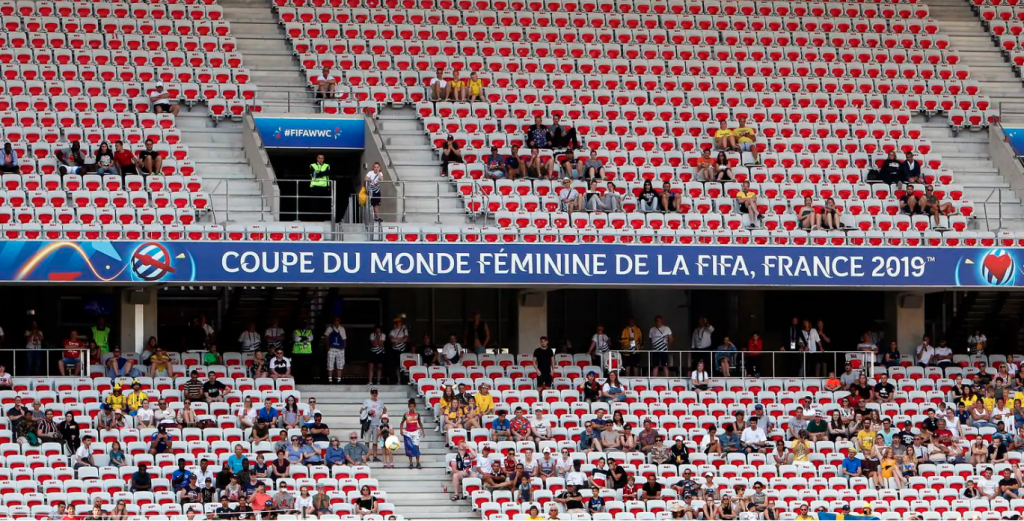
LYON, France (June 27, 2019) — Ever wondered why women’s professional sports are watched and otherwise supported so meagerly by women themselves? The underlying premise here may strike one as obtuse, even churlish this week, what with thousands of women in the stands watching the 2019 Women’s World Cup in stadia all over France. But none of last week’s Round of 16 matches sold out and World Cup crowds can mislead. You’ll recall they were enormous during the 1999 Women’s World Cup, here in the U.S. That event was seen as a tipping point for the women’s game in North America, and yet three separate women’s professional leagues have been attempted in the two decades since. The first two folded and the third — the National Women’s Professional Soccer League — continues to teeter on the brink of financial collapse and cultural irrelevance.
Soccer remains a funny duck in America. More than those in other footballing nations, soccer fans here are beguiled by and pay outsized attention to their national teams — as opposed to the privately administered clubs that compete in domestic leagues. And surely there are entrenched gender biases that have worked against the serial iterations of women’s pro soccer in this country, or the WNBA, or women’s professional hockey wherein the Canadian professional league just folded. U.S. hockey international Kendall Coyne Schofield told the New York Times in April that, “People are drooling for women’s hockey. But the product we deliver isn’t being shown.”
Are they drooling for it really? And what does she mean when she says, “people”? I don’t have numbers on how many folks consume women’s hockey at the Olympics, for example, and how that audience breaks down by gender. But it might surprise you to learn that nearly 70 percent of the WNBA’s viewership is male. That surprised me.
Women’s Professional Sports have ‘a marketing problem’
The WNBA has been around since the late 1990s; it has never turned a profit, despite being financially backed and marketed by one of the most savvy organizations in world sport, the NBA — an organization that has every incentive to create a larger audience for both of its on-court products. The core of that new, larger audience would presumably be women who don’t otherwise follow the NBA. But women have responded to the WNBA with the same relative indifference they exhibit toward women’s professional soccer and hockey. Here’s Adam Silver on the subject in 2018:
“It’s interesting: Women’s basketball is largely supported — just in terms of the demographics — by older men, for whatever reason, who like fundamental basketball, and it’s something I’ve talked a lot to the players about,” he said. “We’re not connecting with almost the same demographic that our players are. Our players are roughly, let’s say, 21 to 34, in that age range. I’m saying [to the players], ‘Why do you think it is that we’re not getting your peers to want to watch women’s basketball?’
“So in a way I think it’s a good problem to have, in that I think the game looks fantastic, and it’s amazing where the league now is from over 20 years ago when it launched,” Silver added, “but we still have a marketing problem, and we gotta figure it out. We gotta figure out how we can do a better job connecting to young people and how they could become interested in women’s basketball.”
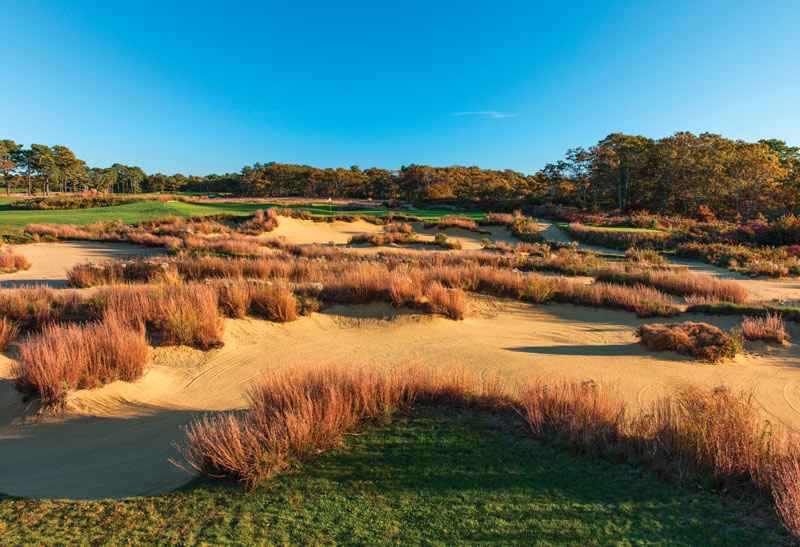
[Ed. This story on golf course organics appeared in the January 2018 issue of Golf Course Managementmagazine. In April 2019 it won the Gardner Award from TOCA, the Turf & Ornamental Communicators Association. I’ve won a bunch of these over the years but the Gardners are new — a sort of Best in Show among all the annual winners apparently. So I figured it was worth sharing here. There’s a link in the story body to another profile I wrote about the same time for GCM, on Dr. Frank Rossi. That one came out pretty well, too, especially if a) you’re a fan of kunekune pigs; or b) you want to know why Bethpage Black has agronomic relevance outside this week’s PGA Championship.]
By Hal Phillips When Kevin Banks was a turfgrass management student at the University of Massachusetts Amherst, it wasn’t uncommon for decorated or otherwise experienced golf course superintendents to drop in for guest lectures. When Jeff Carlson, CGCS, came by in 2005, Banks says he remembers thinking, “Wow, this guy is crazy!”
Frankly, that’s how most students in the midst of a traditional turf management education might have appraised Carlson’s work at the Vineyard Golf Club. When permits were being sought for building this golf course on environmentally sensitive Martha’s Vineyard in Edgartown, Mass., in 1998, developers were obliged to promise the local conservation commission that the prospective golf course would be managed in an entirely organic manner.
The Vineyard Golf Club opened for play in 2002, and Banks graduated in 2008. He would then apprentice at several traditional clubs before this story came full circle — Banks took over for Carlson as head golf course superintendent at the Vineyard Golf Club on April 1, 2015.
“I guess I’m the crazy one now,” the nine-year GCSAA member says.
Two-plus years into his tenure, Banks has more than warmed to the nonconforming aspects of his job, one of the few in golf course management that takes the organic approach from mere trend or direction to guiding principle. “It’s definitely been a challenge, but I’ve also definitely become addicted to it,” Banks admits.
Just 31, Banks today finds himself at the crux of another nascent industry trend, a phenomenon where head superintendents hire and groom their replacements, having accepted another position at the same club. Carlson stepped aside in the spring of 2015, but he remains at the Vineyard Golf Club as property manager, where he oversees capital projects — a just-concluded Gil Hanse redesign, for example.
Golf Course Organics and Politics of Succession
The idea of having the previous superintendent at the club — perhaps hovering, perhaps exerting undue or unwanted influence — may strike some as awkward. Not Banks, and here the organic dictates governing turf management at the club intertwine with these issues of succession.
“Before I took this job, I knew who Jeff Carlson was. Almost everybody in New England and New York did too, and I’m sure that reputation extends even farther than that,” Banks says. “He has been the organic ambassador for my entire turfgrass career. Having him help manage the golf course with me my first season here was a really sensible transition. I knew it would be very different for me, at first, but Jeff knew exactly where to expect an outbreak. He knew where we would first see weed pressure, and all this input came with his very relaxed and calm presence.
“I will always thank him for being patient and mentoring me into a truly organic manager — something I take great pride in today,” Banks adds.
Can Banks imagine having taken on the organic learning curve without Carlson there, on-site?
“Not really,” he answers. “Jeff was very patient. My first year, the disease we encountered in certain areas maybe should not have happened. I believed moisture levels were adequate and acceptable enough to fight disease pressure. They weren’t. But Jeff sat back and let me learn from my mistakes, and watched me grow.
“From the beginning, I was talking to anyone and everyone to get my head around the issues. And I still do that.”
Banks says he frequently talks with colleagues, companies and researchers about the specific issues he faces. Frank Rossi, Ph.D., of Cornell University and recipient of GCSAA’s 2018 President’s Award for Environmental Stewardship, is “a great resource,” he adds.
“But the way I look at it, Jeff is my best researcher. As often as I do interact with all these organic contacts and their ideas, I still take most of them with a grain of salt. They can recommend what they think is right, but you must compare that to what I’m finding here on the ground and what I think is right — and to what Jeff thinks, because he’s done it.”
The first new golf course to be built on Martha’s Vineyard in 30 years when it opened in 2002, the Vineyard Golf Club was designed, built and is maintained in an all-organic manner to satisfy the community’s strict environmental standards. Photo by Larry Lambrecht
[Ed. This story appeared in the August 2015 issue of Golf Australia magazine, as a preview for October’s President’s Cup.]
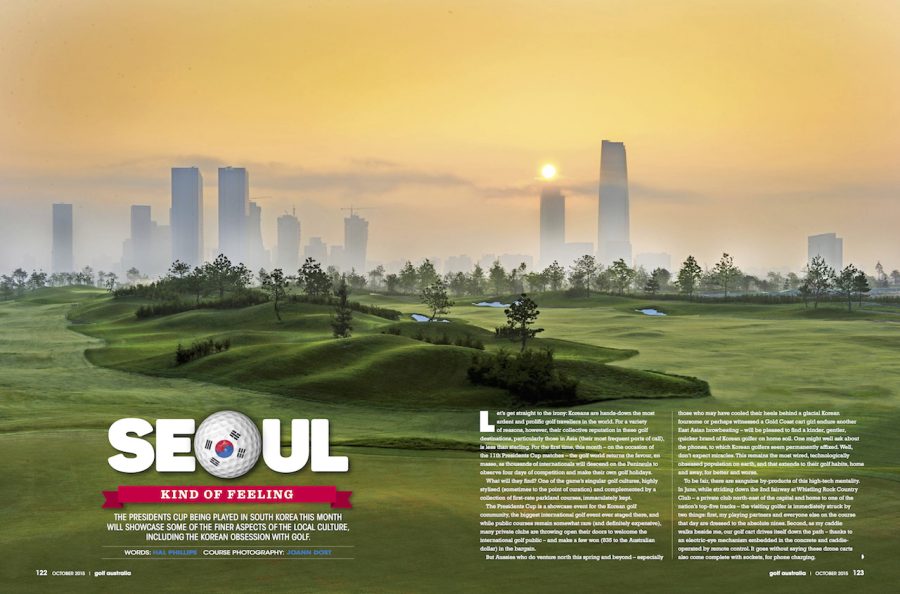
By Hal Phillips SEOUL, South Korea (May 8, 2019) — Let’s get straight to the irony: Koreans are hands-down the most ardent and prolific golf travelers in the world. For a variety of reasons, however, their collective reputation in these golf destinations, particularly those in Asia (their most frequent ports of call), remains less than sterling. For the first time, this October — on the occasion of the 11th Presidents Cup Matches — the golf world returns the favor, en masse, as thousands of internationals will descend on the Peninsula to exprerience golf in Korea, observe four days of competition and make their own golf holidays.
What will
they find? One of the game’s singular golf cultures, highly stylized (sometimes
to the point of curation) and complemented by a collection of first-rate parkland
courses, immaculately kept. The Presidents Cup is a showcase event for the Korean
golf community, the biggest international golf event ever staged here, and
while public courses remain somewhat rare (and definitely dear), many private
clubs are throwing open their doors to welcome the international golfing public
— and make a few won (855 to the Australian dollar) in the bargain.
But
Aussies who do venture north this spring — especially those who may have cooled
their heels behind a glacial Korean foursome in Pattaya, or perhaps witnessed a
Gold Coast waitress endure another East Asian browbeating — will be pleased to
find a kinder, gentler, quicker brand of Korean golfer on home soil. One might well
ask about the phones, to which Korea golfers seem permanently affixed. Well,
don’t expect miracles. This remains the most wired, technologically obsessed population
on earth, and that extends to their golfing habits, home and away, for better
and worse.
To be
fair, there are sanguine byproducts of this high-tech mentality. In June, while
striding down the 2nd fairway at Whistling Rock Country Club — a
private club northeast of the capital and home to one of the nation’s top 5
tracks — the visiting golfer is immediately struck by two things: First, my playing
partners and everyone else on the course that day are dressed to the absolute
nines. Second, as my caddie walks beside me, our golf cart drives itself down
the path — thanks to an electric-eye mechanism embedded in the concrete and caddie-operated
by remote control. It goes without saying these drone carts also come complete
with sockets, for phone charging.
Golf in Korea: Totally Wired & Sharply Dressed
“I love
Korea, totally wired and everyone looks sharp, man or woman, 25 or 65,” says
David Dale, a partner with California-based course architects at Golfplan, who
have designed 22 courses in Korea. “Golfers arrive at the course in sport coats
and slacks, carrying small grooming bags with golf shoes and change of clothes.
They go to their lockers with their 4-digit security codes and change into
these highly fashionable pants, shirts and caps (with ball markers on the brims).
Most of the time, they’re putting on sleeves to keep the sun off them, even the
men.”
Dale and
Golfplan have designed courses in 75 different countries, “But I’ve never been
to any other country that had a stronger sense of fashion,” he says. “They have
these awesome golf slacks that are fleece-lined with waterproofing and pin
stripes. I’ve got a pair. They’re thermal. I use them for construction visits
in cold climates — but they’re stylish enough to wear with a sport coat!”
The clubhouse at Whistling Rock is typical of the genre here: palatial, modernist and staffed to the gills. Upstairs, a long, narrow Zen garden splits the hallway leading to a massive but still-elegant dining space, where picture windows look out onto the golf course.
Downstairs, some 40 members of a course-rating panel (representing GOLF Magazine Korea) populate a sumptuous meeting space of burled wood and overstuffed chairs. Back upstairs, I pass a golf shop that is, well… remarkably modest: mostly golf balls and a few shirts.
The Fashions are Ever Changing
According
to Whistling Rock Vice President David Fisher, this is typical of Korean clubs,
which stock very little logoed merchandise because the lion’s share of golf
apparel is purchased not from clubs but direct from top designers. The golf
apparel industry in Korea has been estimated at USD$3.5 billion — this for a
country of just 1.5 million golfing souls.
“In Korea, the fashion changes. We have four distinct seasons and the manufacturers come up with new designs for each season,” explained Michael, a Korean-American living in Korea and working for a golf industry company (he asked that his real name not be used). “People tend to keep up with the season and they don’t have loyalties to the club they belong to. Elsewhere it’s common that members will wear shirts with the club logo, but in Korea that’s not the case. People tend to lean toward designers shirts, which can be very expensive, 200-300 dollars. Even if they don’t have a good game in terms of golf skill, they try to look good. In Korea, if you don’t dress up, you’re pretty much looked down upon.”
For men, shorts on the golf course are considered
particularly frumpy. “Most of the membership golf courses,” Michael says, “do
not permit shorts — and golfers must wear hats outside the clubhouse. Without
hats, you cannot go out on the course.”
Um, why is that?
“I don’t know.”
The shorts thing is good to know, though daytime temperatures for October typically range from 7-18 degrees (and these days hats make good skin-care sense most anywhere, anytime). Still, Dale suggests that exacting standards and high fashion are just what we should expect from a population with “the highest level of elective cosmetic surgery in the world and the no. 1 destination for these procedures in Asia. I’m even thinking about getting something done, around my eyes… I’m serious.”
SOUTH PORTLAND, Maine (April 27, 2019) — Golf course closures typically elicit howls of indignation and despair, as locals countenance their stark, newly diminished reality. Still, it’s fair to wonder exactly how the public golfing population here in Southern Maine processed the news, received here late in January, that Sable Oaks Golf Club would not reopen this spring. The land will instead be marketed to housing developers.
I loved Sable Oaks. Consider this my own, contrarian howl of indignation.
However, most of the Maine golfers I know never cared much for Sable Oaks. Too penal, they said. Too often the course took driver out of their hands, they howled, on account of wetlands too often cutting across fairways in constricting fashion. For walkers, hilly Sable Oaks was a death march. It was an extraordinarily demanding 6,300 yards. In every sense.
Still, I must protest. It’s bad manners to speak ill of the dead, and I’m here today not merely to praise Sable Oaks but to defend her — for perhaps the last time.
All the things people hated about Sable Oaks recommended the course, to me, when I moved to Portland in 1992. I was 28 years old and a pretty good player back then — breaking 80 at Sable, something I managed only three times in 30 years, really meant something.
I didn’t carry a driver for much of the ‘90s, relying instead on a 1-iron and a persimmon Ping 2-wood. Walking 18 holes at Sable with a bag on my back was certainly a workout and a half; the hike from 17 green to 18 tee in particular was a heart-stopper. But I was young in the early ’90s! A round at Sable meant I need not go to the gym.
Sable Oaks: A Great Walk, Rarely Spoiled
And what a taxing-but-comely walk it was. Designed by architect Brian Silva — who laid out the once-private, now semi-private Falmouth Country Club at exactly the same time — Sable Oaks made for golf in an undeniably gorgeous secluded setting. The dramatic terrain was uniformly lush, with gargantuan specimen trees framing the greens and colorful wetlands everywhere one turned.
Okay. Those wetlands required forced carries on four of the first five holes. Come Fall, however, those wetland went technicolor — something we noticed because Silva brought them into play SO many times.
Yes, Sable Oaks was located directly in the Portland Jetport flight path — but the forested environs otherwise muffled the sound from nearby I-95 (!).
I arrived in Portland that March of 1992 to take a new job: editor-in-chief at Golf Course News, a national business journal published by Yarmouth-based United Publications. When I stumbled upon Sable Oaks that spring, I was honestly blown away. The greens were inventive and fun — always in superb shape, too, something Sable could boast to its dying day. Opened in 1989, the place seemed pretty brand new. The overall conditioning, the contour/detail around those greens, the bunkering throughout seemed way too nice for a public course — especially one that charged just $20.
Sable had been conceived and built as a private golf/residential community. A late-80s recession obliged it to open and operate as a public course. Ownership would change several times through the years. The housing and other commercial elements? Never built. An oversupply of competing courses meant Sable would never do more than survive. National trends didn’t help matters: The U.S. course stock has suffered an annual net loss of some 150 properties each year since 2008. Ironically, Greater Portland’s red-hot housing market today — and Sable’s prime location on a wooded hillock right across I-95 from the Maine Mall — made the closure decision, from current owners, Delray, Fla.-based Ocean Properties Hotels Resorts & Affiliates, something of a no-brainer.
Why was Sable Reviled? It’s complicated
Curiously, though, none of this existential chaos accounts for Sable Oaks’ poor reputation among Greater Portland golfers. Did it get a bad rap? Or was it simply too hard to enjoy? Are Southern Maine golfers a bunch of pussies? Is course difficulty something they want to observe on television but avoid for ourselves?
The answers are complicated. I can tell you this much, having spent 30 years in the golf business rating courses and writing about course-design issues: Difficult tracks are, more often than not, successfully marketed on account of their resistance to scoring, not in spite of it. Throughout the 1990s, Portland-area golfers eagerly drove 2-plus hours for the pleasure of losing 10 golf balls and shooting 117 at Sugarloaf GC, where river crossings are celebrated.
The Woodlands in Falmouth, another track that debuted about the same time as Sable and Falmouth CC, is a much harder golf course than Sable Oaks, in my view. And yet, to this day, it has succeeded in attracting private club members in this market.
What’s more, Sable Oaks was not a long course. It played only 6,300 yards from the tips. Indeed, the choosing of one’s tees at Sable was key to maximizing the fun and strategy Silva created there. Too often, in my view, Sable-haters didn’t manage this aspect particularly well for themselves.
Here’s what I mean: There were only three par-5s at Sable Oaks. Two of them, nos. 5 and 14, played directly alongside each other, in the old-world routing tradition. Both featured the same riparian corridor cutting across the fairways some 220-240 yards from their respective greens. So yes, driver on both holes was risky. But if you cozied up to that wetland, both greens were eminently reachable in two strokes. In the course design trade, they call this risk/reward. Architecture Nerds swoon over this stuff. At Sable, they turned up their noses.
From the back tees, on both holes (especially 14), it was frankly difficult for mere mortals to even reach the hazard with driver… But most guys played the middle tees and complained about not being able to hit driver. Pick your poison, I say.
Fourteen was a striking-if-peculiar hole. Its peninsular green, buttressed by a stone retaining wall and surrounded by those colorful wetlands, proved a demanding target. Going for that green in two shots was very risky – even a pitching wedge approach to that putting surface was difficult… It was also pretty thrilling.
Legitimate Issues at 12 and 15
The two holes at Sable Oaks that stood out to me for being legitimately overtaxing were the par-4s at 12 and 15. Yet, again, both got bad raps in my view.
Twelve was a monster measuring some 460 yards and requiring an accurate drive up and onto a plateau, followed by an approach playing all the way back down to sea level. There was internal out of bounds all along the right side, where the par-5 2nd hole played, in the same direction. Internal OB is never ideal, but without it, folks would have played down the 2nd — a clear safety issue.
Yet 12 remained a classic half-par hole, the likes of which design legend Donald Ross created routinely. The Nerds praise him for such things still today. The key is convincing one’s self the hole is a par 4.5, meaning 4 would indeed be great but 5 is just fine. The adjoining 2nd hole played about the same yardage with the same expectations. The simple fact that it was listed on the scorecard as a par-5 elicited very few complaints.
On a course that played to par 70 where all three par-5s were reachable in two shots, the difficulty of no. 12, and the ease of no. 2, have always seemed reasonable to me. Off-setting even. To its lasting aesthetic credit, No. 12 was also a stunningly beautiful, topographically gripping golf hole.
The 15th was another outwardly difficult hole that just required a bit of imagination. What made this par-4 so hard was the landing area — or rather, the lack of one. Nothing to defend here: Silva was clearly obliged to get from point A to point B along the northern boundary of the property. Yhe massive wetland at left, and the steep slope at right, made the landing area on 15 almost ribbon-like.
But the green at 15 — and the contours/bunkering right and left — were superbly rendered. Solution? We often played the 15th as a drivable par-4 — from the women’s tee high on the right slope. The hole still played tight but the prospect of eagle or an easy 7-iron/wedge par changed our outlook and expectation, two factors over which we golfers enjoy total control.
Family Matters
That June of 1992, my brother and father came north from Massachusetts to play our annual Father’s Day match. I took them to Sable; they were similarly struck and smitten. We moved our annual game around from year to year, but they were always more than happy to revisit Sable Oaks. I was all too happy to oblige.
In 1997, I left Golf Course News (today known as Golf Course Industry magazine). I started a media company, a family. We moved from Portland out to New Gloucester. My father passed away, in 2011. My brother and I maintained the Father’s Day golf tradition. We didn’t always play Sable but often enough we did. Matthew lives in coastal New Hamster. Sable remained reasonably equidistant from our respective homes.
Some 5 or 6
years ago, however, I noticed a change.
So, I’m a better golfer than my brother. Always have been. He would cop to this, if asked. If we play 10 rounds together, I’ll beat him 7-8 times. Yet somewhere in the middle of the second Obama administration, the competitive worm turned in a specific way: We came to realize that he was building an anomalously successful record, against me — at Sable Oaks specifically. We both remarked on it. Then I treated him to a subsequent birthday round there, and he beat me again.
I could have just as easily avoided playing my brother ever again at Sable Oaks. But that would’ve been churlish. And I loved the golf course! So we kept going back. And I’m glad we did, because now it’s gone.
When I read this winter of Sable Oaks’ imminent demise, I sent my brother a link to the Portland Press-Herald story. “Sorry, dude,” I texted him. His reply was swift and brief:
“Noooooooo!!!”
One of my final strokes on the 15th green at Sable Oaks GC.
NEW GLOUCESTER, Maine (April 18, 2019) — So my wife and I have a 12-year-old girl staying with us for a while and last Thursday evening she settled down beside me — armed with a big bag of magic markers and a sketch pad — as I watched a DVR recording of The Masters first round. She wasn’t paying much attention. In that way she was a credible stand-in for the broader American public, which, let’s face it, doesn’t pay much attention to golf, even its majors. Indeed, when she did take notice, she playfully mocked the idea of watching golf altogether — that is, until she noticed Tiger Woods walking off a tee.
“Who’s that?” she asked.
That’s Tiger Woods, I told her. I swear to god, I did not prep her in any way; she picked him out of the crowd of players all on her own. The next afternoon, during the live broadcast of round two, she wandered back into the living room. Unbidden she asked, “How’s Tiger doing?”
He’s
doing quite well, actually. You like him?
“Yeah.”
Why?
“He’s handsome.”
What
else do you like about him?
“He’s cool. Look at the way he’s walking around. He’s very confident.”
What
about that mock turtleneck? Is that cool?
“Oh yeah. Those are in.”
Tiger Woods: The Anointed One
Watching golf with a 12-year-old, distaff, golfing neophyte is a fascinating exercise in its own right. This one in particular had strong opinions: She thought Jon Rahm looked like a fat punk; she didn’t like him at all and rode him without mercy throughout (“He should just go home”). She quickly remarked on the unusually lanky stature of both Tony Finau and Matt Kucher. Brooks Koepka was notably swaggy — but nothing like Tiger, in her opinion. Surprisingly, Ricky Fowler’s youthful mien did nothing for her — something about his eyebrows being too dark (“And I don’t like his shirt”). Norwegian amateur Victor Hovland was pilloried for his prominent schnozz, which, in fairness, was fair comment.
But these were all bit players in the drama so far as she was
concerned. Tiger was the anointed one.
A lot has already been written about how Tiger’s victory on Sunday has introduced his phenomenon to an entirely new generation of golfers. I don’t anticipate this girl will suddenly want to play the game, or start wearing mock T’s. But it has been 11 years since Tiger won a major. This weekend’s performance reminded many of us of what we’ve been missing.
Forget the 15 majors, the renewed Nicklaus chase. We’ve missed this
man’s naked charisma most of all. No golfer in history has half the presence
Tiger exhibits just walking down a fairway. Charisma is a hard thing to
quantify, but it’s also one of the few things that readily spills over from a niche
sport like golf into the larger culture. And that’s another thing golf has been
missing these past 11 years.
I watched Sunday morning’s finale at Tomaso’s, a fashionably down-market, diner-sized cantina in Portland, Maine. At 10:30 a.m., when I showed up, there weren’t but 3 or 4 us there. An hour later, the brunch crowd had attracted a full house of young, bearded, IPA-swilling hipsters. This was no sports bar, much less a golf bar (Does such a thing exist north of Pinehurst?). Even so, when Tiger birdied 15, the place went crazy. The barman quickly turned off the music — a pleasant alt-country playlist featuring the likes of Ryan Adams, Old Crow Medicine Show and Jason Isbell — and turned up the CBS television feed. Tiger had this unlikely place in the palm of his hand. When his tee shot on 16 came to rest 2 feet from the hole, the patrons inside Tomaso’s erupted.
About this time, I noticed a text had arrived. A friend of mine was
down in Boston at the TD Garden watching the Celtics-Pacers playoff game, an
inelegant affair he referred to as a “game/rock fight.” He reported there were
“tons of people clustering around TVs on the concourse watching golf. It’s
amazing how much love there is for Tiger.”
Stupid Amounts of Charisma
There’s really is something about this guy — something non-golfers
can appreciate. Yes, he has battled back from considerable personal/physical adversity,
but this obscures the larger point: He was stupidly charismatic when he
appeared on the Mike Douglas Show at the age of 2, when he won three straight
U.S. Amateurs, when he debuted as Nike’s cross-over pitch man, when he claimed
those 14 majors… Apparently, after a decade away, he remains stupidly
charismatic, not just to core golfers but to casual fans and mere onlookers
around the world.
Sunday night, my daughter
sent me a text: “Is Tiger Woods good again?”
She’s 20 years old, a junior in college, and couldn’t care less about golf. But somehow word of his resurrection had reached her via the broader cultural news drip. I asked exactly how she had learned of his Masters victory.
“I saw him on the TV at this
bar! Some people were watching.”
Do you find him charismatic?
“Not really. He’s cheated on a
lot of women.”
My daughter is clearly not so forgiving of Tiger, in part because she’s a woke young woman, but also because she’s yet to make the mistakes that Tiger and the rest of us 40, 50 and 60somethings have made. But her admonition is well taken: Recognizing and appreciating anew Tiger’s ungodly magnetism doesn’t mean we should get all crazy (again) about what that charisma really means.
It doesn’t mean, for example, that we should start believing Tiger’s
mere presence will bring millions of kids (or Millennials, or Baby Boomers)
into the game. That never held in 2003; it doesn’t hold now. Nor does it mean
we should start building new golf courses willy nilly to accommodate this chimerical
wave of converts. It doesn’t mean Tiger has, on account of his victory,
instantly become a particularly good man or father. It made no sense to ascribe
him these qualities in 2007 frankly; knowing what we know, it makes even less
sense now. Why we blithely attach these sterling personal traits to men (or
women) who exhibit extraordinary sporting skill is beyond me. One hopes we’ve
learned our lesson here.
Golf is Different Now
But it does seem clear that Tiger and the professional game in which he competes have changed more than a little in the 11 years since he limped to his last major win. Today’s Tiger is 43 years old, his hairline in full retreat. He’s been through a world of shit, both physical and personal. The process of dealing and coming back from all that would change anyone. His swing and his outlook on life are forever altered.
And here we confront what might be the most interesting
manifestation of all this change: Sunday’s victory was the first time Tiger has
ever come from behind in the final
round to win a major tournament. The greatest front-runner in history has
learned how to come back.
Tiger won from the front so frequently because, from 1997 through 2008, his outsized aura truly cowed most all of his would-be competitors. Remember how they’d wilt when paired with him? Francesco Molinari and Tony Finau did not play well beside Tiger on Sunday but here, too, the game has changed a great deal in 11 years. Today’s PGA Tour is stocked to the gills with young, dynamic, swaggering talent. It will be fascinating to watch this generation of professionals compete with the man many of them grew up idolizing.
Because one thing has not changed: You can’t take your eyes off this Tiger Woods fellow. This was true over the weekend; it was true through 2008. If we’re honest with ourselves, it was true afterward, too, through his many trials. We rather shamelessly rubbernecked the wounded, struggling Tiger like we ogle an accident on the side of the road. More than a decade has passed and we still can’t look away. Why? Because he still has more charisma than anyone who has ever played this game, more perhaps than all the major winners in history, combined. Even a 12-year-old, non-golfing girl can see that.