Tag Archives

21 Articles
Dugmar GC: The Curious Story of a Golf Course Submerged

Dugmar GC: The Curious Story of a Golf Course Submerged

[Ed. This story appeared in March/April 2003 issue Golf Journal magazine.]

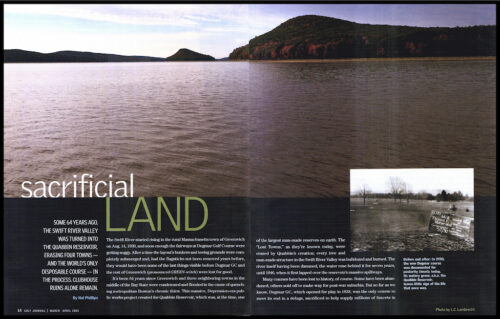
The Swift River started rising in the rural Massachusetts town of Greenwich on Aug. 14, 1939, and soon enough the fairways at Dugmar Golf Club had become unseasonably soggy. After a time the layout’s bunkers and teeing grounds were completely submerged, and had the pins not been removed years before, their flags would have been some of the last things visible before this 9-hole track and the rest of Greenwich were lost for good.

It’s been 68 years since Greenwich and three neighboring bergs were systematically condemned and flooded, all in the name of Metropolitan Boston’s chronic thirst. This massive, Depression-Era public works project  on whose ass the loss of Dugmar GC was but a pimple, created the Quabbin Reservoir, then the largest man-made, fresh-water reserve on earth.

The Lost Towns, as they’re known today, were literally erased by the Quabbin’s introduction; every tree, every man-made structure in the Swift River Valley was burned or bulldozed to make way for it. The river itself having been dammed, the water rose behind it for seven long years, until 1946, when it first lapped over the reservoir’s massive spillways.

By then Dugmar GC had been largely forgotten — but not erased, for memories are made of stronger stuff.

Other layouts have been lost to history, of course. Some have simply been abandoned; others were sold off to make way for post-war suburbia. But so far as we know, Dugmar GC — opened for play in 1928, hard by Curtis Hill — was the only golf course to meet its end in a purposeful deluge, sacrificed (along with four 200-year-old communities) to supply tens of millions of faucets in larger communities some 60 miles east.

Hundreds of golf clubs were built, as Dugmar had been, during the heroic age of Jones and Ruth as the moneyed classes sought to bring the same sort of bravado to their own lives (not to mention a place to drink hooch in a country gone dry). More than a few of these establishments “went under” during the ensuing Depression, but none quite like (nor quite so literally as) Dugmar Golf Club, for unlike their unwitting, high-living contemporaries, Dugmar’s developers KNEW the club’s fate before the course was ever built — before the bentgrass was imported from southern Germany, before the elegant stone patio was laid beside the farmhouse-turned-clubhouse, before the first crate of Canadian Club was hidden from view.

It was, in short, a set up: a crafty land deal with golf at its core; a trifle built to amuse its backers, for a time, before enriching them at the public’s expense. “Those guys knew what they were doing; they made out,” recalls a chuckling, 85-year-old Stanley Mega, who caddied at Dugmar GC and still lives close by Quabbin’s shores, in Bondsville. “Those guys knew the reservoir was going in and they made a killing.”

In essence, Dugmar GC was conceived and ultimately proved to be the world’s first and only disposable golf course.

•••

Read More

Hal Phillips, A Fine Golfing Ambassador: 1936-2011
Big Hal and Little Hal, crossing the Shannon on the way to Ballybunion in 2008.

Hal Phillips, A Fine Golfing Ambassador: 1936-2011

Big Hal and Little Hal, crossing the Shannon on the way to Ballybunion in 2008.

My father and namesake, Harold G. Phillips Jr., passed away Saturday, Aug. 27, after a 15-month battle with lymphoma, and so I’ve been thinking and writing a lot about him this past week. Most of this bittersweet rumination has nothing to do with golf but some of it surely does. He’s the guy who introduced me to the game, taught me the game, claimed to do most of his “fathering” on the golf course, and took great satisfaction in the fact that I once played the game well and have ended up making my living, to a certain extent, writing about it.

Golf differs from most sporting and recreational pursuits for its heavy reliance on venue. Unlike those playing grounds accommodating tennis, baseball, soccer, football or whatnot, golf courses are all unique and, like a fragrance stuck in the deep recesses of the mind, they summon things that other stimuli cannot. I can’t possibly remember each round I played with my dad, but if I think about where we played, the memories — some fully formed, some mere bits and pieces — come flooding back. Indeed, I can begin to appreciate and readily recall, in quite extraordinary detail, the long coincidental relationship he and I had on courses stretching from the sands and forests of New England and the Northeast, to islands in the Caribbean, to the Mull of Kintyre and Ring of Kerry. Here are a few that come to mind:

As he looked when we started our golfing adventures, in the mid-1970s.

• Powderhorn GC, Lexington, Mass.: This joint is where I started out in the game, at my father’s side. I was 8 or 9, and we had just moved to nearby Wellesley from northern New Jersey. Powderhorn was a par-3 course but that unfairly belittles it. There were 18 holes and while some were no more than 100 yards, others measured well over 200 and none were flat, rinky-dink or boring. I remember my dad and his game seemed sort of god-like back then, in that I played a lot of these holes like par-4s and -5s and there wasn’t a single hole he couldn’t “reach”. Powder Horn stood us in good stead for at least two years, and I remember playing there with my grandmother, a steadfast player in her own right (for some seven decades). I recall that I once pitched a mighty fit here after butchering the uphill 11th hole. There were tears. I recall her being sort of perturbed at my behavior but my dad, as per usual, never was… We picked up games with all sorts of people at Powderhorn — another lesson learned early: that one always invites people to join him, even when one might rather not. Made my first-ever birdie on the 17th hole there, a 130-yarder over water. We were playing with a fellow named Mr. Jolly; when that ball dove into the cup, he was nearly as excited as we were. Powderhorn is gone now, converted to a condo development in the early 1980s, which is a shame because I’ve often wanted to go back — and play it like a god.

Claiming some tournament hardware from Ken “the Hawk” Harrelson, second low gross, if memory serves (Why does it serve? because I was third!).

• Stow Acres CC, Stow, Mass.: We were public golf vagabonds, my dad and I, never belonging to a private club, at least in these early days. We played all over Eastern Massachusetts at places like Juniper Hill, Sandy Burr, South Natick CC and Saddle Hill. South Natick was just nine and survives today as a mere driving range surrounded by housing; Saddle Hill has since gone private and goes by the name of Hopkinton CC. But when we wanted to play somewhere truly fine, we ventured 45 minutes north to Stow Acres, home to a pair of really fun Geoffrey Cornish/Bill Robinson designs. They didn’t take tee times and I recall hanging around that clubhouse, sometimes for an hour or more, before finally going off. From the time I started playing until the time he turned 55, some 20 years, my dad played off anything from 7 to 10. A good player and very steady; did nothing super well but nothing at all poorly. One day at Stow North, when I was 14 or so, he went out in 33. I self-destructed at some point on the back nine, went into a funk, but managed to pull myself out of The Dark Place about the 17th hole, at which point I consulted the scorecard. “Hey dad: Par 18 and you shoot 72!”

“I know!” he shot back, clearly wishing I had continued to pout and leave him alone with his demons. He made that par and I’m pretty sure it was his best round ever, though I know he shot 73 in competition a couple times during high school matches at Fort Monmouth CC (I’ve seen the newspaper clippings). He had a great story about the one year he played collegiately, at Lehigh University. He scrabbled his way onto the varsity as the 8th and last man for a match at Penn State, apparently, and managed to put together a 79. The guy dropped 71 on him. “The 8th guy! And it could have been 69!” he would later explain, still amazed that there were seven Nittany Lions better than that. Thereafter my dad resolved to concentrate on his studies.

Rocking the Merion 1981 U.S. Open hat, as he would for many years.

• Pleasant Valley CC, Sutton, Mass.: My dad and his business partner, Harvey Howell, owned a polystyrene manufacturing operation south of Worcester, Mass., and they commuted an hour each way from Wellesley and neighboring Dover, every day, my whole growing up. There wasn’t much great golf to be played out that way, not back then. But there was Pleasant Valley, which for years hosted one of only two PGA Tour stops in New England (the other was The Greater Hartford Open, now The Travelers; PV hosted its final Tour event in 1998). So, while it was no design masterpiece, Pleasant Valley was sort of a big deal club among golfing Massholes. Because my dad was a local business guy of some standing, he could arrange games for us there. He arranged a lesson for me at PVCC, too, the only formal one I ever had as a kid; the teacher was Rick Karbowski, quite a good player out on satellite tours back in the early ‘80s… I played a match there once in college, vs. Assumption College. I was playing no. 1 for Wesleyan that day and drew a guy named Frank Vana, who would go on to win a bunch of Mass. Amateurs. We were dead even on the 12th or 13th hole when I spied my dad walking along the fairway; he had snuck away from the office, just a few miles down the road. I remember being pleased he was there, though I promptly doubled the next hole and bogeyed two more. My dad had played enough golf with me to know what sort of volcanic response was coming. He got out of there pretty fast.

I had all sorts of blow-ups like this as a kid, as a young adult… okay, as a full-on grown-up, too. My dad’s temperament, on and off the golf course, is really nothing like mine. A very mellow dude, he was. The worst he would ever say after botching some shot was, “Oh, Hal…” He was surely embarrassed sometimes by my behavior but he never really called me on it, beyond a quiet-but-stern, “That’s enough now.” When I heard that, it was time to pull myself together.

• Pine Valley GC, Clementon, N.J.: When one serves on any sort of course-rating panel, the inevitable question is whether one has played Pine Valley. Thanks to my dad, I’ve played it twice, both during my college days. He had business contacts at Dupont, and whoever it was (Hugh something?) invited us down during the fall of my freshman and sophomore years. They have a bet there, at the other PVCC (!), as you readers may know, that guests can’t shoot within 10 shots of their handicaps. I never came close to cashing in. My dad won that bet twice. In his day, he could shoot 84-85 pretty much anywhere. This was pre-cell phone, of course, and it would’ve been quite bourgeois to bring a camera, so no pictures exist to mark

At The Equinox in Manchester, Vt. After he had arranged so many games for me, at places like Pine Valley and Merion, it was nice to arrange them for him.

our visits. But I do have the paper placemat (a nice map of the layout and scorecard) from our luncheon, which I framed and have hanging in my office. One of the years we played Pine Valley, it must have been the first, we followed up the round with another just a few miles west, in the Philly suburbs, at Merion. This was only a year or so after David Graham’s win there at the 1981 U.S. Open. My dad closed me out on the 16th hole, the famous Quarry hole, where I four-putted, snapped my putter in two and left it in the little waste-basket below the ball-washer on 17 tee. I parred in, putting out with my 2-iron. We were not invited back… However, the Merion legacy proved long-lasting: My dad picked up a commemorative U.S. Open bucket hat there, and he would wear it for years on golf courses and soccer sidelines far and wide (see image of that above: white with a blue band). The entire time I knew him, my dad had a head of hair not unlike Albert Einstein’s. And so he always wore a hat on the golf course or anywhere the wind might make for unreasonable coiffure-maintenance. He rarely wore baseball caps, always some sort of bucket hat with the brim turned down on all sides. Before he procured the Merion model, he had a green one that he wore for years (see that model further up in this story). I dabbled with it for a time. Wish I knew where that thing was… In later years he went to the wide-brimmed straw model — see the lead image for an example of this mode — which my mother never liked. Half in jest, she claimed made him look like a fruit vendor.

• Old Orchard CC, Red Bank, N.J.: This was the course my dad grew up on, where he learned the game at the knee of the pro there, George Sullivan. My grandparents would play with my dad, along with me, and they’d often marvel that he still had “that same, smooth George Sullivan swing.” It was indeed smooth, quite effortless. He never, ever overswung (unlike some of us). Of course, my dad also learned the game from his own father, my grandfather, Harold Phillips Sr., in his prime a high single-digit player in his own right,

That smooth George Sullivan swing, circa 1952

a lefty who had a penchant for aces. Poppy would post 5 or 6 over the course of his many golfing days, at least two while he lived at Shadow Lake Village, a N.J. retirement community with a par-3 course. I remember going to visit there as a lad, by which time Pop had become a bit dotty. He was bragging to me on a hole-in-one he’d just made and I looked over at Gram with circumspection — “No, it’s true,” she exclaimed. “He had another one!”… In any case, one time during the late 1980s, my dad and I went back over to Old Orchard; it had been decades and he really got a kick out of going round there again. He had caddied there, too. Apparently there were several gangland figures whose bags he toted in the 1940s and 50s. Good stories were related that day. Plus I shot 76 and totally torched the Old Man on his own turf… I would love to have gotten him back down to the Jersey Shore in later years to play Hollywood GC in Deal, which is supposed to be a great old Dick Wilson design, recently restored, and where Pop had been a member in the 1930s. Thereafter we’d have scooted west across the Pennsylvania border, on Route 22, to play Saucon Valley, Lehigh’s home club, where my dad hadn’t played since college. But we never did find the time. File that one under “Regrets”.

• Nehoiden GC, Wellesley, Mass.: This is the 9-hole, private club across the street from which my family lived for 20-odd years. It’s owned by Wellesley College and while it’s nothing stupendous from a design standpoint, it was notorious in the 1970s and ‘80s for having a 10- or 15-year waiting list. Why? Membership was open to college faculty and staff, to folks who worked for the Town of Wellesley, and it was cheap compared to the swanky clubs all around us (Wellesley CC, Woodland GC, Weston GC, Dedham Golf & Polo, Brae Burn CC). The first 10 years we lived in the chocolate brown Victorian across the street, my dad didn’t gain membership at Nehoiden. He didn’t really play the course at all. However, I played the course ALL THE TIME: My friends and I would sneak onto Nehoiden constantly, in addition to playing in the sprinklers there on hot summer nights, looking for golf balls, sledding, playing hockey on the 7th fairway, and generally treating the place like our own personal playground, which, from sundown to sun-up half the year, and 24/7 the rest of the year, it was.

Oddly, when my dad did become a member, in 1983 or so, he

My ace, recorded at Nehoiden 7.16.90 … The poor man was witness to several but never had one himself.

started playing a golf course that he hardly knew — but his sons knew intimately.

My dad was sort of shy socially and by that I mean he didn’t seek out social situations. Once in them, however, he was famously genial, almost courtly (a quality his NOLA-bred father exhibited in spades). So it’s no surprise that he became an active and, I think, extremely well liked figure across the street. He served on committees and enjoyed regular games with different sets of guys; he was a sought-after partner in the various scotch foursome events — because he was courtly, because he would never make a woman or any lesser player feel badly about being lesser, and because he played off 7. Though I had a big head start on him, the universe of our shared experiences at Nehoiden would prove vast. We were together there the first time I broke 80; the time he pegged that car crossing the 9th fairway; the time I aced the 4th hole (my only hole-in-one; the poor man never did post one); the many times one of us would hit what appeared to be a perfect, blind approach on 6 only to see the ball bound back into view after hitting the unforgiving pavement on Route 16; and the time he came closest to winning the club championship — finishing second, with me on the bag for the final round… He let his membership lapse over this past winter, as he didn’t think he’d be well enough to play. My brother and I called the Nehoiden powers-that-be in June, seeing if we could arrange what had become our regular Father’s Day game. They bent over backwards to make that happen, even hooked him up with a riding cart (which are banned at Nehoiden), something for which we remain eternally grateful. It was the last time he set foot on the property… Until we sprinkled his ashes in the bunkers surrounded the 8th green.

• Western Gailes, Ayrshire, Scotland: For all his travels, my dad was 60 or so before he ever played golf in the U.K. My brother Matthew and I sorted that, in 1998, when we arranged a mini-tour of Scotland’s west country: Gleneagles, Turnberry and Machrihanish. However, our very first game took place at Western Gailes, and it stands out for me because 1) it really was an eye-opener for the man, walking and playing amidst the dunes as opposed to watching them on TV during the British Open; and 2) my dad, for all his wonderful traits, was one of the slowest men on earth. I’m not talking a slow golfer,

Stalking a putt at Machrihanish in the late 1990s.

which, to be fair, he surely was. Physically, he did everything slowly and deliberately. This just naturally spilled over into his golf game: always the last one to his ball; never altering his pre-swing routine or undertaking it before it was his turn to play (partly because he was so frequently the last one to his ball); always coming over to look for your ball, but often disappearing into the woods/rough and having to be coaxed out. Surrounded by Scots, his game proved positively glacial. We had prepped him on this, telling him we had to keep the pace good, that there would be precious few if any yardage markers, and, of course, no riding carts. I remember walking up the first fairway at Western Gailes and there was my dad, behind me, standing over the ball, looking around: “What do you think I’ve got from here?” Dad, there are no markers! Eye it and hit it. Of course, he continued to ask this same question over and over, throughout the trip, never registering the new reality. During some later round, when I was just finished admonishing him yet again to move his ass — and to stop asking me where the the non-existen 150 marker was — I turned to my brother and said, “You know what? I sound just like mom.”

• Lahinch GC, County Clare, Ireland: In retrospect, the timing on this trip couldn’t have been much better. In 2008 my dad was 71 and, so far as we knew, in pretty good nick. But even in fair health he’d arrived at the stage of life where walking four rounds in 4 days was too much. And little did we know that in less than three years, he’d be gone. So, this trip to Ireland was a godsend and we made the most of it (see video capsule from that trip below). The round at Lahinch was our first, the one we played fresh off the plane, in brilliant sunshine and 70-degree weather, with one set of rented clubs (my brother’s had been misplaced by the airline), around one of the peerless links on God’s green earth. It’s not fair to single out Lahinch at the expense of our rounds at Doonbeg, Ballybunion and Tralee; they were lovely all four and we even wangled a buggy for dad at the latter. Indeed, the day before he had been able to walk only 14 holes of Round III, at Ballybunion. We met him that day back at the clubhouse where he was chatting up a group of fellow Americans in the bar, pint in hand, grinning ear to ear. “This Guinness is really pretty good,” he said. My God, Dad: How old are you? You’re just figuring this out? … Not much of a drinker, my dad.

I remember asking him once — when I was quite grown-up, working in the golf business, and ever more curious about courses, design and travel — exactly where he had played his golf when we’d all lived in northern New Jersey. This would have been the early 1970s, before we moved to Greater Boston, when he was still in his golfing prime (30-35 years old) but when I, his eldest son, was too young to play with him.

“Oh, I didn’t play much of anywhere really.”

What do you mean?

“Well, I had a wife and kids and a job. I didn’t play much at all until you were old enough to play with me.”

A True Golf Road Warrior Does It Behind the Wheel

A True Golf Road Warrior Does It Behind the Wheel

You can’t call yourself a proper Golf Road Warrior, no matter how far you travel from home, if you merely settle in one place and encounter only the courses in that vicinity. You’ve got to cover some ground, laddie, behind the wheel — and that we did over the course of our nine days in Ireland, courtesy of our not-quite-British-racing-green VW Transporter. Reputable tour companies, like our friends at Perry Golf, will hook you up with both car and driver, but you can dispense with the latter. Call me a control freak, but I’d rather our party controlled its own destiny. Highlights and observations from our Irish driving experience include:

• In total, I reckon we spent a full 23 hours driving to, from and between various golf courses. That’s nearly 1/9th of our entire sojourn, or 11 percent of our time here. Too much? Perhaps. I’ll drive an hour to play golf at home, each way. That’s 40 percent of the golf experience, not the day itself… I will say that if you’re playing 36 on a road trip like ours, you can’t afford to be driving any more than 2 hours between them. Even if they are right next to each other, at the same resort, that sort of regimen leaves little time for anything else (like blogging).

• On Day I, we landed in Dublin, secured our van and headed dead north to Ballyliffin, 4 hours away at the very northern tip of the island. That’s serious and immediate motoring immersion, but driving on the other side really isn’t that big a deal. Honestly. It’s disorienting for 10 minutes, and then everything locks in, mirror imaged, and you don’t think about it again — until you pay a toll. The urge to hand money to the person on the left is quite overwhelming…

• The big issue is leftward drift, or the tendency to not hug the centerline on Ireland’s famously ribbon-like roads. I don’t really have that center-line-hugging sensation when I drive at home, on the right side. I must do it instinctually. When that instinct isn’t contrived, in Ireland, you tend to hear it before you see it — either the brush of a hedgerow on your left sideview mirror, or maybe something like, “Curb, CURB, CURB!!” from your co-pilot.

• Our gas station/convenience mart of choice on this trip was the Topaz. We stopped at our first one in Northern Ireland, about 2.5 hours north of Dublin. I’m not sure we realized we had passed over this once dangerous, now fairly workaday border. Later we realized that signs in Northern Ireland no longer featured both English and Gaelic language words, but it certainly became clear exactly where we were when the woman behind the counter explained that we could pay in Euros, but she was obliged to give us change in pounds sterling. Hello, plastic…

• This signage dynamic stood in contrast to that which we discovered in the far west of Ireland, where, in Bellmullet, home to the superb Carne Golf Club, we discovered the signs to be written only in Gaelic.

• My mother’s been complaining for all my years about the poor signage adorning New England roadways. She’s probably right, and the signage in Ireland (like that in her native California, in the 1950s) is extremely detailed, copious and accurate. One can simply follow the various road names (N25, R344), or one can keep onesself headed toward the various cities that form the links in a chosen route’s chain, or one can do both. All in all, it’s difficult to get truly lost. That is, if one can read a map.

• I can read a map, and so can Tom Harack, my co-pilot for the great majority of our odyssey. We split the driving and orienteering. We screwed up only a couple times — mainly missed turns at roundabouts (nothing a quick U-turn won’t solve) or not properly divining the most efficient way around substantial towns, as opposed to through crowded city centres.

• We were provided a Garmin GPS plug-in unit along with the van, courtesy of the rental company. It was never once employed during this trip. It was eschewed in favor of a gigantic fold-out map of Ireland where one side featured the northern half of the island, the other the south. There are, as you know, hazards to map usage. Can’t see the left side-view mirror when someone has it fully unfolded in the passenger seat, for example. But there are comic advantages, such as the times I glanced over to see Tom reading the unfolded map but appearing to be hiding under it, as one might hide under a bedsheet.

• There are three major designations of roadway in Ireland: The M’s, like the M1, denote a motorway, or what we’d call an interstate highway in the U.S.; the N’s designate a “national” roadway, one that is pretty substantial, will provide passing lanes on uphill portions, and will more than likely connect major towns (it seems there are also N roads, like the N59, which seem to imply some kind of scenic byway designation). Then there are the R’s which are basically rural routes. They can range from roads of N-like quality to the most rudimentary country lanes. There are some L-designated roads, usually followed by 4 digits, as in the L2364. From a distance, these looked like deer paths and we never did venture down one, by choice or necessity, thank goodness.

• You really want to minimize your time on the rural routes. They’re often beautiful, no question, but they’re a freakin’ hazard and you generally make poor time. We picked up the R253, for example, on the way to Narin & Portnoo Golf Club on Day III. It was no wider than my driveway at home, questionably asphalted, and we were on that sucker for 38 kilometres! Luckily, it was early on a Saturday morning and we only encountered a handful of cars coming the other way. Each time, however, it was the same drill: See oncoming car, come to a full stop, inch by said car (checking both side mirrors all the while), continue on our way.

• Another disadvantage to the rural routes, and narrow Irish roads in general? Passing. Or, as they say over here, “overtaking” (undertaking on motorways, or passing on the left, is seriously frowned upon in the U.K., I’ve found). As indicated, on N and R routes, there is barely room for two cars to pass each other going in opposite directions. When you finally get some visibility and pull out into the oncoming lane to pass, occupying nearly all of that narrow passage, it’s a leap of faith.

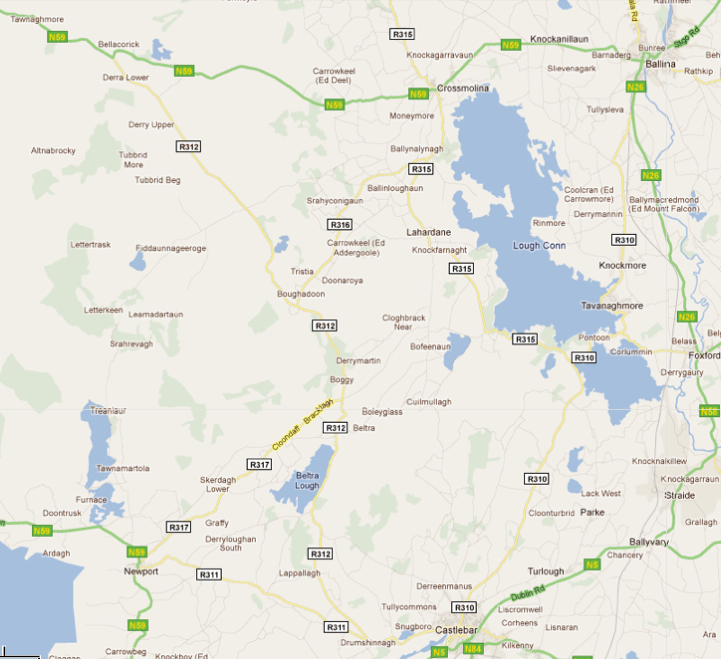
• The one place we avoided a rural route where perhaps we shouldn’t have was some 30 km outside Carne, after our game there. We were headed dead east to Ballina and then took a right turn south to Castlebar, where we planned to pick up good road to Galway, then Limerick, around the River Shannon to Killarney. We had a chance to turn right and angle our way down to Castlebar on the R312 — it was clearly more direct, but we’d have traded an N for an R. So I opted against it. We may never know if this saved or cost us time. It’s a decision that may well haunt me for the rest of my days.

Tralee: Canny Punctuation to an Irish Golf Smorgasbord
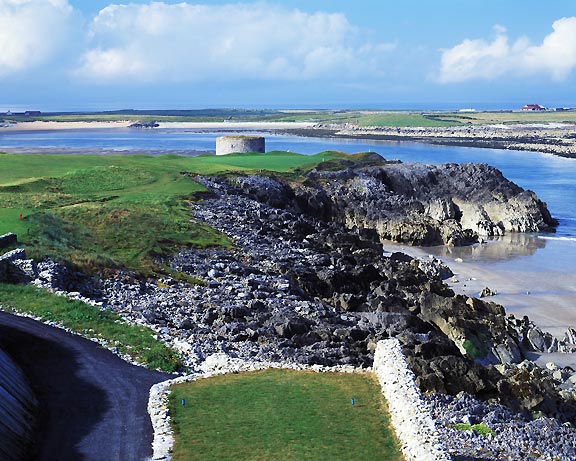
The crazy-good par-3 3rd at Tralee, from the lesser of two killer nines.

Tralee: Canny Punctuation to an Irish Golf Smorgasbord


The crazy good par-3 third at Tralee Golf Links. [photo courtesy of John & Jeannine Henebry]


The odyssey is complete, our nine-courses-in-nine-days schedule has been dispatched, and it’s all over but the ibuprofen withdrawals. Eight links, one parkland track. Three venues in the very north, four in the west of Ireland, and three more in the southwest. I arrived with a bag full of balls and 24 new ones in a box. I’m happy to report there are at least 18 left and, God be praised, I’m actually swinging the club better now than I was at the start. That’s not typical. I’ve been on plenty of long golf trips were things get bad, before they get worse, and there they stay, excruciatingly. But I tallied an 85 at Tralee today and it could have been 81 or 82. For me that’s something to blog about.

But I won’t. Tralee Golf Links, not my 85, is the story today, and what a grand golf course it is. The back nine is among the best loops of links golf you’ll find anywhere, and after the brutally long, quite tight 10th, 11th and 12th holes, this Tiger does something unique: It retracts his claws and treats the sojourner to six exquisite holes of only moderate length, as they snake up, over and around some massive dune formations.

Tralee is a bit different than many of the links courses I’ve played, on this trip and previously. As indicated, it finishes very reasonably with two short par-4s, a par-3 and a short par-5 (no. 18). It’s nowhere near Tralee town; just a few houses are scattered about the hillside nearby. It sits way out on a point, surrounded by huge tidal lagoons and an estuary or two. The feeling of isolation would be total, if you weren’t looking down off tees over long beaches dotted with families, dogs, etc. When we walked back to the 14th tee, serving a magnificent 300-yard uphill par-4, we noticed a jet ski peeling its way out of a lagoon to our right, headed for more open water. Would’ve made a fine video… sorry we didn’t act quickly enough.

One of our colleagues at Failte Ireland, the estimable Michelle McGreevy, says that the back nine at Tralee is her favorite loop in the country. As a senior tourism official, that means something. As a former Irish Girls Champion who plays off 1, that means a little more. She’ll get no argument from this quarter. Tralee’s front nine is perhaps as beautiful — it skirts massive cliffs before looping back beside another lagoon, across which sit the ruins of some ancient castle — but the back nine is worth the trip on its own.

It was a helluva way to punctuate ours.


Old Links vs. New Links: Viva la difference
The 17th at Donegal GC

Old Links vs. New Links: Viva la difference


The 17th, a broad and beautiful par-5, at Donegal Golf Club.


The assumption is that all the links courses here in northwest Ireland are “ancient”, but that’s not the case. Donegal Golf Club, also known as Murvagh, was built in the 1970s, though you’d never guess it.

We’ve played two even newer links on this trip, the Sandy Hill track at Rosapenna, and the Glashedy Links at Ballyliffin GC. Both courses are superb but severe, built amid the big dunes slightly inland from the older courses at both venues, on land Old Tom Morris (who did the original course at Rosapenna) would never have dreamed of using. I’ve written elsewhere that many of these new links suffer from agronomic issues: The rough is too thick, has not been burned off appropriately over the course of decades, and doesn’t generally have that wispy-penal-but-you’ll-find-it quality. But there’s more to it. Back in the day, Old Tom and his like didn’t have the technology to carve holes from terrain like this — so they wisely fashioned subtle holes amid the gentler topography closer to the ocean.

These new links are more dramatic but, as you might imagine, much tougher, too; the locals, who have the option to play either course at both Ballyliffin and Rosapenna, invariably choose the older courses, the staffs inform us. Sensible.

In any case, despite its relative youth, Murvagh has that ‘old course’ feel. The front nine circles around the perimeter of the property — an estuary dotted with dunes — while the back nine forms a separate central loop. Returning nines is perhaps a sign of its recent design, but what a golf course. Old Tom would have approved.


A Day in the Life: 36 more and a Warrior down
The 12th at Narin & Portnoo Golf Club

A Day in the Life: 36 more and a Warrior down

The 12th at Narin & Portnoo Golf Club [photo courtesy of John and Jeannine Henebry]

The day-to-day existence of The Golf Road Warrior might sound, well, sorta cushy when viewed from a distance. But trust me: The pace is unrelentingly, if purposely, grueling. Let me give you the blow by blow of our Saturday in County Donegal, using the 24-hour clock that pervades here:

01:15, Saturday, 23 July — To bed at the Rosapenna Golf Resort Hotel. We had arrived here for our 16:30 tee time the day before, whereupon we tackled the super striking, super difficult Sandy Hill Links, one of two golf courses here perched high on the North Atlantic coast. We finished at 21:00 or thereabouts, rushed over to the hotel for a lovely dinner, and set about blogging re. Friday’s events. My post was uploaded well after midnight and I was dead away the moment my head hit the pillow.

06:30 — Outta bed and upstairs for quick continental breakfast.

07:30 — On the road for Narin & Portnoo Golf Club, which sits in a remote village on the northwest coast — next stop to the west, Newfoundland. Thirty-seven kilometers of this trip from Rosapenna to Portnoo were logged on a road no wider than my driveway back home. Thankfully, unlike my driveway, it was paved, and there was little oncoming traffic. It is Saturday morning after all.

09:15 — Arrival at the club, and off the first tee 15 minutes later. Beforehand, however, I pop an 800 mg tablet of ibuprofen — a canny purchase I made in Cabo san Lucas the previous May. You can’t get that much ibuprofen in the U.S., not in a single serving and without a prescription. They’re bright orange and the size of a horse pill… Finian is our caddie. Like most we’ve retained here, he’s young and a very good player (he plays off 3).

10:30 — About four holes into this track, the thing takes off. Many of these links begin in flattish, gently duned, lowland areas, or maybe some sort of salt-water bog or estuary. This was the case at N&P. Yet as we made our way out to the beach, we could see a line of huge dunes rising to our left. At no. 5, we played a dogleg up into the breach of one and there we stayed for the next 13 holes, diving down off the dunes to seaside greens (no. 8), playing par-3s from promontory to promontory amid the dunes, and banking our way around the base of this stunning dunescape, right to left and left to right. This is a course you may never have heard of unless you book a Perry Golf tour or consult the Northwest Ireland web site. It’s superb, and if you’re doing 36 a day, it forms a nice link between the northern courses and Donegal GC.

13:30 — We finish the round literally one step ahead of the three women who pushed us the whole back nine, as we hit entirely too many balls in the junk, and spent entirely too much time looking for them. It was a big day at P&N, Lady Captains Day, where the leading ladies from clubs all over Ireland converge for their annual to-do. We grabbed a quick bite in the clubhouse, which was mobbed with some 60 women, all fresh off the golf course. Ran in to the threesome behind us outside; they had picked up a head cover we had dropped somewhere along the line. I took this opportunity to apologize for playing so slowly. They smiled and shot me a polite look that said, “Well, that’s all well and good but you should be ashamed for having played so slowly.” And so we skulked off to our green VW van, suitably admonished.

14:15 — In the parking lot we run into another group of three women, whom we had encountered prior to the round. They asked where we were headed next: Donegal Golf Club, also known a Murvagh (mer-vah). Well, that’s their home club. They advised us that Murvagh was several miles beyond Donegal Town and to “stay out of the rough.”

16:15 — Arrived at Donegal GC. We headed straight off the back, and the weather couldn’t be better: 70 degrees and 15 mph of wind. Fifth consecutive round in shorts. Second horse pill of the day, down the hatch.

17:45 — On the 8th, a lovely par-4 that plays off a dune down to a left-turning fairway, our fellow Road Warrior Peter Kessler was felled. We didn’t know it yet, but he ruptured a tendon in his left hip trying to hit a sand wedge a bit farther than perhaps was feasible. (I heard him say as much, to himself, before the swing.) This was serious: 5 rounds in 3 days had taken its toll, and Peter’s day was done. He couldn’t walk, so fellow Road Warrior Tom Harack packed it in after nine and brought him to the clinic in Donegal, from whence Peter was shipped north to Letterkenny Hospital for an x-ray, where the tendon-issue was confirmed. At this writing, Peter remains in hospital. We’ll pick him up tomorrow, with his crutches, and head to Enniscrone GC. At least, that’s the plan…

18:30 — And then there were two. Fellow Road Warrior Jeff Wallach and I headed out to play our final nine. Hey, we told ourselves, Tom has it handled — and he’d played the course before, whereas we had not, and Donegal GC is too good to simply walk away from.  I snagged Peter’s Adams Redline driver and hit the shit out of it. If he doesn’t play for a couple days, I’m appropriating it. If he rallies, we’ll share it.

20:30 — We holed out on 18, victimized by the Murvagh rough twice on the last two holes. In the clubhouse, Tom and Peter are nowhere to be seen, so we grab a Smithwicks and a bite to eat. They’re still sorting the patient, we’d soon learn from Brendan Reck, the affable club captain whom we met in the bar; I recognized him from his portrait hanging in the hallway. Tom arrived around 21:00 with all the details re. Peter’s condition. Nothing to do but find the hotel and start blogging.

22:00 — Saturday night in Donegal, and it’s quite a scene at The Abbey Hotel, where we’re kipping for the night. First-floor disco with a live band. The place is packed, and up and down the high street every bar and hotel is similarly equipped with live music, packed houses and dozens of folks on the street smoking butts. How does the Golf Road Warrior respond to such stimuli? “Um, excuse me: What’s the wireless password?” Thirty-six holes and two 90-minute drives have sapped us of all partying energy and initiative. Must post.

02:09, Sunday 23 July — The above is written, the photos/video are downloaded and posted. Looking to sleep in tomorrow, if only just. A 90-minute drive and a 16:30 tee time at Enniscrone await — that is, after we retrieve Peter from Letterkenny.

Thirty six holes in one day can be taxing. Thirty six with at least one 90-minute drive in between is more so. Thirty six on this sort of schedule three days in a row? Well, it has proved to be a bit more than at least one hip tendon can bear. Twenty-seven at Enniscrone tomorrow. I mean, today.

Ballyliffin: Old Links a Nearly Flawless Trip-Opener
The Old Links at Ballyliffin Golf Club

Ballyliffin: Old Links a Nearly Flawless Trip-Opener


The Old Links at Ballyliffin Golf Club


All you need to know about the Old Links at Ballyliffin is that, for the 4 hours we spent going round it, I never did consider laying down for a couple hours in the fescues. Not strongly anyway, for they were invitingly cushy and sunsplashed.

We arrived here on the northern most tip of Ireland pretty pooped, following a 4-hour drive north through Newry and Armagh and Cookstown and Londonderry, all the way from Dublin in other words. That drive (wherein I took the wheel) had been preceded by a 6-hour blogger-wrangling exercise at the airport, which had been preceded by the 5-hour flight from Boston to Dublin. I departed at 6:20 p.m. Boston time and landed at what would have been 11:20 p.m. my time, Boston time. There simply isn’t time to sleep, or for appropriate sleep-aids to take effect. So I didn’t, and they never did, and I’ve not slept yet.

It’s coming, and soon.

But first, Ballyliffin, which sports two courses, the Glashedy Links and the Old Links. With Glashedy Rock sitting like a monolith in the surf, a couple miles off shore, and Malin Head (that northernmost point) framing the view to the East, the Old Links — which aren’t THAT old; they were laid out in the 1940s, and renovated very subtly and deftly by Nick Faldo in 2009 — simply never serves up an ordinary golf hole. There aren’t the towering dunes we associate with some Irish links courses; indeed, the neighboring Glashedy, would appear to occupy that sort of ground.

Nope, the Old Links just fits the land like a glove, moves right and left, is impeccably bunkered, and sports the perfect combination of firm, fast, bouncy turf, the perfect combination of green and brown, never anything but a perfect lie in the fairway, and stern rough that punishes but rarely swallows the ball whole. It also features enough wind — in combination with holes that do, in fact, play markedly up and downhill — that 6,300 yards was plenty. One could go further back, to 6,937 yards. But why would four guys working on a sleep debt do that?

I’ve flown to the U.K. before, and it’s nearly always the same sort of drill: The first day is crazy. One gets off the plane and fights the jet lag by playing golf. Yet there’s something to be said for saving a day for the entire arrival ritual, for a long drive if you’ve got one in store, for a relaxing dinner overlooking the course you will play the next day. That’s the difference between an Irish linksfest organized by professionals, like those at Perry Golf, and those organized by a bunch of journalists cum bloggers.

We worked the Old Links at Ballyliffin in to the itinerary because one simply cannot come to this part of the world and not play it. Now we have. Glashedy tomorrow. But now, sleep.

The Joys of Disc Golf: Yeah, you heard me right…

The Joys of Disc Golf: Yeah, you heard me right…

Starting this weekend, in honor of The Masters, we’re “Fighting the Pieties that Be” here at halphillips.net by celebrating golf’s non-traditional, even subversive appeal. Friday we featured the internally illuminated, colorfully sequined mannequins I recently came across in a Vietnamese pro shop. Today’s topic: Disc Golf.

Nothing rolls the eyes of traditional golfers than a discussion of disc golf. Well, I’m here to tell you that not only does disc golf totally rock, but I played more disc rounds in 2010 than actual golf rounds.

Why? Well, there are lots of reasons: First and foremost, between the ears the two versions are uncannily similar. Let me give you an example: Driving. We all know that over-swinging is a recipe for disaster, especially when wielding the big stick. The dynamic is identical with the disc, including the urge to vacantly muscle a drive out there in order to 1) satisfy some animal urge; and 2) gain 5-10 extra yards that won’t, in the end, truly enable you to play the hole in fewer strokes. Managing this dynamic is a dead-on crossover shared by these two incarnations of the game.

Here’s another: When you’re standing over a 4-foot putt, the traditional golfer must weigh the merits of charging said putt, taking the break out, and, should he miss, living with the consequences of another 4-footer coming back — or lagging it, increasing the break one must play, but pretty much guaranteeing one won’t three-jack. The same thought process and consequences are extant with a putting disc in your hands. Exactly.

I could go on and on. There are differences. The most striking is disc golf clever rendering of the body and club as one. But it’s the same game.

I plan to blog more on this topic because there are so many aspects to disc golf’s striking appeal — aspects that tend to address directly many misgivings we have concerning actual golf: A disc round takes no more than 90 minutes to play, for example; there is no dress code; there is absolutely no barrier to entry — anyone can become competent in a few weeks; rounds are $5-10; the courses themselves are really cool, all of them distinct 3:1 miniatures of actual golf courses — with the added dimension that forested areas, if thinned a smidge, produce a corridor of play unlike anything in the actual golf world.

I’ll leave you, for now, with a word on the game’s aural sensations. There are no “cups” in disc golf. One holes out by landing the disc in a basket. I’ve included a picture here, to give you an idea of what I mean. But imagine a circular metal basket that sits halfway up a 5foot metal pole. Atop the poll sits a metal disc the same diameter as the basket. Draping down from the top disk are chains that deaden the oncoming disc, dropping it into the basket.

Holing out in actual golf only makes a sound on TV, whereas holing out with a disc produces a distinctive sound: faintly metallic, a bit plinky, but definitely audible from a couple hundred yards away and pleasing in a communal sense. It’s sorta like the sound a kid makes as he mounts a chain link fence, with the idea of clambering over. Not exactly the roar of a crowd filtered through Georgia pines; indeed, that’s something that most of us will never hear, on any golf course. But to the ears of disc golfer, it’s music.

New Links, New Rough, New Sleeve: Doonbeg Could Use Some Old-Time Greenkeeping

New Links, New Rough, New Sleeve: Doonbeg Could Use Some Old-Time Greenkeeping

It’s been a couple years since I played Doonbeg Golf Club, Greg Norman’s “new” Irish links in the southwest of the country. I’ve thought about it quite a bit since because, well, a lot folks have played it too — it’s just south of Lahinch and just across the Shannon River from Ballybunion and Tralee — and we’re headed back to the Emerald Isle next week. Doonbeg GC is also coupled with one of the finest on-site golf hotels anywhere in the world. So it’s natural to stay at Doonbeg and play the course at least once during a weeklong tour of this stupendous golfing corner of Ireland.

That’s pretty fast company to keep, and Doonbeg is a new course, not even 10 years old, so perhaps it’s not surprising that it tends to suffer by comparison. I don’t see it frankly. I found the terrain, the routing and the greens to be of a very high quality, design-wise. Doonbeg is, as its critics contend, very difficult to play. Too difficult, one could argue, but I’ve decided this judgment has very little to do with the design.

Agronomics are important to the maximizing of any course design, but maintenance of the outlying areas on a links course is particularly crucial. We saw what an overzealous fertilization program could do to the best players in the world during the famous train-wreck at Carnoustie in 1999, and this is the nub of the issue at Doonbeg. The dunes through which the fairways quite masterfully weave here are covered with a thick matting of ball-eating, deep-green fescues. My opening drive at Doonbeg landed in the fairway and bounced some 5 yards into the rough, never to be found. I’ve heard tell that Norman himself lost 10 balls during his inaugural round. That’s nuts, and one begins to understand why even those players far better than I tend not to leave Doonbeg with that warm fuzzy feeling we expect following a round on the coast of Ireland.

I had played Lahinch the day before. As is my custom, I drove the ball all over the map. But the outlying areas at Lahinch were quite different, featuring as much brown matter as green. The fescues were high but sorta wispy. I found a dozen of my wayward balls in there and nearly always had a swing, albeit a recovery swing, at most every one. That’s what more than a hundred years of expertly burning off the rough can produce: The perfect balance of playability and penalty. Doonbeg is simply not there yet.

Will it get there? A murkier question, that. Despite the fact there had once been an ancient links on the site, Doonbeg’s modern development came with caveats. The club rightly touts what is a heavy emphasis on organic maintenance practices, but I’ve heard from several people in the know that Doonbeg isn’t free to do everything it would like in caring for these rough areas. I doubt very much the crews are fertilizing them, at all, but I’d bet they’re not allowed to burn them off as often as they’d like. Like I said, I played there two years ago and I’d wager they had never been burned off.

You gotta figure that today not every British course superintendent who graduates from turf school, or leaves his various course apprenticeships, with a working knowledge of how to properly burn off the rough on a links course. Not any more (and, of course, not every course in Britain is a links; most are not). Methinks the crazy-thick rough at a place like Doonbeg, or at Sand Golf Club (a fabulous Steve Forrest-designed “faux” links, which I played in Sweden the week before Doonbeg) is more the result of agronomic stricture, or a lack of ancient know-how in our modern age, than design intent. Here’s hoping it’s the latter, and it is ultimately overcome, because Doonbeg (and Sand) are both awesome tracks in need of, well, a trim.

Bali Nirwana stands as epic coda to a golf season
The 7th at Nirwana needs no hype. Note Tanah Lot temple at left.

Bali Nirwana stands as epic coda to a golf season


The 7th at Nirwana needs no hype. Note Tanah Lot temple at left.

It may well be that I’ve played my last golf round for 2010. This is the reality of Maine residence. However, if that’s the case (and I’m not invited to Augusta National next week), I can say that my golf season went out with a bang. I finished par-par-birdie-par after an otherwise dreadful scoring display, but it was the venue, and the finishing holes at said venue, that provided the epic coda to my golf year.

I had toured Bali Nirwana Golf Club two years prior. (Yeah, I know: why go all the way from Maine to Bali and merely tour one the top 3-4 resort tracks in all of Asia-Pacific, what many feel to be Greg Norman’s best work? It’s a long story. And this is a blog, wherein I’m supposed to be concise and punchy. And look how long I’ve gone already…) Well, I played Bali Nirwana this time and it’s something, boy. The kind of course that keeps you thinking about golf all through the long New Gloucester winter.

There are 13 Hindu temples located out and about on this diverse routing, and just off the cliff-to-cliff, 185-yard par-3 7th sits the oft-photographed island temple at Tanah Lot. It’s right there, just offshore, perched on its own rocky cliff, and the devout wade out at sunset in the hundreds amid a faintly orange, billowing cloud of incense. A moving scene. So moving I drilled a 5-iron to 20 feet. Then birdied the next.

As Mickey Dolenz once said, I’m a believer.

There are four more seaside holes at Nirwana nearly as good as the vaunted 7th, and a dozen strong inland-jungle holes on terrain that made it pretty darned incumbent on Norman to conceive killer golf holes. It’s riven by rushing streams and bounded by working rice paddies, which are elegantly tiered and in several spots integrated into holes as hazards. Pretty cool. Then there’s the long and superb par-4 4th playing along a plateau that takes you way up high all of a sudden, with long views to the sea. The opening hole plays gracefully up and around a hillside of rice cultivation, capped by a bold pod of steep-faced bunkers at the elbow. When I toured the course I was struck by how hard an opening hole this seemed to be. When I played it, I found it plenty generous out right of all this eye candy. I also loved the hole; the green is cleverly sunk beside a brook. There’s nothing like putting with the sound of water rushing by. There’s a lesson here on the matter of touring vs. playing a golf course.

We played the back nine first and finished on the front side which, to be honest, is the way the golf course is mostly dramatically routed — for chops like myself and tournament studs. This sorta matters because Bali Nirwana GC, part of the swank Pan Pacific Nirwana Bali, is under new management as of July 2010. They have big plans for place. Big televised-tournament plans, and the two pros I played with — new Bali Nirwana Director of Golf Paul Lightbody and Howie Roberts, his counterpart at the sterling, new Norman-designed Danang Golf Club in Vietnam — both felt an event would better finish on the front side, as it were, along the Indian Ocean at 7, and home to the 9th green with its natural amphitheater setting.

That the amphitheater is tiered with working rice paddies speaks once again to what makes the course, and the experience on that course, so memorable. Enough to last a winter.