Tag Archives

2 Articles

FulhAmerica Phenomenon Revisited

Fulhamerica
Ed. — Almost 20 years ago, I ventured to the SW6 section of London to report on the Yank-laden Fulham FC phenomenon for espn.com, which posted the piece in two lengthy parts. It lived a good long life online but sadly, now it’s gone. So it’s preserved here. For posterity.

LONDON (March 26, 2007) — There are moments, sublime moments, when spectators sitting in the Johnny Haynes Stand at Craven Cottage can look to the far corner of the ground — where the perpendicular, geometric grandstands fail to meet — and see straight through to the Thames. The river fairly well glistens on sunny spring afternoons like the one we spent late in March, watching Fulham F.C. and its sizable American contingent salvage a 1-1 draw with visiting Portsmouth. Through these gaps in the stadium seating, one spies Putney on the far bank before yet another eight sculls in and out of the V-shaped frame — a window, however small and diversionary, on why FulhAmerica has grown into the Premiership’s most compelling storylines across the pond.

American soccer fans might not know Fulham Football Club from Scunthorpe United if the two shared the same lower division, or and the same critical mass of Yanks on their rosters. But Fulham does play in the Premiership — for now — and the club has made a habit of buying up U.S. talent on the cheap, to the point where Craven Cottage has become ground zero for U.S. futbol fans heading to London to check on our boys.

That was exactly our charge in late March: To stop merely scouring the Internet for the odd mention of Brian McBride, Carlos Bocanegra and Clint Dempsey. To “just go” and see them in person, while sampling those venues where would-be Fulham fans might eat, drink and be merry on either side of Putney Bridge.

We didn’t arrive in South London expecting to watch the club fight for its Premiership life. As it turned out, our late-March visit would prove the club’s last carefree weekend of the season. Having won only twice since Dec. 18, the Cottagers followed their home draw vs. Portsmouth with two successive defeats. The club would sack manager Chris Coleman on April 11, replacing him with Lawrie Sanchez. Fulham’s precarious position — just four points above the drop zone — set the stage for a harrowing three weeks of relegation-avoidance.
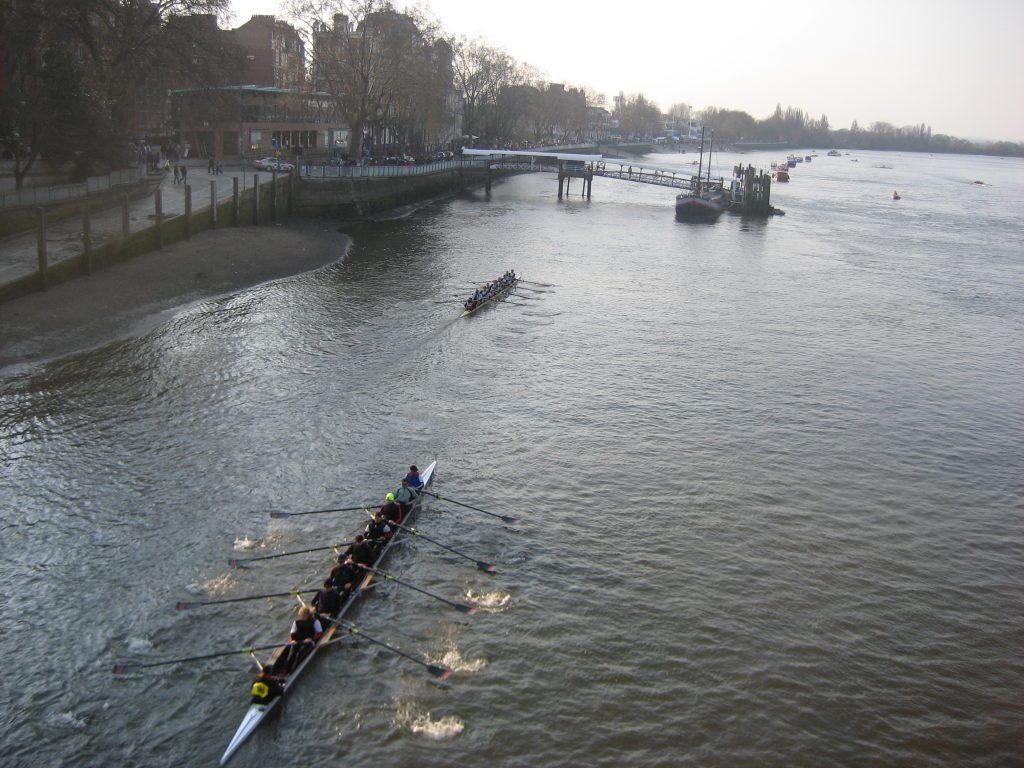
Putney River scene

FulhAmerica on Thames

None of this appeared at all probable just two weeks prior, when we alighted our District Line train into the spring sunshine. A quick, intuitive look at the London Underground map might lead one to exit The Tube at Fulham Broadway, but that’s miles away — and serves the other Premiership club in SW6, dread Chelsea. Putney Bridge Station is your best point of departure, your gateway to the ground itself, to a fine bunch of pubs and the folks who comprise Fulham Nation.

This tidy neighborhood on the north bank of the Thames has everything you need for pre-match entertainment. The closest pub to the Tube stop, however, the Eight Bells, is one designated for away fans. So don’t show up there in your Brian McBride replica shirt. The day we happened by, still some two hours before kick-off, Portsmouth fans had spilled out onto the surrounding sidewalk eight deep and there were dozens of policemen about, mounted and otherwise, to keep the peace.

We didn’t venture into the Bells. Too crowded. But we did, as clear Fulham backers, enjoy a pint and some pleasant chat with several Pompey fans in the Temperance, formerly known as the Pharaoh & Firkin, another de facto “visitors” pub serving Craven Cottage. Just that day, rumors were swirling that Michael Dell, of Dell Computer fame, was angling to buy Fulham F.C. (word of Wal-Mart billionaire Stan Kroenke’s new 9.9 percent stake in Arsenal emerged a week later). One Portsmouth supporter, Paul, politely bemoaned the fact that Americans George Gillett and Tom Hicks had already purchased Liverpool, Randy Lerner had snapped up Aston Villa, and Malcolm Glazer had assumed control of Manchester United, against the club’s will.

“We didn’t think you Americans even liked proper football,” Paul said with a wry smile.

The best Fulham pub in this village is The Golden Lion, directly across Fulham High Street from the Temperance and teeming with locals. Game-day spreads are often served up gratis. The big screen beckons for those without tickets; there’s always someone at the bar ready, willing and able to talk Fulham footy. If you don’t fancy the menu’s standard meat and potatoes, you’ll find a great little curry house (India Cottage) right next door. What’s more, there’s an official Fulham supporters shop just around the corner.
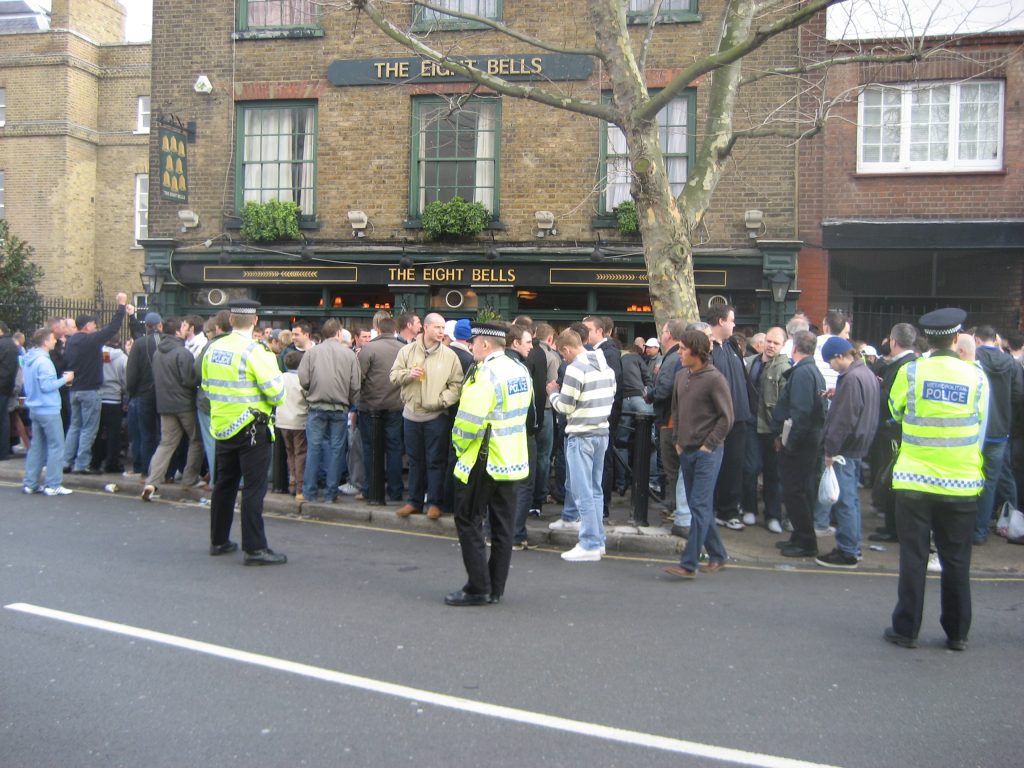
Fulham FC pubs

Best Pubs? Over Putney Bridge

The Larrick represents another solid, pint option here but, truth be told, the best Fulham pubs are found across the river, on the south bank. Just over Putney Bridge — the very span featured as a shotgun-dump in the Guy Ritchie film “Lock Stock & Two Smoking Barrels” — and up a quiet side street sits The Bricklayer’s Arms, an old-fashioned, off-the-high-street, football-supporting, still-proper-pint-pulling public house if there ever was one. Another sign of its legitimacy? No TV. If you’re a purist, they reckon, you’re at the game and the other fixtures don’t much matter.

One Fulham supporter, John from Reading, explained to us that several “football” pubs on both sides have actually gone away of late, and not necessarily for lack of support: “What they’ve done with a lot of these pubs — The Cottage is a good example — is they’ll rip out the insides and turn them into nice, gentrified dining pubs. All the clientele disappear, of course, all the football fans. A good British business model that. Get a load of Ikea furniture and there you go, you’ve got an empty pub. Well done.”

Rest assured, plenty remain. The Whistle & Flute, Half Moon and Coat & Badge — each another block or so south of the Thames — are all cracking venues where, if you show up wearing FFC scarves, you’ll be among friends. But The Brick is the choice here for atmosphere, beer selection (pulled pints of Taylor’s; try the Landlord) and camaraderie.

There is no tailgate scene here. All that social energy funnels straight into these local pubs, where the home club and its fortunes are dissected, lauded and bemoaned en masse, by turn and according to a predictable fixture list. One Fulham supporter at The Brick summed it up quite neatly: “It’s a social life that I don’t have to organize.”
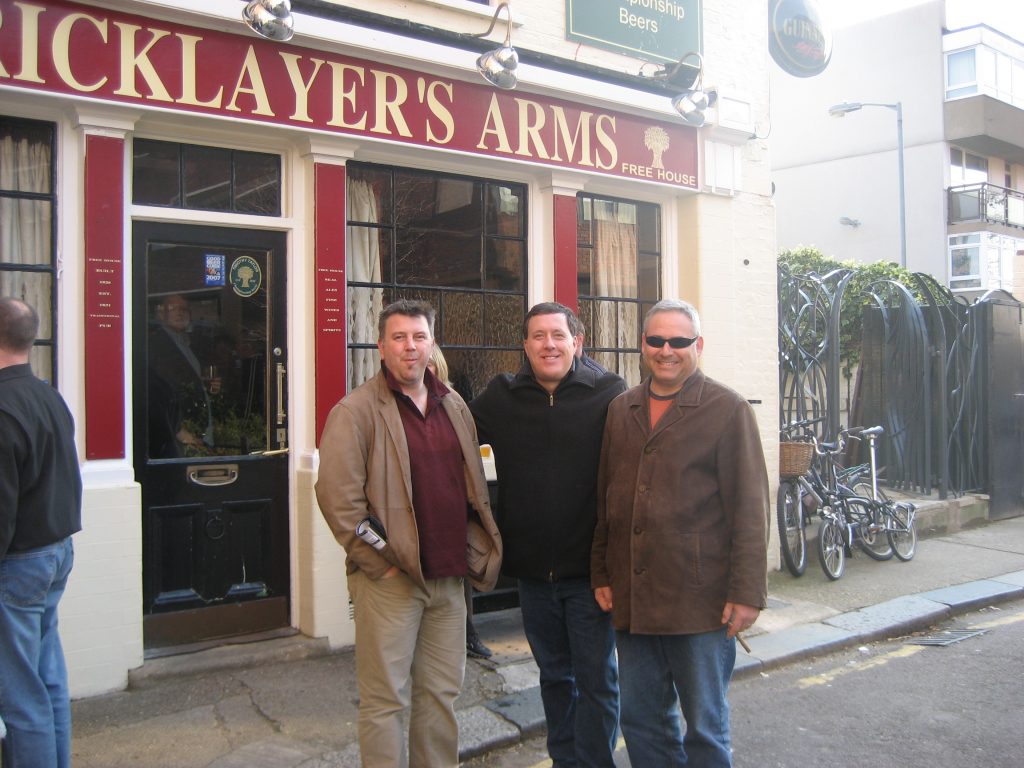
Fulham pub scene

Stadium Approach thru Bishops Park

It doesn’t much matter whether the pre-game pint comes north or south of the Thames. If one’s ultimate destination is Craven Cottage, one is pretty much obliged to approach the ground from the east — directly through Bishops Park, a stretch of riverside green space that surely stands as the most comely stadium walk-up in the Premiership, if not all Christendom.

It’s late Marc, the sun is shining and life is good. Over the coming 10 days, these Cottagers will fail to secure a single point from three games. In two weeks, manager Chris Coleman will lose his job. Of course, as we traipse through Bishop’s Park on our way to face visiting Pompey, no one knows any of this. The mood is buoyant as we join thousands of Fulham supporters for a long journey that nevertheless passes quickly, as befits a walk in the park.

Craven Cottage was built in 1896 and hasn’t been significantly modernized since. Yes, the club has added seating on the Thames side, but the original Johnny Haynes Stand opposite — named for the man who played a club-record 658 games for Fulham and scored 158 goals between 1952-70 — looks all of its 110-plus years. Which is to say, well kept but truly ancient, right down to its original brick masonry, its lattice of exposed ductwork under the stands, and its wooden fold-down seats buffed smooth and dark by eons of intimate backside contact.

Imagine Fenway Park, built for soccer and sitting right on the Charles River — with no plastic and better beer (at two-thirds the price). That’s Craven Cottage, the perfect venue for London’s oldest professional football club.

At halftime, with Fulham scoreless and trailing by a goal, we amble back down under the stand for the traditional beer and cottage pie — like shepherd’s pie, only with beef in place of lamb. We retrieve this sustenance at our leisure, unmolested by great masses of people. Craven Cottage is so small (capacity: 24,600) and, one could argue, so well designed, it never feels crowded. Even if the place is crawling with Yanks.
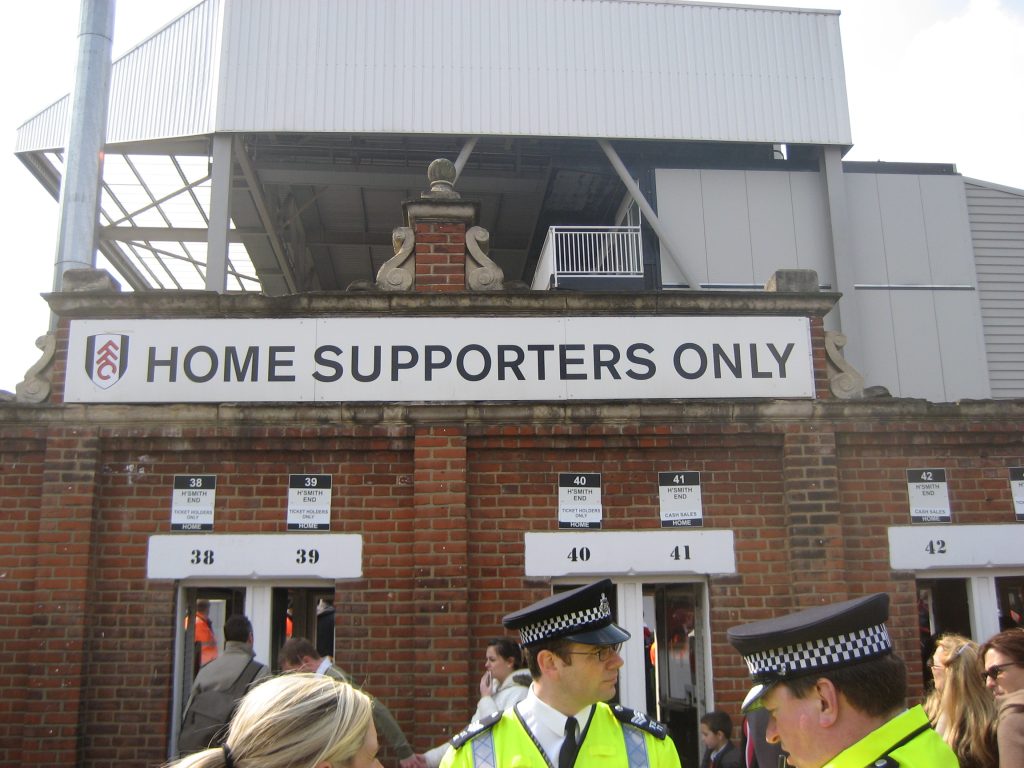
Fulham FC ground

‘And they do spend’

“Starting in the summer and throughout the season we’ve got loads of Americans coming over,” Graham James tells me. He’s the retail manager at Craven Cottage. “We have a big American fan base now. [Brian] McBride kicked it off really, being the most well known at the moment. Now with [Clint] Dempsey just kicking off his career, we have a younger element coming in. There’s been good progress for American players here, so it’s no surprise they’ve become supporters. And they do spend a lot of money.”

Despite the exchange rate. With banks trading nearly two U.S. dollars for every British pound, it’s ironic (if not surprising) that Americans spend so freely in the Craven Cottage Stadium Shop, where James chats amiably before touching finger to ear and excusing himself. Fulham has stockpiled U.S. players precisely because they are a cheap source of talent. In happier times, Coleman had said of McBride, “For the amount of money we spent and the service he has given us, it has got to be the best £700,000 that anyone has ever spent.”

A cynic would point out that American players provide great value these days while the American consumer, traveling to see them, gets precious little. A small price to pay, however, for nowhere else have U.S. players made such a positive impression on a foreign club, beginning with the 1999 arrival of keeper Marcus Hahnemann (now of fellow Premiership side Reading). Eddie Lewis came aboard in 2000 and while he didn’t exactly set SW6 on fire, his performance didn’t prevent the subsequent acquisition of Carlos Bocanegra, Dempsey and McBride, who, at 34, recently signed on for another season at the Cottage.

Nearly everywhere else Americans play British soccer, they are still seen as something of an oddity. Only at Fulham can supporters view their Yanks with an eye unjaundiced by anomaly.

“With the Premiership these days, it’s almost unusual to see a lot of English players in a side,” jokes John from Reading, whom we met walking back through Bishops Park after the match. “But I think the American players have made their mark now. There have always been good [U.S.] goalkeepers, but now you find them making their mark in the lower reaches of the Premier League. It’ll be interesting to see what happens in the next five or 10 years. If they make the next step in quality.”

“You take a player like Brian McBride,” interjects Ferret, another Fulham lifer now ensconced with us at The Bricklayers Arms, the Fulham pub across the river in Putney, “and I think people see him for what he is: an English-style forward, in the Teddy Sheringham mold. Teddy had skills, wasn’t completely full of flair but he looked after himself, worked very hard, put his head in, and thinks about it.”

Demps Not Yet Come of Age

Even before Coleman’s departure there had been grumbling, from some quarters, that while he was a shrewd judge of young talent, the coach didn’t necessarily develop said talent. John from Reading, for one, fears for Dempsey’s future with the club. “I’m a bit worried about him because I think he’s got a lot of promise. He’s certainly not playing much now, through no fault of his own.”

Indeed, Dempsey did not feature in the 1-1 draw with Pompey. He sat out a subsequent loss at Everton, and only came on for the final 20 minutes in another defeat, home to Manchester City. John from Reading’s mate Tristan reckons Deuce may end up signing next season at a newly relegated Premiership team, or another Championship side, where he’ll get plenty of playing time.

Today, Cottager fans on both sides of the Atlantic are hoping that newly relegated Premier League side isn’t Fulham itself. The April 9 loss to Man City put the club within four points of the relegation zone with five to play. Fulham has 35 points and while no top-flight team with that many has ever gone down, the club’s two remaining home fixtures are no bargain and the team hasn’t won on the road in 13 attempts.

It would be crying shame for Fulham to be relegated. Here’s an underdog club that has gallantly and cleverly carved out a credible spot in today’s top flight; a mere 10 years ago they were a third division side, four levels down. Fulham has earned everything it’s got — unlike the blue-shirted, free-spending bunch who also reside in SW6. If one can get past the fact that Hugh Grant and Daniel “Harry Potter” Radcliffe are counted among FFC’s celebrity supporters, and the club is owned by arch media hound Mohamed Al-Fayed (owner of Harrods, father of ill-fated Dodi), this is a club anyone could get behind.

But the reality isn’t nearly so sentimental. If Fulham does go down, its Americans go down with it. How long will we wait before another Premiership club fields three Yanks? Hard to say, but this much is clear: You can still see them all, in Fulham jerseys, at Craven Cottage on April 21 (v. Blackburn) and May 5 (v. Liverpool). Catch them playing Premiership football while you can.

USMNT 2017: Mr. Federation Man — Just how bare is thy cupboard?

USMNT manager Bruce Arena in lighter times — with former L.A. Galaxy charge, David Beckham.

SAN JOSE, Costa Rica (March 22, 2017) — Sixty minutes into what remained of the March 15 match here in the Costa Rican capital, BeIN color commentator Thomas Rongen festered aloud at the visiting Americans’ inability to go forward. He rightly identified the problem in the center of midfield, where 29-year-old Michael Bradley dropped ever deeper and 35-year-old Jermaine Jones drifted even further into irrelevance. Rongen suggested that 2017 USMNT coach Jurgen Klinsmann needed to make a change — that inserting Sacha Kljestan was the best option to link up, in attacking fashion, with the troika of Bobby Wood, Jozy Altidore and Christian Pulisic.

Right then, I recognized the U.S. was doomed this night and Klinsi would soon be looking for work.

The USMNT went on to lose the match, 1-0. Rongen’s analysis had been spot on. But if Sacha Kljestan is your best midfield attacking option off the bench, one can reasonably argue the cupboard is more or less bare.

As it happened, the Federation relieved Klinsmann of his U.S Men‘s National Team duties the following Tuesday morning. L.A. Galaxy skipper Bruce Arena took his place.  And so, pointless and facing a win-at-all-costs game at home vs. Honduras this Friday night, March 24, U.S. Soccer finds itself at an unfamiliar crossroads.

Yeah, sure: the U.S. has once or twice stumbled or started slowly in Hexagonals past. But the U.S. finds itself in an altogether different situation in 2017.

Prior to 1990, the U.S. had never qualified for a modern World Cup. That signal success, after 40 years of utter failure, ushered in a new era of American soccer, one where qualification was a given. The challenge lay in determining a) how U.S. teams would inevitably ascend to the next echelon, to truly compete toe-to-toe with the best 12-15 teams on the planet; and b) who would lead them to this new place of relevance.

USMNT 2017: Fork in the Road

Well, a funny thing happened on the way to relevance.

For the first time ever, the USMNT lost the first two games of a Hexagonal qualifier. Not since 1990 — when another Euro, Lothar Osiander, gave way to another Yank, Bob Gansler — had the U.S. changed coaches in the middle of a qualification campaign. Yes, FIFA has pretty much guaranteed the U.S a spot at the World Cup Finals every four years, thanks to FIFA’s awarding 3.5 spots to just six Hex participants (thanks, Sepp!). 

Today we’ll need every last one of those 3.5 spots. In the meantime, we pick over the entrails of Klinsmann’s tenure. The German was in charge of the U-23s, too. Their failure to qualify for the last two Olympic tournaments is another blot on his resume. However, in looking for clues, explanations, blame and hope, let us not be coy.

The nations comprising The Hex have never been stronger. More important and relevant, this crop of senior U.S. players Klinsmann had to work with was neither young nor particularly talented. As such, we can’t honestly call their performance the last two summers and during the nascent 2018 CONCACAF Qualification Hexagonal “under achievement”.

I haven’t heard anyone suggest, in retrospect, that Klinsmann had, in pushing for European club experience or courting Euro talent with American bloodlines, ignored or failed to develop a pool of talented, USMNT-worthy domestic players. Frankly, I don’t think those players exist. That’s what makes this qualification such an anomalous throwback.

Since Arena’s hire, his familiarity with the domestic league has been mentioned with metronomic frequency. But I watch Major League Soccer. You watch MLS. We can agree there are no glaring omissions for which Klinsi must answer — or rather, which Arena can now run out as remedy… You think Dax McCarty was the answer and Klinsi just ignored him? You would perhaps prefer to have seen Darlington Nagby running the show in Costa Rica?

Klinsmann Was Never the Problem

The German may have “lost the locker room” in wake of the 2014 World Cup in Brazil, but I don’t think we should go forward under any illusion that Klinsmann was the problem here. I have a stronger feeling that he was merely doing the best he could with a pool of players whose core is aging, whose younger options are largely not up to snuff, and whose successors — that oft-invoked golden generation of 20 year olds poised to assert themselves — simply isn’t in the offing.

That is the crossroads at which American soccer finds itself today.

And here’s another sobering point on the eve of these two crucial Hex matches (a loss in either one would make outright qualification a tall order indeed): The Americans Klinsmann fielded, and Arena will field, are only as good as they are on account of half the starting XI being wooed away from Germany by Klinsmann himself, which begs the question of whether that clearly rich Teutonic vein can be tapped going forward by just anyone.

Klinsi’ perfectly reasonable expectation that U.S. players seek regular gigs in the world’s best leagues has also come under major scrutiny since his firing, which is unfortunate because it’s a big, red, bulbous herring. Look around and scrutinize the attitudes of national team coaches serving all but the elite soccer nations. Klinsmann’s was not and is not a controversial position. Players become world class only by competing with the elite, day in and day out. We know this. Every national team coach outside Europe knows this.

And I’ve got news for you: Bradley, Jones, Clint Dempsey, Tim Howard and Altidore aren’t playing in MLS today because they want to be closer to their families, or they have some romantic responsibility to bolster the fortunes of our domestic league. Klinsmann had the misfortune of steering the U.S. ship at a time when all five of these core figures lost their value in Europe — because they were no longer good enough to command dollars or playing time there. If they could make the same money playing in France or the Netherlands, they’d be doing it.

What we saw in Costa Rica (and, to a lesser extent, in Columbus vs. Mexico in the Hexagonal opener) is demonstrable evidence that the old guard needs changing. I’m still fairly sanguine re. Arena’s ability to get this team to Russia, by hook or by crook. FIF has done all it can to make this happen. But that does not mitigate the larger issue — that the pool of international caliber U.S. players does not seem to be growing, here or abroad, in the manner we might expect from a world-top-15 footballing nation.

Hell, the current choices, save Mr. Pulisic, point to a discernable, troubling regression.

Few Birthrights in International Futbol

Bruce Arena was a far younger man in 2002, when he led the U.S. to its only World Cup quarterfinal, a 1-0 loss to Germany where only the unseen hand of Thorsten Frings separated our boys from overtime, penalty kicks and perhaps a place in the semifinal. Arena was 51 in 2002, just 6 years removed from the head coaching position at the University of Virginia (where he started out as a lacrosse assistant). Thereafter, on the strength of this idiosyncratic coaching background, his D.C. United teams proved the class of Major League Soccer — indeed, that’s why this former lax long-stick and soccer goalkeeper at Cornell came to be tapped as U.S. Men’s National Team coach, succeeding Steve Sampson after the debacle at France ’98.

Though it was a crushing quarterfinal defeat in South Korea, a mighty opportunity lost, 2002 made us forget about 1998. The showing in South Korea was surely yet another in a succession of high-water marks we had come to expect from American soccer. The Yanks had qualified for its first World Cup only 12 years before — a moment that surely marked the slow and steady brightening of American fortunes in the decades to come.

Today, the U.S. performance in 2002 is looking more and more like an anomaly, not another step forward non an inexorable rise.

U.S. soccer fans should perhaps start coming to grips with this — with what most of the footballing world has already come to know and accept: There are very few birthrights at the international level.

Look at Sweden. Every 20 years or so, the Swedes produce a generation that can compete for a place at the title-seeking table. In between they are also-rans and struggle to qualify for big tournaments.  Here is a country that has produced semifinalists and finalists, several world-class players by any measure, even coaches who are hired to lead the teams of other nations.

Can any of this be said of U.S. Soccer, 14 years after South Korea?

Generation Zero: One Cohort in a Long Game

I’m now researching/writing a book called Generation Zero: The Class of 1990 and the Birth of Modern American Soccer. It was indeed this cohort of young players — Harkes, Balboa, Meola, Ramos and Vermes, to name just a few — whose qualification for Italia ’90 changed the game here in America, forever. It paved the way for this new era of U.S. soccer we now enjoy, one where participation in the World Cup is routine, where the domestic league not only exists but builds new soccer-specific stadia to keep up with demand, where, in theory, our best young players are courted, vetted and bettered by clubs in top European leagues, where American plutocrats own iconic clubs like Liverpool FC and Manchester United, where three major networks fight over the rights to televise European, South American and major tournament games to a U.S. soccer audience.

I’m a member of Generation Zero myself. Bruce Murray once billeted in my house, and I in his. Take it from someone who remembers the wasteland that was American soccer in the post-NASL ‘80s: None of the above existed prior to 1990. It wasn’t even a part of our wildest dreams, frankly. The players who first qualified America for the World Cup made all this possible, then formed the core of the team that hosted the 1994 World Cup (something else, I’ve learned, that might not have taken place were it not for the Class of 1990).

But this cohort of pioneering U.S. players in Generation Zero created something else, something that does appear to be rising inexorably: a foundational fan base, upon which all of American soccer support now rests.

Again, with the 3.5 World Cup allotted to CONCACAF each quadrennial, FIFA has done its best to more or less guaranteed the U.S. will compete in every World Cup going forward. It’s highly likely that Arena will indeed get the job done. That is my most fervent hope, in fact.

But it’s high time we American soccer fans, in our every expanding numbers, get real about where we truly are as a footballing nation and what sort of exercise we’re engaged in here. It’s high time we dispensed with this “Will America win a World Cup by 2022, 2026 or 2030?” banter. Competing on the world stage is what we call “the long game”. Settle in, America. In world football, national team programs don’t compete for world titles merely because they set their minds to this goal and/or throw resources at it.

Only the Germans, Italians, Spanish and Argentinians can honestly enter each World Cup cycle believing they have a legitimate shot to win the whole ball of wax. Brazil, currently in crisis following the disaster of 2014, would make it five. France and the Netherlands are capable of winning a big tournament. Apparently Portugal is, too… Everyone else, the U.S. included, is hoping to build and/or luck into a golden generation of talent — then catch lightening in a bottle.

Generation Zero produced the first American cohort of talent good enough to qualify for a World Cup. It took 40 years to get that done, and it was “golden” only relative to all those previous generations of Americans who’d tried and failed. Right now, the 2002 USMNT roster may be closest thing to a truly Golden Generation this country has yet produced.

Klinsmann had promised to change all that, and we wanted to believe him. He offered grand plans to transform the way Americans played soccer on the international stage — by the sheer force of belief, and by influencing the way Americans played at all the various developmental levels. The plan was ambitious and almost credible. He did, after all,  have a hand in transforming an entrenched system in no less a world soccer power than Germany, from 2002-2006. And yet for all his efforts, we remain essentially the same soccer nation we were before he took the wheel, albeit with a few more German-Americans in the fold. We even have the same coach we had in 2006, one who knows how difficult it is to coach two consecutive World Cup cycles).Welcome to the big leagues, America. Adjust your sights as events warrant. Football on the world stage is hard.