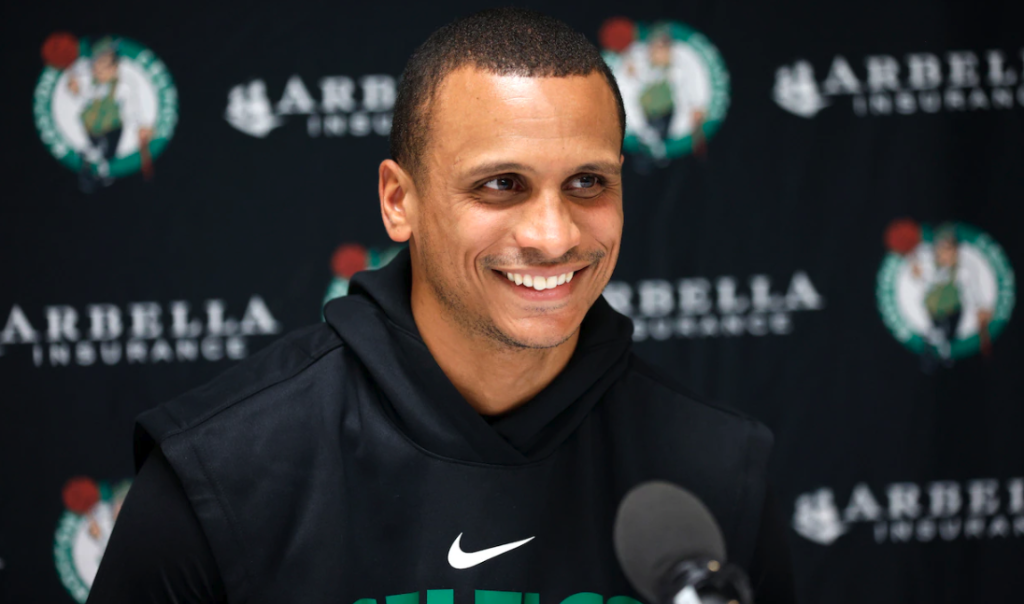
BOSTON, Mass. (June 3, 2026) — This column concerns Joe Mazzulla and the Celtics, but bear with me while I use George Horton as a framing device: My very first-ever sports-writing job allowed me to cover Horton’s Lincoln-Sudbury Regional High School boys basketball team. That winter of 1986-87, the genial, middle-aged coach had trained up a talented collection of 7-8 kids, none of whom were taller than 6 feet — but all of whom could run, gun and handle the ball.
The mighty L-S Warriors didn’t bother with many plays. Their non-stop press resulted in absolute chaos, great masses of layups off turnovers, a league title, and more tournament glory than anyone could have expected.
The next season, just two kids remained from that squad — the slowest two. I went and saw them play early in December and was stunned to watch them meticulously run a half-dozen offensive sets I’d not seen the year before. This new scheme created great shots in the half court for a team short on athleticism. The Warriors never pressed; Horton arrayed them in an air-tight match-up zone. The team went 14-4 and went to another state tournament.
Having watched his team the year before, I had assumed that Horton was one of those coaches who just rolled the balls out and let things happened. But he recognized what he had and leveraged squad skills. Same same the following winter, only Horton devised a completely different scheme for an entirely different roster.
That’s great coaching. Still convinced I could be the next Bob Ryan, I traded up to a daily newspaper job the following spring/ George Horton died of a heart attack six years later. His wife found him slumped over in his recliner, a Celtics playoff game still playing on the TV.
Joe Mazzulla: Worthy COY winner, but…
I thought of George again when Joe Mazzulla was named NBA Coach of the Year early in May. The Celtics had a great regular season before crashing out in the first playoff round to Philly. Honestly, no one had expected the Sixers to challenge Boston, which had rounded into something approaching championship form after Jason Tatum’s return from a 10-month Achilles tendon rehab. The Celts led the series 3-1 but still managed to lose it. Shit happens.
Before he won it, Joe had deemed the Coach of the Year award “stupid.” I love Mazzulla. He’s candid in a way only someone on the spectrum can be. Earlier in the season, Coach Joe had been interviewed about the team’s new, gold-on-white uniforms. He said he liked them. The reporter asked why. “Because they say Boston on the front,” he deadpanned.
I love Joe. He’s shown the rare ability to identify and develop young talent. This season was a master class: He made viable NBA rotation players out of Jordan Walsh, Neemi Queta, Sam Hauser, Baylor Scheierman, Hugo Gonzalez and Payton Prichard. As a result, he earned those guys hundreds of thousands of dollars on their next contract. Maybe millions. That’s one reason the team plays hard for him, stars and grunts alike.
But that’s not the only reason. They like him. They want to please him, and that’s no small thing. What’s more, they play defense for him, which is what enables an under-skilled, callow group like this one to win so many games over the course of a long NBA season.
Squeezing 56 wins out of this team largely without Tatum, integrating the star back into the squad, developing a new team gutted by the departure of a whole host of key veterans: Al Horford, Jrue Holiday, Kristaps Porzingis, Luke Kornet. Mazzulla was a more-than-worthy Coach of the Year winner.
But (and you knew one was coming), Joe and this team desperately need an offensive reboot.
No Plan B? Coaching Malpractice
Folks who follow the NBA, as a league, may not realize that the playoff loss to the Sixers was indicative of what Celtics fans watched all year long. Yes, we won a bunch of games. But when the three-point attempts didn’t go down, we lost — to some pretty marginal teams, which is what I would call the Philadelphia 76ers.
Many NBA coaches rely shooting three-pointers but in the playoffs, they refine the offensive approach out of necessity. When they shoot less than 30 percent from three, they go to a motion offense. They may leverage the mid-range and crash the boards. Last week I watched Game 7 of the epic Spurs-OKC Western Conference Final. Thunder head coach Mark Daigneault — born and bread in Leominster, Mass., not 25 miles from Sudbury — was playing without three impact scorers: Jalen Williams and AJ Mitchell were injured; Chet Holmgren appeared to be stricken with PTSD. Daigneault threw the offensive kitchen sink at San Antonio in a desperate search for points.
Joe does not do this. He never waivers from Celtics’ stock three-point barrage. Up 3-1 in the Sixers series, the Celtics proceeded to post these numbers from behind the arc: 11 for 39 in Game 5, 12 for 41 in Game 6, and 13 for 49. That’s 28 percent over three games. He never changed the approach, and out they crashed.
Boston won a lot of games this season, but they lost to some terrible opponents, too. In 95 percent of those cases, they shot poorly from three and never adjusted. (I’m remember the game in San Antonio when Jaylen Brown got tossed. That wasn’t down to poor three-point percentage. Maybe there was another — but that’s it.)
Three-point data speaks to Joe Mazzulla the way it speaks to a lot of NBA head coaches and front offices. Over the course of an 82-game season, the data don’t lie. But in a must-win game, in a short series, such strict adherence to the “plan” amounts to coaching malpractice.
Hire Joe a Savvy, Veteran Offensive Assistant
There’s quite a long tradition of NBA teams forcing a head coach to address a deficit of ideas on one side of the ball. And you know what? It’s the good teams, the good coaches who seek out and accept this new perspective. The bad coaches just get fired.
Larry Bird couldn’t coach defense. Dick Harter helped turn the late-90s Pacers into contenders. Doc Rivers needed Thibs to do the same, in Boston; that hire won the Celts a championship in 2008 (and nearly another in 2010). There’s no shame in this. Joe Mazzulla served as an assistant to Ime Udoka before he left for Houston, where, today, his Rockets desperately needs an offensive consigliere, too. (Udoka could use a veteran assistant solely to tell him, “Hey, Ime. Sit the fuck down.”)
High school and college coaches often have just one way to coach offense or defense. College coaches can recruit the players they need to make such a mono-system work. High school coaches can’t — that’s why George Horton was a such a gem.
NBA coaches can acquire players to suit a philosophy, but the demands of playoff basketball require of them more resourcefulness and flexibility. What the other 15 Celtic assistants do, I can’t say. But Boston needs another offensive voice as part of the sideline brain trust. Because, if the threes don’t fall, Joe has no Plan B.