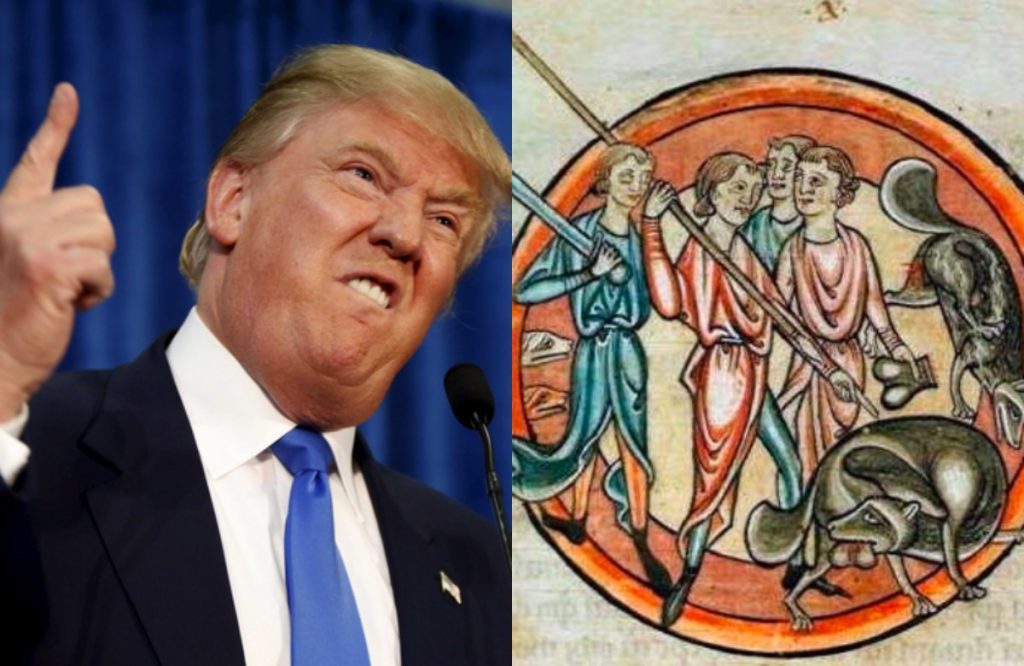
Turns out Moms & PBS were right: Reading is fundamental — to democratic stability. Neo-fascist leaders and their movements are ever more prevalent and powerful in 2026 because so-called low-education voters are ever more prevalent and easily led. These are the constituents famously preferred by Donald Trump. Yet these voters are proliferating worldwide, because the technological conditions that have created our 21st century literacy deficit — social media platforms newly super-charged by machine learning — are global.
We Americans often shovel these folks into a “non-college educated” bucket. During the last decade, however, smartphones — our 24/7 gateways to AI-enhanced social media algorithms — have hacked our behaviors in broader, more dangerous ways that have greatly expanded this suggestible-voter category.
In the U.S. specifically, a 2025 study in iScience found that pleasure reading fell 40 percent from 2003 to 2023. Non-audio/visual news consumption are both declining — according to Americans news consumers themselves. Effective literacy is shrinking globally but only in so-called first-world nations, where internet and smartphone usage are highest. Even the recently college-educated cannot complete nor comprehend entire books today, or so their professors report. Attention spans and critical thinking skills have attenuated in concert.
We readers and would-be readers are instead ever more reliant on watching or listening. Myself included.
Old school authoritarians hate readers. They love listeners and watchers.
As humans around the world read less — less often, less well — we are, all of us, more susceptible to the power dynamics that political leaders once deployed in pre-literate times, for millennia ahead of the Enlightenment. Trump is medieval in so many ways: the naked patronage, his championing of a Christian faith he does not follow. But Trump is cunning, as primitive leaders proved cunning. High walls don’t control immigrant populations. But they impress illiterate peasants as signs of strength and safety.
As literacy wanes, as cognitive and social behaviors related to reading wane, we are witnessing leadership styles respond and devolve. We refer to these newly empowered leaders as authoritarians or fascists; their communication capabilities feel new. In fact, they’re drawing upon age-old, foundational elements of power acquisition and maintenance, tools devised to dominate pre-literate cultures: fear stemming from the assertion of raw power and violence, personal charisma, symbolism, and xenophobic rhetoric.
Reading Resists Medieval Politics
It’s possible that humans will adapt, or democracies will eventually gird themselves to better resist these demagogues who have leveraged new technological realities. Early returns don’t look so promising.
The more reasonable assumption: Modern democracies simply cannot function without a preponderance of informed, literate citizens who can effectively process and parse written information. On the eve of an American Bisesquicentennial, it seems relevant to point out that the U.S. democratic project, in particular, would not have been established 250 years ago without broad-based literacy among its 18th century citizens.
Colonial thought-leaders like Thomas Paine and Thomas Jefferson, “founders” like Alexander Hamilton and James Madison (dedicated pamphleteers in their own right), argued as much. In print. They were agreed on this point because the Enlightenment thinkers they revered, figures like David Hume and John Locke, believed self-government was not possible without literate populations. They, too, established that stipulation, in print.
On July 3, 1776, Great Britain’s North American colonies were among of the most literate communities in the history of mankind. According to the World Economic Forum (WEF), average literacy for white men in the late-colonial period was roughly 70% to 90%, while white women averaged 45% to 50%.
The inevitable rise and political salience of literacy have been taken for granted the last two centuries. And why not: Prior to 1800, nine of 10 earthly humans were illiterate, according to the WEF. By the year 2000, those figures had fully reversed: Nine in 10 human adults could read. This development felt inevitable.
In 2026, we’re learning that technology can and will reverse such an evolution. Very quickly. Today, in remarkably short order, we are reaping the political whirlwind.
Donald Trump: No Public Virtue
In the American colonies, the highest ideal among late 18th century statemen was “public virtue,” which meant never giving in to the charismatic fearmongering, lies and othering of demagogues. Such rogues clearly exhibited the ability to sway public opinion, rouse the rabble and accrue power for themselves. The founding generation understood this firsthand. They had observed kings, war lords and preachers build and maintain power using fear, violence, charisma and othering — in the recent past. These were British subjects, after all. They were well familiar with Cromwellian juntas, with religious wars, with absolute monarchy run amok.
They viewed a literate population as a kind of inoculation against such public maladies. American Founders further created the U.S. Senate, an Electoral College and other constitutional measures to specifically neuter the power of such medieval, pre-Enlightenment figures. They bet the house on the wisdom of largely literate crowds, without whose consent men lacking in public virtue could not get elected or commandeer a government.
The only profession specifically articulated in the U.S. Constitution is that of of journalist. There’s a reason the “free press” must be protected from government intimidation. Yet the very First Amendment also protects citizen readers. The ability to report freely, the ability to read that reporting, the ability to check facts against and through competing written narratives, the ability to entertain and absorb a multiplicity of written views — all of these freedoms proved literally foundational to citizens and the enterprise undertaken in 1789. Or so the founders believed.
When it comes to modern citizens processing information, we’re seeing what our moms and PBS always told us was true: Reading is fundamental. So far as the body politic is concerned, reading remains distinct from and superior to the more passive acts of listening or watching.
Tech allows Return to Medieval Times
Humans have enjoyed and relied upon oral traditions for millennia. They’re powerful and important in their own right. But reliance on them and other passive communication modes isn’t enough — not to administer and safeguard a modern democracy. We’re seeing politics change as a result of falling literacy. Trump isn’t the only practitioner. Wielding a bottomless vat of AI slop, fascist charismatics are gaining ground in Germany, Argentina, Hungary, France, England and India — the recent fall of Victor Orban’s government notwithstanding.
Let’s be clear: Test scores measuring literary facility are dropping worldwide. No one knows where that will lead, what with AI breathing down our necks in hundreds more human respects. But we’re seeing the political fall-out first, as technological “progress” runs roughshod over the established mechanisms of political power we’ve enjoyed the last 200 years.
Technology doesn’t acknowledge borders, not in the digital age. This fact doesn’t vindicate Trump, but it does explain the global rise of similar fascist movements.
“Doctored photographs predate AI and even the digital camera,” Katya Ungerman wrote in her May 18 New York Times op-ed. “But fabricating proof used to take work. AI has removed that friction — any claim can now be furnished with evidence on demand, evidence increasingly indistinguishable from the real thing.”
Ungerman goes on to underline what I’ve been thinking, on the political front, for several years now: “The result of all of those conditions is that life has begun to feel governed by forces beyond our understanding, by knowledge that is unverifiable and by authority that is distant and suspect. It is, in a word, beginning to feel medieval.”
It’s no wonder that folks don’t trust U.S. institutions as they once did. Doing their own research? For most post-literate folks, that means watching youtube videos until they find one that supports their predisposed views — only to have algorithms flood the would-be researcher with more of the same.
Hacking Our Evolutionary Programming
Such algorithms push our buttons in elemental ways that pre-date and effectively trump literacy. Historian and philosopher Yuval Harari crystalized our precarious human position in his May 26 podcast with the NYT’s Ezra Klein. I recommend you listen to the whole thing, but here’s the gist:
“You see the politicians who rise to the top today. They’re extremely exciting and engaging personalities,” Harari says. “You cannot take your eyes off them… This comes from misusing our evolutionary programming.
“If you’re walking around the savanna tens of thousands of years ago, most of what you see is not very exciting. There are some bushes here. There are some gazelles over there. That’s fine.
“And then there is a snake. Now, the snake is exciting. The snake literally excites your entire nervous system. Because, if you don’t focus your entire nervous system on the snake, you die. We are programmed that if something is exciting, we drop everything else and just focus on that. And that makes sense in the African savanna.
“If you are on Instagram, you’re basically scrolling on your phone going, Snake! Snake! Snake! Snake! Snake! … The algorithm has hacked our evolutionary programming. They’ve hacked us. And what we are seeing around us is just the beginning. As AI become more and more sophisticated, it will learn to hack us on deeper and deeper levels.”
Sticking to the political implications of this changing world: We wring our hands about lost faith in institutions, in science and vaccines, in diplomatic treaties that have demonstrably reduced armed conflict (and nuclear warfare) since 1945.
Literacy, the absorption of critical information, was central to the faith and understanding in all these things. Without it, faith and understanding wither in terms of public confidence.
As readership declines, as literacy and attention spans diminish, we should expect that fear, violence, charisma and xenophobia will continue to flourish in the political arena. They are tried and true in this context. Prior to the Enlightenment, they held sway everywhere, across all borders, for millennia.
This is the “real world” Stephen Miller has notoriously deployed to describe his administration’s philosophical underpinning.
America’s founding generation understood the dangers of this formula even more viscerally. They lived under an absolute monarch. Their literate culture was a radical new exception to dynamics that had predominated for thousands of years. They may have assumed there was no going back to those primitive times. In this, they were mistaken.