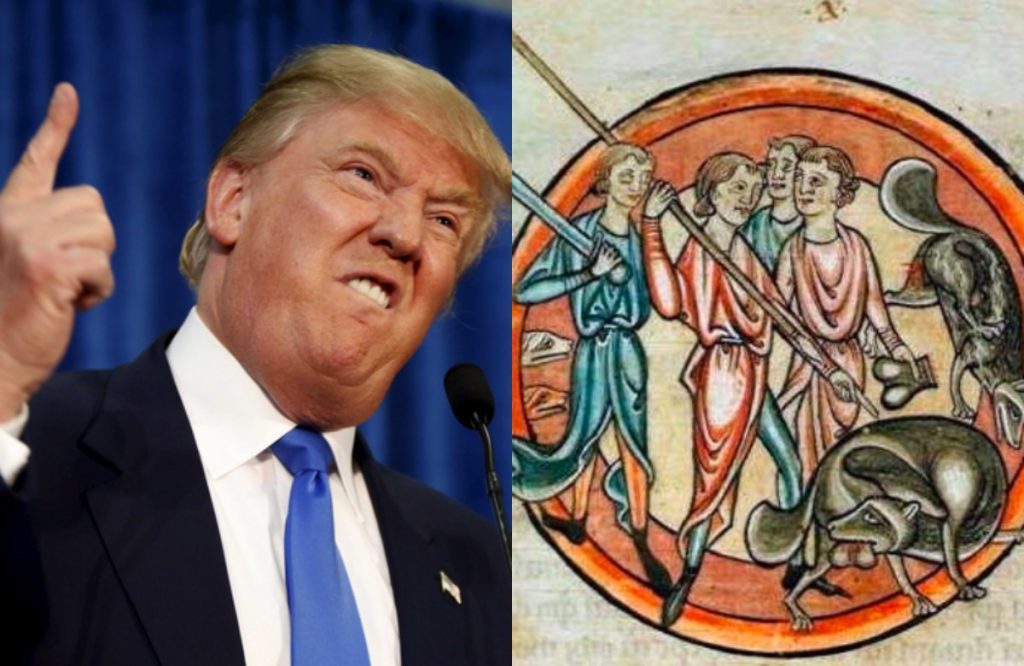
Turns out Moms & PBS were right: Reading is fundamental — to democratic stability. Neo-fascist leaders and their movements are ever more prevalent and powerful in 2026 because so-called low-education voters are ever more prevalent and easily led. These are the constituents famously preferred by Donald Trump. Yet these voters are proliferating worldwide, because the technological conditions that have created our 21st century literacy deficit — social media platforms newly super-charged by machine learning — are global.
We Americans often shovel these folks into a “non-college educated” bucket. During the last decade, however, smartphones — our 24/7 gateways to AI-enhanced social media algorithms — have hacked our behaviors in broader, more dangerous ways that have greatly expanded this suggestible-voter category.
In the U.S. specifically, a 2025 study in iScience found that pleasure reading fell 40 percent from 2003 to 2023. Non-audio/visual news consumption are both declining — according to Americans news consumers themselves. Effective literacy is shrinking globally but only in so-called first-world nations, where internet and smartphone usage are highest. Even the recently college-educated cannot complete nor comprehend entire books today, or so their professors report. Attention spans and critical thinking skills have attenuated in concert.
We readers and would-be readers are instead ever more reliant on watching or listening. Myself included.
Old school authoritarians hate readers. They love listeners and watchers.
As humans around the world read less — less often, less well — we are, all of us, more susceptible to the power dynamics that political leaders once deployed in pre-literate times, for millennia ahead of the Enlightenment. Trump is medieval in so many ways: the naked patronage, his championing of a Christian faith he does not follow. But Trump is cunning, as primitive leaders proved cunning. High walls don’t control immigrant populations. But they impress illiterate peasants as signs of strength and safety.
As literacy wanes, as cognitive and social behaviors related to reading wane, we are witnessing leadership styles respond and devolve. We refer to these newly empowered leaders as authoritarians or fascists; their communication capabilities feel new. In fact, they’re drawing upon age-old, foundational elements of power acquisition and maintenance, tools devised to dominate pre-literate cultures: fear stemming from the assertion of raw power and violence, personal charisma, symbolism, and xenophobic rhetoric.
Reading Resists Medieval Politics
It’s possible that humans will adapt, or democracies will eventually gird themselves to better resist these demagogues who have leveraged new technological realities. Early returns don’t look so promising.
The more reasonable assumption: Modern democracies simply cannot function without a preponderance of informed, literate citizens who can effectively process and parse written information. On the eve of an American Bisesquicentennial, it seems relevant to point out that the U.S. democratic project, in particular, would not have been established 250 years ago without broad-based literacy among its 18th century citizens.
Colonial thought-leaders like Thomas Paine and Thomas Jefferson, “founders” like Alexander Hamilton and James Madison (dedicated pamphleteers in their own right), argued as much. In print. They were agreed on this point because the Enlightenment thinkers they revered, figures like David Hume and John Locke, believed self-government was not possible without literate populations. They, too, established that stipulation, in print.
On July 3, 1776, Great Britain’s North American colonies were among of the most literate communities in the history of mankind. According to the World Economic Forum (WEF), average literacy for white men in the late-colonial period was roughly 70% to 90%, while white women averaged 45% to 50%.