By HAL PHILLIPS
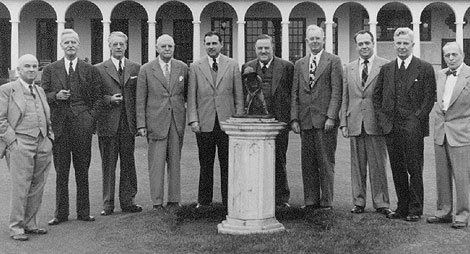
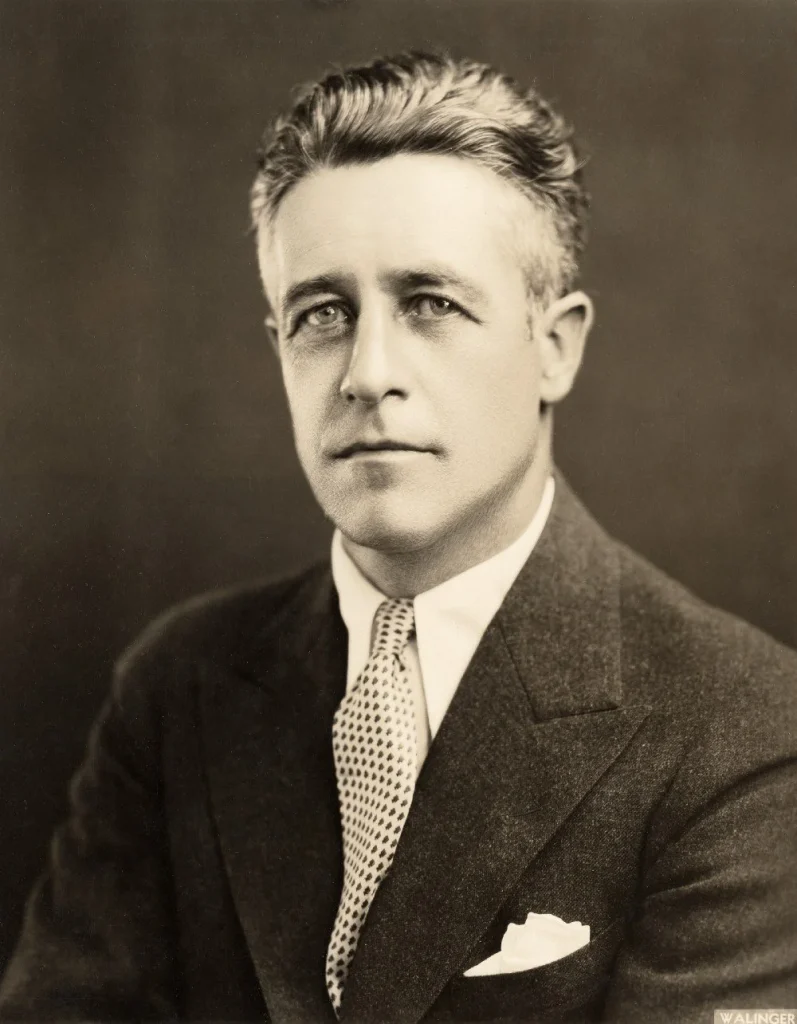
PINEHURST, N.C. (June 1, 2005) — There’s a famous black & white photo taken at the inaugural meeting of the American Society of Golf Course Architects. Design nerds have surely seen it: Ten founding members, all lined up in front of the clubhouse at Pinehurst, standing rather stiffly in their tweedy, post-war vestments. Not exactly the stuff of Annie Leibowitz, but the image still resonates — for it was here, back 1946, that the modern idea of ‘golf course architect’ was born. Third from left stands a handsome fellow named William Langford.
Midwest-born but Ivy-educated, Langford served as president of ASGCA in 1951 and again in 1963. Yet it was much earlier, over the first half of the 20th Century, that he earned his rightful place beside Ross, Jones, Thompson and Bell. During this heyday, William Boice Langford was perhaps the most prolific course designer in the Midwest, laying out 250 courses and, at one point, employing 80 men to do so.
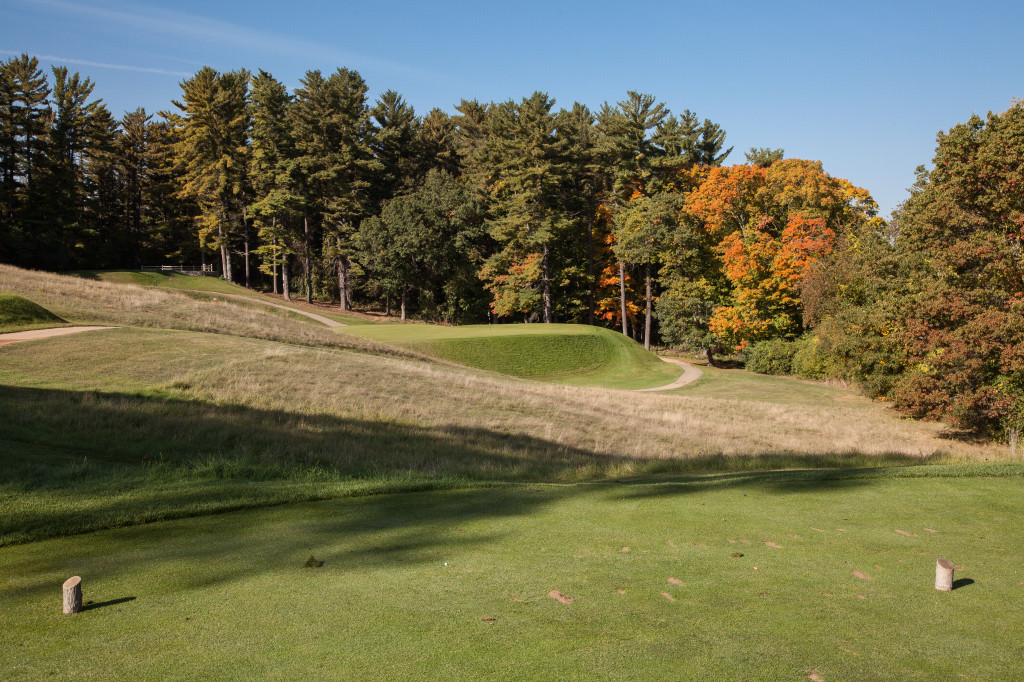
Several Langford layouts rank right there with the Golden Age greats. Lawsonia Links in Green Hill, Wis., is perhaps the best known, but there are myriad others: Riverside, Butterfield and Ridgemoor country clubs in Greater Chicago; Minnehaha in South Dakota; the original 18 at Greenville CC in South Carolina; and the much-praised old nine at Harrison Hills in Attica, Ind. His renovations of Skokie in Chicago and Wakonda in Des Moines are credited with transforming these courses into the classics we revere today.
At all these venues, Langford displayed a masterful understanding of approach angles. He also deployed a dramatic, steep-sloped bunker philosophy highly reminiscent of Seth Raynor’s work, but it’s not clear that Langford ever played or studied the work of C.B. Macdonald’s famous protégé. Regardless, his style rubbed off on dozens of young midwestern designers, an unwitting Pete Dye among them, and resulted in some of golf’s most striking, strategic green settings.
“Langford’s designs were excellent. I’ve tried to copy him as much as I could,” says 91-year-old Larry Packard, the Chicago-based architect who got his start under Robert Bruce Harris — another Pinehurst attendee — but moonlighted for Langford in the 1950s. “I’ve always felt that Langford did a first-class job, better than the guy I worked for. At that time, [Langford] was beginning to slow down a bit and needed someone to assist him with all the drawing. I used to come over, at night, and I’d help him. When we got tired, we’d go out in the yard and play croquet.
“The thing about Langford was, you could tell he was an excellent player. He knew more closely about where someone would hit a ball than Harris did. After Harris got a layout, he’d just put sand traps in like raisins in a plum pudding. Langford knew exactly how far and where a guy would hit a ball, and which angles would make good players think.”
William Langford: Thrice an NCAA Champion
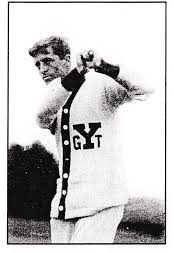
Golfing acumen isn’t necessarily a precondition for course architects, but it clearly benefited Langford who suffered from polio as a child and took up the game as part of his rehabilitation. It worked wonders. In New Haven, where his undergraduate studies predated the Macdonald/Raynor design at Yale GC, he played on three consecutive NCAA championship teams (1906-08) and remained a superb amateur player all his life. For the record, the Bulldogs played matches at New Haven GC, then Race Brook CC before moving over to YGC, in 1926.
After earning a master’s degree in mining engineering from Columbia — a discipline that would eventually serve him, and the field of golf course design, extremely well — Langford stayed in New York City and, according to Packard, prepared to take over his father’s sheepskin business. But the tug of golf never dimmed and eventually he went to work laying out courses for Chicago-based American Park Builders.
In 1918 he had formed his own firm, a partnership with fellow engineer Theodore J. Moreau. By the onset of World War II, the two partners had authored hundreds of golf course projects from the Dakotas to Florida and most places in between.
It’s difficult to ascribe a “style” to any course designer who works so long, on so many different projects, in so many different physical environments. But Langford — who did most of the design work, while Moreau mainly supervised construction — did have a distinct predilection for raised greens with very sharp edges that fell off precipitously into flat-bottomed, remarkably deep bunkers.
Unique to the Pre-Flymo Era
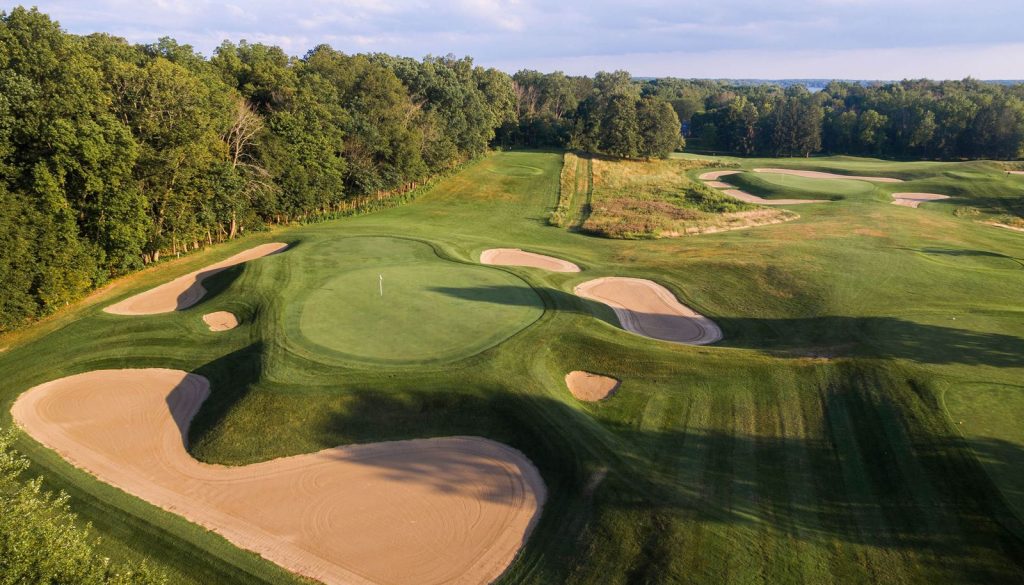
“I don’t know how they maintained those slopes in the 1920s. They must have hand-mowed them because there certainly weren’t any flymos back then,” says architect Tim Liddy, who recently attempted to mimic Langford’s style in adding nine new holes at Harrison Hills. “What I learned while working in Attica was that Langford’s style was a function of his construction technique. He used a steam shovel” — what today we would call a bucket loader— “to build a big pile of a green pad. They just scraped off the top, which gave you the sharp edge, then hand-raked everything out from that pile. The dirt would fall at the natural angle of repose, which created the steep banks that are so cool.
“I learned something else at Harrison Hills: how difficult it was to copy this technique with a modern bulldozer.”
Liddy admits the new nine in Attica doesn’t match Langford’s dramatic slopes particularly well, which makes us appreciate all the more his well preserved originals — at places like Lawsonia, Eglin Air Force Base GC in Pensacola, Fla., and the original nine at Wisconsin’s West Bend CC — where severe green settings and impossibly deep bunkers look for all the world like Seth Raynor had fashioned them.
The similarities between Raynor’s style — at places like Camargo and Shoreacres — and Langford’s are striking indeed, but they’re probably coincidental. According to architecture historian Ron Whitten, there’s no evidence that Langford knew Raynor, corresponded with him or consciously emulated his M.O. “It’s amazing how little communication there was between architects in that golden age,” Whitten says. “It’s not likely that there was any influence between Langford and Raynor.”
But that doesn’t mean Langford didn’t influence others.
“Mr. Langford built several holes at a 9-hole course in Culver [Ind.] that I’ve been playing since 1950 called Maxinkukee [Golf Club],” Pete Dye told me. “Langford did five holes there. There’s a real marked difference between his holes and the others. His are much better. Very Raynorish. But I didn’t find out until a couple years ago that they were Langford’s.”
A false lead as to Langford’s influence on Dye? Maybe not.
Mr. Dye, of course, has made his own name designing plateau greens, hard-edges and deep, flat-bottomed bunkers. They’re on display at Whistling Straits, site of this summer’s PGA Championship, and across the country.
“Pete Dye told me years ago that he was influenced by all these Seth Raynor courses in Indiana,” Whitten recalls. “Back in the 80s, when I was first visiting with him, he would tell me about all this Raynor stuff he’d seen. But when I would go visit them — the Culver course, Harrison Hills, West Bend — I learned they were all Langfords! Pete thought they were Raynors, maybe because he’d also been to Camargo. But they were all Langfords.”
Perhaps Dye has been channeling Langford’s spirit and style all along.
Larger Contributions to Early American Golf
Langford widely influenced the maturation of golf in other, more direct ways. For starters, he introduced the fractional system of golf course rating during the 1920s. Later, Thomas G. McMahon of the Chicago District Golf Association refined Langford’s technique and introduced “differentials” between scores and course ratings. But it was Langford who advanced the idea that handicaps could and should reflect course difficulty.
He was also one of the first, if not THE first architect to create for his courses detailed engineering drawings that specified in advance exactly what cut-and-fill figures would be used during construction. Raynor was an engineer, too, of course; but he was on site for many of his projects, overseeing the day-to-day work.
Langford’s engineering prowess and meticulous documentation enabled his contractors and crews (often supervised by Moreau) to build his trademark slopes accurately and efficiently, whether the architect was on site or not. “He had a 4-by-8-foot piece of plywood in his basement that he used as a drawing board,” recalls Packard. “Mr. Langford drew in a very large scale: 1 inch equals 100 feet. He drew each green separately and very, very accurately — every bit of dirt was accounted for.”
In essence, Langford helped pioneer the “science” of course design – a key development because, during the 1920s and ‘30s, architects were just starting to employ heavy equipment to manufacture golf landscapes on a larger scale. These exhaustive pre-construction practices also allowed Langford & Moreau tracks to be built more cost effectively, as construction figures and their financial ramifications were meted out in advance.
Cost concerns were particularly vital to Langford and his clients, because while most of his designs listed here remain private, Langford’s real passion was the creation of affordable golf for the masses — still a minority concern during the 1920s and ‘30s. The architect himself owned and operated two public courses in the Chicago area, though neither Mid City GC nor Twin Orchards GC have survived into the 21st century.
He also served for years on the USGA’s then-fledgling Public Links Committee During the Depression, Langford wrote several articles advocating the creation of 6-hole, daily-fee courses with multiple tees to serve less privileged golfers. Indeed, the bulk of Langford’s designs were built and survive today as public, relatively modest operations that still fulfill the architect’s vision — well, part of it. Many of their trademark slopes and sharp edges have gradually softened, alas, over the course of many decades.
Restoring Langford: No Picnic
Time will do that to bold course features, but so will meddling green committees. In 1957, Langford completely redesigned five holes at Westmoor Country Club in Wisconsin. “They’re our best holes,” says current superintendent Jerry Kershasky, who notes that shortly after they were finished, the club set about softening them. “Our 7th is a great, uphill par-4 to what used to be a Redan, but the club eliminated the back bunker and raised the back of the green. They thought it played too difficult, I guess.”
Luckily, Kershasky has Langford’s plans for Westmoor. Working with architect Bob Lohmann, the two are slowly bringing back what’s been lost. The newly restored 5th hole — an uphill, 217-yard par-3 to a trademark plateau green that falls away precipitously into deep bunkers on two sides — reopened for play in 2003.
“The members absolutely love it,” reports Kershasky, who believes that Langford’s make-or-break green sites are the best way to blunt the onslaught of modern club and ball technology — as opposed to building 8,000-yard courses. “In the bunkers, we dug two or three feet down before we found Langford’s original drainage tiles. They’ve gotta be 9 or 10 feet below the green surface! It’s a pretty good blast out of there now.”
Lohmann also wrapped some forward tees around a pond in front of the 5th tee to create some tantalizing angles into this near-Redan green. “When we looked at Langford’s plans, that’s just what he had in mind,” Kershasky says. “These plans are extraordinary. Everything is spelled out in great detail. You can see why this guy was so well known for his cuts and fills. He was Pete Dye before there was a Pete Dye.”