Category Archives

53 Articles
Thai Golf: Where Buddy Trips are Writ Large and Bawdy
Black Mountain Golf Club in Hua Hin.

Thai Golf: Where Buddy Trips are Writ Large and Bawdy

The stunning clubhouse serving Siam CC’s Plantation Course.

PATTAYA, Thailand (Sept. 5, 2017) — It’s 11 p.m. local time and my 8-man golfing gaggle is strolling down the main drag here. Pattaya’s “Walking Street” is the epicenter what most consider the capital of Thai Golf. The days and nights we’ve spent here, south of Bangkok, depart so radically from typical North American buddy trips, they make one reconsider the entire exercise.

Front and center is the golf component, of course. Normally this is the primary factor in determining quality or desirability. But there’s no denying that packs of (primarily) male golfers generally prize golfing locales for their nightlife, too. Any group of 8-12 golfing friends will include a few lads determined to rip it up each night, their wild hair perhaps offset by a few compatriots who’d just as soon play poker or watch sports in the condo. And so there is equilibrium.

Still, many insist the destination also offer some degree of lascivious attraction — if only to get the hard-partying faction on the plane. Think Myrtle Beach and its strip of nightclubs and bars. Think Vegas and its many diversions.

I consider the different buddy trips I’ve experienced, in these very locales, and I laugh to myself as another sultry Thai evening obliges me to wipe the beads from my perspiring brow. The Walking Street in Pattaya, ground zero for the city’s famously over-the-top nightlife, frankly makes an evening in Vegas feel like a evening out in Amish Country.

Black Mountain Golf Club in Hua Hin.

Blocked to vehicular traffic — save a series of small open-air trucks that continuously circle the downtown area, picking up patrons and dropping them off, for a dollar — Pattaya’s Walking Street stretches several kilometers along the Gulf of Siam beachfront. Either side of this thoroughfare is fairly well riddled with some of the craziest nightclub scenes you can possibly imagine. If you’ve never been to Thailand, you will have to imagine it — because you’ve surely never seen anything like it.

Thai Golf: All comparisons tend to pale

This is the primary take-away from my 10 days golfing across Thailand: There is such a breadth of experiences to be had that, after a point, all comparisons tend to pale.

For starters, it’s a big country — from Chiang Mai in the north to Phuket in the south it’s some 750 miles, or about the distance from Boston to Myrtle Beach. In other words, it’s too big to be climatically or culturally monolithic. This explains the striking contrast between the cool highlands of mountainous Chiang Rai, hard by the Burmese and Lao borders, and the utterly tropical environs of Koh Samui, an island off the east coast of Thailand’s tendril-like southern reach, on the Gulf of Siam.

Chiang Mai feels loose and slightly bohemian, like an overgrown backpacker haven, while Bangkok is the picture of a glittering, modern, bustling, gargantuan metropolis. Hua Hin is a quiet, gracious, retiring, seaside retreat while Pattaya… isn’t.

While the airport in Phuket accepts international arrivals from hubs like Singapore, most international visitors disembark via Bangkok, if only to go somewhere else. And so we did, immediately connecting to Chiang Mai where our early November arrival coincided with Loy Krathong, a festival marking the full moon.

The Hilton Millenium in Bangkok.

It’s different up North

Krathongs are little cup-shaped flowers, each with a candle and incense stick tucked inside; Loy Krathong means “floating Krathongs.” Our first night in town we ate dinner by the Ping River and watched thousands of these illuminated devotionals drift past. This marvelous scene and a stupendously sweet-and-spicy Burmese-style curry made for a keen introduction to the north country.

Next day we were off to Chiang Mai Highlands, home to 18 holes designed by the America duo of Lee Schmidt and Brian Curley. The superb terrain here made their job easy, but the finer touches impress: Profuse bunkering, pleasing to the eye, frames the inside of most every dogleg. The verdant peaks in the distance, the immaculate conditioning, the dryer heat all give the impression of playing somewhere east of San Diego.

The par-5 6th at Chiang Mai Highlands.

The north is a different brand of Thailand, slower and less insistent. After a cabana attendant offered me an iced towel — these weigh stations/snack pagodas come every 4 holes or so — she clasped her palms together, as in prayer, and, smiling contentedly, nodded over them. Just 36 hours in Thailand and this gesture was already reflexive in me, so I returned the gesture — a spiritual though not religious recognition of the divinity the Thais believe resides in each of us.

At the Robert Trent Jones II-designed Santiburi Chiang Rai Country Club — an hour north, where Burma, Laos and Thailand meet to form the famed Golden Triangle — the landscape proves lush, sweeping and equally divine. The holes feel as if they’ve been cut from a jungle, and so they have. Pleasing trade winds cool things down a bit further; it looks, feels and plays like a top-flight Hawaiian track — at one-third the price.

Feels like the Big Island

Back down south in Pattaya — some 90 minutes by car from Suvarnabhumi, Bangkok’s gleeming, modernist airport — we presage our adventure on the Walking Street with a pair of rounds at 36-hole Siam Country Club, host to the Honda PTT LPGA Thailand. The Plantation Course reminded me again of Hawaii — the Big Island this time, with its huge scale and colorful purple-hued undergrowth framing the fairways — while the Old Course feels like a primo private club somewhere in the Carolinas.

That night we took in several Singha and another killer curry (green this time) before swallowing hard and heading for the bright lights.

Walking Street nightclubs run the gamut in theme and tone, from the brazenly sexual to the coyly geisha, from darkly gothic to high camp. On this night we spent 20 minutes — or the time it took us to dispatch an ice-cold Singha — watching a group of 15 topless women dance amongst themselves (with various levels of enthusiasm) on a stage flanked on three sides by stadium-style seating. It was dimly lit and the décor entirely black and red. Sorta grim.

From there we braved a small side street and happened upon a totally different sort of place: cheerful lighting, an outer space theme. Same sort of central, raised dance floor but the mood was leavened 10-fold by the presence of soap suds, trapeze bars and flexible polyurethane tubes, which the dancers playfully wielded against each other’s backsides, and those of patrons, witting or otherwise as they walked near the stage. It was as if “Josie and the Pussycats in Outer Space” had gone live action and gotten really naughty.

I don’t want to make myself out as some naïf. A great many of the patrons were on hand, as I was, for the mere spectacle. But others were clearly on the prowl. Each dancer, after all, wore a number. A mere wave of the hand would summon her to one’s table. After obliging to buy her a few drinks (thereby generating revenue for the club), one is free — or, rather, one is free to pay $50-100 — to bring her back to a motel for the evening.

The comparisons are inescapable

I was reminded of the North American strip joints that we’ve all been exposed to, at one time or another, as adjuncts to golf trips or bachelor parties or whatnot. It’s made quite clear to any patron of these U.S. establishments that nothing, and I mean nothing, is going to happen between you and the hired help. Ever. Chris Rock wrote an entire monologue on the subject that sums it up quite well: “There is no sex in the champagne room.” It’s always confused me, the allure of these places. I mean, one can stuff all the money one likes in a G-string, but she is not going home with you — and that is ironclad.

In Thailand, that stricture is removed. Utterly. It’s a bit dizzying to contemplate frankly, a bit unreal. We could debate the moral merits of this system — clear objectification vs. straightforward commerce. What strikes me is the clarity, legality and transparency of the exercise when set against the equivalent here in the states.

Whether too smart or prudish, no one in our group took the plunge in Pattaya, or anywhere else in Thailand for that matter (there are Walking Street equivalents in most every city of any size). We stumble out of the space bar back onto the teeming streets which, when I look closely, are peopled by men, women and children of two dozen different nationalities. Everyone looks to be on holiday, heads on a swivel, eyes wide. It’s more reminiscent of a circus midway than a den of iniquity. It’s an assault on your senses, each and every one.  To that end, I buy several divine, street-vended skewers of fried squid and satay chicken before heading back to the hotel with my compatriots. On the spur of the moment we decide to get a massage at one of the dozens of parlors around the corner from our hotel, the plush Woodland Suites.

Again, there are plenty of establishments in Pattaya where the word “massage” is just a device, a front — but far more deliver nothing more than the finest $8 massage you’ve ever had. An oil massage is what you’ve probably had elsewhere; a Thai massage involves no oil and can be quite a workout. After 72 holes in four days, there’s a whole lot to be said for either approach.

A Different sort of Golf Round

Sunrise at Muang Kaew GC, in the heart of otherwise urban Bangkok.

You’ll never rake a bunker in Thailand. In the Kingdom, that’s a caddie’s job and it’s but one benefit of the country’s utter reliance on 80- to 115-pound loopers. Yes, they’re all female and they’re a constant at every course in Thailand. Take a cart? They’ll drive it. Feel like driving? They’ll ride on the back. Walking? They’ll pull the trolley. All of this is done with unfailing courtesy and a solid understanding of the course. Club selection? I’d handle that yourself — but that’s my feeling toward caddies most anywhere.

In a place like Thailand, with its walking streets and massage parlors, the whole caddie phenomenon tends to elicit raised eyebrows from the uninitiated. But trust me: There is absolutely nothing sexual about the Thai caddie experience. For starters, despite the heat, they are completely swathed in clothing from head to toe, complete with long sleeves and gloves. Such is the standard of female beauty in Thailand: Tans are not fashionable for women, at all, and caddies go to great lengths to avoid them.

Second, they are all business.  In most cases they are far too busy fixing ball marks, putting sand in divots and raking bunkers to flirt with you.

Some of the best caddies we experienced were served up back in Bangkok at the sporty Muang Kaew Golf Club, where conditions included near-100 degree temperatures and not a breath of wind. Our caddies never wavered — until we did. My two playing partners and I ditched the back nine, paid full caddie fees, and made three friends for life. Then we went for a massage in the clubhouse, a typically sterling facility in a country where they hew to a very high standard.

Asian clubhouses in general make their American counterparts look downright dowdy. Because Thai clubhouses cater to so many Asian golfing tourists, they are borderline palatial — how else to impress the Japanese or Korean who is used to merely opulent clubhouses back home? Massage rooms are standard fare in Thai clubhouses. Locker rooms are cavernous, as each golfer is assigned a locker at no charge, as a matter of course. After the round one is expected to shower, don a change of clothes, and kick back for several hours in the bar or restaurant. It’s a damned fine ethic, if you ask me.

The clubhouse at Thai Country Club has for several years been voted the best in Asia, and it’s not difficult to see why. It has all the bells and whistles, plus a superb restaurant (yellow curry this time, with chicken-lime soup) and an epic hot tub big enough to accommodate you and 11 of your closest friends. The course at TCC is no slouch — good enough to have hosted several tour events, including Tiger’s first foray in Thailand, the 1997 Asia Honda Classic. Despite all his issues of late, Tiger remains popular here. His mother is Thai, after all, and his name remains emblazoned on locker no. 1 at Thai Country Club. At least, it was when I visited…

Never Colonized, Never Outdone

Because Bangkok is the center of Thailand’s ancient culture — a culture, a nation that was never colonized by a Western power — it is naturally home to myriad examples of impossibly grand, ornate Thai architecture, each one more elaborate and awe-inspiring than the last. I recommend taking a cruise up and down the Chao Phraya River, which affords passengers a veritable water-born palace and temple tour. The swank Bangkok Marriott Resort & Spa, where we stayed, has its own boat — the dinner cruise is not to be missed.

With all this history, and with all our western prejudices on board, it’s startling to travel around Greater Bangkok (and indeed all of Thailand) with such ease. Bangkok traffic is world-renowned, but super highways connect the entire country, a monorail runs between downtown BKK and the new airport at Suvarnabhumi, and there are all manner of cheap domestic flights. This is clearly a first world country where everything still goes for second and third world prices.

We finished our Thai journey — arranged through the tour operator Golfasian (www.golfasian.com), roughly along an itinerary comprised of resorts and hotels belonging to Golf in a Kingdom (www.golfinakingdom.com) — with a couple days in the semi-sleepy town of Hua Hin, about 2 hours southeast of the capital on the Gulf of Siam. At the turn of the last century, the Thai royal family decided they liked this place, then just a village called Samoriang. The royals authorized a railway station here and commissioned fancy Italianate hotels. Then King Rama VI hired a Scot, A.O. Robins, to design the country’s first course, Royal Hua-Hin GC.

The rest is history. Today there are 275 golf courses and some 2 million native players, a figure that places them behind only the golf-mad Japan and South Korea. Of course, the vast majority of courses in Japan and Korea are private, so where do they go on golf holiday? Thailand.

Here’s what you see as you turn in to the Anantara Resort Hua Hin.

After waking up in a tropical garden that doubles as the Anantara Hua Hin, we decamp for our final round of the trip. It’s fitting that we close it down with 18 holes at Banyan Golf Club. Not because it was voted (by Asian Golf Monthly magazine) the best new course in Asia-Pacific for 2009, but because it was designed by the Thai architects at GolfEast. And because, as is the case at most Thai courses, one is just as likely to be playing behind a group of Thais as a group of Kiwis, Finns or Singaporeans.

Banyan was laid out over a former pineapple plantation, a giant bowl-shaped plateau set in the foothills above the sea. You get a peak at the Gulf of Siam from the picturesque par-3 15th. The striking modernist clubhouse looks out over the property from a commanding perch and it’s here that my golfing companions contemplate the genius of Thai golf over these final few Singha (and yes, one last curry).

It’s the organic quality of the golf culture here that resonates, we decide. Unlike some Asian nations where golf is nothing but a modern development gambit, or others where a colonial overlord foisted golf on the culture, Thailand came to the game on its own. The Thais really do love their golf. We decide they have every right to feel that way: We love it, too.


Welsh Golf Exceeds the Hype in Unexpected, Arthurian Ways
The 11th at Royal St. David's (photo courtesy of Brandon Tucker/WorldGolf.com)

Welsh Golf Exceeds the Hype in Unexpected, Arthurian Ways

Royal St. David’s Golf Club and its singular Welsh backdrop, Harlech Castle

HARLECH, Wales (July 13, 2017) — The British Open is nearly underway and, while there are myriad reasons to visit the U.K. with your golf clubs, none of them have much to do with British Open venues. Look at Wales, located right next door to this year’s host, Royal Birkdale — to all of England, if we’re honest.The R&A has never staged The Open over this border. Still, the golf up and down the northwestern Welsh coast is outstanding. Welsh golf along the south coast ((Royal Porthcawl, Southerndown, Pennard) is even better.

What’s more, when you venture into this section of the British Isles, you experience a region so remote, so removed from modern resort and tournament conventions, that a golf journey there feels almost Arthurian.

A hefty chunk of the King Arthur legend is Welsh, drawn from early poetic sources such as Y Gododdin. Like the Welsh language itself, theses texts pre-date Roman Britain, much less Christianity. The Druids, the UK’s pre-Christian priestly class, considered the Welsh island of Anglesey sacred. This ancient, mystical aura continues to pervade the country’s dark hollows, its untamed coastline, even its trees. The Celts thought them sacred, you know.

I’m a voracious fan of the historical novelist Bernard Cornwell, whose Arthurian trilogy, The Warlord Chronicles (comprising The Winter King, Enemy of God and Excalibur) were all published about during mid-1990s. Taken together, they represent the best, most accurate and compelling take on the Arthurian tales — and much of the three-book saga takes place in Wales.

Indeed, they made a movie loosely based on Cornwell’s Warlord Chronicles, in 2004 Alas, the film — titled “King Arthur” and starting Clive Owen and Keira Knightly — proved middling at best. But they filmed all the castle scenes in Harlech.

Welsh Golf: Where Worlds Collide

Here’s an example of how this ancient world and the modern golfing world can interact in the UK’s least heralded golf destination:

About 15 years ago my girlfriend, Sharon, who would later become my wife, and I went to visit friends in Market Drayton, Shropshire, just over the Welsh border, in England, and not far from Birmingham. I was there on assignment, writing a travel piece about “where to play in the Midlands” while attending the 1995 Ryder Cup.

We can see what sort of long-term promotional effect that story had: To this day, no one talks about Edgbaston, Beau Desert or Hawkstone Park.

Anyway, we decided to head west a couple hours, over the Welsh border to seaside Harlech, home to Royal St. David’s Golf Club. I had written a letter to the club secretary requesting courtesy of the club (remember written, posted letters?). He had kindly obliged. We three arrived in coat and tie, ready for an audience and perhaps a drink in the bar before teeing off.

Ahead of our game, however, we stashed our clubs in the boot and walked a few hundred meters up the hill from RSDGC to Harlech Castle, which overlooks the course, the town and the entire countryside. Built by King Edward I during his late-thirteenth century conquest of Wales, it served as de facto capital of an independent Wales between 1404 and 1409. That’s when was held by Owain Glyndwr, the last native Welshman to hold the title Prince of Wales.

Try doing something like that within walking distance at Royal St. George’s.

Impressing the Club Secretary

Sharon was a pretty rank novice back then. She had her own clubs and arrived at the club looking pretty darned smart in a turtleneck and one of my vintage sport jackets with the sleeves rolled up (remember the ‘90s?). Still, the club secretary was dubious. I don’t know whether he suspected her inexperience (none of us were asked to present handicap cards), or he was merely a mild sexist when it came to lassie guests playing his course.

Whatever the case, he followed us to the first tee to witness our opening drives. I’m not sure who was made more nervous by this “gesture,” Sharon or myself — but she proceeded to drill one right down the middle, about 210 yards, and off we went. Come to think of it, that may have been the day I decided she was the one.

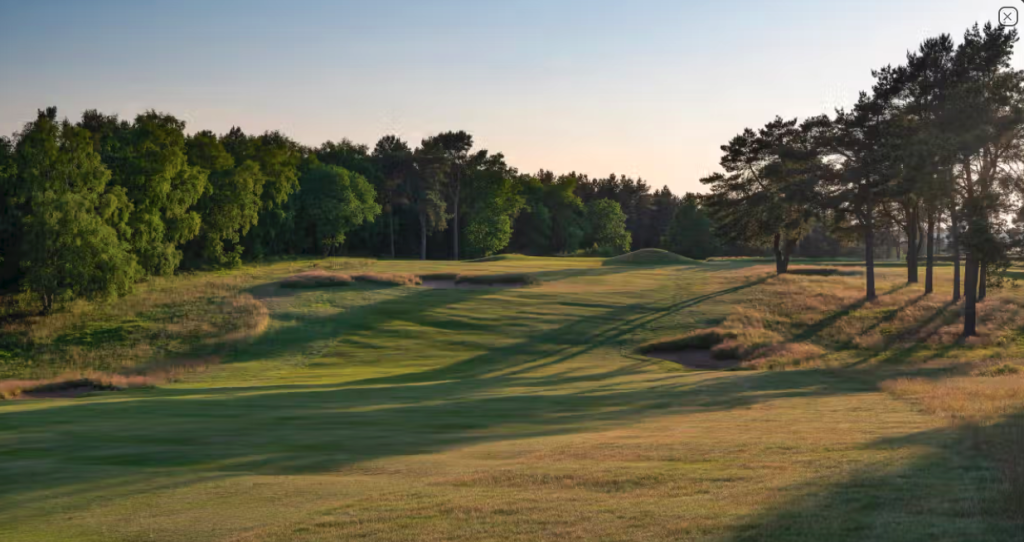
In any case, Royal St. David’s was and remains fairly sublime. The opening holes are a bit ordinary and flattish, hidden as they are behind (and not amid) the giant dunes at seaside. But the back nine rollicks through some truly extraordinary dunesland. Great stuff.

Welsh Golf doesn’t have to be — some would argue that it shouldn’t be — about resorts and tourism initiatives and tournament-enabled marketing synergies. It’s about watching your future wife stripe one, after mingling with the spirits of rebel kings and pre-Christian sorcerers in a real, live castle. Not to belabor the point, but they ain’t doing that at Birkdale.

The 11th at Royal St. David’s (photo courtesy of Brandon Tucker)

Golf’s Longest Week: When Sunday became Monday (then Tuesday) in Toledo

This piece appeared in the April 2004 issue of LINKS Magazine. Above, George von Elm (left) and Billy Burke, combatants in the longest U.S. Open every contested..

TOLEDO, Ohio (April 10, 2004) — The next time you play a round of golf in some modicum of heat and humidity, the next time you trudge up the 18th fairway and feel a bit of lactic acid building up in your thighs, spare a thought for Billy Burke and George Von Elm. These unflinching principals squared off golf’s longest week, the most extraordinary physical and competitive test the game has witnessed. The 1931 U.S. Open was held some 86 Julys ago here at The Inverness Club in Toledo, Ohio. Grantland Rice called their duel there “the most sensational open ever played in the 500-year history of golf.” Burke and Von Elm required 144 holes of medal play to produce a winner: Burke, by a single stroke.

Take a moment to think about the parameters here: 72 holes contested over the first three days, followed by 36 playoff holes on Monday and 36 more on Tuesday. Waged in the midst of a stifling, July heat wave — in an era devoid of fitness trailers, cushioned in-soles, and air-conditioned clubhouses — this match proved golf’s precursor to the Bataan Death March, the games original Duel in the Sun. It was and remains, needless to say, the longest playoff in U.S Open history. Supreme Court cases have taken less time to adjudicate.

Or so it appeared during the morning round on Tuesday, July 6, 1931, as Burke and Von Elm — with 126 holes behind them and 18 still to negotiate — staggered off the 18th green toward the clubhouse for lunch. Even the most callow observer could see the quality of play eroding, under the enormous dual burdens of fatigue and Open-playoff pressure.

Yet Burke rallied to play his finest golf of the tournament over the final 18 holes. Von Elm, too, rose to the occasion and finished but a single shot in arrears.

“I looked for a rather ghastly finish to a grand struggle,” wrote O.B. Keeler in The American Golfer. “Instead it was, and ever shall remain in my mind, the most remarkable exhibition of recovered stamina and poise and of sheer staying power and determination I have ever witnessed.” Legend says that Von Elm, a lithe figure with little to lose, shed nine pounds during the championship, while the stocky Burke managed to gain two. “A circumstance,” Keeler mused, “which, if accurate, gives rise to wonder as to his diet.”

Golf’s Longest Week required No Jones

The first major of of 1931 was the first “Jones-less” U.S. Open since 1920. The Emperor had retired from competitive golf following his epic Grand Slam the year before, and while he was on hand at Inverness, the golfing public was anxious to see just who would fill the considerable void. Golf’s professional class was especially keen. Bobby Cruickshank admitted he and colleagues were delighted to see Jones in the gallery, as opposed to the field.

Nineteen thirty-one was also the year competitors were obliged to deploy the so-called “balloon ball” during Open play. This larger and lighter spheroid didn’t prove popular at Inverness, as competitors complained loudly that mis-hits were exacerbated by the new-fangled thing, which neither carried nor rolled as far. After just one year, the USGA would junk it — returning to the previous, heavier guideline of at least 1.62 ounces, but keeping the balloon’s larger size (1.68 inches in diameter).

Yet the weather soon quelled all talk of balls and would-be kings The heat was oppressive by any discernible measure. Contemporary accounts of the championship are littered with modifiers like blistering, blazing and sweltering. Golf Illustrated‘s “special correspondent” noted that “The field was all on hand early for practice several days ahead of time, but so intense was the heat that on these practice days no one with any chances to jeopardize played more than nine holes of golf.”

The mercury registered 105 degrees on Friday, July 2, the first day of competition. It was no cooler on Saturday, when Von Elm served notice to the field with a 69, the tournament’s low round. His 36-hole total of 144 led 63 players who made the cut; Burke stood one stroke back. Thirty-four years would pass before before the USGA extended the Open format to 18-holes on four consecutive days, so Von Elm’s 73 on Sunday morning placed him two shots clear of Burke with the afternoon round still to play.

By lunch time, temperatures hovering between 97 and 99 degrees. Igniting one of his trademark cigars (he would go through 32 during the championship), Burke went off in the penultimate group with Johnny Farrell, while Von Elm and Al Espinosa formed the final pairing.

Espinosa and Farrell had fallen from contention with substandard third rounds; by Sunday’s final nine, it was essentially a two-man race, with Von Elm in the driver’s seat. Standing on the 12th tee, he led Burke by two strokes but Von Elm would stumble over the next six holes, playing them in four-over. Burke parred the 18th to post a 292, meaning Von Elm needed a birdie 3 to force a playoff. He did just that, calmly draining a 12-footer as the breathless, sweat-soaked multitudes gathered a green’s edge.

With its extraordinary fugue of physical demand and competitive drama, Sunday’s play (the presumptive 36-hole finale) might have gone down as one of the most thrilling days in Open history. As it turned out, the tournament was just half over.

Businessman Golfer vs. the Club Pro

A dapper, big-hitting Californian, Von Elm is one of those curiously recurring characters who isn’t particularly well known but nevertheless continues to crop up as one leafs through the pages of golf history. He won the U.S. Amateur at Baltusrol in 1926, defeating the great Jones, who had claimed the two previous titles and went on to win the Amateur in 1927 and ’28. Only Von Elm kept him from winning five in a row.

A seasoned 30 years of age when he arrived at Inverness, Von Elm was hardly new to golf marathons. During the 1930 Amateur at Merion, he played the longest extra-hole playoff in U.S Amateur history, going 28 holes before succumbing to Maurice McCarthy. What are the odds the same man would participate in both the longest U.S. Amateur playoff and the longest U.S. Open playoff — and lose both?

The defeat at Merion effectively ended Von Elm’s auspicious amateur career. From that point forward he would compete as a “businessman golfer”, meaning he would accept whatever prize money his finishes might earn. This proved a prudent if slightly unorthodox vocational step. According to Herbert Warren Wind’s Story of American Golf, Von Elm’s earned him some $8,000 in January and February of 1931 alone, a veritable king’s ransom in Depression-era America.

Burke, on the other hand, was a 29-year-old, bonified professional of the club variety, playing out of swanky Round Hill in Greenwich, Conn. Born Billy Burkauskas, the Nutmegger spent a portion of his young adulthood puddling iron in a Naugatuck, steel mill. His swing was a tad awkward, and Von Elm outdrove him on nearly every hole. That said, “Temperamentally,” Keeler observed of Burke, “it is difficult to suggest an improvement.”

Some have painted Burke’s showing at Inverness as something of a shock result, but contemporary accounts tell a different story. It’s true that 1931 marked the club pro’s first real foray into national, tournament competition. Yet Captain Walter Hagen shrewdly named Burke to his 1931 Ryder Cup team. Tthe matches took place a week prior to the Open, at nearby Scioto, where Burke won each of his foursomes encounters and his singles match — the latter by 7&6.

Indeed, his cracking Ryder Cup form made him something of a fashionable dark horse entering the U.S. Open at Inverness.

Timeless Terrain in Toledo

The 15th at The Inverness Club.

The championship layout at Inverness, like many of its early-20th century counterparts, has undergone considerable change over the course of a century. The course we know today was created by Donald Ross, who renovated an existing nine and added a companion loop prior to the 1920 U.S. Open. A.W. Tillinghast prepped the course for the 1931 event, and half a dozen different architects have tinkered with it since. Inverness held the Open again in 1957 and 1979, enduring pre-tournament preps each time. [Architect Andrew Green would renovate yet again in 2017, then revisit once more in 2024.]

Despite all this, the ground itself at Inverness has remained essentially unchanged since the last ice age, when a pair of rivers carved two distinct valleys from the sandy soil just south of Lake Erie. “The course has always been laid out across these two gorges,” explains Tom Walker, course superintendent at Inverness since 1980. “The elevation change is about 30 feet, which isn’t a whole lot. But you’re continually playing across these valleys, walking down and coming up the other side. I would not classify this as an easy walking course, not by any means.”

The U.S. Senior Open was held at Inverness in 2003. Sort of ironic, as it’s the only Senior PGA Tour event where the competitors are obliged to walk. As Burke and Von Elm learned — as Bob Tway learned, before he hold out on the 72nd green to beat Greg Norman at the 1986 PGA Championship; as modern seniors learned a decade later — holes 1, 10, 12, 14, 15, 16, 17 all span at least one of these gorges. The other ravine requires similar hikes on holes 4 and 5. As the layout was configured back in 1931, no. 7 required yet another valley crossing.

Walker caddied at Inverness during the 1960s: “I didn’t necessarily enjoy it, especially in July. It’s no walk in the park. To think that these guys — and their caddies — walked 144 holes in five days, in that heat… I think that’s an incredible feat. Just the mental aspect, let alone the physical aspect.”

According to Walker, whose livelihood depends on an accurate meteorological understanding, a typical July day in Toledo is “muggy”, meaning 85-92 degrees with relative humidity of 50-60 percent. During the Open of 1931, these conditions would have qualified as refreshing cold snaps, as temperatures consistently soared into the upper 90s and beyond.

It was, in short, extraordinarily hot.

How hot was it? Nine players who made the cut at Inverness chose instead to withdraw, including two — Albert Alcroft and J.M. Hunter — who reportedly tore up their scorecards after the third round and went fishing. By comparison, at Interlachen the year before, just three Open competitors who made the cut chose to withdraw.

Either it was quite a bit hotter at Inverness, or the fishing just isn’t that good in suburban Minneapolis.

But seriously, folks: How hot was it? Here’s all you need to know: The USGA would never again stage its Open Championship during the month of July.

Monday, Monday: Head to Head

Burke watches Von Elm’s bunker shot come to rest during Tuesday’s final 36 holes at Inverness.

Following Von Elm’s 18th green heroics on Sunday, he and Burke rejoined their Open battle Monday morning. For the first time, the two combatants played alongside one another. The results proved predictably dramatic. “This playoff changed complexion at least 15 times,” Rice wrote in The American Golfer. Indeed, Monday’s remarkable give and take left the normally verbose Keeler at something of a loss: “I saw altogether too much… to make any sensible selection of features from such a wealth of them.”

Von Elm fell four strokes back at one stage, only to birdie four on the trot and reclaim a two-stroke lead. Burke was steadier, and by the time he reached the 36th tee — the 108th, all told — he held a one stroke cushion.

Then, as now, the 18th at Inverness is a short par-4 of just 330 yards. This is where Tway’s birdie from a greenside bunker defeated Norman during the 1986 PGA playoff. This is where Von Elm’s birdie at Sunday’s 72nd hole forced the 1931 Open playoff. Once again, on Monday, Von Elm needed a birdie 3 at the last to fend off defeat. And once again, he delivered — holing a 10-footer and forcing another 36 holes the following day.

Burke and Von Elm trudged on, playing the Tuesday morning 18 amid unrelenting temperatures — into the high 90s by 10 a.m. They played like the exhausted, punch-drunk combatants they had every right to be. Each shot their worst rounds of the tournament, though Von Elm’s 76 nevertheless afforded him a one-stroke advantage at the break.It looked for all the world as though the 1931 Open winner would be meted out by attrition.

And yet, as Keeler noted above, after lunch both players rose magnificently to the occasion. Burke went out in one-under 34, building a two-stroke advantage. Von Elm fought back and drew level with a par on 13. But Californian’s putter deserted him on 14 and 16, where three-putt bogeys essentially sealed his fate. The man whose putter had saved him Sunday and Monday betrayed him on Tuesday afternoon. He shot 73, with 35 putts.

When Von Elm’s long birdie attempt on 18 didn’t find the hole, Burke had the cushion he’d long lacked. Before addressing his own 25-foot birdie attempt, Burke was regaled by a green-side photographer: “Say, Burke, how about a shot?” With 143 holes behind him and poised to claim golf’s greatest prize, the unflappable Burke obliged the press corps by producing a winning smile. “Go ahead,” he said. “I’ve got three putts to make it.”

He would use all three.

Despite this cautious lags on 18, Burke’s exquisite, even-par 71 was his lowest round of the championship. “There is no need to gild a par round at this stage,” the sage Keeler remarked. “It speaks for itself.”

Coats, Ties and Foursomes: UK College Golf in the ’80s was a Breed Apart

Coats, Ties and Foursomes: UK College Golf in the ’80s was a Breed Apart

SUGAR GROVE, Ill. (May 5, 2017) — For all the trans-Atlantic DNA we share with our British cousins, it’s easy and, I daresay, natural to assume that UK college golf is pretty much a comp for the exercise here in the U.S. Not so. Not today, not forty years ago when I played for the University of London.

Today, top players from the U.K. (and mainland Europe) routinely travel stateside to hone their games at American colleges and universities. At scale, this “study abroad” drains the bBritish collegiate game of talent, obviously. Indeed, many of these men, women and their games will be on display here later this month (May 19-31) at Rich Harvest GC, site of the 2017 NCAA Championships.

But why do they make this trip in such appreciable numbers? Because collegiate golf in the U.K. — like all college sports there — is decidedly low-key, even compared to the low-stakes Division III golf I played at Wesleyan University in Middletown, Conn., during the early 1980s.

For my money, however, one can place UK college golf alongside proper ale and period cinema as something the Brits still do better, with more nuance and panache. Yes, our universities turn out more tour professionals, but for the majority of college golfers, in both countries, that’s not the point. It’s about competition and its sensible integration with the game’s social niceties — and no one does that better than the British upper crust.

That posh ethos dominated my university golfing experience abroad: Coats and ties, foursomes in the morning, singles in the afternoon, and no less than two proper English piss-ups sandwiched between them. You can have your vans, your matching shirts and golf bags. To Yanks, collegiate golf in the U.K. may look and feel more like a club sport. Having played both sides of this fence, I’ll go with the Pommies.

UK College Golf: No Vans

At mighty Wesleyan, a perennial golfing doormat, the exercise during the ‘80s remains recognizable: Throw on a pair of khakis and a golf shirt; pile into a van and meet a different college team, or two, at the course venue. We’d play 18 holes of medal, shake hands, tally up the scores, pile back into the van and drive home to campus. Big-time Division I golf schools don’t play many dual or tri-matches like these any more, I understand. More often they play various invitational tournaments whereby dozens of schools show up in one place, seven guys from each team play medal, and the best 5 scores count. We did this, too, though only once or twice a season.

Collegiate golf in England during the mid-1980s, when I played for the University of London, was nothing like this. Nothing. For starters, and perhaps most important, we rarely played other schools. Instead, university teams were hosted by golf clubs themselves, which trotted out their best players for a day of intergenerational match play and assorted reverie. Here’s a typical match-day regimen:

Put on coat and tie, pack some golf clothes in your golf bag and hump it to the nearest Underground station. Yes, we all got ourselves to the golf course, somehow — by bus or subway or some teammate’s car. We played a lot of matches in Greater London, at places like Roehampton and Royal Wimbledon, and I fondly remember riding the Tube with my golf clubs in tow.

Having arrived at the club, we would literally partake of tea, crumpets and scones with our opponents. As with most British golfing clubs back then, coat and tie were mandatory in the clubhouse, hence the need to dress for breakfast. The University of London Golf Team never once faced another school the entire semester I participated. We played the top 7 amateurs at various clubs who had deigned to host us for a day of matches. They were damned good players, as you might imagine, and they took great delight in showing off their home courses and, more often than not, kicking our asses around them.

The 13th at Royal Wimbeldon GC.

Thirty-six holes, Two Outfits

Our first change of address took place in short order, after tea. We’d slip into golf attire and head out for 18 holes of foursomes, or alternate-shot, at match play. This was great fun but very, very difficult. We typically see this format only in the Ryder Cup or President’s Cup contexts. Even then, a world-class professional, if just a bit off his game, can make life truly miserable for his partner. Just imagine teaming with a 7 handicap who’s probably hung-over, hasn’t picked up a club since the last match two weeks prior, and is seeing some course for the very first time.

Ater this first match, we’d change back into coat and tie for lunch. There were matches where we convened for casual buffets “at luncheon,” but more often than not these were grand affairs: four-course meals with elaborate place settings replete with wine, port and various toasts (read: shots of whiskey). If we students had fared well in the morning, the object of our hosts was mainly to get us as drunk as possible in preparation for…

Afternoon singles. Having changed back into golfing attire, we played 18 holes of singles, at match-play, of course. Depending on the luncheon miniseries, these could be quite entertaining affairs.

To complete the golfing day, one more costume chjange — back into coat and tie so as to hang around the clubhouse bar drinking pints of properly pulled ale with our new, middle-aged friends. Sometimes there were “antics”. At Roehampton (or Royal Wimbledon; I can’t remember which), someone suggested a 1-club tournament, whereby we went back out onto the course, at dusk, still dressed like Harry Vardon, pint in hand, to play a short loop of holes using but a single club. Great fun. I recall choosing a persimmon 4-wood. Remember them?

I honestly couldn’t tell you the first thing about whether we won, lost or drew any of these overall matches against the golf club teams. First of all, from a team perspective, I don’t think it mattered to anyone all that much; second, by the end of these marathon golfing days, I was far too drunk to give a fig.

The Semester’s Final Match

Oldest club in England
Royal Blackheath GC

I do remember well my last match before heading home to America, however. It was played at Royal Blackheath, which, if memory serves, is the oldest golf club in England, i.e. south of the Scottish border. We had arranged this match because a fellow on our team has been a member there growing up. He arranged it and, for him, the exercise prove equal parts homecoming, competition and piss-up.

Luncheon had been a complete free-for-all. Some two hours of eating and drinking had finally given way to the singles matches. Our Blackheath alum went out first against one of his oldest friends, while I — because it was my last match before going home, back across the pond — was given the honor of going out last vs. the club captain. He was 50-something fellow who kept offering sips from his flask all along the outward nine. I politely declined; I was plenty buzzed from lunch and wanted to win my swan song. On 12, I went 3 up and we set about finishing his brandy together.

When we arrived at the tee box serving the par-3 15th, our match nearly decided, we came upon the first group. They had decided to park themselves on a bench, wave everyone through, and concentrate on their drinking, reminiscing and needling. In the three years of college golf I played at Wesleyan, the idea that my opponent and I might blow off or otherwise back-burner our match in favor camaraderie like this? Never have occurred to us. Pity, that.

As we gathered in the clubhouse bar that evening, my teammates — in honor of my pending departure — presented me with a formal and quite stylized summary of the day’s results, complete with my skunking during the morning foursomes and my full point (!) from the singles. I’ve just gone and consulted this document in a scrapbook I keep. It was a touching gesture…

The fact that someone like me — an American, but really just a guy who showed up entirely unannounced, for a single semester — could join the golf team, compete in 5 or 6 matches, and be so thoroughly welcomed, then bade such a fond farewell. It speaks both to the informality of the collegiate golf exercise as it existed in England back then and to the oft-maligned English social character. Yes, they can be a bit stand-offish at first but once they let you in, perhaps with the aid of proper lubrication), they are great fun, quite warm and perhaps more prone to overt sentiment than we Yanks.

I don’t honestly remember how I got home from Royal Blackheath that night. My last concrete memory is playing snooker with several guys in the club’s ornate billiard room, a vast mahogany-paneled expanse beneath impossibly high, pressed-tin ceilings. cloud of cigarette and cigar smoke settled over the tables. Every once in a while, people find out I played college golf in England. They often ask, “So, what was that like?”

In a word, exhausting.

Feeding the Faithful: Golfing the East Coast of Scotland, by Rail
The estimable Balgownie Course at Royal Aberdeen GC

Feeding the Faithful: Golfing the East Coast of Scotland, by Rail

WHEN GOLF was first conceived, participants arrived at the course on foot or horseback, or, if the company was honourable enough, by carriage. For this reason, it remained for centuries a parochial, largely Scottish pursuit. In the 18th and 19th centuries, however, all of British culture was transformed by an industrial capacity that among other things launched a transportation revolution.

Trains would change golf forever.

In particular, completion of the Forth Rail Bridge, in 1890, widely exposed the bounty of Scottish links courses for the first time — to the rest of newly mobile Britain and ultimately the world, which still marvels.

The advent of train travel did something else marvelous: It spurred the development of “new” Scottish links built specifically to accommodate the rail-enabled.

Golf may not have been formulated with trains in mind but the idea and practice of “golf by rail” shaped and grew the game during the late 19th century, its first true boom period, an age we now drape with garlands like “ancient”, “timeless” and “classic”. The railway made the game what it was, what it remains today in the minds of many. Without this transformation, the romantic golfing image of golf we so idealize (the one we still travel to Scotland to find) might never have materialized.

Indeed, the very idea of golf travel was born in this time. By 1890, the railways had cozied up to several superb links in the Scottish lowlands. It only made sense: Rail connected population centers, which lay mainly along the coast, close to sea level where terrain was flattest and bed construction easiest. Just a short walk from these new “centre city” train stations lay the common lands, the links where, for example, in East Lothian, clubs like North Berwick, Muirfield and Gullane already resided. Today they remain as practical to play by train as they did in the 19th century — which is to say, perfectly practical for golfers with a sense of history and adventure.

The Forth Rail Bridge, the world’s first steel span, made this travel scenario a practical reality in Fife, revealing the birthplace of golf to the game’s myriad new zealots.

“As the train neared St. Andrews and I noted the gradually increasing numbers of the faithful,” wrote A.W. Tillinghast on his first trip to “that Mecca for golfers”, in 1895, “I marveled that the popularity of the ancient game had continued, unabated throughout the centuries.”

Read More

Baronets & Collieries: Encountering Fowler’s Beautiful, Wild Place

Baronets & Collieries: Encountering Fowler’s Beautiful, Wild Place

Herbert Fowler is one of those architects whose name, curiously, isn’t readily attached to the many great golf courses he laid out and/or substantially retooled. Cruden Bay? That’s a Fowler. Royal North Devon? Fowler’s fingerprints can be found all over this west country antique. Indeed, his renovation of the Old Tom Morris original (a.k.a. Westward Ho!) fairly well accounts for the course we know today.

This lack of name recognition begins to explain why a venue like Beau Desert Golf Club, which Fowler designed nearly 100 years ago in the Staffordshire hamlet of Hazel Slade for the Sixth Marquess of Anglesey, rings few bells. Yet a better heathland course golfers are unlikely to come across, as indeed many have not.

Herbert Fowler

For his own part, The Marquess (nee Charles Henry Alexander Paget) recognized immediately that Fowler had created something extraordinary on his Beaudesert estate. When the course was completed, in 1913, Paget whisked Fowler off to the family’s “other” ancestral estate at Plas Newydd on the Welsh island of Anglesey. There the architect laid out a second course for the Marquess, Bull Bay Golf Club, another sterling Fowler product you’ve probably never heard of.

The majority of Fowler’s brilliant work was done in his native England, but he did get around. Fowler was the man who transformed a ho-hum par-4 at Pebble Beach into one of golf’s most heroic, par-5 finishing holes. His Cape Cod design at Eastward Ho! (whose peculiar moniker now makes perfect, book-ending sense) is an old-world delight. Fowler also refurbished the ancient Welsh links at Aberdovey where venerated golf writer Bernard Darwin learned the game and played all his life.

Darwin would complete the Fowler circle by eventually visiting Beau Desert’s 160 acres of elevated, exposed ground some 25 miles north of Birmingham. Afterward he asserted that, “Here might be one of the very best of courses, for the turf is excellent and there is a flavour of Gleneagles about it. It stands high and is pleasanter in hot weather than cold, for the wind can blow there with penetrating shrewdness.”

The Ryder Cup may have been contested nearby, at The Belfry; Little Aston may be the region’s most fashionable golfing address. But the finest course in this part of England is Beau Desert. And yes, Herbert Fowler designed it.

Read More

A Few Words (not 1000) on the Power of Golf Imagery

A Few Words (not 1000) on the Power of Golf Imagery


In my work, I gather and view killer golf photography all the time. Those of us in the trade often refer to these beauty shots as “golf porn”. This particular photo — the back tee on the 16th at Cape Kidnappers GC in Hawkes Bay, on the east coast of New Zealand’s North Island — has always intrigued me for what it lacks and what it delivers (full disclosure: This course is a client of my firm, Mandarin Media). My job is to get magazines and website to print or post an image like this, but I don’t know that many have done so. It’s a funny shot, captured by Chris Mclennan. Maybe editors choose others from Cape because while the 16th is a magnificent, incredibly photogenic par-5, this image doesn’t give any indication of that. It attaches the viewer’s eye to no golf hole whatever, not that we can see or even vaguely discern. On the other hand, any golfer looking at this photo could and should think to himself, “How bad could this hole possibly be?” I was traveling with some fellow golf writers earlier this month and the subject of Cape Kidnappers came up. One tried to argue that while Cape is a magnificent course (Top 50 in the world according to all the trusted rankings), and among the 10 most photogenic courses on Earth, it’s not that scenic for the golfer actually playing the course.  I beg to differ, and I imagine that anyone standing on 16 tee — a thousand feet above the South Pacific, looking back at five holes with similarly perched vantage points — would beg to differ, as well.


The Mother of All Faux Tuscan Hill Towns?

The Mother of All Faux Tuscan Hill Towns?

What is it about the Tuscan hill town that holds such incredible architectural and social appeal? It can’t be the Seinfeld references alone, can it? My wife and I once spent a lovely week between Aix-en-Provence and Avignon, where one French resort, Pont Royal, featured one such village in miniature — one would have thought the French would not deign to pay their noisy neighbors this sort of homage.

And then there are the many sprawling golf clubhouses that have, of late, taken on this popular design theme: I’m thinking of The Bridges GC near San Diego and whole bevy in Florida, China even. The Italians don’t fancy their golf in any great numbers. But something about this tableau has really hit home with golf developers.

I can’t prove it, but Casa de Campo may have started this trend. Altos de Chavon doesn’t just sit high on the cliffs above Rio Chavon (right next to the Dye Fore 18). It fairly well hangs out over those cliffs, and its lofty perch is but a detail. This is something of an architectural marvel, an entire Tuscan hill town designed by Dominican architect Jose Antonio Caro and created by Italian master designer and cinematographer Roberto Coppa. Local artisans handcrafted the cobblestone pathways, decorative ironwork, furniture and buildings using the volcanic rock and coral displaced by construction of the resort. The village began to take shape in 1976. Frank Sinatra christened altos De Chavon in 1982 with a concert at the amphitheater.

Last night we sampled the considerable atmosphere high above the river (where several scenes from “Apocalypse Now” were shot), and it’s somethin’, boy. After a sumptuous meal at one of the many restaurants in the village, La Piazzetta, we wandered around and through the narrow streets and piazzas, stopping in at a local bar or two (just to make sure they weren’t some Disney-inspired prop), and taking in the incredible views up and down the Rio Chavon basin.

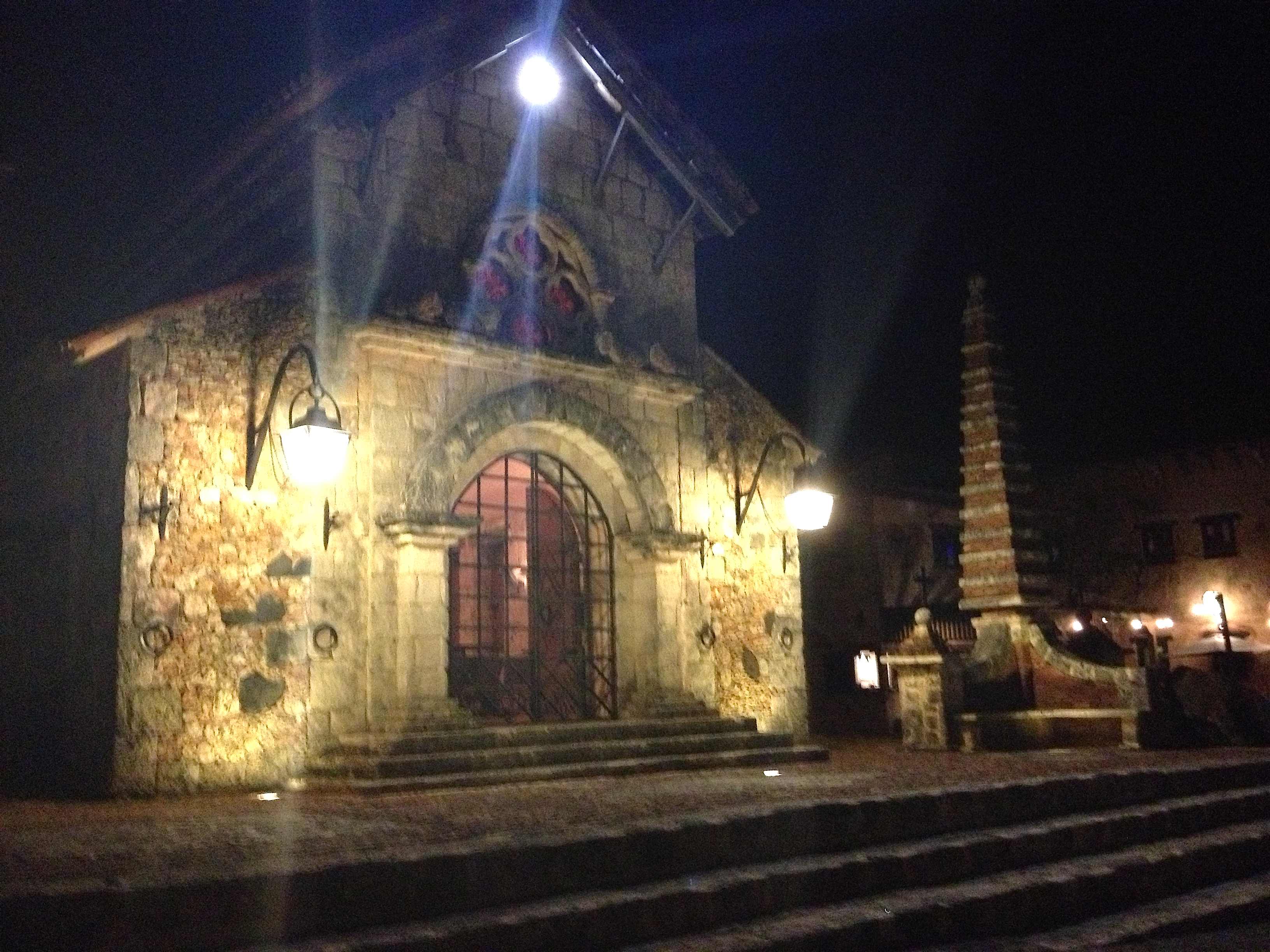
I can attest that it’s all real, not some whimsical creation of the resort. Apparently the place is overrun by tourists and wedding parties during the day; the chapel there, St. Stanislaus Church, is the nuptial venue of choice for women across the DR. There are boutiques, museums and galleries. After night falls, the locals come out and make it more inviting still.


Casa de Campo: Polo Capital of the Caribbean

Casa de Campo: Polo Capital of the Caribbean

Casa de Campo makes no apologies for the luxuries it purveys, and so it should come as no surprise that the resort serves as a sort of Mecca for Caribbean polo, the sport of kings (and anyone else who can afford to show up to a match with the requisite 6-7 horses). If you play polo, odds are you already know that Casa manages some 300 horses for guest play, for all manner of recreational riding, for breeding and sale. For the neophyte, it’s a fascinating window on a sport we hear about (mainly through Prince Charles references) but rarely see.

Cali Garcia-Velez is the man who manages all things equine at Casa de Campo, and he would appear well suited to the role. A Dominican native, Garcia-Velez is tall and dashing (a dead ringer for the actor Will Arnett), a son of the rancher who used to manage the cattle on this vast property, and a former polo professional in his own right.  While Casa has its own polo fields, today Garcia-Velez ably escorted a few of us media scum to a match held at a private ranch some 15 minutes from the resort.

“You see that guy there,” he said, pointing to #4 in black. “He’s riding one of our horses. I sold it to him. He came to me for an upgrade and he couldn’t be happier… In polo, it’s all about the horses. And the guys who can afford it will always have the best horses. That’s just the way it is.”

This was no arms race we witnessed today, as the late afternoon sun bathed the field and surrounding sea of sugar cane in a soft, pale-pink light. In the DR, there are maybe 30 polo players of a high standard and they converge on fields like this one, and those at Casa de Campo, for a match or two each week during winter, the high season. They come from all over the island but mainly from here, Greater La Romana, and Santo Domingo some 90 minutes away.

The action is non-stop, as Red and Black (four players to a side) gambol from one end to the other, flailing and bumping, at speeds you cannot appreciate until you’re this close. Outside the lines, the mood is decidedly more casual and festive, with families spread out on blankets behind one goal and still more gathered in the thatch-roofed clubhouse at midfield. They all greet Garcia-Velez with familiarity. The drinks/conversation flow as play proceeds through the first three chukkers, or periods, which last some 7 minutes apiece.

A proper match is six chukkers; the players change horses after each one. On one level the game is simple: whack the ball between posts 24 feet apart, positioned at each end of a field 300 yards long and 150 wide. On another level, there is great nuance to the strategy, the game’s physicality and officiating. It’s good to have an expert sitting close by, imparting the finer points.

But again, this is a casual Saturday afternoon match in January. The week of Presidents Day, and again over Easter, the polo communities from across the Caribbean and Florida will descend on La Romana for the two biggest tournaments of the year. As Garcia-Velez is telling me about this, along with the reasons for Argentinian Polo dominance, and what a polo pony really costs, the players thunder past en masse. The conversations — ours and those taking place all around us — come to a studious halt, as all eyes follow the action to the north goal.


Casa de Campo: 5 Things You Need to Know
The 4th at Dye Fore, evidence of the gorgeous views here and why you need a good short game to score here. (Larry Lambrecht photo)

Casa de Campo: 5 Things You Need to Know

The 4th at Dye Fore, evidence of the gorgeous views here and why you need a good short game to score. (Larry Lambrecht photo)

Having played the Links Course this morning, the Golf Road Warriors have now sampled all three tracks here at Casa de Campo. With that sort of first-hand experience in tow, I’ve taken it upon myself to issue five vital directives to golfers mulling or already planning a visit here:

1)   Play the Links Course first — If you’re coming from a winter clime and haven’t touched your clubs in months, this is the place to work out the kinks. The front nine is especially playable; it’s not till hole 12 that it gets at all penal — in the form of several lakes that require serious negotiation. Even then, Pete Dye has fashioned an extremely comfortable, attractive piece of eye candy here, a Florida-style faux links with enough elevation change and design interest to place it head and shoulders above 98 percent of the courses you’ll ever find in Florida.

2)   Play Teeth of the Dog next — The temptation is to head out there right away, what with all those ocean holes and the beautiful pictures you’ve no doubt seen in advance. But get a round under your belt first; get the feel of the greens and considerable wind here at Casa de Campo. A quick session with the staff at the Jim McLean Golf School here wouldn’t be a bad idea either. You don’t want to get out there with all those expectations and stink it up.

3)   Play Dye Fore third, when you’re good and ready — The scale of this course and the views from various spots along its 18 holes (down the Rio Chavon canyon, or down to the Marina on the front nine) are truly extraordinary. But Dye Fore is not for the faint of heart (or, for that matter, some New Englander right off the plane after three golf-less months). You’ll want two rounds under your belt before you tackle this beast. But do tackle it. The risk-reward dynamics here are stark, oversized and (should you negotiate them with dexterity) extremely satisfying. My favorite? The gigantic speed slot on the par-5 18th — a veritable half-pipe carved from the left-center of an uphill slope 60 yards wide. Wow.

4)   Bring your “A” short game — Dye courses have the reputation for being difficult, and talk of threading a drive down a half-pipe probably doesn’t help. But that rep is too simple to be true. Pete’s fairways are always generous, with bunkering that, while legion, nearly always funnels golfers down the right path. However, his green complexes are often all-or-nothing affairs. Miss and you’re bunkered (often deeply bunkered) or mired in some swale that requires a putt up a steep, shaved face, or a delicate flop shot to a plateau putting surface, or a bump-and-hope into said steep-shaved face. If you can handle the short sticks, if your sand game is handy, you can score on all three courses here, especially Dye Fore and the Links, where the greenside features are most severe.

5)   Don’t worry about bringing enough golf balls — There are two reasons for this. First, these courses aren’t ball-eaters, thanks to the super wide fairway corridors. Yes, there’s a lot of water on the back nine at the Links, and the Caribbean laps against 7 holes at Teeth of the Dog. But that’s about it. Second, the grounds staff at Casa de Campo has scrubbed the course clean of lost balls, shined them up, grouped them together by brand, and will gladly sell them back to you at very reasonable prices  — a win-win practice Director of Golf Gilles Gagnon fully endorses.