The inimitable Bob Barker, flanked by “Price is Right” eye candy Janice Pennington (left) and Anita Ford.
As yours probably does, my alma mater hits me all too frequently with some manner of e-newsletter cum fund-raising communiqué. One can hardly escape the memories stirred/jarred by all this WesContact, which is surely the way they want it. In any case, a recent MailChimp morsel revealed, among other things, that three Wesleyan University faculty, among them Nat Greene, had received The Binswanger Prize for Excellence in Teaching. While this particular tidbit proved interesting enough to peruse, I’m only now addressing the nostalgia it prompted — immersed as I am, third party, in the college experience of both my kids.
The first thing to say is that my cohort and I attended Wesleyan University in Middletown, Conn., alongside an actual Binswanger — Benjamin Pennypacker Binswanger to be exact. Never knew him but my housemates and I made note of his titanically pretentious name the first week of school freshman year and never forgot it. Never tired of mocking it, either. Always wondered if he was related to Princeton’s Jay Binswanger, winner of the first Heisman Trophy…
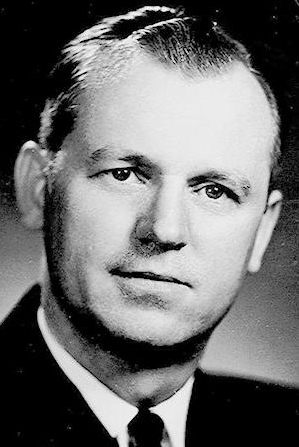
Wesleyan Professor Nat Greene
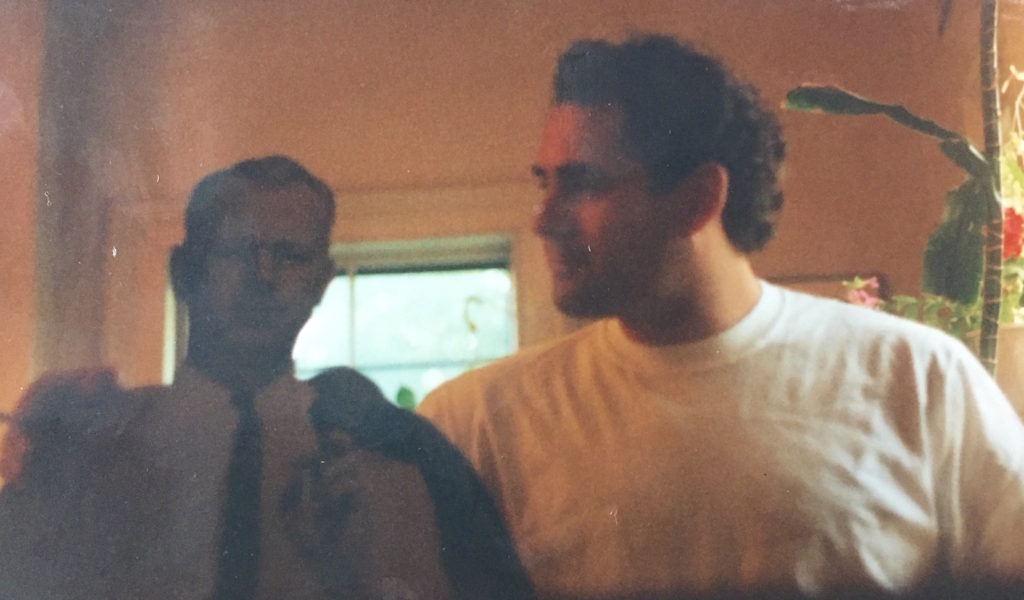
More to the point, Nat Greene was one of these recent Binswanger honorees. I took a couple classes with him but the first was a survey of European history 1815-1945, and I remember it best because it was the only class I ever took with my housemate Dennis Carboni, an art history major whose course load never again overlapped with mine (classical history/modern American lit).
Greene didn’t necessarily tilt the material toward “social” history, an approach then sweeping uber-liberal bastions like Wesleyan. His hewed more to the traditional “Great Men, Great Events” approach. I remember the syllabus included a book of his own scholarship, “From Versailles to Vichy: The Third French Republic, 1919–1940”, which a) struck me at the time as being pretty awesome, that this guy was teaching from his own work; and b) still resides in a bookcase somewhere here in my house, for reasons completely bewildering to my wife. An entertaining lecturer and no-nonsense grader of essays (all testing was conducted via manic, long-hand scribbling in those little blue booklets), Greene was a fine professor, the sort I hope Silas and Clara will experience at some point in their academic careers.
Nat Green Class at 10, Price is Right at 11
But here’s what I remember most from my class with Nat Greene: It ran from 10 to 10:50 on Monday, Wednesday and Friday mornings in the old PAC building — a few steps from the manhole where we often plunged down into Wesleyan’s famous tunnel system, the subject of another remembrance perhaps. If Dennis and I didn’t dawdle after class, we could race home to my off-campus apartment and catch The Price Is Rightat 11 a.m.
Yes, The Price Is Right. It became a sort of ironic obsession for me but something more than that for Dennis, as many things did. It gave me great pleasure to watch him obsessively game this once-seminal game show.
I’m not sure that college kids go in for this sort of thing today, awash as they are in video content and on-demand entertainment delivery choices. However, during the early 1980s, TV was a sort of novel diversion for college kids. We had grown up with it, of course, but had virtually no access to it at school. And so, great delight was taken in the ironic devotion to retrograde programming like soap operas in dorm lounges and late-night reruns of shows like the Rockford Files and Star Trek — things we would never bother watching when home with our families. My sophomore year, my housemate and I came by a tiny black-and-white TV that I’m pretty sure we carried with us the next three years, to three different houses, deploying along the way a staggering array of make-shift aerials including one that involved a pumpkin wrapped in aluminum foil.
The Price is Right fell right into this determinedly low-brow TV consumption, representing, as it did, all that was bourgeois and mass cultural — a great pleasure following high-blown, Nat Greene-led discussions of Marx, Captain Swing and Bismarck’s deft wrangling of German principalities. While Dennis’ note-taking habits at the knee of Professor Green were notoriously suspect, Bob Barker proved another matter entirely. While watching the show, Dennis kept copious notes on the price of every consumer item so that he might later blurt out a winning price before any of the three official contestants. When some dishwasher was revealed from behind the curtain, Dennis would browse his cheat sheet while everyone else in the studio cooed with consumerist abandon (take that, Karl!).
“Whirlpool, eh? That’s upmarket,” Dennis would muse strategically. “I’m going with $538.”
And invariably, it was so — or near enough that Dennis would have earned, in our demented fantasy world, the right to bound up on stage to mug with Barker at close quarters.
Our College/Young Adult Families
I heard an interesting interview a few years ago with writer/director Noah Baumbach and his partner Greta Gerwig, star of his movie, Frances Ha. Gerwig, then 28, talked about how several characters she’s played on screen ]stumble through their mid-20s in an unhinged emotional state — not necessarily because of new adult demands being foisted upon them, but rather because the surrogate families all 20somethings create for themselves at college (and just afterward) invariably fall away, sometimes bit by bit, but always in ways that unmoor. I remember this dynamic: We gathered these people upon leaving our actual families, and Gerwig explained that she was completely taken aback when close college and post-collegiate friends moved away, took jobs that contravened all she had assumed they stood for, or married someone whose presence effectively severed or weakened these bonds — bonds that young, college-educated folk believe are strong and meaningful enough to last forever.
I find Gerwig’s observation to be spot on. I remain close to several friends from college and that immediate-post collegiate period, including Dennis, but many more did fall away over time for reasons that were surely legitimate but felt to me, at the time, like a sort of casual betrayal. I mean, these were people I lived with, for years — they contributed to the shaping of me and presumably I reciprocated in some way. It makes one value all the more those who’ve not fallen away, but it also makes one sad and wistful that all we have to show for these folks, now lost, are weirdly disconnected memories, the odd anecdote, and persistent wonder as to whom they turned out to be.
I stay in pretty good touch with Dennis but there are probably a dozen others I haven’t spoken to for many years now. I wonder how they’re doing, beyond the superficial info I might gather on Facebook (were they, or I, to indulge in such a thing). If we tripped over each other somewhere, would we trade grand truths? Would we trade Nat Greene recollections or their equivalents before falling into the banter we perfected and found so very absorbing all those years ago?
Harold Gardner Phillips Jr. and Lucy Dickinson Phillips at a Manhattan terrace soirée, circa 1969.
NEW GLOUCESTER, Maine (Aug. 9, 2017) — I try to write about my Silent Generation dad each August because, at the close of that month, six years ago, he left this mortal coil. All too soon.
For most of his 74 years, my dad recognized himself as a Tweener, someone who didn’t belong to a specific American generation. He identified the Baby Boomers, who comprise the cohort that took shape once World War II had concluded, when my dad was already 9 years old. The parents of Boomers were, of course, the folks who fought The Big One as young men.
So my dad arrived on this mortal coil between these two sharp-elbowed cohorts. So did my mother and all the parents I knew growing up. Their kids (my own cohort, Generation X) found themselves similarly “tweened” by our Boomer elders — the largest, most consumptive, coddled and self-indulgent generation the U.S. has yet produced — and their children, known as Millennials. In many ways, these hyper-populous and -impetuous Boomers drowned out my dad and his generation, while his son (i.e., me) has lived all his days in their voracious, over-bearing shadow.
William Strauss and Neil Howe, authors of “Generations: A History of America’s Future, 1584-2069,” would quibble with the term “Tweener”. They do classify my dad as a member of a distinct cohort, the Silent Generation, or those born 1923 to 1942. These Americans, unlike members of the preceding G.I. Generation (1901-1924), were born too late to participate in WWII. Yet most Silent citizens entered into sentience during the war, were hugely affected by it, as children. They developed a lasting respect for the way theirG.I. elders rose to that occasion and subsequently shaped the post-war world.
Silent Generation: Tweened and Buffeted
This specific generational placement influenced the way my dad, mom and other Silents intepreted the world, their country, their child-rearing and educational habits, their roles in the public square. Silents were again buffeted by forces outside their own generation when Boomers, the sons and daughters of G.I. folk, overturned then rerouted the culture in the 1960s, by which time my parents were married with three kids.
They didn’t invent it but Strauss and Howe were the first to map this generational theory onto American history. It’s complicated but fascinating stuff (see a more thorough summary of its tenets here). S&H postulate that there are four distinct types of generations: Civic (the WWII G.I. generation, for example), Adaptive (Silent), Idealist (Boom), Reactive (Thirteenth/GenX, my own cohort). They cycle in the same order throughout U.S. History, going back to the Puritans, who, if you allows yourself to think about it, are the offspring of additional, separate, ongoing English generational cycles. Before reading this book, I’d never encountered history told quite this way. It feels a bit pop-psychological at times but the patterns do fit together with remarkable logic, precision and predictability.
My dad in the mid-1970s.
Though “Generations” was published in the early 1990s, my dad never read it. He didn’t know about it, at all, though it’s exactly the sort of thing he liked to read the last 20-30 years of his life, then pass to me when he was done. In the six years he’s been gone now, I’ve had the urge to discuss with him hundreds, maybe thousands of things. This seems to me the most striking and unchanging aspect of his death — the fact that I still instinctively think of matters to discuss with him but cannot.
Generational Constellations
The work of Strauss and Howe is one such subject. It struck a chord because, if there are four distinct generations of Americans alive at any one time (they refer to these groupings as “constellations”), my longtime complaints about being sandwiched between Boomers and their Millennial children are not outlying but grounded in a kind of understandable framework. What’s more, this sandwiching has been going on forever. My mom and dad dealt with a variation on this theme: They led their Adaptive/Silent lives between one highly successful Civic generation — which won us the biggest war ever and presided over the largest economic expansion in the history of mankind — and their Idealist offspring, the Boomers.
This dynamic has not changed the way I think of Boomers, ultimately a feckless lot of shallow, navel-gazing spiritualists. But it did change the way I think of modern U.S. history, my dad and the 1970s.
The past few years I’ve been working on a book concerning a specific generation of U.S. soccer players, and this too makes me think of my dad — and the 1970s. My reporting leads up to a moment in 1990 when this cohort of footballers (exactly my own age) broke through to qualify for the World Cup, something no generation of American players had ever done. Today the U.S. qualifies routinely. These guys, these peers of mine changed the U.S. game, modernized it and ushered in an entirely new and more successful era — but their story begins as youth soccer players in the 1970s, a dense thicket of cultural ferment and a time when folks my age first encountered Boomers, our next elders.
Silents, Pirsig & The Seventies
The 1970s were also the time when Silent generation folks like my parents should, according to the S&H framework that has held serve for 250 years, have ascended to a place of dominance in the culture. That never happened, largely on account of this hulking mass of entitlement known as the Boom. No member of my parents’ generation gained the presidency, for example. That’s extremely unusual. Until a geriatric Joe Biden won the office in 2020, this was the only American generation of which this was true. Boomers diminished/truncated their years in charge of the body politic, economy and media apparatus. After growing up in the shadow of overbearing but undeniably capable G.I. types, they watched as libertine Boomers ascendex and ultimately superseded them on account of sheer size and bluster. My parents’ generation, on many levels, got skipped.
Robert Pirsig passed away this year. In 1974, he published “Zen and the Art of Motorcycle Maintenance”, a remarkable account of what it was like to be a Silent in the 1970s and experience this cultural skipping. My dad read this book in the late ’70s. It made a big impression on him. Here’s an example of how: I remember once asking my dad about the Summer of Love. We had lived an hour or so north of San Francisco at that time; surely there was some spillover — if not in 1967 then some time later.
In response to this supposition, my dad just laughed: “I was 30 years old, married and raising three kids in the summer of 1967.” He was too young for the Korean War, too old for Vietnam, too old for the Summer of Love. By 1976, when I was asking questions like this, he surely felt as if he and his peers were somewhat out of sync with the culture. Like Pirsig and millions of others, he was just the sort of mildly disaffected 40something who was then watching norms and traditions fall away on account of this Boomer-led upheaval.
Silent folks had a choice to make during the ’70s: hew to the conventions still represented by their G.I. elders, or flout convention as Boomers had been doing for some 10-15 years by that point.
Pirsig was my dad’s contemporary. His book spoke to him directly, Silent to Silent. I wish I could speak to my dad directly, today, about how this book affected him. Because I have my theories…
The Madmen Theory of Generations
Something else I’d want to talk with my dad about, because I’ve spoken to his wife about it: “MadMen”. Yes, the killer TV drama. I’m a fan (just prior to its finale, I fantasized about how the series might end). But I now realize the show grabbed me on a deeper level because it focuses entirely on this Silent Generation. The primary characters are all 30something, rising professionally through the 1960s. They are basically my parents — no accident because the guy who created the show, Matthew Weiner, a contemporary of mine at Wesleyan, has confirmed the show was based on his Silent parents.
And what, ultimately, did we learn about Silents like Don Draper and my dad? Draper closes the actual series finale chanting at an E.S.T. retreat in Big Sur. By that time (the show’s arc came to an end in the early 1970s), he’d had it with the gray flannel conventions established by the G.I. Generation. He was finally ready to step out a little bit, to act out a little bit — as Boomers had been doing so publicly and pervasively.
So how did Don Draper, my dad and millions of Silent men act out come the 1970s?
They started smoking dope, for starters. They stopped wearing ties, too. Some came out of the closet. Others read and responded to spiritual things like “Zen and the Art of Motorcycle Maintenance” and E.S.T. In short, they re-evaluated their relationships to the larger conventions of politics, marriage and culture.
But mostly they smoked dope.
My dad’s predilection for pot is a subject about which I’ve never written. [Search halphillips.net for ‘my dad’ and you’ll summon past August essays/tributes — but no overt dope references.] I cannot attribute this silence to any taboo. It was more out of respect for him, my mom, and my own wife & children. He’s gone to meet the choir invisible. My mother has moved on to wearing purple and not giving damn, and Silas & Clara are both in college, which means that horse has well and truly left the barn. What’s more, time moves on and conventions evolve. Recreational marijuana is legal today here in Maine, so historically accurate cannabis facts re. one’s father are perfectly fair game.
And his is a pretty damned good story.
Stories Families Tell about Themselves
Every family has core of stories it tells about itself, some of them true and some less so. The Phillips family genesis story re. my dad’s pot smoking, while whimsical, is pretty free of myth-making. It begins with a 40something suburban square finding his 16-year-old daughter’s pipe one day in 1976, deploying it on a whim, then sitting down and reading TIME Magazine cover to cover.
Unlike Don Draper, my dad had never been much of a drinker. Finally, after 40 years, he’d found a practical vice.
Inside the family unit, this proved something of a scandal frankly, though the 12-year-old me knew nothing of it — not at the time. Nevertheless, there was pushback. Establishment heads of households simply did not, up to that point in the American Story, start smoking pot in their 40s. They did not, according to G.I. convention, go off and join E.S.T. either. They did not divorce.
But these were bizarre, unmoored times. Divorce rates skyrocketed during the 1970s; divorce rates among Silent couples remain the highest of any generation in U.S. history, according to Strauss & Howe. There were swingers, too, and freak-outs and therapy sessions and rehab stints. All manner of personal and social mores lay in waste across the breadth of 1970s suburbia.
My parents’ marriage survived, but my mom never proved keen on this dope development; she preferred a scotch and soda. Yet because she did, neither could she logically prohibit pot use when scotch was hollowing out livers, wrecking marriages and killing people on the roads at such an outsized rates nationwide. She ultimately made the accommodation but it remained a closely held secret for several years to come.
My sister also knew the score, pretty much from the get-go. It was her pipe. Indeed, my dad saddled her with the peculiar, ongoing responsibility of procuring the chronic for my dad — because, back in the late 1970s, this act was awkward if not impossible for 40something novices. She would carry this burden through high school to college (at my dad’s alma mater). This I only learned when Janet was about to graduate from Lehigh and I was headed off to Wesleyan.“You’re in charge of buying dope for dad now,” she informed me.
Wait, what?
Parental Habits
I wasn’t so quick on the uptake back then. Even when, as a high schooler, I would arrive home late some evening to find him lying on the floor listening to a Bartok string quartet via the Harman Kardon and his super-fancy Ohm headphones, I did not develop a clue without Janet’s help.
My dad loved listening to music but he REALLY dug it whilst high. Same for movies, for reading (something he rarely did for himself, pre-pot), for concentrating on anything that was recreational as opposed to “process”. My mother would long and repeatedly argue that his insights into any of these things weren’t necessarily so cogent when he was high, not so cogent as his sober, quite sophisticated feelings on these things. But in terms of his own enjoyment? No contest, apparently.
The circumstances of this pot history meant my dad was a private smoker. Nine times out of 10, he got high late in the evening by himself and listened to some chorale from Estonian composer Arvo Pärt — or he’d watch some 3-hour In Depth profile of Gore Vidal on C-Span (actually one of the best things I’ve ever seen on TV). Once I’d taken up the cause to supply the old man with bags, which is to say I’d started to get high myself, at college, doing so with my dad became a big treat for him. A bit weird for me, at first, but I adapted.
I’ve written about this before: My dad expressed intimacy by badgering one into enjoying a film or book or documentary or piece of music that he admired — and he wanted you to experience it ALONGSIDE HIM, RIGHT THEN. He loved nothing more. Sharing a bowl made the occasion even more special.
But I must say, his largely private smoking ethos, developed more or less in a vacuum, was oddly stunted by this lack of social experience. He didn’t understand, for example, that it’s rude to pack a bowl and not offer it to someone first. Because he had a job and the resulting haute middle-class cash flow, he didn’t understand the idea of NOT having pot. He didn’t smoke it every minute of every day, but he did have it on hand as a matter of routine — like scotch in a liquor cabinet.
This is not the way most people learn to smoke pot, of course. Most start partying in adolescence or young adulthood, when one doesn’t have a job, money, or perhaps transport. Pot smoking was approached from a general position of scarcity. When I think back on my college and young professional days, there were lots of times — most times actually — when one did NOT have a bag.
My dad never experienced this development stage, and so he would get itchy when he was about to run out of dope. I’d look in his little smoke box and see all sorts of pot.
“What about this?” I’d ask him.
“That stuff is old.”
Yes, in some ways, my dad was dope dilettante.
Silent Stoner Folk Wisdom
My father was also convinced it was particularly important to hold one’s bong or bowl hits in the lungs for a reasonable period of time, to maximize the bloodstream’s THC intake. I don’t know where or how he picked up this bit of folk wisdom. It became a running joke, where he’d chide me for not doing so and pretend to wring his hands and bemoan my disappointing behavior. “You think you’ve raised your kids right,” he’d say, rolling his eyes, “and then you learn they can’t even be bothered to hold their hits in!” In the passage of time, when the stigma of pot-smoking had faded considerably and, through me, he was smoking a bit more openly and socially, the old man got the opportunity to express this sentiment a few times in mixed company. Big laughs.
But mostly my dad, while he smoked for 30-plus years, did so in an incredibly low key and private manner. Today, while recreational marijuana is newly legal in Maine, the way I personally indulge in this vice hasn’t changed a lick since January 2017, when the law went into effect. (Someone raised this issue with me on some phone call the Tuesday after the new law took effect. He asked how I had celebrated; I had totally missed it… hadn’t even realized the new law was officially on the books. Next day I put a little mason jar in the liquor cabinet. Because I could.] However, I hail from a different generation, reside in a different culture, and have lived my life in response to a different set of conventions/generations.
My father spent three decades enjoying but concealing this vice, quite happily, but rarely among peers of similar tastes. There were surely more Silent Generation dopers out there, just like him — I know because some did reveal themselves over time and the old man took great joy in flaunting long-held conventions with a like-aged drug buddy.
But I’ll also admit the private nature of his partying made me sorta sad. As sad, I suppose, as someone drinking alone, though the latter has developed a far more negative connotation. To me, it’s evidence of yet another way his cohort got squeezed and ultimately hard done by massive generational forces beyond their control.
Strauss & Howe would remind us here that people from history aren’t 40-55 years old all their lives. They’re certainly in that range when we tend to read about them in the traditional historical contest, when they’re pulling the levers of power, making economic change, fighting injustice, prosecuting unjust wars, ascending to higher office, etc. But middle-aged men were all young kids once — growing up together during a war, admiring the elder generation fighting that war, watching those same people build an empire, then positioning themselves in young adulthood to inherit the world and attendant conventions that haven taken hold.
Inter-Generational Relationships
But Strauss and Howe would also remind us that all of history can be told in terms of these generations, each measuring about 20 years. Of vital importance are the relationships one generation has with others sharing the current constellation. The strongest relationships within that constellation naturally exist between parents and children: G.I.’s and Boomers, Silents and my own generation, Gen X. These couplet generations affect each other profoundly, of course; they pull for each other, coddle one another, or perhaps hold them to a stricter accounting, depending on the circumstances.
But there is always a generation in between parents and their children, a generation with entirely different characteristics and couplet relations.
My mother, father and their Silent cohort have lived their entire lives sandwiched between two massively influential generations. They’ve watched as hordes of spoiled Boomer youths, the spawn of world-bestriding G.I. elders, swooped in and supplanted their political and cultural power — on account of their great numbers, their ardent naval-gazing, their political convenience, their out-and-out avarice.
As the son of my father, I know these people too. I first met the Boomers who taught in my schools (they are the reason I hope never again to hear “Moonshadow” or “Bless the Beasts and the Children”, two ditties drilled into us by young Boomer chorus teachers). Eventually I went to work for Boomers. I watched as these loud former leftists moved relentlessly to the right, politically. Today I watch the news and sit by as the pharmaceutical establishment tries to sell them yet another geriatric wonder drug. I have lived in the cultural shadow of these Boomers my entire life.
If he’d had the chance to read Strauss and Howe, I bet my dad would better understand and articulate his own misgivings about where he’d been obliged to live his American life, generationally. Or maybe he would’ve been cool with it; he was never a bitter man. Either way we could have shared a bowl and talked about it at length…
FORT LAUDERDALE, Fla (June 14, 2017) — Keith Mitchell won last week’s Honda Classic, besting Brooks Koepka and Ricky Fowler with birdie on the 72nd hole. See above. The headline writers at the Palm Beach Post were less than impressed. Behold, more evidence that golf sorta hates a Cinderella story. Mitchell’s win in actually the latest case study in golf’s curious-but-pervasive Cinderella Complex.
That giant sucking sound you hear? That’s the disappointment of U.S. golf fans and sports writers made manifest. Yet another “nobody” had made off with a PGA Tour title that should have gone to one of our major champion darlings.
Intellectually, golf fans recognize that the lowliest shit-kicking tour pro can beat two-time defending U.S. Open champion Brooks Koepka on any given day — as Mitchell did so bravely and cannily here at last week’s Honda Classic. It happens all the time. It’s part of what makes tournament golf so interesting.
What’s less clear is why such a result leaves so many golf observers so very cold. Why are golf’s surprise winners Humpty Dumpty, not Cinderella? We quote Carl Spackler often enough. When an actual underdog comes out of nowhere, why do we root against him?
This phenomenon has been eating away at me for decades. Perhaps, like me, you’ve wondered aloud why golf fans rooted for Tiger Woods so ardently all those years, while rooting against the likes of Bob May, Y.E. Yang and Trip Kuehne.
There will always be a minority who root against Tiger or Phil or Justin, I suppose. But it is a distinct, vanishingly small minority in golf, especially compared to our rooting habits in other sports. Why?
Given a choice, we prefer to live in singular times. It’s one reason why we can’t take our eyes off Tiger, or Dustin, or Rory — and continually compare them to Nicklaus, Palmer and Trevino. They are the best of our time, and something inside us craves the inevitable comparison with previous “all timers”. This urge to confirm that our stay on Earth spans momentous periods in history is why Grampa still natters on about the severity of snowstorms in the 1940s, why he prefers ballplayers from the 1950s. It’s why we have something called The Greatest Generation.
Cinderella Story: Resisting the Irresistable
But we also root for underdogs because their stories are irresistible, right? Only a neutral cad (or a Patriots fan) could have rooted against the Rams in the most recent Super Bowl. Who but a Yankees fan doesn’t routinely back anyone who might face them in post season? When UCLA won those 88 games in a row under John Wooden, who didn’t root for someone to knock them off?
But golf, or some reason, is different.
It’s long been my feeling that we golf fans, we golf media harbor a most peculiar Cinderella Complex — an Underdog Aversion, if you will. When confronted with the prospect of a title going to Keith Mitchell, or (more to the point) a major title going to Todd Hamilton, Ben Curtis, Mike Donald, Rich Beem or Charl Schwartzel, a good many of us reflexively bridle. We root against them.
Think back to 2004, when Hamilton’s tentative 2-iron faded into the right rough on the 72nd hole at Royal Troon. This is where I first recognized this counter-intuitive emotional tug — in myself. Surely this is where the wheels come off, I thought, when Hamilton’s tee shot went astray. The steely, tactical golf he’d displayed through 71 holes of the Open Championship had been admirable and courageous on so many levels. But clearly, this was the first of several lug nuts to be loosened in the glow of Els’ consecutive birdies at 16 and 17.
And here is the truly dark and twisted part: The emotion we golf observers experienced at Hamilton’s apparent collapse wasn’t disappointment. It was relief. Deep down, something inside us wanted this to happen. Somehow we all felt it would be more satisfying to have a “name” victor. But honestly, why would I root against Todd Hamilton? Why would anyone?
Underdog as Interloper
We had the same feeling the year before when Ben Curtis, playing several groups ahead of the leaders, slowly emerged as the unlikely favorite at Royal St. George’s. As the no-name Ohioan waited in the clubhouse (he finished early and watched the leaders all fall away, you’ll recall), an anxiety permeated golf’s fandom and media horde. Surely, we reasoned, Tiger or Thomas Bjorn or Vijay Singh would do what their pedigrees demanded of them — what we demanded of them — and claim the Claret Jug from this… interloper!
I felt it, and it wasn’t a new sensation. I had the same feeling when Tiger and Bob May dueled at Valhalla in 2000. Great tournament. Great playoff. Great major victory. But would golf fans and media have thought so if May had prevailed instead? I don’t think we would. Why are golf fans so underdog averse?
The simple answer, though not the most flattering assessment, is that golf fans and golf media are flagrant front-runners. We want champions to win again and again, and we are curiously galled when someone like Curtis or Rich Beem or Orville Moody or Tommy Aaron wins/absconds with a major. Indeed, we find ourselves rooting against them as the tournament plays out. Looking back, we contort ourselves in order to explain them away. We even blame certain courses (Olympic) for not producing proper major champions.
I went back and checked the TV ratings from the 2004 British Open. Sunday’s telecast pulled a 4.6 — a solid number considering Hamilton, this relative unknown, came out of nowhere to hold off one of the sport’s biggest stars (Phil Mickelson) and nip another (Ernie Els) in a playoff. Compare that number to the record 6.4 share achieved on Sunday in 2002. That British Open, at St. Andrews you’ll recall, was done and dusted by Saturday noon. The entire Sunday broadcast was completely devoid of competitive drama, a simple coronation for Tiger Woods. Yet it was the most watched Open Championship in history.
The record U.S. Open TV rating? It came just a month prior, when Tiger won by 15 strokes at Pebble Beach. What else but overt front-running hero-worship could explain numbers like these?
This goes Deeper than Media Hype
It would be easy to blame the media for this phenomenon, which persists to the present day. With 24/7 capacity, it churns out a stunning amount of analysis and prognostication. Inevitably, all this talk, all these words and imagery ultimately center on known quantities — our stars, our heroes, the odds-on favorites. It’s not unreasonable to assume this would have an effect on our involuntary rooting interests.
However, I think it goes deeper than that and predates the modern media age.
Bobby Jones wasn’t just favored to win every time he teed it up; fans preferred that he win time after time. Ben Hogan had won 8 majors by 1955. Yet when he faced down Jack Fleck in the U.S. Open that June we didn’t root for Fleck. We preferred the Wee Ice Mon win another one.
Sometimes the outcome we staunchly prefer does hold, whereby a sort of anti-Cinderella justice is done (read: Van de Velde at Carnoustie). Other times the impossible happens (say, Fleck slaying Hogan at Olympic in 1955). In either case, we might have enjoyed the rags-to-riches theater through 70 holes, but when push came to shove we wanted the proven quantity to prevail.
The uncharitable way we view these David vs. Goliath duels, in retrospect, is revealing. Fleck, after all, is only a single letter from fluke. Fate clearly intervened on his behalf — and we’re still irked about it. Beat the Great Hogan? How dare he!
Admit it: When Steve Jones nipped Tom Lehman at the 1996 U.S. Open, when Scott Simpson held off Watson at Olympic in ’87, when unfancied Michael Campbell bested Tiger at Pinehurst in 2005, when Zach Johnson slayed Goosen and Woods in the ’07 Masters, when Lucas Glover outlasted Mickelson at Bethpage in 2009, the results were tinged with disappointment. In major championship golf, we want our stars to come through.
Y.A. Yang at the 2009 PGA: Were you rooting for him? I mean, why would you NOT root for the first-ever Asian to win a major. Still, I’m betting that you treated him exactly like you treated Rocco Mediate during the 2008 Open at Torrey Pines — pleased to see him fight so gamely, but ultimately hoping to see Tiger prevail.
I’m sorry. That’s twisted.
Unique to Golf
I don’t see this dynamic as nearly so fully developed in other sports. Yes, there are some who delight in team dynasties — mostly media, as it makes prognostication, the new modus operandi of sports punditry, easier — but no one begrudged the Patriots their miracle Super Bowl victory in 2001. In much of the country, rooting for the Yankees to win yet another World Series is akin to backing the tanks in Tianamen Square. And so we delighted in the Marlins and Diamondbacks having their moments in the sun, in 2003 and 2001, respectively.
Golf is different — but not because it’s an individual sport. Do we not root against Venus Williams, then Serena, now Federer and Nadal once their major victories become so common as to seem preordained? Okay, maybe in the quarters we root for Federer, to set up a killer final vs. Nadal. But in that final, should someone like Robin Soderling gain it, as he did in the recent French Open final, we root for him — the Cinderella story. Track and field history is littered with inspirational tales of underdogs who claimed Olympic gold and, by their unlikely efforts, our hearts.
But golf, for some reason, engenders a different sort of response.
There’s a corollary to this dynamic that pertains to venue. In retrospect, for example, some observers consider Open winners from the Olympic Club in San Francisco — Fleck (over Hogan), Casper (over Palmer), Simpson (over Watson), Janzen (over Stewart) — and conclude the course is somehow diminished because it doesn’t produce “great champions”, whereas a track like Pebble Beach (Nicklaus, Watson, Kite, Woods) does.
This, of course, is a canard of the first order, brimming with conceit. No one doubts the rigor and major-championship fitness of, say, Oakland Hills, even though it served up champions like Andy North and Steve Jones. Indeed, Hogan won there in 1951 and Gary Player in the ’74 PGA.
Conversely, does Tiger’s win at Valhalla peg the layout as “great champion producer”? I think not.
But you’ve heard these arguments. It’s part of golf trying to cover its tracks — those left by glass slippers. If Orville Moody wins the Open, there must be an explanation (Champions Club in Houston: poor venue). Yet behind this sort of prattle we see again the front-running gene seemingly inherent to golf’s rooting interests. When our heroes fall short of the brass ring, we politely applaud the underdog and blame the golf course.
We Overvalue Historical Affirmation
History, so central to golf, plays another role here. We prefer our championships, especially our majors) to be memorable affairs. Major titles are the sticks we use to measure a player’s place in the game’s ongoing epic. We want to believe Nicklaus won 18 majors for a reason. By the same token, we want to believe there’s a tangible reason why Colin Montgomerie and all the other unfortunate souls — from complete unknowns to those who’ve worn the Scarlet BPNTHWAM (“Best player never to have won a major”) — haven’t. The prospect of Mike Reid running away with the 1989 PGA just wouldn’t have satisfied. Thank goodness Payne Stewart eventually reeled him in, eh?
Basically, until you’ve won a major, you’re not even on the radar screen of history. At best you’re an outsider with delusions of grandeur, a bit player on a grand stage with the gall to challenge golf’s natural order. As golfers, we accept as fact that the crucible of major championship play will validate the winner as a “major champion”. Golf fans really, really want to believe that major winners are a breed apart.
It’s commonplace, of course, for lesser-knowns to win from week to week on The PGA Tour — more so nowadays when top 30 players are so rich, they play increasingly abbreviated schedules, thereby diluting fields. But we have different expectations for major championships. We expect them to produce something better. Otherwise, what exactly makes them so “major”?
Since 2002, there have been 64 major championships contested. Of those, “name” players have won all but 15 of them. That means nearly a quarter were claimed by underdogs: Cabrera, Glover, Cink, Yang, Immelman, Johnson, Campbell Hamilton, Weir, Curtis, Micheel, Willett, Schwartzel and Beem (I gave the benefit of the doubt to Geoff Ogilvy, Jim Furyk and David Toms who seemed just too well established to include here). Golf is actually in the midst of a relative Cinderella drought: Only Willett would qualify from any of the last 20 major winners.
Yet this truth remains; While winning a major championship might buttress the reputation of an established star, simply winning one does not validate an underdog as a “great” player. In an ass-backward sort of way, the victor validates the major — and the venue. This, in my view, sits at the heart of golf’s confounding Cinderella Complex. Despite all the drama such a Cinderella story might provide, ultimately we prefer that majors not be tainted by the ambivalence we attach to that sort of victory.
PORTLAND, Maine (May 29, 2017) — Landlord stories are rarely nostalgic. I was fortunate to close my decade-long apartment period with two amazingly positive experiences. When I moved to Portland, Maine 35 years ago — abandoning Greater Boston for what I then considered the ends of the Earth — I lived the first 2-3 weeks at the expense of my new employer, in the city’s lovely West End. The leafy environs there reminded me of the Back Bay. I lived above the carriage house attached to the super cool Pomegranate Inn, a B&B owned by aging, urban hipsters and strewn with modern art.
My studio over the carriage house was so spacious and funky, I fantasized about staying there forever. I met Landord Hall of Fame nominee Frank Rodway only because, eventually, I had to find my own place.
Back in 1992, Frank was owner and proprietor of Thomas Brackett Reed House, a 19th century brownstone once inhabited by and eventually named for a former Maine Congressman and Speaker of the U.S. House of Representatives. When I met him, Frank was a small, trim, 60-something fellow with a vaguely military bearing. Before he walked me upstairs to the third-floor apartment then available for rent, I mentioned my two cats, Scott and Zelda. “Oh, well, we don’t take pets here,” he said.
Frank showed me the place anyway, which gave me the chance to pursue an historical charm offensive. The 1-bedroom space was great: 13-foot, pressed-tin ceilings; windows stretching from the baseboards to somewhere above my head; hardwood floors; $525/month — heated! What’s more, I had just finished The Proud Tower, Barbara Tuchman’s magisterial history of Thomas Brackett Reed’s very heyday: turn of the 20th century, when America was slowly transitioning from insular, adolescent republic to imperialist bestrider of worlds.
We mixed it up, Frank and I, trading Mark Hanna anecdotes, book citations and recommendations. Half an hour later, as he and I were walking downstairs, I mentioned that it was too bad about the cats. “Oh, don’t worry about them,” he said.
Landlord Stories: In Memoriam
Frank Rodway passed away this past January at the ripe old age of 91, the result of a fall on icy pavement as opposed to simple old age. I was among five former residents of Thomas Brackett Reed House who showed up to his memorial service in South Portland. I mean, who does that? Or rather, what sort of landlord inspires that sort of gesture?
TBR House was a different sort of rental property: An historic landmark, for starters, watched over by a guy, Mr. Rodway, who knew the history but also how to engender esprit de corps.
His quite elegant building had a guest apartment on the first floor that tenants could rent for $25 a night. I routinely stashed my parents and visiting Greater Bostonians there. Every Christmas, that guest room and the entire first floor played host to Frank’s holiday party, a shindig that routinely proved the event of the season. Current and former residents alike renewed acquaintances and partook of Frank’s legendarily strong punch.
I should never have known Steve Weatherhead and his lovely wife Annetta; they departed TBR just before I arrived. But I met them at these holiday parties, along with eventual golfing buddy Michael Moore. At Frank’s funeral service, Steve recalled these parties among other things, but not before answering the question that opened his remarks: “I mean, who goes to their former landlord’s funeral?” Well, if it’s Frank Rodway, you go. He was one of a kind, as this obit (clearly written by the man himself) attests.
All about the Eaves
Another former TBR denizen in funeral attendance was one Mary Fowler, my upstairs neighbor and the first real friend I made in Maine. She remains one, but I thought of her again, in the immediate aftermath Frank’s memorial, when Mary Tyler Moore passed away. Mary Fowler and I had a running joke, each of us claiming to be the Mary to the other’s Rhoda.
“Hal,” she would start in, with not inconsiderable finality, “Rhoda was the loud Jew and Mary was the tactful WASP. And my name is Mary. Clearly, I am Mary and you are Rhoda in this relationship.”
“But May-uh,” I’d respond in my best Brooklyn accent, “while all that is true, you live upstairs in the apartment crowded by charming eaves, while I reside in the open and airy apartment downstairs. Cultural heritage has nothing to do with it. It’s all about upstairs, downstairs and picture windows. All the action takes place here, in my apartment. There are no eaves here. These are 13-foot, pressed tin ceilings. It’s all about the eaves!”
These weren’t idle observations because, in my house growing up — a place wherein very little commercial television was deemed suitable for viewing — The Mary Tyler Moore Show and, for that matter, The Dick Van Dyke Show were both sanctioned programming.
I’m confident that I know every last episode of the MTM Show, from the moment she walked into WJM with her long hair and hippie-short skirts (“Murray, get me that list of words Ted mispronounced on the show last night.” Get a load of the top one, Lou. “Chicago?!”), to the episode Rhoda moved out — and onto her own show. I remember when Mary and her ’70s bob moved to that high-rise, modern apartment downtown. Characters came and went, got their own gigs (“Phyllis”), became more prominent over time (Sue Ann Nivens was just a bit player at first), or fell away without so much as a goodbye — sorta like folks who eventually hid their lives away by moving out of Thomas Bracket Reed House.
I absorbed dozens of sitcoms through the years, some darned good, some quite retrograde. But never did I attach myself emotionally to characters quite like I did with Mary Tyler Moore. I was young and impressionable, but when Gavin McLeod took over as captain of the execrable Loveboat, I felt culturally betrayed. It seemed beneath him — then I learned he was born again… Rhoda had, by contrast, gone off to New York City, got married, then divorced, and pretty much stayed in character all along. That spinoff made sense; that’s what people did. That’s what Mary Fowler, Steve and Annetta, Michael Moore and I all did.
When the curtain finally came down on The Mary Tyler Moore Show, after delivering a predictably classic final episode (not an easy trick; try watching the last episode of M*A*S*H or Happy Days), I had trouble adjusting. MTM’s turn as the icy mom in the film Ordinary People was clearly great acting, a little too great. Apparently the real Mary would later develop (then beat) a drinking problem, too. It was all too much. What Mary needed was a good Christmas party where we viewers could get together with all the actors and sort the real from the imagined.
Lifestyle Cardboard Cutouts
The basement at Thomas Bracket Reed House was a dark and dank place, a little dank for storage it seems to me now. Against the musty north-facing wall, a bank of coin-operated washers and dryers rattled and hummed. We residents were obliged to go down at least once a month. One of those times I was taken aback by Frank Rodway lurking in a corner.
Actually, it wasn’t Frank but a life-sized carboard cutout of the man, a vestige of his own, unsuccessful run for the U.S. House of Representatives in 1966 (“Let’s be Frank: Rodway for Congress!”). I was quickly taken with this black-and-white rendering and asked Frank if I could rescue it from obscurity and keep it in my apartment. He seemed flattered, assented, and there it stood in a corner of my living room for most of the three years I lived in TBR House. I even took it with me to the place I ultimately shared with Sharon, once we got engaged.
Marriage reveals a lot about a person. Like good taste. Turns out that a goodly portion of the furnishings I brought to the marriage Sharon never truly loved. The Frank Rodway cutout she found particularly “creepy,” apparently. Somewhere along the line, this admittedly bizarre tribute to my last landlord got junked.
I thought about all this while sitting in the South Portland funeral home listening to Frank’s many nieces and nephews (he had but one daughter, who died young) tell stories about their sui generis uncle. Frank may have been a bit older, Mary Tyler Moore probably a bit taller. My lasting image of him was cardboard; of her, pixelated celluloid. But they now reside together for all time in some pressed-tin corner of my mind.
AUBURN, Maine (Feb. 15, 2017) — David Bowie was introduced to me via my older sister. Janet brought home Hunky Dory at some point late in the Nixon Administration and when she wasn’t playing it to death, I played it to death. In truth I hardly ever bothered with Side 2 because that’s how my barely juvenile musical mind operated at the time. Side 1 had everything I thought I needed: the radio song, “Changes”; a screamer that Janet and I used to goof on together during car trips (“Oh, You Pretty Things”); and my favorite track, the always haunting and beautiful “Life on Mars”. Once I got to college and lived in close quarters with a more fully developed Bowie enthusiast/savant, Dennis Carboni, I would learn that Side 2 wasn’t just superb (“Song for Bob Dylan”, “Andy Warhol”) but indicative of Bowie’s genre-busting album and persona to come (“Queen Bitch”).
[I wouldn’t dream of posting anything regarding Bowie without Dennis’ input. His annotative comments appear below, bolded and bracketed.]
It’s been more than a year since Dennis and I spoke of this and many other things the Tuesday following Bowie’s death, in January 2016. He confirmed what I remember us discussing all those years ago, in the wee hours, confined only by the sterile cinderblock walls of our codependent dorm lives. Bowie wasn’t just consistently 2-3 years ahead of every other rock ‘n’ roll artist in terms of musical direction and fashion sense. He typically hinted at his next departure on the back end (Side 2) of his previous album.
[I like how you wrote, “Dennis and I spoke of this and many other things,” which recalls the lyric, We passed upon the stair, we spoke of was and when — from “The Man Who Sold The World.”]
Bowie’s career didn’t begin with Space Oddity in 1969. He’d been around since 1965, when this shot was taken. A reminder that icons we associate with a particular decade didn’t arrive fully formed from the brow of Zeus.
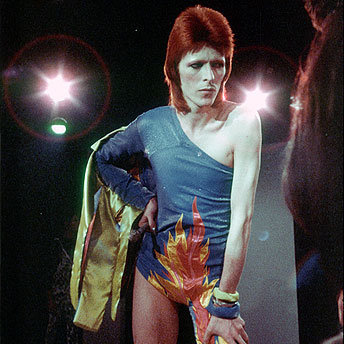
On the generally ethereal Hunky Dory, that clue was, of course, the propulsive and utterly sublime “Queen Bitch”, which heralded the coming of Ziggy Stardust and the Spiders from Mars, one of the great, pure rock (and proto-punk) albums of the decade. To say that Ziggy himself was one of the great “roles” played by any rocker of the period is not necessary, for no one else even attempted this sort of serial shape-shifting back then. Bowie turned this trick 4-5 times throughout the decade — hippie folkster to Ziggy to glam rocker to blue-eyed soul man to Thin White Duke — and competed in this regard only with himself.
[I’ve been reading the blog, “Pushing Ahead of the Dame.” You may know it, but check it out if you don’t. It’s fascinating. Yes, “Queen Bitch” is perfect because it starts with the acoustic guitar C-G-F progression à la Hunky Dory, then switches right to an electric C-G-F à la Ziggy.]
My sister didn’t own the Ziggy album. Indeed, while I knew several cuts well (from FM radio play) I wouldn’t fully absorb it until the early 1980s. She did, however, possess one more Bowie LP: David Live, Bowie’s first official concert release where, once again, he shows us a transition in the making: from the hard-edged glam of Diamond Dogs to the Philly soul of Young Americans. I am not ashamed to admit that I love this particular Bowie period, this dalliance in what he later, somewhat ambivalently referred to as “plastic soul”.
It does shame me to admit, however, that until I was 12-13 years old, I thought this dude’s name was David Live. Indeed, he looked and sounded so different from the Hunky Dory-era Bowie, I thought they were two different guys.
David Bowie as Cultural Touchstone
Dennis Carboni, better known by our particular cohort simply as The Bone, arrived at Wesleyan University in Middletown, Conn., with several well developed musical obsessions. We didn’t bond over them all. I was as confounded/repulsed by The Human League as he was by Neil Young. But we did find common ground in ELO and Steely Dan — and it was through him that I learned to love and appreciate Bowie, and Prince. Part of the reason I was so drawn to these artists was indeed The Bone’s singular, boundless and utterly guileless enthusiasm & advocacy. It wasn’t enough for Dennis to know every song on every album, to know who played each instrument on each track. This was the level of his relatively casual Steely Dan obsession, for example.
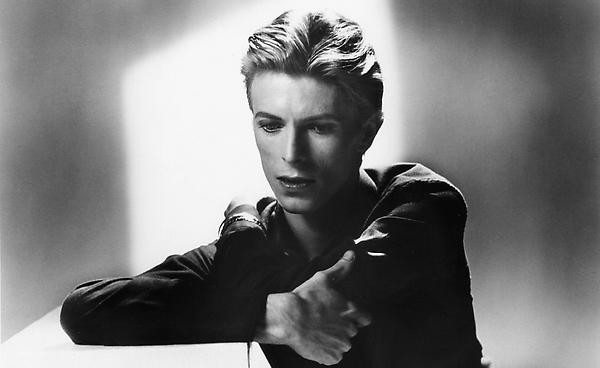
“Thin White Duke” Bowie, an image taken from the same session that produced the cover for the ubiquitous ChangesOne album.
The Bone took it up several notches for Bowie, more or less patterning his own persona, physical presentation and style on the Thin White Duke and Berlin Bowies of the late 1970s — the David Bowie of Station to Station, Low, Lodger and Scary Monsters. These albums, these personae had inspired Dennis to his hair like Bowie did during his famous 1979 Saturday Night Liveappearance, wherein he performed “Boys Keep Swinging”, “TVC15”, “The Man Who Sold the World”. It meant selling his stereo to buy a sewing machine, so he might properly peg his jeans — often installing zippers to turn this trick. It meant shaving his legs, an act that mystified fellow jocks on the track and football teams at staid Orville H. Platt High School in Meriden, Conn. Such acts stood out even at notoriously boho Wesleyan.
It goes without saying that Dennis owned every last bit of vinyl produced by Bowie through 1982, when we all showed up in Middletown as freshmen. And, for the record, he was free to sell his stereo because his roommate had a better one.
Through Dennis I came to know each Bowie album intimately. For example, over a period of weeks our freshman year, Dennis chaperoned my close listening of Pin Ups, Bowie’s beguiling album of ‘60s covers, issued in 1973 (we loved it; Rolling Stonehated it). Much has been written these past few weeks about the generosity of Bowie’s artistic spirit and he did collaborate with, write songs for, and serve as commercial and artistic patron to so many: Mott the Hoople, Iggy Pop, Lou Reed… And so it made sense that Bowie, on Pin Ups, would shout out to the Yardbirds, Them, early Pink Floyd and several more influences from his ‘60s evolution — when Bowie was not some callow teen but leader of his own folky band.
Yet even so: Who takes time between the triumphs of Aladdin Sane and Diamond Dogs to put out an entire album of covers? With Twiggy on the cover alongside him?
The coolest thing about Pin Ups, however — or so I learned from The Bone — was Bowie’s cover of The Who’s “I Can’t Explain”. This was the age of turntables, of course, and Dennis revealed to me that this track could be played as a dirge, at the standard 33 rpm, or as a piece of pristine proto-punk when one simply toggled the turntable to 45 rpm. That blew my mind: Best secret vinyl ruse since the Paul is Dead “campaign”.
[I gave all my Bowie vinyl to my sister. I’m an idiot. I know. Without the vinyl, I wasn’t able to re-hear the amazing 33@45 “I Can’t Explain”, so I just installed the 45rpm app and listened to it on iPhone. Memories came back strong!]
Or Heroic Nights and Ubiquitous Compilations
Come the following academic year, 1983-84, I had moved off campus, to 114 High St., while Dennis and perennial roommate/stereo sugar daddy Dave Rose made house in a different double somewhere in the miasma of late-60s, brutalist dorm architecture that was (and remains) Butterfield C. It was here one night, sometime during our sophomore year, that I popped over unannounced — that’s what people did back in the pre-mobile age —only to find the lights down and “Heroes”, the single, playing on the stereo.
Rose was operating a baby spot, wherein The Bone — effectively bathed but darkly clad in coat and tie — could be seen mimicking Bowie’s expressions and hand-gestures from the Heroes album cover. This went on for some time; such was the power of the kooky, spot-on spectacle. No photographic record exist. Such was the age we occupied at the time. Today we’d havde captured everthing video and, by now, achieved the rank of Internet Sensation.
[I’m glad you have these memories; it feels so good to hear these things that happened… I know it was me, but I just didn’t store the memories well enough. They come back when you trigger them. Funnily, for me it’s easier to remember things like eating pancakes (or Tex-Mex stuff?) and listening to Hall & Oates’ H2O down at your place on High Street.]
Having spent the better part of my freshman year boning up, as it were, on the complete Bowie catalogue, I was in a position to turn up my nose at a few things: The first was Changes One, a compilation, Bowie’s first, released in 1976. At Wesleyan, I’d estimate this album was a mainstay in 75 percent of the record collections I happened upon. As ever, however, the “best of” route proved a dangerous step on the path toward self-administered down-dumbing. Because Changes One merely scratched the surface of Bowie’s enormous appeal. I took to evangelizing my peers to hit the Princeton Record Exchange — a traveling music flea market that showed up on campus twice a year selling perfectly good used vinyl for 10-25 cents a pop — to properly fill out their Bowie collections.
A Recession from Popular Influence
In time, I’d also turn up my nose at what many consider Bowie’s last “influential” album. Let’s Dance hit in the spring of 1983. It featured some good quasi-pop songs, including a few (the title track, “China Girl”, “Modern Love”) that garnered serious “radio play,” a term that had recently been expanded to include “video” play on the nascent MTV.
The ’80s were tough on everyone. See here the blown-dry, bleached-blond, Let’s Dance-era Bowie.
Bowie toured in support of the album and I had the pleasure of seeing him at Schaefer Stadium along with 60,000 others in the fall of 1983 — my very first stadium show. David live would prove magnificent in a pale-yellow, double-breasted linen suit. Studio Master? Not only. He held the audience in his palm by dint of a prowling, feline stage persona, these new hits, and two dozen further samplings from that massive catalogue of his.
Yet his previous decade of prolific hit-making, risk-taking and trail-blazing would ultimately prove the rub when it came to Let’s Dance, not to mention the dozen or so albums Bowie issued thereafter: They didn’t measure up. In the immediate sense, Let’s Dance followed a run of albums that was nothing short of spectacular: Station to Station, Low, Heroes, Lodger and Scary Monsters are masterpieces all, each utterly unique and 2-3 years ahead of would-be tastes. Thanks to Bowie’s seamless transition to the video format, Let’s Dance sold well and kept the dream alive, as it were. But artistically, it was nothing terribly special — indeed, it veered dangerously close to pop, something Bowie always hovered above.
In the longer term, for most all of us (including professional tastemakers these last 30 years), Let’s Dance would prove Bowie’s last true hurrah. He continued to issue a diverse collection of albums. I particularly liked the IDEA of his simply being part of a band (Tin Machine, 1988-92) though he three albums it produced (two studio, one live) didn’t moved me much.
[Nothing to add here apart from the fact that I love Let’s Dance, even though I know the “rock” critics do not. I do think Bowie has been somewhat relevant of late, in both 2013 and 2016. But that may be, sadly, because first he returned after a decade away (issuing Next Day, a powerful album) and then released the greatest final statement (Blackstar) in the history of rock.]
Bowie Ruled the post-Beatles World
Many of the retrospectives and obituaries I’ve read since Bowie’s January passing hint at this last point of contention: that while he assiduously avoided repeating himself — and the cynical formulas that would have sold out once-a-decade nostalgia tours, à la The Rolling Stones — Bowie’s cultural relevance tapered off markedly following Let’s Dance.
While this observation is undeniably true, it does gloss over the fact that from 1971 to 1983, Bowie ruled the post-Beatles world. And no one in the rock ‘n’ roll era, not even the Fab Four, was ever so consistently mode-shattering and commercially popular, over such a long period of time. We can throw straight out the window any further comparisons to the Stones, Zep, REM or any other “bands” — for these were collections of talents, while Bowie was just one man. He proved an individual who assembled bands, looks, sounds and trends pretty much on his own. No individual can claim such an artistically varied, unfailingly daring but still popular run of form.
Dylan? Yeah, he went electric and did a country album. But he shifted shape hardly at all in terms of persona. The only individual who has even attempted this sort of long-term trick is Prince, who managed 6-7 years of arguably comparable output — and sexual non-conformity — before eventually bowing under the pressure.
[Do Michael Jackson or Madonna merit mention?]
Only a fleeting one, you Bone. MJ was a child star, then a full-blown pop icon on the strength of two albums (Off the Wall, Thriller) before riding out his days as a physical, commercial and emotional oddity — not an artist or even a reliable popsmith. Madonna had the shape-shifting down but not 1/10th Bowie’s talent or vision. Lady Gaga works in this space but managed just 2-3 years of relevance. Now she’s singing the national anthem at Super Bowls.
Bowie turned this very difficult trick for 12 years, all the while fostering the work of others, all the while pushing the popular envelope, not just in music but in film and fashion. Indeed, no one in the history of rock ‘n’ roll was so “mainstream” successful while simultaneously inhabiting the avant-garde.
[Are critics afraid to speak of this? Do they think they are belittling all the other artists if they mention the concept you discuss? It’s a perfect closing.]
Heroes-era Bowie
The Man Understood Exits
We’re not quite done: In the 2-3 weeks following Bowie’s death, the music and fan communities issued a sustained outpouring of affection for the man, his music, that enduring commitment to the avant-garde, and his basic humanity. Amazinglly, the latter quality never did get lost amid the trying-on of so many on-stage, public personae. To me, a pair of paeans stood out.
The first was an 18-minute podcast segment produced by The New Yorker, wherein reporter Sarah Larson sat with a fellow from the techno-jazz ensemble that backed Bowie on his last album, Blackstar, issued just weeks before his death. The story of their meeting up is interesting enough on its own: Apparently Bowie wanted to do a jazz-inspired album and anonymously scouted these guys at a couple gotham clubs. He floated the idea of this project via email. Utterly gobsmacked, the band agreed. Bowie then collaborated on the recording without the slightest trace of ego — never mentioning to his new mates that he was terminally ill, for example.
Near the end of the pod segment, Larson asked the saxophonist, Donny McCaslin, whether he’d listened to Blackstar since Bowie’s passing. Twenty seconds of dead air ensued, as the poor bastard tried to gather himself. No, not yet.
The second was a BBC documentary that aired in 2019 on PBS called “Five Years”, where the filmmakers detail these astounding musical and theatrical transitions Bowie authored at the peak of his powers. I can’t recommend these 90 minutes highly enough, as they encapsulates and confirm much of what I describe above, in far greater detail. They also deploy Bowie’s own words, those of his various collaborators, and an amazing collection of period images, sound and video — 75 percent of which I had never before seen or heard.
Bowie himself makes the pivotal point: He really didn’t see himself as a rock ‘n roll star, more an actor who takes on a role, immerses himself therein, then discards it for the next one.
That sentiment seemed to me spot on, though we’ve barely touched on the man’s film work, which also fits neatly into this continuum. Still, fixating on this idea too rigidly does risk our diminishing the incredible body of musical work that grew out of this role-playing — a catalogue that never felt derivative of itself, that was often popular but only rarely veered into “pop”. King Crimson’s Robert Fripp, a featured guitarist on Heroes and Scary Monsters, had some really cogent things to say in Five Years about the making of those two albums, and Bowie’s music in general. He greatly appreciated the freedom he was granted to spin his twisting, screeching guitar riffs, adding what he considered elements of “danger” to otherwise straightforward melodies. Listen to a track from Scary Monsters like Fashion or It’s No Game. You’ll understand what Fripp means.
This documentary was the first time I’d ever seen Fripp speak on camera. He comes off like an avuncular but highly mischievous university semiotics professor, one who just happens to be an aging guitar god/visionary. He points out that Bowie had a genius for using scatalogical things like a Fripp guitar lead — or broadly provocative themes like androgyny, race-mixing, fascism and drug use — to purposely unsettle the listener.
In the doc, Fripp amplifies the point, explaining that it’s precisely this element of menace that separates mere pop from “rock ‘n roll”. The Brit allows that idea to hang there for a moment before sitting up a bit straighter in his chair and adjusting his gaze to look more or less straight into the camera. Lifting an eyebrow ever so slightly, Fripp explains what that danger truly means to the listener: “It means, you might get fucked.”
Having weighed in, soberly and professionally, on the “air rage” phenomenon the Mandarin Media blog, I couldn’t leave the subject without relating the more salacious story of my first trip to the French Alps. It wasn’t exactly an instance of “air rage,” but it well illustrates the peculiar holiday-making mindset among some Brits Abroad. Of course, said mindset can and has led to many an airborne incident. In short (I love quoting myself), “There is something to the idea, born of armchair psychology, that Brits generally and the English specifically cut loose on holiday in reaction to leaving what remains a very buttoned-up, class-restrictive culture.”
It was March 1985. My girlfriend and I were studying abroad, in London, and we’d booked a chartered ski package to La Plagne, in France, for mid-semester break. Our short flight from Gatwick to Geneva, almost entirely peopled by English holiday-makers, quickly degenerated into a sort of raucous booze cruise at 30,000 feet. Everyone, it seemed, had broken open their bottles just procured at duty free.
Normally, such characters scatter to the four winds upon landing, but this was a charter. We had all purchased the same ski package. Accordingly, the same rowdy group piled onto a single coach and set out for La Plagne — in a blizzard.
Brits Abroad: In a Blizzard
By this time, my girlfriend and I had traveled a great deal together. This much was clear: If she wasn’t seated directly behind the bus driver, she was dangerously prone to car sickness. So, from the very front of the coach, we could hear the party raging behind us, as we crept our way along ever more windy, mountainous roads. In a blizzard. This was a non-smoking bus; the Brits defiantly smoked like chimneys and brandished their duty-free liquor bottles like groomsmen at a stag party. Then came the songs.
The unfortunate leader of this charter was a mild-mannered American 22-year-old named Chad. His attempts to tamp things down were met with open ridicule. He was a tad chubby, our Chad. Ultimately, he was regaled with a spirited rendition of “Who ate all the pies?”
From our perch behind the driver, we witnessed the trip’s dramatic inflection point: An oncoming Citroen spun out in the snowy conditions and crossed into our lane. The bus driver tried evasive action but these were shoulder-less roads — and it was snowing like a bastard. The car bounced off the driver’s side of the bus, right below us. After skidding to a stop, we found ourselves literally perched precariously at the edge of a steep and snowy hillside.
We sat there for half an hour, crowded onto the left side of the bus — to avoid tipping the bus and our still soused party into oblivion. Finally, a replacement vehicle arrived. When it did, we all exited out the driver-side window.
Any Train-Station Bar in a Storm
This backup bus was not big enough to accommodate all of our luggage, so the entire party was deposited at a nearby train station, which served some small French mountain town whose name I cannot recall. The station had a bar, however. Our new British friends set about drinking again, as if nothing had happened. To be fair, so did we. Having cheated death, we tucked into a couple bottles of wine with two more American friends traveling with us.
Two hours later, we piled onto the second replacement bus, where our moveable booze-fest was now completely out of hand. Chad just hunkered down beside us. This party could not be stopped — or could it…
The up-and-down, side-to-side nature of our alpine journey would result in two initial incidents of vomiting. Each time the bus ascended and descended, the resulting spew sloshed back and forth along the bus floor. The stench had just the wrong sort of effect on others who teetered at the edge of nausea.
Upon arrival in La Plagne, I don’t believe I’ve ever been quite so thankful to disembark from anything. Rule Brittania!
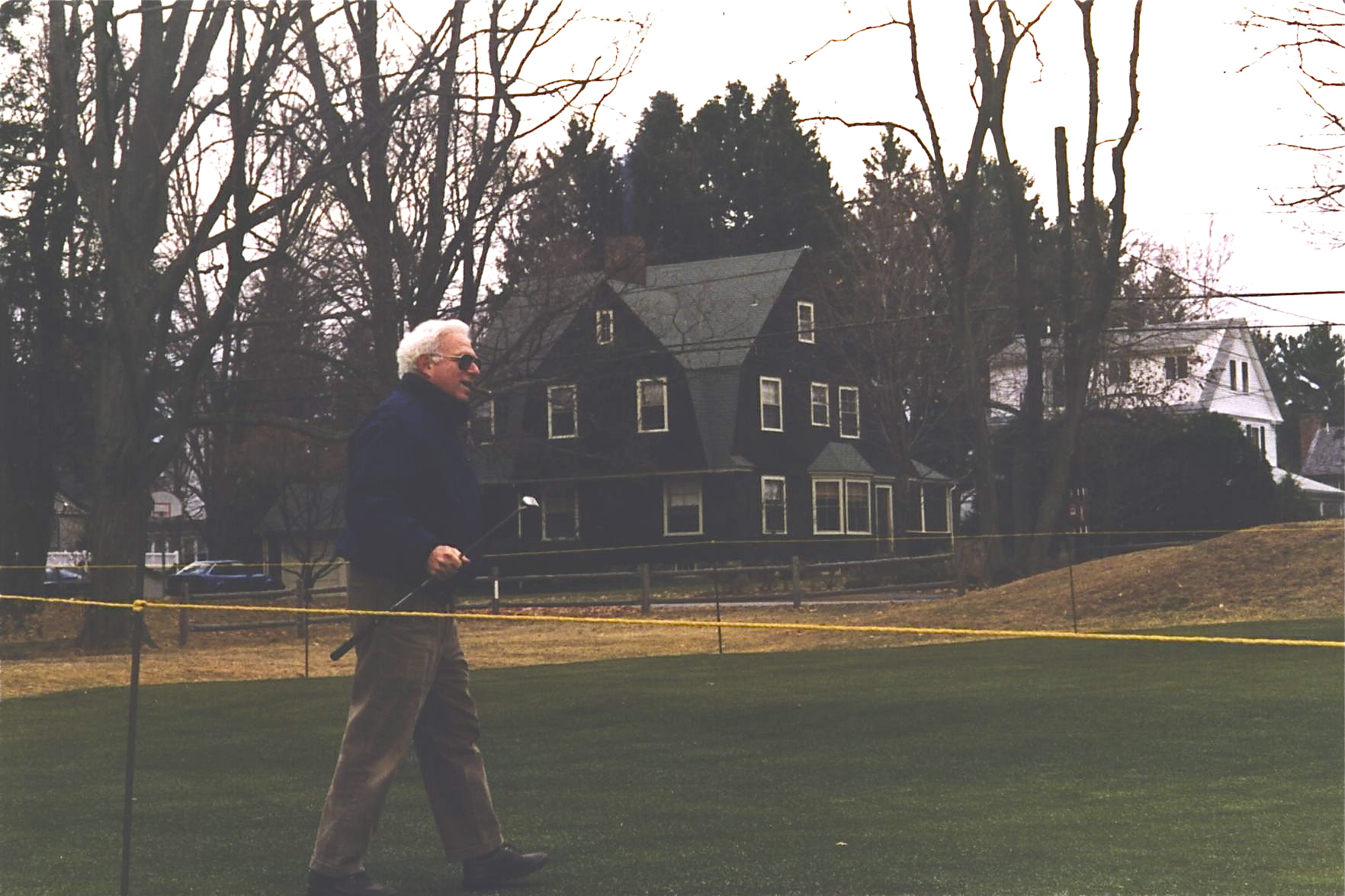
My dad on the 8th green at Nehoiden, right across the street from the house where grew up. It's late November; the greens have been staked for fencing at the first snow. We sprinkled his ashes here, and there's a memorial bench for him just right of this frame, on the 9th tee. There is no headstone in any cemetery for him. This is his spot, for all eternity.
My dad with his dad, the original Harold Gardner Phillips.
NEW GLOUCESTER, Maine (11 August 2014) — I try to write each August about my dad, Harold Gardner Phillips, Jr., as he passed away (all too soon) at the end of this month back in 2011. This exercise is equal parts homage and memory aid, as I suppose one fears these recollections we share as Fathers & Sons, now perfectly strong, will somehow fade with time. This year the jog happened naturally, as today I stand poised at the fulcrum of a generational see-saw: My son Silas goes off to college tomorrow. In turn, the memories rush back re. the day my dad saw me off, out of the nest and into the world.
As is the case with so many stories I’ve shared about my dad, golf plays an intersectional role. This one’s even more fitting because it centers on Ponkapoag Golf Course in Canton, Mass., a municipal track we played dozens of times growing up.
One used to be able to see Ponky from Route 128, the thronging, inner ring road that circles Greater Boston, though methinks ever-maturing trees now obscure that view. Today there are only 27 holes at “Ponky,” but once there were 36 and the course visible from the highway was nothing special. It has been reduce to 9.
The other 18, however, was a Donald Ross design from the 1930s that, despite the rigors of time, high traffic and miniscule maintenance budgeting remained damned sublime.
Fathers & Sons, Drop-offs & Tournaments
My dad and I played Ponky together on a several occasions, but this was mainly a place where he, my mom and other parental figures dropped my friends and me for entire days of golfing adventure. It also served as perennial host to a pair of junior tournaments: The CYO Championship (that’s “Catholic Youth Organization” for those who may not have grown up in Boston, where the Church held such wide-ranging cultural sway) and the New England Junior Championship.
That day I left for college, a cloudy late August morning in 1982, I was scheduled to play a quarterfinal match at the New England Juniors, as I had qualified earlier that week for what stood to be a potentially anti-climactic match-play portion. I had packed our ’78 Dodge Omni that morning with all my stuff. Win or lose, I would decamp for Wesleyan University in Middletown, Conn., some 100 miles to the southwest, directly from the golf course.
As it happened, I won the match, bettering a kid from Rhode Island named Fred, 3 & 1. I signed my card, informed a quite delighted Fred that I would be withdrawing, told the officials, and walked off to the parking lot. There to my surprise I found my dad, who had just rolled up.
As a kid, my competitive golfing career would never prove particularly extensive. Indeed, this tournament and the CYO the year before were the only two official events I had ever played to that point. Golf was a fall sport at my high school, as was soccer, which took clear precedence. In other words, while my dad had played hundreds of rounds of golf with me through the years, and we maintained a spirited, running match for decades, he had never seen me play a proper tournament match against anyone else.
Pleasant Valley Cameo
One time, in college, he showed up at Pleasant Valley Country Club near Worcester to see me play a collegiate tri-match featuring Wesleyan, Springfield College (I think) and Assumption. I know the latter to be true, for certain, because I ended up facing a guy from Assumption that day named Frank Vana, who would go on to win multiple Massachusetts Amateur crowns. My dad worked near PVCC and he showed up on the 9th or 10th hole, at which point my game imploded. He scurried off after we finished 13, not wanting to karmically cause/witness any further carnage.
For many years, I was never sure what exactly my dad meant to “do” that day in the parking lot at Ponky. We had said our goodbyes that morning, and it wasn’t as though I was going off to war. But today, I can see he probably wanted one last moment with his boy, who would soon leave and return in some way, shape or form, more a man.
I’ve been trying to remember what exactly my dad and I talked about during that moment in the parking lot. I surely went over the match with him, and the curious aspect of my winning but withdrawing. I don’t remember that we got into anything particularly deep. I remember being touched that he had shown up, but there were no tears. I’m pretty sure we shook hands.
See here a relevant excerpt from the eulogy I delivered for him in 2011:
Showing, not Telling
My dad was not a particularly emotive man, not for most of the 40 odd years I had a clear picture of him. I remember one time I came home from college and was determined, in the sure and committed way of college students, to simply start hugging him and telling him that I loved him. I had seen other dads do this and been impressed — that a father and son could be so open and physical in their affection for one another. I wanted that for my dad and me, to be honest. So I started out with hugs and, well… the man never really got comfortable with it. It just wasn’t his way. I remember telling him during this same period that I loved him, and noting that, to some extent, one is obliged to let people know that this is so, to verbalize it, to say it plain. He said that wasn’t his way either, that he instead showed people he loved them. I remember thinking, at the time, that this was something of a cop-out.
But the man knew himself. As I grew older, I better recognized the ways he expressed intimacy and let you know how he felt. There are no rules or universalities for these things, I’ve learned, as I myself have grown as old and, in some ways, as wise as he. The more I observed this, over time, I can report that my dad did practice this sort of behavior consistently, with all sorts of people.
I think one of the keys to understanding and appreciating my dad is this: If he enjoyed something, his greatest joy was to share that enjoyment with you. If there was a piece of music that he found thrilling — and the man enjoyed a notably wide musical taste — he wanted you to listen to it and, ideally, derive the same thrill, too. If there was something good he had seen on PBS or C-span, he wanted you to see it, too. If there was food item he had acquired or my mom had made, he wanted you to consume it. Right then. His enthusiasm for this sharing was really quite intimate, almost childlike in its enthusiasm. You might walk into my parents’ home, having not seen him for weeks, and his most deeply held desire was to have you sit down and watch an interview with the historian Gordon Wood, right then, so soon as you put your bag down.
The Side-by-Side Experience
And there was another aspect to this: He wanted you to listen or watch or taste or, to the extent possible, read this stuff WITH you. He wanted to sit right next to you while we watched the Gordon Wood interview, together — so he could pause the recording and discuss it. He wanted you to put the earphones on while he would stand right there beside you, grinning giddily, as you listened to some choral piece by Arvo Part. He would call just to see how far you were in a book he had recommended, to get updates on your progress…
I loved my dad but I, like many sons, have fashioned a great deal of my life in response to his. When Silas heads off tomorrow morning, there will be hugs. There will be tears. That said, I expect that whatever I’m feeling at that moment, is the same thing my dad felt that day, some 32 years ago, in the parking lot at Ponkapoag.
Silas is flying to Montana tomorrow morning, with his mom. I suppose that if I could practically meet them in Chicago for one last goodbye, I’d do it.
How many 14-year-olds do you know who warm up for a star turn with Tiger Woods and Rory McIlroy by defending the most coveted amateur title in Asia, in hopes of re-punching his ticket to The Masters? That is the quite extraordinary story of Guan Tianlang, who, as we speak, is teeing it up at the Asia-Pacific Amateur Championship (AAC) in China’s Shandong province, at Nanshan International GC. The AAC runs Thursday to Sunday — winning it means a Masters invite (Augusta National GC is a tournament organizer) but also a final qualifying slot for the 2014 British Open. So soon as his AAC has concluded, Mr. Guan (surnames first for the Chinese, of course), flies south to Hainan island, where he will participate in a morning Skills Challenge with Messrs. Woods and McIlroy, at Mission Hills Resort Haikou (that afternoon, the two pros will contest The Match at Mission Hills to be held over the resort’s Blackstone Course). Guan, of course, made Masters history earlier this year — competing as a 14 year old and making the cut on golf’s biggest stage. I recently had the chance to sit down with Guan to discuss the state of his game, his travels, his history with Tiger and Rory, and his relationship to Mission Hills, where he’s been a fixture at junior tournaments since 2008 (he’s a native of nearby Guangzhou). Oh, and for the record, all this talk about being a precocious 14 year old goes away this week. Guan turns 15 on Friday, Oct. 25.
Q: You are quite famous, internationally, following your performance at the Masters in April 2013. Tell us what you’ve been doing since that time.
Guan Tianlang: The Masters did make me better known than before. I played several PGA Tour events after The Masters, including the Zurich Classic, HP Byron Nelson Championship, The Memorial, and FedEx St. Jude Classic — before taking the whole summer off for fitness training and catching up with school work. I played one Japan Tour event, the Vana H Cup KBC Augusta, after coming back from the States. Now I am going to school as a normal student and getting ready for the Asia-Pacific Amateur Championship in late October.
Q: The slow-play penalty you incurred during the second round at The Masters gained a lot of attention, as well. How do you view that episode now? Do you play faster, or do you think the penalty was perhaps unfairly applied?
GTL: As I said back then, I respect the decision and I accept it completely. It was a tough day. The weather was bad and it took more time to make the right decision, and you know, it’s The Masters! I have a good routine and I haven’t changed much because of the penalty. But yes, I do pay more attention to my pace and I think I have been doing well on that part. Overall, it was a very valuable experience.
Q: Describe your history with Mission Hills. You have worked on your game there? Competed in tournaments here?
GTL: I have participated in more than 10 junior golf tournaments hosted by Mission Hills, since I was seven. And I won several championships there. The courses are beautiful and challenging. Actually the second time I met Tiger Woods was at Mission Hills Shenzhen. A great memory.
Q: There are many courses at Mission Hills — 12 in Shenzhen and 10 on Hainan Island. Which is your favorite course?
GTL: My favorite one must be the Mission Hills Norman Course. But I haven’t been to the Haikou Mission Hills. I hear it is amazing and can’t wait to play there!
Q: You will appear at a junior clinic and skills challenge prior to Tiger Woods’ and Rory McIlroy’s Match at Mission Hills on Oct. 28. You already have a history with both players.
GTL: Yes, I’ve met both of them before. I met Tiger at the HSBC Championship when I was 12, and we played a par-3 hole together. Met him the second time at Mission Hills Shenzhen and received a trophy from him. And, of course, I got to play with him for 9 holes at Augusta National on the Tuesday of the Masters; it was a dream come true, as everyone knows he is my idol. I haven’t played with Rory before but we had a nice chat at the Masters. He was very supportive and said he wasn’t as good as me when he was 14. He is humble and a very sweet guy. A great player as well!
Q: Have you attended similar junior clinics as a spectator? If so, what did you take away from the experience?
GTL: I have attended some junior golf clinics, when I was younger. The one hosted by Mission Hills with Tiger Wood was one. I can’t say how much in terms of golfing skills I have learned from the instructor, but I shall say the whole experience did inspire and motivate me to practice harder and become a better golfer.
Q: Was Tiger Woods always role model for you? Are you old enough to have the same thoughts about Rory McIlroy?
GTL: Tiger Wood has always been my idol. I believe he is the role model as a golfer for many, many people out there. Look at him: He won 5 PGA Tour events in one year and he is now the world No.1. He is the greatest player of his time and perhaps will become the greatest of all time soon. Rory is such a mature and great player. I can see how much more I need work on myself — to grow into a player like him. Both of them are the players I look up to. I’m very excited to get the chance to challenge them.
Q: What advice did Tiger give you during that Masters practice round — anything that helped you during the tournament, or with your golf going forward?
GL: Yes, it was a great experience and probably the most nervous 9 holes in my life. He is my idol, after all. We did chat a bit during the practice round and also off the course. Lots of advice. But the one piece, as other great golfers also offered to me, is enjoying your game and embracing your experience at The Masters. It was my first Masters journey, and I hope there will be many more coming.
Q: You turn 15 on Oct. 25, just before The Match at Mission Hills. You remain a young man, but do you feel as if golf is more popular today, in China, than it was five years ago? If so, how can you tell?
GTL: I believe so, absolutely. First of all, you can see more and more media are paying attention to the sport. Second, more and more juniors start to pick up the game, which makes the future of golf in China very promising. The golf community in China is expanding with its addition to the 2016 Olympic. Golf will become more and more popular here for sure. It is a great sport, why not?
Q: When will American golf fans see you again? Does your tournament schedule bring you to North America in 2014?
GTL: I hope everyone who supports me will watch me and root for me when I play other events outside the U.S., such as Asia-Pacific Amateur Championship. Augusta National is an organizer [winning this event last year earned Guan his Masters place in 2013] and it is the best amateur event in the region. I am going back to defend my title and I hope they will be watching. I haven’t planned any tournaments in North American next year. Hopefully I will win my ticket back to 2014 Masters.
Casa de Campo Resort here in the Dominican Republic made its mark because the first of its four separate courses, Teeth of the Dog, was designed by the inimitable Pete Dye. Of course, Dye designed all 63 holes here, but it was the Teeth of the Dog layout, opened in 1971, that got the place noticed and today enjoys a place on most everyone’s world top 100 list.
However, while Dye made his own mark with some of golf’s most striking, flamboyant feature work — the volcano green complexes, the hard-edged fairways that fall off steeply 10-15-20 feet into strip bunkers (PGA West), the ubiquitous railroad ties, the island-greens (typified by the 17th at TPC Sawgrass) — Teeth of the Dog features almost none of these things.
One of the most striking things about my round here this morning was this: the features at Teeth of the Dog were surprisingly graceful, almost sedate. There are a few plateau greens that fall of steeply on every side (the par-3 13th, for example), but the mounding, green edges and fairway edges here are largely quite tame. Most of the fairway bunkering is fairly shallow.
Here’s why: Dye’s designs are all about angles, and there are enough here — in tandem with ocean-derived wow factors — to moot the need for flamboyant design features.
Ordinary designers deploy putting surfaces as a sort of period at the end of a fairway; they are almost continuations of the fairway footprint. Dye doesn’t do that. The front of his greens may well connect to fairways, but the green remainders angle away from the player — meaning approaches inevitably require shots over a bunker or deep swale or water in order to find said greens. If the drive is exactly perfect, Dye rewards you with a royal road into his putting surfaces. For all the wayward among us, any deviation from the perfect line means your approach is that much tougher.
The angles Dye created at Teeth of the Dog meet his high standards, and it’s not just the green angles. Every tee box presents the player with a fairway that angles away left or right — attack that angle well (often over a hazard of some kind) and you shorten the hole; fail to do so and the holes is lengthened.
What makes Teeth of the Dog “world-class” is that Dye takes these angles down to the sea, where seven of the 18 holes use the Caribbean to complement his angles, thereby ratcheting up the risk-reward dynamic. The par-4 16th is a lovely example. It plays just 334 yards from the blue tees, but it hugs a cliff top where the ocean borders the entire right side. Dye’s fairway swings inland, away from the water, before tacking back to a green that sits right at the cliff edge. The closer you hug the coastline, the easier your approach — the Caribbean is still your right, but you can always bail out left. Should you bail out left off the tee, however, your approach plays almost directly at the ocean — the slightest push and the waves eat your ball.
Still, there are plenty of fun features at Teeth of the Dog, and it’s the hard edge that makes Dye’s features so striking. His putting surfaces don’t slope off gradually into greenside bunkers — they fall off steeply. It’s all or nothing. You’re either on that green or in the bunker, or in a swale. It’s sort of like a water hazard: There is no in-between — you’re either in it or not.
Teeth of the Dog features relatively little of these hard edges, to accompany the masterful angle work, perhaps because on 7 holes, Dye had the menacing Caribbean with which to work (made all the more knee-knocking by surf crashing over huge, gnarly, volcanic boulders). I suppose you don’t need hard edges all over the course with the ocean so close. It forms the ultimate hard edge.
The 15th green at Teeth of the Dog. This is the approach angle if you bail out away from the water. Note the hard edge at right — you’re either on the green, or in the Caribbean,
A couple quick stories about Pete Dye while I’m sitting here in my barn office, avoiding the packing process while simultaneously champing at the bit to leave this frozen wasteland for the tropical glories of Casa de Campo, where Dye is responsible for all 63 holes:
Circa 1994, I was serving as editor in chief of a national business journal called Golf Course News (today it’s known as Golf Course Industry magazine). For a few years there, GCN sponsored a national trade show called the Public Golf Expo, and as program chair of the associated conference, I was the de facto host of this event. Part of my job was lining up keynote speakers and this particular year, in Orlando, I landed Pete Dye.
Mr. Dye is known for many things: integrating links features and scale into modernist course design, railroad ties, strip bunkers, angles, and courses that, initially at least, totally confounded tour players. What many people don’t realize is this: The man is hilarious. There are quite a few very funny course architects, but Pete’s in a class by himself. He comes off as a sort of rumpled, midwestern bumpkin who meanders around a subject before dropping some zinger that takes everyone by surprise.
I don’t recall what Pete Dye was supposed to talk about that day in Orlando. We had discussed something, surely. But after a few comments to kick things off — each one punctuated by a laugh line funnier than the last — he just threw it open to questions and answers. He kept this up for 40 minutes, fielding each one with off-the-cuff aplomb and hilarity. But two stand out:
• Some fellow rose and asked Pete about the environmental movement in golf, and whether this was stifling development and design creativity, and how he dealt with ever-tightening environmental regulations. You could tell Pete didn’t know quite where to go with this one, and it would not have been like him to launch into some mealy-mouthed defense of golf’s environmental credentials. But he soon launched into a story that went something like this… and I’m paraphrasing here:
Well, we like to have the environmental regulators come out to our golf course sites early in the game, before we’ve even broken ground. They usually like to walk, these environmental types, and I like to walk. So we get out there on the property and I walk ‘em. And I walk ‘em. Then I walk ‘em some more. And when they’re really getting tired, I walk ‘em some more.
Then I lie to them.
• Sometime later that same Q&A session, another fellow rose and asked Pete why he didn’t use railroad ties any more. He had, of course, made their use famous at several courses in the 1970s, including the TPC at Sawgrass, but had foresworn their use by the time 1994 rolled around. I was sure Pete would come back with something like, “I got tired of yo-yo’s like you always asking me about the damned railroad ties,” or maybe a quick quip/yarn about how even Tom Morris got tired of putting sleepers in his bunkers. But he just stared at the guy, and then he smiled before he leaning into the microphone: