It doesn’t matter where MadMen auteur Matthew Weiner picked up the narrative thread when beginning the seventh and final season. Some might have insisted on 1969, to keep the specific-decade ethos in tact — though the award-winning series actually started in the late ‘50s. Others may have argued for 1974, thereby neatly bookending the Dick Nixon Era. I don’t care how the final season might have started, but I have strong feelings how it should have closed.
Fans and critics of MadMen have debated the show’s narrative choices since its debut in 2007. The actual series finale — whereby Don Draper passes over into a 1970s American Milieu by joining an EST retreat in Big Sur — has garnered all sorts of feedback. But still, halfway through Thursday’s 2-hour finale, the show should have leapt forward to a recognizably modern day. Maybe the suit jackets might have seemed a bit oversized, especially through the shoulders. Hairstyles would shift. In keeping with the way other MM seasons have begun, however, it’s not exactly clear what year it is.
What is clear, in this alternate finale of mine, is this:
Sterling Cooper & Partners has survived and thrived, perhaps added a name or two. The agency has taken up residence in chic modern offices high in a glittering Manhattan tower of glass and steel. For 50 minutes of this final hour, in the course of a normal business day, we learn what’s happened to most all the characters who matter, i.e. who remains at the firm, how the hierarchical machinations have shaken out, who’s moved over to or formed competitors, who has leftthis mortal coil, who has divorced and remarried whom, who’s aged well and who hasn’t.
The pacing is pointedly brisk, recalling the Season 3 episode “Shut the Door. Have a Seat,” when our gang reboots the firm. This pacing is important because frankly there’s a lot of ground to cover — for the viewer, absent all these years — and to make clear the agency’s ongoing vitality.
MadMen Finale: Chronological Clues
Indications of the time period dribble out via scene details and workaday conversations at SC&P. The Justice Dept. will no longer seek to break-up Microsoft. The codgers at Sterling Cooper aren’t at all sure, charmingly, what a search engine is. But they do care. They’re courting Netscape, which is jittery because a company called Google has just been awarded US Patent 6,259,999 for the PageRank algorithm used in its search engine.
Bobby Draper has grown up to be a political operative. We see him on TV as chief of staff to Congressman Gary Condit, steadfastly defending a man who would appear to be dying a slow political death while denying an affair with 24-year-old Chandra Levy, now missing for 133 days.
All this catch-up takes place on a single day, a Monday.
The next morning, standing in his Upper East Side apartment, an appropriately aged Don Draper reads the paper. In his stylish breakfast nook, a radio plays in the background: Ahmed Shah Massoud, leader of the Afghan Northern Alliance, has been assassinated in Takhar Province. Draper’s young wife frankly doesn’t know who that is. She’s the spitting image of Betty Draper. Or, maybe it’s another brunette…
What we all accept without debate: It’s a late-summer day of rare clarity, made real under a bright, blue, cloudless sky. Don emerges from a cab and bumps into a colleague (Peggy? Roger? Dawn?) outside their NYC office tower. They’re all running late for a conference call at 9 a.m. As they hustle inside, the camera pans back from the monolithic revolving door. It reveals, for the first time, that the Sterling Cooper offices are housed inside the World Trade Center.
Sterling Cooper in Flames
Cut immediately to the Sterling Cooper offices burning out of control. Don is knocked out but slowly coming to beside his own desk. He lies amid charred debris that includes a bottle of bourbon, a tumbler and a slide carousel. Low-licking flames and the eerie, reedy hum of steady wind provide the only soundtrack, as several ceiling-to-floor windowpanes have been shattered/knocked out by the impact and subsequent blasts of jet fuel. Scene staging and blocking actively recall MadMen’s seminal Korean War flashbacks.
Don ultimately does regain consciousness. Things are suddenly moving fast again. MM characters dart in and out, to see if Don’s alive, to express ignorance or disagreement as to what has actually happened. They tell him so-and-so is dead, inform him they can no longer stay put. As per usual, they exude a massive, sincere reverence for this man in particular, whom they’re now looking to for decision-making, beside whom they might well die. A group has decided to ignore the “stay put” advice of emergency personnel on the ground — they’re leaving, and they’re taking the stairs. Draper says he’ll be right there.
Alone now, he grabs the bourbon, pours himself a drink and downs it. As he takes one last look around the wreckage that was his office/firm/life, the episode-ending music begins (“Be My Baby,” by Ronnie Spector and the Ronnettes). Don walks past the camera toward what we assume is the door. Instead, he walks to the open window and calmly steps out.
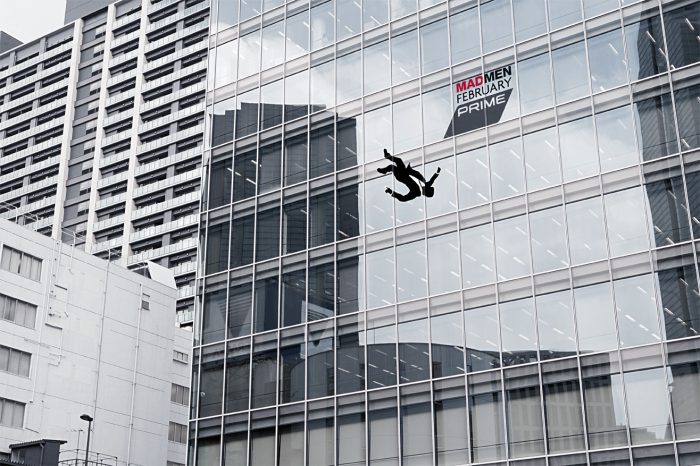
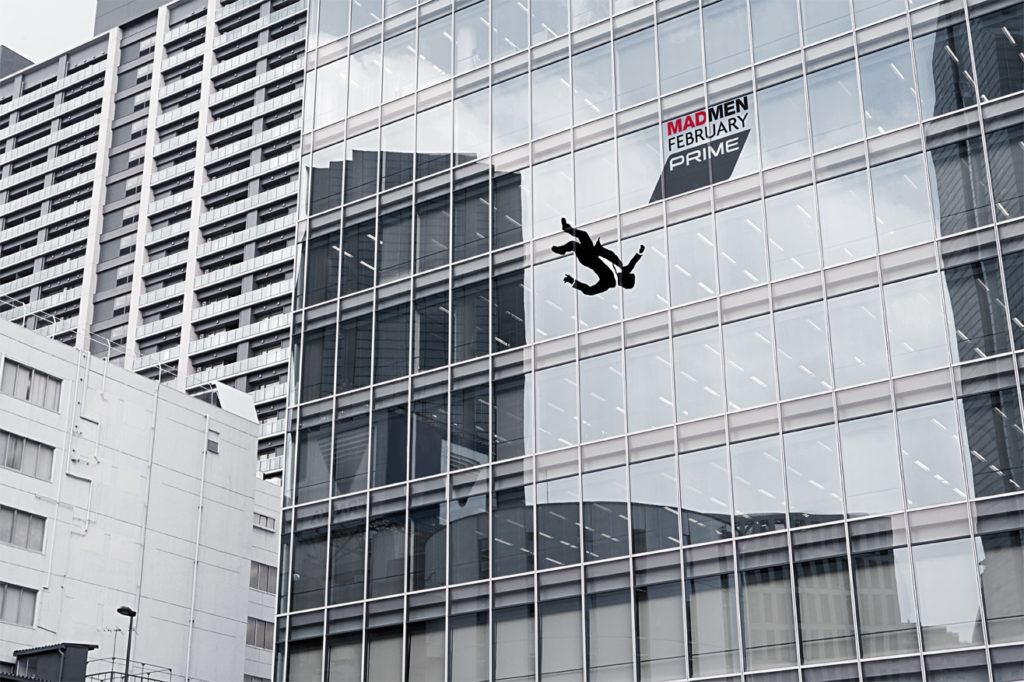
No need to show the trag-iconic footage of that businessman falling from the World Trade Center on 9/11. It is immediately recalled. It provides new meaning to the animated version of that footage we’ve seen at the start of this and every other MadMen episode, including the final one.