The inimitable Bob Barker, flanked by “Price is Right” eye candy Janice Pennington (left) and Anita Ford.
As yours probably does, my alma mater hits me all too frequently with some manner of e-newsletter cum fund-raising communiqué. One can hardly escape the memories stirred/jarred by all this WesContact, which is surely the way they want it. In any case, a recent MailChimp morsel revealed, among other things, that three Wesleyan University faculty, among them Nat Greene, had received The Binswanger Prize for Excellence in Teaching. While this particular tidbit proved interesting enough to peruse, I’m only now addressing the nostalgia it prompted — immersed as I am, third party, in the college experience of both my kids.
The first thing to say is that my cohort and I attended Wesleyan University in Middletown, Conn., alongside an actual Binswanger — Benjamin Pennypacker Binswanger to be exact. Never knew him but my housemates and I made note of his titanically pretentious name the first week of school freshman year and never forgot it. Never tired of mocking it, either. Always wondered if he was related to Princeton’s Jay Binswanger, winner of the first Heisman Trophy…
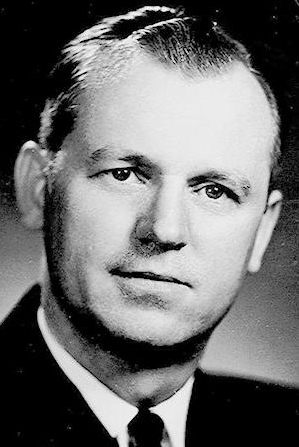
Wesleyan Professor Nat Greene
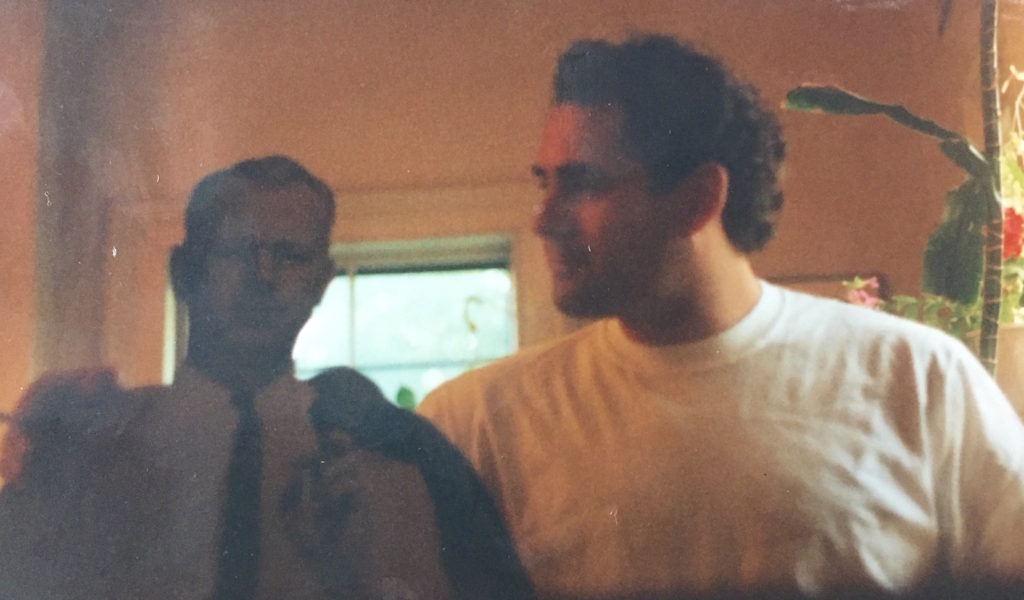
More to the point, Nat Greene was one of these recent Binswanger honorees. I took a couple classes with him but the first was a survey of European history 1815-1945, and I remember it best because it was the only class I ever took with my housemate Dennis Carboni, an art history major whose course load never again overlapped with mine (classical history/modern American lit).
Greene didn’t necessarily tilt the material toward “social” history, an approach then sweeping uber-liberal bastions like Wesleyan. His hewed more to the traditional “Great Men, Great Events” approach. I remember the syllabus included a book of his own scholarship, “From Versailles to Vichy: The Third French Republic, 1919–1940”, which a) struck me at the time as being pretty awesome, that this guy was teaching from his own work; and b) still resides in a bookcase somewhere here in my house, for reasons completely bewildering to my wife. An entertaining lecturer and no-nonsense grader of essays (all testing was conducted via manic, long-hand scribbling in those little blue booklets), Greene was a fine professor, the sort I hope Silas and Clara will experience at some point in their academic careers.
Nat Green Class at 10, Price is Right at 11
But here’s what I remember most from my class with Nat Greene: It ran from 10 to 10:50 on Monday, Wednesday and Friday mornings in the old PAC building — a few steps from the manhole where we often plunged down into Wesleyan’s famous tunnel system, the subject of another remembrance perhaps. If Dennis and I didn’t dawdle after class, we could race home to my off-campus apartment and catch The Price Is Rightat 11 a.m.
Yes, The Price Is Right. It became a sort of ironic obsession for me but something more than that for Dennis, as many things did. It gave me great pleasure to watch him obsessively game this once-seminal game show.
I’m not sure that college kids go in for this sort of thing today, awash as they are in video content and on-demand entertainment delivery choices. However, during the early 1980s, TV was a sort of novel diversion for college kids. We had grown up with it, of course, but had virtually no access to it at school. And so, great delight was taken in the ironic devotion to retrograde programming like soap operas in dorm lounges and late-night reruns of shows like the Rockford Files and Star Trek — things we would never bother watching when home with our families. My sophomore year, my housemate and I came by a tiny black-and-white TV that I’m pretty sure we carried with us the next three years, to three different houses, deploying along the way a staggering array of make-shift aerials including one that involved a pumpkin wrapped in aluminum foil.
The Price is Right fell right into this determinedly low-brow TV consumption, representing, as it did, all that was bourgeois and mass cultural — a great pleasure following high-blown, Nat Greene-led discussions of Marx, Captain Swing and Bismarck’s deft wrangling of German principalities. While Dennis’ note-taking habits at the knee of Professor Green were notoriously suspect, Bob Barker proved another matter entirely. While watching the show, Dennis kept copious notes on the price of every consumer item so that he might later blurt out a winning price before any of the three official contestants. When some dishwasher was revealed from behind the curtain, Dennis would browse his cheat sheet while everyone else in the studio cooed with consumerist abandon (take that, Karl!).
“Whirlpool, eh? That’s upmarket,” Dennis would muse strategically. “I’m going with $538.”
And invariably, it was so — or near enough that Dennis would have earned, in our demented fantasy world, the right to bound up on stage to mug with Barker at close quarters.
Our College/Young Adult Families
I heard an interesting interview a few years ago with writer/director Noah Baumbach and his partner Greta Gerwig, star of his movie, Frances Ha. Gerwig, then 28, talked about how several characters she’s played on screen ]stumble through their mid-20s in an unhinged emotional state — not necessarily because of new adult demands being foisted upon them, but rather because the surrogate families all 20somethings create for themselves at college (and just afterward) invariably fall away, sometimes bit by bit, but always in ways that unmoor. I remember this dynamic: We gathered these people upon leaving our actual families, and Gerwig explained that she was completely taken aback when close college and post-collegiate friends moved away, took jobs that contravened all she had assumed they stood for, or married someone whose presence effectively severed or weakened these bonds — bonds that young, college-educated folk believe are strong and meaningful enough to last forever.
I find Gerwig’s observation to be spot on. I remain close to several friends from college and that immediate-post collegiate period, including Dennis, but many more did fall away over time for reasons that were surely legitimate but felt to me, at the time, like a sort of casual betrayal. I mean, these were people I lived with, for years — they contributed to the shaping of me and presumably I reciprocated in some way. It makes one value all the more those who’ve not fallen away, but it also makes one sad and wistful that all we have to show for these folks, now lost, are weirdly disconnected memories, the odd anecdote, and persistent wonder as to whom they turned out to be.
I stay in pretty good touch with Dennis but there are probably a dozen others I haven’t spoken to for many years now. I wonder how they’re doing, beyond the superficial info I might gather on Facebook (were they, or I, to indulge in such a thing). If we tripped over each other somewhere, would we trade grand truths? Would we trade Nat Greene recollections or their equivalents before falling into the banter we perfected and found so very absorbing all those years ago?
Neo-Hegelian idealist philosopher, educator and fascist Giovanni Gentile. It was he, not Mussolini, who explained, “Fascism should more appropriately be called corporatism because it is a merger of state and corporate power.”
Hey, Kids! Time to play a fun and revealing new game we’re calling, “You Might Be a Fascist!” Follow along and respond. If you’re not careful, you may learn something about yourself before we’re done (!).
Here we go. Complete this statement with candor: When Hillary Clinton conceded the election on Nov. 9, 2016, did you think her speech and the tone of that speech…
Displayed respect for our country’s centuries-old traditions re. the peaceful, orderly succession of power?
Stood in contrast to the concession speech her opponent would not commit to making had the tables been turned (“I will totally accept the results of this great and historic presidential election — if I win.”)?
Didn’t impress me one way or another?
Revealed her to be weak?
If you answered 4, you MIGHT be a fascist!
Here’s another one: When then president-elect Trump claimed on Twitter that, contrary to all demonstrable evidence, he actually won the popular vote because millions of people voted illegally for his opponent, your gut reaction was:
Authoritarians typically exaggerate their popular support to increase the perception of their legitimacy, for the deeper objective is to weaken democratic institutions that invariably limit their power.
Actively eroding confidence in voting and elections (to say nothing of representative bodies and establishment media) gives would-be authoritarians a freer hand to wield power.
Hell yeah! And that bitch was clearly behind all that voter fraud — and the child sex ring, plus all those murders. Lock her up before she kills again.
That’s right, if you answered 3, you’re almost certainly a fascist. (You’re getting really good at this! To think that only 15 months ago, you fancied yourself a mere Libertarian!)
Harold Gardner Phillips Jr. and Lucy Dickinson Phillips at a Manhattan terrace soirée, circa 1969.
NEW GLOUCESTER, Maine (Aug. 9, 2017) — I try to write about my Silent Generation dad each August because, at the close of that month, six years ago, he left this mortal coil. All too soon.
For most of his 74 years, my dad recognized himself as a Tweener, someone who didn’t belong to a specific American generation. He identified the Baby Boomers, who comprise the cohort that took shape once World War II had concluded, when my dad was already 9 years old. The parents of Boomers were, of course, the folks who fought The Big One as young men.
So my dad arrived on this mortal coil between these two sharp-elbowed cohorts. So did my mother and all the parents I knew growing up. Their kids (my own cohort, Generation X) found themselves similarly “tweened” by our Boomer elders — the largest, most consumptive, coddled and self-indulgent generation the U.S. has yet produced — and their children, known as Millennials. In many ways, these hyper-populous and -impetuous Boomers drowned out my dad and his generation, while his son (i.e., me) has lived all his days in their voracious, over-bearing shadow.
William Strauss and Neil Howe, authors of “Generations: A History of America’s Future, 1584-2069,” would quibble with the term “Tweener”. They do classify my dad as a member of a distinct cohort, the Silent Generation, or those born 1923 to 1942. These Americans, unlike members of the preceding G.I. Generation (1901-1924), were born too late to participate in WWII. Yet most Silent citizens entered into sentience during the war, were hugely affected by it, as children. They developed a lasting respect for the way theirG.I. elders rose to that occasion and subsequently shaped the post-war world.
Silent Generation: Tweened and Buffeted
This specific generational placement influenced the way my dad, mom and other Silents intepreted the world, their country, their child-rearing and educational habits, their roles in the public square. Silents were again buffeted by forces outside their own generation when Boomers, the sons and daughters of G.I. folk, overturned then rerouted the culture in the 1960s, by which time my parents were married with three kids.
They didn’t invent it but Strauss and Howe were the first to map this generational theory onto American history. It’s complicated but fascinating stuff (see a more thorough summary of its tenets here). S&H postulate that there are four distinct types of generations: Civic (the WWII G.I. generation, for example), Adaptive (Silent), Idealist (Boom), Reactive (Thirteenth/GenX, my own cohort). They cycle in the same order throughout U.S. History, going back to the Puritans, who, if you allows yourself to think about it, are the offspring of additional, separate, ongoing English generational cycles. Before reading this book, I’d never encountered history told quite this way. It feels a bit pop-psychological at times but the patterns do fit together with remarkable logic, precision and predictability.
My dad in the mid-1970s.
Though “Generations” was published in the early 1990s, my dad never read it. He didn’t know about it, at all, though it’s exactly the sort of thing he liked to read the last 20-30 years of his life, then pass to me when he was done. In the six years he’s been gone now, I’ve had the urge to discuss with him hundreds, maybe thousands of things. This seems to me the most striking and unchanging aspect of his death — the fact that I still instinctively think of matters to discuss with him but cannot.
Generational Constellations
The work of Strauss and Howe is one such subject. It struck a chord because, if there are four distinct generations of Americans alive at any one time (they refer to these groupings as “constellations”), my longtime complaints about being sandwiched between Boomers and their Millennial children are not outlying but grounded in a kind of understandable framework. What’s more, this sandwiching has been going on forever. My mom and dad dealt with a variation on this theme: They led their Adaptive/Silent lives between one highly successful Civic generation — which won us the biggest war ever and presided over the largest economic expansion in the history of mankind — and their Idealist offspring, the Boomers.
This dynamic has not changed the way I think of Boomers, ultimately a feckless lot of shallow, navel-gazing spiritualists. But it did change the way I think of modern U.S. history, my dad and the 1970s.
The past few years I’ve been working on a book concerning a specific generation of U.S. soccer players, and this too makes me think of my dad — and the 1970s. My reporting leads up to a moment in 1990 when this cohort of footballers (exactly my own age) broke through to qualify for the World Cup, something no generation of American players had ever done. Today the U.S. qualifies routinely. These guys, these peers of mine changed the U.S. game, modernized it and ushered in an entirely new and more successful era — but their story begins as youth soccer players in the 1970s, a dense thicket of cultural ferment and a time when folks my age first encountered Boomers, our next elders.
Silents, Pirsig & The Seventies
The 1970s were also the time when Silent generation folks like my parents should, according to the S&H framework that has held serve for 250 years, have ascended to a place of dominance in the culture. That never happened, largely on account of this hulking mass of entitlement known as the Boom. No member of my parents’ generation gained the presidency, for example. That’s extremely unusual. Until a geriatric Joe Biden won the office in 2020, this was the only American generation of which this was true. Boomers diminished/truncated their years in charge of the body politic, economy and media apparatus. After growing up in the shadow of overbearing but undeniably capable G.I. types, they watched as libertine Boomers ascendex and ultimately superseded them on account of sheer size and bluster. My parents’ generation, on many levels, got skipped.
Robert Pirsig passed away this year. In 1974, he published “Zen and the Art of Motorcycle Maintenance”, a remarkable account of what it was like to be a Silent in the 1970s and experience this cultural skipping. My dad read this book in the late ’70s. It made a big impression on him. Here’s an example of how: I remember once asking my dad about the Summer of Love. We had lived an hour or so north of San Francisco at that time; surely there was some spillover — if not in 1967 then some time later.
In response to this supposition, my dad just laughed: “I was 30 years old, married and raising three kids in the summer of 1967.” He was too young for the Korean War, too old for Vietnam, too old for the Summer of Love. By 1976, when I was asking questions like this, he surely felt as if he and his peers were somewhat out of sync with the culture. Like Pirsig and millions of others, he was just the sort of mildly disaffected 40something who was then watching norms and traditions fall away on account of this Boomer-led upheaval.
Silent folks had a choice to make during the ’70s: hew to the conventions still represented by their G.I. elders, or flout convention as Boomers had been doing for some 10-15 years by that point.
Pirsig was my dad’s contemporary. His book spoke to him directly, Silent to Silent. I wish I could speak to my dad directly, today, about how this book affected him. Because I have my theories…
The Madmen Theory of Generations
Something else I’d want to talk with my dad about, because I’ve spoken to his wife about it: “MadMen”. Yes, the killer TV drama. I’m a fan (just prior to its finale, I fantasized about how the series might end). But I now realize the show grabbed me on a deeper level because it focuses entirely on this Silent Generation. The primary characters are all 30something, rising professionally through the 1960s. They are basically my parents — no accident because the guy who created the show, Matthew Weiner, a contemporary of mine at Wesleyan, has confirmed the show was based on his Silent parents.
And what, ultimately, did we learn about Silents like Don Draper and my dad? Draper closes the actual series finale chanting at an E.S.T. retreat in Big Sur. By that time (the show’s arc came to an end in the early 1970s), he’d had it with the gray flannel conventions established by the G.I. Generation. He was finally ready to step out a little bit, to act out a little bit — as Boomers had been doing so publicly and pervasively.
So how did Don Draper, my dad and millions of Silent men act out come the 1970s?
They started smoking dope, for starters. They stopped wearing ties, too. Some came out of the closet. Others read and responded to spiritual things like “Zen and the Art of Motorcycle Maintenance” and E.S.T. In short, they re-evaluated their relationships to the larger conventions of politics, marriage and culture.
But mostly they smoked dope.
My dad’s predilection for pot is a subject about which I’ve never written. [Search halphillips.net for ‘my dad’ and you’ll summon past August essays/tributes — but no overt dope references.] I cannot attribute this silence to any taboo. It was more out of respect for him, my mom, and my own wife & children. He’s gone to meet the choir invisible. My mother has moved on to wearing purple and not giving damn, and Silas & Clara are both in college, which means that horse has well and truly left the barn. What’s more, time moves on and conventions evolve. Recreational marijuana is legal today here in Maine, so historically accurate cannabis facts re. one’s father are perfectly fair game.
And his is a pretty damned good story.
Stories Families Tell about Themselves
Every family has core of stories it tells about itself, some of them true and some less so. The Phillips family genesis story re. my dad’s pot smoking, while whimsical, is pretty free of myth-making. It begins with a 40something suburban square finding his 16-year-old daughter’s pipe one day in 1976, deploying it on a whim, then sitting down and reading TIME Magazine cover to cover.
Unlike Don Draper, my dad had never been much of a drinker. Finally, after 40 years, he’d found a practical vice.
Inside the family unit, this proved something of a scandal frankly, though the 12-year-old me knew nothing of it — not at the time. Nevertheless, there was pushback. Establishment heads of households simply did not, up to that point in the American Story, start smoking pot in their 40s. They did not, according to G.I. convention, go off and join E.S.T. either. They did not divorce.
But these were bizarre, unmoored times. Divorce rates skyrocketed during the 1970s; divorce rates among Silent couples remain the highest of any generation in U.S. history, according to Strauss & Howe. There were swingers, too, and freak-outs and therapy sessions and rehab stints. All manner of personal and social mores lay in waste across the breadth of 1970s suburbia.
My parents’ marriage survived, but my mom never proved keen on this dope development; she preferred a scotch and soda. Yet because she did, neither could she logically prohibit pot use when scotch was hollowing out livers, wrecking marriages and killing people on the roads at such an outsized rates nationwide. She ultimately made the accommodation but it remained a closely held secret for several years to come.
My sister also knew the score, pretty much from the get-go. It was her pipe. Indeed, my dad saddled her with the peculiar, ongoing responsibility of procuring the chronic for my dad — because, back in the late 1970s, this act was awkward if not impossible for 40something novices. She would carry this burden through high school to college (at my dad’s alma mater). This I only learned when Janet was about to graduate from Lehigh and I was headed off to Wesleyan.“You’re in charge of buying dope for dad now,” she informed me.
Wait, what?
Parental Habits
I wasn’t so quick on the uptake back then. Even when, as a high schooler, I would arrive home late some evening to find him lying on the floor listening to a Bartok string quartet via the Harman Kardon and his super-fancy Ohm headphones, I did not develop a clue without Janet’s help.
My dad loved listening to music but he REALLY dug it whilst high. Same for movies, for reading (something he rarely did for himself, pre-pot), for concentrating on anything that was recreational as opposed to “process”. My mother would long and repeatedly argue that his insights into any of these things weren’t necessarily so cogent when he was high, not so cogent as his sober, quite sophisticated feelings on these things. But in terms of his own enjoyment? No contest, apparently.
The circumstances of this pot history meant my dad was a private smoker. Nine times out of 10, he got high late in the evening by himself and listened to some chorale from Estonian composer Arvo Pärt — or he’d watch some 3-hour In Depth profile of Gore Vidal on C-Span (actually one of the best things I’ve ever seen on TV). Once I’d taken up the cause to supply the old man with bags, which is to say I’d started to get high myself, at college, doing so with my dad became a big treat for him. A bit weird for me, at first, but I adapted.
I’ve written about this before: My dad expressed intimacy by badgering one into enjoying a film or book or documentary or piece of music that he admired — and he wanted you to experience it ALONGSIDE HIM, RIGHT THEN. He loved nothing more. Sharing a bowl made the occasion even more special.
But I must say, his largely private smoking ethos, developed more or less in a vacuum, was oddly stunted by this lack of social experience. He didn’t understand, for example, that it’s rude to pack a bowl and not offer it to someone first. Because he had a job and the resulting haute middle-class cash flow, he didn’t understand the idea of NOT having pot. He didn’t smoke it every minute of every day, but he did have it on hand as a matter of routine — like scotch in a liquor cabinet.
This is not the way most people learn to smoke pot, of course. Most start partying in adolescence or young adulthood, when one doesn’t have a job, money, or perhaps transport. Pot smoking was approached from a general position of scarcity. When I think back on my college and young professional days, there were lots of times — most times actually — when one did NOT have a bag.
My dad never experienced this development stage, and so he would get itchy when he was about to run out of dope. I’d look in his little smoke box and see all sorts of pot.
“What about this?” I’d ask him.
“That stuff is old.”
Yes, in some ways, my dad was dope dilettante.
Silent Stoner Folk Wisdom
My father was also convinced it was particularly important to hold one’s bong or bowl hits in the lungs for a reasonable period of time, to maximize the bloodstream’s THC intake. I don’t know where or how he picked up this bit of folk wisdom. It became a running joke, where he’d chide me for not doing so and pretend to wring his hands and bemoan my disappointing behavior. “You think you’ve raised your kids right,” he’d say, rolling his eyes, “and then you learn they can’t even be bothered to hold their hits in!” In the passage of time, when the stigma of pot-smoking had faded considerably and, through me, he was smoking a bit more openly and socially, the old man got the opportunity to express this sentiment a few times in mixed company. Big laughs.
But mostly my dad, while he smoked for 30-plus years, did so in an incredibly low key and private manner. Today, while recreational marijuana is newly legal in Maine, the way I personally indulge in this vice hasn’t changed a lick since January 2017, when the law went into effect. (Someone raised this issue with me on some phone call the Tuesday after the new law took effect. He asked how I had celebrated; I had totally missed it… hadn’t even realized the new law was officially on the books. Next day I put a little mason jar in the liquor cabinet. Because I could.] However, I hail from a different generation, reside in a different culture, and have lived my life in response to a different set of conventions/generations.
My father spent three decades enjoying but concealing this vice, quite happily, but rarely among peers of similar tastes. There were surely more Silent Generation dopers out there, just like him — I know because some did reveal themselves over time and the old man took great joy in flaunting long-held conventions with a like-aged drug buddy.
But I’ll also admit the private nature of his partying made me sorta sad. As sad, I suppose, as someone drinking alone, though the latter has developed a far more negative connotation. To me, it’s evidence of yet another way his cohort got squeezed and ultimately hard done by massive generational forces beyond their control.
Strauss & Howe would remind us here that people from history aren’t 40-55 years old all their lives. They’re certainly in that range when we tend to read about them in the traditional historical contest, when they’re pulling the levers of power, making economic change, fighting injustice, prosecuting unjust wars, ascending to higher office, etc. But middle-aged men were all young kids once — growing up together during a war, admiring the elder generation fighting that war, watching those same people build an empire, then positioning themselves in young adulthood to inherit the world and attendant conventions that haven taken hold.
Inter-Generational Relationships
But Strauss and Howe would also remind us that all of history can be told in terms of these generations, each measuring about 20 years. Of vital importance are the relationships one generation has with others sharing the current constellation. The strongest relationships within that constellation naturally exist between parents and children: G.I.’s and Boomers, Silents and my own generation, Gen X. These couplet generations affect each other profoundly, of course; they pull for each other, coddle one another, or perhaps hold them to a stricter accounting, depending on the circumstances.
But there is always a generation in between parents and their children, a generation with entirely different characteristics and couplet relations.
My mother, father and their Silent cohort have lived their entire lives sandwiched between two massively influential generations. They’ve watched as hordes of spoiled Boomer youths, the spawn of world-bestriding G.I. elders, swooped in and supplanted their political and cultural power — on account of their great numbers, their ardent naval-gazing, their political convenience, their out-and-out avarice.
As the son of my father, I know these people too. I first met the Boomers who taught in my schools (they are the reason I hope never again to hear “Moonshadow” or “Bless the Beasts and the Children”, two ditties drilled into us by young Boomer chorus teachers). Eventually I went to work for Boomers. I watched as these loud former leftists moved relentlessly to the right, politically. Today I watch the news and sit by as the pharmaceutical establishment tries to sell them yet another geriatric wonder drug. I have lived in the cultural shadow of these Boomers my entire life.
If he’d had the chance to read Strauss and Howe, I bet my dad would better understand and articulate his own misgivings about where he’d been obliged to live his American life, generationally. Or maybe he would’ve been cool with it; he was never a bitter man. Either way we could have shared a bowl and talked about it at length…
The phone booth in question, which came from Boston’s Hampshire House — the restaurant above the Bull & Finch, the ‘Cheers’ bar of television fame.
Ed. — From 2000-2003, I wrote an op-ed column for the Portland Press-Herald. I was the ‘30something with kids’ columnist. As I’m now a 50something and my kids — the frequent subject of these columns — are off to college, I figured they’d make for some fun, retrospective fodder here at halphillips.net.
By Hal Phillips First the good news: We’ve come into a lovely piano, a black upright that has been in my family since it was first purchased, new, in 1878. I frankly couldn’t believe my mother was prepared to part with such a hallowed thing, but why question serendipity?
It wasn’t completely random, this bequest. Periodically I’ll see something in my parents’ house, the place I grew up, and I’ll say matter-of-factly, “Will that to me, would you please?” With a sister and brother who share my basic tastes (they are, after all, frighteningly similar to me genetically and experientially) one can’t be too careful.
Anyway, I requested the Steinway at a later date and I’ll be damned if she didn’t offer it up forthwith!
As for the bad news, well, it’s become a running joke in my house… Basically, the place is only so big. As my wife and I get older and come into more compelling stuff, like pianos we don’t have to pay for, other things have to go. Invariably, what goes are my possessions — that is, those things I brought to the marriage seven years ago.
Furniture Displacement as Ritual Dance
The dynamic is bittersweet: First, there’s the sanguine feeling of having acquired something really cool; then the downer — the realization that yet another of my things will soon be politely but ever so systematically removed from the mix.
Like I said, it’s become a comic, ritual dance between my wife and me. She’ll rearrange the living room and I’ll notice another of my things has been set to one side. “Where’s that gonna go?” I’ll ask, assuming my naïve role in the drama.
Her role? A pregnant pause followed by a sweet smile.
I know well this coy pause. It’s my cue to say, “You know, I bet that would look good in the barn.”
Most all of my best stuff has been dispatched to the barn in just this way. The wall art and curios which decorated a half-dozen apartments, my rare Billy Ray Bates poster (for which I’ve been offered all sorts of money), the “distinctive” hassock I picked up in Morocco, my futon couch, the untold boxes of clothing…
Most of it’s junk, I realize. But it’s my junk. It’s part of me. For better and worse, it helps me remember (not forget) who I was when I came into it, who I was when there was no barn, and what my life was like when this was A List, front-room material.
Banished to the Barn
Sharon rearranged the guest room last week and, as a result, my great uncle’s trunk — the one who died in the battle of Midway for Pete’s sake — has been banished to the barn. Then I noticed a bookcase of mine (purchased at one of those impromptu, urban-sidewalk furniture bazaars) had been placed INSIDE A CLOSET. It’s been reduced to mere shelving, hidden shelving at that, which is one foot in the grave basically. It’ll be in the barn by next summer.
Sharon was recently obliged to reorder the living room on account of our new acquisition. Pianos are big, and you don’t need a detailed grasp of Archimedian theory to understand that something big would necessarily be displaced.
“Not the phone booth,” I whispered, hoping against hope.
Silence, then a smile.
The trunk of my war-hero uncle was one thing, but this was truly tough to swallow. My phone booth is an heirloom, too, of sorts. The contractor brother-in-law of my one-time roommate’s brother hauled it out of Boston’s Hampshire House during a mid-‘80s renovation. This is the restaurant above the Bull & Finch, the Cheers bar of television fame. What’s more, my parents courted in the Hampshire House 20 years prior. It’s entirely likely that one of them placed a call from, or walked right by, this very phone booth!
Anyway, it’s not an unattractive phone booth. It would appear to be from the 1940s or ‘50s, making it certifiably vintage. It is undeniably enormous. Indeed, it’s so big that it wouldn’t fit in the new apartment of this contractor fellow, so we happily gave it a high-ceilinged home. When we roommates eventually went our separate ways, in 1988, my friend couldn’t take it. Attic apartment. Eaves. No phone booth.
High Ceilings
So I took the phone booth, as my new apartment had 10-foot ceilings — as did every place I’ve called home for the past 14 years.This free-standing phone booth is so massive and unwieldy that it can’t very well be “moved”, i.e. from apartment to apartment, from house to house. It must be disassembled each time, then reassembled in the new space. I’ve become expert at this breakdown/reassembly process. In fact, I’ve become so skilled and efficient that each time I put it back together, I have a few more screws leftover.]
Bottom line: I am attached to the phone booth.
Yet by this stage of my life, I’ve learned to read the writing on the wall. The piano having been delivered, I called my friend and offered the phone booth back. He couldn’t take it — but his brother could. Good thing because it was too grand and possessed too much singular character for the barn. It deserved better.
So it’s been a traumatic couple of weeks for me, furniture-wise. But there’s more. Turns out my parents are thinking about selling their house! Total bomb shell. Seems the ancestral home, the place of my youth, is more than they care to keep up. Understandable, I guess. They’re close to retirement. Most of their contemporaries sold off long ago. My parents were holdouts, but not for much longer.
Of course, this explains why my mother ditched the piano.
And it occurred to me that while I should be honored to have it, I’m merely replacing a bit of my more recent past (the phone booth) with a bit of my deeper past. More anxiety-ridden displacement theory. My brain hurts.
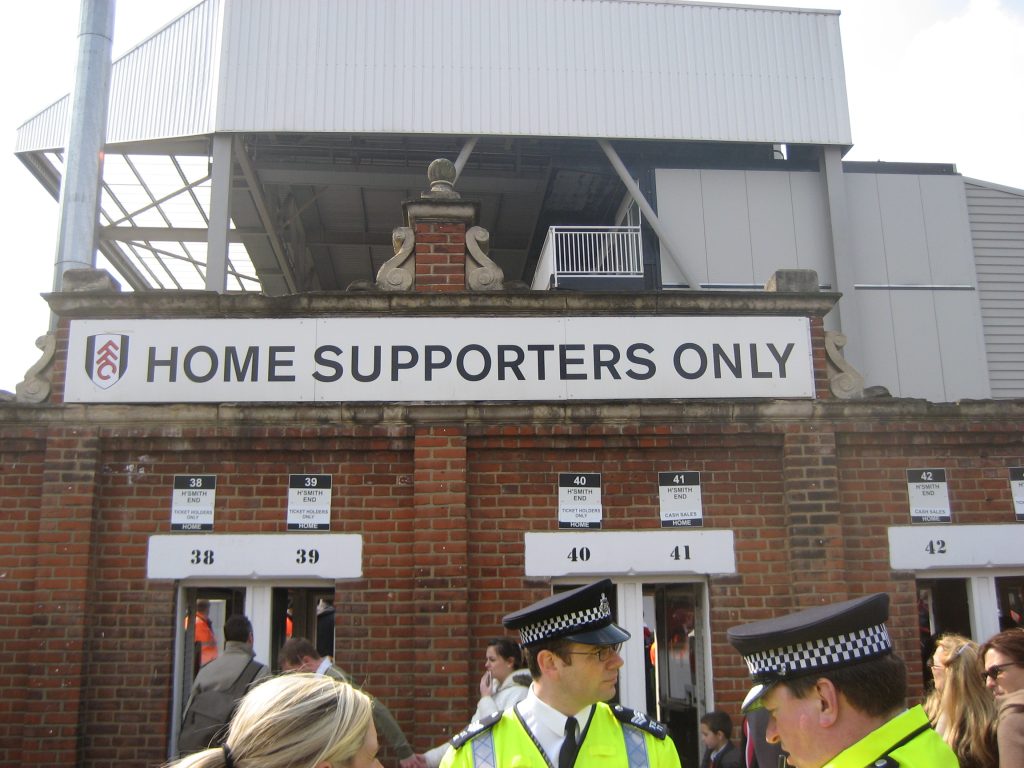
Ed. — Almost 20 years ago, I ventured to the SW6 section of London to report on the Yank-laden Fulham FC phenomenon for espn.com, which posted the piece in two lengthy parts. It lived a good long life online but sadly, now it’s gone. So it’s preserved here. For posterity.
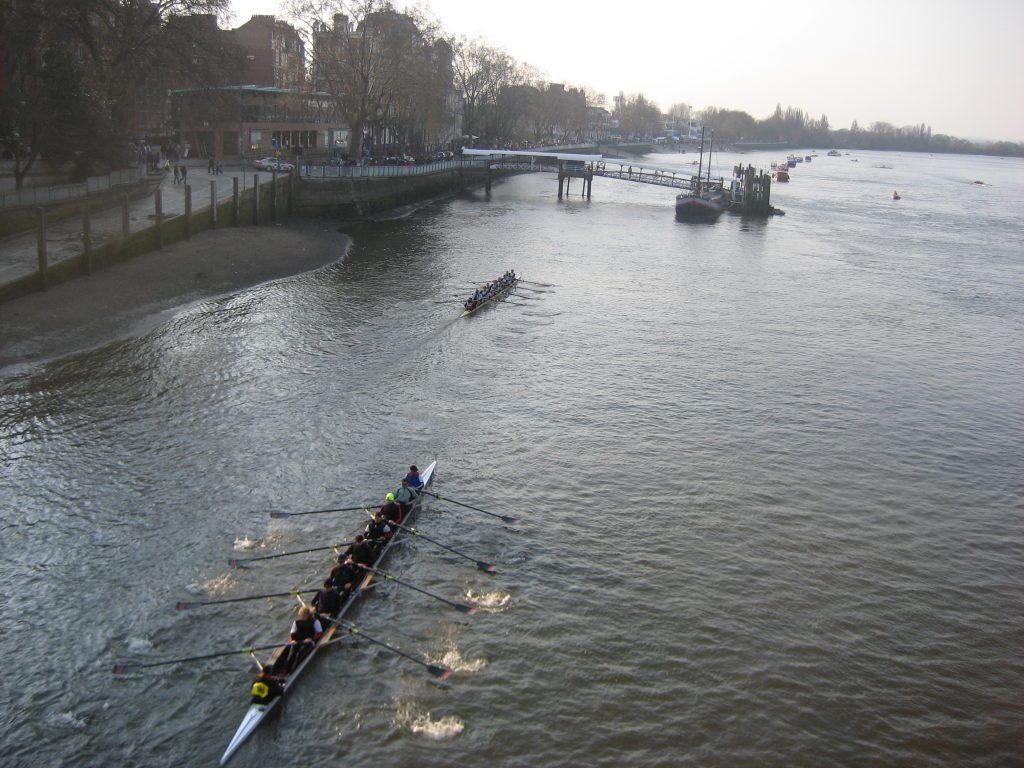
LONDON (March 26, 2007) — There are moments, sublime moments, when spectators sitting in the Johnny Haynes Stand at Craven Cottage can look to the far corner of the ground — where the perpendicular, geometric grandstands fail to meet — and see straight through to the Thames. The river fairly well glistens on sunny spring afternoons like the one we spent late in March, watching Fulham F.C. and its sizable American contingent salvage a 1-1 draw with visiting Portsmouth. Through these gaps in the stadium seating, one spies Putney on the far bank before yet another eight sculls in and out of the V-shaped frame — a window, however small and diversionary, on why FulhAmerica has grown into the Premiership’s most compelling storylines across the pond.
American soccer fans might not know Fulham Football Club from Scunthorpe United if the two shared the same lower division, or and the same critical mass of Yanks on their rosters. But Fulham does play in the Premiership — for now — and the club has made a habit of buying up U.S. talent on the cheap, to the point where Craven Cottage has become ground zero for U.S. futbol fans heading to London to check on our boys.
That was exactly our charge in late March: To stop merely scouring the Internet for the odd mention of Brian McBride, Carlos Bocanegra and Clint Dempsey. To “just go” and see them in person, while sampling those venues where would-be Fulham fans might eat, drink and be merry on either side of Putney Bridge.
We didn’t arrive in South London expecting to watch the club fight for its Premiership life. As it turned out, our late-March visit would prove the club’s last carefree weekend of the season. Having won only twice since Dec. 18, the Cottagers followed their home draw vs. Portsmouth with two successive defeats. The club would sack manager Chris Coleman on April 11, replacing him with Lawrie Sanchez. Fulham’s precarious position — just four points above the drop zone — set the stage for a harrowing three weeks of relegation-avoidance.
FulhAmerica on Thames
None of this appeared at all probable just two weeks prior, when we alighted our District Line train into the spring sunshine. A quick, intuitive look at the London Underground map might lead one to exit The Tube at Fulham Broadway, but that’s miles away — and serves the other Premiership club in SW6, dread Chelsea. Putney Bridge Station is your best point of departure, your gateway to the ground itself, to a fine bunch of pubs and the folks who comprise Fulham Nation.
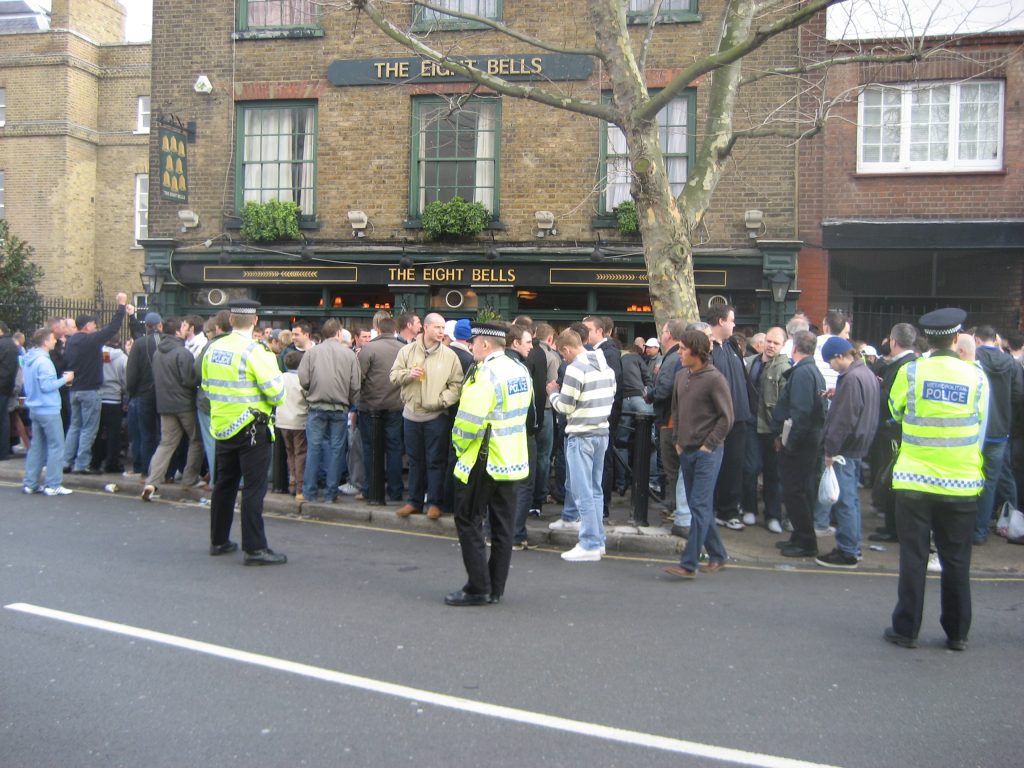
This tidy neighborhood on the north bank of the Thames has everything you need for pre-match entertainment. The closest pub to the Tube stop, however, the Eight Bells, is one designated for away fans. So don’t show up there in your Brian McBride replica shirt. The day we happened by, still some two hours before kick-off, Portsmouth fans had spilled out onto the surrounding sidewalk eight deep and there were dozens of policemen about, mounted and otherwise, to keep the peace.
We didn’t venture into the Bells. Too crowded. But we did, as clear Fulham backers, enjoy a pint and some pleasant chat with several Pompey fans in the Temperance, formerly known as the Pharaoh & Firkin, another de facto “visitors” pub serving Craven Cottage. Just that day, rumors were swirling that Michael Dell, of Dell Computer fame, was angling to buy Fulham F.C. (word of Wal-Mart billionaire Stan Kroenke’s new 9.9 percent stake in Arsenal emerged a week later). One Portsmouth supporter, Paul, politely bemoaned the fact that Americans George Gillett and Tom Hicks had already purchased Liverpool, Randy Lerner had snapped up Aston Villa, and Malcolm Glazer had assumed control of Manchester United, against the club’s will.
“We didn’t think you Americans even liked proper football,” Paul said with a wry smile.
The best Fulham pub in this village is The Golden Lion, directly across Fulham High Street from the Temperance and teeming with locals. Game-day spreads are often served up gratis. The big screen beckons for those without tickets; there’s always someone at the bar ready, willing and able to talk Fulham footy. If you don’t fancy the menu’s standard meat and potatoes, you’ll find a great little curry house (India Cottage) right next door. What’s more, there’s an official Fulham supporters shop just around the corner.
Best Pubs? Over Putney Bridge
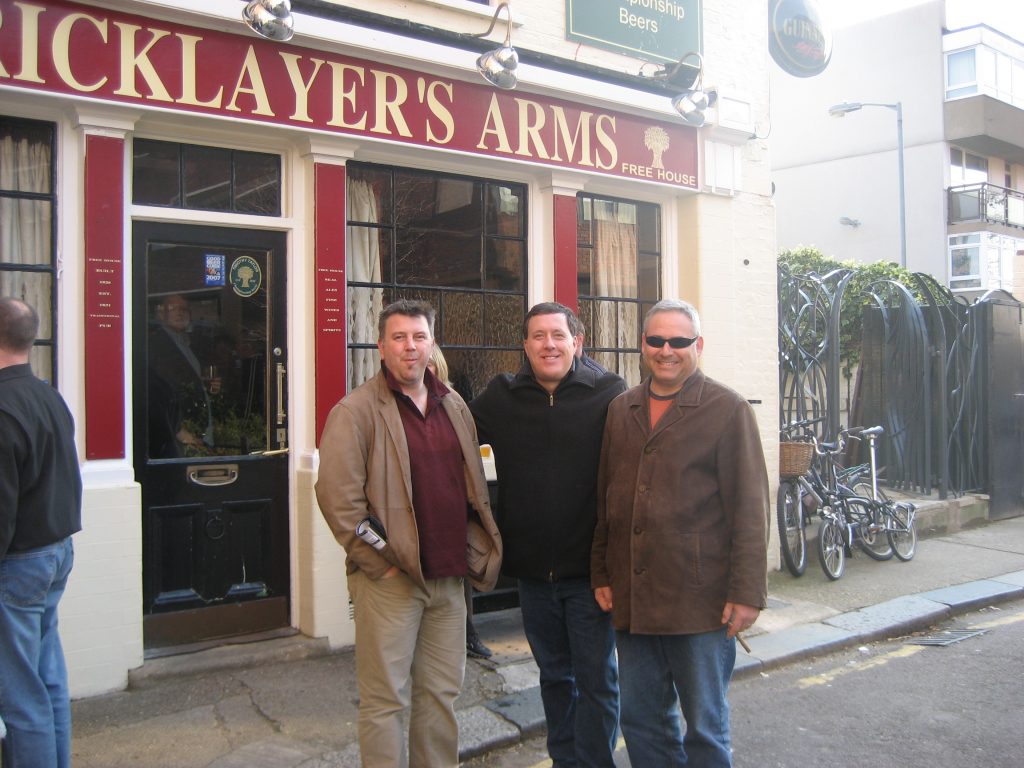
The Larrick represents another solid, pint option here but, truth be told, the best Fulham pubs are found across the river, on the south bank. Just over Putney Bridge — the very span featured as a shotgun-dump in the Guy Ritchie film “Lock Stock & Two Smoking Barrels” — and up a quiet side street sits The Bricklayer’s Arms, an old-fashioned, off-the-high-street, football-supporting, still-proper-pint-pulling public house if there ever was one. Another sign of its legitimacy? No TV. If you’re a purist, they reckon, you’re at the game and the other fixtures don’t much matter.
One Fulham supporter, John from Reading, explained to us that several “football” pubs on both sides have actually gone away of late, and not necessarily for lack of support: “What they’ve done with a lot of these pubs — The Cottage is a good example — is they’ll rip out the insides and turn them into nice, gentrified dining pubs. All the clientele disappear, of course, all the football fans. A good British business model that. Get a load of Ikea furniture and there you go, you’ve got an empty pub. Well done.”
Rest assured, plenty remain. The Whistle & Flute, Half Moon and Coat & Badge — each another block or so south of the Thames — are all cracking venues where, if you show up wearing FFC scarves, you’ll be among friends. But The Brick is the choice here for atmosphere, beer selection (pulled pints of Taylor’s; try the Landlord) and camaraderie.
There is no tailgate scene here. All that social energy funnels straight into these local pubs, where the home club and its fortunes are dissected, lauded and bemoaned en masse, by turn and according to a predictable fixture list. One Fulham supporter at The Brick summed it up quite neatly: “It’s a social life that I don’t have to organize.”
Stadium Approach thru Bishops Park
It doesn’t much matter whether the pre-game pint comes north or south of the Thames. If one’s ultimate destination is Craven Cottage, one is pretty much obliged to approach the ground from the east — directly through Bishops Park, a stretch of riverside green space that surely stands as the most comely stadium walk-up in the Premiership, if not all Christendom.
It’s late Marc, the sun is shining and life is good. Over the coming 10 days, these Cottagers will fail to secure a single point from three games. In two weeks, manager Chris Coleman will lose his job. Of course, as we traipse through Bishop’s Park on our way to face visiting Pompey, no one knows any of this. The mood is buoyant as we join thousands of Fulham supporters for a long journey that nevertheless passes quickly, as befits a walk in the park.
Craven Cottage was built in 1896 and hasn’t been significantly modernized since. Yes, the club has added seating on the Thames side, but the original Johnny Haynes Stand opposite — named for the man who played a club-record 658 games for Fulham and scored 158 goals between 1952-70 — looks all of its 110-plus years. Which is to say, well kept but truly ancient, right down to its original brick masonry, its lattice of exposed ductwork under the stands, and its wooden fold-down seats buffed smooth and dark by eons of intimate backside contact.
Imagine Fenway Park, built for soccer and sitting right on the Charles River — with no plastic and better beer (at two-thirds the price). That’s Craven Cottage, the perfect venue for London’s oldest professional football club.
At halftime, with Fulham scoreless and trailing by a goal, we amble back down under the stand for the traditional beer and cottage pie — like shepherd’s pie, only with beef in place of lamb. We retrieve this sustenance at our leisure, unmolested by great masses of people. Craven Cottage is so small (capacity: 24,600) and, one could argue, so well designed, it never feels crowded. Even if the place is crawling with Yanks.
‘And they do spend’
“Starting in the summer and throughout the season we’ve got loads of Americans coming over,” Graham James tells me. He’s the retail manager at Craven Cottage. “We have a big American fan base now. [Brian] McBride kicked it off really, being the most well known at the moment. Now with [Clint] Dempsey just kicking off his career, we have a younger element coming in. There’s been good progress for American players here, so it’s no surprise they’ve become supporters. And they do spend a lot of money.”
Despite the exchange rate. With banks trading nearly two U.S. dollars for every British pound, it’s ironic (if not surprising) that Americans spend so freely in the Craven Cottage Stadium Shop, where James chats amiably before touching finger to ear and excusing himself. Fulham has stockpiled U.S. players precisely because they are a cheap source of talent. In happier times, Coleman had said of McBride, “For the amount of money we spent and the service he has given us, it has got to be the best £700,000 that anyone has ever spent.”
A cynic would point out that American players provide great value these days while the American consumer, traveling to see them, gets precious little. A small price to pay, however, for nowhere else have U.S. players made such a positive impression on a foreign club, beginning with the 1999 arrival of keeper Marcus Hahnemann (now of fellow Premiership side Reading). Eddie Lewis came aboard in 2000 and while he didn’t exactly set SW6 on fire, his performance didn’t prevent the subsequent acquisition of Carlos Bocanegra, Dempsey and McBride, who, at 34, recently signed on for another season at the Cottage.
Nearly everywhere else Americans play British soccer, they are still seen as something of an oddity. Only at Fulham can supporters view their Yanks with an eye unjaundiced by anomaly.
“With the Premiership these days, it’s almost unusual to see a lot of English players in a side,” jokes John from Reading, whom we met walking back through Bishops Park after the match. “But I think the American players have made their mark now. There have always been good [U.S.] goalkeepers, but now you find them making their mark in the lower reaches of the Premier League. It’ll be interesting to see what happens in the next five or 10 years. If they make the next step in quality.”
“You take a player like Brian McBride,” interjects Ferret, another Fulham lifer now ensconced with us at The Bricklayers Arms, the Fulham pub across the river in Putney, “and I think people see him for what he is: an English-style forward, in the Teddy Sheringham mold. Teddy had skills, wasn’t completely full of flair but he looked after himself, worked very hard, put his head in, and thinks about it.”
Demps Not Yet Come of Age
Even before Coleman’s departure there had been grumbling, from some quarters, that while he was a shrewd judge of young talent, the coach didn’t necessarily develop said talent. John from Reading, for one, fears for Dempsey’s future with the club. “I’m a bit worried about him because I think he’s got a lot of promise. He’s certainly not playing much now, through no fault of his own.”
Indeed, Dempsey did not feature in the 1-1 draw with Pompey. He sat out a subsequent loss at Everton, and only came on for the final 20 minutes in another defeat, home to Manchester City. John from Reading’s mate Tristan reckons Deuce may end up signing next season at a newly relegated Premiership team, or another Championship side, where he’ll get plenty of playing time.
Today, Cottager fans on both sides of the Atlantic are hoping that newly relegated Premier League side isn’t Fulham itself. The April 9 loss to Man City put the club within four points of the relegation zone with five to play. Fulham has 35 points and while no top-flight team with that many has ever gone down, the club’s two remaining home fixtures are no bargain and the team hasn’t won on the road in 13 attempts.
It would be crying shame for Fulham to be relegated. Here’s an underdog club that has gallantly and cleverly carved out a credible spot in today’s top flight; a mere 10 years ago they were a third division side, four levels down. Fulham has earned everything it’s got — unlike the blue-shirted, free-spending bunch who also reside in SW6. If one can get past the fact that Hugh Grant and Daniel “Harry Potter” Radcliffe are counted among FFC’s celebrity supporters, and the club is owned by arch media hound Mohamed Al-Fayed (owner of Harrods, father of ill-fated Dodi), this is a club anyone could get behind.
But the reality isn’t nearly so sentimental. If Fulham does go down, its Americans go down with it. How long will we wait before another Premiership club fields three Yanks? Hard to say, but this much is clear: You can still see them all, in Fulham jerseys, at Craven Cottage on April 21 (v. Blackburn) and May 5 (v. Liverpool). Catch them playing Premiership football while you can.
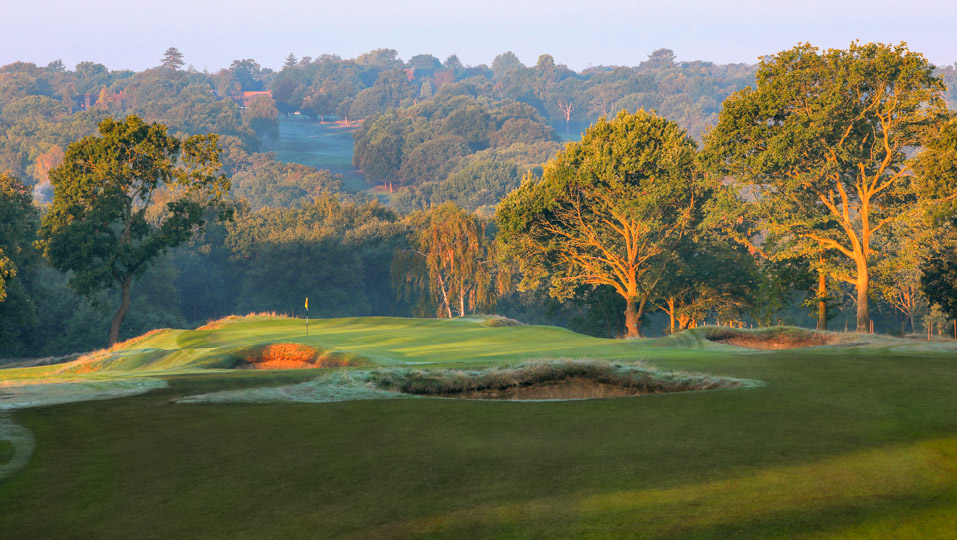
The 11th at Royal St. David's (photo courtesy of Brandon Tucker/WorldGolf.com)
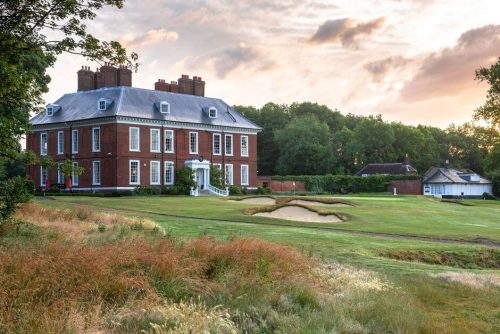
Royal St. David’s Golf Club and its singular Welsh backdrop, Harlech Castle
HARLECH, Wales (July 13, 2017) — The British Open is nearly underway and, while there are myriad reasons to visit the U.K. with your golf clubs, none of them have much to do with British Open venues. Look at Wales, located right next door to this year’s host, Royal Birkdale — to all of England, if we’re honest.The R&A has never staged The Open over this border. Still, the golf up and down the northwestern Welsh coast is outstanding. Welsh golf along the south coast ((Royal Porthcawl, Southerndown, Pennard) is even better.
What’s more, when you venture into this section of the British Isles, you experience a region so remote, so removed from modern resort and tournament conventions, that a golf journey there feels almost Arthurian.
A hefty chunk of the King Arthur legend is Welsh, drawn from early poetic sources such as Y Gododdin. Like the Welsh language itself, theses texts pre-date Roman Britain, much less Christianity. The Druids, the UK’s pre-Christian priestly class, considered the Welsh island of Anglesey sacred. This ancient, mystical aura continues to pervade the country’s dark hollows, its untamed coastline, even its trees. The Celts thought them sacred, you know.
I’m a voracious fan of the historical novelist Bernard Cornwell, whose Arthurian trilogy, The Warlord Chronicles (comprising The Winter King, Enemy of God and Excalibur) were all published about during mid-1990s. Taken together, they represent the best, most accurate and compelling take on the Arthurian tales — and much of the three-book saga takes place in Wales.
Indeed, they made a movie loosely based on Cornwell’s Warlord Chronicles, in 2004 Alas, the film — titled “King Arthur” and starting Clive Owen and Keira Knightly — proved middling at best. But they filmed all the castle scenes in Harlech.
Welsh Golf: Where Worlds Collide
Here’s an example of how this ancient world and the modern golfing world can interact in the UK’s least heralded golf destination:
About 15 years ago my girlfriend, Sharon, who would later become my wife, and I went to visit friends in Market Drayton, Shropshire, just over the Welsh border, in England, and not far from Birmingham. I was there on assignment, writing a travel piece about “where to play in the Midlands” while attending the 1995 Ryder Cup.
We can see what sort of long-term promotional effect that story had: To this day, no one talks about Edgbaston, Beau Desert or Hawkstone Park.
Anyway, we decided to head west a couple hours, over the Welsh border to seaside Harlech, home to Royal St. David’s Golf Club. I had written a letter to the club secretary requesting courtesy of the club (remember written, posted letters?). He had kindly obliged. We three arrived in coat and tie, ready for an audience and perhaps a drink in the bar before teeing off.
Ahead of our game, however, we stashed our clubs in the boot and walked a few hundred meters up the hill from RSDGC to Harlech Castle, which overlooks the course, the town and the entire countryside. Built by King Edward I during his late-thirteenth century conquest of Wales, it served as de facto capital of an independent Wales between 1404 and 1409. That’s when was held by Owain Glyndwr, the last native Welshman to hold the title Prince of Wales.
Try doing something like that within walking distance at Royal St. George’s.
Impressing the Club Secretary
Sharon was a pretty rank novice back then. She had her own clubs and arrived at the club looking pretty darned smart in a turtleneck and one of my vintage sport jackets with the sleeves rolled up (remember the ‘90s?). Still, the club secretary was dubious. I don’t know whether he suspected her inexperience (none of us were asked to present handicap cards), or he was merely a mild sexist when it came to lassie guests playing his course.
Whatever the case, he followed us to the first tee to witness our opening drives. I’m not sure who was made more nervous by this “gesture,” Sharon or myself — but she proceeded to drill one right down the middle, about 210 yards, and off we went. Come to think of it, that may have been the day I decided she was the one.
In any case, Royal St. David’s was and remains fairly sublime. The opening holes are a bit ordinary and flattish, hidden as they are behind (and not amid) the giant dunes at seaside. But the back nine rollicks through some truly extraordinary dunesland. Great stuff.
Welsh Golf doesn’t have to be — some would argue that it shouldn’t be — about resorts and tourism initiatives and tournament-enabled marketing synergies. It’s about watching your future wife stripe one, after mingling with the spirits of rebel kings and pre-Christian sorcerers in a real, live castle. Not to belabor the point, but they ain’t doing that at Birkdale.
The 11th at Royal St. David’s (photo courtesy of Brandon Tucker)
This piece appeared in the April 2004 issue of LINKS Magazine. Above, George von Elm (left) and Billy Burke, combatants in the longest U.S. Open every contested..
TOLEDO, Ohio (April 10, 2004) — The next time you play a round of golf in some modicum of heat and humidity, the next time you trudge up the 18th fairway and feel a bit of lactic acid building up in your thighs, spare a thought for Billy Burke and George Von Elm. These unflinching principals squared off golf’s longest week, the most extraordinary physical and competitive test the game has witnessed. The 1931 U.S. Open was held some 86 Julys ago here at The Inverness Club in Toledo, Ohio. Grantland Rice called their duel there “the most sensational open ever played in the 500-year history of golf.” Burke and Von Elm required 144 holes of medal play to produce a winner: Burke, by a single stroke.
Take a moment to think about the parameters here: 72 holes contested over the first three days, followed by 36 playoff holes on Monday and 36 more on Tuesday. Waged in the midst of a stifling, July heat wave — in an era devoid of fitness trailers, cushioned in-soles, and air-conditioned clubhouses — this match proved golf’s precursor to the Bataan Death March, the games original Duel in the Sun. It was and remains, needless to say, the longest playoff in U.S Open history. Supreme Court cases have taken less time to adjudicate.
Or so it appeared during the morning round on Tuesday, July 6, 1931, as Burke and Von Elm — with 126 holes behind them and 18 still to negotiate — staggered off the 18th green toward the clubhouse for lunch. Even the most callow observer could see the quality of play eroding, under the enormous dual burdens of fatigue and Open-playoff pressure.
Yet Burke rallied to play his finest golf of the tournament over the final 18 holes. Von Elm, too, rose to the occasion and finished but a single shot in arrears.
“I looked for a rather ghastly finish to a grand struggle,” wrote O.B. Keeler in The American Golfer. “Instead it was, and ever shall remain in my mind, the most remarkable exhibition of recovered stamina and poise and of sheer staying power and determination I have ever witnessed.” Legend says that Von Elm, a lithe figure with little to lose, shed nine pounds during the championship, while the stocky Burke managed to gain two. “A circumstance,” Keeler mused, “which, if accurate, gives rise to wonder as to his diet.”
Golf’s Longest Week required No Jones
The first major of of 1931 was the first “Jones-less” U.S. Open since 1920. The Emperor had retired from competitive golf following his epic Grand Slam the year before, and while he was on hand at Inverness, the golfing public was anxious to see just who would fill the considerable void. Golf’s professional class was especially keen. Bobby Cruickshank admitted he and colleagues were delighted to see Jones in the gallery, as opposed to the field.
Nineteen thirty-one was also the year competitors were obliged to deploy the so-called “balloon ball” during Open play. This larger and lighter spheroid didn’t prove popular at Inverness, as competitors complained loudly that mis-hits were exacerbated by the new-fangled thing, which neither carried nor rolled as far. After just one year, the USGA would junk it — returning to the previous, heavier guideline of at least 1.62 ounces, but keeping the balloon’s larger size (1.68 inches in diameter).
Yet the weather soon quelled alltalk of balls and would-be kings The heat was oppressive by any discernible measure. Contemporary accounts of the championship are littered with modifiers like blistering, blazing and sweltering. Golf Illustrated‘s “special correspondent” noted that “The field was all on hand early for practice several days ahead of time, but so intense was the heat that on these practice days no one with any chances to jeopardize played more than nine holes of golf.”
The mercury registered 105 degrees on Friday, July 2, the first day of competition. It was no cooler on Saturday, when Von Elm served notice to the field with a 69, the tournament’s low round. His 36-hole total of 144 led 63 players who made the cut; Burke stood one stroke back. Thirty-four years would pass before before the USGA extended the Open format to 18-holes on four consecutive days, so Von Elm’s 73 on Sunday morning placed him two shots clear of Burke with the afternoon round still to play.
By lunch time, temperatures hovering between 97 and 99 degrees. Igniting one of his trademark cigars (he would go through 32 during the championship), Burke went off in the penultimate group with Johnny Farrell, while Von Elm and Al Espinosa formed the final pairing.
Espinosa and Farrell had fallen from contention with substandard third rounds; by Sunday’s final nine, it was essentially a two-man race, with Von Elm in the driver’s seat. Standing on the 12th tee, he led Burke by two strokes but Von Elm would stumble over the next six holes, playing them in four-over. Burke parred the 18th to post a 292, meaning Von Elm needed a birdie 3 to force a playoff. He did just that, calmly draining a 12-footer as the breathless, sweat-soaked multitudes gathered a green’s edge.
With its extraordinary fugue of physical demand and competitive drama, Sunday’s play (the presumptive 36-hole finale) might have gone down as one of the most thrilling days in Open history.As it turned out, the tournament was just half over.
Businessman Golfer vs. the Club Pro
A dapper, big-hitting Californian, Von Elm isone of those curiously recurring characterswho isn’t particularly well known but nevertheless continues to crop up as one leafs through the pages of golf history. He won the U.S. Amateur at Baltusrol in 1926, defeating the great Jones, who had claimed the two previous titles and went on to win the Amateur in 1927 and ’28. Only Von Elm kept him from winning five in a row.
A seasoned 30 years of age when he arrived at Inverness, Von Elm was hardly new to golf marathons. During the 1930 Amateur at Merion, he played the longest extra-hole playoff in U.S Amateur history, going 28 holes before succumbing to Maurice McCarthy. What are the odds the same man would participate in both the longest U.S. Amateur playoff and the longest U.S. Open playoff — and lose both?
The defeat at Merion effectively ended Von Elm’s auspicious amateur career. From that point forward he would compete as a “businessman golfer”, meaning he would accept whatever prize money his finishes might earn. This proved a prudent if slightly unorthodox vocational step. According to Herbert Warren Wind’s Story of American Golf, Von Elm’s earned him some $8,000 in January and February of 1931 alone, a veritable king’s ransom in Depression-era America.
Burke, on the other hand, was a 29-year-old, bonified professional of the club variety, playing out of swanky Round Hill in Greenwich, Conn. Born Billy Burkauskas, the Nutmegger spent a portion of his young adulthood puddling iron in a Naugatuck, steel mill. His swing was a tad awkward, and Von Elm outdrove him on nearly every hole. That said, “Temperamentally,” Keeler observed of Burke, “it is difficult to suggest an improvement.”
Some have painted Burke’s showing at Inverness as something of a shock result, but contemporary accounts tell a different story. It’s true that 1931 marked the club pro’s first real foray into national, tournament competition. Yet Captain Walter Hagen shrewdly named Burke to his 1931 Ryder Cup team. Tthe matches took place a week prior to the Open, at nearby Scioto, where Burke won each of his foursomes encounters and his singles match — the latter by 7&6.
Indeed, his cracking Ryder Cup form made him something of a fashionable dark horse entering the U.S. Open at Inverness.
Timeless Terrain in Toledo
The 15th at The Inverness Club.
The championship layout at Inverness, like many of its early-20th century counterparts, has undergone considerable change over the course of a century. The course we know today was created by Donald Ross, who renovated an existing nine and added a companion loop prior to the 1920 U.S. Open. A.W. Tillinghast prepped the course for the 1931 event, and half a dozen different architects have tinkered with it since. Inverness held the Open again in 1957 and 1979, enduring pre-tournament preps each time. [Architect Andrew Green would renovate yet again in 2017, then revisit once more in 2024.]
Despite all this, the ground itself at Inverness has remained essentially unchanged since the last ice age, when a pair of rivers carved two distinct valleys from the sandy soil just south of Lake Erie. “The course has always been laid out across these two gorges,” explains Tom Walker, course superintendent at Inverness since 1980. “The elevation change is about 30 feet, which isn’t a whole lot. But you’re continually playing across these valleys, walking down and coming up the other side. I would not classify this as an easy walking course, not by any means.”
The U.S. Senior Open was held at Inverness in 2003. Sort of ironic, as it’s the only Senior PGA Tour event where the competitors are obliged to walk.As Burke and Von Elm learned — as Bob Tway learned, before he hold out on the 72nd green to beat Greg Norman at the 1986 PGA Championship; as modern seniors learned a decade later — holes 1, 10, 12, 14, 15, 16, 17 all span at least one of these gorges. The other ravine requires similar hikes on holes 4 and 5. As the layout was configured back in 1931, no. 7 required yet another valley crossing.
Walker caddied at Inverness during the 1960s: “I didn’t necessarily enjoy it, especially in July. It’s no walk in the park. To think that these guys — and their caddies — walked 144 holes in five days, in that heat… I think that’s an incredible feat. Just the mental aspect, let alone the physical aspect.”
According to Walker, whose livelihood depends on an accurate meteorological understanding, a typical July day in Toledo is “muggy”, meaning 85-92 degrees with relative humidity of 50-60 percent. During the Open of 1931, these conditions would have qualified as refreshing cold snaps, as temperatures consistently soared into the upper 90s and beyond.
It was, in short, extraordinarily hot.
How hot was it? Nine players who made the cut at Inverness chose instead to withdraw, including two — Albert Alcroft and J.M. Hunter — who reportedly tore up their scorecards after the third round and went fishing. By comparison, at Interlachen the year before, just three Open competitors who made the cut chose to withdraw.
Either it was quite a bit hotter at Inverness, or the fishing just isn’t that good in suburban Minneapolis.
But seriously, folks: How hot was it? Here’s all you need to know: The USGA would never again stage its Open Championship during the month of July.
Monday, Monday: Head to Head
Burke watches Von Elm’s bunker shot come to rest during Tuesday’s final 36 holes at Inverness.
Following Von Elm’s 18th green heroics on Sunday, he and Burke rejoined their Open battle Monday morning. For the first time, the two combatants played alongside one another. The results proved predictably dramatic.“This playoff changed complexion at least 15 times,” Rice wrote in The American Golfer. Indeed, Monday’s remarkable give and take left the normally verbose Keeler at something of a loss: “I saw altogether too much… to make any sensible selection of features from such a wealth of them.”
Von Elm fell four strokes back at one stage, only to birdie four on the trot and reclaim a two-stroke lead. Burke was steadier, and by the time he reached the 36th tee — the 108th, all told — he held a one stroke cushion.
Then, as now, the 18th at Inverness is a short par-4 of just 330 yards. This is where Tway’s birdie from a greenside bunker defeated Norman during the 1986 PGA playoff. This is where Von Elm’s birdie at Sunday’s 72nd hole forced the 1931 Open playoff. Once again, on Monday, Von Elm needed a birdie 3 at the last to fend off defeat. And once again, he delivered — holing a 10-footer and forcing another 36 holes the following day.
Burke and Von Elm trudged on, playing the Tuesday morning 18 amid unrelenting temperatures — into the high 90s by 10 a.m. They played like the exhausted, punch-drunk combatants they had every right to be. Each shot their worst rounds of the tournament, though Von Elm’s 76 nevertheless afforded him a one-stroke advantage at the break.It looked for all the world as though the 1931 Open winner would be meted out by attrition.
And yet, as Keeler noted above, after lunch both players rose magnificently to the occasion. Burke went out in one-under 34, building a two-stroke advantage. Von Elm fought back and drew level with a par on 13. But Californian’s putter deserted him on 14 and 16, where three-putt bogeys essentially sealed his fate. The man whose putter had saved him Sunday and Monday betrayed him on Tuesday afternoon. He shot 73, with 35 putts.
When Von Elm’s long birdie attempt on 18 didn’t find the hole, Burke had the cushion he’d long lacked. Before addressing his own 25-foot birdie attempt, Burke was regaled by a green-side photographer: “Say, Burke, how about a shot?” With 143 holes behind him and poised to claim golf’s greatest prize, the unflappable Burke obliged the press corps by producing a winning smile. “Go ahead,” he said. “I’ve got three putts to make it.”
He would use all three.
Despite this cautious lags on 18, Burke’s exquisite, even-par 71 was his lowest round of the championship. “There is no need to gild a par round at this stage,” the sage Keeler remarked. “It speaks for itself.”
FORT LAUDERDALE, Fla (June 14, 2017) — Keith Mitchell won last week’s Honda Classic, besting Brooks Koepka and Ricky Fowler with birdie on the 72nd hole. See above. The headline writers at the Palm Beach Post were less than impressed. Behold, more evidence that golf sorta hates a Cinderella story. Mitchell’s win in actually the latest case study in golf’s curious-but-pervasive Cinderella Complex.
That giant sucking sound you hear? That’s the disappointment of U.S. golf fans and sports writers made manifest. Yet another “nobody” had made off with a PGA Tour title that should have gone to one of our major champion darlings.
Intellectually, golf fans recognize that the lowliest shit-kicking tour pro can beat two-time defending U.S. Open champion Brooks Koepka on any given day — as Mitchell did so bravely and cannily here at last week’s Honda Classic. It happens all the time. It’s part of what makes tournament golf so interesting.
What’s less clear is why such a result leaves so many golf observers so very cold. Why are golf’s surprise winners Humpty Dumpty, not Cinderella? We quote Carl Spackler often enough. When an actual underdog comes out of nowhere, why do we root against him?
This phenomenon has been eating away at me for decades. Perhaps, like me, you’ve wondered aloud why golf fans rooted for Tiger Woods so ardently all those years, while rooting against the likes of Bob May, Y.E. Yang and Trip Kuehne.
There will always be a minority who root against Tiger or Phil or Justin, I suppose. But it is a distinct, vanishingly small minority in golf, especially compared to our rooting habits in other sports. Why?
Given a choice, we prefer to live in singular times. It’s one reason why we can’t take our eyes off Tiger, or Dustin, or Rory — and continually compare them to Nicklaus, Palmer and Trevino. They are the best of our time, and something inside us craves the inevitable comparison with previous “all timers”. This urge to confirm that our stay on Earth spans momentous periods in history is why Grampa still natters on about the severity of snowstorms in the 1940s, why he prefers ballplayers from the 1950s. It’s why we have something called The Greatest Generation.
Cinderella Story: Resisting the Irresistable
But we also root for underdogs because their stories are irresistible, right? Only a neutral cad (or a Patriots fan) could have rooted against the Rams in the most recent Super Bowl. Who but a Yankees fan doesn’t routinely back anyone who might face them in post season? When UCLA won those 88 games in a row under John Wooden, who didn’t root for someone to knock them off?
But golf, or some reason, is different.
It’s long been my feeling that we golf fans, we golf media harbor a most peculiar Cinderella Complex — an Underdog Aversion, if you will. When confronted with the prospect of a title going to Keith Mitchell, or (more to the point) a major title going to Todd Hamilton, Ben Curtis, Mike Donald, Rich Beem or Charl Schwartzel, a good many of us reflexively bridle. We root against them.
Think back to 2004, when Hamilton’s tentative 2-iron faded into the right rough on the 72nd hole at Royal Troon. This is where I first recognized this counter-intuitive emotional tug — in myself. Surely this is where the wheels come off, I thought, when Hamilton’s tee shot went astray. The steely, tactical golf he’d displayed through 71 holes of the Open Championship had been admirable and courageous on so many levels. But clearly, this was the first of several lug nuts to be loosened in the glow of Els’ consecutive birdies at 16 and 17.
And here is the truly dark and twisted part: The emotion we golf observers experienced at Hamilton’s apparent collapse wasn’t disappointment. It was relief. Deep down, something inside us wanted this to happen. Somehow we all felt it would be more satisfying to have a “name” victor. But honestly, why would I root against Todd Hamilton? Why would anyone?
Underdog as Interloper
We had the same feeling the year before when Ben Curtis, playing several groups ahead of the leaders, slowly emerged as the unlikely favorite at Royal St. George’s. As the no-name Ohioan waited in the clubhouse (he finished early and watched the leaders all fall away, you’ll recall), an anxiety permeated golf’s fandom and media horde. Surely, we reasoned, Tiger or Thomas Bjorn or Vijay Singh would do what their pedigrees demanded of them — what we demanded of them — and claim the Claret Jug from this… interloper!
I felt it, and it wasn’t a new sensation. I had the same feeling when Tiger and Bob May dueled at Valhalla in 2000. Great tournament. Great playoff. Great major victory. But would golf fans and media have thought so if May had prevailed instead? I don’t think we would. Why are golf fans so underdog averse?
The simple answer, though not the most flattering assessment, is that golf fans and golf media are flagrant front-runners. We want champions to win again and again, and we are curiously galled when someone like Curtis or Rich Beem or Orville Moody or Tommy Aaron wins/absconds with a major. Indeed, we find ourselves rooting against them as the tournament plays out. Looking back, we contort ourselves in order to explain them away. We even blame certain courses (Olympic) for not producing proper major champions.
I went back and checked the TV ratings from the 2004 British Open. Sunday’s telecast pulled a 4.6 — a solid number considering Hamilton, this relative unknown, came out of nowhere to hold off one of the sport’s biggest stars (Phil Mickelson) and nip another (Ernie Els) in a playoff. Compare that number to the record 6.4 share achieved on Sunday in 2002. That British Open, at St. Andrews you’ll recall, was done and dusted by Saturday noon. The entire Sunday broadcast was completely devoid of competitive drama, a simple coronation for Tiger Woods. Yet it was the most watched Open Championship in history.
The record U.S. Open TV rating? It came just a month prior, when Tiger won by 15 strokes at Pebble Beach. What else but overt front-running hero-worship could explain numbers like these?
This goes Deeper than Media Hype
It would be easy to blame the media for this phenomenon, which persists to the present day. With 24/7 capacity, it churns out a stunning amount of analysis and prognostication. Inevitably, all this talk, all these words and imagery ultimately center on known quantities — our stars, our heroes, the odds-on favorites. It’s not unreasonable to assume this would have an effect on our involuntary rooting interests.
However, I think it goes deeper than that and predates the modern media age.
Bobby Jones wasn’t just favored to win every time he teed it up; fans preferred that he win time after time. Ben Hogan had won 8 majors by 1955. Yet when he faced down Jack Fleck in the U.S. Open that June we didn’t root for Fleck. We preferred the Wee Ice Mon win another one.
Sometimes the outcome we staunchly prefer does hold, whereby a sort of anti-Cinderella justice is done (read: Van de Velde at Carnoustie). Other times the impossible happens (say, Fleck slaying Hogan at Olympic in 1955). In either case, we might have enjoyed the rags-to-riches theater through 70 holes, but when push came to shove we wanted the proven quantity to prevail.
The uncharitable way we view these David vs. Goliath duels, in retrospect, is revealing. Fleck, after all, is only a single letter from fluke. Fate clearly intervened on his behalf — and we’re still irked about it. Beat the Great Hogan? How dare he!
Admit it: When Steve Jones nipped Tom Lehman at the 1996 U.S. Open, when Scott Simpson held off Watson at Olympic in ’87, when unfancied Michael Campbell bested Tiger at Pinehurst in 2005, when Zach Johnson slayed Goosen and Woods in the ’07 Masters, when Lucas Glover outlasted Mickelson at Bethpage in 2009, the results were tinged with disappointment. In major championship golf, we want our stars to come through.
Y.A. Yang at the 2009 PGA: Were you rooting for him? I mean, why would you NOT root for the first-ever Asian to win a major. Still, I’m betting that you treated him exactly like you treated Rocco Mediate during the 2008 Open at Torrey Pines — pleased to see him fight so gamely, but ultimately hoping to see Tiger prevail.
I’m sorry. That’s twisted.
Unique to Golf
I don’t see this dynamic as nearly so fully developed in other sports. Yes, there are some who delight in team dynasties — mostly media, as it makes prognostication, the new modus operandi of sports punditry, easier — but no one begrudged the Patriots their miracle Super Bowl victory in 2001. In much of the country, rooting for the Yankees to win yet another World Series is akin to backing the tanks in Tianamen Square. And so we delighted in the Marlins and Diamondbacks having their moments in the sun, in 2003 and 2001, respectively.
Golf is different — but not because it’s an individual sport. Do we not root against Venus Williams, then Serena, now Federer and Nadal once their major victories become so common as to seem preordained? Okay, maybe in the quarters we root for Federer, to set up a killer final vs. Nadal. But in that final, should someone like Robin Soderling gain it, as he did in the recent French Open final, we root for him — the Cinderella story. Track and field history is littered with inspirational tales of underdogs who claimed Olympic gold and, by their unlikely efforts, our hearts.
But golf, for some reason, engenders a different sort of response.
There’s a corollary to this dynamic that pertains to venue. In retrospect, for example, some observers consider Open winners from the Olympic Club in San Francisco — Fleck (over Hogan), Casper (over Palmer), Simpson (over Watson), Janzen (over Stewart) — and conclude the course is somehow diminished because it doesn’t produce “great champions”, whereas a track like Pebble Beach (Nicklaus, Watson, Kite, Woods) does.
This, of course, is a canard of the first order, brimming with conceit. No one doubts the rigor and major-championship fitness of, say, Oakland Hills, even though it served up champions like Andy North and Steve Jones. Indeed, Hogan won there in 1951 and Gary Player in the ’74 PGA.
Conversely, does Tiger’s win at Valhalla peg the layout as “great champion producer”? I think not.
But you’ve heard these arguments. It’s part of golf trying to cover its tracks — those left by glass slippers. If Orville Moody wins the Open, there must be an explanation (Champions Club in Houston: poor venue). Yet behind this sort of prattle we see again the front-running gene seemingly inherent to golf’s rooting interests. When our heroes fall short of the brass ring, we politely applaud the underdog and blame the golf course.
We Overvalue Historical Affirmation
History, so central to golf, plays another role here. We prefer our championships, especially our majors) to be memorable affairs. Major titles are the sticks we use to measure a player’s place in the game’s ongoing epic. We want to believe Nicklaus won 18 majors for a reason. By the same token, we want to believe there’s a tangible reason why Colin Montgomerie and all the other unfortunate souls — from complete unknowns to those who’ve worn the Scarlet BPNTHWAM (“Best player never to have won a major”) — haven’t. The prospect of Mike Reid running away with the 1989 PGA just wouldn’t have satisfied. Thank goodness Payne Stewart eventually reeled him in, eh?
Basically, until you’ve won a major, you’re not even on the radar screen of history. At best you’re an outsider with delusions of grandeur, a bit player on a grand stage with the gall to challenge golf’s natural order. As golfers, we accept as fact that the crucible of major championship play will validate the winner as a “major champion”. Golf fans really, really want to believe that major winners are a breed apart.
It’s commonplace, of course, for lesser-knowns to win from week to week on The PGA Tour — more so nowadays when top 30 players are so rich, they play increasingly abbreviated schedules, thereby diluting fields. But we have different expectations for major championships. We expect them to produce something better. Otherwise, what exactly makes them so “major”?
Since 2002, there have been 64 major championships contested. Of those, “name” players have won all but 15 of them. That means nearly a quarter were claimed by underdogs: Cabrera, Glover, Cink, Yang, Immelman, Johnson, Campbell Hamilton, Weir, Curtis, Micheel, Willett, Schwartzel and Beem (I gave the benefit of the doubt to Geoff Ogilvy, Jim Furyk and David Toms who seemed just too well established to include here). Golf is actually in the midst of a relative Cinderella drought: Only Willett would qualify from any of the last 20 major winners.
Yet this truth remains; While winning a major championship might buttress the reputation of an established star, simply winning one does not validate an underdog as a “great” player. In an ass-backward sort of way, the victor validates the major — and the venue. This, in my view, sits at the heart of golf’s confounding Cinderella Complex. Despite all the drama such a Cinderella story might provide, ultimately we prefer that majors not be tainted by the ambivalence we attach to that sort of victory.
PORTLAND, Maine (May 29, 2017) — Landlord stories are rarely nostalgic. I was fortunate to close my decade-long apartment period with two amazingly positive experiences. When I moved to Portland, Maine 35 years ago — abandoning Greater Boston for what I then considered the ends of the Earth — I lived the first 2-3 weeks at the expense of my new employer, in the city’s lovely West End. The leafy environs there reminded me of the Back Bay. I lived above the carriage house attached to the super cool Pomegranate Inn, a B&B owned by aging, urban hipsters and strewn with modern art.
My studio over the carriage house was so spacious and funky, I fantasized about staying there forever. I met Landord Hall of Fame nominee Frank Rodway only because, eventually, I had to find my own place.
Back in 1992, Frank was owner and proprietor of Thomas Brackett Reed House, a 19th century brownstone once inhabited by and eventually named for a former Maine Congressman and Speaker of the U.S. House of Representatives. When I met him, Frank was a small, trim, 60-something fellow with a vaguely military bearing. Before he walked me upstairs to the third-floor apartment then available for rent, I mentioned my two cats, Scott and Zelda. “Oh, well, we don’t take pets here,” he said.
Frank showed me the place anyway, which gave me the chance to pursue an historical charm offensive. The 1-bedroom space was great: 13-foot, pressed-tin ceilings; windows stretching from the baseboards to somewhere above my head; hardwood floors; $525/month — heated! What’s more, I had just finished The Proud Tower, Barbara Tuchman’s magisterial history of Thomas Brackett Reed’s very heyday: turn of the 20th century, when America was slowly transitioning from insular, adolescent republic to imperialist bestrider of worlds.
We mixed it up, Frank and I, trading Mark Hanna anecdotes, book citations and recommendations. Half an hour later, as he and I were walking downstairs, I mentioned that it was too bad about the cats. “Oh, don’t worry about them,” he said.
Landlord Stories: In Memoriam
Frank Rodway passed away this past January at the ripe old age of 91, the result of a fall on icy pavement as opposed to simple old age. I was among five former residents of Thomas Brackett Reed House who showed up to his memorial service in South Portland. I mean, who does that? Or rather, what sort of landlord inspires that sort of gesture?
TBR House was a different sort of rental property: An historic landmark, for starters, watched over by a guy, Mr. Rodway, who knew the history but also how to engender esprit de corps.
His quite elegant building had a guest apartment on the first floor that tenants could rent for $25 a night. I routinely stashed my parents and visiting Greater Bostonians there. Every Christmas, that guest room and the entire first floor played host to Frank’s holiday party, a shindig that routinely proved the event of the season. Current and former residents alike renewed acquaintances and partook of Frank’s legendarily strong punch.
I should never have known Steve Weatherhead and his lovely wife Annetta; they departed TBR just before I arrived. But I met them at these holiday parties, along with eventual golfing buddy Michael Moore. At Frank’s funeral service, Steve recalled these parties among other things, but not before answering the question that opened his remarks: “I mean, who goes to their former landlord’s funeral?” Well, if it’s Frank Rodway, you go. He was one of a kind, as this obit (clearly written by the man himself) attests.
All about the Eaves
Another former TBR denizen in funeral attendance was one Mary Fowler, my upstairs neighbor and the first real friend I made in Maine. She remains one, but I thought of her again, in the immediate aftermath Frank’s memorial, when Mary Tyler Moore passed away. Mary Fowler and I had a running joke, each of us claiming to be the Mary to the other’s Rhoda.
“Hal,” she would start in, with not inconsiderable finality, “Rhoda was the loud Jew and Mary was the tactful WASP. And my name is Mary. Clearly, I am Mary and you are Rhoda in this relationship.”
“But May-uh,” I’d respond in my best Brooklyn accent, “while all that is true, you live upstairs in the apartment crowded by charming eaves, while I reside in the open and airy apartment downstairs. Cultural heritage has nothing to do with it. It’s all about upstairs, downstairs and picture windows. All the action takes place here, in my apartment. There are no eaves here. These are 13-foot, pressed tin ceilings. It’s all about the eaves!”
These weren’t idle observations because, in my house growing up — a place wherein very little commercial television was deemed suitable for viewing — The Mary Tyler Moore Show and, for that matter, The Dick Van Dyke Show were both sanctioned programming.
I’m confident that I know every last episode of the MTM Show, from the moment she walked into WJM with her long hair and hippie-short skirts (“Murray, get me that list of words Ted mispronounced on the show last night.” Get a load of the top one, Lou. “Chicago?!”), to the episode Rhoda moved out — and onto her own show. I remember when Mary and her ’70s bob moved to that high-rise, modern apartment downtown. Characters came and went, got their own gigs (“Phyllis”), became more prominent over time (Sue Ann Nivens was just a bit player at first), or fell away without so much as a goodbye — sorta like folks who eventually hid their lives away by moving out of Thomas Bracket Reed House.
I absorbed dozens of sitcoms through the years, some darned good, some quite retrograde. But never did I attach myself emotionally to characters quite like I did with Mary Tyler Moore. I was young and impressionable, but when Gavin McLeod took over as captain of the execrable Loveboat, I felt culturally betrayed. It seemed beneath him — then I learned he was born again… Rhoda had, by contrast, gone off to New York City, got married, then divorced, and pretty much stayed in character all along. That spinoff made sense; that’s what people did. That’s what Mary Fowler, Steve and Annetta, Michael Moore and I all did.
When the curtain finally came down on The Mary Tyler Moore Show, after delivering a predictably classic final episode (not an easy trick; try watching the last episode of M*A*S*H or Happy Days), I had trouble adjusting. MTM’s turn as the icy mom in the film Ordinary People was clearly great acting, a little too great. Apparently the real Mary would later develop (then beat) a drinking problem, too. It was all too much. What Mary needed was a good Christmas party where we viewers could get together with all the actors and sort the real from the imagined.
Lifestyle Cardboard Cutouts
The basement at Thomas Bracket Reed House was a dark and dank place, a little dank for storage it seems to me now. Against the musty north-facing wall, a bank of coin-operated washers and dryers rattled and hummed. We residents were obliged to go down at least once a month. One of those times I was taken aback by Frank Rodway lurking in a corner.
Actually, it wasn’t Frank but a life-sized carboard cutout of the man, a vestige of his own, unsuccessful run for the U.S. House of Representatives in 1966 (“Let’s be Frank: Rodway for Congress!”). I was quickly taken with this black-and-white rendering and asked Frank if I could rescue it from obscurity and keep it in my apartment. He seemed flattered, assented, and there it stood in a corner of my living room for most of the three years I lived in TBR House. I even took it with me to the place I ultimately shared with Sharon, once we got engaged.
Marriage reveals a lot about a person. Like good taste. Turns out that a goodly portion of the furnishings I brought to the marriage Sharon never truly loved. The Frank Rodway cutout she found particularly “creepy,” apparently. Somewhere along the line, this admittedly bizarre tribute to my last landlord got junked.
I thought about all this while sitting in the South Portland funeral home listening to Frank’s many nieces and nephews (he had but one daughter, who died young) tell stories about their sui generis uncle. Frank may have been a bit older, Mary Tyler Moore probably a bit taller. My lasting image of him was cardboard; of her, pixelated celluloid. But they now reside together for all time in some pressed-tin corner of my mind.
SUGAR GROVE, Ill. (May 5, 2017) — For all the trans-Atlantic DNA we share with our British cousins, it’s easy and, I daresay, natural to assume that UK college golf is pretty much a comp for the exercise here in the U.S. Not so. Not today, not forty years ago when I played for the University of London.
Today, top players from the U.K. (and mainland Europe) routinely travel stateside to hone their games at American colleges and universities. At scale, this “study abroad” drains the bBritish collegiate game of talent, obviously. Indeed, many of these men, women and their games will be on display here later this month (May 19-31) at Rich Harvest GC, site of the 2017 NCAA Championships.
But why do they make this trip in such appreciable numbers? Because collegiate golf in the U.K. — like all college sports there — is decidedly low-key, even compared to the low-stakes Division III golf I played at Wesleyan University in Middletown, Conn., during the early 1980s.
For my money, however, one can place UK college golf alongside proper ale and period cinema as something the Brits still do better, with more nuance and panache. Yes, our universities turn out more tour professionals, but for the majority of college golfers, in both countries, that’s not the point. It’s about competition and its sensible integration with the game’s social niceties — and no one does that better than the British upper crust.
That posh ethos dominated my university golfing experience abroad: Coats and ties, foursomes in the morning, singles in the afternoon, and no less than two proper English piss-ups sandwiched between them. You can have your vans, your matching shirts and golf bags. To Yanks, collegiate golf in the U.K. may look and feel more like a club sport. Having played both sides of this fence, I’ll go with the Pommies.
UK College Golf: No Vans
At mighty Wesleyan, a perennial golfing doormat, the exercise during the ‘80s remains recognizable: Throw on a pair of khakis and a golf shirt; pile into a van and meet a different college team, or two, at the course venue. We’d play 18 holes of medal, shake hands, tally up the scores, pile back into the van and drive home to campus. Big-time Division I golf schools don’t play many dual or tri-matches like these any more, I understand. More often they play various invitational tournaments whereby dozens of schools show up in one place, seven guys from each team play medal, and the best 5 scores count. We did this, too, though only once or twice a season.
Collegiate golf in England during the mid-1980s, when I played for the University of London, was nothing like this. Nothing. For starters, and perhaps most important, we rarely played other schools. Instead, university teams were hosted by golf clubs themselves, which trotted out their best players for a day of intergenerational match play and assorted reverie. Here’s a typical match-day regimen:
Put on coat and tie, pack some golf clothes in your golf bag and hump it to the nearest Underground station. Yes, we all got ourselves to the golf course, somehow — by bus or subway or some teammate’s car. We played a lot of matches in Greater London, at places like Roehampton and Royal Wimbledon, and I fondly remember riding the Tube with my golf clubs in tow.
Having arrived at the club, we would literally partake of tea, crumpets and scones with our opponents. As with most British golfing clubs back then, coat and tie were mandatory in the clubhouse, hence the need to dress for breakfast. The University of London Golf Team never once faced another school the entire semester I participated. We played the top 7 amateurs at various clubs who had deigned to host us for a day of matches. They were damned good players, as you might imagine, and they took great delight in showing off their home courses and, more often than not, kicking our asses around them.
The 13th at Royal Wimbeldon GC.
Thirty-six holes, Two Outfits
Our first change of address took place in short order, after tea. We’d slip into golf attire and head out for 18 holes of foursomes, or alternate-shot, at match play. This was great fun but very, very difficult. We typically see this format only in the Ryder Cup or President’s Cup contexts. Even then, a world-class professional, if just a bit off his game, can make life truly miserable for his partner. Just imagine teaming with a 7 handicap who’s probably hung-over, hasn’t picked up a club since the last match two weeks prior, and is seeing some course for the very first time.
Ater this first match, we’d change back into coat and tie for lunch. There were matches where we convened for casual buffets “at luncheon,” but more often than not these were grand affairs: four-course meals with elaborate place settings replete with wine, port and various toasts (read: shots of whiskey). If we students had fared well in the morning, the object of our hosts was mainly to get us as drunk as possible in preparation for…
Afternoon singles. Having changed back into golfing attire, we played 18 holes of singles, at match-play, of course. Depending on the luncheon miniseries, these could be quite entertaining affairs.
To complete the golfing day, one more costume chjange — back into coat and tie so as to hang around the clubhouse bar drinking pints of properly pulled ale with our new, middle-aged friends. Sometimes there were “antics”. At Roehampton (or Royal Wimbledon; I can’t remember which), someone suggested a 1-club tournament, whereby we went back out onto the course, at dusk, still dressed like Harry Vardon, pint in hand, to play a short loop of holes using but a single club. Great fun. I recall choosing a persimmon 4-wood. Remember them?
I honestly couldn’t tell you the first thing about whether we won, lost or drew any of these overall matches against the golf club teams. First of all, from a team perspective, I don’t think it mattered to anyone all that much; second, by the end of these marathon golfing days, I was far too drunk to give a fig.
The Semester’s Final Match
Royal Blackheath GC
I do remember well my last match before heading home to America, however. It was played at Royal Blackheath, which, if memory serves, is the oldest golf club in England, i.e. south of the Scottish border. We had arranged this match because a fellow on our team has been a member there growing up. He arranged it and, for him, the exercise prove equal parts homecoming, competition and piss-up.
Luncheon had been a complete free-for-all. Some two hours of eating and drinking had finally given way to the singles matches. Our Blackheath alum went out first against one of his oldest friends, while I — because it was my last match before going home, back across the pond — was given the honor of going out last vs. the club captain. He was 50-something fellow who kept offering sips from his flask all along the outward nine. I politely declined; I was plenty buzzed from lunch and wanted to win my swan song. On 12, I went 3 up and we set about finishing his brandy together.
When we arrived at the tee box serving the par-3 15th, our match nearly decided, we came upon the first group. They had decided to park themselves on a bench, wave everyone through, and concentrate on their drinking, reminiscing and needling. In the three years of college golf I played at Wesleyan, the idea that my opponent and I might blow off or otherwise back-burner our match in favor camaraderie like this? Never have occurred to us. Pity, that.
As we gathered in the clubhouse bar that evening, my teammates — in honor of my pending departure — presented me with a formal and quite stylized summary of the day’s results, complete with my skunking during the morning foursomes and my full point (!) from the singles. I’ve just gone and consulted this document in a scrapbook I keep. It was a touching gesture…
The fact that someone like me — an American, but really just a guy who showed up entirely unannounced, for a single semester — could join the golf team, compete in 5 or 6 matches, and be so thoroughly welcomed, then bade such a fond farewell. It speaks both to the informality of the collegiate golf exercise as it existed in England back then and to the oft-maligned English social character. Yes, they can be a bit stand-offish at first but once they let you in, perhaps with the aid of proper lubrication), they are great fun, quite warm and perhaps more prone to overt sentiment than we Yanks.
I don’t honestly remember how I got home from Royal Blackheath that night. My last concrete memory is playing snooker with several guys in the club’s ornate billiard room, a vast mahogany-paneled expanse beneath impossibly high, pressed-tin ceilings. cloud of cigarette and cigar smoke settled over the tables. Every once in a while, people find out I played college golf in England. They often ask, “So, what was that like?”