US Soccer: Just how bare is thy cupboard?

USMNT manager Bruce Arena in lighter times — with former L.A. Galaxy charge, David Beckham.

Some 60 minutes into what remained of a 1-0 game in San Jose, Costa Rica on Nov. 15, 2016, BeIN color commentator Thomas Rongen festered aloud at the visiting Americans’ inability to go forward. He identified the problem, quite rightly, as originating in the center of midfield, where 29-year-old Michael Bradley dropped ever deeper and 35-year-old Jermaine Jones drifted even further into irrelevance. Rongen suggested that Jurgen Klinsmann needed to make a change — that inserting Sacha Kljestan was the best option to link up, in attacking fashion, with the troika of Bobby Wood, Jozy Altidore and Christian Pulisic.

It was then that I realized the U.S. was doomed this night and that Klinsi would soon be out of a job. Rongen’s analysis was spot on. But if Sacha Kljestan is your best midfield attacking option off the bench, one can reasonably argue the cupboard is more or less bare.

As it happened, Klinsmann was relieved of his U.S Men‘s National Team duties the following Tuesday morning and L.A. Galaxy skipper Bruce Arena was hired in his place.  And so, pointless and facing a win-at-all-costs game at home vs. Honduras this Friday night, March 24, U.S. Soccer finds itself at an unfamiliar crossroads.

Yeah, sure, the U.S. has once or twice stumbled or started slowly in Hexagonals past.

But the U.S. finds itself in an altogether different situation in 2017.

Prior to 1990, the U.S. had never qualified for a World Cup, of course. That signal success, after 40 years of utter failure, ushered in a new era of American soccer, one where qualification was a given and the challenge lay in determining a) how U.S. teams would inevitably ascend to the next echelon, to truly compete toe-to-toe with the best 12-15 teams on the planet, and b) who would lead them to this new place of relevance.

Well, a funny thing happened on the way to relevance.

Read More

Whither the Jellybean? The Perennial Easter Meditation

It was the best of times. It was the worst of times… This is how historians will judge the prevailing American jellybean situation early in the 21st century.

When I was kid in the 1970s, jellybeans proved a particular obsession of mine and while commercial confectioners didn’t pay this segment a whole lot of attention back then, neither was it hard to find them on store shelves, all year long. As the millennium turned, candy makers/marketers resolved to treat them as seasonal items, available in bounty only the 6 weeks ahead of Easter (i.e., right now). When they do arrive on shelves today, however, they come thicker and faster, in an ever-expanding range of flavors, many inspired by tried-and-true candy genres never before associated with the jellybean.

Easter seems as good a time as any to parse the jellybean’s curious evolution from the quality, variety and accessibility standpoint. Like so many things through time (a handful of jellybeans, for example), it’s proved something of a mixed bag — but one not immune to progress. Twenty-some years into the Internet Era, on the dual continua of jellybean innovation and availability, many would argue we have entered a golden age.

Read More

Feeding the Faithful: Golfing the East Coast of Scotland, by Rail
The estimable Balgownie Course at Royal Aberdeen GC

Feeding the Faithful: Golfing the East Coast of Scotland, by Rail

WHEN GOLF was first conceived, participants arrived at the course on foot or horseback, or, if the company was honourable enough, by carriage. For this reason, it remained for centuries a parochial, largely Scottish pursuit. In the 18th and 19th centuries, however, all of British culture was transformed by an industrial capacity that among other things launched a transportation revolution.

Trains would change golf forever.

In particular, completion of the Forth Rail Bridge, in 1890, widely exposed the bounty of Scottish links courses for the first time — to the rest of newly mobile Britain and ultimately the world, which still marvels.

The advent of train travel did something else marvelous: It spurred the development of “new” Scottish links built specifically to accommodate the rail-enabled.

Golf may not have been formulated with trains in mind but the idea and practice of “golf by rail” shaped and grew the game during the late 19th century, its first true boom period, an age we now drape with garlands like “ancient”, “timeless” and “classic”. The railway made the game what it was, what it remains today in the minds of many. Without this transformation, the romantic golfing image of golf we so idealize (the one we still travel to Scotland to find) might never have materialized.

Indeed, the very idea of golf travel was born in this time. By 1890, the railways had cozied up to several superb links in the Scottish lowlands. It only made sense: Rail connected population centers, which lay mainly along the coast, close to sea level where terrain was flattest and bed construction easiest. Just a short walk from these new “centre city” train stations lay the common lands, the links where, for example, in East Lothian, clubs like North Berwick, Muirfield and Gullane already resided. Today they remain as practical to play by train as they did in the 19th century — which is to say, perfectly practical for golfers with a sense of history and adventure.

The Forth Rail Bridge, the world’s first steel span, made this travel scenario a practical reality in Fife, revealing the birthplace of golf to the game’s myriad new zealots.

“As the train neared St. Andrews and I noted the gradually increasing numbers of the faithful,” wrote A.W. Tillinghast on his first trip to “that Mecca for golfers”, in 1895, “I marveled that the popularity of the ancient game had continued, unabated throughout the centuries.”

Read More

Bowie’s Impact, Departure Still Sinking In

Bowie’s Impact, Departure Still Sinking In

tumblr_m895piaSQS1rblpyto1_500_1

As was the case with many artists of the 1970s, David Bowie was introduced to me via my older sister. Janet brought home Hunky Dory at some point late in the Nixon Administration and when she wasn’t playing it to death, I played it to death. In truth I hardly ever bothered with Side 2 because that’s how my primitive musical mind operated at the time. Side 1 had everything I thought I needed: the radio song, “Changes”; a screamer that Janet and I used to goof on together during car trips (“Oh, You Pretty Things”); and my favorite track, the always haunting and beautiful “Life on Mars”. Once I got to college and lived in close quarters with a more fully developed Bowie enthusiast/savant, Dennis Carboni, I would learn that Side 2 wasn’t just superb (“Song for Bob Dylan”, “Andy Warhol”) but indicative of Bowie’s new genre-busting album and persona to come (“Queen Bitch”).

[I wouldn’t dream of posting anything regarding Bowie without Dennis’ input. His annotative comments appear below, bolded and bracketed.]

It’s been more than a year since Dennis and I spoke of this and many other things the Tuesday following Bowie’s death, in January 2016. He confirmed what I remember us discussing all those years ago, in the wee hours, confined only by the sterile cinderblock walls of our codependent dorm lives — namely, that Bowie wasn’t just consistently 2-3 years ahead of every other rock ‘n’ roll artist in terms of musical direction and fashion sense; he normally hinted at his next departure on the back end (Side 2) of his previous album.

[I like how you wrote, “Dennis and I spoke of this and many other things,” which recalls the lyric, We passed upon the stair, we spoke of was and when — from “The Man Who Sold The World.”]

On the generally ethereal Hunky Dory, that clue was, of course, the propulsive and utterly sublime “Queen Bitch”, which heralded the coming of Ziggy Stardust and the Spiders from Mars, one of the great, pure rock (and proto-punk) albums of the decade. To say that Ziggy himself was one of the great “roles” played by any rocker of the period is not necessary, for no one else even attempted this sort of serial shape-shifting back then. Bowie turned this trick 4-5 times throughout the decade (hippie folkster to Ziggy to glam rocker to blue-eyed soul man to Thin White Duke) and competed in this regard only with himself.

image-1-for-david-bowie-at-65-gallery-323980700

Bowie’s career didn’t begin with Space Oddity in 1969. He’d been around since 1965, when this shot was taken. Pretty mainstream, for the time, and a reminder that these icons we associate with a particular decade didn’t arrive fully formed from the brow of Zeus.

[I’ve been reading the blog, “Pushing Ahead of the Dame.” You may know it, but check it out if you don’t. It’s fascinating. Yes, “Queen Bitch” is perfect because it starts with the acoustic guitar C-G-F progression à la Hunky Dory, then switches right to an electric C-G-F à la Ziggy.]

My sister didn’t own the Ziggy album; indeed, while I knew several cuts well (from FM radio play) I wouldn’t fully absorb it until the early 1980s. She did, however, possess one more Bowie LP: David Live, Bowie’s first official concert release where, once again, he shows us a transition in the making: from the hard-edged glam of Diamond Dogs to the Philly soul of Young Americans. I am not ashamed to admit that I love this particular Bowie period, this dalliance in what he later, somewhat ambivalently referred to as “plastic soul”. It does shame me to admit, however, that until I was 12-13 years old, I thought this dude’s name was David Live. Indeed, he looked and sounded so different from the Hunky Dory-era Bowie, I thought they were two different artists.

Read More

Baronets & Collieries: Encountering Fowler’s Beautiful, Wild Place

Baronets & Collieries: Encountering Fowler’s Beautiful, Wild Place

Herbert Fowler is one of those architects whose name, curiously, isn’t readily attached to the many great golf courses he laid out and/or substantially retooled. Cruden Bay? That’s a Fowler. Royal North Devon? Fowler’s fingerprints can be found all over this west country antique. Indeed, his renovation of the Old Tom Morris original (a.k.a. Westward Ho!) fairly well accounts for the course we know today.

This lack of name recognition begins to explain why a venue like Beau Desert Golf Club, which Fowler designed nearly 100 years ago in the Staffordshire hamlet of Hazel Slade for the Sixth Marquess of Anglesey, rings few bells. Yet a better heathland course golfers are unlikely to come across, as indeed many have not.

Herbert Fowler

For his own part, The Marquess (nee Charles Henry Alexander Paget) recognized immediately that Fowler had created something extraordinary on his Beaudesert estate. When the course was completed, in 1913, Paget whisked Fowler off to the family’s “other” ancestral estate at Plas Newydd on the Welsh island of Anglesey. There the architect laid out a second course for the Marquess, Bull Bay Golf Club, another sterling Fowler product you’ve probably never heard of.

The majority of Fowler’s brilliant work was done in his native England, but he did get around. Fowler was the man who transformed a ho-hum par-4 at Pebble Beach into one of golf’s most heroic, par-5 finishing holes. His Cape Cod design at Eastward Ho! (whose peculiar moniker now makes perfect, book-ending sense) is an old-world delight. Fowler also refurbished the ancient Welsh links at Aberdovey where venerated golf writer Bernard Darwin learned the game and played all his life.

Darwin would complete the Fowler circle by eventually visiting Beau Desert’s 160 acres of elevated, exposed ground some 25 miles north of Birmingham. Afterward he asserted that, “Here might be one of the very best of courses, for the turf is excellent and there is a flavour of Gleneagles about it. It stands high and is pleasanter in hot weather than cold, for the wind can blow there with penetrating shrewdness.”

The Ryder Cup may have been contested nearby, at The Belfry; Little Aston may be the region’s most fashionable golfing address. But the finest course in this part of England is Beau Desert. And yes, Herbert Fowler designed it.

Read More

International Olympic Committee Learning the Hard Truths of PGA Tour Attendance

International Olympic Committee Learning the Hard Truths of PGA Tour Attendance

The life of an elite professional golfer is one of great privilege, born of great skill. And now the International Olympic Committee is learning what organizers of PGA Tour events have known for several years: Getting the elite to schedule your event is like trying to lure multi-millionaires to time-share presentations.

The news that Adam Scott won’t be competing in Rio broke just as the Tour’s traveling road show stops this week in Charlotte for the Wells Fargo Championship, a top-tier event not just on account of its huge purse and quality golf course (Quail Hollow GC), but for the way it has traditionally pampered competitors. This aspect of tour life is seldom discussed outside the most wonky, Tour-obsessed websites and cable channels. However, the last decade has witnessed a startling arms race of perks and incentives, all bestowed with an eye toward delivering “name” players to individual PGA Tour events.

It’s a hard trick to turn, making elite players show up. As the IOC is now learning, top-shelf professionals have no real incentive to show up anywhere outside the Majors and World Golf Championship events, as they set their own schedules and money no longer interests them. Olympic glory? Representing your country? Cementing golf as an Olympic sport after a 112-year hiatus? A familiar 72-hole stroke-play format (as opposed to the team formats first advanced by Olympic organizers)? Today, all these prospects, conceived to excite allure, are likely to be met with indifferent yawns.

And why wouldn’t they yawn? Top players are so well compensated, the incentive to play 25-30 events per year — thus spreading around to many events the Tour’s considerable star power — has largely been removed. The fallback position for event organizers: lavishing of perks and niceties on players and their families.

At The Players Championship, conducted over Pete Dye’s TPC Sawgrass course each May, a purpose-built 77,000-square-foot clubhouse sports a cavernous locker room, a separate champions locker room, and a full-on spa that, during the tournament, dispenses free services (not just massage but manicures, pedicures and hot shaves) to players and their family members. The gourmet vittles served here are also considered the best on Tour.

There was a time when tour events burnished reputations by serving really good milk shakes and providing courtesy cars. Courtesy cars are today de rigeuer for all players, at every tour stop, but Charlotte takes it up a notch. Each golfer there is provided a silver Mercedes-Benz S-300 or S-500 for the week. They are also entitled to police escorts if they happen to encounter something unseemly, like traffic. Free valet parking at Quail Hollow? Of course — even the caddies get that!

Read More

Three Rules to Promote Baseballing Alacrity

Three Rules to Promote Baseballing Alacrity

0528_oag-zimmermangloves

See here three simple rules for the betterment of baseball and the country whose pastime it remains, to the extent that anyone can sit through an entire 9-inning game these days without the aid of a DVR.

First, give the ball to the pitcher and oblige the batter to be ready when the ball is delivered. This sounds simple, and it is. Honestly, it’s more or less the way baseball was prosecuted up until around 1980. We are simply codifying a throwback policy, whereby, once a batter strides to the plate from the on-deck circle and establishes himself in the batter’s box — two things he can do with levels of speed and alacrity entirely of his own choosing — there are no more batter-initiated timeouts.

The batter is not a prisoner there. He can step out. He can wave to his mother in the stands or adjust his balls. He can tug on each batting glove strap as often as he likes, or, to be more accurate, dares. But he clearly won’t overindulge in any of this behavior because he knows the pitcher, once in possession of the ball, can deliver it to the plate whenever he chooses.

Base hit, foul ball or stolen base? The process resets, meaning he can step out and tug on those batting gloves before re-entering the box.

Some have called for the umpire to be more diligent in calling batters back into the box. That won’t work. It’s arbitrary and frankly not the umpire’s charge. Should the batter be inclined to see some pitches (something the Moneyball Era has emphasized), superfluous batter routinization between pitches will disappear almost instantly — and completely organically.

There is no penalty for stepping out of the box – only that you might not be in the hitting position when the ball arrives at/near the plate. There is no need to make special accommodation for the delivery of signs from the third-base coach. They can be delivered to/received by the batter at any time, though it seems prudent to get this done prior to said batter entering the box.

The umpire is free to call time at his discretion — for example, when a player is knocked down or back by an inside pitch. Resetting is a simple matter, as the umpire already holds the game balls on his person. By not handing a new ball to the catcher, or not winging it out to the mound himself, he has called time and allowed the batter to regroup without ever calling time.

I’m not sure whether the baseball rulebook even acknowledges a batter’s right to call timeout. If so, this would be the only rule-change required. Otherwise, it’s a seamless move back to the way batting was prosecuted over the game’s first 150 years.

Read More

Pledge This: ‘I Support The SoPo Three’

Pledge This: ‘I Support The SoPo Three’

Students_pledging_allegiance_to_the_American_flag_with_the_Bellamy_salute

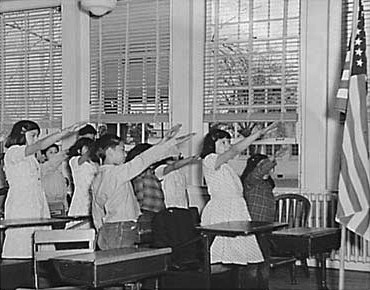
This is how American kids pledged allegiance to the flag pre-WWII. Honest.

[Ed. Apropos of its dodgy, opportunistic political history, the pledge is back in the news. Accordingly, hp.net has reposted this piece from 2015, or rather, we have pinned it to the blog’s most prominent position. All hp.net content remains live and searchable.]

SOUTH PORTLAND, Maine (Feb. 24, 2015 ) — The sad truth is, kids are easy targets when it comes to ideological inculcation outside the home. This time-honored strategy of ‘getting them while they’re young’ may have first been written down in Proverbs 22:6 (“Train up a child in the way he should go and when he is old he will not depart from it.”), but it’s a gambit that is surely much older than that. And so I was heartened to read of the South Portland, Maine girls who recently put their feet down re. the pledge of allegiance, which, I understand, is something SoPo kids — and most American high schoolers — are still expected to recite each and every morning.

Over the public address system, students at South Portland High School hear the same sort of thing we all grew up hearing: At this time, would you please rise and join me for the pledge of allegiance

In late January, however, class president, Lily SanGiovanni, made the decision to start adding what proved to be a controversial 4-word tagline … if you’d like to.

Naturally, in a country so volubly dedicated to liberty and free speech, people freaked out. Love of country was questioned. Ingratitude to fallen soldiers was charged. Educational bureaucrats wavered, then caved. The four words were eliminated.

What a steaming pile of crapola.

It’s probably been a while since most adults have taken a close look at the U.S. pledge of allegiance, or given it much thought. Revealingly, our culture does not ask adults to say these words, every morning, Monday through Friday — only our children are required to do that (if they go to public, taxpayer-funded schools). Still, we old folks can all recite it by heart: I pledge allegiance, to the flag, of the United States of America, and to the republic, for which it stands, one nation, under God, indivisible, with liberty and justice for all.

There. I did that from memory (!). See how impressionable young minds are over the long term? … But seriously folks, it’s instructive to examine this pledge, in the same way SanGiovanni and two of her classmates have done. They were uncomfortable with the invocation of a Christian God, every day, as part of a public statement that students enrolled in government schools are obliged/encouraged to recite every day. They have a point, but that’s not the half of it.

Let’s start with the name: Exactly what sort of authorities, in a democratic republic, would suggest that adult citizens make such a pledge? In my view, it’s not something free peoples should ever be asked to do — especially kids, whose feelings on these matters should formed by parents, not the state. This practice strikes me as something illegitimate or otherwise authoritarian “regimes” would insist upon: maybe the Czech government in 1967, or the Khmer Rouge circa 1975, or Josef Stalin any ol’ time.

In fact, see here the Oath of Allegiance Grandpa Joe did require of the Soviet people, starting in 1939: I, a citizen of the Union of Soviet Socialist Republics, joining the ranks of the Workers’ and Peasants’ Red Army, do hereby take the oath of allegiance and do solemnly vow to be an honest, brave, disciplined and vigilant fighter, to guard strictly all military and State secrets, to obey implicitly all Army regulations and orders of my commanders, commissars and superiors. I vow to study the duties of a soldier conscientiously, to safeguard Army and National property in every way possible and to be true to my People, my Soviet Motherland, and the Workers’ and Peasants’ Government to my last breath. I am always prepared at the order of the Workers’ and Peasants’ Government to come to the defense of my Motherland — the Union of Soviet Socialist Republics — and, as a fighter of the Workers’ and Peasants’ Red Army, I vow to defend her courageously, skillfully, creditably and honorably, without sparing my blood and my very life to achieve complete victory over the enemy. And if through evil intent I break this solemn oath, then let the stern punishment of the Soviet law, and the universal hatred and contempt of the working people, fall upon me.

Read More

Chinese Central Gov’t Moves to Enforce 2004 Golf Course Ban, Retroactively

[Ed. This story below ran in the March 2015 edition of GCM China, a quarterly magazine published by the Golf Course Superintendents Association of America from 2012-2016, in Chinese, for golf industry professionals working in the PRC. The New York Times weighed in this matter in April 2015.]

By Hal Phillips
The overriding mood of the Chinese golf industry in 2015 is one of uncertainty. While the central government has not altered its official stance toward golf since 2004 (when course development was specifically banned), close to 500 new golf course projects have opened or been formally undertaken during this 10-year period. Clearly, there is uncertainty within the central government as to how, when and where to enforce the ban — and how to deal with courses built in spite odf the ban.

There is, in turn, uncertainty on the part of course developers, who have witnessed the successful development of so many projects, since 2004, and have, at the same time, witnessed many projects suspended by the same government since summer 2014, when the 10-year-old ban was enforced anew — with increasing but selective frequency.

There is uncertainty on the part of Chinese golf industry observers — international vendors, native course personnel and golfers themselves — who possess a range of opinions re. where things are headed but dare not speak publicly, for fear of endangering their business interests, employment and club membership values. ]

GCM China spoke to a dozen different sources for this story, in an attempt to shed light on the situation. None wished to be identified. We chose to quote them here anonymously, because the subject matter is so important to our readers across the Chinese golf industry. Their opinions, taken together, reflect widest, most fulsome perspective on where exactly the golf industry stands today, and where it is headed.

There was broad agreement among those interviewed that the change in government policy took hold in late 2013, early 2014.

“We began to see and hear of more and more reports on policy enforcement and the tearing up of courses across the country,” said one golf course architect with design experience in China stretching back prior to 2004. “This began largely with the halting of new construction but soon began to migrate into the shutting down and tearing up of existing courses, even those with active memberships. This crackdown, I believe, was tied largely to the 2012 change of the Politburo and the very public crackdown on government corruption. Government officials across the country, upwards of some 20,000 in 2014, were arrested and jailed, some quite prominent.”

It’s important to distinguish here between local and central governments in China, something GCM readers understand better than anyone. When the golf course ban was instituted in 2004, that was a central government directive. However, in spite of the ban, local governments at the provincial and city levels, viewed golf development as a way to build local economies and employ local citizens. These local governments were the entities that “approved” golf projects. There is today no protocol for central government consideration of golf projects.

As a result, hundreds of golf development projects essentially flew, in various degrees of disguise, under the central government radar thanks to implicit local government cooperation — and a desire on the part of developers not to flout the central government’s official anti-golf stance. In order to avoid central government detection, many projects were classified by local government documentation not as golf courses or country clubs but sports facilities, parks and forested landscapes.

In June 2014, the central government created four classifications for all existing golf courses: those slated for shutdown, those slated for major renovation, those slated for more minor “rectification”, and those simply under “review”, which is seen as the safest of the four groupings.

There was broad agreement among sources that, since the beginning of 2014, the central government has been busy visiting and assessing all the golf facilities in the country — those in operation, in addition to those still in development. It is assumed that all courses will eventually receive one of the four designations, though subsequent actions, according to this classification, have not been made clear.

The situation is that much more murky because some courses have indeed been shut down summarily. Others have been informed that portions of the landscape must be modified, moved away from water resources, or returned to agrarian use; still more have been informed that some unspecified rectification will be required.

But the majority of courses have not been notified of anything. Not yet.

The first courses to be affected by the government crackdown were, not surprisingly, those closest to Beijing, the seat of central government power in China. Initially, there were rumors of pending taxation on water use on those golf courses — a legitimately pressing issue due to longstanding drought conditions in the north. But this was simply a preliminary indication of serious government intervention in all things golf. According to a golf journalist based in Beijing, golf course water usage and other environmental factors were and continue to be a mere pretext for singling out golf developments that flouted the 2004 ban — meaning the vast majority of golf courses in China today.

“I have heard that some courses are being proactive and looking into recycled-water alternatives — and the so-called new government water-use fees seem to be very sporadic in their implementation and how much the local government will charge,” said one Beijing-based course superintendent.  “I’ve also heard there could be new land-use fines. I don’t know how clubs can be viable if they have to keep paying the government money — but still don’t receive official papers or permits for the club [in return]. More clubs just shut down over the last month, so the industry is just crawling along.”

Another superintendent explained why his club was shutdown, before it even opened for play. “The main reason why my course was suspended is the protection of a nearby water source — because the media and public and government misunderstand the pollution caused by golf courses. So in recent times, courses close to water resources, such as lakes, rivers, streams and natural parks, were all inspected and forced to reevaluate the environmental effects. Other courses that are taking over farmland, or once took over farmland, are definitely not permitted right now. Existing courses are all being evaluated by the government now.”

Some Chinese golf courses that have not been the subject of review have been busy filling in bunkers and planting trees — on greens — in an effort to avoid detection, as a “golf course”, by roving government inspectors.

According to the golf journalist, “Some courses had already planned to use recycled water, but it’s just planned. After all, there is still no a clear law about hiking the water tax on the golf industry. But ‘no clear law’ always means a bigger problem. In China, nowadays, the most severe crisis in golf is the ‘Cleaning Up’ movement, not the water matters. Since chairman Xi Jinping took office, the government has tried to clean up the sport of golf. During last six months, they have already removed several courses (even when they are about to open!) in Beijing, then Shanghai, and now Guangdong.

“It is no exaggeration to say, the golf course industry is in one of the most severe recessions in 30 years of Chinese golf history.”

Most observers agree that the central government’s new interest in golf’s environmental impact is simply an excuse to make a larger, political point — namely, that too many golf courses were built illegally following the 2004 ban.

One business development executive for a course design firm fleshed out this perspective — and reinforced that a golf crackdown was related to a broader government-corruption crackdown — by detailing golf-related restrictions placed upon current government employees.

“Here is the latest official red tape from the Guangdong provincial government,” he said. “No government staff shall own or acquire golf membership certificates of any kind. No government staff shall take any positions in golf clubs or golf organizations including honorary positions. No government staff shall use public funds on golf membership cards, VIP cards, other cards with favorable terms, or golf equipment — no government staff shall take any of these above mentioned items from enterprises or individuals. No government officials shall play golf during business hours or play golf with public funds. No government officials shall play golf with those who are within their service objective or those who are under their management. No one shall pay for the expenses of golf for any government staff or his relatives. No government staff shall attend any golf activities or tournaments organized by private enterprise. No government staff shall be involved in any form of golf gambling.”

The larger point here is well taken: Placing these hardline restrictions on government staff is a likely prelude to penalizing courses built during the ban.

“With regard to golf course closure I have heard two rumors,” the business development executive said, echoing sentiments related by others interviewed for this story. “One is, 80 courses all over China will be shut down eventually, before the 30 June 2015 deadline. The other is, Guangdong province alone will have to close down 100 courses (including 15 in Shenzhen). Shanghai will close down 27, and Hubei province 14.”

These official anti-golf stances (which remain mere rumors) are highly ironic — creating further uncertainty within the industry — because, in other demonstrable ways, golf is a growing sport that Chinese clearly enjoy playing, as individuals but also as part of teams officially representing China.

“The Olympics will be a big push,” said one course architect, noting that China has a national golf team that will certainly compete at the 2016 Olympics in Rio de Janeiro. Most Olympic-designated sports receive de facto support from the central government. “More and more Chinese are traveling outside of China to play golf. The Presidents Cup in Korea [8-11 October 2015] is something else that will bring huge awareness to the sport in China. The Chinese have always been very supportive of national sport and culture. In the future, I see changes. Maybe some of these bodies will come out with a mandate that says, if you do develop golf, here are the standards. But right now, development standards are seen as too much of an endorsement. “

Another architect was less positive when it comes to the fate of future development: “The central government is in the process of documenting all the courses in the country. Following this documentation, a report will be distributed. I believe this report will surface sometime in 2015, but most likely not until the summer, maybe even later. Many people believe this report will establish a policy to deal with existing and new course development with strict guidelines. I do not agree. I believe it will deal largely with the elephant in the room: all the existing illegal courses. I do not believe new construction will be dealt with at this time.

“This report (possibly a policy) will name courses to de demolished, courses that can stay, and courses that will need remedial work to be done over a 1-year period — to become compliant with the standards necessary to remain. These issues will include the avoidance of certified farmland, villager relocation and compensation, avoidance of forest preserve, water supply, and water runoff.”

One veteran of the China golf industry, whose firm supplies golf courses with various course-related supplies, said the central government is not necessarily equipped to assess the environmental aspects of course development. This will clearly affect its ability to assess golf courses as part of this report, and to monitor their environmental impact going forward.

“The real interesting cases will be courses that have permits and are least nominally legal, in the manner they were developed, but sit on or near drinking-water reservoirs,” this vendor said, noting that permits in these cases were issued by local, provincial governments, not the central government. “They are just cloaking this crackdown in environmental terms. The question will be, how do they do the monitoring? We’ve worked with their official labs. They are not up to the task.”

The business development source was more optimistic: “I personally think it is good for the industry in the long run. I am hoping the central government will issue the official regulations for getting permits and constructions of new golf courses early in 2015, before the Beijing Golf Show [scheduled for 13-15 March 2015]… My general feeling is that the tension on golf is going to loosen up toward the second half of the year, 2015, and the regulations will be released very quickly in the near future.”

A course construction professional is less convinced. He may have put it best (meaning, with the appropriate tone of uncertainty), when he said, “The Chinese government has always been difficult to predict, no matter what the case, and the same goes with the current state of the China golf industry. We’ve all heard the same rumors for months now, but to be honest, nobody knows! It’s all guesswork at this stage and anyone who tells you different is just relaying another rumor.”

Brits Abroad on Holiday: A Partying Force Most Willful

Brits Abroad on Holiday: A Partying Force Most Willful

travel2

Having weighed in, soberly and professionally, on the “air rage” phenomenon — at the somewhat newly minted Mandarin Media blog — I couldn’t leave the subject without relating the more salacious story of my first trip to the French Alps. It wasn’t exactly an instance of “air rage”, but it well illustrates the peculiar holidaymaking mindset, among some Brits, that can and has led to many an airborne incident. In short (I love quoting myself), “There is something to the idea, born of armchair psychology, that Brits cut loose on holiday in reaction to leaving what remains a very buttoned-up, class-restrictive culture.”

It was March 1985. My girlfriend and I were studying abroad, in London, and we’d booked a chartered ski package to La Plagne, in France, for mid-semester break. Our flight from Gatwick to Geneva, almost entirely peopled by English holidaymakers, quickly degenerated into a sort of raucous booze cruise at 30,000 feet. Everyone, it seemed, had broken open the bottles just procured at duty free.

Normally, such characters scatter to the four winds upon landing, but this was a charter. We had all purchased the same ski package. Accordingly, the same rowdy group piled onto a single coach and set out for La Plagne — in a blizzard.

By this time, my girlfriend and I had traveled a great deal together. This much was clear: If she wasn’t seated directly behind the bus driver, she was dangerously prone to car sickness. So, from the very front of the coach, we could hear the party raging behind us, as we crept our way along ever more windy, mountainous roads. This was a non-smoking bus; the Brits defiantly smoked like chimneys and brandished their duty-free liquor bottles like groomsmen at a stag party. Then came the songs.

The unfortunate leader of this charter was a mild-mannered American 22-year-old named Chad. His attempts to tamp things down were met with open ridicule. He was a tad chubby, our Chad. Ultimately, he was regaled with a spirited rendition of “Who ate all the pies?”

From our perch behind the driver, we witnessed the trip’s dramatic turning point: An oncoming Citroen spun out in the snowy conditions and crossed into our lane. The bus driver tried evasive action but these were shoulder-less roads — and it was snowing like a bastard. The car bounced off the driver’s side of the bus, right below us, and we skidded to a stop — literally perched, precariously, at the edge of a steep, snowy hillside.

We sat there for half an hour, crowded onto the left side of the bus (to avoid tipping the bus and our still soused party into oblivion) until a replacement vehicle arrived. When it did, we all exited out the driver-side window.

This replacement bus was not big enough to accommodate all of our luggage, so the entire party was deposited at a nearby train station, which served some small French mountain town whose name I cannot recall. The station had a bar, however, and our new British friends set about drinking again, as if nothing had happened. To be fair, so did we. Having cheated death, we tucked into a couple bottles of wine with two more American friends who were traveling with us.

Two hours later, we piled onto the second replacement bus, where our moveable booze-fest was now completely out of hand. Chad just hunkered down beside us; this party could not be stopped — or could it…

The up-and-down, side-to-side nature of our alpine journey would result in two initial incidents of vomiting. Each time the bus ascended and descended, the resulting spew sloshed back and forth along the bus floor. The stench had just the wrong sort of effect on others who teetered at the edge of nausea.

Upon arrival in La Plagne, I don’t believe I’ve ever been quite so thankful to disembark from anything. Rule Brittania!