Bruins Pod: Game 4 Has a Tough Act to Follow
Vintage Cheevers, not...

Bruins Pod: Game 4 Has a Tough Act to Follow

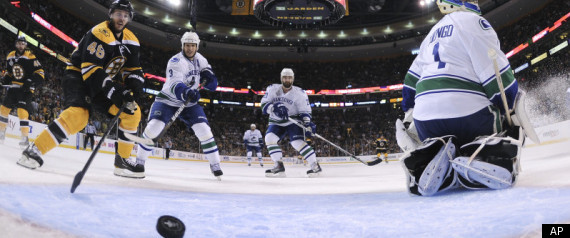
Unless you’ve been living under a rock the last few days, you know that Game 3 of the Stanley Cup Finals was, shall we say, Eventful, with a capital “E”. The BruinsNathan Horton knocked cold by Canucks defenseman Aaron Rome, who was sent off and subsequently suspended by the NHL for 4 games, effectively ending his season. The Bruins went on to smoke Vancouver 8-1, effectively erasing the psychic trauma of two heart-rending losses, in Games 1 and 2. I didn’t think it would be possible for The B’s to put behind them the surrendering of a game-winner with 18 seconds left, in Game 1, and a game-winner just 11 seconds into Overtime, in Game 2. But Game 3, for all its queasy, uncomfortable overtones, was just such a series-changer. We talk about the hit, the suspension and the ramifications in store for tonight’s Game 4 with resident hockey expert David Desmith.

2011.06 Hockey Pod Part II

Special Pod: B’s Resume Cup Quest v. Northlanders

Special Pod: B’s Resume Cup Quest v. Northlanders

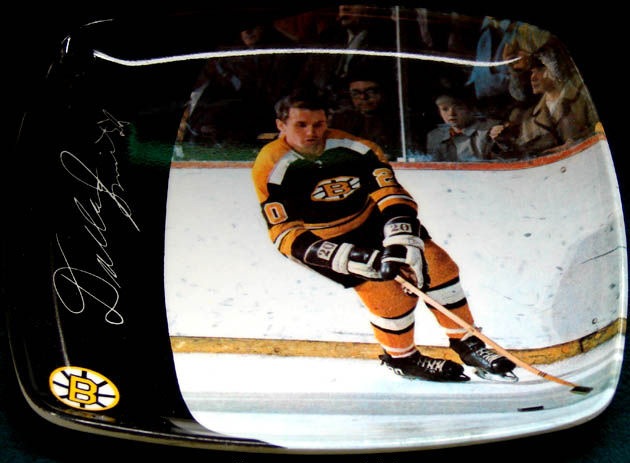
As I hope y’all know, the Boston Bruins open their Stanley Cup Finals series tonight, June 1, in Vancouver against the Canucks. To mark the occasion I tracked down perhaps the most hockey-crazed, hockey-savvy, hockey-literate U.S. citizen I know, David Desmith… The Bruins have not won the Cup since 1972. When I moved to the Boston area, in 1973, they “owned the town” — in such a way as to have inspired the commemorative plate pictured here. In my youth, many a night was spent watching Ch. 38’s local broadcasts of Bruins game. Indeed, I learned the game as much at the knee of WSBK announcers Fred Cusick and Johnny Peirson, as I did on the ponds of Wellesley, Mass. …  The Bruins have since been to the Finals 5 times, losing the last four times to Canadian teams: Montreal twice in the late 1970s, and twice more to Edmonton. The last time they appeared in the Stanley Cup Finals, 1990, and I was there, three days after the Broons’ epic triple-overtime loss to the Oilers in Game 1; I covered Game 2 at the old Boston Garden for those oracles of sports journalism, the Marlboro Enterprise and Hudson Daily Sun. The Bruins had the misfortune, in all four of these “international” Cup Finals, to encounter the finest teams of their eras, among the best of all time. Are they running into a similar buzz saw tonight? Not likely, but just how good are these Bruins? David and I talk about how the team has grown through the playoffs, and we preview the finals in Part I of this special “Dallas Smith Edition” of the podcast. Watch for Part II later this week.

2011.06.01 Bruins Stanley Cup Podcast, Part I

Fullcourt Pod: Deal with the Final Solution


No one would have lapped up another Celtics-Lakers series more ardently than Fullcourt Pod host Hal Phillips and senior analyst Jammin’. But rather than discuss whose pipe dream proved more fanciful (the Green one, or the Purple & Gold one), we concentrate on the matter at hand, which doubles as the cold, hard reality: this most intriguing Finals match-up that starts Tuesday night in Miami. Dirk and the Mavs weren’t chosen to get out of the First Round, but now all of America (outside South Florida) is pulling for them to win it all. Such is the low esteem in which we hold Lebron, D-Wade & Co. How did we get here? And where will it all go…

2011.05.30 Fullcourt Pod, Glamour Edition

Fullcourt Pod: NBA Playoff Chat for April 25, 2011

Fullcourt Pod: NBA Playoff Chat for April 25, 2011

It’s NBA Playoff time, about midway through Round I, and so we take stock of key developments courtesy of  Fullcourt Pod’s resident near-savants, Hal Phillips and Jammin’ James W. Jackson Jr. This week’s fixation and jumping-off point is Laker Coach Phil Jackson‘s indifference toward defending Chris Paul — or should we say inability?

2011.04.25 Fullcourt Pod

Desert Golf Safari Conjures Memories of Bob Labbance

Desert Golf Safari Conjures Memories of Bob Labbance

So I’ve been thinking a lot about Bob Labbance lately. Bob was a good friend, a golf writer and historian, a counter-culturist after a fashion, and, as my grandfather would have described him, one of nature’s gentlemen. Note the tense. Bob suffered a traumatic fall and paralysis in 2007. He fought back to regain a great deal of motion and a large measure of his life, only to contract Lou Gehrig’s disease, degenerate quite quickly and pass away in Aug. 2008, at the tender age of 56.

You learn a lot about a guy when horrible shit befalls him. You talk more deeply and seriously about things with that person. You learn more about the man — more than you ever would have if, as we do with most acquaintances, both parties were to skate together through life largely unaffected by tragedy.

Bob loved the desert, and I thought of him as my family and I toured the American Southwest last week and played a fine Johnny Miller design in St. George, Utah: Entrada Golf Club at Snow Canyon. Bob grew up in Fairfield County, Connecticut, went to school in Maine, and lived much of his adult life in Vermont. He was a New Englander through and through, and he was what I like to call an unreconstructed hippie. But he loved golf, and the counter-culturist in him allowed an appreciation of desert golf — something a lot of golf design nerds reflexively disdain.

I first met Bob in about 1994, and only later in his all-too-short life did I learn that he fancied the idea of retiring to Flagstaff, Arizona. I got the impression his family wasn’t as keen on this particular idea, and in that way his untimely death mooted the issue. I thought of him as we passed through Flagstaff twice last week. We were there to play some disc golf but found far more than an excellent track tucked beside the athletic complex at Northern Arizona University. More than a mile high, surrounded by open chaparral and sitting in the shadow of the 10,000-foot San Francisco Peaks, Flagstaff is physically gorgeous and a pleasing college vibe pervades. Many towns in the north of Arizona — hell, in all of Arizona and much of the West — are striking (to a New Englander especially) for just how new or post-modern they feel. Flagstaff has some of that, but it also has a proper, turn-of-the-19th-century downtown where today funky galleries and a wide variety of non-chain, quite excellent restaurants abound.

I didn’t start playing disc golf until after Bob had passed away, and playing in Arizona made me wonder what he’d have thought of it. Hardcore golfers tend to look askance at this golfing cousin, and while Bob was in many ways a counter-culturist — he lived in a commune after college on the shores of Sabbathday Lake, for chrissakes — he was something of purist when it came to golf. He revered the old course designs, soaked up the game’s rich history, and collected old clubs and books… But when he wrote books on course design, his subjects were Wayne Stiles and Walter Travis, not Donald Ross and Alistair Mackenzie. Bob also organized an annual Cayman tournament at his place in Vermont, where competitors holed out by chipping the ball either against a car tire (1 stroke) or into said tire (no stroke).

I’m betting Bob would have liked disc golf, recognizing that between the ears it’s essentially the same game — minus the status-seeking, the collared shirts, and the reliance on expensive, ever-upgradeable equipment. I’m also betting that as an eminently practical unreconstructed hippie, Bob would have recognized that to love one game doesn’t prevent the love of another.

The Joys of Disc Golf: Yeah, you heard me right…

The Joys of Disc Golf: Yeah, you heard me right…

Starting this weekend, in honor of The Masters, we’re “Fighting the Pieties that Be” here at halphillips.net by celebrating golf’s non-traditional, even subversive appeal. Friday we featured the internally illuminated, colorfully sequined mannequins I recently came across in a Vietnamese pro shop. Today’s topic: Disc Golf.

Nothing rolls the eyes of traditional golfers than a discussion of disc golf. Well, I’m here to tell you that not only does disc golf totally rock, but I played more disc rounds in 2010 than actual golf rounds.

Why? Well, there are lots of reasons: First and foremost, between the ears the two versions are uncannily similar. Let me give you an example: Driving. We all know that over-swinging is a recipe for disaster, especially when wielding the big stick. The dynamic is identical with the disc, including the urge to vacantly muscle a drive out there in order to 1) satisfy some animal urge; and 2) gain 5-10 extra yards that won’t, in the end, truly enable you to play the hole in fewer strokes. Managing this dynamic is a dead-on crossover shared by these two incarnations of the game.

Here’s another: When you’re standing over a 4-foot putt, the traditional golfer must weigh the merits of charging said putt, taking the break out, and, should he miss, living with the consequences of another 4-footer coming back — or lagging it, increasing the break one must play, but pretty much guaranteeing one won’t three-jack. The same thought process and consequences are extant with a putting disc in your hands. Exactly.

I could go on and on. There are differences. The most striking is disc golf clever rendering of the body and club as one. But it’s the same game.

I plan to blog more on this topic because there are so many aspects to disc golf’s striking appeal — aspects that tend to address directly many misgivings we have concerning actual golf: A disc round takes no more than 90 minutes to play, for example; there is no dress code; there is absolutely no barrier to entry — anyone can become competent in a few weeks; rounds are $5-10; the courses themselves are really cool, all of them distinct 3:1 miniatures of actual golf courses — with the added dimension that forested areas, if thinned a smidge, produce a corridor of play unlike anything in the actual golf world.

I’ll leave you, for now, with a word on the game’s aural sensations. There are no “cups” in disc golf. One holes out by landing the disc in a basket. I’ve included a picture here, to give you an idea of what I mean. But imagine a circular metal basket that sits halfway up a 5foot metal pole. Atop the poll sits a metal disc the same diameter as the basket. Draping down from the top disk are chains that deaden the oncoming disc, dropping it into the basket.

Holing out in actual golf only makes a sound on TV, whereas holing out with a disc produces a distinctive sound: faintly metallic, a bit plinky, but definitely audible from a couple hundred yards away and pleasing in a communal sense. It’s sorta like the sound a kid makes as he mounts a chain link fence, with the idea of clambering over. Not exactly the roar of a crowd filtered through Georgia pines; indeed, that’s something that most of us will never hear, on any golf course. But to the ears of disc golfer, it’s music.

Masters Week: Fighting The Pieties That Be
Sequined mannequins: You'll never see them at Augusta. And bravo for that...

Masters Week: Fighting The Pieties That Be

As close readers of this blog already know, I possess a highly developed aversion to sanctimony. As a result, Masters Week really is something of a trial for me — until Saturday afternoon, when the inherent competitive attractions of the tournament ultimately win out and take precedence over the weeks of bullshit fawning and musing that routinely precede and general suffuse media coverage of golf’s first major championship of the year.

In this spirit of Fighting The Pieties That Be, I offer this week a series of posts that discuss or otherwise celebrate golf in non-traditional and subversive ways. By mentioning the Masters only obliquely, and with derision, I do my part in diminishing the hype — and perhaps opening our eyes just a bit to the fact that there really is a lot more to like about golf than yet another story on how cheap the sandwiches are at Augusta National, how struck with wonder the amateurs have been in the Crow’s Nest all week, what a fabulous tradition the meaningless par-3 tournament is, and yet another gauzy feature on Arnold Palmer, against whom I have nothing, but let’s get real: The man last won a major in 1964, the year I was born… (Quick caveat: If said story centers on how and why Arnie never won a major once he quit smoking, after the ’64 Masters, I’ll read that with enthusiasm, as I’m fascinated by this little-shared but quite fascinating factoid.)

So, without further ado, see here Fight the Piety Golf Tidbit No. 1:

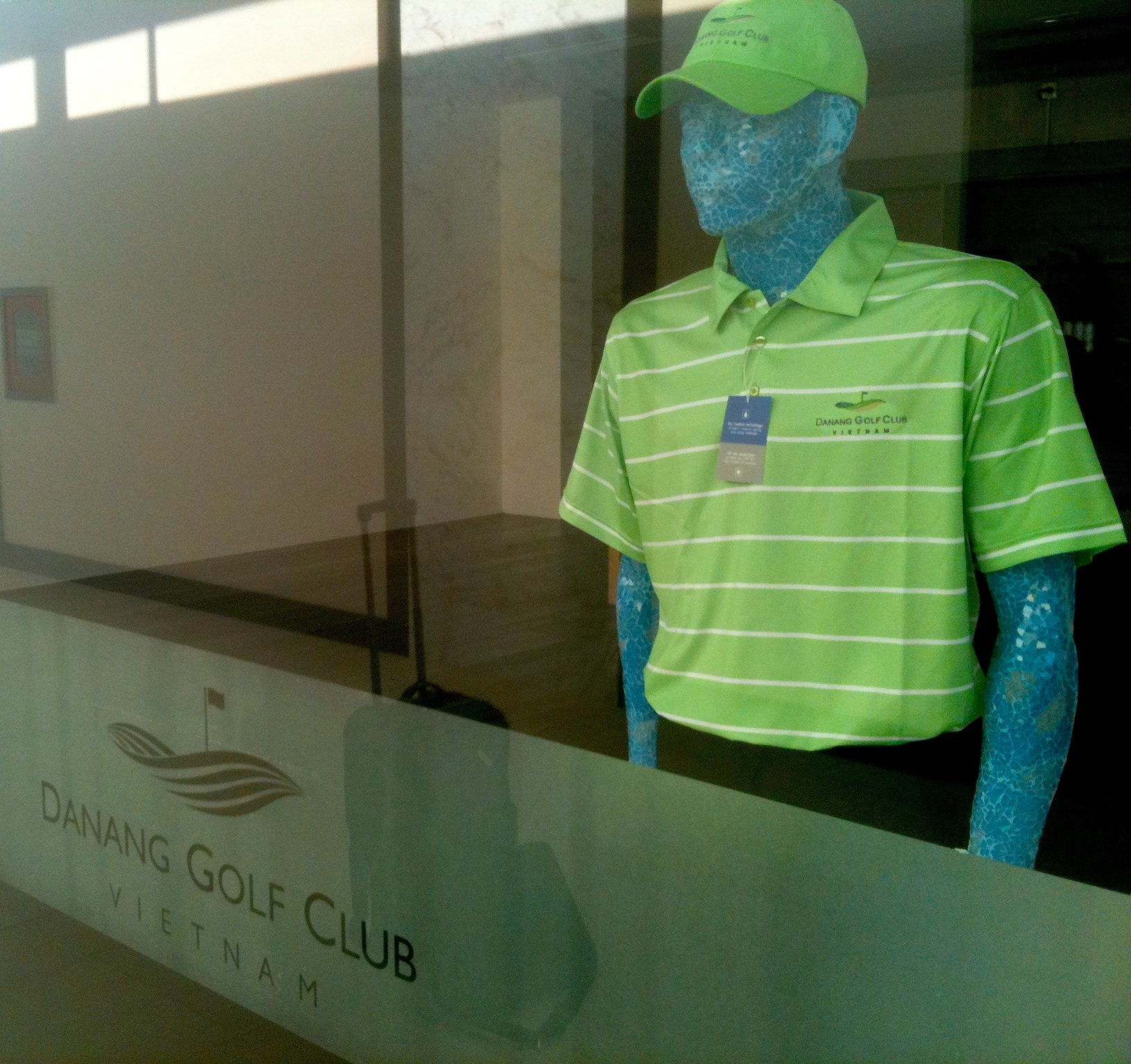
Check out what I saw recently on display in the striking new clubhouse at Danang Golf Club, on the Central Coast of Vietnam. The image here provided says more than I ever could. Are those not the coolest mannequins you’ve ever seen? I’m not a golf apparel guy; it doesn’t much interest me. For the record, the shirt here was produced by a company called AB Pro Golf, whose own innovations include a line of reversible shirts and high-performance fabrics that include anti-bacterial agents.

But enough about that. I first saw them in March, but I still can’t take my eyes off these mannequins. There’s a cyborg quality to them that I find eerie but irresistible. Howie Roberts, the general manager at Danang GC, reports that such mannequins are quite the rage in Bali, but I’ve not seen anything like them in golf shops anywhere in Asia-Pacific, North America or Europe. They’re sequined, of course, with different combinations of colors: red and black, teal and pale green (pictured), orange and yellow… They simultaneously bring out the best in a shirt’s color while grabbing the eye and never letting go. Check out the shop the next time you’re visiting Danang GC, and bring your sticks; this Norman design may well be the best new course (opened May 2010) you’ll find anywhere.


Unsightly American Soccer Podcast: April 4, 2011

Join Hal Phillips and a cast of characters/correspondents spanning the Globe to discuss  the burning, hot, molten issues of the footballing day. This week we talk with Tom Wadlington about the two international friendlies the U.S. played last week, vs. Argentina and Paraguay. Hal and Tom also touch on the fate of Jozy Altidore, the Champions League quarters that begin Tuesday, and the new statue of Michael Jackson that was unveiled this weekend outside Craven Cottage, home to Fulham FC. If you’re wondering what the connection is between Fulham and the King of Pop, you’re not alone.

UASP 2011.04.02 2

Unsightly American Soccer Podcast: April 1 Edition

Unsightly American Soccer Podcast: April 1 Edition


Join Hal Phillips and a cast of characters/correspondents spanning the Globe to discuss  the burning, hot, molten issues of the footballing day. This week we present a pre-Champions League Quarterfinal edition, in advance of the four matches scheduled for April 5 and 6. Big doings, but that’s not all: Hal and guests Dave Batista and Stephen Myers also tackle the strange fate of Fernando Torres, why we hate Manchester United and the bizarre dispute now gripping Spanish football, which may result in a work stoppage this weekend.

2011.04.01 UASP 2

New Links, New Rough, New Sleeve: Doonbeg Could Use Some Old-Time Greenkeeping

New Links, New Rough, New Sleeve: Doonbeg Could Use Some Old-Time Greenkeeping

It’s been a couple years since I played Doonbeg Golf Club, Greg Norman’s “new” Irish links in the southwest of the country. I’ve thought about it quite a bit since because, well, a lot folks have played it too — it’s just south of Lahinch and just across the Shannon River from Ballybunion and Tralee — and we’re headed back to the Emerald Isle next week. Doonbeg GC is also coupled with one of the finest on-site golf hotels anywhere in the world. So it’s natural to stay at Doonbeg and play the course at least once during a weeklong tour of this stupendous golfing corner of Ireland.

That’s pretty fast company to keep, and Doonbeg is a new course, not even 10 years old, so perhaps it’s not surprising that it tends to suffer by comparison. I don’t see it frankly. I found the terrain, the routing and the greens to be of a very high quality, design-wise. Doonbeg is, as its critics contend, very difficult to play. Too difficult, one could argue, but I’ve decided this judgment has very little to do with the design.

Agronomics are important to the maximizing of any course design, but maintenance of the outlying areas on a links course is particularly crucial. We saw what an overzealous fertilization program could do to the best players in the world during the famous train-wreck at Carnoustie in 1999, and this is the nub of the issue at Doonbeg. The dunes through which the fairways quite masterfully weave here are covered with a thick matting of ball-eating, deep-green fescues. My opening drive at Doonbeg landed in the fairway and bounced some 5 yards into the rough, never to be found. I’ve heard tell that Norman himself lost 10 balls during his inaugural round. That’s nuts, and one begins to understand why even those players far better than I tend not to leave Doonbeg with that warm fuzzy feeling we expect following a round on the coast of Ireland.

I had played Lahinch the day before. As is my custom, I drove the ball all over the map. But the outlying areas at Lahinch were quite different, featuring as much brown matter as green. The fescues were high but sorta wispy. I found a dozen of my wayward balls in there and nearly always had a swing, albeit a recovery swing, at most every one. That’s what more than a hundred years of expertly burning off the rough can produce: The perfect balance of playability and penalty. Doonbeg is simply not there yet.

Will it get there? A murkier question, that. Despite the fact there had once been an ancient links on the site, Doonbeg’s modern development came with caveats. The club rightly touts what is a heavy emphasis on organic maintenance practices, but I’ve heard from several people in the know that Doonbeg isn’t free to do everything it would like in caring for these rough areas. I doubt very much the crews are fertilizing them, at all, but I’d bet they’re not allowed to burn them off as often as they’d like. Like I said, I played there two years ago and I’d wager they had never been burned off.

You gotta figure that today not every British course superintendent who graduates from turf school, or leaves his various course apprenticeships, with a working knowledge of how to properly burn off the rough on a links course. Not any more (and, of course, not every course in Britain is a links; most are not). Methinks the crazy-thick rough at a place like Doonbeg, or at Sand Golf Club (a fabulous Steve Forrest-designed “faux” links, which I played in Sweden the week before Doonbeg) is more the result of agronomic stricture, or a lack of ancient know-how in our modern age, than design intent. Here’s hoping it’s the latter, and it is ultimately overcome, because Doonbeg (and Sand) are both awesome tracks in need of, well, a trim.