Thai Golf: Cost vs. Benefit

It’s impossible to discuss Thai golf without offering some manner of cost-benefit analysis.

Eighteen holes at Chiang Mai Highlands or Banyan Golf Club will run you about $75, plus a caddie fee of $10. Green fees are a bit more expensive around Bangkok and Phuket, a bit less expensive in Pattaya and Hua Hin — but you’ll never pay more than $100 a round, which stands in stark contrast to resort green fees in North American golfing hubs.

The equation as it relates lodging is perhaps more revealing. Forget about golf for a moment: Thailand is the premier holiday destination for Asians, full stop. As such, the hotel stock here is enormous, diverse, and features all the brands you recognize and trust (Marriott, Sheraton, Hilton, etc), plus a few more you should get to know (Anantara, The Peninsula, Mandarin Oriental). Yet most 5-star rooms don’t exceed $150, especially as part of golf packages, and you can find very functional lodgings for less than $50 a night, if you so choose.

Our tour operator, Golfasian (golfasian.com) booked all our golf and hotels, plus a driver and van to ferry us back and forth. Our boutique hotel in Chiang Mai, The DeNaga, is an example of the high lodging standard in Thailand. Though technically a 4-star lodging (due to its lack of a full-size pool and conference facilities), it was nothing short of elegant with spacious rooms, great service and free, dependable WiFi (Fact: Starting at midnight one evening, I conducted an entire, 3.5-hour fantasy basketball draft via Skype from my room at the DeNaga, without incident). Our rooms there were but $100 a night.

It’s true that airfare to Thailand can run anywhere from $1,000 to $1,500. Yet over the course of a week, the savings on golf and lodgings in Thailand dwarf whatever premium international air travel to Bangkok might be, when compared to domestic U.S. airfare. One must ask himself this, too: How much does it cost to eat and drink in Phoenix, in Myrtle Beach, in Palm Springs? The average cost of a first-class meal in Thailand is no more than $12 per person; beers are $2 apiece. Double or triple those figures for almost any North American golf destination. Over the course of 7-10 days, that really adds up.

In Thailand? Not so much.

We could compare the world-renowned nightlife in Bangkok, Pattaya or Phuket to the nightlife in Phoenix, Myrtle Beach or Palm Springs. But that’s hardly a fair fight, and not so much a matter of dollars and cents. More like night and day.

For more information on Thai golf vacations, visit www.golfasian.com and www.golfinakingdom.com

The Curmudgeon: Golf’s Most Bracing Pod

The Curmudgeon: Golf’s Most Bracing Pod


We know how it is. You like your golf. You might even love it, but the game’s fawning media echo chamber leaves you cold, and often woefully ill-informed. Perhaps The Curmudgeon — the golf podcast that dares speak truth to power — is for you. Join host Hal Phillips and a panoply of journalists who aren’t afraid to put their access at risk. What’s more, you don’t have to wear a collared shirt to listen in.

Inside this Special PGA Championship pod:
• Should the Masters really be a Major?
• Sartorial Screed: The Case Against Cargo Shorts
• What are the spoils of Ryder Cup hospitality exactly?

2010.08.12 The Curmudgeon

The Unsightly American Soccer Podcast, August 2010


Join Hal Phillips and a veritable cast of characters/correspondents spanning the Globe to discuss  the burning, hot, molten issues of the footballing day. This week we present the Post-World Cup, pre-Apocalyptic (but just barely) edition, in two parts. Tom Wadlington comments in Part I on the Spanish victory, on his way to Fenway Park to see Sporting Lisbon vs. Celtic; he also weighs in on the “Bob Bradley to England” scenarios, which started with Fulham but now involve Aston Villa. Hal and Esteban get a bit political toward the end of Part I before delving deep into World Cup matters in Part II, fixating, in a meandering sort of way, on the tournament’s Best XI, making sternum plans for Nigel DeJong, and the never-ending tension between form and function.

2010.08 UASP Part I

2010.08 UASP Part II

Unsightly American Soccer Podcast: World Cup Final Preview


Join Hal Phillips and a veritable cast of characters/correspondents spanning the Globe to discuss the World Cup and all the burning, hot, molten issues of the footballing day. This week’s episodes (that’s right, there are two, so listen in order): We get the view from Asia by way of Highbury with Spencer Robinson, plus Esteban again providing the Spanish view, which is only right, followed by Dave Batista from Brookline, fresh from the Vineyard. Everything you need to know leading up to Sunday’s final.

2010.07.10 UASP Part I

2010.07.10 UASP PART II

Unsightly American Soccer Podcast for 6.26.2010


Join Hal Phillips, Tom Wadlington and an assortment of correspondents spanning the Globe to discuss the World Cup and all the burning, hot, molten issues of the footballing day. This week’s World Cup Episode for 6.26.2010: Tom and Hal pick up the pieces following the US-Ghana Round of 16 thriller, while special guest Esteban again provides us the view from La RaZa, along with that of the West African faithful.

2010.06.26 UASP 2

World Cup Nostalgia: Ultimately, it was televised

World Cup Nostalgia: Ultimately, it was televised

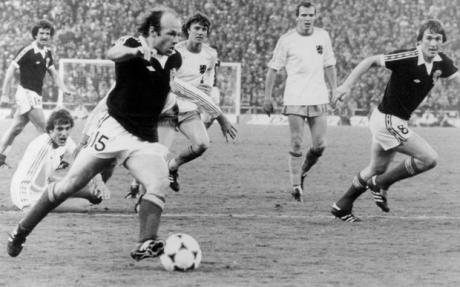
The inimitable Archie Gemmel, on the rampage against Holland in 1978.

Like the Olympic Games, the World Cup comes round but once every four years. Unlike the modern Olympiad, the World Cup has only recently attracted the exhaustive attention of television programmers, a fact driven home to me by my friend and colleague, Dieter Schmidt, in his debut column at halphillips.net. There was indeed no international soccer on U.S. television in the early 1970s (before Dee got a bit too stoned and spent the next 32 years frozen in a northern Manitoba trash heap). Indeed, the World Cup final — the most watched sporting event the world over — was not televised live in America until 1982, and each game of the tournament was not available on TV until ESPN undertook the task for the 1994 games, staged here in the U.S.

The United States’ thrilling last-minute victory over Algeria on Wednesday was testament to the overwhelming power of the shared televised sports experience. My fellow podcaster Tom Wadlington and I watched at DiMillo’s Bayside, a nice little sports bar in Portland, Maine. It’s not every day that two strangers leap into my arms while screaming with unbridled joy, as happened when Donovan buried the winner. It’s the latest in a series of World Cup TV Memories that I will take with me always.

I have fairly visual, broadcast-enabled memories of each World Cup starting with 1974, some more vivid and complete than others. Catching a World Cup match pre-1994, even a final, took some real doing, some planning. Here’s the first in a two-part rundown of how I managed it.

1974: West Germany

I don’t know who the chick is, but that’s Hubie, at right, just as he looked in the 1970s.

I grew up playing for the Wellesley United Soccer Club in suburban Boston, and club wide for many years our uniforms were, for reasons unknown to me, a fairly exact copy of the German national kit at that time: white socks, black shorts, white shirt with black piping. So, we had a kinship with the Franz Beckenbauer, Paul Breitner, Gerd Muller teams of that period. One of my very first coaches, in fact, Mr. Krause, was a German national whose son, Dirk, would fling himself about the goalmouth during practice making saves and yelling “Sepp!”, in honor of the Mannschaft’s imperious, talented keeper, Sepp Maier. Even so, while I knew the Germans had won the 1974 World Cup, I didn’t see the final until 1977, when I attended the Puma All-Star Soccer Camp — run by another Teutonic type, one Hubert Vogelsinger, an Austrian national who, rumor had it, had been banned from his native soccer community (and emigrated to San Diego) after head-butting a referee during a match in Vienna. In any case, Hubie showed films every night after running us ragged all day long. He was understandably Germanophilic and it was there, in the Taft School cafeteria, in Watertown, Conn., seated beside my Wellesley roommate Mike Mooradian, that I finally saw the 1974 final, in its entirety: Holland with its kick-ass Orange uniforms; both teams with their amazingly long hair and mustaches; Holland’s 15 consecutive passes to start the game, culminating in a penalty and converted spot kick by Johann Cruyff to put the Dutch ahead 1-0 — before the Germans had even touched the ball (!); Breitner’s PK to tie the game; Bertie Vogts dogging a sub-par Cruyff the rest of the game; and the Germans’ ultimate 2-1 triumph, with Franz raising the trophy overhead two-handed. There was a great deal of slow-motion included in the game film, an effective motif for the game action but also for visceral reaction shots of these impossibly hirsute Germans, who very much looked the part of marauding Visigoths. Even three years late, it was impossibly exotic and heroic.

1978: Argentina

Just a year later, I returned to Hubie’s camp and, if I’m not mistaken, we saw the ’74 final again one night. But we also saw a highlight reel of the just-completed World Cup in Argentina. This made less of a lasting impression, maybe because we only saw snippets from the tournament. I remember Mario Kempes on a mazy run and scoring a goal in extra time. Was it the second goal in the 3-1 Argentina victory, or the third? Who knows? … I recall a hail of goals from Argentina in a 6-0 drubbing of Peru. Only much later did I learn that this was a match Peru and its Argentina-born keeper were accused of throwing, to put the host country in the final at Brazil’s expense (back then, teams qualified for the final directly from group play; confounding)… And then there is Archie Gemmel, the Scot who scored one of the great goals in British football history vs. the Dutch in some group game. Scotland won the game but didn’t advance out of the group, while Holland went to the final. Still, Gemmel’s goal was so sublime, it’s the highlight from 1978 I remember best — maybe because it remains so talked about and, thanks to the Internet, ubiquitous. Check it out on youtube. You won’t be sorry.

1982: Spain

This was a big deal, seeing the game live. I watched it with my high school girlfriend, Renée, at her parents’ house. There were breaks for advertisements, but I don’t recall that being controversial at the time. Not to me. I was American. I couldn’t yet conceive of a sporting event that didn’t accommodate such interruptions.

1986: Mexico

I watched this game at my house in Wellesley, and I have to admit that I don’t recall anything about the game or the event that was particularly memorable. Just graduated from college and spending the requisite jobless downtime at my parent’s place, no doubt I was stoned at the time.

1990: Italy

A few years ago, my friend Dave called and asked me a cryptic question.

“Remember that time I came over to your house in Watertown and we watched that World Cup game?”

Um, yeah…

“Well, what day was that?”

What do you mean, ‘what day’? It was June 1990; I don’t know the exact day…

“Oh. Okay…”

Dave, why do you want to know this?

“Well, we ordered cheeseburger subs from that place, and I’ve just realized that was the last time I ate meat.”

Well, thanks to the Internet, now it can be told. Dave last ate meat on June 25, 1990, the same day Romania eliminated Ireland on penalty kicks in the Round of 16. I remember quite a bit from that day, and that tournament. Not every group game was televised, on ESPN, but every knockout game was. For a soccer nut who was getting only the semi-finals and finals up to that point, this was Nirvana. At the time, I was 26 and working as city editor at a daily newspaper, which meant I didn’t go to work until 5 p.m. As Italy was 6 hours ahead I could get up and watch World Cup matches all day long before heading to the newsroom. Fabulous.

One more delicious note from 1990: “That place” was The International, a fabulous pizza and sub shop that delivered — and delivered to my address with great frequency. That same day that Dave at his parting cheeseburger sub, I was in the shower and he was in the kitchen doing something when the delivery guy, Ahmed, walked in without ringing the doorbell, as was his custom. I was a regular customer; we had an understanding. With Dave looking on, Ahmed proceeds to set the food on coffee table, sit himself down in front of the television set and take a hit off the bong that was a fixture on said coffee table in that apartment. Dave, who knew nothing of our understanding, was understandably taken aback and hid in the kitchen until I emerged from the bathroom. I’ve always loved that memory, and was only too happy to add the cheeseburger sub aspect.

A Tale of Two Soccer Melting Pots


By Dee Schmidt

One of the things you need to know about me is that while I’m counter-cultural and an American through and through (you can be both, my brothers and sisters), my paternal ancestry is seriously Teutonic. Dig: My dad was Austrian and because the heyday of Austrian football came in the 1930s — bet you didn’t know Das Team finished 4th at the 1934 World Cup, and runners-up at the ’36 Olympics — his loyalties and interest (and mine, by extension) naturally shift to the Germans, who, even critics will allow, are totally outta sight when trophies are at stake. The finest tournament performers in the history of world football, I reckon.

The other thing you need to know about me, if you don’t already, is that my soccer experience was interrupted in 1973 by the 32 years I spent in a weed- and ice-induced state of suspended animation (see details here: The Story of Dee).

So it’s with great interest that I follow both the American and German teams at the World Cup now underway in South Africa — not just because I have national rooting interests, but because the make-up of these teams today is nothing as I or any other self-respecting football-freak would have expected them to be in the early 1970s.

I watched the Germans roast and pluck the Australians on Sunday, 4-0, and the result wasn’t nearly so mind-blowing as the German roster: Two Polish-born goal scorers (Miroslav Klose and Lukas Podolski), backed by a withdrawn striker of clear Turkish origin (Mesut Özil) and a defensive midfielder named Sami Khedira, who was born in Stuttgart to a father from Tunisia. The two strikers who came on? Why, naturally it was a fellow named Mario Gomez (father: a Spaniard) and Cacau, who did what Brazilo-Germans are supposed to do: score on his first-ever World Cup touch.

In my day, Die Mannschaft was the whitest, most purely German thing in the country. I’m not about to use the word “Aryan” to describe it, but the national team was a clear reflection of a very white, quite homogenous country. This has changed, and viva la difference, to quote a famous Alsatian (!).

Team USA also features a diverse juxtaposition of flavors, colors and textures. But I have to say, 36 years ago it was an accepted fact that, eventually, the country’s Latin flavor would come to dominate the game here in America. I’m from San Diego (Encinitas, to be exact; my colleague and blood brother Hal Phillips likes to call me “Encinitas Man”, after some movie about a once-frozen cave man) and we could see it happening even in the early 1970s.

So, I’ve gotta ask, what happened?
I look at this team, and though I marvel at its overall skill and athleticism (I really do; the progress we’ve made as a soccer nation makes the hair stand up on the back of my neck), I’m frankly perplexed by how few Latin players are in the team and how Northern European the American style of play remains.

In my day, American soccer was very direct, very straight-ahead, very aerial. And this could be credibly explained by the fact that most of the foreigners coaching American kids back then were British or German. But it would appear that not much has changed. The American style remains Northern European. One look at either of the Mexico-USA World Cup qualifiers shows how much the Mexicans want to hold the ball, and how quickly the Americans want to get rid of it, up the field, in the air.

More pointedly, where are the Mexican-Americans? If the bleats of politicians in Arizona are to be given any credence, should the U.S. roster not be peppered with Latino kids who grew up playing in California, Arizona and Texas?

Carlos Bocanegra from Upland, California, just north of L.A.? Check.

Herculez Gomez? No doubt.

Jose Francisco Torres? Yeah, I think so.

Ricardo Clark? Nope. His dad’s from Trinidad.

Benny Feilhaber? Another Brazilo-German.

Jozy Altidore? Of Haitian descent.

Clint Dempsey? He’s from Nagadoches, Texas, but he ain’t Latin and neither is his style of play.

I’m not saying the USMT isn’t a melting pot. It is.

And I’m not saying that there should be some sort of Latin quota.

It merely strikes me as odd that with so many Mexican-Americans in America, our national team program has not tapped this rich vein of talent more markedly. We used to say that when it does, American soccer will develop a unique hybrid style that is not just its very own, but very difficult to beat. But if it hasn’t happened by now, one wonders when and whether it will.

Defrosted Retromensch serves up pre-WC punditry


By Dee Schmidt

Hello, world. I’m from the ‘70s and if you’re reading this, you’re probably not. So bear with me, future dudes. I’ve spent 32 of the last 36 years frozen solid, biding my time at the bottom of an ever-expanding trash heap on the snow-white shores of Hudson Bay. I’m from Encinitas, man. There’s no way I should be alive! But Dee lives, he still breathes the game, and he’s holding forth on the World Cup thanks to his righteous new sugar daddies at The A Position, who’ve asked me to blog my way through the world’s greatest sporting spectacle.

Lookit: Four years ago, Dee didn’t even know what a blog was. Or a “personal” computer. Or the Internet. And I’m still learning — still trying to get my head around this Net thing: Was all this information always up there, just floating around in space?

You know what? Nevermind. I don’t care. I love the Net, for no other reason than Dee can follow Bundesliga matches as they happen, or get Serie A results the same day! And here’s another reason: Anyone can dig my backstory by just clicking on this colored, underlined “link” bit here (The Story of Dee).

Trust me, this was not possible in 1973. Not even close. In 1973, that was a sausage. More to the point, do you realize what Dee had to do, back in the day, to check on the Scudetto? Either I had to call my dad’s brother in Salzburg (Horst knew everything about European football), or Dee had to hump it up to Long Beach and buy a London Times at this special ex-pat newsstand on Alamitos.

Forget television. Do you realize that during the 22 years of my former life, Dee never ever saw a match on TV? EVER. I’ll never forget the night some four years ago, fairly soon after my thaw, when I’m flipping through the gajillion channels at my buddy Proo’s pad. He grabs the remote and shows me to a station that broadcasts nothing but soccer. God praise Fox Soccer Channel! … I gotta tell ya, the adjustments to 21st century life have been many. But Dee likes it better this way.

Besides, uncle Horst is dead. Hell, my parents are dead, too, and I never got the chance to say goodbye. Most of my old friends are unrecognizable to me: married, married-and-divorced, parents, even grandparents. Some of them still follow the footy (like Proo, who zoinked majorly when I showed up at his place in La Jolla; he’s a BANKER, man! But we watched a Bundesliga match on his FSC and we zoinked at the kits. Well, I did. More on that later). But in every other way I’m basically unrecognizable to Proo, too. Dee’s a 58-year-old, ice-aged panel-head with a 22-year-old brain, a head of hair that’s going gray at a bitchin’ rate, and the palest, saggiest damned skin you ever saw (apparently, one’s natural elasticity and melanin count tend to suffer after three decades in the freezer. It’s true — I read it on the Net.).

So that’s my story, dig? It’s a sad and bizarre tale in many ways but I’m glad my mother, a writer herself, made me keep a diary all those years and steered me toward a journalism gig at San Diego State. I’m loving this iMac thingy. It’s good therapy for me, and it’s helped me realize it could’ve been worse: Dee could still be sleeping with the fish heads in Churchill, or they coulda dug me out this summer and I’d have missed another World Cup.

In the meantime here are some initial observations on the state of the soccer world leading up to South Africa 2010 — and the world at large — issued by yours truly, the Retromensch, one of the only pentagenarians on Earth totally untouched by disco. I’ve heard this shit, man; what were y’all thinking?

•••

• Much has changed since 1973, but Dee has to say it was a comfort to see certain fashions, which arrived and thrived during my previous life, have endured uninterrupted to the present day. Bell-bottoms and butterfly collars, for example. You wouldn’t believe the shit I caught for making that fashion move in the mid-‘60s, when pants were still pegged and collars buttoned-down. Now that I’m a dirty old man, I can agree even more strongly with my younger self that nothing flatters the female form like a pair of hip huggers, man (nothing with long pants anyway). Another look clearly built to last: mutton chops. When me and my boys grew our sideburns out in high school, we thought we were on to something BIG. But we never dreamed it would stay so big for so long.

• Football fashion? That’s another story. What’s with the clown pants, man? Y’all look like the second coming of Ferenc Puskas. That’s a look older than I am – baggy shorts down to the knees went out with over-the-ankle boots. Give me Gerd Mueller in a pair of proper shorts any day. I will say, future dudes, that y’all are onto something pretty groovy with some of these national team kits. I watched Cameroon and Ivory Coast plays some African Nations Cup matches in February — psychedelic!

• In 1973, there were two Germanys, East and West. Now there is just one. In 1973, there was this wall, see? Not anymore, I gather. This is basically a huge freak for a dude of my latent vintage, but it’s all well and good. My dad was Austrian, but he’d have been well chuffed that the Germans got their act together politically, and that Austria successfully co-hosted the last European Championship, an event I was privileged to watch (even if the side looked fairly inept). My dad might have gone with me to West Germany in ‘74, had the Austrians qualified, but they didn’t. Neither did England, a fact that rocked the soccer world in 1973. Trust me, it did. They had won it all only eight years before and brought a wonderful team to Mexico in 1970. England’s failure to qualify in ’74 hung like a pall over the pre-tournament atmosphere… Get used to my continual references to West Germany 1974. I understand that eight WCs have since come and gone, but that’s my last, pre-frozen point of reference and you’ve got to recognize that my whole life was leading up to that tournament, man. And Dee missed it!

• George Best is dead? Okay, but here’s my question: It only just happened? Sad, and apparently I missed his stint in Southern California with some NASL outfit called the Aztecs (?), but even based on what I knew of George Best, i.e. leading up to 1973, I’d have put the over-under on his liver giving out at around 1986, 1990 max.

• Okay, in this first column I’ve saved the best for last: Nothing warms my defrosted heart or bends my flower-power brain more than the fact that America will be participating in its sixth consecutive World Cup finals this month. Fuck the Berlin Wall. This development is truly earth-shattering, to me anyway. Never in his wildest dreams did Dee think this was possible. I’ve seen most every U.S. international over the last four years and the class of soccer we’ve mustered is, well, mind boggling. If you were suddenly transported back to 1973 (sort of like my own experience, in reverse), you’d understand what leaves me so gob-smacked. But the thing that really sends chills down my arthritic spine is the fan support. The crowds, man! American crowds! Thousands upon thousands turning out to see proper football — in the United States of America!

In August 1973, I saw the Americans play Poland in a friendly up in the Bay Area. We lost 4-0 and there couldn’t have been 200 people there. I hope you realize just how far y’all have come — how far we’ve come! I watch Landon Donovan and think surely he’s some Irish national who just been naturalized. But he’s an American, from L.A., and that dude can play. The quality and pace of Michael Bradley, of Stuart Holden, of Jozy Altidore — the physical specimen that is Oguchi Onyewu… For a dude whose standard of excellence had been Kyle Rote Jr., whose last pair of new boots were 1971 Puma Apollos (seriously!), it’s a bit overwhelming. But I’m adjusting — to everything but the shorts.

US roster finally deserving of Best 11 Debate

US roster finally deserving of Best 11 Debate

If you’re searching for a meaningful measure of the progress American soccer has shown to date, look no further than the Best 11 Debate. This is the time-honored parlor game enjoyed by the denizens of actual soccer nations, whereby headstrong fans and observers argue as to exactly who should start, and where. You got Satellite Radio? Tune in to Sirius 126 and listen to 606, from the BBC’s Radio 5: hundreds of fans calling in from all over the U.K., gabbing on, mostly intelligently, about how Gerrard and Lampard must learn to play together, or not.

America has now qualified for six straight World Cups, but I’d argue that this year’s tournament — beginning Friday, June 11 in South Africa (Saturday’s the day for the U.S. opener, vs. England) — is the first one that allows American fans to indulge in such banter. Why? Because until this particular quadrennial, the Yanks simply didn’t have the options necessary for debate.

We were lucky to have 11 international-standard players for each position.

In 2010, we do. We have more than that, actually, which is requisite for arguments re. who should play and who should sit. For long-time observers of the national team, this is something of a revelation. Coach Bob Bradley even left some quite serviceable players at home, as WC rosters can only number 23.

You’ll not hear any idle banter from this quarter. The U.S. can and should get out of its group. It might get lucky and win a Round-of-16 match and earn its second Quarterfinal in 8 years. That, in itself, would be an extraordinary achievement.

But I’ll say now that American progress is already clear, to me. The choices at Bob Bradley’s disposal speak eloquently to this point.

Okay, so here is my Best 11, and how I’d line them up — from the strikers back to keeper:

Jozy Altidore                                    Clint Dempsey

Michael Bradley

Jose Francisco Torres                                                            Landon Donovan

Ricardo Clark

Carlos Bocanegra                                                                        Steve Cherundolo

Clarence Goodson                            Jay Demerit

Tim Howard

Torres, whose parentage gave him the opportunity to play for either Mexico or the United States (and he did play some under-23 matches for El Tri), is the late-emerging wild card here. Bradley didn’t feature him in many qualifiers, not at all in games that mattered actually. But he plays in the Mexican first division for Puebla (he’ll move to Pachuca in the fall) and he was the best player on the pitch, for my money, during the Yanks’ 2-1 win over Turkey in Philadelphia on May 29, the day before the U.S. left for South Africa. He held the ball with real cool and tackled with surety and fierceness. Some would like to see him at defensive midfielder, in place of Clark, and even though stature shouldn’t matter at this position (think Claude Makelele for Chelsea, and France), at 5’5” and 136 pounds, I do wonder about Torres holding his own in the middle of the pitch against a team like England.

Jose Francisco Torres, born in Longview, Texas

That’s why I like him on the left. He can play more centrally and defensively, as his opposite, Donovan, is sure to be roaming forward much of the time. Indeed, with Torres cheating in a bit more centrally to support the midfield — and hold the ball, something we need more of — Clark can cheat a bit right. All this frees Bradley to go forward, as well.

Is this the team that will start vs. England June 11. Doubtful. Bradley seems content to play Dempsey and Donovan as wing midfielders. Edson Buddle scored twice vs. Australia in the final WC tune-up on Saturday; if Dempsey’s at midfield, Buddle should start (Altidore has turned an ankle but reports indicate he’ll be ready for the English). I’d rather get Torres on the field and sacrifice Buddle, but I’m not in charge… One gets the impression that Onyewu will start vs. England, and he is our best central defender when healthy. But I don’t think he’s healthy. How could he be? He wasn’t fit enough to play a single game for AC Milan this spring. I’d leave him out vs. England, a game we can afford to lose, in hopes that he is fit for Slovenia and Algeria.

But the presence of Buddle and Goodson and Torres is a luxury we’ve not had before. It’s a luxury for Coach Bradley, and a luxury for us fans. Without choices, the Best 11 gambit is a non-starter, so to speak.

We’ve not even discussed Stu Holden, who could just as easily claim a spot at right midfield, push Landon to the left and Dempsey up front; or Maurice Edu, a starter in defensive midfield for Rangers (one of the two elite teams in Scotland), who may well be better than Clark but isn’t as quick, and Bradley seems to sense, rightly in my view, that our defensive four (other than Cherundolo) is a bit plodding; or Jonathan Spector, a starting defender for West Ham United in the English top flight.

To me, Spector’s case speaks volumes: In World Cups past, if there was an American starting for a Premiership side, he was in the Best 11. Full-stop, no questions asked. As it happens, Spector might be our sixth-choice defender out of seven on the WC 2010 roster.

That, my friends, is progress.