We had only been a day in Phan Thiet and, frankly, I’d have rather stayed another two. The links at Ocean Dunes Golf Club, part of the seaside Novotel Phan Thiet Resort, were superb — good enough to warrant another go-round, or two. What’s more, only a fool would have begged off one fully flaked-out day on the hotel’s long, quiet stretch of tropical beach.
But the itinerary can be a stern taskmaster, so I kept my peace and prepared for our scheduled departure. Then, on the way to breakfast, I saw them — those motorcycles and their attendant sidecars, all neatly lined up in front of the hotel. My ambivalence melted away. No one could resist the sheer romance of 200 kilometers, by sidecar, from this perch on the South China Sea to the mountain retreat of Dalat. I was glad to see that my driver, Gilles Poggi, sported a kroma, that distinctive, all-purpose Cambodian scarf. [Note to self: Invest in my own kroma for future travel.] I was also hoping we could line up behind our respective machines and, at the sound of a starter’s gun, sprint to our vehicles and begin the journey rally-style.
The reality proves more banal, if not at all unpleasant. The sun now peeking over the hotel façade, we slather on the sunscreen, affix our sunglasses, helmets and hats, and wait for the last of our group to return from the bathroom. Hardly the stuff of Paris to Dakar, though our three-wheelers do turn over, en masse, with a very satisfying rumble. We pull out in precise formation, one after another, like bathing starlettes from a 1930s-era musical follies into the pool.
Poggi, a Corsican who wears his kroma with all the Gallic élan one might expect, is a hotelier. His next project is poised to open just south of here in Ho Tram. These sidecars and their motorized escorts are his personal obsession and side hustle. He leads these trips — along with his friends in Team Camel, their touring club — as a one-of-a-kind amenity for guests and acquaintances seeking 360-degree tours of the south Vietnamese countryside.
Three-Wheeling & Pothole Dodging

“We started adventuring with sidecars more than 10 years ago, in Hanoi,” Poggi shouts as we travel up the coast, his voice perfectly audible above the 4-stroke din. “I had two friends who had hooked up with these sidecars. One of them invited me to go to Sapa. I’ve been riding ever since.”
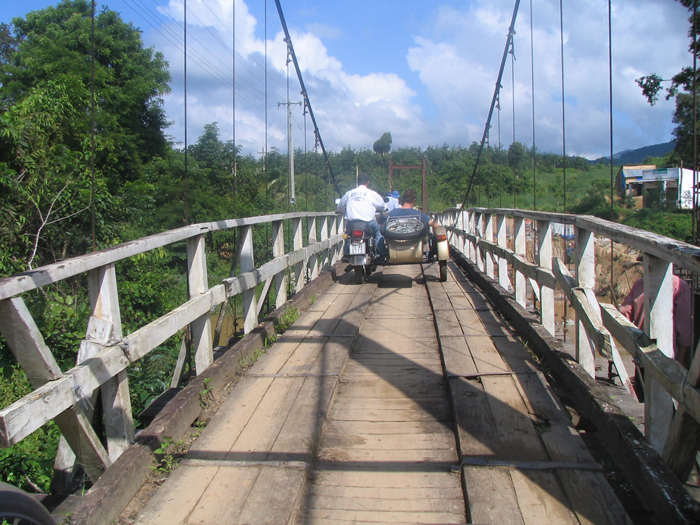
Poggi slows down and stops his narrative for the moment to avoid a cavernous pothole. We’ve turned away from the water now, the roads becoming more narrow and dodgy with every passing kilometer. My sidecar, of course, is suspended between three points of a triangle: the two wheels of the motorcycle, to my left, and a third wheel to my right. When Poggi dodges a pothole, my carriage often passes directly over the blemish. The passenger sees it coming and instinctively braces for a jolt that never comes. This is a fine metaphor for sidecar travel: All in all, the experience is far more comfortable than one might expect.
“Later, when we moved to Phan Thiet, I decide to get one for myself,” Poggi continues, neatly avoiding a herd of cows in the roadway. “I met a policeman who was selling one, and when I asked him how much, he quoted me a price — by kilo! So I bought one, for maybe $200 US. Later, I realized we should have another one, so we could go out as a group. I bought a second, and the policeman told me, ‘I’ll do you a favor. You buy the second and I’ll give you a third for free.’
“Today, we have 11.”
The ride of choice for Team Camel is the 650cc Ural M-72, a Russian replica of the vaunted BMW R71, a German-army staple during World War II and the very bike Steve McQueen made famous jumping barbed-wire fencing in the 1966 film, “The Great Escape”. Urals became ubiquitous in Vietnam only after 1975. They remain practical, Poggi says, because the Russians did a good job simplifying the design. Parts remains readily available. Vietnamese mechanics know their way around the beasts. They’ve been fixing them for 30 years after all.

Rice Paddies, Urals & Sauvignon Blanc
In our party there are two quite spiffy, official-looking sidecars while the others are decorated more flamboyantly, according to the whims of individual club members. Remi Faubel, Poggi’s friend and a quite celebrated chef here in VN, drives a Ural of canary yellow featuring the snarling countenance of a large cat-like creature. Poggi and I ride a black model named for “The Ramones”. It’s an odd-but-pleasing juxtaposition, wending my way through a Vietnamese tableau with a Corsican guide, seated in a Russian-made BMW knock-off named for the proto-grungers who gave us “Sheena is a Punk Rocker”.
Having passed through a narrow shelf of level ground set aside for rice paddies, we soon set off into the highlands. We have taken the back roads where villages are fewer and further between. The Urals are working hard now, taking on steep inclines and those potholes too large to straddle. The higher we go into the mountains, the less tropical the landscape becomes. But never is it anything less than lush: 10 shades of deep green set against still darker greens.
On a tree-less plateau set high above a reservoir of sparkling blue-green, we stop for lunch. Thanks to Faubel, the repaste qualifies as perhaps the most elegant picnic ever devised by man. Holding a glass of sauvignon blanc, Poggi defends his precious Urals from the half-serious charge that they are, well, rather ungainly in appearance. “The sidecar is not a very noble piece of transportation, it’s true. No matter how we package it. But there is nobility in riding a sidecar. There is nobility in experiencing the highlands in this way. There is nobility in enjoying a lunch of foie gras and perhaps a glass of white wine.”
There’s no arguing this.
After lunch we climb ever higher into the highlands on narrow roads of the switchback variety. Each is flanked by precipitous drop-offs lurking just beyond the guardrails — when there are guardrails. It’s something of a shock to see that Vietnam can be so legitimately mountainous. Two hours from Dalat, we zig-zag our way up through a broad mountain pass. Poggi points to a hillside dotted with cultivated vegetation: “Café,” he shouts, lifting an imaginary demitasse to his lips. It was the first of many plantations we would pass in the next half-hour. Vietnam is now the world’s second largest producer of coffee beans, behind Brazil, thanks to elevations and hillsides like these.

Leaning into VN’s French Past
As we draw closer to our destination, the roads get better and the population less sparse. For several hours, we had passed only through dusty, remote hamlets. Locals met our odd caravan first with surprise, then with smiles and waves. In these more populous areas, our standing as curiosities is more modest. Dalat is a resort Mecca that attracts all kinds, foreign and domestic. A light rain begins to fall. We draw less and less attention as pedestrians veil themselves and we join a wider flow of traffic.
Though we’d been climbing steadily since mid-morning, the final stretch of road is the steepest yet. Halfway up a series of switchbacks, the vegetation turns again. There are pine trees at roadside now and the air sports a startling crispness. This absence of moisture I had not experienced since my plane touched down in Ho Chi Minh the week before.
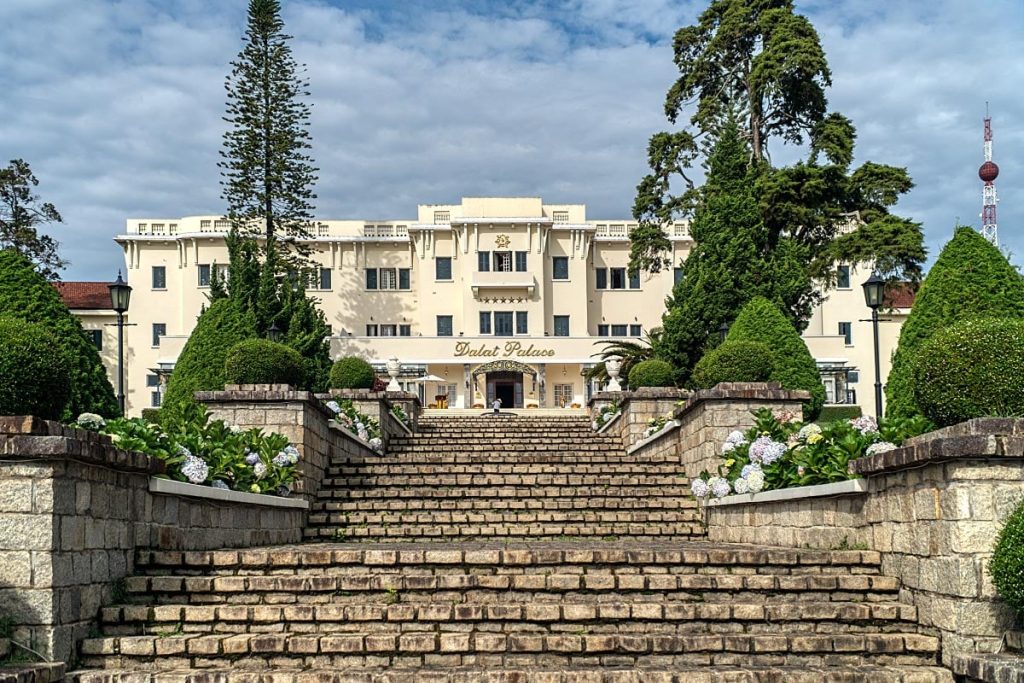
The French influence in Vietnam is hard to miss, even 50 years and three wars removed. Yet because the French founded Dalat — as opposed to merely occupying it during 130 years of colonial rule — this mile-high city has retained more of its Gallic character than just about any place in Vietnam. With its alpine qualities, planned neighborhoods and ubiquitous French architecture, parts of Dalat could be mistaken for Lausanne, or Grenoble. Our ultimate destination, the Sofitel Dalat Palace hotel — surrounded by topiary gardens and verdant lawns sloping down to sparkling Xuan Huong Lake — does nothing to mitigate this sensation. Opened in 1922 and restored to the last period detail, the Palace and its fine-dining venue, Le Rabelais, evoke a level of colonial grandeur and indolence the equal of anything in Southeast Asia.
And yes, that is a golf course I spy on the hillside across the lake. Not just any course, apparently, but the one laid out in 1932 for Bao Dai, the last emperor of Vietnam. I think I’m going to like it here.
Bedecked in shorts and flip-flops, I surely looked a fright as I hoist my dust-covered frame from the Sheena Express. Had I alighted in this state from a mere automobile, I might have felt out of place. As it was, I ascend the Palace’s white marble steps in the perfect historical idiom, regretting only that I had failed to pack a tuxedo.