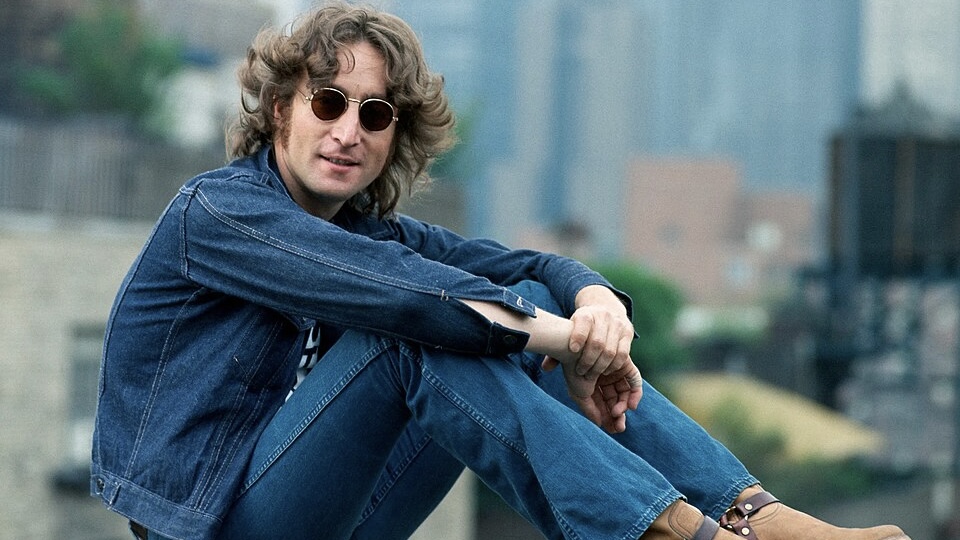
NEW GLOUCESTER, Maine (Dec. 8, 2017) — Like many others that fateful night 37 years ago, I learned that John Lennon had been killed from Howard Cosell. Yeah, that Howard Cosell.
It was a Monday night, and the Patriots were in Miami playing the Dolphins. In December of 1980, Howard was still presiding over Monday Night Football, in his inimitably pedantic, bombastic, half-in-the-bag fashion. In the pre-cable era, MNF was the week’s premier sports broadcasting event; my dad and I always watched it together, as an act of ritual.
Howard was respectful of this traumatic news — as respectful as his on-air persona would allow. In other words, he treated the murder as he would a punt returner who’d broken clear of the pack with only the kicker to beat. See that bizarre media moment, preserved for all time, here. ESPN would later weigh in with its own meta-media doc, here.
I was 16 years old in December 1980. My dad was not yet 44, 10 years younger than I am today. We were stunned by this news, naturally. It was legitimately unmooring to have it delivered by such an unlikely source, in such a peculiar context. The Pats’ left-footed, English place kicker — John Smith, who hails from Leafield, Oxfordshire— was lining up a field goal attempt when Cosell abruptly altered the narrative. The only thing that would’ve made it more bizarre? If Smith had hailed from Blackburn, Lancashire.
John Lennon was 41. Same as my Mom
We quickly called my mother into the room. She was the founding and still presiding Beatles lover in our family, and John was clearly her favorite. She was 41 in 1980, essentially the same age as John Lennon. She had latched onto them from the start. Indeed, my dad had teased her for digging a band whose enthusiasts were, at that stage, mainly 13- and 14-year-old girls.
But my mom has always possessed a keen musical sensibility and her early support for their chops were more than justified in the years to come. She wordlessly teared up while listening to Cosell bloviate, then left the room.
Not sure why, but the holiday period tends to include a lot of Beatles content on PBS. Just last week I watched Ron Howard’s “Eight Days a Week,” along with something called “Sgt. Pepper’s Musical Revolution,” as part of a fundraiser. All these years later, the Beatles are considered subject matter for the whole family, apparently.
If you should get the chance, make time to watch the superb documentary “LENNONYC,” about his post-Beatles years in Gotham (I saw it on PBS, but today you can catch it online, here). The Seventies proved an eventful decade that followed hard on the band’s official break-up back in April 1970. For Lennon it featured a gaggle of outsized characters and spanned a remarkable procession of music-making, protesting, drug-taking, deportation-resisting, legal wrangling, breaking up, getting back together, child-rearing and, ultimately, growing up.
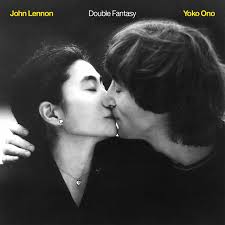
That was the message one took away at film’s close: Here was a guy who had finally shed the latent adolescence of rock stardom and become a man, in his own right, only to be killed by a psychopath at the exact moment that maturity was to be revealed. Lennon’s his gorgeous new album, “Double Fantasy,” had been released on Nov. 17, 1980. I don’t know that it gets much sadder than that.
NEW GLOUCESTER, Maine (Dec. 5, 2017) —‚Since the early 1990s, when Newt Gingrich and his para-parliamentarians initiated their hostile take-over of the Republican Party, I’ve struggled to describe (or identify a lucid framework to help me articulate) what sort of pathology had infected the GOP, its rhetoric, its attitude toward the liberal left, national media, and our government itself. With help from the Washington Post and Project Veritas, I’ve finally hit upon the words to describe this larger framework: I’m Not OK – You’re Not OK.
Refugees from the 1970s will perhaps recognize this reference to Thomas Harris’ 1969 pop-psychology treatise, “I’m Ok – You’re Ok,” whose title refers to an optimal state of human relations, one that most of us do indeed strive day to day to achieve. “Treat they neighbor as thyself” predates Harris’ coinage, but they go together: One cannot hope to treat his/her neighbor well if, to begin with, one doesn’t have a decent sense of self-worth.
There are two more middling, less healthy states that Harris used to describe people suffering from undue superiority (I’m OK – You’re Not OK) and undue inferiority (I’m Not OK – You’re OK).
It is the fourth state, I’m Not OK – You’re Not OK, that is generally reserved for inveterate grumps and outright sociopaths. Let me describe why this phrase so cogently describes today’s GOP and the media apparatus that supports it.
I’m Not OK: Project Veritas, Exhibit A
By now the failed frame-up of the Washington Post in November 2017 — whereby a right-wing “media watchdog” group, Project Veritas, was caught red-handed trying to feed the newspaper a false story re. Alabama U.S. Senate candidate Roy Moore — qualifies as old news. The intent of the unabashed dirty tricksters at Project Veritas (PV) is not disputed. WaPo — which had led the reporting on Moore’s sordid, cradle-robbing past — was meant to knowingly publish the fake story; Project Veritas would call out the paper for its lack of reporting acumen borne of liberal bias. Then the newspaper would be discredited in the narrow context of any further reporting on the Alabama U.S. Senate race, but also in the broader context of all its political reporting.
The whole thing backfired, of course. WaPo’s reporting process (a fact-based process) proved to be anything but the partisan exercise PV would like to have alleged.
But PV’s strategic thinking here is yet another example of a longstanding dynamic — one where right-wingers just assume left-wingers operate as mendaciously as they do, as utter movement soldiers. This attempt at equivalence doesn’t wash, has never washed, as the WaPo example and hundreds more would capably illustrate.
But the underlying rationale behind this behavior and attitude from the right, this I’m Not OK – You’re Not OK sociopathy, has nevertheless informed right-wing charges of left-wing media bias for 30 years. It stems from this basic tenet, held on the right: Some right winger in a position to tilt media coverage (to favor or otherwise advance the right) surely will do so — in large part because he/she alleges counterpart, left-leaning media types are already operating on the same mendacious level.
An Extraordinary Perversion
This charge, that fact-based media (known colloquially on the right as “mainstream media”) are themselves movement soldiers, has led to an extraordinary perversion of the right-wing journalistic ethic, one with larger political goals. Listen to Breitbart.com editor Matthew Boyle speaking to this phenomenon during an event held laste summer:
“Journalistic integrity is dead. There is no such thing anymore. So, everything is about weaponization of information. Both sides are fighting on the battlefield of ideas and you know, CNN, the New York Times, the Washington Post, Politico, Associated Press, MSNBC, NBC, CBS, the whole alphabet soup — they’ve all thrown in together with the institutional left.
“Our viewpoint at Breitbart has always been that we’d rather be open about our personal biases. We’re openly conservative. We don’t hide it. We’re very honest with our audience. We told people we all wanted Trump to win last year. If you’re open with your audience about that, I think you’re honest with your audience.”
The mainstream media, he continued, “claim to be objective. They claim that they don’t have a side. And many of them actually believe their own lies. So, a lot of these people are decent human beings who are working in a broken institution. We’re getting past these guys…We’re winning this war and we’re outnumbered. So the more people that get involved, the more people that stand up and fight, the closer we are going to get to a total victory.”
Knowing Fabrication
For any media outlet, there’s a big difference between being open about an organization’s political biases — something fact-based media routinely do, in their editorial/opinion pages — and openly admitting that said media organization would actively, knowingly fabricate or distort a story in order to fit a desired narrative or serve a political priority.
But read Boyle’s reasoning more closely: Breitbart claims to have gone this direction because the mainstream media (the “opposition media” in this perceived war of ideas) is deploying similar tactics already. This is not the case and never has been the case. Nevertheless, this sort of cynical, pre-emptive, tit-for-tat nihilism has informed right-wing media for 30 years now, and today we see the result, the right wing’s desired result: huge swaths of the American public perceive all media-delivered information as strenuously biased, and so it has all been devalued to the point of castration.
Sorry to get all dramatic and pointed here, but this result — our current media landscape, where widely held truths are no longer held — did not just happen. It is the result of deliberate strategy, yet another tried and true tactic deployed by fascists and authoritarians. Hannah Arendt explains:
The moment we no longer have a free press, anything can happen. What makes it possible for a totalitarian or any other dictatorship to rule is that people are not informed; how can you have an opinion if you are not informed? If everybody always lies to you, the consequence is not that you believe the lies, but rather that nobody believes anything any longer.
This is because lies, by their very nature, have to be changed, and a lying government has constantly to rewrite its own history. On the receiving end you get not only one lie — a lie which you could go on for the rest of your days — but you get a great number of lies, depending on how the political wind blows. And a people that no longer can believe anything cannot make up its mind. It is deprived not only of its capacity to act but also of its capacity to think and to judge. And with such a people you can then do what you please.
Spreading the Gospel according to Steve Bannon
Note that there was no pretension on the part of Project Veritas to determine whether Roy Moore’s accusers were actually telling the truth. The bumbling dirty tricksters at PV don’t care about truth. To them, it is beside the point. Like religious zealots, they care only about furthering the narrative, spreading the gospel, which, as Boyle makes clear, centers on destroying the credibility of competing, fact-based media and the left-leaning political entities that are presumed to support them, in the same way right-leaning political entities support and shape narrative for Breitbart and Fox News.
Would-be fascism of this ilk brings with it an entirely new set of language and tactics, which, though shocking, offensive and nihilistic on many levels, isn’t inscrutable. Here’s a benign example: When our president says, “Nobody knew health care could be so complicated,” what he’s really saying is, “I just found out how complicated health care can be.”
The WaPo sting attempt speaks symbolically, but with fulsome clarity, to right-wing media intentions that are anything but benign. PV’s chosen target and tactics communicate quite clearly that Project Veritas itself believes in the veracity of Roy Moore’s accusers. Otherwise, PV and its lame-brain henchmen would have been out there trying by hook and crook to puncture holes in their allegations, their characters, their credibility as accusers.
But Project Veritas clearly believed these women. That’s why it sought instead to discredit the media outlet that had broken many of the stories re. Moore’s predilection for underage girls. PV and the alt-right don’t care about Roy Moore any more than they care about ferreting out the truth. They believe they have more to gain, in the long run, by neutering this pillar of fact-based media. By doing so, they stake out their position and self-worth quite clearly:
The inimitable Bob Barker, flanked by “Price is Right” eye candy Janice Pennington (left) and Anita Ford.
As yours probably does, my alma mater hits me all too frequently with some manner of e-newsletter cum fund-raising communiqué. One can hardly escape the memories stirred/jarred by all this WesContact, which is surely the way they want it. In any case, a recent MailChimp morsel revealed, among other things, that three Wesleyan University faculty, among them Nat Greene, had received The Binswanger Prize for Excellence in Teaching. While this particular tidbit proved interesting enough to peruse, I’m only now addressing the nostalgia it prompted — immersed as I am, third party, in the college experience of both my kids.
The first thing to say is that my cohort and I attended Wesleyan University in Middletown, Conn., alongside an actual Binswanger — Benjamin Pennypacker Binswanger to be exact. Never knew him but my housemates and I made note of his titanically pretentious name the first week of school freshman year and never forgot it. Never tired of mocking it, either. Always wondered if he was related to Princeton’s Jay Binswanger, winner of the first Heisman Trophy…
Wesleyan Professor Nat Greene
More to the point, Nat Greene was one of these recent Binswanger honorees. I took a couple classes with him but the first was a survey of European history 1815-1945, and I remember it best because it was the only class I ever took with my housemate Dennis Carboni, an art history major whose course load never again overlapped with mine (classical history/modern American lit).
Greene didn’t necessarily tilt the material toward “social” history, an approach then sweeping uber-liberal bastions like Wesleyan. His hewed more to the traditional “Great Men, Great Events” approach. I remember the syllabus included a book of his own scholarship, “From Versailles to Vichy: The Third French Republic, 1919–1940”, which a) struck me at the time as being pretty awesome, that this guy was teaching from his own work; and b) still resides in a bookcase somewhere here in my house, for reasons completely bewildering to my wife. An entertaining lecturer and no-nonsense grader of essays (all testing was conducted via manic, long-hand scribbling in those little blue booklets), Greene was a fine professor, the sort I hope Silas and Clara will experience at some point in their academic careers.
Nat Green Class at 10, Price is Right at 11
But here’s what I remember most from my class with Nat Greene: It ran from 10 to 10:50 on Monday, Wednesday and Friday mornings in the old PAC building — a few steps from the manhole where we often plunged down into Wesleyan’s famous tunnel system, the subject of another remembrance perhaps. If Dennis and I didn’t dawdle after class, we could race home to my off-campus apartment and catch The Price Is Rightat 11 a.m.
Yes, The Price Is Right. It became a sort of ironic obsession for me but something more than that for Dennis, as many things did. It gave me great pleasure to watch him obsessively game this once-seminal game show.
I’m not sure that college kids go in for this sort of thing today, awash as they are in video content and on-demand entertainment delivery choices. However, during the early 1980s, TV was a sort of novel diversion for college kids. We had grown up with it, of course, but had virtually no access to it at school. And so, great delight was taken in the ironic devotion to retrograde programming like soap operas in dorm lounges and late-night reruns of shows like the Rockford Files and Star Trek — things we would never bother watching when home with our families. My sophomore year, my housemate and I came by a tiny black-and-white TV that I’m pretty sure we carried with us the next three years, to three different houses, deploying along the way a staggering array of make-shift aerials including one that involved a pumpkin wrapped in aluminum foil.
The Price is Right fell right into this determinedly low-brow TV consumption, representing, as it did, all that was bourgeois and mass cultural — a great pleasure following high-blown, Nat Greene-led discussions of Marx, Captain Swing and Bismarck’s deft wrangling of German principalities. While Dennis’ note-taking habits at the knee of Professor Green were notoriously suspect, Bob Barker proved another matter entirely. While watching the show, Dennis kept copious notes on the price of every consumer item so that he might later blurt out a winning price before any of the three official contestants. When some dishwasher was revealed from behind the curtain, Dennis would browse his cheat sheet while everyone else in the studio cooed with consumerist abandon (take that, Karl!).
“Whirlpool, eh? That’s upmarket,” Dennis would muse strategically. “I’m going with $538.”
And invariably, it was so — or near enough that Dennis would have earned, in our demented fantasy world, the right to bound up on stage to mug with Barker at close quarters.
Our College/Young Adult Families
I heard an interesting interview a few years ago with writer/director Noah Baumbach and his partner Greta Gerwig, star of his movie, Frances Ha. Gerwig, then 28, talked about how several characters she’s played on screen ]stumble through their mid-20s in an unhinged emotional state — not necessarily because of new adult demands being foisted upon them, but rather because the surrogate families all 20somethings create for themselves at college (and just afterward) invariably fall away, sometimes bit by bit, but always in ways that unmoor. I remember this dynamic: We gathered these people upon leaving our actual families, and Gerwig explained that she was completely taken aback when close college and post-collegiate friends moved away, took jobs that contravened all she had assumed they stood for, or married someone whose presence effectively severed or weakened these bonds — bonds that young, college-educated folk believe are strong and meaningful enough to last forever.
I find Gerwig’s observation to be spot on. I remain close to several friends from college and that immediate-post collegiate period, including Dennis, but many more did fall away over time for reasons that were surely legitimate but felt to me, at the time, like a sort of casual betrayal. I mean, these were people I lived with, for years — they contributed to the shaping of me and presumably I reciprocated in some way. It makes one value all the more those who’ve not fallen away, but it also makes one sad and wistful that all we have to show for these folks, now lost, are weirdly disconnected memories, the odd anecdote, and persistent wonder as to whom they turned out to be.
I stay in pretty good touch with Dennis but there are probably a dozen others I haven’t spoken to for many years now. I wonder how they’re doing, beyond the superficial info I might gather on Facebook (were they, or I, to indulge in such a thing). If we tripped over each other somewhere, would we trade grand truths? Would we trade Nat Greene recollections or their equivalents before falling into the banter we perfected and found so very absorbing all those years ago?
AUBURN, Maine (Feb. 15, 2017) — David Bowie was introduced to me via my older sister. Janet brought home Hunky Dory at some point late in the Nixon Administration and when she wasn’t playing it to death, I played it to death. In truth I hardly ever bothered with Side 2 because that’s how my barely juvenile musical mind operated at the time. Side 1 had everything I thought I needed: the radio song, “Changes”; a screamer that Janet and I used to goof on together during car trips (“Oh, You Pretty Things”); and my favorite track, the always haunting and beautiful “Life on Mars”. Once I got to college and lived in close quarters with a more fully developed Bowie enthusiast/savant, Dennis Carboni, I would learn that Side 2 wasn’t just superb (“Song for Bob Dylan”, “Andy Warhol”) but indicative of Bowie’s genre-busting album and persona to come (“Queen Bitch”).
[I wouldn’t dream of posting anything regarding Bowie without Dennis’ input. His annotative comments appear below, bolded and bracketed.]
It’s been more than a year since Dennis and I spoke of this and many other things the Tuesday following Bowie’s death, in January 2016. He confirmed what I remember us discussing all those years ago, in the wee hours, confined only by the sterile cinderblock walls of our codependent dorm lives. Bowie wasn’t just consistently 2-3 years ahead of every other rock ‘n’ roll artist in terms of musical direction and fashion sense. He typically hinted at his next departure on the back end (Side 2) of his previous album.
[I like how you wrote, “Dennis and I spoke of this and many other things,” which recalls the lyric, We passed upon the stair, we spoke of was and when — from “The Man Who Sold The World.”]
Bowie’s career didn’t begin with Space Oddity in 1969. He’d been around since 1965, when this shot was taken. A reminder that icons we associate with a particular decade didn’t arrive fully formed from the brow of Zeus.
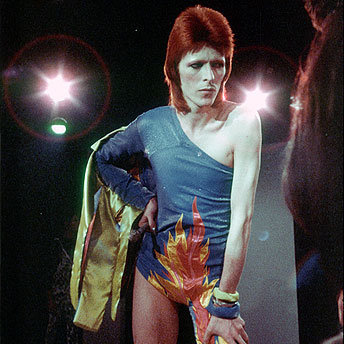
On the generally ethereal Hunky Dory, that clue was, of course, the propulsive and utterly sublime “Queen Bitch”, which heralded the coming of Ziggy Stardust and the Spiders from Mars, one of the great, pure rock (and proto-punk) albums of the decade. To say that Ziggy himself was one of the great “roles” played by any rocker of the period is not necessary, for no one else even attempted this sort of serial shape-shifting back then. Bowie turned this trick 4-5 times throughout the decade — hippie folkster to Ziggy to glam rocker to blue-eyed soul man to Thin White Duke — and competed in this regard only with himself.
[I’ve been reading the blog, “Pushing Ahead of the Dame.” You may know it, but check it out if you don’t. It’s fascinating. Yes, “Queen Bitch” is perfect because it starts with the acoustic guitar C-G-F progression à la Hunky Dory, then switches right to an electric C-G-F à la Ziggy.]
My sister didn’t own the Ziggy album. Indeed, while I knew several cuts well (from FM radio play) I wouldn’t fully absorb it until the early 1980s. She did, however, possess one more Bowie LP: David Live, Bowie’s first official concert release where, once again, he shows us a transition in the making: from the hard-edged glam of Diamond Dogs to the Philly soul of Young Americans. I am not ashamed to admit that I love this particular Bowie period, this dalliance in what he later, somewhat ambivalently referred to as “plastic soul”.
It does shame me to admit, however, that until I was 12-13 years old, I thought this dude’s name was David Live. Indeed, he looked and sounded so different from the Hunky Dory-era Bowie, I thought they were two different guys.
David Bowie as Cultural Touchstone
Dennis Carboni, better known by our particular cohort simply as The Bone, arrived at Wesleyan University in Middletown, Conn., with several well developed musical obsessions. We didn’t bond over them all. I was as confounded/repulsed by The Human League as he was by Neil Young. But we did find common ground in ELO and Steely Dan — and it was through him that I learned to love and appreciate Bowie, and Prince. Part of the reason I was so drawn to these artists was indeed The Bone’s singular, boundless and utterly guileless enthusiasm & advocacy. It wasn’t enough for Dennis to know every song on every album, to know who played each instrument on each track. This was the level of his relatively casual Steely Dan obsession, for example.
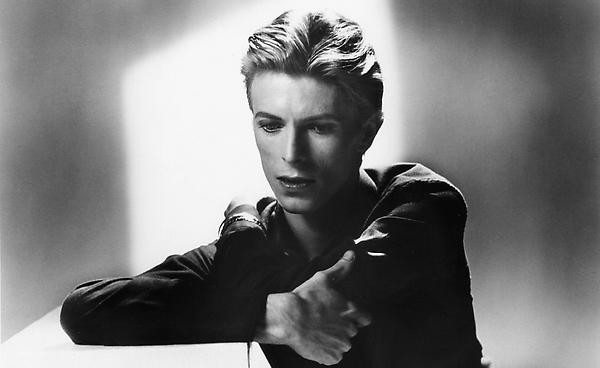
“Thin White Duke” Bowie, an image taken from the same session that produced the cover for the ubiquitous ChangesOne album.
The Bone took it up several notches for Bowie, more or less patterning his own persona, physical presentation and style on the Thin White Duke and Berlin Bowies of the late 1970s — the David Bowie of Station to Station, Low, Lodger and Scary Monsters. These albums, these personae had inspired Dennis to his hair like Bowie did during his famous 1979 Saturday Night Liveappearance, wherein he performed “Boys Keep Swinging”, “TVC15”, “The Man Who Sold the World”. It meant selling his stereo to buy a sewing machine, so he might properly peg his jeans — often installing zippers to turn this trick. It meant shaving his legs, an act that mystified fellow jocks on the track and football teams at staid Orville H. Platt High School in Meriden, Conn. Such acts stood out even at notoriously boho Wesleyan.
It goes without saying that Dennis owned every last bit of vinyl produced by Bowie through 1982, when we all showed up in Middletown as freshmen. And, for the record, he was free to sell his stereo because his roommate had a better one.
Through Dennis I came to know each Bowie album intimately. For example, over a period of weeks our freshman year, Dennis chaperoned my close listening of Pin Ups, Bowie’s beguiling album of ‘60s covers, issued in 1973 (we loved it; Rolling Stonehated it). Much has been written these past few weeks about the generosity of Bowie’s artistic spirit and he did collaborate with, write songs for, and serve as commercial and artistic patron to so many: Mott the Hoople, Iggy Pop, Lou Reed… And so it made sense that Bowie, on Pin Ups, would shout out to the Yardbirds, Them, early Pink Floyd and several more influences from his ‘60s evolution — when Bowie was not some callow teen but leader of his own folky band.
Yet even so: Who takes time between the triumphs of Aladdin Sane and Diamond Dogs to put out an entire album of covers? With Twiggy on the cover alongside him?
The coolest thing about Pin Ups, however — or so I learned from The Bone — was Bowie’s cover of The Who’s “I Can’t Explain”. This was the age of turntables, of course, and Dennis revealed to me that this track could be played as a dirge, at the standard 33 rpm, or as a piece of pristine proto-punk when one simply toggled the turntable to 45 rpm. That blew my mind: Best secret vinyl ruse since the Paul is Dead “campaign”.
[I gave all my Bowie vinyl to my sister. I’m an idiot. I know. Without the vinyl, I wasn’t able to re-hear the amazing 33@45 “I Can’t Explain”, so I just installed the 45rpm app and listened to it on iPhone. Memories came back strong!]
Or Heroic Nights and Ubiquitous Compilations
Come the following academic year, 1983-84, I had moved off campus, to 114 High St., while Dennis and perennial roommate/stereo sugar daddy Dave Rose made house in a different double somewhere in the miasma of late-60s, brutalist dorm architecture that was (and remains) Butterfield C. It was here one night, sometime during our sophomore year, that I popped over unannounced — that’s what people did back in the pre-mobile age —only to find the lights down and “Heroes”, the single, playing on the stereo.
Rose was operating a baby spot, wherein The Bone — effectively bathed but darkly clad in coat and tie — could be seen mimicking Bowie’s expressions and hand-gestures from the Heroes album cover. This went on for some time; such was the power of the kooky, spot-on spectacle. No photographic record exist. Such was the age we occupied at the time. Today we’d havde captured everthing video and, by now, achieved the rank of Internet Sensation.
[I’m glad you have these memories; it feels so good to hear these things that happened… I know it was me, but I just didn’t store the memories well enough. They come back when you trigger them. Funnily, for me it’s easier to remember things like eating pancakes (or Tex-Mex stuff?) and listening to Hall & Oates’ H2O down at your place on High Street.]
Having spent the better part of my freshman year boning up, as it were, on the complete Bowie catalogue, I was in a position to turn up my nose at a few things: The first was Changes One, a compilation, Bowie’s first, released in 1976. At Wesleyan, I’d estimate this album was a mainstay in 75 percent of the record collections I happened upon. As ever, however, the “best of” route proved a dangerous step on the path toward self-administered down-dumbing. Because Changes One merely scratched the surface of Bowie’s enormous appeal. I took to evangelizing my peers to hit the Princeton Record Exchange — a traveling music flea market that showed up on campus twice a year selling perfectly good used vinyl for 10-25 cents a pop — to properly fill out their Bowie collections.
A Recession from Popular Influence
In time, I’d also turn up my nose at what many consider Bowie’s last “influential” album. Let’s Dance hit in the spring of 1983. It featured some good quasi-pop songs, including a few (the title track, “China Girl”, “Modern Love”) that garnered serious “radio play,” a term that had recently been expanded to include “video” play on the nascent MTV.
The ’80s were tough on everyone. See here the blown-dry, bleached-blond, Let’s Dance-era Bowie.
Bowie toured in support of the album and I had the pleasure of seeing him at Schaefer Stadium along with 60,000 others in the fall of 1983 — my very first stadium show. David live would prove magnificent in a pale-yellow, double-breasted linen suit. Studio Master? Not only. He held the audience in his palm by dint of a prowling, feline stage persona, these new hits, and two dozen further samplings from that massive catalogue of his.
Yet his previous decade of prolific hit-making, risk-taking and trail-blazing would ultimately prove the rub when it came to Let’s Dance, not to mention the dozen or so albums Bowie issued thereafter: They didn’t measure up. In the immediate sense, Let’s Dance followed a run of albums that was nothing short of spectacular: Station to Station, Low, Heroes, Lodger and Scary Monsters are masterpieces all, each utterly unique and 2-3 years ahead of would-be tastes. Thanks to Bowie’s seamless transition to the video format, Let’s Dance sold well and kept the dream alive, as it were. But artistically, it was nothing terribly special — indeed, it veered dangerously close to pop, something Bowie always hovered above.
In the longer term, for most all of us (including professional tastemakers these last 30 years), Let’s Dance would prove Bowie’s last true hurrah. He continued to issue a diverse collection of albums. I particularly liked the IDEA of his simply being part of a band (Tin Machine, 1988-92) though he three albums it produced (two studio, one live) didn’t moved me much.
[Nothing to add here apart from the fact that I love Let’s Dance, even though I know the “rock” critics do not. I do think Bowie has been somewhat relevant of late, in both 2013 and 2016. But that may be, sadly, because first he returned after a decade away (issuing Next Day, a powerful album) and then released the greatest final statement (Blackstar) in the history of rock.]
Bowie Ruled the post-Beatles World
Many of the retrospectives and obituaries I’ve read since Bowie’s January passing hint at this last point of contention: that while he assiduously avoided repeating himself — and the cynical formulas that would have sold out once-a-decade nostalgia tours, à la The Rolling Stones — Bowie’s cultural relevance tapered off markedly following Let’s Dance.
While this observation is undeniably true, it does gloss over the fact that from 1971 to 1983, Bowie ruled the post-Beatles world. And no one in the rock ‘n’ roll era, not even the Fab Four, was ever so consistently mode-shattering and commercially popular, over such a long period of time. We can throw straight out the window any further comparisons to the Stones, Zep, REM or any other “bands” — for these were collections of talents, while Bowie was just one man. He proved an individual who assembled bands, looks, sounds and trends pretty much on his own. No individual can claim such an artistically varied, unfailingly daring but still popular run of form.
Dylan? Yeah, he went electric and did a country album. But he shifted shape hardly at all in terms of persona. The only individual who has even attempted this sort of long-term trick is Prince, who managed 6-7 years of arguably comparable output — and sexual non-conformity — before eventually bowing under the pressure.
[Do Michael Jackson or Madonna merit mention?]
Only a fleeting one, you Bone. MJ was a child star, then a full-blown pop icon on the strength of two albums (Off the Wall, Thriller) before riding out his days as a physical, commercial and emotional oddity — not an artist or even a reliable popsmith. Madonna had the shape-shifting down but not 1/10th Bowie’s talent or vision. Lady Gaga works in this space but managed just 2-3 years of relevance. Now she’s singing the national anthem at Super Bowls.
Bowie turned this very difficult trick for 12 years, all the while fostering the work of others, all the while pushing the popular envelope, not just in music but in film and fashion. Indeed, no one in the history of rock ‘n’ roll was so “mainstream” successful while simultaneously inhabiting the avant-garde.
[Are critics afraid to speak of this? Do they think they are belittling all the other artists if they mention the concept you discuss? It’s a perfect closing.]
Heroes-era Bowie
The Man Understood Exits
We’re not quite done: In the 2-3 weeks following Bowie’s death, the music and fan communities issued a sustained outpouring of affection for the man, his music, that enduring commitment to the avant-garde, and his basic humanity. Amazinglly, the latter quality never did get lost amid the trying-on of so many on-stage, public personae. To me, a pair of paeans stood out.
The first was an 18-minute podcast segment produced by The New Yorker, wherein reporter Sarah Larson sat with a fellow from the techno-jazz ensemble that backed Bowie on his last album, Blackstar, issued just weeks before his death. The story of their meeting up is interesting enough on its own: Apparently Bowie wanted to do a jazz-inspired album and anonymously scouted these guys at a couple gotham clubs. He floated the idea of this project via email. Utterly gobsmacked, the band agreed. Bowie then collaborated on the recording without the slightest trace of ego — never mentioning to his new mates that he was terminally ill, for example.
Near the end of the pod segment, Larson asked the saxophonist, Donny McCaslin, whether he’d listened to Blackstar since Bowie’s passing. Twenty seconds of dead air ensued, as the poor bastard tried to gather himself. No, not yet.
The second was a BBC documentary that aired in 2019 on PBS called “Five Years”, where the filmmakers detail these astounding musical and theatrical transitions Bowie authored at the peak of his powers. I can’t recommend these 90 minutes highly enough, as they encapsulates and confirm much of what I describe above, in far greater detail. They also deploy Bowie’s own words, those of his various collaborators, and an amazing collection of period images, sound and video — 75 percent of which I had never before seen or heard.
Bowie himself makes the pivotal point: He really didn’t see himself as a rock ‘n roll star, more an actor who takes on a role, immerses himself therein, then discards it for the next one.
That sentiment seemed to me spot on, though we’ve barely touched on the man’s film work, which also fits neatly into this continuum. Still, fixating on this idea too rigidly does risk our diminishing the incredible body of musical work that grew out of this role-playing — a catalogue that never felt derivative of itself, that was often popular but only rarely veered into “pop”. King Crimson’s Robert Fripp, a featured guitarist on Heroes and Scary Monsters, had some really cogent things to say in Five Years about the making of those two albums, and Bowie’s music in general. He greatly appreciated the freedom he was granted to spin his twisting, screeching guitar riffs, adding what he considered elements of “danger” to otherwise straightforward melodies. Listen to a track from Scary Monsters like Fashion or It’s No Game. You’ll understand what Fripp means.
This documentary was the first time I’d ever seen Fripp speak on camera. He comes off like an avuncular but highly mischievous university semiotics professor, one who just happens to be an aging guitar god/visionary. He points out that Bowie had a genius for using scatalogical things like a Fripp guitar lead — or broadly provocative themes like androgyny, race-mixing, fascism and drug use — to purposely unsettle the listener.
In the doc, Fripp amplifies the point, explaining that it’s precisely this element of menace that separates mere pop from “rock ‘n roll”. The Brit allows that idea to hang there for a moment before sitting up a bit straighter in his chair and adjusting his gaze to look more or less straight into the camera. Lifting an eyebrow ever so slightly, Fripp explains what that danger truly means to the listener: “It means, you might get fucked.”
Having weighed in, soberly and professionally, on the “air rage” phenomenon the Mandarin Media blog, I couldn’t leave the subject without relating the more salacious story of my first trip to the French Alps. It wasn’t exactly an instance of “air rage,” but it well illustrates the peculiar holiday-making mindset among some Brits Abroad. Of course, said mindset can and has led to many an airborne incident. In short (I love quoting myself), “There is something to the idea, born of armchair psychology, that Brits generally and the English specifically cut loose on holiday in reaction to leaving what remains a very buttoned-up, class-restrictive culture.”
It was March 1985. My girlfriend and I were studying abroad, in London, and we’d booked a chartered ski package to La Plagne, in France, for mid-semester break. Our short flight from Gatwick to Geneva, almost entirely peopled by English holiday-makers, quickly degenerated into a sort of raucous booze cruise at 30,000 feet. Everyone, it seemed, had broken open their bottles just procured at duty free.
Normally, such characters scatter to the four winds upon landing, but this was a charter. We had all purchased the same ski package. Accordingly, the same rowdy group piled onto a single coach and set out for La Plagne — in a blizzard.
Brits Abroad: In a Blizzard
By this time, my girlfriend and I had traveled a great deal together. This much was clear: If she wasn’t seated directly behind the bus driver, she was dangerously prone to car sickness. So, from the very front of the coach, we could hear the party raging behind us, as we crept our way along ever more windy, mountainous roads. In a blizzard. This was a non-smoking bus; the Brits defiantly smoked like chimneys and brandished their duty-free liquor bottles like groomsmen at a stag party. Then came the songs.
The unfortunate leader of this charter was a mild-mannered American 22-year-old named Chad. His attempts to tamp things down were met with open ridicule. He was a tad chubby, our Chad. Ultimately, he was regaled with a spirited rendition of “Who ate all the pies?”
From our perch behind the driver, we witnessed the trip’s dramatic inflection point: An oncoming Citroen spun out in the snowy conditions and crossed into our lane. The bus driver tried evasive action but these were shoulder-less roads — and it was snowing like a bastard. The car bounced off the driver’s side of the bus, right below us. After skidding to a stop, we found ourselves literally perched precariously at the edge of a steep and snowy hillside.
We sat there for half an hour, crowded onto the left side of the bus — to avoid tipping the bus and our still soused party into oblivion. Finally, a replacement vehicle arrived. When it did, we all exited out the driver-side window.
Any Train-Station Bar in a Storm
This backup bus was not big enough to accommodate all of our luggage, so the entire party was deposited at a nearby train station, which served some small French mountain town whose name I cannot recall. The station had a bar, however. Our new British friends set about drinking again, as if nothing had happened. To be fair, so did we. Having cheated death, we tucked into a couple bottles of wine with two more American friends traveling with us.
Two hours later, we piled onto the second replacement bus, where our moveable booze-fest was now completely out of hand. Chad just hunkered down beside us. This party could not be stopped — or could it…
The up-and-down, side-to-side nature of our alpine journey would result in two initial incidents of vomiting. Each time the bus ascended and descended, the resulting spew sloshed back and forth along the bus floor. The stench had just the wrong sort of effect on others who teetered at the edge of nausea.
Upon arrival in La Plagne, I don’t believe I’ve ever been quite so thankful to disembark from anything. Rule Brittania!
Bald Hill played the Peace Fair on Brunswick Green Saturday. Our mando player, Ben, arranged the gig: His mother is a German war bride and longtime social justice activist. She administers this event, which annually draws a healthy cross-section of southern Maine’s aged hippie population. This year, for these unreconstructed lefties, we performed a Pete Seeger tribute/sing-along. The crowd was big (for a peace fair, in August) and the weather held off. But the noteworthy development arrived before I had played a note. Ben’s brother Matt, a gifted pianist, was up for the event and brought along a fellow Nutmegger native on sax. They started our set (we followed a five-piece that featured two steel drums) with a four-piece tribute to the recently departed Horace Silver (above), a jazz name I sorta knew but not really. Altogether appropriately, the song they chose was “Peace”, and it quickly transported me.
During the early 1990s, I worked as the news editor at a couple of daily newspapers in Massachusetts. The life was somewhat nocturnal: I’d arrive at 5 p.m., put the paper on the press at 2 a.m., and go home — unless the paper crowd had gathered for very late-night revelry. We were somewhat obliged to socialize together because who else was awake? Even a ridiculous schedule like this can become routine: I’d arrive in the newsroom and flip on NPR via WGBH in Boston. The first two hours of the work “day” were a mix of gay banter, serious story planning, photo assessment (from what had been shot that day) and assignment (to be shot that night), and front page/section layout. All this took place with All Things Considered airing in the background, as soundtrack.
At 7 p.m., things got more down to business. Reporters headed off to meetings or returned from accidents/crime scenes/sporting events to begin filing stories — stories that I would read and edit before sending the final layout to the paste-up/press operation a few towns over.
But nothing seriously got done, not at my desk anyway, until 7:04. WGBH aired a jazz program starting each night at 19:00 called “Eric in the Evening”. The show theme was this beautiful piece of jazz that dripped from the transistor radio each night, all on its own, starting at exactly 7 p.m. The routine of its play provided the perfect respite and regathering moment before the radio got turned off and we all transitioned to the mania of another evening on deadline.
I’m not a huge jazz guy. I like a massive cross-section of the genre, though when I pin myself down, I can see how the influence of Charlie Brown and Vince Guaraldi shaped this particular aspect of my musical taste. Dave Brubeck. Bill Evans. That’s the stuff I’m drawn to apparently: white guys from the late ‘50s and early 60s. Very uncool, I’m afraid. Just the way it is.
I left the Marlboro Enterprise and Hudson Daily Sun in 1992. I never did get the name of that theme music to “Eric in the Evening”. Every couple years it would jump into my brain — not because I’d heard it, but because I’d remember just how resonant and important it was to me, at one time, in my work life. I googled “Eric in the Evening theme” one time, with no luck. For a long time, apparently, Eric Jackson still hosted a jazz show on WGBH radio, but at some point he’d eschewed the regular-theme music thing, opting instead for excerpted bits from that night’s guest or spotlight artist.
Well, I can report without question that “Peace”, was in fact Eric’s old show theme. I knew it from the moment I heard the opening two measures at the 2013 Peace Fair. Only took me 23 years… And now Eric Jackson has passed away, at 72.
Here is Silver’s original version, from 1959. Here is the Tommy Flanagan version that specifically served as the “Eric in the Evening” theme. Peace out, Mr. Jackson.
In joining the wide chorus of praise for director Daniel Gordon’s superb “30 for 30” documentary on the Hillsborough soccer disaster, we should be reminded of two things: First, the state of British football fandom in the mid- to late-1980s was legitimately menacing and pervasive; and second, the 1985 Heysel Stadium disaster, where 39 died in a similar crush of humanity, should hang over the Hillsborough proceedings with a pall all its own.
That Gordon never found space in his film for Heysel, nor Britain’s genuine and warranted cultural worry over hooliganism (and Liverpool’s connection thereto) is somewhat startling.
Gordon was clearly at pains to accentuate the unfair and, some would argue, criminal treatment that Liverpool fans received in the wake of Hillsborough. It’s a fair and important point, and the facts here have been too long obscured. However, the context Gordon seeks — namely, that Liverpool’s reputation for hooligan behavior contributed to the way the disaster was investigated — surely cannot be summoned without a discussion of Heysel, which colored everything that came afterward and certainly fixed uncomfortable attention on a club and fan base that played central roles in both tragedies.
Liverpool FC was indeed front and center on May 29, 1985, when the Reds met Juventus of Turin in the European Cup Final, forebear to today’s Champions League Final. Thirty-nine predominantly Italian fans perished that night in Brussels, where Liverpool fans stormed a purportedly neutral area inside the gates but outside the stadium itself. Juventus supporters fled the threat, into the stadium, toward a concrete retaining wall. Fans already seated there were crushed by the onslaught of humanity — then the wall collapsed.
Unlike the Hillsborough narrative, very little of the above account is disputed, by Liverpool supporters or anyone else. Six hundred more were injured at Heysel that night and, as a result, English clubs were banned from all European competitions for five years. Liverpool was banned for 10, but was allowed back after 7 years served.
Gordon makes the important point that, rightly or wrongly, the fear of untoward supporter behavior tragically influenced police actions before, during and after the tragic 1989 FA Cup semifinal. The presumption that drunken fan violence had played a role ultimately moved the English Football Association (FA) to an appalling continuum of cynical posturing. That same presumption influenced media coverage of the event for years to come.
As such, it’s vital to understand the climate in which that semifinal, and so many other matches were routinely played during this period.
The police, the FA and the media behaved abominably post-Hillsborough. Full stop.
However, they were not behaving in a vacuum. The mid- to late-1980s were rife with soccer hooliganism. I was there, in London, for most of 1984-85 season. No one should require my eyewitness accounts, gathered from four separate city grounds, but serious alcohol consumption routinely played a role in the violence.
And yet Gordon touches on this broader cultural phenomenon very little.
Hey, it’s a big subject — probably too big to address fully/fairly in a 120-minute documentary on Hillsborough. But again, methinks Gordon soft-pedaled it because undo context here would tend to explain, if not justify, the behavior/presumptions of police, the FA and media in relation to Hillsborough.
Gordon does make it clear that police, the FA and England’s tabloid culture took this fear of hooliganism — born of Heysel and myriad other incidents involving dozens of clubs — and manipulated it in disgraceful fashion. However, menacing fan behavior was no figment of the FA’s nor Rupert Murdoch’s imagination.
It was all too real and totally out of control in many cases, as I witnessed first hand.
•••
It can be argued that the spring of 1985 represented the nadir of British football hooliganism, as Heysel had not yet gone down and English supporters still traveled to away grounds, foreign and domestic, with impunity. As it happened, this low point coincided with the semester I spent at the University of London, on loan, as it were, from my American college. I traveled all over the city that winter and spring, taking in a dozen matches at three separate grounds.
My maiden voyage, however, would prove the ultimate eye-opener.
I had two English roommates at the Westfield College, University of London; both were rugby fans and sarcastically dismissed football as a meaningless diversion for working class oiks. Accordingly, when Barry — a fellow American and Sheffield Wednesday fan (thanks to several summers spent in South Yorkshire with his cousins) — suggested we and I take in the Chelsea-Wednesday match one early February night at Stamford Bridge, I didn’t even mention it to my roommates. Off Barry and I went.
The word “hooligan” has always been loaded with questionable motivation, but there is no doubt that English soccer in the mid-1980s was then developing, in earnest, its notorious reputation for what has since become known, in a blanket fashion, as “hooliganism”, whereby traveling supporters of certain clubs would clash with home-standing counterparts before, during and after matches in miniature manifestations of England’s particular brand of xenophobia. People always harp upon English hatred of the French, and they do hate them (who wouldn’t). But in truth, the English aren’t particularly fond of anyone in Europe. Indeed, people from the South of England belittle people from the North, and vice versa; residents of Shropshire deride their neighbors in Worcestershire, and vice versa; even neighboring towns have managed to work up healthy mutual hatreds over the course of centuries.
As a consequence, “support” for football clubs routinely takes on a tribal, fever pitch (to borrow a phrase) the likes of which we really cannot imagine here in the States. There is no cultural equivalent that even begins to fit.
The year before, after Liverpool had defeated Roma in the 1984 European Cup Final, bands of Italian toughs on scooters had apparently attacked celebrating British fans as they danced in the Eternal City’s many fountains. Hit and run, or hit and scoot, apparently. This sort of behavior didn’t sit well with the English, as it probably wouldn’t with anyone. A year later, at Heysel, it was payback time.
Yet fan violence wasn’t reserved for internationals. English fans — not all fans, but relatively small subgroups of young toughs — routinely practiced their sordid craft at domestic matches, where rivalries were arguably more heated. Familiarity and contempt, don’t you know. This was the backdrop, only a few months pre-Heysel, as Barry and I left Westfield College, in the north London borough of Hampstead, for south London.
The tableau in and around Stamford Bridge that night was truly surreal. We came up and out of the Fulham Broadway Tube station and immediately walked past a pub that had been thoroughly gutted, all its windows shattered following a punch-up late that afternoon apparently; police and angry masses milled about everywhere.
Picture the scene from Apocalypse Now where Martin Sheen and the boys reach that bridge, the one a few clicks beyond which lies Cambodia and certain peril, the one eerily bejeweled with hanging lights and flairs, where a night-time firefight rages and chaos reigns. I love that scene, and that’s what it was like in and around Stamford Bridge that night, minus (ironically) the illuminated bridge. It was an atmosphere only enhanced by the fact that the river of supporters streaming toward the ground was continually fed by tributaries emanating from local pubs. Plus, I’d gotten well and duly stoned before leaving Hampstead. I was effectively channeling Timothy Bottom’s surfer dude character, Lance, who was transfixed but not effectively warned by the spectacle.
Following Barry’s lead we entered the stadium through a portal reserved for visiting fans alongside a gaggle of Wednesday supporters. The terrace (no seats) set aside for visitors at Stamford Bridge was located behind the North goal. To our left there was nothing — just a sunken access road, well below us, that led to the field. Indeed, 30 feet of open space separated us from the main stand along the touchline.
To our right was an unoccupied terrace guarded on either side by 15-foot, wrought-iron fencing punctuated at foot-long intervals by sharp spikes. Beyond that was the remainder of Stamford Bridge’s North Terrace, occupied by thousands of Chelsea fans, clearly hammered and beside themselves with venom, all of it aimed at — us.
I had been utterly naïve about this excursion. I would soon learn what I should have known beforehand — what my roommates would have readily told me — namely, that Chelsea supporters, back then anyway, were among the “hardest” and most hostile in London, rivaled only by Millwall’s and West Ham’s. Put the money of Russian oligarch ownership out of your mind. This was not the posh club it is today. Chelsea was a hardscrabble, working class club in 1985, with fans to match.
Today, as home to one of the world football’s richest clubs, Stamford Bridge is a jewel (I’ve heard some older fans deride it as a bleedin’ galleria). In 1985, it was no such thing. Picture a dingy, no-frills ground very much like the Hillsborough we see in Gordon’s documentary.
•••
Inside the ground, the Wednesday fans (along with at least one woefully underprepared, somewhat stoned Yank), occupied a pen current observers might also recognize from the “Hillsborough” documentary. No seats. Completely enclosed. But that February evening in 1985, we were but a few hundred traveling supporters from Sheffield. There was no crush of fans clamoring to enter all at once. There was plenty of room to move about freely, though we instead huddled together — to guard against the cold and various projectiles.
From the outset and this considerable distance — the full width of the open terrace, maybe 25 yards — the Chelsea faithful pelted us with AAA batteries and pound coins. However, to be honest, it wasn’t all that threatening. It was a bit of a laugh at that stage. What a good and practical idea, I remember thinking, to leave that section open, as a buffer.
The game? Well, at times it seemed almost secondary to our homestanding neighbors a section removed. Chelsea scored first, through Kerry Dixon, and Sheffield managed to equalize just before halftime.
About then, to our horror, the empty section that separated the home crowd from ours was opened up, practical caution apparently giving way to the reality of ticket sales.
What ensued was a jailbreak. There’s no other way to describe it, and it lends insight to the rush/crush of fans that took place at Heysel and Hillsborough. The Chelsea throng poured over (!) and around this huge, spear-tipped fence like a horde of rabid 11th century Danes, and made a beeline for the lone wrought-iron barrier now separating us. Soon they were pressed up against it, screaming obscenities and taunting us, their arms reaching through the fence like desperate, famished prisoners. We all instinctively moved away from the fence, gathering at the far edge of the terrace and pulling our jackets up around our heads so as not to take a AAA in the ear. Let me tell you: It was fucking scary. I remember turning to Barry and saying, “I should NOT have gotten stoned.”
This was not some frenzied spasm of menace that faded with time. The Chelsea fans were on us the whole time, the entire second half, bombarding us with all manner of pocket-sized ammo. Thank god no human could spit that far.
There was no police presence in the terrace, only a smattering along the access/egress concourse that ran along the back of all three sections, behind the north goal. While the Chelsea horde had scaled one wrought-iron fence, an identical fence continued to separate them from us. The only thing stopping them from invading our space was, well… I don’t know. The fact that police were watching from above and perhaps an obscure, deep-seated tenet of British restraint?
Fortunately Chelsea scored in the final 10 minutes to secure a 2-1 victory. I don’t want to think about how things might have played out if Wednesday leveled things, or managed to win the game. As a player myself (at the time), I remember considering the prospect later that night: Did the Wednesday players, for example, recognize what victory might mean for the 800 or so supporters who’ve traveled down from Sheffield? Can one try to win with all the same commitment, knowing that a goal or victory — or perhaps a goal celebration taken a bit too far — might well bring a battery down on someone’s head, to say nothing of what might happen afterwards, outside the stadium?
Today, in the more refined Premiership era, visiting players score and make beelines to visiting fan sections, where much fist pumping and bellowing is enjoyed by the merry bands of traveling supporters. English football comportment was generally far less exhibitionist during the 1980s (so few of the games were televised). But visiting goal celebrations were relatively muted, in part, so as not to put traveling supporters in unnecessary danger inside and outside the ground.
As it was, when the final whistle blew and the referee pointed to the spot, the home supporters spent a few minutes hugging each other and chanting before they turned back to us and emptied their pockets one last time.
The trip out of the stadium was more frightening still. We Wednesday supporters exited first — and now there were several dozen policemen to help us execute this delicate task. The entire stadium was sealed but for our Bobby-lined egress route, which, of course, passed right behind our neighboring terrace, where the horde reached out to us one last time through the fence. They let us have it again, but I didn’t see any of this spectacle. I had my coat up over my head.
Outside the stadium there were two long lines of police on horseback; we walked between them the three city blocks back to the Tube station, where a special train was waiting for us. We piled on, the doors closed, and, as we slowly pulled away, a group of Chelsea fans burst down onto the platform, half of them singing “We love you Chelsea/Oh yes we do-oo…”, while the other half reiterated the epithets to which we had become accustomed inside the Bridge.
The context is important: Wednesday was and remains no particular rival of Chelsea’s. This was a run-of-the-mill, February match between a pair of mid-table sides, with nothing special to play for. And yet the atmosphere between the two sets of supporters was dire — and routine. That everyday menace like this, and incidents like Heysel, did nothing to move the FA toward meaningful institutional reform and stadium renovation, is a bit mystifying 30 years on. That it took Hillsborough to make that happen, finally, is tragic.
Back at Westfield, just off the Finchley Road, I found my roommates at home and started to regale them with tales of my nerve-rattling introduction to top-flight English football. Yet I’d hardly begun when Trevor interrupted. “Hang on, mate. You sat with the away supporters?” As indicated, Trev was no football fan back then, but he knew enough to throw a disbelieving glance at Adrian, before turning back to me. “That was fucking stupid.”
It doesn’t matter where MadMen auteur Matthew Weiner picked up the narrative thread when beginning the seventh and final season. Some might have insisted on 1969, to keep the specific-decade ethos in tact — though the award-winning series actually started in the late ‘50s. Others may have argued for 1974, thereby neatly bookending the Dick Nixon Era. I don’t care how the final season might have started, but I have strong feelings how it should have closed.
Fans and critics of MadMen have debated the show’s narrative choices since its debut in 2007. The actual series finale — whereby Don Draper passes over into a 1970s American Milieu by joining an EST retreat in Big Sur — has garnered all sorts of feedback. But still, halfway through Thursday’s 2-hour finale, the show should have leapt forward to a recognizably modern day. Maybe the suit jackets might have seemed a bit oversized, especially through the shoulders. Hairstyles would shift. In keeping with the way other MM seasons have begun, however, it’s not exactly clear what year it is.
What is clear, in this alternate finale of mine, is this:
Sterling Cooper & Partners has survived and thrived, perhaps added a name or two. The agency has taken up residence in chic modern offices high in a glittering Manhattan tower of glass and steel. For 50 minutes of this final hour, in the course of a normal business day, we learn what’s happened to most all the characters who matter, i.e. who remains at the firm, how the hierarchical machinations have shaken out, who’s moved over to or formed competitors, who has leftthis mortal coil, who has divorced and remarried whom, who’s aged well and who hasn’t.
The pacing is pointedly brisk, recalling the Season 3 episode “Shut the Door. Have a Seat,” when our gang reboots the firm. This pacing is important because frankly there’s a lot of ground to cover — for the viewer, absent all these years — and to make clear the agency’s ongoing vitality.
MadMen Finale: Chronological Clues
Indications of the time period dribble out via scene details and workaday conversations at SC&P. The Justice Dept. will no longer seek to break-up Microsoft. The codgers at Sterling Cooper aren’t at all sure, charmingly, what a search engine is. But they do care. They’re courting Netscape, which is jittery because a company called Google has just been awarded US Patent 6,259,999 for the PageRank algorithm used in its search engine.
Bobby Draper has grown up to be a political operative. We see him on TV as chief of staff to Congressman Gary Condit, steadfastly defending a man who would appear to be dying a slow political death while denying an affair with 24-year-old Chandra Levy, now missing for 133 days.
All this catch-up takes place on a single day, a Monday.
The next morning, standing in his Upper East Side apartment, an appropriately aged Don Draper reads the paper. In his stylish breakfast nook, a radio plays in the background: Ahmed Shah Massoud, leader of the Afghan Northern Alliance, has been assassinated in Takhar Province. Draper’s young wife frankly doesn’t know who that is. She’s the spitting image of Betty Draper. Or, maybe it’s another brunette…
What we all accept without debate: It’s a late-summer day of rare clarity, made real under a bright, blue, cloudless sky. Don emerges from a cab and bumps into a colleague (Peggy? Roger? Dawn?) outside their NYC office tower. They’re all running late for a conference call at 9 a.m. As they hustle inside, the camera pans back from the monolithic revolving door. It reveals, for the first time, that the Sterling Cooper offices are housed inside the World Trade Center.
Sterling Cooper in Flames
Cut immediately to the Sterling Cooper offices burning out of control. Don is knocked out but slowly coming to beside his own desk. He lies amid charred debris that includes a bottle of bourbon, a tumbler and a slide carousel. Low-licking flames and the eerie, reedy hum of steady wind provide the only soundtrack, as several ceiling-to-floor windowpanes have been shattered/knocked out by the impact and subsequent blasts of jet fuel. Scene staging and blocking actively recall MadMen’s seminal Korean War flashbacks.
Don ultimately does regain consciousness. Things are suddenly moving fast again. MM characters dart in and out, to see if Don’s alive, to express ignorance or disagreement as to what has actually happened. They tell him so-and-so is dead, inform him they can no longer stay put. As per usual, they exude a massive, sincere reverence for this man in particular, whom they’re now looking to for decision-making, beside whom they might well die. A group has decided to ignore the “stay put” advice of emergency personnel on the ground — they’re leaving, and they’re taking the stairs. Draper says he’ll be right there.
Alone now, he grabs the bourbon, pours himself a drink and downs it. As he takes one last look around the wreckage that was his office/firm/life, the episode-ending music begins (“Be My Baby,” by Ronnie Spector and the Ronnettes). Don walks past the camera toward what we assume is the door. Instead, he walks to the open window and calmly steps out.
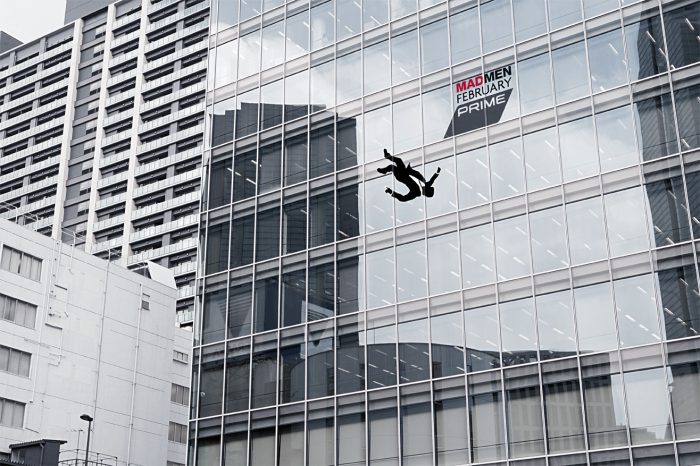
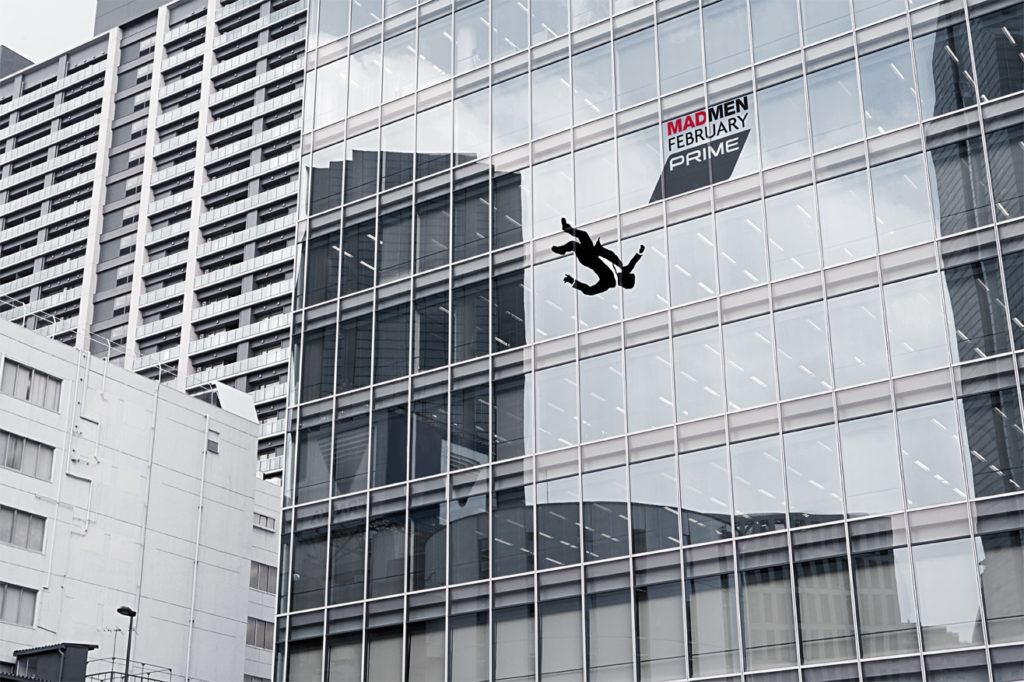
No need to show the trag-iconic footage of that businessman falling from the World Trade Center on 9/11. It is immediately recalled. It provides new meaning to the animated version of that footage we’ve seen at the start of this and every other MadMen episode, including the final one.
Raised to be aggressively “skeptical of consumerism in general and advertising in particular,” I have, throughout my adult years, embraced this credo and further developed it. I dutifully change channels during commercial breaks and flip right past magazine ads, for example. I diligently disable any and all online pop-ups. I watch on television virtually nothing that hasn’t already been DVR’d, allowing me to buzz right through any and all consumer appeals. When I am obliged to confront an advertisement, I delight in letting loose upon it all my powers of sarcasm and mockery. In fact, I’m hard pressed to think of a single instance where I was moved to purchase anything on the basis of its formal advertisement.
Anything, that is, except special edition burgers mongered by fast food giants.
Much as I’m loath to admit it, I am quite helpless in the face of fast-food burger innovators and their army of propagandists.
I recognize this is for the major character flaw it is. Perhaps by writing about this phenomenon, this innermost shame, I hope to overcome it. Until that time, I am putty in the hands of Burger King each and every time it trots out a special-edition Whopper.
The King and his competitors are a sophisticated bunch and it’s not merely the power of their marketing. They spend years in secret labs researching and building into their products the neuroscientific triggers designed to elicit in unsuspecting consumers, like me, the desired Pavlovian response. When it comes to new burgers, I am essentially their Munchurian Candidate.
Ads for existing burger products don’t have the same effect. You could pimp Big Macs to me all day long and I wouldn’t be moved. I know from Big Macs, and I’m over them.
However, when the burger establishment pitches me a new, highly accoutered beefy morsel, I MUST TRY IT.
Intimates of mine may well read this and say, “Well, Hal is famously enthusiastic about all things edible.” And this is true. The same parents who so well prepped me to resist consumerism also imparted to me, by nature and nurture, an overdeveloped appreciation of worthy foodstuffs. But while I’m saddled with an unnatural love of pizza, for example, I don’t see an ad for some new Domino’s product and feel I must rush out to buy it. I don’t notice a fancy new offering at my local pizzeria and feel any immediate urge to sample it. Introduction of a new chicken-based sandwich anywhere leaves me essentially unmoved.
The burger situation, however, is anomalous and insidious. Something about cow flesh reaches my involuntary subconscious on a primal, unsettling level.
I recently ran across the above ad — for something Jack in the Box is calling the Hot Mess. Am I the only one intrigued by the mere name of this thing? We don’t even have Jack in the Box in Maine, or anywhere in New England, so far as I know. Still, I am plotting my next trip to the West Coast where I can cram a Hot Mess down my pie-hole forthwith.
Methinks it’s the special edition aspect that truly breaks down my fragile defenses. Homer Simpson proved famously spellbound by the Ribwich, a McRib-like concoction whose periodic availability (“for a limited time only!”) he met with unbridled enthusiasm. Indeed, Homer ultimately followed the Ribwich around the country, from city to city, like a Grateful Dead fan.
Thankfully, I don’t have the need to eat these things over and over, but I must try them. When Dairy Queen unleashed its Flamethrower burger — hot sauce, jalapenos, pepper jack and bacon — I naturally went out and sampled one straightaway. Okay, several.
I get over such things in due course, but it’s the initial curiosity that gets to me. If they’re equipped with bacon and/or jalapenos? Well, it’s “Katy bar the door…”
I’m a Burger King guy, because I like underdogs and their fries have always been superior, but mainly because their menus have routinely featured more bacon-bedecked items than McDonalds’, or any other competitor’s. Naturally, it didn’t take me long to sample their new “Angry” Whopper, so called because of the jalapenos, complemented by bacon and onion rings. Formidable!
Wendy’s Baconator combined the same time-honored lure of cured meats with another clever name. Of course I’m gonna try me one of those. If they ever figure out a way to work a fried egg in there, I’ll be among the first in line.
The value proposition is another trigger. Much has been written about the obesity of underprivileged Americans due to the remarkable affordability of fast food. A clear connection there, in my view. For the pure delivery of calories (worthless calories, but calories nonetheless), $7 goes a very long way. No, I don’t need a second Whopper — but if you’re offering me one for a dollar? I’m likely to be persuaded by that, even if I’m not hungry. Two Egg McMuffins for $3? Only a fool would pass that up.
I’m already over the recently unveiled Angry Whopper. Been there, done that. But this Hot Mess thing… It’s in my head. I’m headed to California in April. I’m intrigued enough that I may well bypass the SoCal delights of In ‘n Out Burger.
The regional nature of some chains does figure prominently in this equation, so far as I’m concerned anyway. I’m participate in an NBA fantasy league, so I watch a lot of NBA TV, where they merely co-opt regional cable feeds from, say, Sacramento, and share it with the nation. The commercials there naturally feature West Coast brands like Carl’s Jr. or Jack in the Box — that’s how I discovered the Hot Mess. When I first started traveling in Florida, I had an uncontrollable urge to investigate what Checkers had to offer. In North Carolina, how can one travel around the state and not drive-thru at Biscuitville?
In Kalamazoo, Mich., from whence my wife hails, I was, for a time, fascinated by something called Hot ‘n Now, a local chain that serves only drive-thru patrons from small, purple, A-framed establishments in mall parking lots. “Oooh… What’s that?” I cooed to her the first time we passed one.
“Ugh. They’re disgusting,” she reported.
“Well, yeah. Naturally. But we’re going to need to turn around.”
In my work, I gather and view killer golf photography all the time. Those of us in the trade often refer to these beauty shots as “golf porn”. This particular photo — the back tee on the 16th at Cape Kidnappers GC in Hawkes Bay, on the east coast of New Zealand’s North Island — has always intrigued me for what it lacks and what it delivers (full disclosure: This course is a client of my firm, Mandarin Media). My job is to get magazines and website to print or post an image like this, but I don’t know that many have done so. It’s a funny shot, captured by Chris Mclennan. Maybe editors choose others from Cape because while the 16th is a magnificent, incredibly photogenic par-5, this image doesn’t give any indication of that. It attaches the viewer’s eye to no golf hole whatever, not that we can see or even vaguely discern. On the other hand, any golfer looking at this photo could and should think to himself, “How bad could this hole possibly be?” I was traveling with some fellow golf writers earlier this month and the subject of Cape Kidnappers came up. One tried to argue that while Cape is a magnificent course (Top 50 in the world according to all the trusted rankings), and among the 10 most photogenic courses on Earth, it’s not that scenic for the golfer actually playing the course. I beg to differ, and I imagine that anyone standing on 16 tee — a thousand feet above the South Pacific, looking back at five holes with similarly perched vantage points — would beg to differ, as well.