
Hot Mess and The Insidious Power of New-Burger Mania

Hot Mess and The Insidious Power of New-Burger Mania

Raised to be aggressively “skeptical of consumerism in general and advertising in particular,” I have, throughout my adult years, embraced this credo and further developed it. I dutifully change channels during commercial breaks and flip right past magazine ads, for example. I diligently disable any and all online pop-ups. I watch on television virtually nothing that hasn’t already been DVR’d, allowing me to buzz right through any and all consumer appeals. When I am obliged to confront an advertisement, I delight in letting loose upon it all my powers of sarcasm and mockery. In fact, I’m hard pressed to think of a single instance where I was moved to purchase anything on the basis of its formal advertisement.

Anything, that is, except special edition burgers mongered by fast food giants.

Much as I’m loath to admit it, I am quite helpless in the face of fast-food burger innovators and their army of propagandists.

I recognize this is for the major character flaw it is. Perhaps by writing about this phenomenon, this innermost shame, I hope to overcome it. Until that time, I am putty in the hands of Burger King each and every time it trots out a special-edition Whopper.

The King and his competitors are a sophisticated bunch and it’s not merely the power of their marketing. They spend years in secret labs researching and building into their products the neuroscientific triggers designed to elicit in unsuspecting consumers, like me, the desired Pavlovian response. When it comes to new burgers, I am essentially their Munchurian Candidate.

Ads for existing burger products don’t have the same effect. You could pimp Big Macs to me all day long and I wouldn’t be moved. I know from Big Macs, and I’m over them.

However, when the burger establishment pitches me a new, highly accoutered beefy morsel, I MUST TRY IT.

Intimates of mine may well read this and say, “Well, Hal is famously enthusiastic about all things edible.” And this is true. The same parents who so well prepped me to resist consumerism also imparted to me, by nature and nurture, an overdeveloped appreciation of worthy foodstuffs. But while I’m saddled with an unnatural love of pizza, for example, I don’t see an ad for some new Domino’s product and feel I must rush out to buy it. I don’t notice a fancy new offering at my local pizzeria and feel any immediate urge to sample it. Introduction of a new chicken-based sandwich anywhere leaves me essentially unmoved.

The burger situation, however, is anomalous and insidious. Something about cow flesh reaches my involuntary subconscious on a primal, unsettling level.

I recently ran across the above ad — for something Jack in the Box is calling the Hot Mess. Am I the only one intrigued by the mere name of this thing? We don’t even have Jack in the Box in Maine, or anywhere in New England, so far as I know. Still, I am plotting my next trip to the West Coast where I can cram a Hot Mess down my pie-hole forthwith.

Methinks it’s the special edition aspect that truly breaks down my fragile defenses. Homer Simpson proved famously spellbound by the Ribwich, a McRib-like concoction whose periodic availability (“for a limited time only!”) he met with unbridled enthusiasm. Indeed, Homer ultimately followed the Ribwich around the country, from city to city, like a Grateful Dead fan.

Thankfully, I don’t have the need to eat these things over and over, but I must try them. When Dairy Queen unleashed its Flamethrower burger — hot sauce, jalapenos, pepper jack and bacon — I naturally went out and sampled one straightaway. Okay, several.

I get over such things in due course, but it’s the initial curiosity that gets to me. If they’re equipped with bacon and/or jalapenos? Well, it’s “Katy bar the door…”

I’m a Burger King guy, because I like underdogs and their fries have always been superior, but mainly because their menus have routinely featured more bacon-bedecked items than McDonalds’, or any other competitor’s. Naturally, it didn’t take me long to sample their new “Angry” Whopper, so called because of the jalapenos, complemented by bacon and onion rings. Formidable!

Wendy’s Baconator combined the same time-honored lure of cured meats with another clever name. Of course I’m gonna try me one of those. If they ever figure out a way to work a fried egg in there, I’ll be among the first in line.

The value proposition is another trigger. Much has been written about the obesity of underprivileged Americans due to the remarkable affordability of fast food. A clear connection there, in my view. For the pure delivery of calories (worthless calories, but calories nonetheless), $7 goes a very long way. No, I don’t need a second Whopper — but if you’re offering me one for a dollar? I’m likely to be persuaded by that, even if I’m not hungry. Two Egg McMuffins for $3? Only a fool would pass that up.

I’m already over the recently unveiled Angry Whopper. Been there, done that. But this Hot Mess thing… It’s in my head. I’m headed to California in April. I’m intrigued enough that I may well bypass the SoCal delights of In ‘n Out Burger.

The regional nature of some chains does figure prominently in this equation, so far as I’m concerned anyway. I’m participate in an NBA fantasy league, so I watch a lot of NBA TV, where they merely co-opt regional cable feeds from, say, Sacramento, and share it with the nation. The commercials there naturally feature West Coast brands like Carl’s Jr. or Jack in the Box — that’s how I discovered the Hot Mess. When I first started traveling in Florida, I had an uncontrollable urge to investigate what Checkers had to offer. In North Carolina, how can one travel around the state and not drive-thru at Biscuitville?

In Kalamazoo, Mich., from whence my wife hails, I was, for a time, fascinated by something called Hot ‘n Now, a local chain that serves only drive-thru patrons from small, purple, A-framed establishments in mall parking lots. “Oooh… What’s that?” I cooed to her the first time we passed one.

“Ugh. They’re disgusting,” she reported.

“Well, yeah. Naturally. But we’re going to need to turn around.”

Speak the Unspeakable: Celts should deal KG for Howard

Speak the Unspeakable: Celts should deal KG for Howard

You heard it here first.

Tell me what doesn’t make sense about this trade. With Rajon Rondo out for the season with a torn ACL, the Celts are done this year. Maybe they’ll make the playoffs, but it’s time to turn the page. The Lakers and Dwight Howard are not proving a good fit, and he’s a free agent at the end of this year. Most of the talk has been about trading Pau Gasol, but the Lakers are instantly NBA Finals material with Garnett, a better fit for Coach Mike D’Antoni’s offense, a different but comparably excellent defender, a man Kobe would prefer to Howard, for right now (Nash, too, but he doesn’t have anything like Kobe’s veto power in LA).

Who says no to this trade?

Not the Lakers, who must think short term with the pieces they have. Things have gone so awry with Howard, personally, they might not even be able to sign him this summer. Dealing for KG cuts their losses and makes them better.

Not the Celtics, who can build around Howard, Rondo and maybe someone like Josh Smith (ATL homeboys reunite!), for Boston instantly becomes a free agent destination of choice with that young core (a core that doesn’t need to shoot; the gunners will line up to play with those guys).

Not the League: The numbers match up. Garnett makes $19 million and Howard just 11, but throw in Jeff Green ($8 million) or Brandon Bass (6) and it fits.

KG is one of the few NBA players with a no-trade clause. He’s been a model Celtic, but if we’ve learned anything about Garnett during his tenure in Boston, winning is paramount. The window is closing for him, too, and it’s gotta be clear, to him, this Celtics incarnation is toast (I’ve argued they could not realistically have won the last three years; they’ve been gallant but never had have the horses). He has two years in him, I reckon. So do Kobe and maybe Nash. Gasol for sure. Why would he say no?

Because the Lakers are, well, the “hated Lakers”, and because they have 16 championships to Boston’s 17, Pierce — who is too much of a Celtic to ever leave for the Lakers — would say no to a Howard-for-Pierce, Gasol-for-Pierce deal. He grew up in LA but he’s been that anomalous single-team player his whole career. He would not want to go to LA on a championship-mercenary mission.

I don’t believe KG looks at it the same way. He undertook that mission when he came to Boston. Perhaps he wouldn’t go to Miami, but I say he goes to LA.

Only the Celtics would have plausible motivation to say no. While they would probably not trade KG within the Eastern Conference, they might also balk at sending him to the “hated Lakers”. Danny Ainge could potentially be handing LA a 17th title and a place directly level with Boston in the Pantheon.

Still, that’s a lot of yes and a single no.

If you haven’t checked out Zach Lowe’s NBA reporting at Grantland.com, do. He’s extremely informed and a facile writer. This was a clever piece, for example, exploring the Celtics options and multiple potential trade partners. The Spurs make sense, though KG and Tim Duncan reportedly loath each other and San Antonio has nothing to give in return. Lowe (and Jalen Rose) both posit an Al Horford/Kyle Korver for Howard scenario, which makes more sense. But neither floats the Garnett for Howard idea, which makes the the most sense of all. The salaries line up. So do the stars, in an astrological sense and this vital sense: KG & Kobe would assent. These two stars are nearly burned out, and they want to win.

A Few Words (not 1000) on the Power of Golf Imagery

A Few Words (not 1000) on the Power of Golf Imagery


In my work, I gather and view killer golf photography all the time. Those of us in the trade often refer to these beauty shots as “golf porn”. This particular photo — the back tee on the 16th at Cape Kidnappers GC in Hawkes Bay, on the east coast of New Zealand’s North Island — has always intrigued me for what it lacks and what it delivers (full disclosure: This course is a client of my firm, Mandarin Media). My job is to get magazines and website to print or post an image like this, but I don’t know that many have done so. It’s a funny shot, captured by Chris Mclennan. Maybe editors choose others from Cape because while the 16th is a magnificent, incredibly photogenic par-5, this image doesn’t give any indication of that. It attaches the viewer’s eye to no golf hole whatever, not that we can see or even vaguely discern. On the other hand, any golfer looking at this photo could and should think to himself, “How bad could this hole possibly be?” I was traveling with some fellow golf writers earlier this month and the subject of Cape Kidnappers came up. One tried to argue that while Cape is a magnificent course (Top 50 in the world according to all the trusted rankings), and among the 10 most photogenic courses on Earth, it’s not that scenic for the golfer actually playing the course.  I beg to differ, and I imagine that anyone standing on 16 tee — a thousand feet above the South Pacific, looking back at five holes with similarly perched vantage points — would beg to differ, as well.


The Mother of All Faux Tuscan Hill Towns?

The Mother of All Faux Tuscan Hill Towns?

What is it about the Tuscan hill town that holds such incredible architectural and social appeal? It can’t be the Seinfeld references alone, can it? My wife and I once spent a lovely week between Aix-en-Provence and Avignon, where one French resort, Pont Royal, featured one such village in miniature — one would have thought the French would not deign to pay their noisy neighbors this sort of homage.

And then there are the many sprawling golf clubhouses that have, of late, taken on this popular design theme: I’m thinking of The Bridges GC near San Diego and whole bevy in Florida, China even. The Italians don’t fancy their golf in any great numbers. But something about this tableau has really hit home with golf developers.

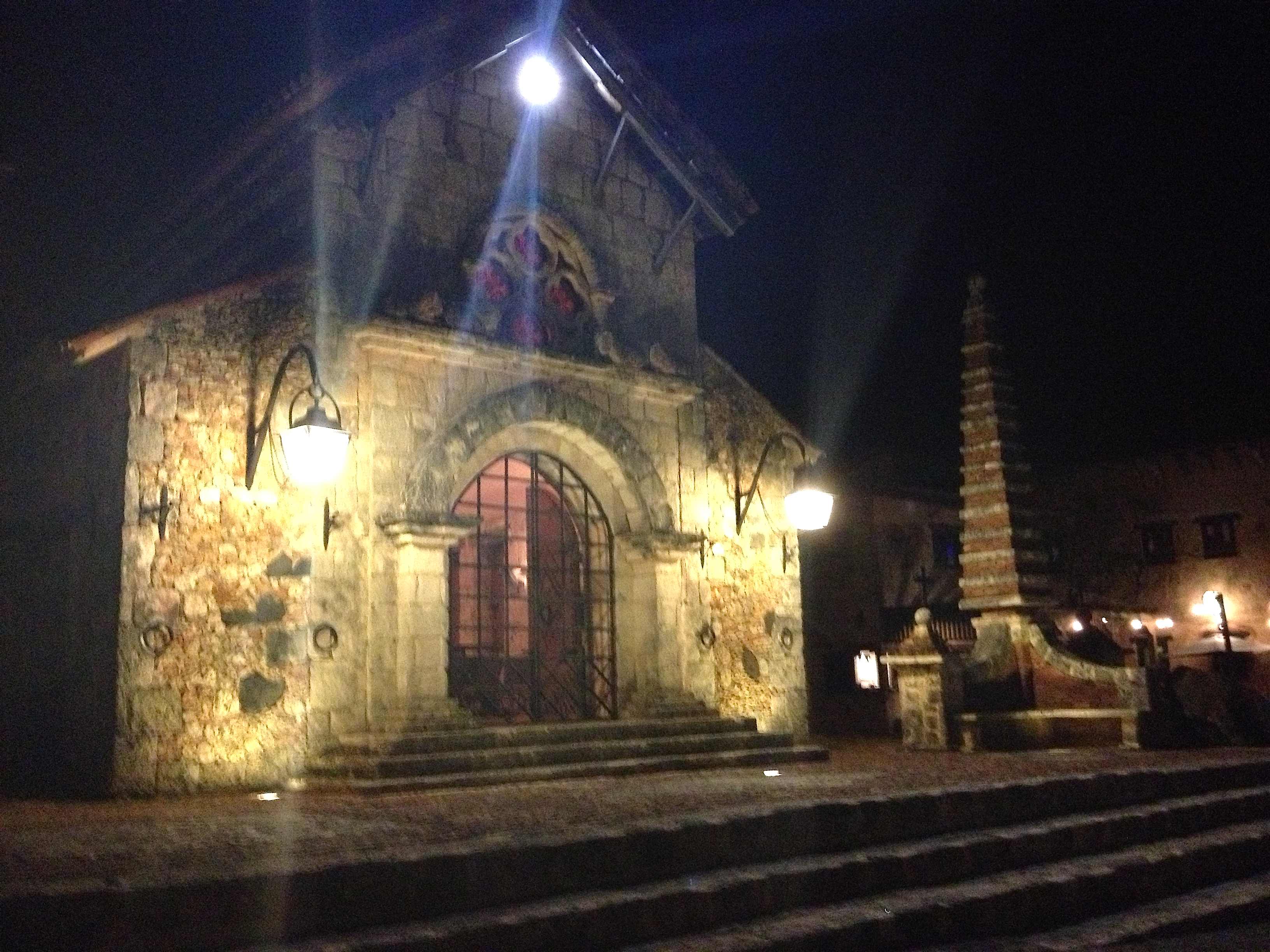
I can’t prove it, but Casa de Campo may have started this trend. Altos de Chavon doesn’t just sit high on the cliffs above Rio Chavon (right next to the Dye Fore 18). It fairly well hangs out over those cliffs, and its lofty perch is but a detail. This is something of an architectural marvel, an entire Tuscan hill town designed by Dominican architect Jose Antonio Caro and created by Italian master designer and cinematographer Roberto Coppa. Local artisans handcrafted the cobblestone pathways, decorative ironwork, furniture and buildings using the volcanic rock and coral displaced by construction of the resort. The village began to take shape in 1976. Frank Sinatra christened altos De Chavon in 1982 with a concert at the amphitheater.

Last night we sampled the considerable atmosphere high above the river (where several scenes from “Apocalypse Now” were shot), and it’s somethin’, boy. After a sumptuous meal at one of the many restaurants in the village, La Piazzetta, we wandered around and through the narrow streets and piazzas, stopping in at a local bar or two (just to make sure they weren’t some Disney-inspired prop), and taking in the incredible views up and down the Rio Chavon basin.

I can attest that it’s all real, not some whimsical creation of the resort. Apparently the place is overrun by tourists and wedding parties during the day; the chapel there, St. Stanislaus Church, is the nuptial venue of choice for women across the DR. There are boutiques, museums and galleries. After night falls, the locals come out and make it more inviting still.


Casa de Campo: Polo Capital of the Caribbean

Casa de Campo: Polo Capital of the Caribbean

Casa de Campo makes no apologies for the luxuries it purveys, and so it should come as no surprise that the resort serves as a sort of Mecca for Caribbean polo, the sport of kings (and anyone else who can afford to show up to a match with the requisite 6-7 horses). If you play polo, odds are you already know that Casa manages some 300 horses for guest play, for all manner of recreational riding, for breeding and sale. For the neophyte, it’s a fascinating window on a sport we hear about (mainly through Prince Charles references) but rarely see.

Cali Garcia-Velez is the man who manages all things equine at Casa de Campo, and he would appear well suited to the role. A Dominican native, Garcia-Velez is tall and dashing (a dead ringer for the actor Will Arnett), a son of the rancher who used to manage the cattle on this vast property, and a former polo professional in his own right.  While Casa has its own polo fields, today Garcia-Velez ably escorted a few of us media scum to a match held at a private ranch some 15 minutes from the resort.

“You see that guy there,” he said, pointing to #4 in black. “He’s riding one of our horses. I sold it to him. He came to me for an upgrade and he couldn’t be happier… In polo, it’s all about the horses. And the guys who can afford it will always have the best horses. That’s just the way it is.”

This was no arms race we witnessed today, as the late afternoon sun bathed the field and surrounding sea of sugar cane in a soft, pale-pink light. In the DR, there are maybe 30 polo players of a high standard and they converge on fields like this one, and those at Casa de Campo, for a match or two each week during winter, the high season. They come from all over the island but mainly from here, Greater La Romana, and Santo Domingo some 90 minutes away.

The action is non-stop, as Red and Black (four players to a side) gambol from one end to the other, flailing and bumping, at speeds you cannot appreciate until you’re this close. Outside the lines, the mood is decidedly more casual and festive, with families spread out on blankets behind one goal and still more gathered in the thatch-roofed clubhouse at midfield. They all greet Garcia-Velez with familiarity. The drinks/conversation flow as play proceeds through the first three chukkers, or periods, which last some 7 minutes apiece.

A proper match is six chukkers; the players change horses after each one. On one level the game is simple: whack the ball between posts 24 feet apart, positioned at each end of a field 300 yards long and 150 wide. On another level, there is great nuance to the strategy, the game’s physicality and officiating. It’s good to have an expert sitting close by, imparting the finer points.

But again, this is a casual Saturday afternoon match in January. The week of Presidents Day, and again over Easter, the polo communities from across the Caribbean and Florida will descend on La Romana for the two biggest tournaments of the year. As Garcia-Velez is telling me about this, along with the reasons for Argentinian Polo dominance, and what a polo pony really costs, the players thunder past en masse. The conversations — ours and those taking place all around us — come to a studious halt, as all eyes follow the action to the north goal.


Casa de Campo: 5 Things You Need to Know
The 4th at Dye Fore, evidence of the gorgeous views here and why you need a good short game to score here. (Larry Lambrecht photo)

Casa de Campo: 5 Things You Need to Know

The 4th at Dye Fore, evidence of the gorgeous views here and why you need a good short game to score. (Larry Lambrecht photo)

Having played the Links Course this morning, the Golf Road Warriors have now sampled all three tracks here at Casa de Campo. With that sort of first-hand experience in tow, I’ve taken it upon myself to issue five vital directives to golfers mulling or already planning a visit here:

1)   Play the Links Course first — If you’re coming from a winter clime and haven’t touched your clubs in months, this is the place to work out the kinks. The front nine is especially playable; it’s not till hole 12 that it gets at all penal — in the form of several lakes that require serious negotiation. Even then, Pete Dye has fashioned an extremely comfortable, attractive piece of eye candy here, a Florida-style faux links with enough elevation change and design interest to place it head and shoulders above 98 percent of the courses you’ll ever find in Florida.

2)   Play Teeth of the Dog next — The temptation is to head out there right away, what with all those ocean holes and the beautiful pictures you’ve no doubt seen in advance. But get a round under your belt first; get the feel of the greens and considerable wind here at Casa de Campo. A quick session with the staff at the Jim McLean Golf School here wouldn’t be a bad idea either. You don’t want to get out there with all those expectations and stink it up.

3)   Play Dye Fore third, when you’re good and ready — The scale of this course and the views from various spots along its 18 holes (down the Rio Chavon canyon, or down to the Marina on the front nine) are truly extraordinary. But Dye Fore is not for the faint of heart (or, for that matter, some New Englander right off the plane after three golf-less months). You’ll want two rounds under your belt before you tackle this beast. But do tackle it. The risk-reward dynamics here are stark, oversized and (should you negotiate them with dexterity) extremely satisfying. My favorite? The gigantic speed slot on the par-5 18th — a veritable half-pipe carved from the left-center of an uphill slope 60 yards wide. Wow.

4)   Bring your “A” short game — Dye courses have the reputation for being difficult, and talk of threading a drive down a half-pipe probably doesn’t help. But that rep is too simple to be true. Pete’s fairways are always generous, with bunkering that, while legion, nearly always funnels golfers down the right path. However, his green complexes are often all-or-nothing affairs. Miss and you’re bunkered (often deeply bunkered) or mired in some swale that requires a putt up a steep, shaved face, or a delicate flop shot to a plateau putting surface, or a bump-and-hope into said steep-shaved face. If you can handle the short sticks, if your sand game is handy, you can score on all three courses here, especially Dye Fore and the Links, where the greenside features are most severe.

5)   Don’t worry about bringing enough golf balls — There are two reasons for this. First, these courses aren’t ball-eaters, thanks to the super wide fairway corridors. Yes, there’s a lot of water on the back nine at the Links, and the Caribbean laps against 7 holes at Teeth of the Dog. But that’s about it. Second, the grounds staff at Casa de Campo has scrubbed the course clean of lost balls, shined them up, grouped them together by brand, and will gladly sell them back to you at very reasonable prices  — a win-win practice Director of Golf Gilles Gagnon fully endorses.


Add Béisbol to Casa de Campo’s Rich Sporting Life

Add Béisbol to Casa de Campo’s Rich Sporting Life

Casa de Campo bills itself as enabler of The Sporting Life, and they deliver on that claim in myriad ways: golf, of course, but shooting, polo, tennis, yachting and several more I’m sure I’m missing. But there is baseball, too, and tonight we got a thoroughly entertaining taste.

La Romana, the city of 250,000 that is home to Casa de Campo, is home to Los Toros del Este of the Dominican League, a winter circuit comprised of the country’s many fine players and a few U.S.-based stars home for the Major League Baseball offseason. Thursday night we ventured out to Estadio Francisco A. Micheli to watch “The Bulls of the East” drop a 4-3 decision to visiting Estrellas Orientales, who hail from the noted baseball hotbed, San Pedro de Macoris.

MLB fans surely understand by now what a huge impact Dominican players have had on America’s national pastime. Indeed, as a Red Sox fan, I’m forever in debt to Dominican stars David Ortiz, Manny Ramirez and Pedro Martinez for delivering two World Series in the last 8 years. But the Dominican league is something substantial in its own right, a brand of beisbol that must be experienced to be believed.

Yes, there are MLB stars on hand, though Los Toros’ Erick Aybar, who plays for the Angels, and Estrellas’ Felix Pie were the only two “big” leaguers on hand this night. Aybar didn’t even play actually, which is typical apparently. Sometimes these MLBers show up to games, sometimes they don’t. Sometimes they show up and never leave the dugout. It’s all very loose down here, and the crowd whoops it up regardless — waving banners, dancing to the band ensconced in the loge section, chanting scatologically, and tittering as the PA announcer ogles hot chicks in the crowd.

“I want an American girl, and her little friend,” the crowd chanted in the third inning, commenting on U.S.-Dominican couples they spy in the crowd, assuming the Dominican guy is just angling for a green card.

After Los Toros pushed one across in the bottom of the third, the PA announcer broke into a low growl, and intoned, “Attention, attention: Section 5, black top, blue pants… How healthy the women are tonight!”

In the middle of the fourth, the Toros mascot (a bull, naturally), delivered one of the raunchiest dances you’ll ever see from a man in orange fur, and it sure beat the hell out of any between-innings dot race — or the execrable Sweet Caroline sing along. Until this year there had been cheerleaders at Estadio Micheli; they’d been banned because they weren’t particularly family oriented. “Basically they were strippers,” our local guide explained, and the players spent too much game time ogling them as they worked it atop the home dughout. There’s been a strong call for their reinstatement.

The baseball itself is quite good, certainly on par with AAA, but it’s the little twists on the game that make it worthwhile for a tourist. There are cashews, not peanuts on offer. The beer flows, of course (the ubiquitous Presidente Light — in special Toros orange cans), but also rum — in plastic bottles to mix with Coke. When they flash player stats on the big screen, there’s the recognizable AVG and HR figures, but RBI is replaced by “C.E.”, for Carreras Empujadas, or “pushed runs”.

The DR may have thrilled this summer when Félix Sánchez won gold at the London Olympics in the 400-meter hurdles, but this is a baseball country, first, foremost and always. When we pulled into the stadium parking lot, it was not yet full and dozens of kids were playing baseball on the hard top. For visitors to Casa de Campo, baseball is yet another sporting diversion. For the locals in La Romana and across the country, it’s the only real game in town.

The Figure Eight: How to Get More Beach in your Golf

The Figure Eight: How to Get More Beach in your Golf

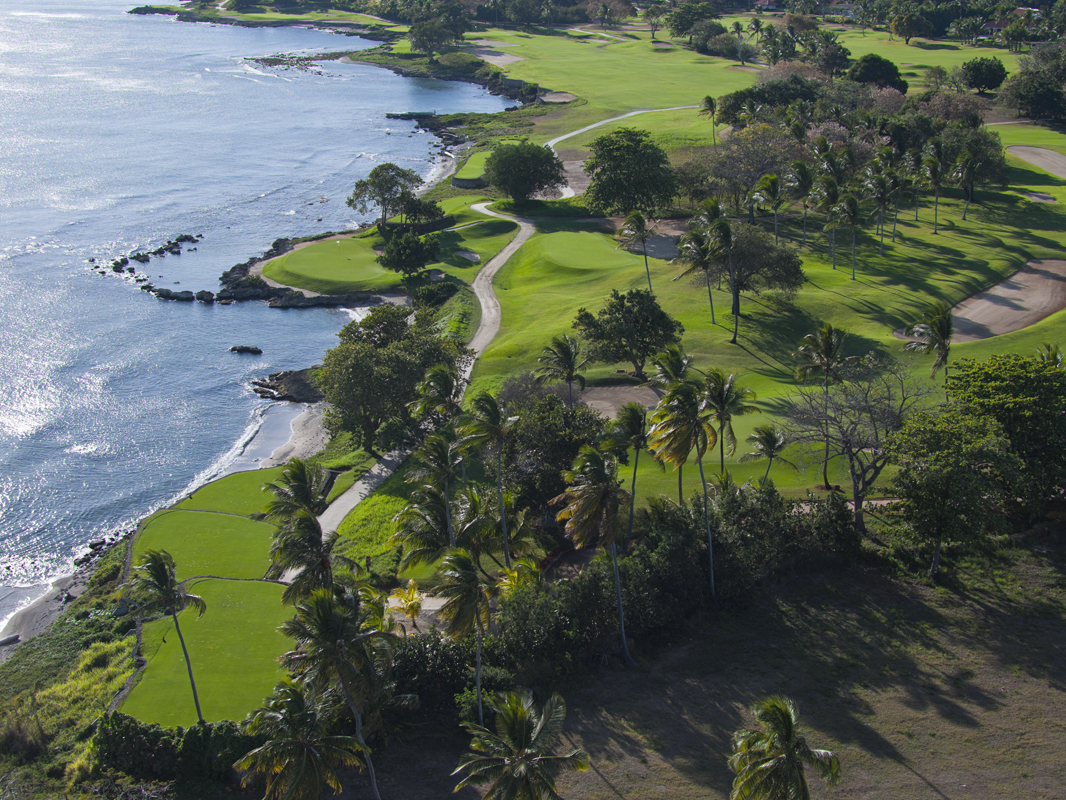
It takes Pete Dye four holes to arrive at the beach on the front nine at Teeth of the Dog, allowing holes 5, 6 and 7 to play along the sea. (Larry Lambrecht photo)

One last word re. Teeth of the Dog, before we head up country to play another Pete Dye product here at Casa de Campo, Dye Fore, which, I’m quite certain, will be (to) Dye Fore:

The Teeth of the Dog course is similar to most seaside tracks in that there is but one stretch of beach, and it was the course architect’s job to maximize the number of holes played at seaside. That’s what we all want, right? To play as many holes as possible by the beach?

But how exactly does one make that happen? Dye shows us a pretty foolproof method here. It’s called the Figure Eight, and it achieves many practical objectives.

Imagine a stretch of beach. The clubhouse sits inland, above the beachfront, right in the middle of two circles that form the Figure Eight, which lies on its side (more like the infinity symbol). The first nine follows the outline of the right circle, holes linking up with each other while progressing in a clockwise fashion. When you reach 4 or 5 o’clock, the beach shows up on the players left and several holes can then be routed along the sea, before heading back inland to the clubhouse.

The back nine follows the outline of the left circle, progressing counter clockwise. When you reach 8 o’clock or so, the ocean shows up on the player’s right and several holes follow the beach before heading inland for home.

This is the routing plan at Teeth of the Dog, and it practically maximizes the beach frontage, while simultaneously providing players the variety of playing both ways along that beach. The wind affects seaside holes on the front and back sides differently, of course, as you’re playing them in different directions. Golfers who draw the ball, for example, will feel more comfortable dealing with the ocean hazard on one side, while struggling a bit more going the other way. Both nines return to the clubhouse.

Et voila.

The Figure Eight has been around for more than a century, but not all seaside courses maximially deploy it. Consider Royal Aberdeen’s Balgownie Course, a superb layout whose outward nine plays spectacularly all along the dunes bordering the North Sea. The inward nine follows the same path back to the clubhouse, in the opposite direction, entirely inland. There are great holes on the back, but it’s sort of a downer that once you make the turn, the sea and the dunes are no longer part of the equation.

Dye didn’t invent the Figure Eight, but he deployed it masterfully at Teeth of the Dog.

Angles and Edges: What Puts Teeth in the Dog

Angles and Edges: What Puts Teeth in the Dog


Casa de Campo Resort here in the Dominican Republic made its mark because the first of its four separate courses, Teeth of the Dog, was designed by the inimitable Pete Dye. Of course, Dye designed all 63 holes here, but it was the Teeth of the Dog layout, opened in 1971, that got the place noticed and today enjoys a place on most everyone’s world top 100 list.

However, while Dye made his own mark with some of golf’s most striking, flamboyant feature work — the volcano green complexes, the hard-edged fairways that fall off steeply 10-15-20 feet into strip bunkers (PGA West), the ubiquitous railroad ties, the island-greens (typified by the 17th at TPC Sawgrass) — Teeth of the Dog features almost none of these things.

One of the most striking things about my round here this morning was this: the features at Teeth of the Dog were surprisingly graceful, almost sedate. There are a few plateau greens that fall of steeply on every side (the par-3 13th, for example), but the mounding, green edges and fairway edges here are largely quite tame. Most of the fairway bunkering is fairly shallow.

Here’s why: Dye’s designs are all about angles, and there are enough here — in tandem with ocean-derived wow factors — to moot the need for flamboyant design features.

Ordinary designers deploy putting surfaces as a sort of period at the end of a fairway; they are almost continuations of the fairway footprint. Dye doesn’t do that. The front of his greens may well connect to fairways, but the green remainders angle away from the player — meaning approaches inevitably require shots over a bunker or deep swale or water in order to find said greens. If the drive is exactly perfect, Dye rewards you with a royal road into his putting surfaces. For all the wayward among us, any deviation from the perfect line means your approach is that much tougher.

The angles Dye created at Teeth of the Dog meet his high standards, and it’s not just the green angles. Every tee box presents the player with a fairway that angles away left or right — attack that angle well (often over a hazard of some kind) and you shorten the hole; fail to do so and the holes is lengthened.

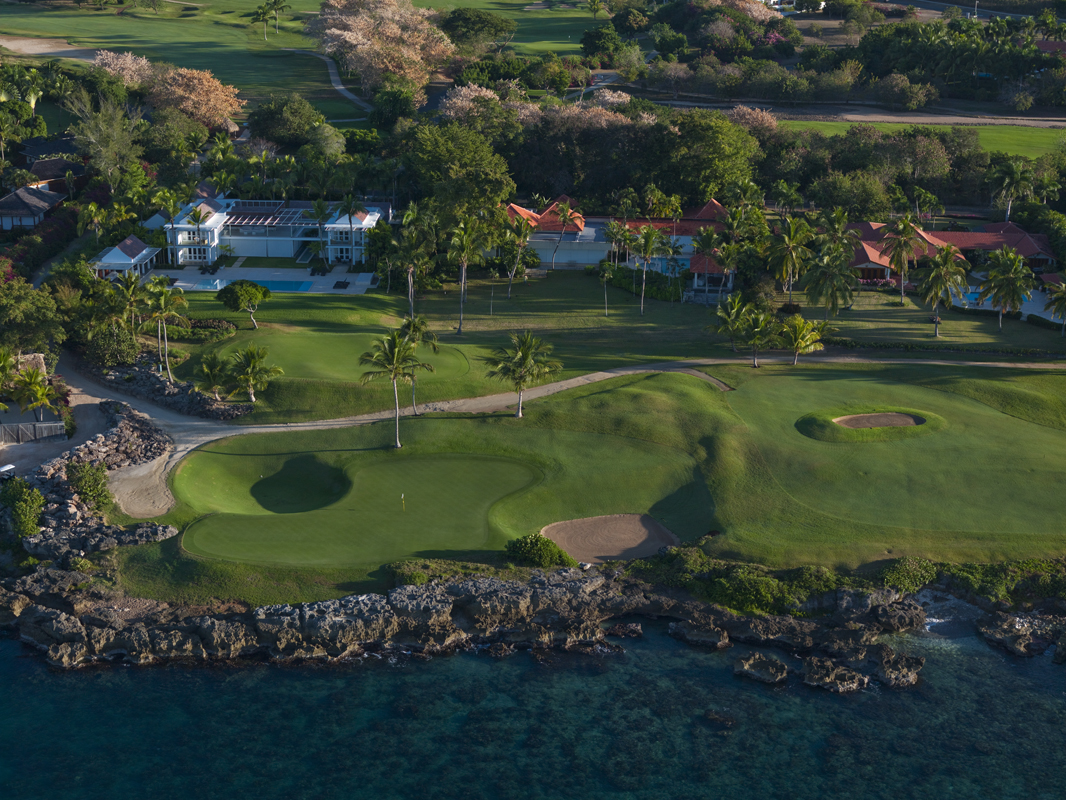
What makes Teeth of the Dog “world-class” is that Dye takes these angles down to the sea, where seven of the 18 holes use the Caribbean to complement his angles, thereby ratcheting up the risk-reward dynamic. The par-4 16th is a lovely example. It plays just 334 yards from the blue tees, but it hugs a cliff top where the ocean borders the entire right side. Dye’s fairway swings inland, away from the water, before tacking back to a green that sits right at the cliff edge. The closer you hug the coastline, the easier your approach — the Caribbean is still your right, but you can always bail out left. Should you bail out left off the tee, however, your approach plays almost directly at the ocean — the slightest push and the waves eat your ball.

Still, there are plenty of fun features at Teeth of the Dog, and it’s the hard edge that makes Dye’s features so striking. His putting surfaces don’t slope off gradually into greenside bunkers — they fall off steeply. It’s all or nothing. You’re either on that green or in the bunker, or in a swale. It’s sort of like a water hazard: There is no in-between — you’re either in it or not.

Teeth of the Dog features relatively little of these hard edges, to accompany the masterful angle work, perhaps because on 7 holes, Dye had the menacing Caribbean with which to work (made all the more knee-knocking by surf crashing over huge, gnarly, volcanic boulders). I suppose you don’t need hard edges all over the course with the ocean so close. It forms the ultimate hard edge.

The 15th green at Teeth of the Dog. This is the approach angle if you bail out away from the water. Note the hard edge at right — you’re either on the green, or in the Caribbean,


Pondering the Genius of Pete Dye, Uber Quipster

Pondering the Genius of Pete Dye, Uber Quipster

A couple quick stories about Pete Dye while I’m sitting here in my barn office, avoiding the packing process while simultaneously champing at the bit to leave this frozen wasteland for the tropical glories of Casa de Campo, where Dye is responsible for all 63 holes:

Circa 1994, I was serving as editor in chief of a national business journal called Golf Course News (today it’s known as Golf Course Industry magazine). For a few years there, GCN sponsored a national trade show called the Public Golf Expo, and as program chair of the associated conference, I was the de facto host of this event. Part of my job was lining up keynote speakers and this particular year, in Orlando, I landed Pete Dye.

Mr. Dye is known for many things: integrating links features and scale into modernist course design, railroad ties, strip bunkers, angles, and courses that, initially at least, totally confounded tour players. What many people don’t realize is this: The man is hilarious. There are quite a few very funny course architects, but Pete’s in a class by himself. He comes off as a sort of rumpled, midwestern bumpkin who meanders around a subject before dropping some zinger that takes everyone by surprise.

I don’t recall what Pete Dye was supposed to talk about that day in Orlando. We had discussed something, surely. But after a few comments to kick things off — each one punctuated by a laugh line funnier than the last — he just threw it open to questions and answers. He kept this up for 40 minutes, fielding each one with off-the-cuff aplomb and hilarity. But two stand out:

• Some fellow rose and asked Pete about the environmental movement in golf, and whether this was stifling development and design creativity, and how he dealt with ever-tightening environmental regulations. You could tell Pete didn’t know quite where to go with this one, and it would not have been like him to launch into some mealy-mouthed defense of golf’s environmental credentials. But he soon launched into a story that went something like this… and I’m paraphrasing here:

Well, we like to have the environmental regulators come out to our golf course sites early in the game, before we’ve even broken ground. They usually like to walk, these environmental types, and I like to walk. So we get out there on the property and I walk ‘em. And I walk ‘em. Then I walk ‘em some more. And when they’re really getting tired, I walk ‘em some more. 

Then I lie to them. 

• Sometime later that same Q&A session, another fellow rose and asked Pete why he didn’t use railroad ties any more. He had, of course, made their use famous at several courses in the 1970s, including the TPC at Sawgrass, but had foresworn their use by the time 1994 rolled around. I was sure Pete would come back with something like, “I got tired of yo-yo’s like you always asking me about the damned railroad ties,” or maybe a quick quip/yarn about how even Tom Morris got tired of putting sleepers in his bunkers. But he just stared at the guy, and then he smiled before he leaning into the microphone:

Not expensive enough.