Maine v. Casa de Campo — 57 Degrees of Separation

Maine v. Casa de Campo — 57 Degrees of Separation

Because Maine feels like this (inset), I’m trading it for The Beach Club at Casa de Campo, starting tomorrow.

The mercury outside my Maine window, right now, registers 20 degrees F. It will fall to 16 come later tonight, according to the gurus at weather.com, and that’s frankly an improvement over recent conditions. In the New Year we’ve experienced several days where it never climbed out of single digits. There were two nights in particular, last week, when overnight temperatures were below zero everywhere in the state.

Tomorrow morning I decamp for the Dominican Republic and the much-ballyhooed delights of Casa de Campo, probably the finest golf resort in the entire Caribbean, and for once I am not dreading the 4 a.m. alarm. Bring it on.

I do a lot of business in Southeast Asia, with Southeast Asians, naturally, and I’ve found they are nearly as curious about life in Maine as we New Englanders are about life in Bali, or Jakarta, or Saigon. I love to lay this one on them:

It’s quite cold here today.

How cold?

It’s 4 degrees…

Oh my goodness.

Fahrenheit.

That last bit fairly well blows their minds. They literally cannot conceive of it, because they don’t really comprehend Fahrenheit (as so many Americans don’t get Celsius) and many have never set foot anywhere that cold.

And why, unless one skis, would anyone purposely set foot in a place that could potentially serve up temperatures that freakin’ cold? There is no reason… Don’t sit around and wait for a caveat, not from me. If you weren’t born a Norwegian, or a Mainer, or a Siberian, which would oblige even the most heartless Norwegian, Mainer or Siberian expatriate to eventually go home and see his mom, there is no reason.

There are things you learn about yourself when living in a climate like Maine’s. For starters, we are the lifeblood of places like Casa de Campo, where right now it’s 77 degrees F (and partly cloudy, for the record). If it weren’t for us sub-arctic masochists landing there all through January and February — kissing the ground in La Romana upon arrival — they could never have afforded to pay Pete Dye to design 63 holes.

Here’s another thing I’ve learned about my Boston-born, Maine-residing self: I know intrinsically when it drops below 5 degrees F, because, upon venturing out of doors, the snot in my nose instantly crystallizes with that first nasal in-take. Actually, last Thursday night after poker I was standing outside and experienced this very sensation. Smart phones at the ready, we determined it to be only 7 degrees, not 5. I must be getting old.

But, honestly, be it 5 degrees or 7, this is something I don’t need to know about myself, or needn’t be reminded of.

What I need to know, right now, is how many pairs of shorts to pack.

Medinah’s Ryder Road Full of Stops, Starts, Remakes
One of the few things that hasn't changed at Medinah: Lake Kadijah, named for the

Medinah’s Ryder Road Full of Stops, Starts, Remakes

One of the few things that hasn’t changed at Medinah: Lake Kadijah, named for the first wife of the Prophet Muhammad, still represents the dominant hazard on several par-3s.

[Ed. This piece ran in GOLF Magazine during the summer of 1999. Its observations, while dated, remain damned prescient.]

Fitting for a golf course located a scant 15 miles from the nation’s busiest air field, in a city that serves as switching gate for half the country’s rail traffic, Medinah Country Club sits at the crossroads of those peculiar trends and politics that now swirl around major championship site selection. When the century’s final major — the 81st PGA Championship — is staged here at Medinah Aug. 9-15, players and spectators will reacquaint themselves with an undeniably classic golf course, a consensus top 25 layout that has nevertheless been repeatedly revamped, strategically elongated and fully leveraged to meet 21st century demands.

In an age when pre-major renovations have become routine, Medinah’s No. 3 course stands as one of the most-tinkered-with layouts in golf’s major championship rota; at 7,384 yards, it is without question the longest. Medinah is also one of several elite clubs which have agreed to host the PGA in order to get their hands on golf’s new commercial grail, The Ryder Cup Matches. As part of its agreement with the PGA of America, Medinah will host the coveted Ryder Cup in 2011 — by which time the club will have held this year’s PGA and another in 2006.

As we learned during this winter’s run-up to the Masters, and during all those periods preceding today’s major engagements, the game of golf and its attendant demands are continually evolving. Accordingly, our championship venues evolve, too. For better and ill, Medinah has come to embody much of what major championship venues have necessarily become in a world so frightfully concerned with licensing deals, technological advancement and the moans of frustrated competitors. Medinah’s ongoing story, which includes an honorable obsession with the ultimate concern (par), tells us a great deal about where golf has been and where it’s headed as the game enters its second millennium.

Read More

My Long and Winding Road to Built-to-Spill Fandom
Built to Spill, rockin' The State Theater in Portland, Maine on Aug. 30, 2012

My Long and Winding Road to Built-to-Spill Fandom

Built to Spill, rockin’ The State Theater in Portland, Maine on Aug. 30, 2012

The path I followed from first discovering Built to Spill, back in 2002, to my place front and center at Portland’s State Theater last Thursday night is nothing if not post modern. The way we find and consume musical media today seems hilariously random to this late 40something, raised and educated in such matters on 45s and LPs, college radio, live shows, mixed tapes and the ever-vital personal loaning of vinyl.

Here’s how I went from Built to Spill ignoramus to devoted fan: Early in the millennium I dabbled in Limewire, a web-based, Napster-like file-sharing community where one could search band and song names for download. The first thing I did, upon appreciating the enormity of what Limewire enabled, was reacquire most every 45 I had possessed in the 1970s (this effort yielded some real gems: It never rains in California, by Albert Hammond; Brand New Key, by Melanie; Rubber Band Man, by the Spinners).

The next phase moved me to sift through contemporary artists I knew way too little about, folks like Ben Folds, Weakerthans, Fountains of Wayne and Dressy Bessy. Soon it became clear that individual treasure troves from all manner of music fans — meaning those thousands who had digitized their vinyl, all their live bootlegged tapes, and transferred all their CDs and random mp3s to the computer — were available, too, via Limewire file-sharing.

This meant older bands and tracks were fair game.

Now, I came of age musically in the 1980s, or, I should say I came into my own at that time. College, an all-vinyl and mixed-tape experience, ended for me in the spring of 1986, when I moved to Boston and there luxuriated in the Hub’s potent alt/indie scene. There were several bands we followed in earnest, taking in live shows at TT the Bears, The Rat, Club III, The Channel and Nightstage, among others. One band, Big Dipper, came and went all too quickly, and so, 15 years later, I was eager to see what live performances and otherwise obscure files I might procure via Limewire, to augment or otherwise fill out my own digital library.

Yet every time I searched Big Dipper, I got nothing. Nothing, that is, but a song entitled Big Dipper, by this band called Built to Spill, about which I knew nothing. This happened a couple separate times — because it was worth Limewiring intermittently on the same subject; one never knew who might be online to share files at any particular time — before curiosity finally overcame me. I downloaded the BTS version of this song Big Dipper. Listen to that fateful tune here.

Well. These guys were awesome. More specific searches and downloads revealed just the sort of alternative rock I like best, a mix of Dinosaur Jr.’s driving garage sound, Pavement’s unpredictable song structures, the Pixies’ rumbling melodies, and Neil Young’s wistful lyric style and guitar godliness (a goodly portion of all that thanks to BTS front man supreme Doug Martsch, who gives an interesting interview here). I reveled in this totally new band and the dozens of songs I had come into, each one as interesting as the last.

The weird thing was, this band had pretty much come and gone by 2004! Or so I thought. They’d enjoyed their heyday in the ‘90s and appeared broken up, diverted into side projects or put on permanent hold due to solo efforts from Martsch. Or so I learned by reading up on them online.

Built to Spill remained a self-contained obsession. My son Silas adopted them whole-heartedly but hardly anyone else I knew had heard of them or cared much to get on board. I desperately wanted to see them live but figured I was 5 years late to the party.

But then, as happens almost continuously nowadays, the band reformed and started touring again. I saw them at Citi on Landsdowne Street in Boston circa 2006, then again in 2010 at the Paradise. When they scheduled Portland earlier this year, I snapped up two tickets for Silas and myself. Last April, in Seattle, we visited the Experience Music Project museum at the base of the Space Needle. Great freakin’ museum. Spent three hours in there and greatly enjoyed the super-expansive, highly-interactive exhibit on grunge, which included a particular exhibit on the regional scenes across the Northwest — including Boise, from whence BTS hails. Did you know Martsch was also in Treepeople? Probably not.

The Aug. 30 show at The State was predictably thrilling and the less-than-full-capacity crowd, while it might preclude a return engagement, enabled great viewing from a small riser, center stage, just 25 feet from Doug. We stood next to a guy who could not have been 30 years of age, so I asked him how he got into this band from the ‘90s. He was a metal guy. Someone had recommended Built to Spill, and he YouTubed them. The rest was history.

YouTube didn’t exist in 2002, of course. Had it, I might have come by Big Dipper and ultimately BTS with more alacrity. But as they say, better late than never.

The HGP II Scorecard Series: A Final Accounting
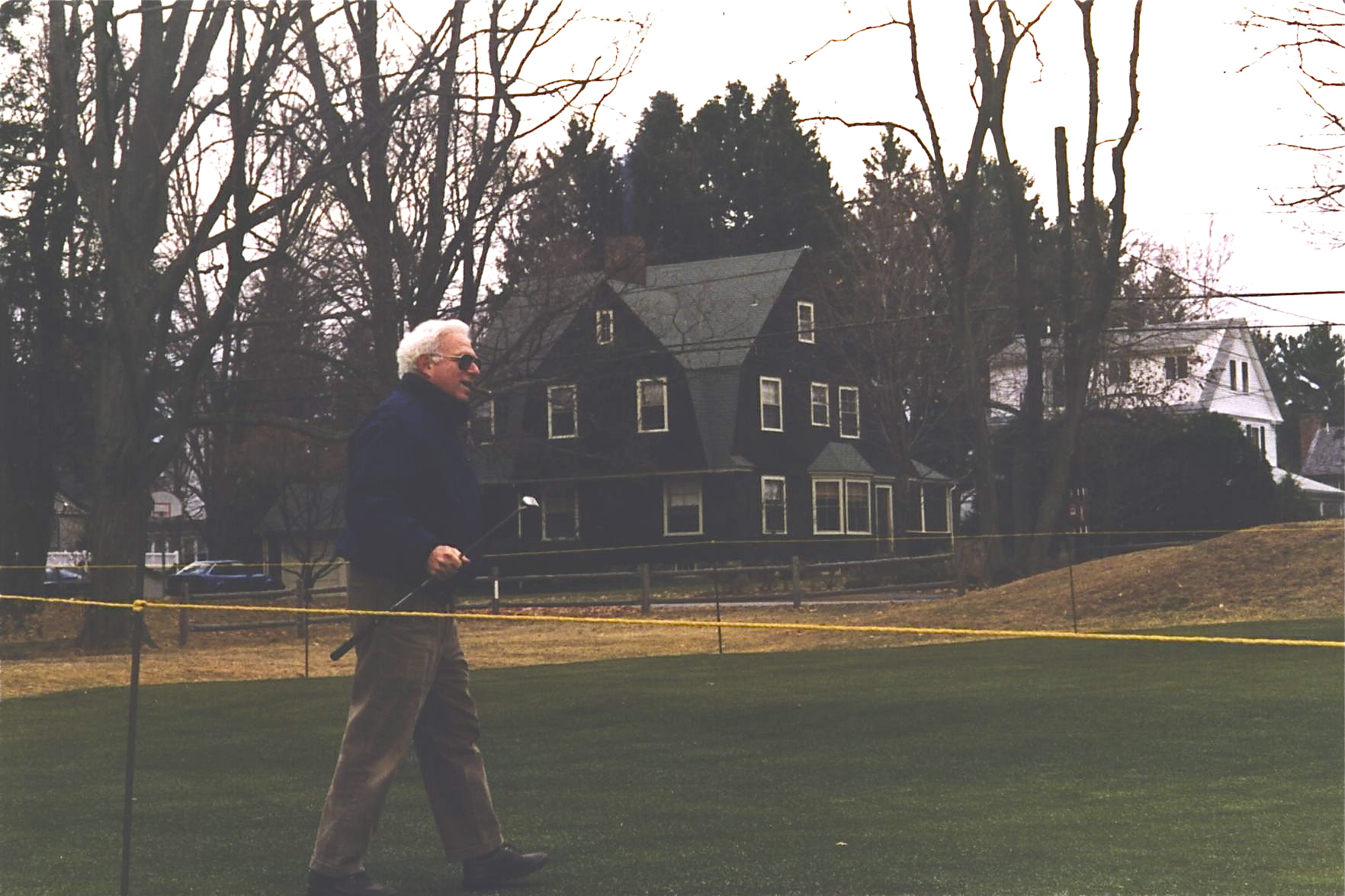
My dad on the 8th green at Nehoiden, right across the street from the house where grew up. It's late November; the greens have been staked for fencing at the first snow. We sprinkled his ashes here, and there's a memorial bench for him just right of this frame, on the 9th tee. There is no headstone in any cemetery for him. This is his spot, for all eternity.

The HGP II Scorecard Series: A Final Accounting

I’ve been picking through a few scorecards left behind, in a shoebox, by my father, Harold Gardner Phillips, Jr., who passed away a year ago this week. They didn’t surface until a month or two after his death. It’s taken till now for me to really engage with them. Haven’t avoided it exactly. It’s been an eventful year, the proof being just how quickly it’s flown by. But I’m glad I waited. A little distance allowed me to revel again in my memories of him. I won’t bore you with a comprehensive accounting of all their lovely time-capsule qualities. See below a third and  final installment in The HGP Scorecard Series, as it’s time write and remember more about him than his golf game. See previous posting on this subject here and here.… A word on the photo above: That’s my dad on the 8th green at Nehoiden GC, in Wellesley, Mass., his home club the last 30 years of his golfing life. Across the street is the home we made those 30 years. It’s late November in this image; the greens have been staked for fencing come the first snow. We sprinkled his ashes here. His memorial bench sits just right of  frame, on the 9th tee. There is no headstone in any cemetery for the man, at his request. This was his chosen spot and will be for all eternity.

The Niagara Falls Country Club, Lewiston Heights, N.Y., circa 1950: My dad was probably 13 or 14 and playing with his dad when this round was recorded. Pop was a jewelry salesman and traveled all over the Northeast visiting clients and playing golf with them. I’d heard tell that he’d take my dad on some of these trips, and here’s the evidence (there’s another card from Hershey CC that details the same sort of round). My dad and I were so different temperamentally. If I played badly, it could get real ugly, especially when I was this age. Whereas Poppy and his son were both incredibly even tempered. I’m sure my dad never embarrassed Pop with any histrionics on this day, despite shooting 92. And who knows: Maybe this was 1948 and a 12-year-old Harold Gardner Phillips Jr. was well pleased with 92, which appeared to best the group. This round is also notable for the fact that there were three Harolds in the group. Filling out the troika was Harold Osw. [sic], probably short for Oswald or something. Some poor boring bastard named Bob was the fourth (!). The card is quite ornate and well designed in an old-fashioned way. There’s a special column for “Side matches”, a table detailing “85% Handicap allowances”, four perforated/detachable tags for the submission of tournament scoring, another long table (opposite the tags) showing what your handicap should be based on “Your Ten Best Scores Total”; and an admonition to “Please have caddies rake traps and replace divots.” I don’t think I’ve ever seen that written on a scorecard, in quite that way, ever in my life. They don’t make cards like they used to.

Fort Monmouth GC, Fort Monmouth, N.J., May 12, 1954: I’ve heard the brief tale and read the brief press clippings re. this game. This was the 73 he shot in some high school match against another dude named Bob, who shot 78 and got smoked. It remained his best round ever in competition, if I’m not mistaken. FMGC is now known as Sun Eagle’s Golf Course at Fort Monmouth. It’s reputed to be a Tillinghast design, built in 1940, or maybe A.W. merely stopped to walk the place and a tap out his pipe here one day — the next thing you know it’s “a Tillinghast”. Couldn’t tell you if it had the markings; never played it, and my dad never had much of anything to say about the course. It was 6,417 from the tips in 1954, so it wasn’t any Mickey Mouse layout for the persimmon era. Military officers formed a big part of the membership here and the high school team played there, which is indicative of 1) good communitarian spirit; and 2) Fort Monmouth probably not being the most prestigious club in the area. But 73 in competition is 73 in competition (he bogeyed the first and played the rest at par). His personal best for the next 25 years. No trouble understanding why he kept this card.

Saddle Hill Country Club, Hopkinton, Mass., circa 1981: It’s obvious why some of these cards were kept in the shoebox, while other keepers are more cryptic. I don’t really keep cards, but if I shot 73 in a high school match, I might have considered it! My best in competition was 75. Somewhere I may have stashed the card recording the day I finally beat my dad, a spring Saturday at Nehoiden that just happened to be same day I first broke 80. So I can’t blame him for keeping the Saddle Hill scorecard, which is from just this time period, when I had finally caught the guy. I could  beat him now, which I think that gave him a great deal of joy (I don’t think there’s another word for that broad emotion I attribute to him in this context: pride, empathy, large amounts of credit probably apply, too). By the same token, it now meant something — something more — to beat me, which he did this day at SHCC, 78-81. This was a big game in another way: We both played quite well, and it may have been the first time that really did happen. You can play years with a guy, and you know his game, you see him play well, he sees the same from you. But it’s actually quite rare for two longtime playing partners, amateurs, to both post really good rounds on the same day. So a round like this is something both parties remember… Saddle Hill was and remains an interesting place. We played many times at Juniper Hill CC just down the road in Northborough, but Saddle Hill always struck us as a fun and finer golf course. There’s a middle portion, holes 8-12 or something like that, where a bunch of par-4s all run back and forth, down into a valley and back up to a green; these were weaker juice, as they also suffered from their sameness. But the rest of the routing was solid and engaging. It was taken private a few years back, renamed Hopkinton Country Club, and redesigned by Canada-based Welshman Ian Andrew. I thought I had read that he’d reversed a bunch of holes — where a redesign literally turns greens into tees and vice versa — but more recently I read or got the impression he had just switched the nines. I’ve gotta get back there and play it because I’m  curious now, especially the idea of reversing some holes I know so intimately, or did. Won’t be nearly as fun going back there without my dad though.

Hollywood GC, Deal, N.J., circa 1951: This was a find. I don’t think my dad remembered, later in life, that he had played here. We talked about it and I didn’t get that impression. Indeed, I had talked about taking him to play there along with sorta-nearby Saucon Valley, where he played his collegiate golf. But we sadly never got around to it. I can say pretty safely there weren’t many of these trips never taken. We did the Scotland and Ireland things, together with my brother Matthew, and we hit a good many plums here in the States. But that Mid-Atlantic romp would have been a great stroll down memory lane for him, and both venues are reputed to be top notch … My dad played Hollywood  this day with his mother, father and some dude identified here as “The Sheep.” I’d like to know who that was, but I doubt that information is available anymore. Pop had been a member here a decade or so earlier, but they were definitely not members at this time. They belonged to Old Orchard CC in Long Branch. Hollywood is and was, to my understanding, the truly fashionable Jewish club on the Shore, with a Walter Travis design, updated by Dick Wilson (much later Rees Jones redid it again). I can’t be sure but I think this card was kept not for what my dad had done there but for what his mom, my Gram, had done. She shot 41 on the front and 45 on the back to shoot 86, tied with my dad. (Pop self-immolated, posting 97). I think shooting 86 and halving my dad, at medal, was probably a superb day for her — and she just happened to have made 9 on the par-5 10th and 7 on the par-4 11th before closing extremely well. I just reckoned the card at match play and she beat her 15-year-old son 2 & 1, straight up, with no handicaps taken into account. I only ever played with Gram as a much older woman, naturally, so I can’t say whether this was a typical round for her, but that’s pretty good golf for a 50-year-old tennis player. She was a handsome woman who, if pictures are any indication, was doing a creditable Joan Crawford thing during this time. I’d like to have seen it. I’d like to have played Hollywood, and maybe I will some day.

There was a Saucon Valley CC card in the shoebox. It’s clearly from the mid-50s, as my dad played collegiate golf there, as a freshman, and enjoyed other rounds at SVCC during his time at Lehigh (’53-58). My dad revered this place. I can date the card pretty well because it lists a third loop (the “New Nine”), built in 1953. This would become known as the Grace Course, designed by William Gordon. Herbert Strong had done the Old Course; Gordon did a lot of renovations there, too. In any case, this card must have been gathered during my dad’s college days, before the Grace was made whole, with the fourth nine, in 1958… As indicated above, we didn’t leave too many stones unturned. When I was young, he got me on all sorts of great courses. In my late 20s, when I started in the golf business, I returned the favor. But I greatly regret never taking him back to Saucon Valley. Arranging a game for us there would not have been too much trouble, but I never made it happen. Fittingly, the SVCC card he kept is empty. No scores. It’s a pure keepsake of the place, of the time. I’ll keep it myself, as a reminder to play it. Maybe with my son, Silas.

Of Kilties and Stymies: A Long Golfing Life Re-examined

Of Kilties and Stymies: A Long Golfing Life Re-examined

My dad passed away almost exactly one year ago this week, so I’m marking the anniversary with a sampling of the scorecards he saved over the years. They were handed down posthumously, in a shoebox, along with other golfing trinkets and memorabilia. The cards form a useful trail of crumbs, which, if followed and elaborated upon, inform us re. the man and his seven decades in the game. The first post can be found here.

• Pinehurst No. 2, Pinehurst, N.C., circa 1974: I’m dating this round by the vintage of Sansabelt slacks modeled on the front of this scorecard. This most decorated of the Pinehurst courses has just undergone a thorough retrofitting from Ben Crenshaw and Bill Coore, who endeavored (as most course renovators do) to restore the “original vision” of Donald Ross (read: lots of exposed sand and scrub). This picture shows the 1970s incarnation and it couldn’t have been further from that purported vision: bright green, overseeded fairways flanked everywhere by wall-to-wall dormant Bermuda. Glad the Old Man got to play and brag about playing No. 2, even at its likely design nadir. News Flash: He shot 83, as he did by default nearly everywhere he played for the first time. A maddeningly steady player, he was… If the course had featured more sand when he played there, my dad would have made frequent use of The Meat Hook, the club he deployed for years as his sand wedge. There was nothing written on this unique club, no markings at all. It was notably heavy, antiquated and rust-colored (this was real oxidation mind you, as it was rendered long before coppery wedges became fashionable). There was something faintly menacing and mysterious about it — a Stealth Wedge, if you will. My dad exploded with a full swing nearly every sand shot around the greens, and he was pretty good at it. He never picked the ball with a smaller, steeper swing imparting serious spin, which is a limiting strategy, of course. He was apparently beguiled by the act of blasting balls from bunkers via the power of The Meat Hook, which he never played  from anywhere but a bunker, which, again, was limiting. He opened his pitching wedge when he wanted to flop something. It was old school, but there’s just no comparing what one can do with a proper sand wedge, with a heel, as I told him many times as a precocious teen and for decades afterward. My dad was nevertheless highly competent around the greens. His misses were never that bad, and he could routinely get up and down from green side with a bumped 5- or 6-iron. In a sense, his short game was what you’d expect from a 12-14 handicap, whereas he was a 7-8 tee to green. His putting followed this form: a decent lag putter but didn’t make a lot of putts, it seemed to me. He wore a glove and never removed it to putt, as many folks do. I think that removal routine seemed to him an affectation — like the kilties he routinely removed from his golf shoes, long before they went out of style completely. My dad was no fashion plate, far from it. But here we must give him credit for being ahead of the curve.

Old Orchard CC, Long Branch, N.J., circa 1950: I wish he’d have dated this one, because he shot 75 (bogeying the par-5s that opened and closed the round; the only sixes on the card) and this was his home course. Was it the first time he broke 80? Or did he keep it because this was his career best here? Was it merely the first time he ever went really low? He couldn’t have been more than 15, as this card would appear older — in its wear and more Spartan post-war design — compared to those he saved from roughly the same period. When did the stymie go out? A key question as this card features a stymie measure across the top! It’s my understanding the USGA abolished this arcane rule in 1950, so my dad could have been well younger than 14 when this score was posted. He played with someone identified as E, and the kid shot a big number. There’s little else to work with in terms of historical detail/clues, but he must have kept it for some reason as he played hundreds of rounds at OOCC. Old Orchard wasn’t a fancy place. My dad claimed to have routinely caddied there for local mobsters and found at least one gun in the bag. But my grandparents socialized and played bridge  there, too, so I don’t think there was anything inherently untoward about the place. (Wise guys need a place to play golf, too.) He never held the course up as anything special and it wasn’t. But he was sentimental about it, and this was the only Old Orchard card in the shoebox… There was, however, another card in the box and it’s a curious one. It says “Long Branch Country Club, Eatontown, New Jersey”, which is a village just west of Long Branch, or so Google Maps informs me. But there’s a logo top left that clearly says “Old Orchard Country Club”. I’ve compared the cards and while the yardages do not always match up exactly, it would appear to be the same golf course. My dad and I played Old Orchard together in the late 1980s — maybe the club toyed with a new name at some point? Indeed, The Architects of Golf, the definitive reference guide to all courses built prior to about 1995, lists Long Branch CC, but not Old Orchard (today the club is again known as Old Orchard). This odd Long Branch CC card would appear to be from the 1980s; someone shot 78 but this is the sole score line and the player is not identified (though the writing for all the world looks like mine). I’m thinking this was indeed the round I played with my dad at Old Orchard and an explanation re. the scoring  is likely mundane — probably an in-the-car recounting of the round, by me, because the original card had been left behind.

HGP II: Following the Crumb Trail of a Golfing Life
Harold Gardner Phillips, Jr., 1936-2011

HGP II: Following the Crumb Trail of a Golfing Life

Harold Gardner Phillips, Jr., 1936-2011

So my dad, who died almost exactly one year ago, was a pretty serious pack rat. He didn’t really save things with any kind of direction. It was more or less an involuntary urge he had (and one I happen to share). Some of us simply cannot countenance the idea of parting with something that, at one time, meant something to him or provided her lasting joy, or insight. At some point my mother threw away a pair of sweatpants my dad had worn in college. This was the source of playful recriminations for years to come. Books were something never to be discarded and while he quite avidly lent them out, he wanted them back. The man passed from this Earth with at least 40 programs on his TiVo, all of which he’d seen but for some reason felt the need to archive.

I suppose that assembling these things, even as a sort of random catalogue (and holding them over time), does indicate direction. He would run across them randomly, on his own, and enjoy the memories. His wife and children might run across them, too, and their reports or remarks would bring it all rushing back to him yet another time.

My father was the first of our immediate family core to go, and so this is the first time our little unit has dealt with one of the five being permanently absent. Accordingly, there has been an active gathering and parsing of these trinkets, these literal souvenirs he left behind. We’ve paid special attention to these things, interpreting them in the context of this fellow we all knew so intimately.

Dad was a big golfer. The U.S. Amateur concluded last week and it was just the sort of televised sporting event he would have adored (see my account here). I’ve written about the golfing life my dad enjoyed, the subtext being that I wouldn’t have much of a golfing life without exposure and direction from his.

But it was ultimately his golfing life, not mine, just as the tiny, sleek, leather-detailed lighter — the one that sat unused in his top-left bureau drawer for decades — was his memento, reminiscent of a time he apparently wished to bank and recall. And maybe the lighter and all this other stuff had been meant for me or my brother, sister or mother to remember him by. During his last year, he passed to me the Johnny Hopp model baseball bat and first-baseman’s mitt he’d owned since he was a kid. Why else would he do something like that?

Among other things, there were several shoeboxes of stuff left behind when my dad, a firm atheist, left this mortal coil. There were big, substantial things, too, things the family reverently went through, remembering him and feeling sad about it, then dividing up so we might all have a healthy supply of these bits going forward.

But the smaller stuff fit into a few shoeboxes, and one was full of scorecards and other golf paraphernalia. Some of these items I had seen but very few of the scorecards were familiar. Here and in a few posts to come is a select accounting, because in the thousands of rounds he logged over seven decades, he only saw fit it to save these dozen or so. They must have meant something to him, and it seems fitting to pore over them and try to discern that something — along with other historical tidbits from his golfing life — on the first anniversary of his death.

This shot of my dad as a young high schooler was taken some time contemporaneous with the round at Jumping Brook.

• Jumping Brook CC, Neptune, N.J., circa 1953: No date on this one. My dad seemed to date only the scores worth dating, and he shot another 84 here with a fellow named Jack Sax (which could be a shortened version of the guy’s full name; my dad refers to himself as Hal Phill; it’s definitely his writing). In 1953 my dad would have been 17 and you gotta figure he played this match as a member of the Red Bank High School golf team in the spring of 1953, before he went off to Lehigh as a freshman. I can pinpoint the date because Johnny Alberti is listed as the pro and he’s also mentioned in passing as being the pro at Jumping Brook in an October 1953 issue of Golfdom, the forebear of all golf trade journals. I edited one of its progeny, Golf Course News, in the ‘90s, and it was fascinating to read this compilation of golf news from all over the country, published as one continuous column for 20 pages! Every new pro and retired superintendent and new course rumor is granted a paragraph. At GCN, we’d have broken all this into 40 stories with their own headlines to make a new section, which probably would have gone on for 20 pages (!). The more things change… My dad was a Jersey guy. Raised on the shore in Little Silver, Long Branch and Red Bank; he and his family would ultimately make house in Montclair and Haddonfield, before moving more or less permanently to Massachusetts. My paternal grandparents were both keen golfers, members of the post-war, hyper assimilated Jewish middle class. When you’re aping WASPs, you play golf and they did honestly love it. They were members of Old Orchard Country Club, where my dad grew up playing and caddying, but they ventured out to places like Jumping Brook, Fort Monmouth and Canoe Brook. My grandfather, Poppy, was a member of Hollywood GC in nearby Deal sometime in the 1930s. He was a lefty and was, at times, a single-digit player himself, according to my dad. My Gram was a good athlete, a tennis player really but picked up golf to be more like Clare Booth Luce or maybe Martha Gellhorn. They arranged lesson for my dad with George Sullivan, the pro at Old Orchard, and off he went. He and another good player, Ronnie Choquette, actually formed the golf team at Red Bank High, if I’m not mistaken. I’m sorta hoping this was merely a casual round because poor Jack Sax shot 102. But the first three holes would seem to indicate a match underway, as there’s a +1, a +2, and +3 listed two rows below the scores. Upon examination, the card shows my dad winning the first 12 holes before halving the 13th, but it would appear he didn’t see the point in writing any of that down. I’ll do it, dad: You beat him 10 & 8.

• TPC Sawgrass, Ponte Vedra, Fla., circa 1983: I have no idea who these guys were my dad played with that day in north Florida: Emil, Pete (a 7 handicap apparently) and Dave. But I was certainly made aware of this round. “Hal” shot 82 from the blues and claimed 12 skins, though he and Dave lost the team match. My dad was playing off 12, or so says the card (this was probably some tournament connected to a convention held nearby; the scorecard is kept quite formally, in a way maybe an event administrator had requested; my dad certainly never scored in this sort of detail). This is a typical round from my dad when he was playing some pretty good, middle-aged golf. He sandbagged this a bit because he carried for years a steady 7-10 handicap at his home course, Nehoiden GC, across the street from our house in Wellesley, Mass., which was and remains a low-slope job, antique and tight, but a place you should score. But then my dad was, in a way, a true 12. He went to the TPC, site unseen, and shot 82. He could shoot 83-84 pretty much anywhere, which is a fairly rare gift… Like a lot of golfers in 1983, he was pretty gob-smacked by the golf course, Pete Dye’s breakthrough design in the flamboyant, post-modern, stadium-mounded links category. My dad was never a course-design freak, though he got into it more as I got into it more. [I presented him at one point, years later, a signed first edition of Tom Doak’s “Confidential Guide”, wherein the architect — long before he became the It Boy of Minimalist Design — lavishes praise and shits upon, by turn, a laudably wide-ranging assemblage of the courses he’s played. It’s some of the best bathroom reading ever devised, and I mean that as an unalloyed compliment. These editions are rare and sought after these days, though my dad never really grasped the import of having one. Now I’ve got his copy back. Then both burned in a 2016 barn/office fire.] The TPC Sawgrass clearly made an impression on him, and I think that (and the course’s subsequent notoriety) moved him to keep this scorecard. When my dad played a golf course that, for good or ill, either confused or radically challenged his expectations, he wasn’t always eloquent in explaining his views. He would assess it as “sorta kooky” or “a little weird”, then close the thought with a mildly exasperated cackle.

Fox Claims US Am to Remember, but Was It Ever Live?

Fox Claims US Am to Remember, but Was It Ever Live?

Anyone who missed Steven Fox’s unlikely victory in Sunday’s 36-hole final of the U.S. Amateur Championship is the lesser for it. You won’t witness a better argument for the dramatic glories of match play and its magnificent leveling qualities. Fox should never have beaten Michael Weaver, as he ultimately did on the 37th hole at Denver’s Cherry Hills Country Club. Indeed, if it weren’t for the vagaries of tape-delayed telecasts and modern media alliances, I’d have missed it myself.

Here’s what happened: I was called away Sunday afternoon by a gaggle of visiting relatives, so I recorded (with my DVR) what I presumed to be NBC’s edited/taped presentation of the final that aired from 4-6 p.m. EST. Saturday’s NBC telecast was tape delayed and generally I’ve got real problems with networks presenting golf events on tape, as the viewer knows in advance the action has been edited to fit a specific programming period, which can in turn lead to the outcome being revealed ahead of time. For example, if it’s 5:50 p.m. EST and some dude is two up with two to play, clearly the other dude isn’t going to stage a monumental comeback, nor is the match going to extra holes — because the local news is coming on at 6 p.m., come hell or high water.

Still, I wanted to see this final. I wanted to see Cherry Hills, which I played a few years back, and I wanted to see which unheralded participant would win this match-up of 60th and 63rd seeds (!). So, late Sunday night, I settled in to watch what I presumed to be NBC’s taped coverage, which I in turn had taped.

On the 17th hole with Weaver dormie, the tape ran out. Apparently, the telecast ran over its allotted 2-hour time slot. For all the world, NBC’s coverage resembled the pre-packaged, edited version they always present on the Amateur’s final day — salted strategically, of course, with myriad feel-good features on the competitors, their families, the vaunted trophy room at Cherry Hills (site of 9 USGA championships), and Arnie’s driving the 1st green en route to a closing 65 to win the 1960 Open.

But maybe NBC had run the event live. Why else would the 4-6 p.m. time slot have been breached? … Or maybe my DVR clock was off kilter… Or maybe they switched the live telecast at 6 p.m. over to their partners at The Golf Channel? … Maybe the match had indeed ended just seconds after the tape ran out — Weaver was just a putt from claiming a 2 & 1 victory…

Mystified and slightly irked, I flipped over to The Golf Channel, where, 5 hours after the fact, surely the event was still being parsed 16 different ways. But lo and behold, what was on TGC but an encore presentation of Sunday’s NBC telecast! And here’s the really weird part: I switched it on almost precisely where my DVR’d version had cut out — on the 17th green, both guys with birdie putts, Fox’s to stay alive and Weaver’s to close out the match.

It was sort of eerie. I mean, The Golf Channel programmers surely had no idea that I had taped the NBC telecast. Even if they did, surely they wouldn’t have any idea WHEN I would watch the recording. Or would they…

In any case, a hearty round of applause for NBC’s partnership with The Golf Channel, without which I would have missed one of the most compelling finishes to an Amateur since Steve Scott took Tiger Woods to extra holes before losing in 1996.

Fox drained his birdie at 17, while Weaver missed, leading to a crazy 36th hole where Fox looked dead to rites (in the thick right rough) but somehow found the elevated green from a steep, side-hill lie. His two putts left Weaver with a 4-footer to win it all, but the Cal student authored one of the most cruel and violent lip-outs I’ve ever seen, on TV or in person.

Turns out all the syrupy flashbacks and references to Palmer driving the 1st green in 1960 had resonance, because Weaver’s decision to drive the 346-yard, 37th hole cost him the Amateur. He pulled it left, beyond the green and the 2nd tee. He fluffed his chip, then chunked another. Fox hit 6-iron off the tee, dropped his approach 15 feet above the pin, and coaxed into the cup his birdie attempt when two putts would have sufficed.

Fox had no business winning that match. His unorthodox swing, his lack of length and collegiate pedigree should have left him happy to have merely qualified for match play, much less the final. But he was dogged and nervelessly drained every putt he looked at, all day. Still, if Weaver had made that 4-footer on the 36th hole, it would not have been enough.

But it was enough. It was heartbreaking. It was thrilling. It was all highly unlikely, and eventually I got to see the best bits, plus the extraordinary denouement, via recordings of a recording, on two different TV outlets, late at night, on the couch by myself.

Bob Ryan Retires: All Hail the All-Time NBA Sage

Bob Ryan Retires: All Hail the All-Time NBA Sage

The encomia are surely piling up across the web, but I couldn’t let slide the fact that Bob Ryan has retired from The Boston Globe as full-time basketball sage and de facto Commissioner of all things hoops (a title bestowed decades ago, by his fellow scribes). Here’s a link to his farewell column, delivered Aug. 11 with his signature directness, brevity and authoritative elegance.

Having grown up in Greater Boston, I latched onto Ryan early, in the mid-1970s, when the Celtics were winning championships and knowledge of the team was nearly the exclusive province of Mr. Ryan, whose game reports and columns were often the only worthwhile analyses available the next morning. Yes, some games were televised locally, but only a few. Radio was an option, but Johnny Most was so bombastic, his account of the goings-down, while entertaining, could not be trusted.

Above all things, Ryan could be trusted — to authoritatively tell you the “why” behind wins and losses; the “who” when it came to contenders and pretenders. His appraisal of players was never erring. When Larry Bird was drafted, as a junior, and all of Boston watched his senior year at Indiana State wondering if his game would translate to the pros, Ryan put that matter to rest. He sized up Bird a basketball genius way before it was obvious to the rest of us, and so Larry turned out to be.

His between-the-lines sizing-up of personalities was similarly spot on and vital to a young basketball mind in its formative stages. It really was about the guy’s authority. You could tell when Ryan truly admired a player (Dave Cowens) or didn’t deem one worth a damn (Sydney Wicks). It was clear when he admired someone but didn’t necessarily like him (David Stern), and when someone didn’t like Ryan (Tommy Heinsohn). It was all done very professionally, perhaps a bit coyly, and I found it all thrilling — that someone could earn a living by chronicling such fabulously interesting things in a public forum.

All through my high school, college and early years as a sports writer, Bob Ryan’s professional life was the one I wanted for myself. One time, in high school, circa 1979, my mom got us tickets to a Celtics game (vs. the Jazz) at the old Boston Garden, where she endeavored to introduce me to the guy before tip-off. I remember that he was cordial but not especially helpful or inspiring. My mom was a bit disappointed, but I couldn’t hold it against him — he was probably concocting some new way to convey to readers the utter ineffectiveness of James Hardy and Ben Poquette.

I did indeed try to follow Ryan’s path but his times were not my times. In his farewell column, he writes about going straight to the Globe sports department after graduating from Boston College in 1968. In the mid-1980s, no one did that — years of daily newspapering experience were required before one would even be considered. Further, by that time, the Globe sports section was a veritable all-star team of talent, and thousands of aspirants were all clamoring for the opportunity to sit at Ryan’s knee, along with those of Will McDonough, Peter Gammons, Dan Shaughnessy and Leigh Montville. Even if you had the experience, and the chops, the Globe was notorious for its minority hiring policies. I remember one reporting colleague claiming that he’d already have a job on Morrissey Boulevard, “If only I were a black, female, Cape Verdean.”

In any case, dreams die and/or they’re deferred. I left daily newspapers in 1992, having had a chance to cover the Celtics (and all the Boston teams) for smaller newspapers with nothing like the Globe’s reach and influence. I was tired of making no money, tired of being essentially nocturnal. Soon the newspaper model would collapse, and I frankly count my blessings that I got out when I did.

Ryan pressed on through this period of industry decline, adapting to the web realities and even moving into television a fare bit. Personally, I could listen to him talk about basketball and other sporting matters till the cows came home, but I think even he’d admit that his rapid-fire, staccato delivery — along with his advanced age — never truly dovetailed with the medium as it exists in the 21st century.

This winter, at the height of the Jeremy Lin craze, Ryan sat and did a podcast with Bill Simmons, the guy who has emerged as Ryan’s heir apparent on matters NBA. Check it out here; it’s linked as part of my own post comparing/contrasting Billy Ray Bates and Lin. It would seem that Simmons was the guy who successfully crafted for himself a Ryanesque place in the basketball firmament, and I enjoy his writing and podcasts nearly as much.

Best of luck to them both. The torch has been passed.

With Paterno book due in August, A Question Nags

With Paterno book due in August, A Question Nags

One thing’s for sure with the Joe Paterno/Jerry Sandusky/Penn State scandal-saga, which re-emerged to dominate headlines this week upon release of Louis Freeh’s damning report: I’m glad Jerome Carboni didn’t live to see it. Had the father of my college housemate, Dennis Carboni, not passed away a few years ago, this Paterno debacle would surely have killed him.

The Carbonis were a hardcore football family and though it hailed from Meriden, Conn., hundreds of miles from Happy Valley, Mr. Carboni worshipped Joe Paterno and Penn State football. Dennis hinted to me that it might have had something to do with a shared Italian-American heritage, but let’s be honest: There was a lot for a 70something football fan to admire in the way Paterno conducted his affairs at Penn State. The perceived emphasis on academics. The pointedly unflashy blue-and-white uniforms. The long tenure. The hundreds of victories. The absence of scandal.

Joe Posnanski is 50something, but he was similarly drawn to this Paterno story-myth. Starting in early 2011, Posnanski, then a Sports Illustrated baseball writer, went so far as to secure access to Paterno and his family, relocate to State College, Pa., and set about researching a biography. The idea, as detailed in his own book proposal, was to “tell the remarkable story about a man who could have been anything but decided that the best way he could help change America was one college football player at a time.”

Like Jerome Carboni, Joe Posnanski was a true believer.

The contents of this eagerly awaited book — scheduled for release in August — will be all the more anticipated for the author’s pre-publication seclusion. Posnanski has said or written next to nothing about the project since going underground shortly after the scandal broke in November 2011, other than to acknowledge the obvious: The tenor of said book has changed dramatically. He’s also been under the gun; Simon and Schuster moved up publication of the book some 10 months to cash in on the salacious topicality of the subject. (Since leaving SI to write it, Posnanski has found time to partner with Major League Baseball on a web venture that involves USA Today, apparently).

I have nothing against Posnanski, but I’ve read pretty much everything I can find online about his peculiar role in this ongoing drama (which, at the risk of sounding melodramatic, certainly qualifies as tragic), and nowhere does the SI man offer, nor does any media colleague care to ask, the most nagging question here. So allow me: What did Posnanski know and when did he know it?

With every passing day, it gets harder to believe that an experienced, by all counts ethical, professional biographer was ensconced in State College doing research for months ahead of November 2011, and never got any wind of the allegations against Sandusky. People in the Penn State community knew what was going down. Janitors. Administrators. Journalists. Grand juries, the likes of which leveled the charges against Jerry Sandusky back in November, don’t get called or conducted in a vacuum. Word gets around. Consider all of Sandusky’s alleged victims across the community. You’re telling me they were all so cowed by Paterno, so deludedly intent on avoiding damage to the school’s football “brand”, that no one would have taken Posnanski aside and said, “You should read what this guy Mark Madden’s been writing in the Beaver County Times”? One conversation like this one and a single Google search would have put most writers well on the scent.

Maybe these sources were indeed too intimidated to have that conversation with an SI reporter on book leave. Freeh’s report indicates that janitors in the locker rooms witnessed many damning things but never reported them, so fearful they were for their jobs. That’s logical, that Paterno would wield enough power to deter a janitor from reporting a child rape in a Penn State locker-room shower. And, as we’ve read in Freeh’s report, Paterno did know about what had happened and moved concertedly with administrators to keep it hidden.

It’s complicated, but Posnanski is damned if he did and damned if he didn’t. If he knew something and sat on it, yikes… If he didn’t know anything, what sort of research was he doing all through 2011? A lot of sitting around the kitchen table with Joe Paterno and his family, apparently.

The latter is certainly less damning on the ethical scale. There’s no moral lapse in setting out to write a sports hagiography; they are written and read all too frequently. But if he was truly caught unawares, the surface nature of Posnanski’s research becomes embarrassingly clear when we consider the massive powder keg he failed to notice.

Counterintuitive Historical Trends Tumble at Euro 2012

Counterintuitive Historical Trends Tumble at Euro 2012

Maybe it’s my peculiarly American viewpoint (read: spotty historical perspective on all things European Championships pre-1984) but it’s striking to consider that Spain, until it drained the soul of France today, 2-0, had never beaten the French in a competitive match before today. Ever. Even in a qualifier or something? Yes, never. The French have won trophies and, like Spain, was a top-class side for a long time before it finally did win something, but surely the Spanish, defending Euro and World Cup champions, had managed to beat France at some point, somewhere. Apparently not.

I read, too, that Spain has never beaten Italy over 90 minutes, ever, only on penalties (in the quarters at Euro 2010). There’s a mind-blower.

Somewhere I read similarly that Germany had never beaten Italy in a major tournament, i.e. the Euros or World Cup. Germany. Actually, to be fair, I think it was some German football dignitary who had opined that in “big matches”, knock-out games, Germany had never beaten Italy — and so they looked forward to the opportunity in the approaching semi should The Azzurri take down England Sunday. But still, I had just assumed that the holes in my own historical knowledge of past Euro and World Cup encounters would account for the one time Germany had surely ousted Italy from a major tournament. The Mannschaft’s nearly alien efficiency in grinding out tournament results alone should account for one win, even against the Italians. Apparently not.

Makes you wonder what sort of chance the English really have on Sunday, in the last of four quarters. After all, I learned recently of another fascinating historical tidbit — that England had never beaten any past World Cup or Euro champion nation outside Wembley Stadium in a major competition, other than Denmark. The lengths to which some stat freak went to gather that obscure, apparently true factoid dampens one’s awestruck wonder just a bit. But in another way, it remains incredibly telling. Basically, as the English have never won any tournament other than the World Cup (at Wembley), they’ve also never beaten any truly elite time, at any time, in any major tournament, anywhere but North London. Except Denmark of course.

It seems clear to me that these footballing heavyweights could not have played that many times over the years — that’s one reason these “records” have, counterintuitively, lasted as long as they have. England and Italy, the nation that claims to have invented the game and the four-time world champions, have met only twice before in major tournaments, never on neutral soil, and only four times in qualifying games for major competitions. The Germans have played Italy 27 times in 89 years, the vast majority being friendlies and qualifiers, as opposed to Euro semifinals or whatnot. Telling to note that Germany’s overall record vs. Italy is a paltry 7 wins, 14 losses and 6 ties.

Clearly there are some major historical forces being put to the test on Europe’s eastern frontier this summer. Spain has slain one demon in France. England and/or Germany will have the chance to slay another later this week.