Sadly, an Era Marked More by Near-Misses than Titles

Sadly, an Era Marked More by Near-Misses than Titles

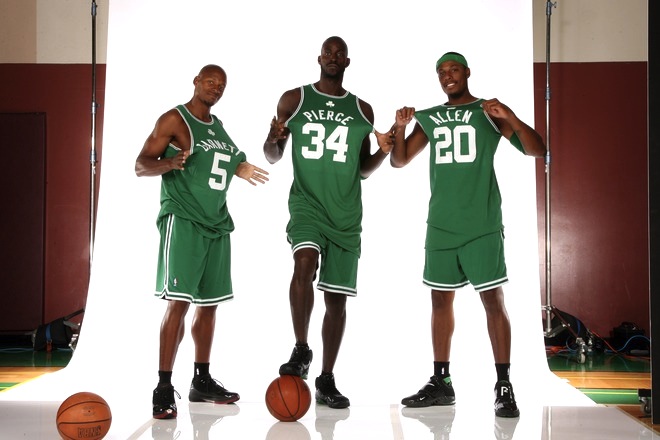
We Celtic fans will always have 2008, with its initial flood of exhilaration enabled by the Big Three. While their arrival immediately ended the longest championship-fallow period in the team’s storied history, there was in those days much talk of “The Window”, that period during which Boston’s already aged stars might reasonably deliver championships. To win it all in their first year together felt like gravy, a gift. Little did we know, five years on (with the development of Rajan Rondo into one of the NBA’s premier point guards) that one title would be the sum and total.

The reality is this: The Big Three era is over and but for that one title it will rightly be remembered more for a series of excruciating, valiant near misses . Wednesday night’s OT loss in Miami is merely the latest and perhaps final indignity.

Think of the 76ers from 1979-84. A great and wholly admirable team that played some of the most hotly contested, best-remembered playoff series in NBA history. But the numbers don’t lie. That group accounted for a single title, and that — hard though it is for Boston fans to admit — will be the identical legacy of this thoroughly likeable, often-heroic, somewhat unlucky, but ultimately underachieving Celtics incarnation.

A quick recap:

• 2008: A title, fairly won and glory be to God.

• 2009: Kevin Garnett is hurt late in the season, and the Celtics still take Orlando to 7 in the Conference Finals. Clearly undermanned, they battled and nearly stole the series. Valiant? Yes, but that and $8.50 will get you a cup of coffee.

• 2010: The nearest miss of them all, a Game 7 loss to the Lakers in the NBA Finals. Kobe went 6 for 24 and Boston (Kendrick or no Kendrick) couldn’t get it done.

• 2011: Out in the second round to Miami in a deceivingly competitive 5-game series wherein Rondo broke his elbow in Game 3. Even then, the final two games were toss-ups, and Boston blew an 8-point lead in the final two minutes of Game 5.

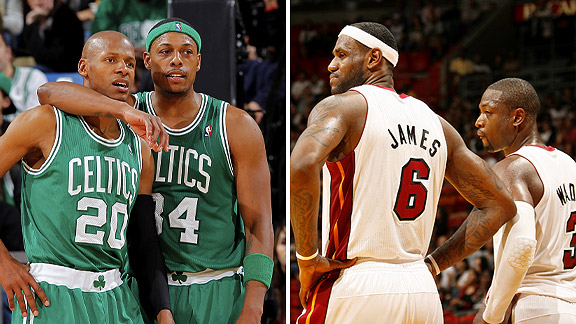
Picking over the debris of last night’s harrowing defeat in South Florida, which drops the Celtics in a 2-0 hole headed back to Boston, it’s difficult to find fault with the team — as it is difficult to find fault or cast blame associated with any of these playoff exits. Indeed, while the word “heroic” is tossed around all too lightly in American sporting circles, Doc Rivers’ crew once again proved lion-hearted in defeat. Ahead of last night’s Game 2, conventional wisdom held that Boston had to win or the series was over; no one would beat Lebron and DWade four games out five, even with 3 of those games in the Garden. Unfortunately for the Celtics — and they were monumentally unfortunate, watching James go to the line 29 times and accrue just 2 fouls in his nearly 50 minutes on the floor, while the guys who guarded him (Pierce and Pietrus) both fouled out — the 2011-12 season, and the Big Three Era, would appear to be done and dusted.

In the fourth quarter last night with just under three minutes remaining and the Celtics holding a 94-89 lead, I texted my friend Jammin’: “3 baskets or 6 points wins this game, but the Celts will need all 6… Proud to be a Celts fan tonite regardless.”

They got five, not six — good enough for overtime but not the victory they so desperately needed. But I’m no less proud.


Celts v. Heat: Plenty of Glamour and a Few Grudges

Celts v. Heat: Plenty of Glamour and a Few Grudges

Welcome back to Glamour Profession, the NBA podcast here at halphillips.net. Last year at about this time, the Celtics faced off with the Heat in Game 5 of their second-round playoff series, trailing 3 games to 1. Your pod host, Hal Phillips, was in New Zealand. Heading out to play the back nine at Kauri Cliffs Golf Club, some 17 hours ahead of Eastern Standard time, he checked the Game 5 score in the clubhouse — Boston led Miami by 8 with 2 plus minutes remaining. Standing over his approach on no. 10, his playing partner consulted the Blackberry and reported the game and series were over — the Celts having failed to score in those last 2 minutes. Well, here we are again, this time in the Eastern Conference finals. Both teams are beat up, short-handed by major injuries and seemingly inferior to either team contesting the Western Conference Finals, San Antonio and Oklahoma City. We caught up with the GP’s resident sage, Jammin’ Jim Jackson, at halftime of Sunday night’s Spurs-Thunder game to discuss that match-up and the pending Heat-Celtics series, which kicks off Monday night.

Try To Ignore Mario Balotelli. I Dare You

Try To Ignore Mario Balotelli. I Dare You

Why IS it always Balotelli? Missed in the stupefying events of extra time vs. QPR was Mario’s super touch to free Khun Aguero for the Prem-deciding tally. His insertion at 75 minutes, or whenever it was exactly, surely rolled millions of eyeballs around the world. Yes, Roberto Mancini should be applauded for swallowing his pride and running out both Mario and Carlos Tevez after saying they’d never play for the club again. But Balotelli has, by turn, been a moribund and distracting force in 2012. There was no reason to play him. Only desperation-laced necessity brought him on Sunday afternoon, late, along with Dzeko, against 10-man Rangers. But few men can so effectively and quickly put to rest all the psycho-vainglorious-marketing issues we might have with the guy. (Joey Barton should be so lucky). Whatever the packaging, Balotelli makes it happen. His possession at the top of the box, his lunging toe-poke to Aguero… Both touches were brave and deft. (All credit to the Argentinean for exhibiting the cool not to shoot straight away; Taye Taiwo would surely have been blocked it.) Balotelli has again shown himself to be that rare footballer who at once repels and attracts us neutrals. It’s not always him. It’s just that he’s so very good enough, often enough, that we genuinely want to see what he does next.

Jeremy Lin Channels his Inner Billy Ray Bates

Jeremy Lin Channels his Inner Billy Ray Bates


Two-plus weeks into the Jeremy Lin Era, you’ve no doubt heard the odd reference to one Billy Ray Bates. When basketball sage of yore Bob Ryan recently did a podcast with heir apparent Bill Simmons, Billy Ray’s out-of-nowhere emergence in 1980 was held up as the only apt comparison. Indeed, Ryan — whose stellar work for the Boston Globe in the 1970s and ‘80s fueled my interest in sports writing — claims to have been the first to make the Billy Ray analogy.

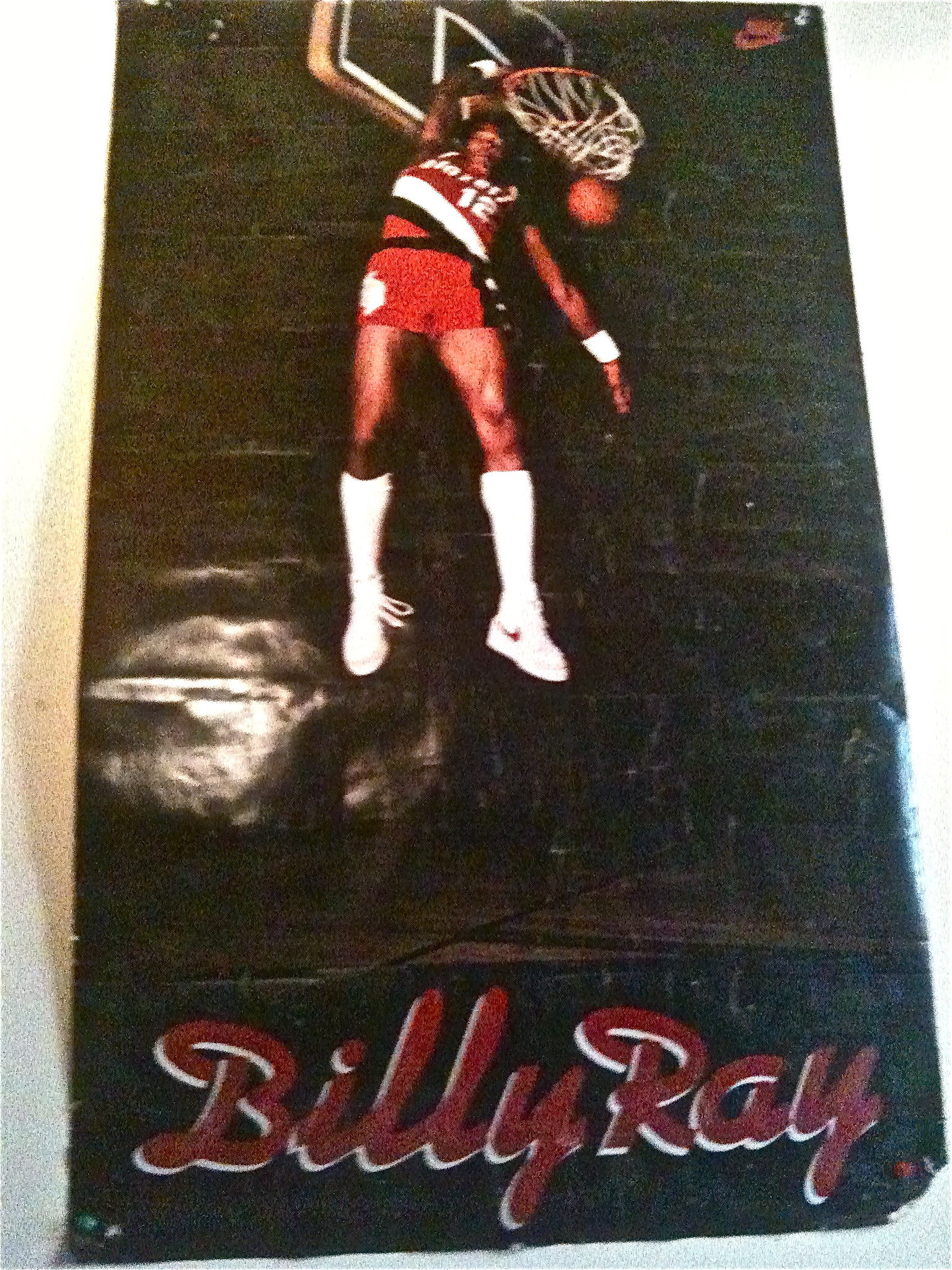
Not so. I believe I can claim to have made it almost immediately — not only because I, too, revere David Halberstam’s iconic book, “Breaks of the Game”, in which Billy Ray’s legend figures prominently, but because I stare Mr. Bates in the face every day when I sit down in my barn office. Yes, I own the poster pictured here and have since 1981. I only wish I’d have taken better care of it through the years. I mean, how many of these can there be out there?

Listen to the podcast linked above. It’s 45 minutes of all-world basketball chatter. But it should be said that even the Billy Ray analogy doesn’t quite fit (despite the fact that he, too, was cut by the Rockets before signing the 10-day contract that stuck). Bates was a brawny, 6’4” shooting guard, not a point guard like Lin. What’s more, he wasn’t completely unknown and unheralded: Billy Ray was voted Rookie of the Year in the Continental Basketball Association, the D League of its day; he won the CBA All-Star Game dunk contest and is reported to have broken no less than four backboards. Even in the media dark ages of 1980, word like that gets around.

In other ways, Lin has a ways to go in order to produce the same impact. Billy Ray was a gunner par excellence — he once scored 40 points (in 32 minutes) against the San Diego Clippers, and 35 in 25 minutes against the Mavericks — but he saved his best for the playoffs, averaging 25 ppg in the 1980 tournament and 28.3 ppg a year later (still a franchise record).

So while the Billy Ray-Jeremy comparison might be the best we can identify in the long history of the NBA, it’s not perfect — which merely speaks further to the truly anomalous goings-on in New York these days. The point guard aspect makes it completely unique. There simply isn’t any sort of precedent for a point guard emerging from developmental-league obscurity to score and dish on this scale.

If we mine the point guard vein a little deeper, we begin to better understand the evolution of this phenomenon. Lin was an excellent high school player and solid contributor on some decent Harvard teams, decent for the Ivy League anyway. But he never starred or produced anything like the numbers we’ve seen these last few weeks. Further, he was cut by both the Golden State Warriors and Houston Rockets this year. Clearly he didn’t show this sort of offensive firepower in either place.

Why? Well, because he was doing what he’d always done, what marginal back-up point guards in the NBA are supposed to do — that is, run the offense and avoid mistakes.

Lin himself has said that he was determined in New York to try something else — clearly what he was doing in Houston and Oakland weren’t working. This is not the same ol’ Jeremy Lin now setting the League on fire. It’s a radical departure, of his own making. That he landed in New York beside a coach who doesn’t care about defense (Lin remains a suspect defender) and encourages such aggressive (some would argue reckless) offensive hedonism is either blind luck, fate, or both.

Perhaps without knowing it, Lin changed his game in New York by channeled his inner Billy Ray.


Mr. Cornish Covered Lots of Ground in 97 Years

Mr. Cornish Covered Lots of Ground in 97 Years

We were again reminded, by the recent passing of esteemed golf course architect Geoffrey Cornish, of just how integral the act of walking is to the practice and perception of golf course design.

Mr. Cornish died at his home in Amherst, Mass. on Feb. 10, at the ripe old age of 97. Much has already been written about him, in golf circles, though maybe not so much about his work. Every day, right up until the very end of his long life, Mr. Cornish walked/hiked the nearby Lawrence Swamp. Many a tale was related this week about younger men struggling to keep up. For a guy who designed more than 200 golf courses over the course of a 70-year career, for an eminence who was known and loved by nearly everyone, it seemed an odd thing to fixate upon.

I grew up in New England and have lived here pretty much my entire adult life, so I’ve probably played close to 75 of the 200-plus courses credited to Geoffrey Cornish. Still, his design work is difficult to assess. In detailing why that is, we get a fuller picture of the man — and why he was such a beloved and unique figure.

For starters, Mr. Cornish, though Canadian born, was a frugal Yankee on a par with all too many of his clients. He was the anti-signature architect, if you will, often taking jobs with small budgets, on land of questionable golfing value, and making from this the best course he could — one that might be efficiently maintained. (He was trained as an agronomist, after all.) It should come as no surprise that few men designed more municipal tracks than Mr. Cornish (the solid Chicopee Muni in Western Mass., pictured above, is but one example).

Consider the vast number of 9-hole courses where he added new nines, or the rudimentary courses he renovated and/or formalized. I can think of several examples of real dog tracks that Mr. Cornish made whole, and wholly improved, with his renovations and 9-hole expansions. They are today understood to be “Cornish designs”. But it must be said that an architect more concerned with his signature, his reputation, might not have even taken these jobs. But Mr. Cornish could turn down no one.

By the same token, this mixing and matching of his work with that of others tends to muddy evidence of his design skill. In the late 1950s at Wahconah CC in Dalton, Mass., Mr. Cornish added nine to a spectacular original loop laid out in the 1930s by Wayne Stiles. The newer work is good but frankly pales in comparison. At Brunswick (Maine) GC, Mr. Cornish did essentially the same thing and his nine — some of his very best work — is certainly equal to that of the Stiles nine, maybe better. In neither case does there seem to have been an attempt on Mr. Cornish’s part to build upon or advance or mimic Stiles’ style from the original holes. I’m not sure what that means… Just figured I’d throw it out there.

•••

Read More

James Connects Unlikely Dots Between Dewey, Pitt & my Wife

James Connects Unlikely Dots Between Dewey, Pitt & my Wife

Out of the blue Thursday night the wife suggested we order, On Demand, one of the movies nominated for Academy Awards. It came down to Tree of Life, Midnight in Paris or Moneyball. We went with Moneyball and both found it extremely enjoyable.

Some 12 hours later, I happened upon an all-too-rare but typically brilliant article from Bill James, the godfather of modern statistical analysis as it relates to sports, baseball in particular. I’ve been a fan of James for more than 20 years (his Historical Baseball Abstract is perhaps the finest bathroom reading ever devised by man), but in the last 24 hours I’ve been jolted anew by the power of his thinking.

Without James, I would never have considered Dwight Evans Hall of Fame material, despite watching him patrol right field for the Red Sox for 17 years. Further, without James there would have been no Moneyball, neither book nor feature film.

For a woman who likes baseball well enough (my wife once resided in the Chicago neighborhood of Wrigleyville) and lives in New England (surrounded by “die-hahd” Red Sox fans), there was a lot in the film for her to like and/or relate to: Brad Pitt, naturally, but also a triumph- and pathos-packed story and myriad Sox references. Still, I was surprised by the extent to which she was engaged by the statistical analysis on which the story is based — the idea that ballplayers can be cannily appraised with such statistical breadth, and that a modest organization like the Oakland A’s could use that edge to compete with richer teams. It was handled beautifully in the context of the movie. I had assumed Hollywood would find ways to soft-peddle it, and they did — building up around it other storylines (Pitt’s single fatherhood, the magical rise of one-time journeyman and former Sox catcher Scott Hatteburg) to defray the essential wonkiness of the stat theme.

But the stat stuff was interesting to her. I hope she reads the James story linked here because what Moneyball author Michael Lewis and the makers of this film (Bennett Miller directed) have done is attach broader meaning and appeal to the gob-smacking insights James pioneered. Maybe she won’t care enough about Dewey Evans to read all the way through, but I would never have dreamed to share such a story with her before we watched Moneyball together.

One Week: To Restore the NFL’s Competitive Morality
12 41 2 Get Sports Alerts Sign Up Submit this story Ines Sainz, the Azteca reporter who was allegedly harassed last summer while interviewing Mark Sanchez at a New York Jets practice, returned to cover Super Bowl XLV at Tuesday's media day in Dallas.

One Week: To Restore the NFL’s Competitive Morality

Patriots practice squad player Malcolm Williams high-fives a Mexican TV reporter after taping a vital interview on Tuesday.

Settle down, people. Thank you. Let’s get started, shall we?

Good morning, and welcome to this year’s Pre-Super Bowl meeting of the Bert Bell Memorial Support Group. Yes, it’s been a long season in many respects but we’re almost there! [Half-hearted applause] With each other’s help, we can survive another NFL season with our families and psyches in tact. My name is Rudy, and I’ll be your enabler this morning.

I can see we have some unfamiliar faces this year. Great to see you; you’re welcome here. Are there any questions? … Yes, you can leave that Colts paraphernalia in the coat check room… Okay, sure: The trash can is down the hall, around the corner… No, but that’s an excellent question: This is not an NFL-sanctioned meeting. This is important people, so listen up: Our group is not affiliated with the league office in any way.

This isn’t about the league, people; it’s about you. As we are each week during the NFL season, we’re here for your benefit. The fans’ benefit…

We have a busy morning planned. Today we’re going to discuss chip-to-dip ratios and the merits of large-screen television rentals. Those will be round-table discussions. We’ve also set aside some time for role-playing; our topic this week is, “Can I bring my wife? No really, I’m serious.”

But before we get started, we have a special guest speaker. I’d like to introduce Hal Phillips; he’s vice president pro tem of SWACO, Sports Writers Against Corporate Omnipotence, and he’s here to talk about scheduling.

Mr. Phillips?

[Light applause]

“Thanks, Rudy. Nice to see you back in football, putting that Jesuit education to good use… Good morning, football fans.”

GOOD MORNING, MR. PHILLIPS.

“Before I get started, I want you to know that we at SWACO are just like you. We love football and that’s why we want you to look back — back to January 2000, when the NFL in its momentary wisdom chose to conduct the Super Bowl exactly one week following its conference title games.

“As you know, the league routinely extends the period between its  conference championships and Super Sunday to a full fortnight. But that year, 2000, was different, and look at the results: The game itself was superb, a last-second tackle at the goal-line to preserve a 23-16 Ram victory over the Titants — not the anti-climactic blowouts we’ve come to expect.

“Further, the ‘short’ week automatically reduced the drone of media hype by half, leaving in its place actual anticipation for the game itself. Imagine that! Less insipid pre-Super Bowl prattle AND a competitive championship game that fits into the time-honored scheduling parameters to which pro football teams have adhered for 80 years.

“Simply put, football enthusiasts — even those who, like you, don’t have meaningful lives outside of football — don’t need two weeks of pre-Super Bowl ‘coverage’. The litany of reports (‘on location’, where desperate pundits literally scrounge for meaningful ‘news’) is nauseating enough after three or four days. Two weeks of this piffle is completely over the top. We at SWACO further believe that if football fans, fresh off 21 days of fawning playoff coverage, aren’t by then familiar with the respective Super Bowl combatants, surely they never will be.

“Make no mistake: This extra week isn’t there for teams to ‘get healthy’. It isn’t there because the two teams couldn’t fully adjust to the gravity of their Super Bowl moment in a single week.

“No. The extra week is there so the NFL’s corporate partners will have 7 additional days to foist their products upon us, via television, radio, web and the print press. [Circumspect murmurs float through the crowd]

“To support the thousands of Super Bowl-oriented advertisements, to synergize with the ubiquitous and tedious Super Bowl contests (which are essentially corporate fronts for still more advertisements), media outlets are obliged by their corporate sugar daddies to ‘preview’ and analyze this single football game for two solid weeks.

“This sort of rehash, while unnecessary and invariably annoying, is obligatory during the week directly leading up to the Super Bowl. We at SWACO understand and accept this. However, we feel it’s craven and superfluous to jam this piffle down anyone’s throat a full 12 days before kickoff.

“Even more important, however, we at SWACO believe the two-week break is competitively amoral. Yes, you heard me right. Pro football games aren’t meant to be played every other week; they’re meant to be played on consecutive Sundays, one after another, until a champion is crowned.

“Let’s be very clear about this: Professional football is predicated entirely on a team’s ability to prepare for an opponent — physically, mentally and strategically — in one week’s time. Bye weeks notwithstanding, regular-season records, playoff position and playoff qualification itself are determined on the sole basis of this 7-day framework.

“To throw it out the window for the Super Bowl — the most important game of the season — perverts the entire process.

“Think about it: The two-week layoff is one reason Super Bowls are traditionally lopsided, mind-numbing affairs. It’s a pretty simple equation: Give a superior team two weeks to prepare and the possibility of a walkover is only enhanced.

“Keep it to a week and anything can happen.

“Exhibit A: The absorbing Rams-Titans game in 2000.

“Exhibit B: The previous Super Bowl to be contested just one week after the respective conference championships — the 1990 affair, when the Giants claimed a similarly thrilling 20-19 victory over the Bills.

“Indeed, the Super Bowl’s average margin of victory when employing a two-week layoff is 17 points; with a week’s break, the average margin is a mere 7 points. Isn’t that what we want? A game where the conclusion isn’t forgone? A game contested in the same way as those preceding it, under the same competitive strictures? Was the Giants’ win over the Cowboys on the last game of the regular season this year any less important, in the great scheme of things, than this Super Bowl? The Giants wouldn’t be in Indianapolis right now if it weren’t. That game was contested with a week’s preparation. Why should the Super Bowl be any different?

“Corporate America has already perverted football in too many ways to count. Witness the plethora of mandatory television time-outs, the most offensive being those book-end commercial breaks following points after touchdown. You know the ones I mean: the PAT, three minutes of ads, the kick-off, then three more minutes of ads. The new kickoff-from-the-40 rule results in so many touchbacks, rarely does the return even represent actual game content. It’s outrageous!

“Citizens: You may think this policy is set in stone, but it’s not — not if we act immediately, with purpose, together. The sanctity of the Super Bowl depends on it.

“Thank you.”

The NFL’s New Rules re. Playoff OT: Safety First?

The NFL’s New Rules re. Playoff OT: Safety First?

So, I’ve got a question: Following a week when one team lost 24-2, and another ended abruptly under new playoff OT rules, what happens when an NFL playoff game goes into overtime and, under these new rules, an opening possession results in a safety?

We were informed, as OT loomed in Denver on Sunday, that the only thing that could end the playoff game without both teams getting the chance to possess the ball was a touchdown on the opening possession. However, it seems to me that a safety on that first possession should also end the contest. Indeed, it must end it, by my reckoning.

We all got a glimpse of the new rules governing OT during the Broncos’ Wild Card victory over Pittsburgh on Sunday.

In short, the old system had been pure sudden death: If you won the toss, got the ball, moved into field goal range and made said kick, the game was over. The first score of any kind won the game, in other words.

The new rules were devised to address what was believed to be an unfairness: the idea that your season could be ended, by an opposing field-goal kicker, in overtime, without your team ever having touched the ball. The new system says:

•  if you win the toss and score a field goal, the other team gets the ball and has a chance to tie with a field goal — in which case the game proceeds in pure sudden-death fashion from the moment the second field goal is kicked — or win the game with a touchdown.

• if you win the toss and fail to score, the game essentially proceeds in pure sudden-death fashion from the moment you punt or otherwise turn the ball over.

• if you win the toss and score a touchdown the game is over; the other team does not get a chance to respond — as indeed The Steelers did not following the Denver’s 80-yard TD pass on the first play of overtime Sunday.

My question is — and I think the answer is both byzantine and self-evident — what happens if you win the toss and your QB is sacked in the endzone for safety?

It says here that this eventuality must also end the game immediately, under the new rules, as the result of a safety means  the scoring team gets the ball back… right?


HH Flashback: Nixon & Dave Remembered

[The Harold Herald, the blog prototype I launched in the early 1990s, was nothing if not political, though the coverage wasn’t always traditional, nor was it my own.  Mark Sullivan, a fellow alum/refugee from the Enterprise-Sun newsroom, was a frequent contributor. Today he’s a skilled and prolific blogger in his own right. His HH essay below, marking the passing of Richard Nixon, was always a favorite of mine.]

By MARK SULLIVAN

Dave was in a triumphant mood when he stopped by my dorm room one night early in the fall of my sophomore year at Boston University. He was quaffing mightily from his favorite mug, a prep-school tankard emblazoned with a Pegasus-like winged beaver, and was pickled to his sizable gills.

I have a picture in my mind’s eye of Dave as he looked that night: The jumbo build, characteristically clothed in club tie and seersucker that gave him the look of giant Ivy League Good Humor man, but this night wrapped in a too-small blue dressing gown; the large head, topped by an outsized Boys’ Regular haircut — part Kemp, part Koppel, crowned by an ungovernable cowlick; the Mr. Limpet-like fish-lips and spectacles, the latter worn for chronic nearsightedness and leading him a resemblance to Piggy, the precocious but doomed overweight boy in the film, Lord of the Flies.

Dave had brought his transcript of President Richard Nixon’s resignation speech, which he proceeded to read in his best Milhousian timbre. When he came to the end of a page, Dave would toss it with a flourish over his shoulder, the sheets fluttering through the air and landing between my bed frame and the wall.

As he approached the end, he summoned all the stage poignancy he could muster: “Uhh, this is, ehr, not goodbye,” he read in choked, Checkers-speech tones, building to the farewell line in fractured Nixonian French: “This is, uhh, ehr, au-rev-oyeur.”

There were tears in his eyes.

I thought of Dave recently when news came of Richard Nixon’s death. David idolized Nixon, or, as he called him, “the, euhr, Pray-sident.” In conversation, Dave would often lapse into his Nixon voice, which was similar to the Nixon impersonation Dan Ackroyd did on Saturday Night Live. The Nixon voice was always preceded and intermittently punctuated by a distinctive low “euhrr” from the back of the throat, as in, “Euhrr, get down on you knees and, euhr, pray with me, Henry.” The delivery was always accompanied by a dismissive, two-digit wave of his index and middle fingers.

Dave Kept about him trappings of his hero. On the large Papal flag that hung on his dorm-room wall were pinned various “Nixon’s The One” campaign buttons. He liked to compose memos, which he would initial “RN.” Opposed to the Kennedys on principle, he liked to play a 1960s novelty recording of the Troggs’ Wild Thing sung by a comic impersonating Bobby Kennedy.

Dave had Praetorian Guard leanings: He once assigned himself the job of advance man to a student-union candidate, preceding his man into the auditorium and giving the audience the “Up, up” gesture, proclaiming, “All rise! All rise for the Pray-sident!”

As a character, Dave was, in a word, preposterous.

He came from a Pennsylvania industrial town on Lake Erie where his family was in the tire business, and from which Dave, given his predilections, had happily escaped none too soon. He endured a checkered career in private school and ended up at Avon Old Farms, in Connecticut, which had been the prep school of last resort.

He weighed in at a good 250 and was given to blazers and oxford-cloth buttondowns of commodious cut, wide-wale corduroys, Norwegian fisherman sweaters, L.L. Bean duck loungers, which were tested by his wide, almost Flintstonian feet. In appearance, he suggested a cross between convicted Nixon aide Chuck Colson and Tweedledee.

Dave disliked the light and kept the shades in his room perpetually drawn, leaving his complexion continually pasty. He was ticklish and did not like to be touched. He chain smoked non-filtered Camels, several packs a day. The butts in his unemptied ashtrays were piled like Mayan pyramids, and his fingers were dyed yellow from the nicotine. He would rise some mornings at 6:30 and immediately begin drinking straight sloe-gin from his 28-ounce Avon Old Farms mug, the flying beaver on which was named Amy.

Dave’s romantic orientation was a matter of conjecture. Some thought him to be asexual. He became obsessed with one friend, John, an easy-going preppie from Wisconsin who sailed boats. Dave referred to John as “the Pray-sident” and kept an hour-by-hour itinerary of John’s classes, which Dave carried about in a case he called “the political football.” John and his roommates gave Dave a key to their dorm suite, which Dave would clean and vacuum.

Read More

Pay College Golfers? Maybe on a Per-Antic Basis…
The majority of Wesleyan students during the 1980s were indifferent to sports and would've been hostile to the golf team, had they known it existed.

Pay College Golfers? Maybe on a Per-Antic Basis…

Most Wesleyan students during the 1980s were ambivalent toward organized sports and would’ve reserved an outright hostility for the golf team, had they known it existed.

The June 2021 Supreme Court decision allowing for the paying of collegiate athletes nevertheless provided little guidance as to how those athletes should be paid. What revenue might college golfers, for example, possibly generate and ultimately demand? Future touring professionals might reasonably command/accept endorsement money from Titleist or the like, but most collegiate golf programs themselves generate no revenue at all. They are essentially loss leaders at most colleges and universities. Back in 2017, Sports Illustrated reported that the University of Oregon annually budgets around $650,000 for its men’s golf team. This might still represent some time of standard for Division I college programs, but that sum is probably jolting to anyone who participated in small-college programs, which accommodate the vast majority collegiate golfers.

It’s positively mind-blowing to those of us who competed for Division III Wesleyan University during the 1980s. This was competitive golf, but it was the stuff of van-enabled matches, mismatched shirts, and the odd overnight invitational. We got paid a couple times: per diems of $5 for lunch at the Big Boy just off I-91 in Agawam, Mass.

Still, while I would never hold up my college golf experience as an argument for or against strict amateurism, neither would I trade the experience. WesGolf was an absolute blast. What stands out today, 35 years on, aren’t the personal victories (which were sadly few) but the ridiculous personalities the game attracts and the sometimes-absurd situations tournament golf continually drops in our laps. You can’t put a price tag on this stuff. At hippy Wes, where the vast majority of students essentially scorned athletics, golf kept a very low-profile. Indeed, our fellow WesKids would have surely been appalled had they known the varsity golf team existed.

•••

Two of my teammates and I recently harkened back to those days via an email roundtable. Rich “Danny” Gibbons and John Brais each shared three Wesleyan golf seasons with me. Despite what the rest of campus didn’t know or ignored, much hilarity ensued.

John Brais: So I’m in Professor Greene’s class, which is set up to produce your Senior paper, to complete your History major. We’re at his house for dinner, about 10 of us, and we’re sitting around the table, setting up the schedule to present our papers. Two separate dates: First day, five people present and the other five choose a paper to critique. The following week, same thing but reversed. Problem for me was the second week was the first day of New England Intercollegiates at New Seabury and I present this dilemma to the professor while going over the schedule, in front of everyone. I suggest that I present and critique on the same day, first week. Professor Greene’s response: “You do know, John, that I was on a committee to cancel the golf program outright as certain students have protested that to support golf, which is obviously an elitist sport, is against the moral and ethical principals that Wesleyan represents.” I replied, If these people knew the members of the golf team, I am sure they would reconsider this opinion. Professor Greene went on to say, “It is your decision to make, if others in the group agree… By the way, congratulations for the great year on the hockey team. My son and I are huge fans.” The other students were stunned.

Rich Gibbons: Talk about worlds colliding. Golf team and the People’s Republic of Wes ethos…

JB: I seem to remember we consumed several cases of beer and an assortment of doobies that trip to New Seabury.

Hal Phillips: I seem to remember that was the case any time we traveled with the golf team. There was one epic quarters game and general piss-up inside some condo where we stayed at New Seabury. Much silliness. That was the year Teddy Galo shot 75 or something on the easy course, when all the good teams were playing the gnarly Ocean Course. So he was, like, top 5 overall after Day I. He pointedly maintained a level of sobriety that night but went out and shot something in the high 90s next day. Classic.

JB: It was 102 actually.

HP: Epic. That may be the biggest spread in the history of New England Intercollegiates.

JB: Wes golf was an absolute forum for top-notch comedy. You remember that 1st hole at New Seabury, the Ocean Course, like 590 yards dead into the wind to a green about an acre in size? Dude from Middlebury (you know that guy… blonde, blue eyes, 6’4” basketball player with no personality) is on the back of the green putting downhill, downwind to the front, about 120 feet of putt. The three of us are near the pin as he crouches down to read the putt. Now picture his golf getup. He’s got tan Haggar slacks (the kind Jack Nicklaus made popular in the ‘70s) with not a millimeter of room to spare around his waist… He crouches down and we hear this amazingly long and loud tear. He has split his paints, front near the belt buckle to back near his belt. He looks like he’s wearing one of those huggy blankets, only this one is for his legs not his arms. He plays nine holes like this and actually turns out to be a great dude.

RG: I recall the guy shredding his pants. What a cruel game. What a wealth of material. New Seabury brings to mind another, but it may have been my senior year after you graduated… I’m rolling a few on the green in preparation for the tumult that is a New Seabury round in wind/rain/cold. Pat Dudley comes out of the clubhouse, walks onto the green looking vexed. Then he’s shaking his head and muttering to himself. “Pat, what’s wrong?” He says, There’s some poor guy in the bathroom just pissing out his ass with diarrhea. I don’t know how he’s going to go 18… College golf. Nothing better. Life lessons of endurance and fortitude abound.

HP: And empathy. Pat could have been that guy. Remember when we did an overnight for the NESCAC Championships, spring of my senior year, up at Middlebury? As captain, I had located for us a killer party on campus. On the way back to the hotel, Pat projectile vomited out the passenger-side window of the Wesleyan Athletics van, into the cold Vermont night. We got him home and, next morning, revived him in time to stumble onto the 1st tee, successfully drive the ball in play, and walk down the 1st fairway — into a gathering snow squall! This was, like, March or early April, in Vermont. Poor Pat. He turned back to those of us assembled on the tee behind him with profound resignation. He and his ghost-like pallor disappeared into that freak storm like an old time baseball player into a field of corn.

JB: Incident B — some horrible condo course outside Hartford…

HP: I think that place was called Farmington Woods. Tightest course in captivity.

JB: Yes. It’s Wes, Trinity and Coast Guard and the course is short and tight with condos on BOTH sides of almost every fairway. White stakes everywhere. The guy from Coast Guard is tall, thin and rigid in both swing and personality. I’m telling you, he had one way to play every hole: aim dead left off the tee and hope the first half of the trajectory cleared the trees. If this occurred the ball would slice back into play and land on the right side of the fairway. He was not a good player — but he was even par going into the 9th!! I swear it was a miracle round and he was actually loosening up and we were having a good time. Now, why am I telling you this: Well, we all know the golf gods are sometimes with us and sometimes against us, usually within reasonable degrees. The golf gods were not going to be reasonable for this poor sucker, not this day. The way they set this poor bastard up for the fall made me rethink my own faith. Like I said, he’s going into nine even par… the round of his life… and that 80-yard slice is working like a charm. So he gets to the 9th tee, aims dead left, straight at one of those condos — and hits the condo. No slice. Out of bounds, so he re-tees. No slice. Hits the roof. He re-tees, no slice — puts it in the backyard. He re-tees, no slice, hits the house again. Finally he takes out a 5 iron, finishes the hole and cards a 15. Poor bastard.

HP: What about the Isao Aoki incident?

RG: Lyman Meadows GC, circa 1985. My putting is a disaster at the time. Eager to try ANYTHING to shake me out of my rut, I adopt an unconventional address/stroke that seemed to be getting some traction on the practice green. Brais and I are playing an afternoon practice round with, I think, Teddy [Galo]. My Aoki set up with the hands-low, putter-heel-down has been working well for six or seven holes, allowing me to sink several over 20 feet. Finally, Brais can’t take it anymore. I roll in a 17-footer and you’re standing on the apron shaking your head, incredulous, yet also disgusted: “Look at him. He looks ridiculous… but he’s FUCKIN’ DRAININ’ THEM!!!” Delivered in your Chowderhead accent of course, which made it.

JB: Gotta shed light on the Little Three foursome.

HP: This is the year we did three-way match play against Williams and Amherst?

JB: Yeah. Me and Matty Shatz, alternate shot. We have no business being in this match but I swear every time I hit a putt, the ball drops in. The other guys are pissed, as we are one up with two to play (9-hole format) after I hit a seeing-eye 30-footer on 7. It was ridiculous. Matty steps up on the 8th tee, 160-yard par 3. He makes his swing but unfortunately that swing just did not hold up. His left side collapsed like an overcooked noodle and he shanked it dead right, 50 feet into the woods. The ball MAY have gotten two feet off the ground. I remember just trying to comprehend the simple physics of that shot. I think I came to the conclusion that only Matty and a jai alai player could produce that one.

So I get into the woods and find the ball. I’d say 110 yards through bushes, trees, you know, the works. I figure we got nothing to lose and just whack a half 5-iron. It clears everything: hits a mound, launches over a bunker and miraculously bends up 40 feet from the pin, on the apron. Marty stands over the putt and rolls it down the hill — and it lips out. He almost made the putt! I tap in which means we go to the last hole all square. Poor Matt is shaking like a leaf. He steps over the ball in the fairway and all five of us literally cover our eyes and, unfortunately, that swing just doesn’t hold up…

HP: Danny, perhaps now’s the time for you to share with us the “Brutalization of Matty Shatz” story.

RG: Circa 1986, Herb was coming down the passenger side of that huge white van. It was parked close to another vehicle, creating a tight alley. He was trying to get by Matty. In what was likely just Herb clowning around, but taken by Marty as an act of overt derision by the coach, Herb shoved him against the sheet metal of the van and walked past while muttering something. Marty was stammering and stupefied, repeating to anyone who would listen in high falsetto, “Did you see that???!?!! He just shoved me. HERB SHOVED ME INTO THE VAN!!” If you’d told me that day Marty was Woody Allen’s nephew, I would have bought it. Piss-your-pants funny.

HP: We haven’t talked much about Herb Kenny, our coach. He was the basketball coach at Wes, too, and a good one. Was an assistant on the 1972 Olympic team, or something like that. Golf was just a lark for him, another way to snag a stipend. I wouldn’t call him fun-loving. But he wasn’t a grouch either. Danny, tell the good people how Herb screened incoming freshmen to determine whether they had the right stuff to play golf for Wesleyan.

RG: “You got shoes? You got clubs? Alright then…”

JB: That’s pretty much all it took.

HP: I will say this about Herb — in my last match as a collegiate, he trotted me out at no. 1 against some dude from Williams, who was New England Champion, all divisions, and some other stud from Amherst. It was three-way match play and I had been playing no. 3 or 4 that year. He tried to pass it off as an honor to play no. 1, as it was my last match as a collegiate, my last match as captain, etc. I was like, “Fuck that, Herb. You’re sacrificing me.” He just smiled and sent me off. The miracle was, I halved the guy from Williams. When I reported in after the round, he seemed genuinely happy and impressed. “Let me buy you a beer,” and he did.

RG: I recall one spring afternoon, Herb engaging in some “coaching”… We were mustered on the practice green and he called us over, intoning:

“If you’re having trouble with your 7-iron, get out there on the range and practice your 7-iron.”

“If you’re having trouble with your 6-iron, get out there on the range and practice your 6-iron.”

“If you’re having trouble with your 5-iron, get out there on the range and practice your 5-iron.”

“If you’re having trouble with your 4-iron, get out there on the range and practice your 4-iron…”

I looked around desperately to lock eyes with someone. Anyone. I was stunned.

I was this close to asking, “Herb, are you going to go through the whole bag?!”