Like It or Not, Jozy Altidore’s the Best We’ve Got

Like It or Not, Jozy Altidore’s the Best We’ve Got

by Hal Phillips 0 Comments

Here’s the result we’re after: Jozy Altidore (left) running up front with another striker, Clint Dempsey.

European soccer fans and pundits have a luxury we Americans do not. When followers of these more established futbol nations piss and moan that a particular player doesn’t merit a place in the starting national XI, there are nearly always viable alternatives. Such is the size and quality of the player pool. You don’t like Lukas Podolski? Plug in Mario Gomez. Think John Terry’s over the hill? Opt for Phil Jones.

I enjoy the soccer guys at SI, especially the work of Grant Wahl, but I was listening to their Soccer Roundtable podcast for Oct. 19, and I must protest their incomplete, irrational critique of both U.S. striker Jozy Altidore and, by extension, new coach Jurgen Klinsmann. Steve Davis, Wahl and John Godfrey were trotting out the now-familiar complaint that Altidore does not merit starts for the USMNT. This naturally led to the idea of who exactly should take his place. Their ideas, offered as mere afterthoughts: Chris Wondolowski, Hercules Gomez and Justin Braun.

Are you kidding me? I mean, at some point, any criticism of starting Altidore must be accompanied by a reasonable alternative. These three are simply too fanciful to be taken seriously. I’m all for giving young guys a chance to impress, but you honestly want to plug in Justin Braun v. France? Honduras, perhaps. At home. But not against a top-flight opponent, on the road.

I’ll go further: If you want to judge Jozy Altidore, first play him in the upcoming friendlies against France and Slovenia alongside Clint Dempsey, or Juan Agudelo, or anyone. Then make the call. You simply cannot fairly judge a striker by how he plays running alone in a 4-5-1, on the road, against an opponent of quality. And in the case you should judge him harshly, there must be someone worth plugging into his place, which, considering the American player pool, is an extremely dicey exercise.

Ever since the 2010 World Cup, when Altidore played quite well (as a 19-year-old!), thereby eliciting interest from clubs all over Europe, followers of U.S. soccer have been waiting for this guy to blossom. It hasn’t happened on the club level and much hew & cry has accompanied his admittedly spotty performances for the USA.

But people just seem way too eager to give up on this guy.

First Jozy was not a good choice because he wasn’t getting first-team run at Hull, or Villareal. Now that he’s getting that run at AZ Alkmaar, in Holland, and scoring (7 goals in 11 appearances), he’s derided for not scoring or looking “dangerous enough” for the U.S. — the SI Roundtable specifically cited his lackluster performance when running alone up front against Belgium and its accomplished central defender, Vincent Kompany of Manchester City.

Lookit, Jozy is the best striker the Americans have. Full stop. He is 21 years old for chrissakes and, somehow, has convinced three quality European clubs that he has the goods. I’ll take my chances with him, in any game that matters, until we find someone better.

Why Klinsi’s even playing one striker in any friendly is a bit nutty, if you asked me. What sort of result is he seeking? What’s he looking to protect? This is not exactly the free-wheeling, attacking approach he promised. He deserves some questioning on that, not for starting Altidore.

Will Jozy ever turn himself into a world-class striker? Well, I don’t know. But here are two things I do know: the U.S. has never produced a world-class striker (Brian McBride was the closest we’ve come), so waiting around for Jozy to become one seems a bit unrealistic and unfair. I also know that Wondolowski, Gomez and Braun have not earned a place ahead of him — in Braun’s case, the guy has never even been capped. You can’t simply pluck guys who’ve  been scoring on the club-level and expect them to score in top-flight international play, and that goes double (triple?) when they’re plucked from MLS. Brek Shea is the exception to the rule, one of the few who’ve come straight from MLS and immediately proved ready to do anything at this level, much less worry the likes of Vincent Kompany.

If the World Cup started tomorrow, I’d play Altidore and Dempsey together up front. Shea’s emergence at left midfield allows Deuce to play there. If Altidore were sacrificed, I’d play Agudelo there, next to Clint. Actually, if it were World Cup group play, where you might reasonably play for a “result”, the 4-5-1 could be justified, and even then, Jozy’d be the best choice, because there are no better choices. Not yet.


Golf still shoulders ambivalence toward all things bourgeois

Golf still shoulders ambivalence toward all things bourgeois

Golf simply cannot shake its reputation as a sport for rich, white guys in bad pants, not even where the game has spread its seeds, i.e. halfway around the world from the preppy, bourgeois, American suburbs where those pants were worn and that reputation was formed.

In Vietnam, one government bigwig, citing the growing number of his minions who’ve taken up the game, has forbade all those in his ministry from taking part. According to the Saigon Times, “Minister of Transport Dinh La Thang has banned senior leaders, chairmen and directors of companies under his ministry from playing, organizing or attending any golf event… According to Minister Thang, some leaders working in organizations under his ministry were not focused on their work and duties which was affecting the progress of several projects. One of the reasons for this heedless neglect of their duties was that officials had adopted the time consuming sport of golf.”

Naturally this tidbit was lapped up by news outlets far and wide, once again proving golf to be a convenient whipping boy — for environmentalists, media, even one-time communists — mainly because its devotees are presumed to be plutocrats with nothing better to do. It’s always been an easy target. I’m surprised Augusta National has not yet been occupied.

The minister is correct that 18 holes can easily occupy 5 hours of your day, and zealots have been known to think of little else. But does anyone think SCUBA diving and skiing require any less money or time? I don’t see them being singled out in this way. Is it the fault of golfers that one cannot conduct business 15 meters below the ocean surface, or in the 10 minutes you might be sharing a chair lift?

The big difference between golf and other cost-exclusive, time-sucking recreational pursuits actually dovetails with a striking irony. Governments like those in China and Vietnam, which spent decades railing against the evils of bourgeois capitalism, still aren’t comfortable with golf and its trappings.  However, golf development is growing all across Asia, in China and Vietnam especially, and where courses are built, jobs and tourists and native golfers follow.

In China, there is an official moratorium on course development, though hundreds of courses continue to be built on the sly, with local government support (because local pols are the guys who provide developers the land, for a price).

Time Out magazine recently detailed the politics of golf development in Vietnam, quoting yours truly in the process. The government in Hanoi has never banned course development, but neither had it ever publicly backed it — not until 2010, when Decision 1946 issued guidelines on how and where all VN courses were to be built going forward. The Decision also capped at 89 the number of courses to be completed by 2020. The government has since increased that number.

But the VN government can and should do more — to promote Vietnam as the burgeoning golf destination it is. Golf attracts tourist revenue, and the Vietnamese clearly love the game, especially those in the Ministry of Transport. This show ban will surely be lifted or simply peter out. Thereafter, let’s keep it to the weekend hours, shall we boys? We don’t want to go spoiling it for everyone else.

Lost and Found: Demi-Icons from the Vinyl Age

Lost and Found: Demi-Icons from the Vinyl Age

Sometimes it’s what you don’t write.

Case in point: An otherwise solid piece in the Wesleyan alumni magazine (“Wesleyan Rocks”) recently fleshed out the stories of two Wes-gestated bands, MGMT and Das Racist, along with a bit of Wes-spawned band history. It also and detailed a few other contemporary outfits trying to make it similarly big. Everyone knows about Dar Williams ’89, but did you know the folkist Highwaymen were Wesboys? I sorta did but was glad to be reminded.

However, the historical rundown of Wes bands stood out to me for a couple ’80s-era omissions that deserve their place in the pantheon, such as it is. Actually, after a little digging (a.k.a. “reporting”), I’ve learned only one omission is legit, but both stories remain intertwined — through me anyway.

Been thinking a lot about vinyl lately. We’re throwing a Vinyl Halloween party in a couple weeks, whereby guests bring an album and dress from the album. Going through my vinyl in search of costume inspiration drove home the fact that record albums, their sound and visual aesthetics, were so very central to my early life, through college but especially at Wesleyan. I had arrived at school with a few records, maybe 10? But to this  freshman single, a tiny cubicle in Butterfield C, I had brought from home only a “box” (this was well before briefcase-sized radio/tapedeck/speaker combos even claimed to boom), i.e. nothing to play vinyl upon.

Luckily, the double two doors down was occupied by two guys I’d end up living with the next four years, plus a few thereafter. Dave Rose ’86 brought a fine stereo to the table. Actually, the turntable sat atop a standard dorm-issue dresser that was, now that I think back on it, the perfect height — chest high, a somewhat novel but ingenious arrangement, as it made the manipulation of the record and needle far more facile. Optimal even.

It was in this dorm room that I gathered and otherwise brazenly co-opted a huge chunk of music and, ultimately, my musical sensibility. Rose was responsible for the entire stereo and a goodly portion of new bands I would absorb. He naturally saw patterns in the stuff I took to, and I remember him suggesting this band called Dumptruck, from Boston. It must have been played, something off that one album Rose owned at the time, Positively, but I don’t remember it making any impact on me.

After college we all moved to Boston, well… Somerville and Medford. At some stage that first year out of school, Rose’s brother Tom had gone to see Dumptruck at Jack’s in Cambridge. Said they kicked ass. When visiting Rose in Somerville I placed Positively on the turntable in his apartment and it was great. See here an extraordinary video from that era, one that could have been filmed in our basement, at 388 Medford Street. And here’s another. “Dumptruck is really good,” I told Rose, who replied with mild exasperation: Yeah, I’ve been saying you’d like them. For years.

When you’re right, you’re right. About that time, late 1986, we came by (okay, Rose purchased) a new Dumptruck album, For the Country. Even better. Not sure they or anyone knew it at the time, but these guys were playing really solid, driving, garage-inflected alt country in the mold of Uncle Tupelo, Son Volt and Wilco. But, of course, Dumptruck anticipated the mold.

For the Country did well but the band and their label soon parted ways, in no way amicably. They sued each other and Dumptruck were effectively barred from any further recording, pending resolution of the actions. So they toured, and we went to see them as often as possible, must have been 10-15 times. They were a tremendous live act, urgent and tight, playing all our faves and a raft of inspired covers (Dylan, Neil Young, Procol Harum).

One drunken night when the Butterfield C boys were living together in Somerville, we decided Dumptruck needed a legal defense fund. We wrote them a note briefly detailing our simplistic legal strategy and enclosed a check for $50. To our shock, we got a letter back from Dumptruck front man Seth Tiven, who addressed the letter “Hey, Somerville Dudes”. Couldn’t have been nicer. Offered a few pleasantries and included a cassette tape of their embargoed new material, which we loved and subsequently played to death. There was even a back-up tape made because, well, they were temperamental, fragile bastards those TDKs.

Sometime shortly thereafter we caught Dumptruck at the legendary bandbox club TT the Bear’s, in Central Square Cambridge. It was, on several levels, one of the finest club shows I’ve ever seen. Galaxie 500 opened; I bought their album On Fire the very next day… Dumptruck killed and played all their songs from the demo tape. Only we Somerville Dudes knew the words, of course, and I thought for a moment Tiven looked our way when perhaps he could hear someone singing the high harmony on my favorite track, Ghost Town.

We said hello backstage, after the show, and though we saw them a bunch more times, we never had any real contact thereafter. By the early 1990s, the band’s moment had come and gone. The label lost the suit, ultimately, but the damage had been done. That incarnation of Dumptruck would never record another album. Tiven moved to Austin in the early ‘90s and recorded some of the demo songs along with his newer material. I believe the album is called Terminal. The name Dumptruck was employed, as it would on some future releases, too, but it was Tiven and a whole new line-up.

There would be a Dumptruck reunion at SXSW, in 2007. I recall hearing about this shortly after the fact and being very angry we didn’t go down to Austin. They did another in 2011, and while I wasn’t at all aware that was happening, it’s possible this gig occasioned the Dumptruck retrospective I read online somewhere this past spring. It was in this retelling of the band’s saga that it was revealed Seth Tiven had attended college at… Wesleyan.

Could this be true? Yep. A Bachelor of Arts in Music, class of 1980.

I emailed Rose: “Did we know this?” No, he confirmed; we had not. But we agreed it was damned cool. So, I think I speak for Rose and other followers of the Boston club scene in the late 1980s when I say, Seth Tiven merited inclusion in the Wes alumni magazine story.

Sadly, while Seth Tiven has been added to my own personal pantheon, there’s one Wes music luminary I must let go. That night at TT’s, I thought for sure I had recognized another Weskid, Naomi, the sullen-cool bassist for Galaxie 500. I spotted her immediately and was convinced we had shared least a couple English classes back in the day, at Fiske Hall, though I can’t claim to have known her really. For more than 20 years I’ve accepted this as fact, that the bassist for Galaxie 500 had Wesroots. However, in researching this piece I’ve come across quite a bit of info to the contrary. Naomi Yang, who would go on to record several more albums post-Galaxie as part of a new line-up, Damon & Naomi, went to Harvard apparently. I am trying to accept this.

One Boy’s Particular Obsession, When Puma was King

One Boy’s Particular Obsession, When Puma was King


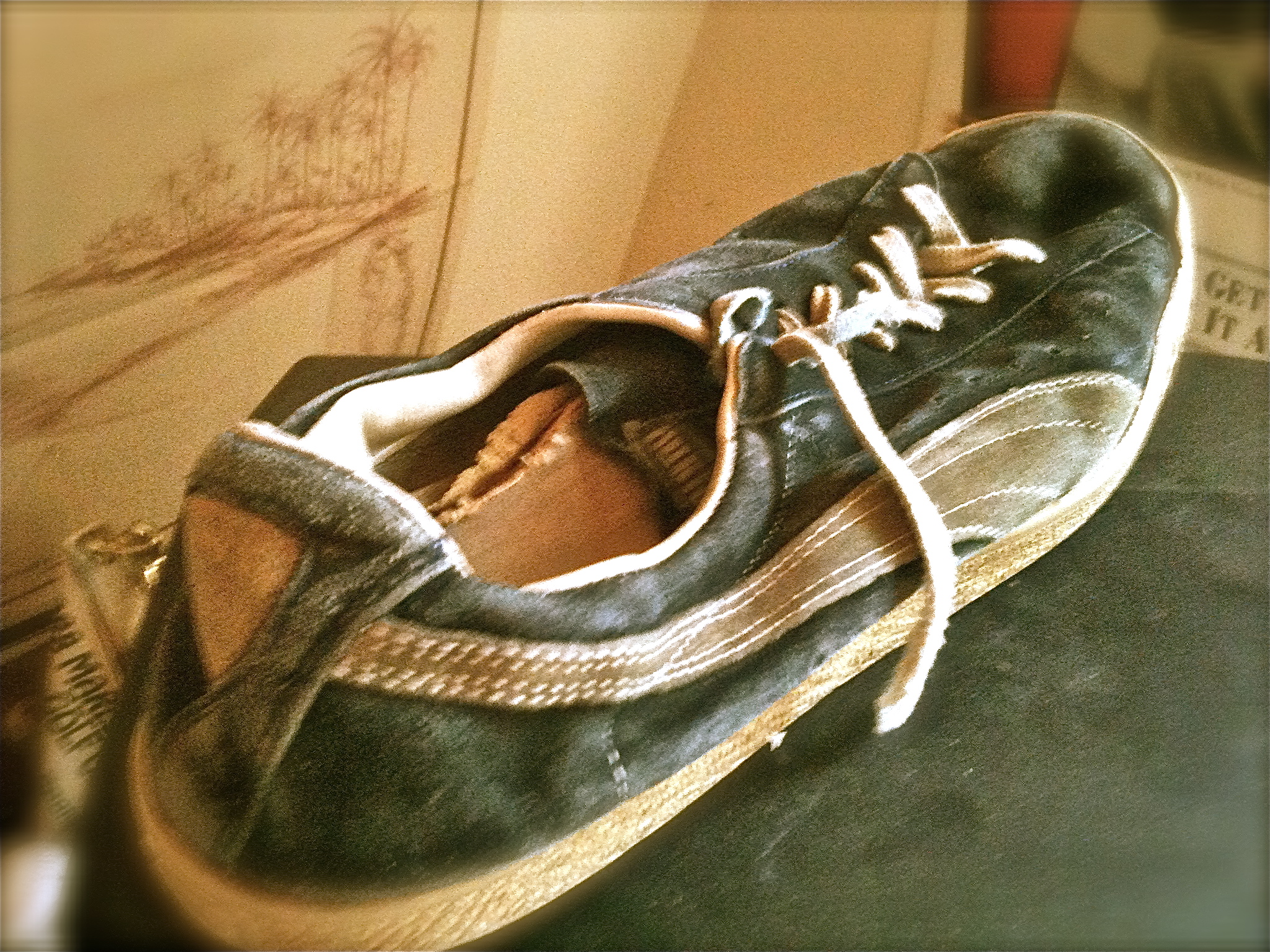
When I was 9 or 10 years old, the soccer shoe everyone wanted was the adidas World Cup. I wanted Puma’s King Pele model. I don’t toe the brand line as an adult, but as a childhood footwear consumer, I was always a Puma guy.

Never did swing that pair of King Peles with the ‘rents. They were top of the soccer cleat line, Puma’s anyway, and too expensive for a kid who needed a new pair every year. When I was about 12, I did get myself into the next step down, the Puma Apollo, which distinguished itself from the yellow swoosh and piping of the Peles with a white swoosh and a red dot — the dot being Puma’s trademark back-of-the-heal design. I had two pairs of Apollos then a succession of Pumas straight through my high school, club and college careers. My last pair was procured in Amsterdam, at the close of a backpacking expedition through Europe, the summer before my junior year at Wesleyan. The trip was nearly over, we’d soon be back at school for two weeks of soccer preseason, prior to classes. They were replaceables, the studs that is, and they were expensive but I had to have them. I emptied the vault to buy them, occasioning the first of many dire afternoons in Heathrow, waiting for a flight home with no money for food and nothing but a pack of Dunhills.

Truth be told, those particular cleats never proved very comfortable. Good for sloppy tracks but I had another pair of plastic molded-sole Pumas that got most of the run. For some reason I blacked out the swoosh with some dye that sat in a box full of shoe polish, brushes, rags and neatsfoot oil. It had been at my parents’ house; I took it to college to care for my various brogues and paint my soccer shoes. Is that gay?

More important, is it an actual swoosh that adorns Puma cobblery? I don’t know what to call that upside-down pipe that got wider as it traveled horizontally and form-fittingly from heel to mid-arch, before turning south and terminating where the arch met the sole of the shoe. Should Nike have control of that word? I think not.

Off the pitch I was obsessed with getting me a pair of Puma Clydes, blue felt low-top basketball sneakers with a gray inverswoosh and dot. I played hoops and these were THE coolest shoe anyone could hope to have in 1978, so far as I was concerned. I pleaded with my mom for some, but we stuck to our routine of buying cheap shoes that wore out about the time I outgrew them. However, my feet had stopped growing by 1978, and I argued that a pair of Clydes would last twice as long as the cheap knock-offs at Marshall’s. So she bit, and I remember gathering great confidence and strength from them, on court and off. Seriously. Shoes can do that. When were really young a new pair of sneakers would be appraised for speed in addition to élan. Look how fast they are… With my Clydes I experienced a pre-adolescent version of that sensation when wearing them, or simply by gazing upon them.

In the 9th grade I played my first real basketball, at junior high school, and I went in another direction: the Puma Basket, a white leather job with black dot and inverse-swoosh. I loved my Pumas so much, I devoted to them artistic energy. For fun I drew very detailed renderings of black cleats, taking great care to use just the right colors for the inverswoosh, and the dot, which was rendered in semi-circular fashion because I depicted the shoes in profile. In some junior high school art class I crafted a hollow rendering of the Basket out of clay, painting it and affixing a complete rawhide shoelace. Miraculously, this eminently breakable item still sits on shelf in my parents’ house.

I was down there last month and noticed on my mother’s washing machine a shoe. I went over and inspected it, and here was the original right-footed Puma Clyde I wore so proudly the first day of the 8th grade, and many days thereafter. But how could it be here, and why?

My mother explains: When down parkas and comforters became available, we learned that you could wash them yourself — but you had to dry them properly, or the down would get lumpy. The instructions advised (still do, I guess) that you dry them “three times, with a tennis shoe or tennis ball in the dryer.” I guess “three times” insures they are really dry, all through, and the shoe or ball sort of “stirs” the down while it’s drying. The same technique works to wash/dry down pillows, which I’ve been washing the last few years…

Funny you should ask today because this morning I decided to put my comforter on my bed, and it was all flat; so I put it in the dryer and realized I’ve lost my SHOE! So I went to the garage and got a gardening clog made of rubber, which worked fine…

So yeah, I took her shoe, which was mine all along. I’m looking at it right now. And it feels really good.


Insomniacs Take Heed: Must-See Rugby This Weekend

Insomniacs Take Heed: Must-See Rugby This Weekend

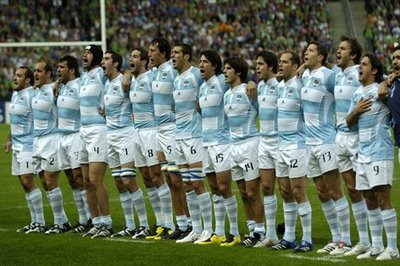
Full-throated Pumas belt out the Argentine national anthem.

I’m just back from Asia where the Rugby World Cup was televised live, every afternoon, via the most basic hotel cable packages, in rugby hotbeds like Ho Chi Minh City and Danang. It was as refreshing to see it routinely beamed there as it is depressing to mull my current situation: stuck in the United States where the games go on at 3:45 a.m. EST, where even the semifinals are available only via some Direct TV channel and/or PPV. Bars are not an option at that hour, of course, so I’m scrambling today in order to sort the situation on my home TV — so I can record the games and watch the next morning. I mean, tonight’s Wales-France semi should be epic, while Saturday night’s New Zealand-Australia semifinal (played at 9 p.m. Sunday night in Auckland) will be cataclysmic, the reverberations sure to be felt across the southern hemisphere. I visited NZ in May and the vibe I got there is clear: If the All Blacks don’t win this game, and the title, on home ground, the entire Kiwi nation will go into the fetal position.

I love the rugger. It took me several months to fully understand what’s really happening in the course of a game. Unlike soccer and basketball, whose rules (if not their respective nuances) are fairly self-evident, and more akin to cricket or baseball, rugby is a game that must be learned at the knee of a rugby person — not an expert necessarily but someone who can explain exactly why they’ve awarded the various penalties, why they’ve kicked it away just there, why possession seemed to have changed hands arbitrarily in that scrum situation, but not the time before. I learned at the knee of my two housemates at the University of London, both rugby guys who thought soccer to be a game for working-class oiks. They were joking, of course, but only just.

Curiously, this exceedingly fast and violent game is played by the upper classes in England. Soccer is and always has been a working class pursuit. In France, it’s the opposite — and, just as curiously, rugby is a game of the south, not the north where proximity to the English, who invented the game, would have made it more popular, one would have thought. And then there is the pure anthropological interest, for US nationals particularly,  in watching a game from which American football has sprung. When we consider the football of John Heisman and Walter Camp, this is the game they were playing.

It’s these funky shadings that make me more of a sporting internationalist with each passing day. I’m not some contrarian who ONLY digs the events that take place outside the insular American sporting scene. That would be extra-nationalist. I love all sport (my Red Sox are out, but I’ve not missed a single game in either League Championship series. I do, however, increasingly appreciate anything that pits nation against nation. It’s of particularly interest to me when the US is involved, but only a corpse could watch France win its RWC quarterfinal v. England and not be moved.

Though this Rugby World Cup tournament is seriously top heavy — strong rugby nations are so much better than mid-level sides that the entire group stage is even more useless than, say, the group stage at the FIFA or FIBA world championships — the gap is closing, but not fast enough to make anything pre-quarterfinal of much interest. That said, I did take in the one truly meaningful group-stage game, Scotland-Argentina in late September, in a Saigon sports bar called Phatty’s, alongside myriad Scottish and Irish expats (the Green had dispatched some guppy 70-6 an hour before). The experience proved such a strong argument for the sport, and this internationalist outlook: Both teams needed a victory in order to make the quarters and both played with desperate vigor; a late-try (the only one of the match) secured a 13-12 win for the Pumas, who are one of those mid-level teams poised to join the big boys; and the largely UK crowd was hard-drinking and vocal but gracious to the few Argie supporters in the crowd. Watching the gigantic front liners — 6’5″ 250-pound, V-shaped behemoths — run up and down the field without a break, beating the shit out of one another, one imagines this is what American football players, especially the linemen, would look like if they were obliged to play the whole game, on both sides of the ball, without commercial interruption.

I’ve often heard American skeptics dismissively brag that the US would dominate rugby if we could just poach enough U.S. football talents to play the game; indeed, I’ve heard Australians say the same thing. This simply doesn’t apply to the linemen:  A year’s rugby training/playing would cleave 100 pounds off Vince Wilfork or any of the huge interior linemen playing today. I don’t care what American football apologists say; they are simply NOT FIT. But it does apply to the other positions on a rugby pitch, esp. the backfield, the fleet fellows who mainly run the ball: LaDainian Tomlinson or Edgerrin James in their primes, taking the oversized ball wide, shedding and juking would-be tacklers and breaking into the open field? I’d stay up until 3:45 a.m. to watch that, too.

Brett Favre Needs a Smack, Followed by a Serious Career Re-evaluation

Brett Favre Needs a Smack, Followed by a Serious Career Re-evaluation

I’ve held my peace on this matter, publicly, for some time. However, it’s high time we all spoke truth to megalomania in the case of Brett Favre.

Has anyone ever faded into retirement more haltingly, with less class, candor or self-knowledge than our Ol’ Gunslinger friend, Brett? When he wasn’t dicking around his various former teams, teasing out his impending retirement charade on an annual basis (the hot breath on his neck being that of ESPN), he was literally showing his dick to distaff media types via his mobile phone.

But now, if that weren’t enough, Favre’s shoddy, delusional comments re. Aaron Rodgers have landed him back in the news. And so, it’s time that we leveled with Brett Favre:

You’re a fraud. A media creation. A compiler of yardage and touchdowns at the expense of titles. A man who stands but a hair’s breadth — a single kickoff-return-for-touchdown — from being the second coming of Dan Marino, or Fran Tarkenton, or Jim Kelly.

Let’s recap, shall we? Here’s the entire offending quote, delivered during a radio interview this week with Atlanta’s 790 The Zone:

“He’s got tremendous talent, he’s very bright and he got a chance to kind of sit and watch and he saw successful teams do it right,” Favre said of Rodgers. “And so he just kind of fell into a good situation. And on top of that, he’s a good player. I don’t think anyone would question now the talent around him is even better than when I was there. So I really was surprised it took him so long. Really, the early part of last season, it hadn’t quite clicked yet and I didn’t know if it would. I just figured at some point, when they hit their stride, they’re going to be hard to beat. And that’s what happened.”

That there is a very nuanced bit of damnation via faint praise, and there is so much to take issue with:

• The Packers team that won it all last year had more talent than the back-to-back Super Bowl teams Favre quarterbacked in the late 1990s? Um, I don’t think so… Green Bay limped into last year’s playoffs at 10-6, got hot and won it all. They are arguably a better team THIS year, compared to last, but they were certainly no juggernaut in 2010-11, nor in the three years Rodgers led the team following Favre’s departure.

• Rodgers sat on the bench and watched successful Packer teams do it right? Really? Rodgers spent three years as an understudy to Favre in Green Bay: In 2005, the Pack went 4-12; in 2006, they missed the playoffs. The following year Green Bay and Favre were admittedly superb, but the season ended in the NFC Championship Game when the Ol’ Gunslinger killed yet another playoff game-winning drive by throwing a foolish interception, in Giants territory, in overtime.

Indeed, while Rodgers may well have learned a lesson there — don’t be so fucking careless with the ball, so late in a playoff game — Favre, in his grizzled wisdom, did not. After retiring (following the OT loss to the Giants), then petitioning the league to join the Jets for 2008 (no playoff appearance ensuing), then pulling the same retirement charade again before joining the Vikings for the 2009 season, Favre similarly threw way his team’s chance at a Super Bowl berth by slinging an even more heedless interception in the dying moments of another NFC Championship Game, against the Saints.

Hey, Wrangler Boy: Sorry to be the one to level with you, but despite all your dramatics, all your meaningless yardage and consecutive-starts records, you are one of the great underachievers in football history. You are but a Desmond Howard return-for-touchdown away from being Marino, Tarkenton or Kelly — only worse, because 1) your teams were routinely better than Dan-O’s one-dimensional Dolphin teams of the 1980s, Tarkenton’s overmatched 70s-era Vikings, or Kelly’s Bills from the early 1990s ; 2) you blatantly threw away more playoff games with your impetuosity, something these guys never did; and 3) Kelly and Tarkenton, it should be said, each qualified their teams for 4 Super Bowls, something you did but twice.

•••

Let’s turn back the clock to January 1997, to the only big game Favre did win, Super Bowl XXXI vs. the New England Patriots, because I think we can already see that a great deal of his Hall of Fame reputation rides on this single result, the only Big One he ever one, on any level.

Of course, the Patriots have gone on to bigger and better things since that fateful night in New Orleans (amazing just how many Patriot highlights and lowlights have been recorded there, eh?). The Packers were, you will recall, an excellent team in 1996-97, clearly the better team. Pats poobah Bill Parcells was literally on his way out the door to coach the Jets, something the Patriots players knew and it undoubtedly affected their performance. Favre’s team was favored by 14 points (!) and Drew Bledsoe was the opposing quarterback…

And yet, the Patriots had every chance to win that game, and it wasn’t Brett Favre who won it for Green Bay. Midway through the fourth quarter, New England had driven down the field and scored a touchdown to make it 27-21 — The Pack and their all-World QB had been stuck on 27 points since late in the second quarter. Favre and the Green Bay offense were inert; one more defensive stop from the Patriots and that game was completely up for grabs. But then Desmond Howard returned the ensuing kickoff 99 yards for the TD that sealed the game.

“We had a lot of momentum, and our defense was playing better. But [Howard] made the big play,” Parcells intoned after the game. “That return was the game right there.”

Howard won the game for Green Bay. He totaled a Super Bowl record 90 punt return yards— most of them in the first half, utterly swinging the field position battle in the Pack’s favor. He would rack up 154 kickoff return yards, and his 244 all-purpose yards tied a Super Bowl record. He was the MVP, naturally.

It’s not stretch to say that, but for Howard’s performance and that one huge play, Marino, Tarkenton and Kelly would have company in the Greatest QBs Never to Win the Big One Club (GQBNWBOC).

[Note: My buddy Jammin’ has concocted an intriguing theory attached to this game, Super Bowl XXXI, and this particular play. The last player struck from the Patriots Super Bowl roster that year was none other than Troy Brown, then a 4th year reserve wide receiver and special teams player who would later become not just an all-pro but one of the most respected Patriots of all time. Why? Because Brown was a complete football player, catching passes, playing special teams, even stepping in to play defensive cornerback for the 2004 and 2005 Patriots. As Jammin’ argues, not unconvincingly, “If Parcells keeps Troy Brown on the roster to play special teams, he makes the play on Desmond Howard. Guaranteed.”]

I don’t want to minimize too much Favre’s centrality to what was an excellent Green Bay team, one that would go 13-3 the next year and win a second consecutive NFC championship. But here again, Favre failed to win the Big One. He and the Packers returned to the Super Bowl in 1998 as 11½-point favorites but contrived to lose to John Elway and the Denver Broncos, 31-24, thereby releasing Elway from GQBNWBOC ignominy.

So yeah. Favre is a fool. He’s retired and should just go away. And I wanted it noted, for the record, that I’ve laid out this entire argument and never once referred to Vicodin.


Cartoonish Hues, Vertiginous Views on The Plateau
The crazy-high black tee at Redlands Mesa's 17th hole. Note bunker at right:

Cartoonish Hues, Vertiginous Views on The Plateau

The nose bleed-inducing black tee on the par-3 17th hole at Redlands Mesa in Grand Junction, Colorado.

About 10 miles outside Delta, Colorado, the road heading southwest turns a rough grade of gravel and, about the same time, the scenery on either side goes Technicolor. In the fall, cottonwood trees here in the rugged Umcompaghre Reserve turn an unreal, Tweetie Bird yellow. Come spring, wild flowers blanket the mile-high cow pastures in every other conceivable hue. There’s plenty of time drink in this wondrous detail as no sane person would drive more than 45 mph on gravel this serious, on a byway this narrow and cambered, this secluded — though the odds are good there’s no one else on the road to Nucla but you and a few adventurous steer.

It’s a good three hours from Devil’s Thumb GC in Delta, through the Umcompaghre, to The Hideout GC in Monticello, Utah. It’s another two from the swanky Tamarron Resort above Durango, Colorado, to the superb Pinon Hills GC in Farmington, New Mexico. But if indeed golf is a journey (as the New Agers keep telling us) then this is just the place to get your bliss on. For here is a starkly beautiful, mesa-strewn wonderland where the sky is big, where the next turnoff is liable to mean another national park, where the rides between courses are as inviting as the golfing outposts themselves.

This is the Colorado Plateau, a hunk of arid landscape stretching southwest from The Rockies’ Western Slope to the highlands northwest of Phoenix. One reaches this golf-rich region through Salt Lake City or Denver, connecting to places like Durango or Grand Junction, Colorado, where the mountains end and the desert sage takes over.

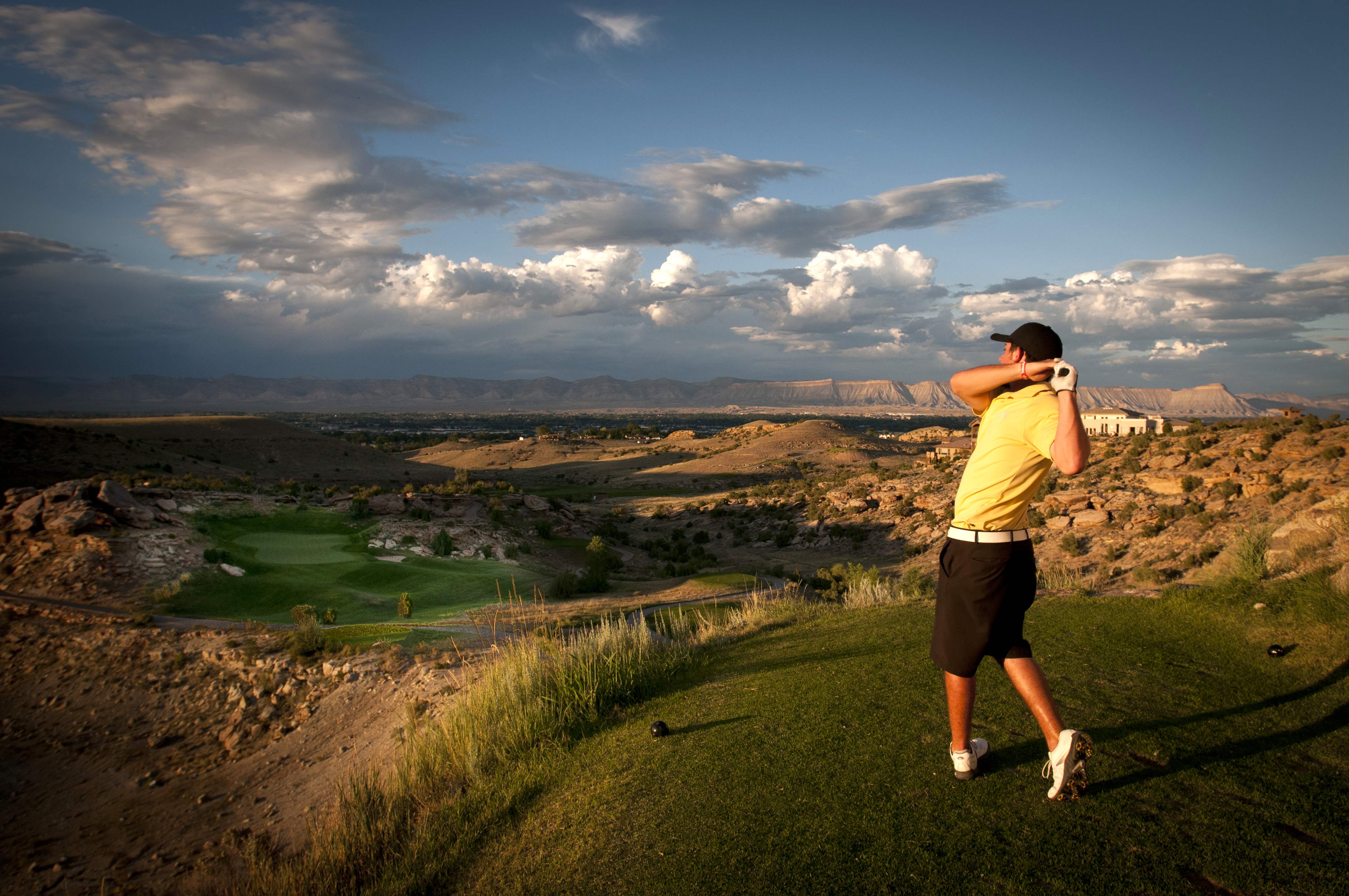
Grand Junction is a logical place to start (or finish) as it’s home to what is arguably region’s best course, The Golf Club at Redlands Mesa. This Jim Engh design has earned a raft of national plaudits and it’s not difficult to understand why: The setting here is at once startling and exhilarating, a dither of canyons, random rock formations and high-desert heaths. At the par-3 17th, the black tee is nestled on a peak so tall and acute, you half expect the Grinch to show up with his sleigh-full of stolen toys. I’m not joking; it’s looks and feels like the freakin’ Matterhorn. Watching your ball fall the 100-odd feet to earth is like watching Wile E. Coyote resignedly plunge off a cliff to the canyon floor below (there’s even a bail-out bunker right of the green to serve up an appropriate “poof” at impact).

Forgive all the animated allusions, but the scenery out here honestly does border on the cartoonish. It’s bloody spectacular and the rides between venues — i.e., the ascetically magnificent terrain one must pass through — make golfers appreciate each layout’s physical attributes all the more. Devils’ Thumb, an hour south of Grand Junction in Delta, Colorado, is clearly a product of its inimitable landscape. Imagine a honest-to-goodness links laid out in the Sea of Contentment, and one begins to envision what architect Rick Phelps has created here. Opened in 2001, Devil’s Thumb careens around a veritable moonscape with alarming originality. Like Redlands Mesa, this course is difficult if not impossible to negotiate on foot. So take a cart. And some Dramamine.

•••

The locals in Delta may warn city slickers away from the vaunted road to Nucla, but do ignore them. A ride through the Umcompaghre Reserve is not to be missed. At one stage the motorist is convinced he’s barreling into oblivion, as a pair of cavernous canyons slowly encroach on either side of the gravel ribbon. Rest assured you will find your way down, to safety. Just make sure you’ve set aside plenty of time, check that your rental has a viable spare tire, and bring your camera.

Having negotiated the Umcompaghre, the road to Nucla will deposit you on Highway 191 which runs north-south along the eastern edge of Utah. Turn right (north) and it’s 40 minutes into Moab, home to Arches National Park with its breathtaking rock formations, myriad southwestern eateries of high quality (check out the Desert Bistro and its goat cheese-stuffed, corn tortilla-crusted chicken breast), and a lovely little golf course by the name of Moab GC. Designed and built by the owners, it’s 6,400 from the middle tees, beautifully kept and wiggles cleverly into the foothills outside of town.

Turn left (south) on 191 and it’s 20 minutes into Monticello, home to the region’s newest “destination course” — with drives like this, they all fit this description. The Hideout GC (no. 15 pictured above) was built across the street from any old uranium mill using federal dollars left over from the inevitable Superfund clean-up. Designed by Phoenix-based architect Forrest Richardson, The Hideout rises well above the novelty of its odd development history. The gorgeous 4th and 16th holes run side by side (in opposite directions) atop a ridge that marks the land for what it is: glorious, high chaparral. Holes rise and fall, dart in and out of miniature canyons, and slice their way through thick stands of cottonwood and choke cherry — all in the shadow of the mighty Abajos, a free-standing mountain range that tops out at some 11,500 feet. Overlooking the entire scene is the Horse of Abajo, an outline of trees on the eastern face which, as locals point out, really does resemble the head of a noble, all-seeing stallion.

Just over the Abajos from Monticello lies Canyonlands National Park. It’s a 20-mile drive into the wilderness before one even reaches the park entrance. Blowing down this remarkable access road at dusk — or in either direction on Highway 191 — can be a disorienting sensory experience. In the distance, long strings of deep purple clouds appear to settle atop and extend beyond the surrounding buttes, creating an irregular and ever-shifting horizon of soil, rock and, on occasion, impending weather. Radio reception out here isn’t so great; in the resulting silence of a rental car, or standing in the red dust at a roadside look-out, one revels in the seclusion and shudders slightly at the many peoples who over the centuries have arrived, thrived and been extinguished here in this unforgiving landscape.

Indeed, an hour east of Monticello is Mesa Verde National Park, where tribes of ancestral Pueblos carved a life for themselves in a series of remote canyons some 800 years ago. The cliff dwellings here are as eerie as they are awesome. Somehow it comes as no surprise to learn the thriving culture that built these cities in relief disappeared as abruptly as they appeared — the victims of severe drought, unrelenting enemies, or perhaps cannibalism. Theories abound on their plight but, in truth, no one knows for sure. The Four Corners region, where Utah, Colorado, New Mexico and Arizona come together, has for millennia been home to tribes of indigenous peoples. The Spanish arrived circa 1500 and modern American “civilization” turned up only 150 years ago. It is the confluence of these cultures — some extant, some recently supplanted, some long gone — that makes the place, the cuisine, the general ambience so distinctive.

Does golf work alongside buffalo meat and abandoned cliff dwellings? Well, that’s like asking whether it goes with haggis and derelict castles. Just remember this particular tableau is a mile high — so drop a club to account for the elevation.

Indie Godfathers R.E.M. Refuse to Waste Another Year

Indie Godfathers R.E.M. Refuse to Waste Another Year

How to take the fact that R.E.M. have apparently broken up? It’s not with sadness or shock exactly. Thirty-one years from a band that, at one time, carried the flag for independent/college rock would seem counterintuitive, like perhaps it stayed way too long. Yet this judgment would be obtuse. There was an integrity to R.E.M., a sense that the band was always doing pretty much what it wanted to do — not what the market, nor the recording industry, nor even its loyal following wanted or expected. And while the boys were in certain ways pioneering — a fusion of jingle-jangle folk and post-punk — few would assert they invented anything. “Alternative” rock? I don’t think so. Even from their earliest post-punk days, lotsa bands introduced more and spit more ardently in the face of the establishment that these mellow neo-hippies from Athens.

What R.E.M. always did, however, without fail, was their own thing. So, perhaps we can agree they were the original “indie” band, laudable avatars of the Indie Rock Movement that stemmed from the post-punk era. I’d argue for that. They came from a backwater, stayed on the road playing backwaters well after they made it big, issued several seminal albums whose lyrics were more or less unintelligible, and, aside from offering more enunciation over time, consistently delivered the same brand of anachronistic original work well after signing with established labels, playing bigger venues and establishing a national following. Hell, they even covered Roger Miller, Tommy James, Glenn Campbell and Aerosmith when it was totally not cool to do so. Even today, in an era when commercially viable bands never really go away, R.E.M. has gone away, on their own terms, seemingly without rancor.

In addition to serving as avatars of the indie movement, R.E.M. were, on a personal level, the beginning of my own predilection towards mournful rock, something to which my wife will attest, perhaps with a roll of her lovely blue eyes. Ditto for most of my housemates at college. I wore out the early R.E.M. albums, Murmur and Reckoning; one dirge off the latter, “Camera”, was a particular favorite (of mine). You just can’t beat the melancholy beauty of these tracks, most of them accented by some truly inspired high-background harmonies from bassist Mike Mills, the most underrated aspect of the R.E.M. appeal, in my view… Cuyahoga!

There were always a few radio hits off each of these first 6 to 8 R.E.M. albums, the ones to which I paid particular attention, at the time, and to which I pay particular homage here. What made these LPs so great was their depth. The longer the listening, the more they served up, and the more I tended to discover and better appreciate the deeper cuts. This is the sign of a truly great album in my book, and it’s rare — so the fact that R.E.M. did it with so many albums on the trot is noteworthy.

I’m thinking of “Camera” and “Seven Chinese Brothers” off Reckoning; “Wendell Gee” and “Green Grow the Rushes” off Fables of the Reconstruction; “World Leader Pretend” off Green; “King of Birds” off Document; “Find a River”, “Try Not to Breath” and “Ignoreland” off Automatic for the People (an underrated-but-spectacular piece of work, start to finish); “Electrolite” off New Adventures in Hi-Fi; Murmur’s “Laughing”; and “Near Wild Heaven” off Out of Time. There are dozens more…

The risk in praising R.E.M. for its alt or indie cred is ignoring the critical acclaim and radio play the band did garner, which I suppose is what makes them indie poster boys: commercial success combined with the continued disinterest they showed toward success. Some of their “radio” songs were deserving of wider marketing support: “Fall on Me” was the lynchpin of what I believe to be their finest album, full-stop: Life’s Rich Pageant — a consistently fabulous compilation of songs, keyed from the get-go by “Begin the Begin”, one of the finest album-opening riffs in rock history.

“Radio Free Europe” off the incomparable debut LP Murmur, got tons of deserved play, as did Reckoning’s “Don’t Go Back to Rockville” — one of those tunes that people of a certain age will unabashedly wail along to, if drunk enough. It’s nearly anthemic, something to which indie rock isn’t supposed to inspire. These two radio hits are from the early days, from the high mumble period, and yet they still penetrated the wider culture. I remember walking through the airport in Savannah, Georgia, circa 1994, and hearing a sort of easy-listening version of another Reckoning single, “South Central Rain,” over the PA. Ten minutes later, I saw Peter Buck and a woman I presume to be his girlfriend walk past me on the way to baggage. I still regret not running him down and soliciting comment on the irony.

At the same time, there were lots of radio songs that, in light of the great depth of R.E.M. albums, fell short of these high standards: “Orange Crush”, “The One I Love” and “Losing my Religion” seemed to me repetitive and derivative compared to the broader contents of their respective LPs. The latter just got played to death. I’m still tired of it. But then, who can really claim to extend logic to the process of choosing hit singles. Indeed, they poked fun at that very dynamic with “Radio Song”, the lead cut off of Out of Time.

These are front-loaded observations. The band’s later work was, to me, largely lost in the welter of other adult interests, musical and otherwise. Maybe there are people out there who find their last 6 or 7 albums just as good, just as strong as their earlier work, but I honestly have not heard that point made, even by staunch R.E.M. freaks. When they’d run out of time, they knew it.

A Day Like Few Others, in Arromanches
The beach at Arronmanches-sur-mer, where remains of the artificial harbor — crafted on the fly by Allied Forces to supply the D Day Invasion — still mark the land and sea scapes.

A Day Like Few Others, in Arromanches

The beach at Arromanches-sur-Mer, where remains of the artificial harbor — crafted on the fly by Allied Forces to supply the D Day Invasion — still mark the land and sea scapes.

The following piece appeared in the Portland Press-Herald in late October 2001. I was a regular op-ed columnist for the PPH from 2000-02. Figured it merited a reprint.


“This won’t stand,” she said. “We are with you.”

This was the straightforward sentiment conveyed to me the morning of Sept. 12, 2001, in the French seaside village of Arromanches-sur-Mer. It was offered by an elderly British woman, which explained the Churchillian tone. There were tears in her eyes.

I spluttered some expression of thanks but little else. A bewildered roll of the eyes perhaps. Standing on the coast of Normandy, we were all struggling to process the import and implications of what had happened the day before, some 3,000 miles away — of what would happen next. What’s more, we were all struck by the irony of what had brought us together.

“It’s no mistake that we are here,” she added, “in a place like this, on a day like today.”

Her tone and reference were apt. It was here in this sleepy fishing village that British engineers created a vast, man-made port through which the entire D-Day invasion force was supplied. It had been Churchill’s outlandish idea, his pet project, and it remains one of the great triumphs in the history of war-time engineering.

It would have been enlightening enough to leave Normandy having learned of the vital role Arromanches played during the largest amphibious assault in human history. It would have been amazing enough to see with my own eyes just how sharply these cliffs rise from Norman shore. It would have been moving enough to have walked amid the grave markers belonging to more than 9,000 U.S. servicemen, who rest for all eternity in bluff-top cemeteries overlooking Omaha Beach.

But this was Sept. 12, 2001, and it was all a bit too much.

IT WAS INDEED a curious time for a family of U.S. citizens to be abroad. We could follow events, but we felt more than a bit detached. Still do, in fact. Americans will always remember where they were that morning; I remember, too, but it wasn’t morning at all. It was four hours after the fact and six time zones ahead.

Almost two months later I still feel strange having essentially missed an extraordinary moment of national, collective consciousness.

What my family and I did experience, firsthand, were heartfelt words of support, not just for us personally but for the American situation in general. All over Western Europe in the days immediately following Sept. 11, restaurateurs bought us beers. Hoteliers cut us deals. In a Dutch internet café, people at neighboring terminals turned, made eye contact (a true cyber rarity) and offered their sympathies.

Driving our Citroen through Belgium, we listened (again, with an odd detachment) to the British voice of outrage via the BBC World Service. Even in haughty Paris, where an American visitor might well be treated as if he were the personal embodiment of U.S. cultural imperialism, we encountered nothing but comfort and concern.

These are staunch allies, of course. These are the people who best remember and appreciate America’s role in beating back fascism. Yet behind their statements of allegiance and comradeship there was the clear realization that, “It could have been us”. They counted themselves lucky, but they also knew full well that, “We could be next”.

Today, as we all wait the next shoe to drop, those sentiments go double for American citizens. Triple for those who happened to be abroad on Sept. 11 — perhaps 10-fold for those, like us, who flew from Logan to Dulles to Paris on Sept. 7, and back the same way on Sept. 16.

ONE OF THE STRIKING things about Normandy is its uncanny historical primacy; whole eras have a habit of dawning and setting here. From these shores in 1066, for example, William launched the Norman Invasion; his subsequent victory at the Battle of Hastings altered the course of Western Civilization forever. Before the millennium was out, dear friends would go once more into the breech here. Tattered armadas would wash ashore here. And allied troops would land here, diverting the flow of history once more.

And there I was, standing on the beach in Arromanches that beautiful, sunlit morning, witnessing the passage of yet another epoch on Norman soil. The Post-Cold War Era had drawn to its horrific close the day before. It was Sept. 12, my birthday, the day the world embarked on a new, unsettling, as-yet-unnamed era.

It’s a funny thing, a uniquely American thing, that we must travel so far to set foot on ground like this. That we must travel 3,000 miles to see these memorials in person speaks to the insular way, the fortunate way we Americans have spent the previous century. Indeed, for Mainers, Pearl Harbor is further still.

We no longer enjoy such a luxury, of course. In its place, we have a cold, hard perspective that Europeans and others around the world have long held — namely, that external forces CAN commit savage acts very close to home. And here’s the grim corollary: Civilian lives are routinely lost in the crossfire. To a long and grisly list which includes London, Dresden, Budapest and Sarajevo, we now add Lower Manhattan… and Kabul.

Little of this was clear to me back on the beach at Arromanches — but maybe it was to her. I wanted to ask my new British friend about World War II, her role in it, what she remembered from June 1944… But I couldn’t find the words, and she didn’t offer anything more. To the both of us, D-Day seemed curiously off the subject and remote.

We wished each other well and slowly drifted down the beach in different directions.

Hal Phillips, A Fine Golfing Ambassador: 1936-2011
Big Hal and Little Hal, crossing the Shannon on the way to Ballybunion in 2008.

Hal Phillips, A Fine Golfing Ambassador: 1936-2011

Big Hal and Little Hal, crossing the Shannon on the way to Ballybunion in 2008.

My father and namesake, Harold G. Phillips Jr., passed away Saturday, Aug. 27, after a 15-month battle with lymphoma, and so I’ve been thinking and writing a lot about him this past week. Most of this bittersweet rumination has nothing to do with golf but some of it surely does. He’s the guy who introduced me to the game, taught me the game, claimed to do most of his “fathering” on the golf course, and took great satisfaction in the fact that I once played the game well and have ended up making my living, to a certain extent, writing about it.

Golf differs from most sporting and recreational pursuits for its heavy reliance on venue. Unlike those playing grounds accommodating tennis, baseball, soccer, football or whatnot, golf courses are all unique and, like a fragrance stuck in the deep recesses of the mind, they summon things that other stimuli cannot. I can’t possibly remember each round I played with my dad, but if I think about where we played, the memories — some fully formed, some mere bits and pieces — come flooding back. Indeed, I can begin to appreciate and readily recall, in quite extraordinary detail, the long coincidental relationship he and I had on courses stretching from the sands and forests of New England and the Northeast, to islands in the Caribbean, to the Mull of Kintyre and Ring of Kerry. Here are a few that come to mind:

As he looked when we started our golfing adventures, in the mid-1970s.

• Powderhorn GC, Lexington, Mass.: This joint is where I started out in the game, at my father’s side. I was 8 or 9, and we had just moved to nearby Wellesley from northern New Jersey. Powderhorn was a par-3 course but that unfairly belittles it. There were 18 holes and while some were no more than 100 yards, others measured well over 200 and none were flat, rinky-dink or boring. I remember my dad and his game seemed sort of god-like back then, in that I played a lot of these holes like par-4s and -5s and there wasn’t a single hole he couldn’t “reach”. Powder Horn stood us in good stead for at least two years, and I remember playing there with my grandmother, a steadfast player in her own right (for some seven decades). I recall that I once pitched a mighty fit here after butchering the uphill 11th hole. There were tears. I recall her being sort of perturbed at my behavior but my dad, as per usual, never was… We picked up games with all sorts of people at Powderhorn — another lesson learned early: that one always invites people to join him, even when one might rather not. Made my first-ever birdie on the 17th hole there, a 130-yarder over water. We were playing with a fellow named Mr. Jolly; when that ball dove into the cup, he was nearly as excited as we were. Powderhorn is gone now, converted to a condo development in the early 1980s, which is a shame because I’ve often wanted to go back — and play it like a god.

Claiming some tournament hardware from Ken “the Hawk” Harrelson, second low gross, if memory serves (Why does it serve? because I was third!).

• Stow Acres CC, Stow, Mass.: We were public golf vagabonds, my dad and I, never belonging to a private club, at least in these early days. We played all over Eastern Massachusetts at places like Juniper Hill, Sandy Burr, South Natick CC and Saddle Hill. South Natick was just nine and survives today as a mere driving range surrounded by housing; Saddle Hill has since gone private and goes by the name of Hopkinton CC. But when we wanted to play somewhere truly fine, we ventured 45 minutes north to Stow Acres, home to a pair of really fun Geoffrey Cornish/Bill Robinson designs. They didn’t take tee times and I recall hanging around that clubhouse, sometimes for an hour or more, before finally going off. From the time I started playing until the time he turned 55, some 20 years, my dad played off anything from 7 to 10. A good player and very steady; did nothing super well but nothing at all poorly. One day at Stow North, when I was 14 or so, he went out in 33. I self-destructed at some point on the back nine, went into a funk, but managed to pull myself out of The Dark Place about the 17th hole, at which point I consulted the scorecard. “Hey dad: Par 18 and you shoot 72!”

“I know!” he shot back, clearly wishing I had continued to pout and leave him alone with his demons. He made that par and I’m pretty sure it was his best round ever, though I know he shot 73 in competition a couple times during high school matches at Fort Monmouth CC (I’ve seen the newspaper clippings). He had a great story about the one year he played collegiately, at Lehigh University. He scrabbled his way onto the varsity as the 8th and last man for a match at Penn State, apparently, and managed to put together a 79. The guy dropped 71 on him. “The 8th guy! And it could have been 69!” he would later explain, still amazed that there were seven Nittany Lions better than that. Thereafter my dad resolved to concentrate on his studies.

Rocking the Merion 1981 U.S. Open hat, as he would for many years.

• Pleasant Valley CC, Sutton, Mass.: My dad and his business partner, Harvey Howell, owned a polystyrene manufacturing operation south of Worcester, Mass., and they commuted an hour each way from Wellesley and neighboring Dover, every day, my whole growing up. There wasn’t much great golf to be played out that way, not back then. But there was Pleasant Valley, which for years hosted one of only two PGA Tour stops in New England (the other was The Greater Hartford Open, now The Travelers; PV hosted its final Tour event in 1998). So, while it was no design masterpiece, Pleasant Valley was sort of a big deal club among golfing Massholes. Because my dad was a local business guy of some standing, he could arrange games for us there. He arranged a lesson for me at PVCC, too, the only formal one I ever had as a kid; the teacher was Rick Karbowski, quite a good player out on satellite tours back in the early ‘80s… I played a match there once in college, vs. Assumption College. I was playing no. 1 for Wesleyan that day and drew a guy named Frank Vana, who would go on to win a bunch of Mass. Amateurs. We were dead even on the 12th or 13th hole when I spied my dad walking along the fairway; he had snuck away from the office, just a few miles down the road. I remember being pleased he was there, though I promptly doubled the next hole and bogeyed two more. My dad had played enough golf with me to know what sort of volcanic response was coming. He got out of there pretty fast.

I had all sorts of blow-ups like this as a kid, as a young adult… okay, as a full-on grown-up, too. My dad’s temperament, on and off the golf course, is really nothing like mine. A very mellow dude, he was. The worst he would ever say after botching some shot was, “Oh, Hal…” He was surely embarrassed sometimes by my behavior but he never really called me on it, beyond a quiet-but-stern, “That’s enough now.” When I heard that, it was time to pull myself together.

• Pine Valley GC, Clementon, N.J.: When one serves on any sort of course-rating panel, the inevitable question is whether one has played Pine Valley. Thanks to my dad, I’ve played it twice, both during my college days. He had business contacts at Dupont, and whoever it was (Hugh something?) invited us down during the fall of my freshman and sophomore years. They have a bet there, at the other PVCC (!), as you readers may know, that guests can’t shoot within 10 shots of their handicaps. I never came close to cashing in. My dad won that bet twice. In his day, he could shoot 84-85 pretty much anywhere. This was pre-cell phone, of course, and it would’ve been quite bourgeois to bring a camera, so no pictures exist to mark

At The Equinox in Manchester, Vt. After he had arranged so many games for me, at places like Pine Valley and Merion, it was nice to arrange them for him.

our visits. But I do have the paper placemat (a nice map of the layout and scorecard) from our luncheon, which I framed and have hanging in my office. One of the years we played Pine Valley, it must have been the first, we followed up the round with another just a few miles west, in the Philly suburbs, at Merion. This was only a year or so after David Graham’s win there at the 1981 U.S. Open. My dad closed me out on the 16th hole, the famous Quarry hole, where I four-putted, snapped my putter in two and left it in the little waste-basket below the ball-washer on 17 tee. I parred in, putting out with my 2-iron. We were not invited back… However, the Merion legacy proved long-lasting: My dad picked up a commemorative U.S. Open bucket hat there, and he would wear it for years on golf courses and soccer sidelines far and wide (see image of that above: white with a blue band). The entire time I knew him, my dad had a head of hair not unlike Albert Einstein’s. And so he always wore a hat on the golf course or anywhere the wind might make for unreasonable coiffure-maintenance. He rarely wore baseball caps, always some sort of bucket hat with the brim turned down on all sides. Before he procured the Merion model, he had a green one that he wore for years (see that model further up in this story). I dabbled with it for a time. Wish I knew where that thing was… In later years he went to the wide-brimmed straw model — see the lead image for an example of this mode — which my mother never liked. Half in jest, she claimed made him look like a fruit vendor.

• Old Orchard CC, Red Bank, N.J.: This was the course my dad grew up on, where he learned the game at the knee of the pro there, George Sullivan. My grandparents would play with my dad, along with me, and they’d often marvel that he still had “that same, smooth George Sullivan swing.” It was indeed smooth, quite effortless. He never, ever overswung (unlike some of us). Of course, my dad also learned the game from his own father, my grandfather, Harold Phillips Sr., in his prime a high single-digit player in his own right,

That smooth George Sullivan swing, circa 1952

a lefty who had a penchant for aces. Poppy would post 5 or 6 over the course of his many golfing days, at least two while he lived at Shadow Lake Village, a N.J. retirement community with a par-3 course. I remember going to visit there as a lad, by which time Pop had become a bit dotty. He was bragging to me on a hole-in-one he’d just made and I looked over at Gram with circumspection — “No, it’s true,” she exclaimed. “He had another one!”… In any case, one time during the late 1980s, my dad and I went back over to Old Orchard; it had been decades and he really got a kick out of going round there again. He had caddied there, too. Apparently there were several gangland figures whose bags he toted in the 1940s and 50s. Good stories were related that day. Plus I shot 76 and totally torched the Old Man on his own turf… I would love to have gotten him back down to the Jersey Shore in later years to play Hollywood GC in Deal, which is supposed to be a great old Dick Wilson design, recently restored, and where Pop had been a member in the 1930s. Thereafter we’d have scooted west across the Pennsylvania border, on Route 22, to play Saucon Valley, Lehigh’s home club, where my dad hadn’t played since college. But we never did find the time. File that one under “Regrets”.

• Nehoiden GC, Wellesley, Mass.: This is the 9-hole, private club across the street from which my family lived for 20-odd years. It’s owned by Wellesley College and while it’s nothing stupendous from a design standpoint, it was notorious in the 1970s and ‘80s for having a 10- or 15-year waiting list. Why? Membership was open to college faculty and staff, to folks who worked for the Town of Wellesley, and it was cheap compared to the swanky clubs all around us (Wellesley CC, Woodland GC, Weston GC, Dedham Golf & Polo, Brae Burn CC). The first 10 years we lived in the chocolate brown Victorian across the street, my dad didn’t gain membership at Nehoiden. He didn’t really play the course at all. However, I played the course ALL THE TIME: My friends and I would sneak onto Nehoiden constantly, in addition to playing in the sprinklers there on hot summer nights, looking for golf balls, sledding, playing hockey on the 7th fairway, and generally treating the place like our own personal playground, which, from sundown to sun-up half the year, and 24/7 the rest of the year, it was.

Oddly, when my dad did become a member, in 1983 or so, he

My ace, recorded at Nehoiden 7.16.90 … The poor man was witness to several but never had one himself.

started playing a golf course that he hardly knew — but his sons knew intimately.

My dad was sort of shy socially and by that I mean he didn’t seek out social situations. Once in them, however, he was famously genial, almost courtly (a quality his NOLA-bred father exhibited in spades). So it’s no surprise that he became an active and, I think, extremely well liked figure across the street. He served on committees and enjoyed regular games with different sets of guys; he was a sought-after partner in the various scotch foursome events — because he was courtly, because he would never make a woman or any lesser player feel badly about being lesser, and because he played off 7. Though I had a big head start on him, the universe of our shared experiences at Nehoiden would prove vast. We were together there the first time I broke 80; the time he pegged that car crossing the 9th fairway; the time I aced the 4th hole (my only hole-in-one; the poor man never did post one); the many times one of us would hit what appeared to be a perfect, blind approach on 6 only to see the ball bound back into view after hitting the unforgiving pavement on Route 16; and the time he came closest to winning the club championship — finishing second, with me on the bag for the final round… He let his membership lapse over this past winter, as he didn’t think he’d be well enough to play. My brother and I called the Nehoiden powers-that-be in June, seeing if we could arrange what had become our regular Father’s Day game. They bent over backwards to make that happen, even hooked him up with a riding cart (which are banned at Nehoiden), something for which we remain eternally grateful. It was the last time he set foot on the property… Until we sprinkled his ashes in the bunkers surrounded the 8th green.

• Western Gailes, Ayrshire, Scotland: For all his travels, my dad was 60 or so before he ever played golf in the U.K. My brother Matthew and I sorted that, in 1998, when we arranged a mini-tour of Scotland’s west country: Gleneagles, Turnberry and Machrihanish. However, our very first game took place at Western Gailes, and it stands out for me because 1) it really was an eye-opener for the man, walking and playing amidst the dunes as opposed to watching them on TV during the British Open; and 2) my dad, for all his wonderful traits, was one of the slowest men on earth. I’m not talking a slow golfer,

Stalking a putt at Machrihanish in the late 1990s.

which, to be fair, he surely was. Physically, he did everything slowly and deliberately. This just naturally spilled over into his golf game: always the last one to his ball; never altering his pre-swing routine or undertaking it before it was his turn to play (partly because he was so frequently the last one to his ball); always coming over to look for your ball, but often disappearing into the woods/rough and having to be coaxed out. Surrounded by Scots, his game proved positively glacial. We had prepped him on this, telling him we had to keep the pace good, that there would be precious few if any yardage markers, and, of course, no riding carts. I remember walking up the first fairway at Western Gailes and there was my dad, behind me, standing over the ball, looking around: “What do you think I’ve got from here?” Dad, there are no markers! Eye it and hit it. Of course, he continued to ask this same question over and over, throughout the trip, never registering the new reality. During some later round, when I was just finished admonishing him yet again to move his ass — and to stop asking me where the the non-existen 150 marker was — I turned to my brother and said, “You know what? I sound just like mom.”

• Lahinch GC, County Clare, Ireland: In retrospect, the timing on this trip couldn’t have been much better. In 2008 my dad was 71 and, so far as we knew, in pretty good nick. But even in fair health he’d arrived at the stage of life where walking four rounds in 4 days was too much. And little did we know that in less than three years, he’d be gone. So, this trip to Ireland was a godsend and we made the most of it (see video capsule from that trip below). The round at Lahinch was our first, the one we played fresh off the plane, in brilliant sunshine and 70-degree weather, with one set of rented clubs (my brother’s had been misplaced by the airline), around one of the peerless links on God’s green earth. It’s not fair to single out Lahinch at the expense of our rounds at Doonbeg, Ballybunion and Tralee; they were lovely all four and we even wangled a buggy for dad at the latter. Indeed, the day before he had been able to walk only 14 holes of Round III, at Ballybunion. We met him that day back at the clubhouse where he was chatting up a group of fellow Americans in the bar, pint in hand, grinning ear to ear. “This Guinness is really pretty good,” he said. My God, Dad: How old are you? You’re just figuring this out? … Not much of a drinker, my dad.

I remember asking him once — when I was quite grown-up, working in the golf business, and ever more curious about courses, design and travel — exactly where he had played his golf when we’d all lived in northern New Jersey. This would have been the early 1970s, before we moved to Greater Boston, when he was still in his golfing prime (30-35 years old) but when I, his eldest son, was too young to play with him.

“Oh, I didn’t play much of anywhere really.”

What do you mean?

“Well, I had a wife and kids and a job. I didn’t play much at all until you were old enough to play with me.”