[See here an archival excerpt from The Harold Herald, the world’s first blog, a form I invented in the early 1990s. Yeah, I did… One of the things that made the HH special, and thereby transcend the as-yet-created blog genre, was a stable of talented contributors. Dave Rose was one of these, and here we reprint one of my favorite bits of his, first published circa 1995, when global CO2 levels were still rather quaint. ]
By DR. DAVID ROSE BOSTON, Mass. (Feb. 12, 1995) — From a meteorological perspective, this winter has been a particularly difficult one in New England. The ground here has been snow-covered for at least a month, and each time the snow begins to retreat a new storm sets in, dumping a foot or two of the white stuff on the city’s long-suffering populace.
In times like these, even the most stalwart, Eastern masochist can cast an admiring eye to the South or West, imagining more comfortable — if less character-building — Februarys. In weaker moments we are all capable of believing we would be less miserable if only the weather were better.
What few people realize, however, is that misery — like matter, energy or gravity — is a measurable entity subject to strict physical laws. Paramount among these is the law of conservation of misery, which states that misery can be neither created nor destroyed. What the law of conservation of misery means is that each human being is subject to a fixed quantity of misery during his or her lifetime. This “misery quotient” is absolutely immutable, a constant that holds across socioeconomic groups and geographic boundaries.
The law can be demonstrated in the field by measuring and tabulating misery in test subjects by using sensitive, electronic monitoring equipment. In the following study, diary entries for three individuals are followed by the amount of misery experienced by each, expressed in misery units (MU).
Subject 1, Los Angeles, Calif.
Day 1: Beautiful day. Saw Erik Estrada at Arby’s (.002 MU)
Day 2: Beautiful day. Discussed Rolfing with a Scientologist. (22.001 MU)
Day 3: Beautiful day. Around noon my house ripped loose from its foundation, slid down a hill, burst into flames and was swallowed up by a huge fissure that opened in the Earth’s crust. I was trapped for four weeks and forced to drink by own urine to survive. One of the paramedics looked just like Kevin Bacon in Footloose. (1223.12 MU)
Subject 2, Tallahassee, Fla.
Day 1: Beautiful day. Stayed in the trailer and ran the air conditioner. (.003 MU)
Day 2: Beautiful day. Noticed that some, but by no means all, of my neighbors bear a striking resemblance to Gomer Pyle. (12.4 MU)
Day 3: The morning was beautiful, but in the afternoon I was mistaken for a German tourist and shot in the head, doused with gasoline, and set afire during a hurricane that destroyed the entire trailer park. (1232.72 MU)
Subject 3, Boston, Mass.
Day 1: Mixture of snow and sleet. Frostbite in right foot. (415.041 MU)
Day 2: Mixture of snow and freezing rain. My right foot has become gangrenous, and the stench is unbearable (415.041 MU)
Day 3: More snow. However, I reflected today that my house remains intact and this gave me a sense of stability and well-being. Right foot amputated. (415.041 MU)
Note the three subjects had very different experiences during the test period. However, the total amount of misery endured by each subject is identical (1245.123 MU).
Petty Humiliations, Annoyances
While life in Boston is characterized by an endless series of petty humiliations and annoyances, life to the South or West consists of long stretches of inane, vapid, colorless contentment punctuated by absolute cataclysm. You can take your pick, but you can’t avoid misery altogether.
And before you move to warmer climes, consider the fact that spring will bring nicer weather to Boston, whereas Gomer Pyle lives in Tallahassee year ’round.
Herald Science Editor David Rose, PhD, is among the world’s foremost authorities on suffering. While he still gets a charge from the warranted misfortune of others, he specializes in chance trauma and self-imposed misery. He once dieted for two weeks on nothing but chicken boullion and carrots. His latest book, “I’m Wretched — You’re Wretched” (Knopf, $14.95), was published in September.
NEW GLOUCESTER, Maine (Dec. 8, 2017) — Like many others that fateful night 37 years ago, I learned that John Lennon had been killed from Howard Cosell. Yeah, that Howard Cosell.
It was a Monday night, and the Patriots were in Miami playing the Dolphins. In December of 1980, Howard was still presiding over Monday Night Football, in his inimitably pedantic, bombastic, half-in-the-bag fashion. In the pre-cable era, MNF was the week’s premier sports broadcasting event; my dad and I always watched it together, as an act of ritual.
Howard was respectful of this traumatic news — as respectful as his on-air persona would allow. In other words, he treated the murder as he would a punt returner who’d broken clear of the pack with only the kicker to beat. See that bizarre media moment, preserved for all time, here. ESPN would later weigh in with its own meta-media doc, here.
I was 16 years old in December 1980. My dad was not yet 44, 10 years younger than I am today. We were stunned by this news, naturally. It was legitimately unmooring to have it delivered by such an unlikely source, in such a peculiar context. The Pats’ left-footed, English place kicker — John Smith, who hails from Leafield, Oxfordshire— was lining up a field goal attempt when Cosell abruptly altered the narrative. The only thing that would’ve made it more bizarre? If Smith had hailed from Blackburn, Lancashire.
John Lennon was 41. Same as my Mom
We quickly called my mother into the room. She was the founding and still presiding Beatles lover in our family, and John was clearly her favorite. She was 41 in 1980, essentially the same age as John Lennon. She had latched onto them from the start. Indeed, my dad had teased her for digging a band whose enthusiasts were, at that stage, mainly 13- and 14-year-old girls.
But my mom has always possessed a keen musical sensibility and her early support for their chops were more than justified in the years to come. She wordlessly teared up while listening to Cosell bloviate, then left the room.
Not sure why, but the holiday period tends to include a lot of Beatles content on PBS. Just last week I watched Ron Howard’s “Eight Days a Week,” along with something called “Sgt. Pepper’s Musical Revolution,” as part of a fundraiser. All these years later, the Beatles are considered subject matter for the whole family, apparently.
If you should get the chance, make time to watch the superb documentary “LENNONYC,” about his post-Beatles years in Gotham (I saw it on PBS, but today you can catch it online, here). The Seventies proved an eventful decade that followed hard on the band’s official break-up back in April 1970. For Lennon it featured a gaggle of outsized characters and spanned a remarkable procession of music-making, protesting, drug-taking, deportation-resisting, legal wrangling, breaking up, getting back together, child-rearing and, ultimately, growing up.
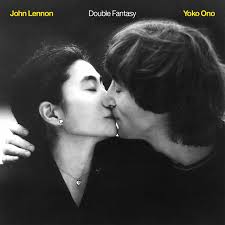
That was the message one took away at film’s close: Here was a guy who had finally shed the latent adolescence of rock stardom and become a man, in his own right, only to be killed by a psychopath at the exact moment that maturity was to be revealed. Lennon’s his gorgeous new album, “Double Fantasy,” had been released on Nov. 17, 1980. I don’t know that it gets much sadder than that.
NEW GLOUCESTER, Maine (Dec. 5, 2017) —‚Since the early 1990s, when Newt Gingrich and his para-parliamentarians initiated their hostile take-over of the Republican Party, I’ve struggled to describe (or identify a lucid framework to help me articulate) what sort of pathology had infected the GOP, its rhetoric, its attitude toward the liberal left, national media, and our government itself. With help from the Washington Post and Project Veritas, I’ve finally hit upon the words to describe this larger framework: I’m Not OK – You’re Not OK.
Refugees from the 1970s will perhaps recognize this reference to Thomas Harris’ 1969 pop-psychology treatise, “I’m Ok – You’re Ok,” whose title refers to an optimal state of human relations, one that most of us do indeed strive day to day to achieve. “Treat they neighbor as thyself” predates Harris’ coinage, but they go together: One cannot hope to treat his/her neighbor well if, to begin with, one doesn’t have a decent sense of self-worth.
There are two more middling, less healthy states that Harris used to describe people suffering from undue superiority (I’m OK – You’re Not OK) and undue inferiority (I’m Not OK – You’re OK).
It is the fourth state, I’m Not OK – You’re Not OK, that is generally reserved for inveterate grumps and outright sociopaths. Let me describe why this phrase so cogently describes today’s GOP and the media apparatus that supports it.
I’m Not OK: Project Veritas, Exhibit A
By now the failed frame-up of the Washington Post in November 2017 — whereby a right-wing “media watchdog” group, Project Veritas, was caught red-handed trying to feed the newspaper a false story re. Alabama U.S. Senate candidate Roy Moore — qualifies as old news. The intent of the unabashed dirty tricksters at Project Veritas (PV) is not disputed. WaPo — which had led the reporting on Moore’s sordid, cradle-robbing past — was meant to knowingly publish the fake story; Project Veritas would call out the paper for its lack of reporting acumen borne of liberal bias. Then the newspaper would be discredited in the narrow context of any further reporting on the Alabama U.S. Senate race, but also in the broader context of all its political reporting.
The whole thing backfired, of course. WaPo’s reporting process (a fact-based process) proved to be anything but the partisan exercise PV would like to have alleged.
But PV’s strategic thinking here is yet another example of a longstanding dynamic — one where right-wingers just assume left-wingers operate as mendaciously as they do, as utter movement soldiers. This attempt at equivalence doesn’t wash, has never washed, as the WaPo example and hundreds more would capably illustrate.
But the underlying rationale behind this behavior and attitude from the right, this I’m Not OK – You’re Not OK sociopathy, has nevertheless informed right-wing charges of left-wing media bias for 30 years. It stems from this basic tenet, held on the right: Some right winger in a position to tilt media coverage (to favor or otherwise advance the right) surely will do so — in large part because he/she alleges counterpart, left-leaning media types are already operating on the same mendacious level.
An Extraordinary Perversion
This charge, that fact-based media (known colloquially on the right as “mainstream media”) are themselves movement soldiers, has led to an extraordinary perversion of the right-wing journalistic ethic, one with larger political goals. Listen to Breitbart.com editor Matthew Boyle speaking to this phenomenon during an event held laste summer:
“Journalistic integrity is dead. There is no such thing anymore. So, everything is about weaponization of information. Both sides are fighting on the battlefield of ideas and you know, CNN, the New York Times, the Washington Post, Politico, Associated Press, MSNBC, NBC, CBS, the whole alphabet soup — they’ve all thrown in together with the institutional left.
“Our viewpoint at Breitbart has always been that we’d rather be open about our personal biases. We’re openly conservative. We don’t hide it. We’re very honest with our audience. We told people we all wanted Trump to win last year. If you’re open with your audience about that, I think you’re honest with your audience.”
The mainstream media, he continued, “claim to be objective. They claim that they don’t have a side. And many of them actually believe their own lies. So, a lot of these people are decent human beings who are working in a broken institution. We’re getting past these guys…We’re winning this war and we’re outnumbered. So the more people that get involved, the more people that stand up and fight, the closer we are going to get to a total victory.”
Knowing Fabrication
For any media outlet, there’s a big difference between being open about an organization’s political biases — something fact-based media routinely do, in their editorial/opinion pages — and openly admitting that said media organization would actively, knowingly fabricate or distort a story in order to fit a desired narrative or serve a political priority.
But read Boyle’s reasoning more closely: Breitbart claims to have gone this direction because the mainstream media (the “opposition media” in this perceived war of ideas) is deploying similar tactics already. This is not the case and never has been the case. Nevertheless, this sort of cynical, pre-emptive, tit-for-tat nihilism has informed right-wing media for 30 years now, and today we see the result, the right wing’s desired result: huge swaths of the American public perceive all media-delivered information as strenuously biased, and so it has all been devalued to the point of castration.
Sorry to get all dramatic and pointed here, but this result — our current media landscape, where widely held truths are no longer held — did not just happen. It is the result of deliberate strategy, yet another tried and true tactic deployed by fascists and authoritarians. Hannah Arendt explains:
The moment we no longer have a free press, anything can happen. What makes it possible for a totalitarian or any other dictatorship to rule is that people are not informed; how can you have an opinion if you are not informed? If everybody always lies to you, the consequence is not that you believe the lies, but rather that nobody believes anything any longer.
This is because lies, by their very nature, have to be changed, and a lying government has constantly to rewrite its own history. On the receiving end you get not only one lie — a lie which you could go on for the rest of your days — but you get a great number of lies, depending on how the political wind blows. And a people that no longer can believe anything cannot make up its mind. It is deprived not only of its capacity to act but also of its capacity to think and to judge. And with such a people you can then do what you please.
Spreading the Gospel according to Steve Bannon
Note that there was no pretension on the part of Project Veritas to determine whether Roy Moore’s accusers were actually telling the truth. The bumbling dirty tricksters at PV don’t care about truth. To them, it is beside the point. Like religious zealots, they care only about furthering the narrative, spreading the gospel, which, as Boyle makes clear, centers on destroying the credibility of competing, fact-based media and the left-leaning political entities that are presumed to support them, in the same way right-leaning political entities support and shape narrative for Breitbart and Fox News.
Would-be fascism of this ilk brings with it an entirely new set of language and tactics, which, though shocking, offensive and nihilistic on many levels, isn’t inscrutable. Here’s a benign example: When our president says, “Nobody knew health care could be so complicated,” what he’s really saying is, “I just found out how complicated health care can be.”
The WaPo sting attempt speaks symbolically, but with fulsome clarity, to right-wing media intentions that are anything but benign. PV’s chosen target and tactics communicate quite clearly that Project Veritas itself believes in the veracity of Roy Moore’s accusers. Otherwise, PV and its lame-brain henchmen would have been out there trying by hook and crook to puncture holes in their allegations, their characters, their credibility as accusers.
But Project Veritas clearly believed these women. That’s why it sought instead to discredit the media outlet that had broken many of the stories re. Moore’s predilection for underage girls. PV and the alt-right don’t care about Roy Moore any more than they care about ferreting out the truth. They believe they have more to gain, in the long run, by neutering this pillar of fact-based media. By doing so, they stake out their position and self-worth quite clearly:
NEW GLOUCESTER, Maine (Oct. 19, 2017) — One of the great privileges of child-rearing is what I call the Transportation Effect, whereby adults — in playing or otherwise communing with their kids in an appropriately committed fashion — are transported back to a time in their own lives when, say, erecting the most efficient Hot Wheels match-race scheme was about the most engrossing thing imaginable. Halloween, with its attendant masquerading and confectionary trappings, transports like few other phenomena. Because candy nostalgia trumps Hot Wheels nostalgia all day long.
A couple years back my fully transported mother actually demonstrated apple-bobbing to my children, full dunk and all — something she never did for my benefit during the umpteen Halloweens of my own childhood. But the point is taken: Hayrides, costumes, haunted houses, pumpkin carving… They’re all transcendentally nostalgic acts.
But they’re all secondary to the hoarding of candy.
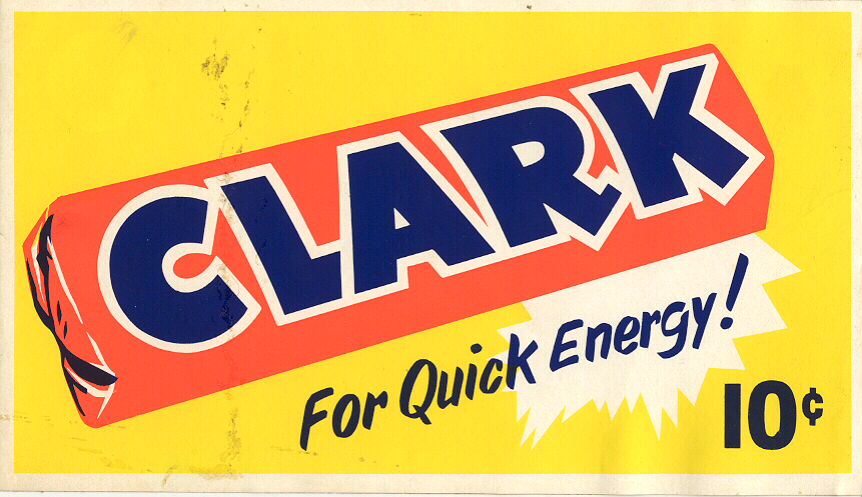
I re-entered the Halloween scene in the late 1990s, on account of my young children (Silas and Clara, who are 21 and 19 today). Walking the neighborhood, my own well spring of candy knowledge took me aback. For example, I couldn’t help but notice the surprising re-emergence of the Clark bar — that peanutty, soft-but-crunchy Butterfinger forebear.
After plucking one from a neighbor’s bowl, I stood there on the street and stared wistfully at the little red packaging. I nearly shed a tear. Not because it was so very fun sized. [There is nothing “fun” about small candy bars.] But rather because I remembered a time when Clarks were “right there,” a legitimate option in the full-sized, 10-cent category at J&A News Agents in downtown Wellesley, Mass., circa 1974.
“What’s this Clark thing?” Silas asked me, without a scintilla of guile. Poor lad. He had no idea.
Candy Nostalgia: Charleston Chew Edition
It’s this sort of benign, ignorant prompt that sends me winging back in time. Indeed, my kids’ questions serve as able catalysts. We were in Cloutier’s, a local convenience story, the other day when Silas, the more adventurous eater of the two, pointed to the Charleston Chews and expressed curiosity.
What’s this? Never had a Charleston Chew? Well, that won’t do.
No childhood is complete, after all, without a working knowledge of the Charleston Chew’s stupendous, metabolic duality. I bought all three (chocolate, strawberry and the ever-underrated Vanilla) and we shared a third of each. Then we went home, froze the remainders and, 40 minutes later (any sooner and the effect isn’t complete — the stuff you remember!), we all experienced the crackling-hard but ultimately chewy, half-eaten Charleston Chew. Their first time! And I was there to witness this tri-lateral genius.
I related this story to a group of late-30/early-40somethings at a cocktail party shortly thereafter. A woman interrupted me halfway through. “Wait,” she said urgently, “where did you find Charleston Chews?”
“They have ‘em up at Cloutier’s.”
“Get OUT! I thought they were gone forever!”
I bought three more that week and figured I’d leave them on her doorstep, but my kids and I ate them instead.
Candy-Related Recall
Thanks to me, I suppose, my children have developed a healthy appreciation, not just for candy, but for candy history. They really want to know what I enjoyed as a kid; I am duly transported and we’re all amazed at the volumes of my candy-related recall.
Bubble Yum was the source of mass hysteria among the pre-teen set upon its introduction in the mid-1970s.
Silas and Clara could not believe, for example, that Starburst haven’t been around since time immemorial. Indeed, I remember their introduction some time during the mid-1970s. Skittles came later, I tell them.
The Great Bubble Yum Run of 1974 left them equally fascinated. This vast improvement in bubble gum technology, this new state of the art, sent 9- and 10-year-old boys scrambling all over town to buy up the few available test packs. With no real knowledge of inflation, the kids go goggle-eyed at the idea that candy bars used to cost just a quarter. “That’s nothing,” I tell them. “I remember paying 7 cents for a Baby Ruth at Bernie’s, Montclair, New Jersey, as late as 1971.”
“What’s Bernie’s?”
“That was the candy story your Aunt Janet and I used to walk to when we lived in New Jersey.”
“You walked to the candy store? It was that close?”
“Well, yeah. It was on the way to school.”
“WOW!!!”
I don’t have war stories. This is all I’ve got to pass on to later generations.
An Era of Innovation: Right Now!
Another example of limited edition candy marketing, and a good one. Dark beats milk in almost every case.
Keeping it all in perspective , I tell them they’re fortunate to live in a time of unprecedented candy innovation. Here’s an era where most everything that was any good still lives — save the superb Milk Shake bar I coveted as a 6- and 7-year-old but haven’t seen since. What’s more, we live in an era when candy purveyors, in search of gimmicky limited-edition sales, apparently, have dreamed up some ne, genuinely exciting twists on old favorites. Some fall flat, of course (the craven “Inside Out” Reese’s Cup), but have you checked out the dark-chocolate Kit Kat? Stunning.
If you haven’t seen or dared try the Pina Colada Almond Joy (with white chocolate), please take my advice and get thee to a participating convenience store post haste.
The irony here is that I’ve become, in my advanced age, something of a candy snob. Most mass-produced American milk chocolate tastes waxy to me. The relative unpopularity of dark chocolate continuall disappoints me. In my view, dark is vastly superior on its own and would, if substituted for its milky cousin, improve almost any candy product you can name. Moreover, my mother passed on to me a love and appreciation for fine, pectin jelly beans. As a result I look down my nose at these newfangled “jelly bellies” with their foppish, speckled shells and their contrived flavors. Buttered popcorn indeed. What complete and utter dross!
The inimitable Chocolate Babies: One has to wonder what Project Rescue would have to say about this, erm… confection.
But my candy past, especially as it rushes back to me in middle age, is almost completely middlebrow and unashamedly so. If I ate it as a kid, I’ll eat it now, with nearly the same abandon and ardor — though I draw the line at Jujubees and Chocolate Babies, the two candies my paternal grandfather always had on hand. Jujubees, you’ll recall, are horrible things, the concoction of some perverse confectioner whose sole contribution to the genre, it would appear, was an item that never gets stale because it starts out that way. Chocolate Babies? Does anyone even remember these things beside me and my siblings? They were vaguely Tootsie Rollish in taste and texture — and shaped like small, brown, human fetuses! Possibly the most grotesque candy product this side of Crunchy Frog.
Late One Halloween Night…
With little prompting, I think you’ll find that most adults have candy histories as wide-ranging as my own. Late on Halloween night one year, Silas and I arrived at our neighbor’s place for one final stop. Field and Suze had company but they kindly invited us in, promptly served Silas a piece of apple pie (to go along with the Snickers, Milky Ways and Three Musketeers they had on hand for the occasion), and poured me a glass of wine. We sat by the fire and conversation soon turned to the candy, as we all agreed that Three Musketeers was the most overrated candy bar on the planet. So boring. Salvageable only when frozen. The new limited edition mint version is actually an improvement.
I offered that Milky Ways were only slightly more interesting, and isn’t it funny that the mere addition of peanuts can turn a worthless bar like Milky Way into the sublime tour de force that is a Snickers?
Well, Field rejected my whole premise, maintaining there were great differences between the Milky Way and Snickers. No, I countered, a Snickers is merely a Milky Way with peanuts. He couldn’t accept this, and so proposed the only reasonable course of action: a side-by-side surgical procedure and examination of the candies in question. With great solemnity he proceeded to the front door, snagged both items from the bowl, unwrapped them, sliced them open and studied the evidence. Eventually I was proved correct. Never underestimate the transformative power of a peanut.
Sky Bar, a New England Candy Co. (or NECCO) product and probably its finest. Not hard to best the execrable NECCO wafer, however.
Back in front of the fire we moved to other subjects of interest: The relatively recent introduction of the Snickers Ice Cream Bar, which reproduces the Snickers taste and integrates an ice cream element with genuine aplomb; the superb new Milky Way Dark, the answer to my prayers; and even the quirky, four-compartment Sky Bar, which has somehow survived into modern times. We agreed those Sky Bars now on shelves may well be the same ones we spurned as 10-year-olds.
“Field tells me you’re a writer,” one of his guests remarked at one point.
Click photo to hear The Feelies pay homage to Jimi Hendrix during their encore at The Sinclair in Cambridge, Mass., Oct. 14, 2017.
Nerd rockers The Feelies played The Sinclair in Cambridge over the weekend. For all the band’s laudable work churning out two solid sets, the encore left the greater impression. This is perhaps by design, from a band that does encores like no one else and whose 21st century incarnation just happens to have played out like one long, extended encore.
Formed in 1976, this Hoboken 5-piece achieved a modest commercial success and sizeable cult following comprising not insignificant numbers of Velvet Underground devotees. The 1980s would produce four superb studio albums. Eventually they’d break up (1992), re-form (2008), go out on limited tour (trademark diffidence in tow) and eventually release two new discs, including this year’s In Between.
And yet, I come before you not to reflexively extoll the virtues of The Feelies sound, which I love, but about which reasonable people can disagree. I’d rather applaud the remarkable structure of their shows. We’re all familiar with the two-sets-plus-appended-encore format of most club dates. Here The Feelies do not break any molds.
When it comes to the content of those encores, however, they deviate from the norm to stirring effect.
I’ve long maintained that any band — even one whose original music I can’t get enough of — should be obligated, by law, to play at least one cover during a live show. Covering someone else’s material exhibits range; it provides insight into a band’s outside influences, tastes and admirations. It is at once self-effacing and evidence of a certain kind of bravado.
A Window on The Feelies Soul
In this respect, The Feelies consistently hit it out of the park and they do so with an emotional intensity they don’t always apply to their originals. After playing not a single cover during the first two sets at The Sinclair, they re-emerged to produce their specialty: the rare all-cover encore, a half dozen tunes that, taken together, provide a veritable window on the band’s soul:
Astral Plane, The Modern Lovers
Paint It Black, Rolling Stones
I Can’t Stand It, Velvet Underground
Got to Get You Into My Life, The Beatles
Real Cool Time, The Stooges
Damaged by Love, Tom Petty
See No Evil, Television
Are You Experienced?, Jimi Hendrix
I watched this show with a couple certifiable Feelies Freaks who admitted afterward that both formal sets had come off as a bit labored. The band played a bunch of new material from InBetween, i.e. songs still to be polished in the live setting. While they nailed plenty of oldies from Time For a Witness, Crazy Rhythms and The Good Earth, there wasn’t exactly a surfeit of energy up there. Of course, with The Feelies, stage histrionics are not what they’re selling.
In any case, once the encore kicked off, they summoned reservoirs of new life. Even Glenn Mercer, the famously cadaverous and impassive lead singer/guitarist, perked up. Mid-Stooges, after two sets of studied catatonia, he could be seen bouncing about the stage and rubbing his guitar against the mic stand.
All-Cover Encores: Rare Stuff
I don’t know of any other bands that deliver all-cover encores, aside from those who do nothing but covers. In some small way, The Feelies are innovating here — which is ironic, for in most every other respect, they have stubbornly refused to evolve.
When Yo La Tengo debuted with Ride the Tiger in 1985, these two Jersey-derived bands could easily have been mistaken for one another. Here was a pair of similarly skilled, post-punk, Velvet-obsessed, art-house darlings. Yo La Tengo actually has a thing for covers, too. But while YLT moved on — issuing a dozen increasingly expansive, sonically adventurous albums — The Feelies never abandoned their own specific brand of jangly, guitar-driven avant-pop, proving just how much there is to mine from such a seemingly constrictive niche.
And you know what? Their encore habits further demonstrate their desire to cling just as tightly to their earliest influences. Today, of course, there are websites devoted entirely to the fan-chronicling of set lists, even those performed by obscure bands from the 1980s. The Sinclair show has not yet been logged for all time, but here we gather from www.setlist.fm a further sampling of encore tunes from The Feelies’ Detroit show at The El, in July:
Dancing Barefoot, Patti Smith
White Light, White Heat, Velvet Underground
I’m a Believer, Neil Diamond (The Monkees didn’t write this, silly)
Everyone’s Got Something but Me and My Monkey, The Beatles (or this one)
Child of the Moon, Rolling Stones
Take It As It Comes, The Doors
Seven Days, Bob Dylan
Alt Audience Engagement
I’ve seen The Feelies three times now, all post 2008, and I just love the way these guys deploy their encore/cover strategy to paint for the audience (and re-experience for themselves) a rich picture of their collective musical tastes circa 1978, when the band was just getting going, young and impressionable.
This gambit functions additionally as an ingenious audience-engagement strategy. Everyone at The Sinclair was at least as old as I am (53). Who in their 50s doesn’t want to hear one of their favorite bands cover Television, or Patti Smith? And I find this sorta touching: The Feelies rarely leave out the Beatles and Stones — because, honestly, how could anyone, even the most overly curated latent punk aesthete, come of age in the early 1970s and completely resist their many, many charms? After all, when The Feelies were coming up, 1969 just wasn’t that long ago.
What sort of new music are The Feelies into these days? The Lord only knows. If the contents of their encores are any guide, the answer is “not much”. They knew Tom Petty has recently passed away —evidence of a basic musical awareness. Otherwise, the course of modern rock these last 25 years would appear to have made little to no impression on their song choices.
They’re a band whose predilections and influences, like their own sound (even today), remain frozen in amber. It’s hard not to love them for it.
NEW GLOUCESTER, Maine (Sept. 27, 2017) — Can we please stop talking about Bernie Sanders’ policy suggestions as if he were by some kind of unhinged fantasist? Sanders recently introduced to the Senate a bill that would expand Medicare to include citizens under 65 years of age — and you’d have thought he proposed the changing of water into wine. Hey, obstinate right-wingers: What Bernie said, what he has proposed, is more or less the working model for the existing healthcare systems now operating in every industrialized nation on earth — that is, every one but the United States. And if believe we have innovated our way out of that obligation, or will, YOU are thje fantasist.
What’s more, as the facts relay — in spite of reflexive carping from actual fantasists, those of the Randian variety — nearly every one of those socialized systems delivers health care for less cost per citizen than the system we Americans currently deploy (the ACA) and the largely private one it has partially replaced.
Sanders’ call for “free public college tuition for all” during the 2016 campaign also elicited no small amount of tittering from observers on both the right and left. Hey, morons: As recently as the late 1970s, the U.S. itself offered public higher education for close to nothing.
What Bernie Said: Free PUBLIC college tuition
Let’s first examine what Bernie actually said: free PUBLIC college tuition. No one, including Sanders, is suggesting we subsidize anyone’s matriculation at private institutions. Second, we already offer free primary and secondary education as a matter of course; in terms of prepping workers and citizens for lifelong utility (to the culture, to the economy) why should college be any different?
Last, check the stats: The average annual in-state public university room, board and tuition in 1977 — $2,067. That’s not “free”, but even when inflation is accounted for, that is highly affordable. The average price of a new car in 1977 was $5,813. More to the point, that was a four-year education debt load of some $8,200, a sum any college-educated student could expect to chip away at quite substantially — over their summers! It’s certainly nothing like the crushing debt load graduates encounter today.
When it comes to higher education, it’s fair to ask, “Why the discrepancy?” Answer: Because we subsidized (read: socialized the cost of) public colleges to a far greater extent, not just in the 1970s but throughout the ‘50s and ‘60s. This was not some government decision, mind you; we THE PEOPLE decided it was worthwhile to make higher education attainable and affordable.
Starting with the Reagan administration, fewer and fewer people saw the value in socializing the cost of higher education. Bit by bit over the ensuing four decades, that socialization was dismantled and/or reduced, to the point where today the average annual room, board and tuition cost for the public, in-state college student is $20,090.
Bernie’s Not Some Oracle
I’ll be honest: I have never felt the Bern to any great extent. At 76, he remains too old to have been a viable two-term president. He fixates on certain issues to the exclusion of others — which is what senators do, a role that suits him. I’m not sure he plays particularly well with others, a presidential trait we can see the value of today.
He looks and sounds way too much like Larry David.
What’s more, his carping at the Democratic National Committee seemed to me churlish and misplaced. Of course the DNC favored Hilary Clinton; she maintains membership in the Democratic Party, after all, and Bernie does not. Lest we forget, political parties in this country are private organizations. I don’t see why the DNC is obliged allow anyone who isn’t registered with the party to seek that party’s nomination. If an independent candidate like Bernie is allowed to compete for delegates, he should not be surprised when establishment Dems bend the rules to favor one of their own.
Demystifying Socialist Principles
But I’ll say this: God bless the man. For the entirety of my life — for the entire post-WWII era — the mere mention of anything nominally socialist here in America produced howls of derision and irrational fear-mongering (thanks, Russia). The mere existence of Bernie and his sensible policy proposals have gone a long way toward demystifying the term and curing our nation of this impractical, hypocritical phobia.
Hysteria helps no one, but let’s be honest with ourselves. We already socialize all sorts of costs and risks in this country: schools, highway construction/upkeep, libraries, congressional and veterans’ health care, Social Security, all branches of the military, police and fire departments, the court system, the Centers for Disease Control, public transportation and yes, even PBS. Socialized medicine and low-cost, subsidized public higher education are not fantasies. Variations on these specific themes are functioning to great effect in the real world, all around the world, even here in America once upon a time.
Which is more than we can say for trickle-down economics and its fanciful enabler, The Laffer Curve.
Ed. — This story first appeared in March/April 2003 issue Golf Journal magazine.
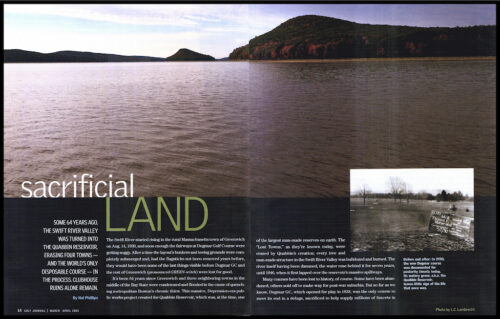
By HAL PHILLIPS The Swift River started rising in the rural Massachusetts town of Greenwich on Aug. 14, 1939. Soon enough the fairways at Dugmar Golf Club had become unseasonably soggy. After a time the bunkers and teeing grounds were completely submerged. Had the pins not been removed years before, their flags would have been some of the last things visible before this 9-hole track and the rest of Greenwich were lost for good.
It’s been 68 years since Greenwich and three neighboring bergs were systematically condemned and flooded, all in the name of Metropolitan Boston’s chronic thirst. This massive, Depression-Era public works project, on whose ass the loss of Dugmar GC was but a pimple, created the Quabbin Reservoir, then the largest man-made, fresh-water reserve on earth.
The Lost Towns, as they’re known today, were literally erased by the Quabbin’s introduction; every tree, every man-made structure in the Swift River Valley was burned or bulldozed to make way for it. The river itself having been dammed — in Belchertown, to the south — some 412 billion gallons of water gradually rose behind the Winsor Dam and Goodnough Dike. Not until 1946 did they first lap over the reservoir’s massive spillways.
By then Dugmar GC had been largely forgotten — but not erased, for memories are made of stronger stuff.
Dugmar Golf Club: The First Disposable Course
Other layouts have been lost to history, of course. Some have simply been abandoned; others were sold off to make way for post-war suburbia. But so far as we know, Dugmar GC — opened for play in 1928, hard by Curtis Hill — was the only golf course to meet its end in a purposeful deluge, sacrificed along with four 200-year-old communities to supply tens of millions of faucets in larger communities some 60 miles east.
Hundreds of golf clubs were built, as Dugmar had been, during the heroic age of Jones and Ruth, when the moneyed classes sought to bring the same sort of bravado to their own lives (not to mention a place to drink hooch in a country gone dry). More than a few of these establishments “went under” during the ensuing Depression, but none quite so purposely or literally as Dugmar Golf Club. You see, Dugmar’s developers KNEW the club’s fate before the course was ever built — before the bentgrass was imported from southern Germany, before the elegant stone patio was laid beside the farmhouse-turned-clubhouse, before the first crate of Canadian Club was hidden from view.
Dugmars creation was, in short, a set up: a crafty land deal with golf at its core; a trifle built to amuse its backers, for a time, before enriching them at the public’s expense. “Those guys knew what they were doing; they made out,” recalls a chuckling, 85-year-old Stanley Mega, who caddied at Dugmar GC and still lives close by Quabbin’s shores, in Bondsville. “Those guys knew the reservoir was going in and they made a killing.”
In essence, Dugmar GC was conceived and ultimately proved to be the world’s first and only disposable golf course.
This aerial of Dugmar GC was taken in 1931
Canny Chapman Valve Co. Executives
“Those guys,” the men behind Dugmar Golf Club, were a pair of canny executives from the Chapman Valve Co. in Springfield, then and still today the hub of Western Massachusetts. In 1924, Chapman President Thomas F. Mahar and Treasurer John J. Duggan together purchased a pleasant chunk of property some 30 miles northeast of their corporate offices — in the tiny hamlet of Greenwich (pronounced green-witch), conveniently located on the Athol branch of the Boston-Albany Railroad.
The towns of Greenwich, Dana, Enfield and Prescott were poor farming communities and had been for centuries, but their lakes and myriad points of river access were popular with holiday-makers from the big city. It was common for Springfielders to own summer camps and cottages up there.
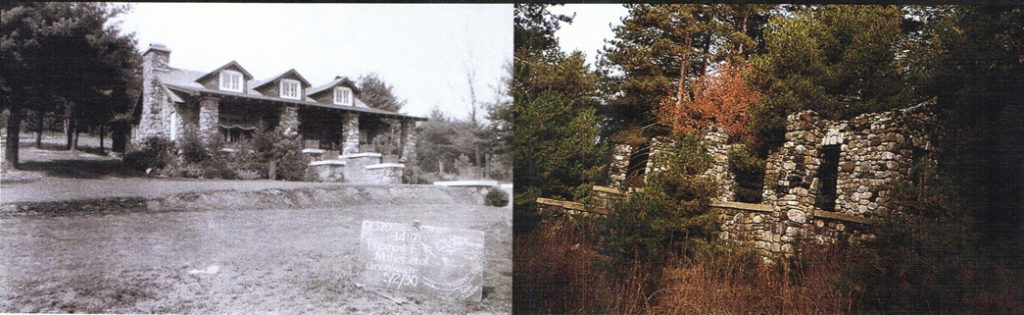
Duggan and Mahar had far grander plans. After paying $6,850 for 147 acres of abandoned agricultural land, they immediately set to work refurbishing the property’s existing farmhouse. In 1925 its value was assessed at $2,000; two years later this homestead was valued at $7,000. Next, Duggan and Mahar built a striking fieldstone lodge on the south-facing slope of Curtis Hill. Completed in 1926, it was assessed a year later at $12,000.
Once an additional 15 acres had been purchased, they commissioned Orrin Smith to design and build Dugmar’s golf course. Opened in 1928, the nine-hole layout occupied ground southeast of Curtis Hill, in full and magnificent view of the lodge with its distinctive stone-pillared porch.
The layout at Dugmar — a moniker created by combining the surnames Duggan and Mahar — was not some bit of amateur course design. Smith had been a respected and quite prolific New England architect, one who had apprenticed with Willie Park Jr. and Donald Ross before starting his own Hartford, Conn.-based practice in 1925. Dugmar GC measured a stout 3,160 yards from the back tees, boasted state-of-the-art putting surfaces of South German bentgrass, and featured 8,000 feet of underground irrigation pipe, something only the better courses could afford in those days.
An unforgettable place
“It was an unbelievably beautiful place right there in the valley. I’ll never forget it,” says Mega. “It was a very nice golf course, but I was too young to play back then. We caddied. I used to travel up there with Dave Belisle and Jimmy Fitzgerald. We spent a lot of time up there. If I made 35 cents a round, well, that was great!”
Mega and his older brother Alec would often rise in Bondsville, their tiny home town just south and west of the Swift River Valley, and take the train up to Greenwich. Or they’d hitch a ride via Belchertown on Route 21, the only paved road that ran north/south through the watershed. “It was quite a place up there. A few of the holes I forget, but I remember everything else. Between the 1st and 2nd there was a big stand of pine, sort of squared off. There were more woodlands guarding the 3rd, on the right. That’s where I found all my golf balls, you know. Now that was a nice hole, a great dogleg par-5.
“The greens were what always impressed me,” Mega continues, gathering steam. “Tiny things. You had to be accurate! And boy were they in great shape. Beautiful. Imported! People were always bragging about how they were imported. In fact, before they flooded the place, someone came in, picked up those greens and took them away! … I just caddied up there but my brother, he was a good golfer. He played Dugmar quite a bit. So did another good player, Whitey Wisnewski, who was almost like a pro. He used to play with [Henry] Bontempo here in Springfield. He played the best around. Good golfers played up at Dugmar. I still remember.”
A Raucous Close to Phase I
The 1928 opening of Dugmar’s 9-hole course fulfilled the “Phase I” vision of its founders. This was now a fully fledged country club, complete with a golf course ana clubhouse. It featured several guest rooms and a lively social calendar — because, lest we forget, this was the decade of Prohibition.
“There were raucous parties up there; they certainly took advantage of the remoteness of the place,” explains J.R. Greene, an historian who’s been researching Quabbin and the Lost Towns since 1975.
“The Greenwich Village train stop was very close to the golf course, a short walk. So it was very convenient for these ‘bit city outlanders’ to travel there from Springfield. And I have it on very good authority that Dugmar members brought plenty of liquor up there — and women who weren’t necessarily their wives. This was a heavily Yankee, Protestant region; there were no bars or taverns there, even before Prohibition. So that sort of behavior was duly noted.”
“It was a wild place,” Mega concurs. “To be served drinks, well, you had to know the right people. There was a lot of drinking. Those guys were really something; they knew what they were doing.”
The fieldstone lodge serving Dugmar used to sit on Curtis Hill. Today, it’s Curtis Island.
Phase II? Depends on Whom You Ask
Duggan and Mahar’s Phase II vision for Dugmar GC remains, to this day, the subject of some speculation. The idea of creating Quabbin Reservoir, you see, was put forward as early as 1919. The Legislature formally proposed the measure three years later. In 1927, the state legally impounded the mighty Swift River, thereby clearly declaring its intention to take the towns of Dana, Prescott, Enfield and Greenwich by eminent domain. That act that would eventually displace some 2,500 residents.
In other words, by 1929, when Dugmar Golf Club’s curious, boisterous run was just beginning, many residents of The Lost Towns had already sold their condemned properties to the state and moved their lives elsewhere. Others had sold out and rented their own homes, buying time to determine where and how exactly their lives might continue.
“This area was dying unless you raised livestock or fowl. For the younger generation it was an obvious opportunity to get out and start fresh,” says Greene, whose history, The Creation of Quabbin Reservoir, was reissued by Performance Press in 2001. “But for people in their 40s and up, their lives were torn apart – during the Depression no less! This was a tragedy. And of course, these folks didn’t want some peckerwood from the state telling them to move out. You have to remember, this was a very wrenching thing. There was no job-relocation assistance. Nothing like that. They had to find a new house, a new job, a new life — in the heart of the Depression.”
So why build a remote country club here, on land legally destined to sit under 40 feet of drinking water?
“It was an investment,” Greene says flatly, fighting a wry smile. “Just a part of the game Duggan and Mahar played. I believe they knew the reservoir was going to happen and this golf project was pure speculation on their part. I’ve had older residents say as much to me. It’s received wisdom, if you will.”
Claiming Qualified Ignorance
Of course, Duggan and Mahar claimed no such wisdom, not publicly anyway. They didn’t claim ignorance of the proposed reservoir project; when pressed in court, they claimed to have considered the Quabbin in the same way many Commonwealth residents still view certain state-funded, public works initiatives: I’ll believe it when I see it.
In any case, by the time the Commonwealth of Massachusetts had formally taken the Dugmar property — on Sept., 15, 1933, by eminent domain — Duggan and Mahar had naively or shrewdly (take your pick) drawn up an 800-lot subdivision plan for their property. A “gentlemen’s estate,” they called it — with “beach access.” They had secured access to Curtis Pond and harbored visions, on paper at least, of selling these lake-front lots to Springfield swells in search of a holiday home.
As the creation of Quabbin Reservoir was going to happen after all, Duggan and Mahar sought “fair” compensation from the Commonwealth of Massachusetts — to the tune of $436,500, or some $11.2 million in 2026 dollars.
For the record, the town of Greenwich in its entirety had last been assessed, in 1932, at $640,000.
The state, which valued the golf property at no more than $56,000 — basically, a sum of the club’s biggest assets, plus maintenance equipment and whatnot — immediately balked at Duggan and Mahar’s asking price. The matter was referred to a Board of Referees, a body specially appointed by Quabbin’s administrative entity, the Metropolitan District Water Commission, to arbitrate disputes such as this. At first the Referees awarded Duggan and Mahar a split-the-difference sum of $221,000, pending approval by the state Supreme Court. The court would offer no such approval; it remanded the matter to the Referees.
Determining fair market value for Dugmar Golf Club — at the time of its “taking” in 1933 — would prove an arduous task. The legal process took nearly four years and produced some gloriously arcane golf course-related testimony. An endless parade of real estate experts took the stand, but so did an assembly of New England golf luminaries, all of whom offered their varying opinions on the quality (read: ultimate monetary value) of Dugmar.
Golfing Luminaries Take the Stand
Appearing for the state, among others, were Walter Hatch, longtime construction superintendent in the employ of Donald Ross. Fred Wright, a 1923 Walker Cupper and 7-time Massachusetts Amateur champion, took the stand. So did Dr. Lawrence S. Dickinson, distinguished agronomist and longtime member of the faculty at the University of Massachusetts in nearby Amherst. Produced by the Commonwealth to argue for Dugmar’s lower valuation, Dickinson was particularly critical of the property’s soil. As evidence, he toted several samples to the Springfield District Courthouse in masonry jars.
Appearing for Duggan and Mahar were Orrin Smith and fellow course architect Wayne Stiles, both of whom offered testimony well ahead of their times. For instance, while the nine holes themselves were built for $18,000, the architects testified that Dugmar’s golf course actually increased the value of the property around it, including these would-be housing units. Similar arguments would be trotted out for several decades to come.
Assistant Attorney General John S. Derham, a bombastic figure of the non-golfing variety, wasn’t buying any of this conjecture. At one stage, he pointedly asked Stiles whether it was “good architecture” to place larger greens on holes requiring a long approach and smaller greens where only a short carry is necessary. “Any fool knows that,” snapped Mr. Stiles — or so reported the Springfield Evening Republican, which doggedly covered the hearings from start to finish.
Long story short, the state’s witnesses agreed that Dugmar was worth anywhere between $52,000 and $56,000. Duggan and Mahar’s cadre of specialists all agreed the property was worth between $340,000 and $360,000, mainly on account of all the house lots they might have sold.
In the end, on June 11, 1937, the Board of Referees ruled that Duggan and Mahar be awarded $150,000 for their condemned property, plus 4 percent interest accrued from the land-taking in September 1933. That brought the total payout, including legal and court fees, to $179,042.
Not bad return for a disposable item.
Ultimately, Duggan and Mahar received more than $1,100 per acre for Dugmar GC. On average, Greene asserts, other landowners in the Swift River Valley towns of Dana, Prescott, Enfield and Greenwich were compensated at approximately $100 per acre. Contemporary press accounts in the Athol Transcript described Duggan and Mahar as “aggressive, up-to-date businessmen”, and so they were. It took a while, but eventually they beat the state at its own game — in its own eminent backyard.
One Step Ahead of the Flood
Once the June 1937 judgment was handed down, Dugmar GC beat a hasty retreat into the deeper recesses of public consciousness. Our Chapman Valve executives had up and left Greenwich in 1933, content to pursue their Dugmar concerns in court. The putting greens, if Stanley Mega is to be believed, were uprooted and sold, perhaps to some long-admiring greenkeeper at a nearby course. “When did the course close for good?” Greene asks rhetorically. “We have reports of people playing there well after it had been abandoned, in 1933. But other than that, we don’t really know.”
One thing’s for sure: the water started rising on Aug. 14, 1939. By that time Dugmar GC had been thoroughly disposed of.
Mahar didn’t long enjoy his share of the $179,042. He died of a massive cerebral hemorrhage just six weeks after the judgment came down. He was 52 years old. Duggan lived a while longer. He became a member of Longmeadow and Springfield country clubs. Duggan would succeed Mahar as president of Chapman Valve and make a name for himself as a philanthropist and Democratic Party bigwig, though he never stood for office. He too suffered a debilitating cerebral hemorrhage, in 1953, and died a year later at the age of 65.
The Quabbin Reservoir project was originally budgeted at $65 million. Amazing though it may seem to educated observers of Massachusetts’ infamous public works scene, the job was completed under budget. A mere $54 million was spent, thanks to depressed labor costs and federal grants.
“So, paying Duggan and Mahar was a drop in the bucket,” Greene notes. “Even so, that was taxpayer money. Their attitude was, ‘We’ll do this, have a good time and if things work out, we’ll make some money on it.’ ”
And so they did. Duggan and Mahar even managed to fashion a lasting, relatively dry testament to themselves and their anomalous, dually eponymous endeavor: The fieldstone lodge on Curtis Hill still stands — on the south-facing shore of what became Curtis Island. It remains the only man-made structure, the only above-water evidence of The Lost Towns in the entire 89-square-mile Quabbin reserve.
“I find that extremely ironic,” says Greene, “because here’s something that was built by outsiders — and it was one of the very last things ever built in the valley. It’s really quite a monument.”
To what exactly?
“To the cupidity of Duggan and Mahar.”
Chasing Pre-Pollution Fauna
Biologist and scuba enthusiast Dr. Ed Klekowski is way into pre-pollution fauna. This explains why, for years, he had tried to get a close, forensic look at the Quabbin’s floor — to study the organic legacies of lakes and streams long ago overwhelmed by 412 billion gallons of river water. Several years ago, he succeeded. Klekowski led a dive of the area during the 2001 filming of “Under Quabbin”, a Massachusetts public television documentary which chronicled the lives of humans (and pre-pollution fauna) in the Lost Towns.
Klekowski, his cameramen, and their guides in the Mass. State Police Underwater Recovery Team are the last people to see Dugmar up close.
“Diving the golf course was much more interesting to think about than actually do,” reports Klekowski, a professor of biology at UMass Amherst. “Flooded fairways are probably the planet’s most monotonous dive sites: endless vistas of algae-covered flatness! We spent most of our time searching for something, anything, to film. Golf will never be an underwater sport.”
Klekowski’s team did find several of Dugmar’s irrigation pipes protruding from what is now the reservoir floor. They found the stone patio Duggan and Mahar had built beside the old farmhouse where, six decades earlier, martinis had been served (despite federal law) and beknickered sportsmen (despite their marital status) had flirted with flappers.
“Our goal,” Klekowski says, “was to find and video the remains of the buildings associated with the course. When we finally found the old foundations, you couldn’t but feel a bit nostalgic. It was actually sort of creepy being down there, where there had been so much life at one time.”
Lunch on Curtis Island
It’s illegal to set foot on Curtis Island today, but Bradley Gage has done it. Twenty years ago, as a member of the state Fisheries and Wildlife Board, he and his fellow board members lunched there. The day trip was an odd homecoming for Gage who was born in nearby Enfield — some 40 feet below the reservoir’s surface and two miles north. He spent the first 8 years of his life there before his father, Roy, moved the family to Amherst in 1932.
“My dad played Dugmar,” Gage says. “He talked about it with pride and interest, that he and his friends had played it.” Gage had been too young to have experienced the course himself, to remember much of anything about the place. Fact is, the number of folks with first-hand memories of Dugmar is small and getting smaller.
Gage grew up to become a golfer and the state official wishes he had spoken more of Dugmar with his dad, while they had the chance. This memory is a false one. Still, it’s one he might have cultivated further — because some memories are worth having, even if they’re not your own.
They are complicated things, these memories. Stanley Mega retains many of his own, but they can prove a burden. It had been 30 years since Mega had spoken or thought of Dugmar Golf Club, he says, and one could see the act — exhilarating for a time — eventually led him back to the realities of an 85-year-old life. Mega doesn’t play much golf anymore. After 20 minutes of animated recollections, his voice trailed off in that way an older man’s sometimes does. His brother is gone now. So are Dave Belisle and Jimmy Fitzgerald. Whitey Wisniewski, too.
Dugmar GC may as well be gone. It exists only in the suspended, dreamy netherworld of algae, pre-pollution fauna and would-be tap water — utterly hidden from all those lacking scuba gear and a state police escort. The train doesn’t stop in Bondsville or Greenwich any longer. Route 21 survives, but only in part. The road terminates outside Belchertown, its asphalt ribbon slowly descending toward, then disappearing beneath the Quabbin with an eerie, incongruous finality.
The stone patio beside the converted farmhouse is the only underwater evidence that Dugmar GC was ever there…
NEW GLOUCESTER, Maine (Sept. 11, 2017) — I’ve got work to do, but here I am getting misty writing about Gene Michael — a New York Yankee no less! I support the Red Sox but here’s the thing: His passing last week jolted me back to a time when my baseball allegiances were new, and rather muddled, thanks to geography and the insistent, dulcet tones of Lindsay Nelson, Ralph Kiner and Bob Murphy.
I was born in Stoughton, Massachusetts in 1964. Soon enough my father’s corporate work life moved our family to New Jersey, then to California, and then, in 1969, back to the northern Jersey suburb of Upper Montclair. It was there, in the mammoth penumbra cast by the Gotham sporting scene, that I first took a shine to baseball. Yeah, I played it in the streets on Waterbury Road, and I collected baseball cards, but this is when I first started watching games en masse. All through the early 1970s I absorbed this NYC baseball vibe via WPIX Channel 11 (Yankees) and WOR Channel 9, where Mets broadcasters Nelson, Kiner and Murphy plied their trade.
It was an intoxicating time to follow sports in New York. The Yankees were shit, but the Mets were a legit phenomonon. Joe Willie Namath and the Jets were literal world-beaters, and the Knicks had begun their most dominant era in team history.
My family would move to suburban Boston in 1973, and there my dad would chuck his corporate odyssey for some stability in a town my parents were loath to leave. That move meant I could, from that point forward, seamlessly pass myself off as a legitimately rabid Sox, Celtics, Bruin and Patriots fan with impeccable historic and geographic credentials.
But that would be a white lie.
Gene Michael, then Bud Harrelson
The first sports teams I truly learned and observed closely were the Yankees and Mets of the early 1970s, and that’s why I was moved by thoughts of Gene Michael, the Yanks’ light-hitting glove man at shortstop. Not every game was televised back then but many were and I watched the man called Stick play dozens and dozens of them beside Horace Clarke, behind pitchers Doc Medich, Fritz Peterson and Steve Kline, taking cut-offs from Bobby Murcer and Roy White. New York was a terrible team at this time. It confused my 7-year-old brain that the Yankees had, apparently, been so dominant once — but had nevertheless come to suck so bad.
Convenient to my eventual Sox fandom, I much preferred Bud Harrelson’s Mets to Michael’s Yankees. I don’t remember the Miracle Mets of 1969. But I did enjoy those NYM teams of the early 1970s, and any mention of Gene Michael, or Dave Schneck, or Thurman Munson or Tommy Agee summons the memory of just how hard and quickly a 7-year-old boy can fall for the game.
I watched those shitty Yankee teams because they were the only thing on.
But I developed a real attachment to those Amazin’ Mets.
Let me say right here that no Google has been deployed in the writing of this blog item. As such, here’s the whole Met team from 1973, the guys who nipped St. Louis and a great Pirates team (World Series champs in ‘71) to win the old Eastern Division (with just 82 wins!) before handling the 99-win Big Red Machine to capture the NL pennant: Jerry Grote and Duffy Dyer at catcher; the inimitable and original Met Ed Kranepool at first; Felix Milan and Ken Boswell platooning at second; feisty Bud Harrelson at short; Wayne Garrett at third; John Milner, Don Hanh and my favorite Met of all, Cleon Jones, patrolling the Shea Stadium outfield.
Pitching Made the Mets Magnificent
Everywhere but the mound, this was a pretty darned different team from the shock World Series champions of ’69. Only Harrelson, Kranepool and maybe Grote held over from Miracle Mets. But the pitching was a constant. It was Seaver, Matlack and Koosman who made the Mets of this entire era so very formidable. Just to shore things up, a young Tug McGraw closed. And who did the Mets pick up late in 1973 to give them a bit o’ pop? Only a 40-year-old Willie Mays and Le Grande Orange, Rusty Staub.
Still, come October, those Mets were not expected to trouble the Oakland A’s, a dynasty at its peak. But what a series I watched from my new home in Boston during the fall of 1973, surrounded by people who could not have cared less. The Mets went down valiantly, in 7 games, after having led the series 3-2. Lefthander Kenny Holtzman didn’t just win the finale; he got the big hit off opposing starter Jon Matlack to turn the tide. Bert Campaneris hit a home run to seal it. I was mighty disappointed.
The ’73 Series would prove the end of serious contention for this generation of Mets; the club would fall into disarray before regrouping in time to put a stake through my heart in October 1986. Gene Michael, for whom Baltimore’s Mark Belanger would be a pretty good comp, would retire in 1975 — right before the Yankees got good again. He managed the Cubs and eventually served in the thankless role of Yankees GM under George Steinbrenner. Stick would hold his nose long enough to build the great Yankee teams of the late 1990s.
And now he is gone, another withered petal on my fading flower of youth…
The stunning clubhouse serving Siam CC’s Plantation Course.
PATTAYA, Thailand (Sept. 5, 2017) — It’s 11 p.m. local time and my 8-man golfing gaggle is strolling down the main drag here. Pattaya’s “Walking Street” is the epicenter what most consider the capital of Thai Golf. The days and nights we’ve spent here, south of Bangkok, depart so radically from typical North American buddy trips, they make one reconsider the entire exercise.
Front and center is the golf component, of course. Normally this is the primary factor in determining quality or desirability. But there’s no denying that packs of (primarily) male golfers generally prize golfing locales for their nightlife, too. Any group of 8-12 golfing friends will include a few lads determined to rip it up each night, their wild hair perhaps offset by a few compatriots who’d just as soon play poker or watch sports in the condo. And so there is equilibrium.
Still, many insist the destination also offer some degree of lascivious attraction — if only to get the hard-partying faction on the plane. Think Myrtle Beach and its strip of nightclubs and bars. Think Vegas and its many diversions.
I consider the different buddy trips I’ve experienced, in these very locales, and I laugh to myself as another sultry Thai evening obliges me to wipe the beads from my perspiring brow. The Walking Street in Pattaya, ground zero for the city’s famously over-the-top nightlife, frankly makes an evening in Vegas feel like a evening out in Amish Country.
Black Mountain Golf Club in Hua Hin.
Blocked to vehicular traffic — save a series of small open-air trucks that continuously circle the downtown area, picking up patrons and dropping them off, for a dollar — Pattaya’s Walking Street stretches several kilometers along the Gulf of Siam beachfront. Either side of this thoroughfare is fairly well riddled with some of the craziest nightclub scenes you can possibly imagine. If you’ve never been to Thailand, you will have to imagine it — because you’ve surely never seen anything like it.
Thai Golf: All comparisons tend to pale
This is the primary take-away from my 10 days golfing across Thailand: There is such a breadth of experiences to be had that, after a point, all comparisons tend to pale.
For starters, it’s a big country — from Chiang Mai in the north to Phuket in the south it’s some 750 miles, or about the distance from Boston to Myrtle Beach. In other words, it’s too big to be climatically or culturally monolithic. This explains the striking contrast between the cool highlands of mountainous Chiang Rai, hard by the Burmese and Lao borders, and the utterly tropical environs of Koh Samui, an island off the east coast of Thailand’s tendril-like southern reach, on the Gulf of Siam.
Chiang Mai feels loose and slightly bohemian, like an overgrown backpacker haven, while Bangkok is the picture of a glittering, modern, bustling, gargantuan metropolis. Hua Hin is a quiet, gracious, retiring, seaside retreat while Pattaya… isn’t.
While the airport in Phuket accepts international arrivals from hubs like Singapore, most international visitors disembark via Bangkok, if only to go somewhere else. And so we did, immediately connecting to Chiang Mai where our early November arrival coincided with Loy Krathong, a festival marking the full moon.
The Hilton Millenium in Bangkok.
It’s different up North
Krathongs are little cup-shaped flowers, each with a candle and incense stick tucked inside; Loy Krathong means “floating Krathongs.” Our first night in town we ate dinner by the Ping River and watched thousands of these illuminated devotionals drift past. This marvelous scene and a stupendously sweet-and-spicy Burmese-style curry made for a keen introduction to the north country.
Next day we were off to Chiang Mai Highlands, home to 18 holes designed by the America duo of Lee Schmidt and Brian Curley. The superb terrain here made their job easy, but the finer touches impress: Profuse bunkering, pleasing to the eye, frames the inside of most every dogleg. The verdant peaks in the distance, the immaculate conditioning, the dryer heat all give the impression of playing somewhere east of San Diego.
The par-5 6th at Chiang Mai Highlands.
The north is a different brand of Thailand, slower and less insistent. After a cabana attendant offered me an iced towel — these weigh stations/snack pagodas come every 4 holes or so — she clasped her palms together, as in prayer, and, smiling contentedly, nodded over them. Just 36 hours in Thailand and this gesture was already reflexive in me, so I returned the gesture — a spiritual though not religious recognition of the divinity the Thais believe resides in each of us.
At the Robert Trent Jones II-designed Santiburi Chiang Rai Country Club — an hour north, where Burma, Laos and Thailand meet to form the famed Golden Triangle — the landscape proves lush, sweeping and equally divine. The holes feel as if they’ve been cut from a jungle, and so they have. Pleasing trade winds cool things down a bit further; it looks, feels and plays like a top-flight Hawaiian track — at one-third the price.
Feels like the Big Island
Back down south in Pattaya — some 90 minutes by car from Suvarnabhumi, Bangkok’s gleeming, modernist airport — we presage our adventure on the Walking Street with a pair of rounds at 36-hole Siam Country Club, host to the Honda PTT LPGA Thailand. The Plantation Course reminded me again of Hawaii — the Big Island this time, with its huge scale and colorful purple-hued undergrowth framing the fairways — while the Old Course feels like a primo private club somewhere in the Carolinas.
That night we took in several Singha and another killer curry (green this time) before swallowing hard and heading for the bright lights.
Walking Street nightclubs run the gamut in theme and tone, from the brazenly sexual to the coyly geisha, from darkly gothic to high camp. On this night we spent 20 minutes — or the time it took us to dispatch an ice-cold Singha — watching a group of 15 topless women dance amongst themselves (with various levels of enthusiasm) on a stage flanked on three sides by stadium-style seating. It was dimly lit and the décor entirely black and red. Sorta grim.
From there we braved a small side street and happened upon a totally different sort of place: cheerful lighting, an outer space theme. Same sort of central, raised dance floor but the mood was leavened 10-fold by the presence of soap suds, trapeze bars and flexible polyurethane tubes, which the dancers playfully wielded against each other’s backsides, and those of patrons, witting or otherwise as they walked near the stage. It was as if “Josie and the Pussycats in Outer Space” had gone live action and gotten really naughty.
I don’t want to make myself out as some naïf. A great many of the patrons were on hand, as I was, for the mere spectacle. But others were clearly on the prowl. Each dancer, after all, wore a number. A mere wave of the hand would summon her to one’s table. After obliging to buy her a few drinks (thereby generating revenue for the club), one is free — or, rather, one is free to pay $50-100 — to bring her back to a motel for the evening.
The comparisons are inescapable
I was reminded of the North American strip joints that we’ve all been exposed to, at one time or another, as adjuncts to golf trips or bachelor parties or whatnot. It’s made quite clear to any patron of these U.S. establishments that nothing, and I mean nothing, is going to happen between you and the hired help. Ever. Chris Rock wrote an entire monologue on the subject that sums it up quite well: “There is no sex in the champagne room.” It’s always confused me, the allure of these places. I mean, one can stuff all the money one likes in a G-string, but she is not going home with you — and that is ironclad.
In Thailand, that stricture is removed. Utterly. It’s a bit dizzying to contemplate frankly, a bit unreal. We could debate the moral merits of this system — clear objectification vs. straightforward commerce. What strikes me is the clarity, legality and transparency of the exercise when set against the equivalent here in the states.
Whether too smart or prudish, no one in our group took the plunge in Pattaya, or anywhere else in Thailand for that matter (there are Walking Street equivalents in most every city of any size). We stumble out of the space bar back onto the teeming streets which, when I look closely, are peopled by men, women and children of two dozen different nationalities. Everyone looks to be on holiday, heads on a swivel, eyes wide. It’s more reminiscent of a circus midway than a den of iniquity. It’s an assault on your senses, each and every one. To that end, I buy several divine, street-vended skewers of fried squid and satay chicken before heading back to the hotel with my compatriots. On the spur of the moment we decide to get a massage at one of the dozens of parlors around the corner from our hotel, the plush Woodland Suites.
Again, there are plenty of establishments in Pattaya where the word “massage” is just a device, a front — but far more deliver nothing more than the finest $8 massage you’ve ever had. An oil massage is what you’ve probably had elsewhere; a Thai massage involves no oil and can be quite a workout. After 72 holes in four days, there’s a whole lot to be said for either approach.
A Different sort of Golf Round
Sunrise at Muang Kaew GC, in the heart of otherwise urban Bangkok.
You’ll never rake a bunker in Thailand. In the Kingdom, that’s a caddie’s job and it’s but one benefit of the country’s utter reliance on 80- to 115-pound loopers. Yes, they’re all female and they’re a constant at every course in Thailand. Take a cart? They’ll drive it. Feel like driving? They’ll ride on the back. Walking? They’ll pull the trolley. All of this is done with unfailing courtesy and a solid understanding of the course. Club selection? I’d handle that yourself — but that’s my feeling toward caddies most anywhere.
In a place like Thailand, with its walking streets and massage parlors, the whole caddie phenomenon tends to elicit raised eyebrows from the uninitiated. But trust me: There is absolutely nothing sexual about the Thai caddie experience. For starters, despite the heat, they are completely swathed in clothing from head to toe, complete with long sleeves and gloves. Such is the standard of female beauty in Thailand: Tans are not fashionable for women, at all, and caddies go to great lengths to avoid them.
Second, they are all business. In most cases they are far too busy fixing ball marks, putting sand in divots and raking bunkers to flirt with you.
Some of the best caddies we experienced were served up back in Bangkok at the sporty Muang Kaew Golf Club, where conditions included near-100 degree temperatures and not a breath of wind. Our caddies never wavered — until we did. My two playing partners and I ditched the back nine, paid full caddie fees, and made three friends for life. Then we went for a massage in the clubhouse, a typically sterling facility in a country where they hew to a very high standard.
Asian clubhouses in general make their American counterparts look downright dowdy. Because Thai clubhouses cater to so many Asian golfing tourists, they are borderline palatial — how else to impress the Japanese or Korean who is used to merely opulent clubhouses back home? Massage rooms are standard fare in Thai clubhouses. Locker rooms are cavernous, as each golfer is assigned a locker at no charge, as a matter of course. After the round one is expected to shower, don a change of clothes, and kick back for several hours in the bar or restaurant. It’s a damned fine ethic, if you ask me.
The clubhouse at Thai Country Club has for several years been voted the best in Asia, and it’s not difficult to see why. It has all the bells and whistles, plus a superb restaurant (yellow curry this time, with chicken-lime soup) and an epic hot tub big enough to accommodate you and 11 of your closest friends. The course at TCC is no slouch — good enough to have hosted several tour events, including Tiger’s first foray in Thailand, the 1997 Asia Honda Classic. Despite all his issues of late, Tiger remains popular here. His mother is Thai, after all, and his name remains emblazoned on locker no. 1 at Thai Country Club. At least, it was when I visited…
Never Colonized, Never Outdone
Because Bangkok is the center of Thailand’s ancient culture — a culture, a nation that was never colonized by a Western power — it is naturally home to myriad examples of impossibly grand, ornate Thai architecture, each one more elaborate and awe-inspiring than the last. I recommend taking a cruise up and down the Chao Phraya River, which affords passengers a veritable water-born palace and temple tour. The swank Bangkok Marriott Resort & Spa, where we stayed, has its own boat — the dinner cruise is not to be missed.
With all this history, and with all our western prejudices on board, it’s startling to travel around Greater Bangkok (and indeed all of Thailand) with such ease. Bangkok traffic is world-renowned, but super highways connect the entire country, a monorail runs between downtown BKK and the new airport at Suvarnabhumi, and there are all manner of cheap domestic flights. This is clearly a first world country where everything still goes for second and third world prices.
We finished our Thai journey — arranged through the tour operator Golfasian (www.golfasian.com), roughly along an itinerary comprised of resorts and hotels belonging to Golf in a Kingdom (www.golfinakingdom.com) — with a couple days in the semi-sleepy town of Hua Hin, about 2 hours southeast of the capital on the Gulf of Siam. At the turn of the last century, the Thai royal family decided they liked this place, then just a village called Samoriang. The royals authorized a railway station here and commissioned fancy Italianate hotels. Then King Rama VI hired a Scot, A.O. Robins, to design the country’s first course, Royal Hua-Hin GC.
The rest is history. Today there are 275 golf courses and some 2 million native players, a figure that places them behind only the golf-mad Japan and South Korea. Of course, the vast majority of courses in Japan and Korea are private, so where do they go on golf holiday? Thailand.
Here’s what you see as you turn in to the Anantara Resort Hua Hin.
After waking up in a tropical garden that doubles as the Anantara Hua Hin, we decamp for our final round of the trip. It’s fitting that we close it down with 18 holes at Banyan Golf Club. Not because it was voted (by Asian Golf Monthly magazine) the best new course in Asia-Pacific for 2009, but because it was designed by the Thai architects at GolfEast. And because, as is the case at most Thai courses, one is just as likely to be playing behind a group of Thais as a group of Kiwis, Finns or Singaporeans.
Banyan was laid out over a former pineapple plantation, a giant bowl-shaped plateau set in the foothills above the sea. You get a peak at the Gulf of Siam from the picturesque par-3 15th. The striking modernist clubhouse looks out over the property from a commanding perch and it’s here that my golfing companions contemplate the genius of Thai golf over these final few Singha (and yes, one last curry).
It’s the organic quality of the golf culture here that resonates, we decide. Unlike some Asian nations where golf is nothing but a modern development gambit, or others where a colonial overlord foisted golf on the culture, Thailand came to the game on its own. The Thais really do love their golf. We decide they have every right to feel that way: We love it, too.
This August 2002 essay first appeared in the Portland Press-Herald, where I was an op-ed columnist from 2000-2003. The prognostication below should have made me famous: In 2004, the Sox came back from a 3-0 ALCS deficit to beat the Yankees. They defeated another cosmic nemesis, the St. Louis Cardinals\, to win the 2004 World Series.
By Hal Phillips PORTLAND, Maine (Aug. 17, 2002) — I never saw Ted Williams play. Not in person, not on television. We Red Sox fans born in the 1960s never had the chance. All we got were gilt-edged glimpses served up in black and white: the triumphant but out-of-context film clip, the seemingly staged on deck swings, the hyper-reverent musings of our elders. Yet the shadow Teddy Ballgame cast over New England was so large that it hardly mattered. Heroic figures like The Kid transcend generation gaps.
For as long as I can remember, I’ve coveted a Red Sox away jersey — not the ‘70s-era pajama tops of my youth, but the genuine flannel article from well before my time. From Ted’s time. When my darling wife delivered on this wish last Christmas, the number choice was a no-brainer: 9.
Ted Williams touched all of us New Englanders, regardless of age.
Yet perhaps my lack of first-hand exposure allows me to examine his recent passing with a more clear, spiritually acute eye. As his children fight over the fate of his remains, and Williams remains in corporeal limbo, I think it’s important that we ask ourselves this question: Are the Sox better off now that Ted Williams is gone?
You may find my premise obsequious in its optimism, or perversely macabre, perhaps a tad heretical. But hear me out.
Ted Williams as Psychic Burden
The numbers don’t lie. The seminal digits which should be flashing across the beleaguered eyes of Red Sox Nation this summer are “1918-2002”. Those are the years The Kid bestrode the Earth. However, these same dates also measure with excruciating accuracy the span of Boston’s World Series drought. Coincidence? If so, it’s a genuine doozie — even by the wacky standards of numerology.
Is it possible that Harry Frazee’s selling of Babe Ruth has been a mere front, a convenient explanation of Boston’s sad championship void thereafter? Shouldn’t we at least consider possible corollaries — namely, that until Ted Williams and his outsized, symbolically fraught persona joined the hereafter, his beloved Sox were cosmically doomed to underachieve?
In this, The Age of Irony, it’s worth exploring. If on some agnostic level we accept as valid The Curse of the Bambino — wherein The Sox endure pain and misfortune on account of Frazee’s notorious salary dump — we should also ponder the possibility that those same Sox will prosper now that the Splinter has been removed from our collective paw (or soon will be, if his offspring get with the program).
If nothing else has been established during our brief period of mourning, it’s now clear that Ted was right: He probably was the greatest hitter who ever lived. But look at the type of player we know Ted Williams to have been: all hit/marginal field… station-to-station… statistically obsessed… stubborn… probably took his own cab home on occasion… and lest we forget, he couldn’t pitch.
Quintessential but not Win-Enabling
It’s not just that Ted was The Greatest Player in Red Sox History. He was the proto-Sox, our heroic archetype (Joseph Campbell would have had a field day with this one). He was Jim Rice and Walt Dropo and Wade Boggs combined and writ large. The quintessential Fenway slugger, the Uber-Sox, the superannuated embodiment of all the fine Boston players (read: hitters) who, from 1918 up to now, have piled up batting achievements but never brought home that ultimate rash of bacon, a World Series title.
Honestly, I’m not trying to be morbidly clever or in any way disrespectful. I never wished Ted gone.
But now that he is gone, I can’t help but feel an enormous cosmic weight has been lifted from our shoulders.
The Curse of the Bambino is a fine theory; it may even contain a shred of supernatural relevance. But this is bigger than the Bambino. After all, Christianity was nothing until He was taken up. The Greeks didn’t take Troy until Achilles ritually bought the farm.
I’m hear to inform you that Ted’s passing, for Red Sox followers, is the same sort of watershed event. Witness the extraordinary outpouring of communal grief. Clearly, the breadth of this emotional expression speaks to the near-divine place Teddy long occupied in the New England psyche.
Now that Teddy Ballgame has left us, I submit that his actual divinity can be realized. I submit that he’s destined to occupy a far more emotionally positive place in the years to come. His earthly passing, while sad, trumps The Curse. It has freed us — once we’ve had a good, long cry — to get on with our baseball lives.
Back to Mr. Campbell
Campbell himself — the author of “A Hero with a Thousand Faces,” not overpriced/failed late-70s reliever Bill Campbell — would urge us not merely to consider the fable but to interpret it. The Lion (us) winced when the thorn (Ted) was removed from its paw. It was an agonizing, emotionally wrenching process. But now that The Splinter has been dislodged and the pain has subsided, we are spendidly released.
We’re talking the cathartic removal of spiritual baggage here, people.
You want corroborative evidence? Enos Slaughter joined the choir invisible on Monday [Aug. 12, 2002], officially throwing dirt on that ghost.
Which brings us back to the matter of Ted’s delayed departure from this earthly realm, for indeed he does not to appear to occupy that cosmically harmonic place. Not yet. As you know, certain factions within the Williams family wish to put Ted to rest in traditional fashion. Others, led by his son John Henry, want his body and brain cryogenically frozen.
Good god. A pox on his son for handling this process so shoddily — so damned slowly! My gray Sox jersey (which I have vowed to wear, and not wash, until such time that Ted’s passage to the spiritual plane has been successfully achieved) grows more rank by the day. What’s more, Ted’s place in limbo has dragged our boys down into second place, behind the Yankees and other Wild Card hopefuls.
So, let me here express my hope that Ted’s son does the right thing and drops this scandalous business of suspending (animatedly) his dad’s remains for DNA transactions to be named later. Please, John Henry, respectfully commit The Kid to the soil, or at least set him upon the modern equivalent of a funeral pyre. Put your heroic father in harmony with the cosmos so the stars might finally, at long last, begin their alignment.
Postscript
While it’s plenty clear the Sox were not destined to win a World Series while The Kid walked the earth, it’s not clear that Sox fortunes depended entirely on his physical remains being properly laid to rest, as is posited above. In fact, it’s not clear that Ted Williams has ever been afforded the opportunity to rest in peace. His son, John Henry, whose fault that limbo is, certainly got his. He died in March 2004, from leukemia.